Isaiah 28:17

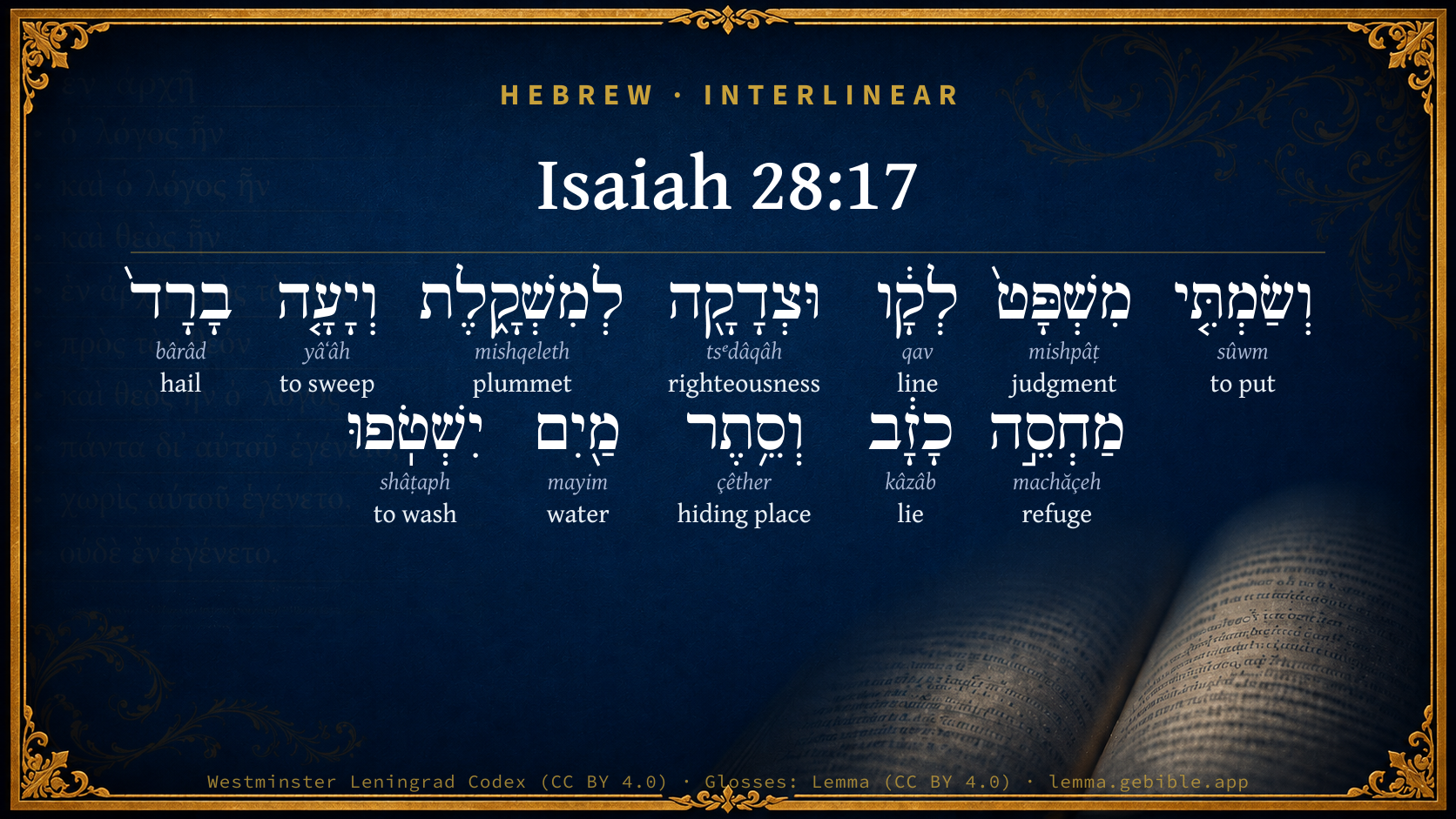
Hebrew (Westminster Leningrad Codex) Isaiah 28:17 appears in the Hebrew Old Testament. The text above is from the Westminster Leningrad Codex. Each word links to its Strong’s number, a concise gloss, and parsing drawn from the Open Scriptures Hebrew Bible morphology. Click any word for its full Brown-Driver-Briggs (BDB) entry.
Download image
Cite this verse

Isaiah 28:17 (World English Bible). Public Domain. Lemma interlinear Bible study tool, https://lemma.gebible.app/v/isaiah/28/17.

Show BibTeX & RIS
BibTeX
RIS
English Translation
I will make justice the line, and righteousness the plummet; and the hail shall sweep away the refuge of lies, and the waters shall overflow the hiding-place.
World English Bible · Public Domain
Highlights
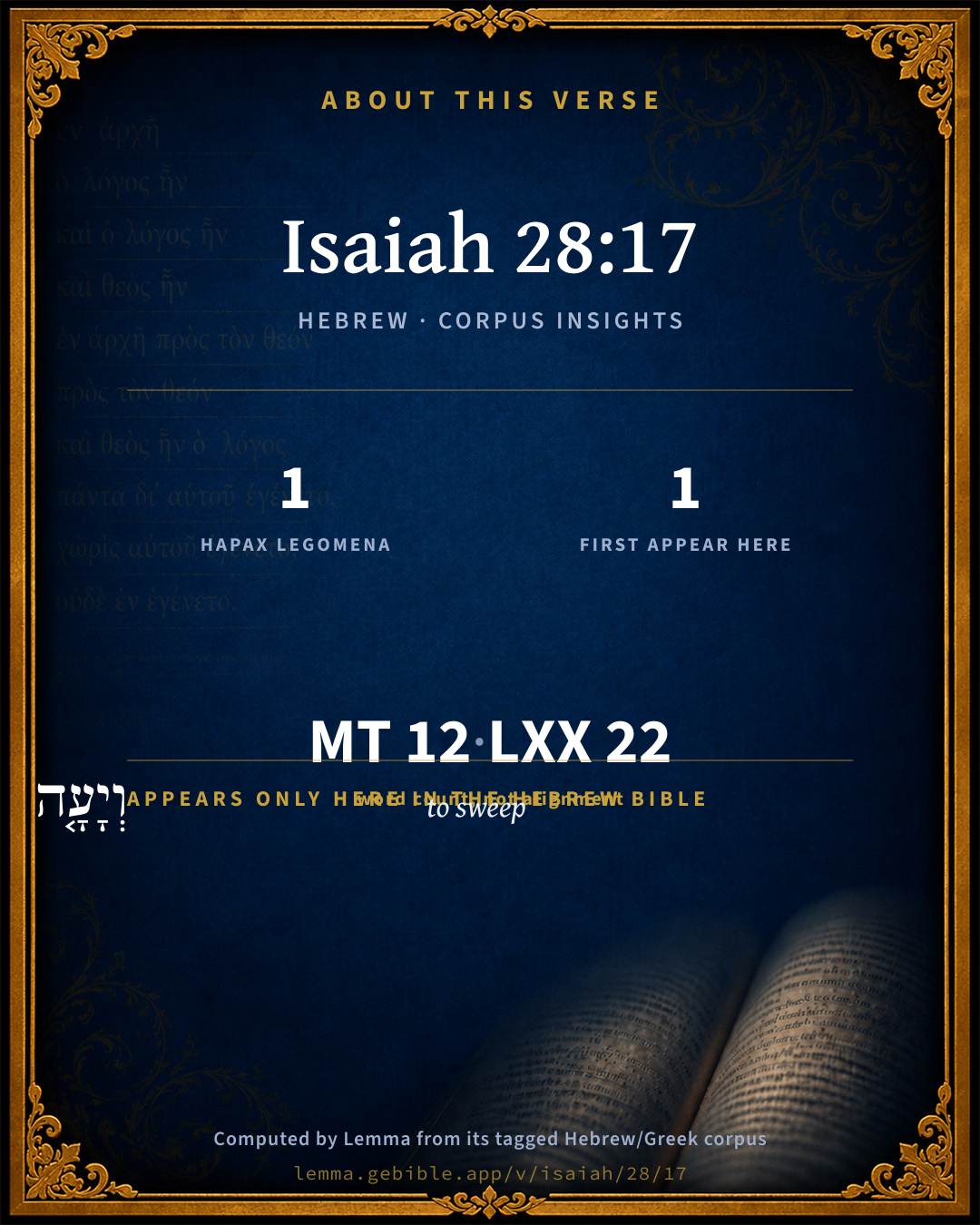
  • 1 hapax legomenon — only here in the Hebrew Bible
  • 1 first appearance in the Hebrew Bible
Full analysis ↓
Download a study sheet

One document with this verse’s original text, its word-by-word gloss line, the meaning frame, cross-references with their text, attributed commentary, and full source and license credits — printable, and it pastes into notes with its structure intact.

This verse Autodidact and up

Study sheet (.html) Plain text (.txt)

A passage Seminary Student

Up to 50 verses in one chapter. A passage sheet keeps up to 6 commentary sources and 12 cross-references per verse, in the order this page ranks them, and says so on the sheet whenever that leaves anything out. Ask for a single verse and you get the Autodidact verse sheet above.

Everything on this page stays free to read, with no account — the sheet is a download of what is already on screen, not access to it.

Want to remove ads? Support Godless Engineer
Compare translations 3

The same verse in 3 English versions, stacked beneath the original-language interlinear above. Click any original word for its lexicon entry.

Each is an independent rendering of the whole verse — the interlinear is not word-aligned to these translations.

Highlighted words mark where these versions differ — a whole-verse word diff, not a word-by-word alignment.

  • World English Bible Public Domain
    I will make justice the line, and righteousness the plummet; and the hail shall sweep away the refuge of lies, and the waters shall overflow the hiding-place.
  • King James Version Public Domain
    Judgment also will I lay to the line, and righteousness to the plummet: and the hail shall sweep away the refuge of lies, and the waters shall overflow the hiding place.
  • unfoldingWord Literal Text CC BY-SA 4.0
    And I will make justice the line and righteousness the plumb line. But hail will sweep away the refuge of lying, and waters will overflow the hiding place.

unfoldingWord Literal Text — © unfoldingWord, licensed CC BY-SA 4.0. Word-aligned USFM3 via Door43 (git.door43.org/unfoldingWord/en_ult).

Versions to compare (up to 4)

3 of 4 selected

Show all 18 translations

Every available English version of this verse, each an independent rendering of the whole verse.

  • World English Bible Public Domain
    I will make justice the line, and righteousness the plummet; and the hail shall sweep away the refuge of lies, and the waters shall overflow the hiding-place.
  • Berean Standard Bible Public Domain
    I will make justice the measuring line and righteousness the level. Hail will sweep away your refuge of lies, and water will flood your hiding place.
  • Majority Standard Bible Public Domain
    I will make justice the measuring line and righteousness the level. Hail will sweep away your refuge of lies, and water will flood your hiding place.
  • King James Version Public Domain
    Judgment also will I lay to the line, and righteousness to the plummet: and the hail shall sweep away the refuge of lies, and the waters shall overflow the hiding place.
  • American Standard Version (1901) Public Domain
    And I will make justice the line, and righteousness the plummet; and the hail shall sweep away the refuge of lies, and the waters shall overflow the hiding-place.
  • Revised Version (1885) Public Domain
    And I will make judgment the line, and righteousness the plummet: and the hail shall sweep away the refuge of lies, and the waters shall overflow the hiding place.
  • Geneva Bible (1599) Public Domain
    Iudgement also will I laye to the rule, and righteousnesse to the balance, and the haile shall sweepe away the vaine confidence, and the waters shall ouerflowe the secret place.
  • Douay-Rheims (1899) Public Domain
    And I will set judgment in weight, and justice in measure: and hail shall overturn the hope of falsehood: and waters shall overflow its protection.
  • Young's Literal Translation Public Domain
    And I have put judgment for a line, And righteousness for a plummet, And sweep away doth hail the refuge of lies, And the secret hiding-place do waters overflow.
  • Literal Standard Version CC BY-SA 4.0
    And I have put judgment for a line, || And righteousness for a plummet, || And hail sweeps away the refuge of lies, || And waters overflow the secret hiding place.
  • Unlocked Literal Bible CC BY-SA 4.0
    I will make justice the measuring stick, and righteousness the plumbline. Hail will sweep away the refuge of lies, and the floodwaters will overwhelm the hiding place.
  • unfoldingWord Literal Text CC BY-SA 4.0
    And I will make justice the line and righteousness the plumb line. But hail will sweep away the refuge of lying, and waters will overflow the hiding place.
  • Darby Bible Public Domain
    And I will appoint judgment for a line, and righteousness for a plummet; and the hail shall sweep away the refuge of lies, and the waters shall overflow the hiding-place.
  • World Messianic Bible Public Domain
    I will make justice the measuring line, and righteousness the plumb line. The hail will sweep away the refuge of lies, and the waters will overflow the hiding place.
  • Webster's Bible Public Domain
    Judgment also will I lay to the line, and righteousness to the plummet: and the hail shall sweep away the refuge of lies, and the waters shall overflow the hiding-place.
  • Free Bible Version CC BY-SA 4.0
    I will make justice as straight as a measuring line, and doing what's right the standard rule. Hail will destroy the protection of your lies, and water will flood the place where you're hiding.
  • Bible in Basic English Public Domain
    And I will make right decision the measuring-line, and righteousness the weight: and the ice-storm will take away the safe place of false words, and the secret place will be covered by the flowing waters.
  • JPS Tanakh (1917) Public Domain
    And I will make justice the line, and righteousness the plummet; and the hail shall sweep away the refuge of lies, and the waters shall overflow the hiding-place.

Literal Standard Version (2020), Covenant Press — licensed CC BY-SA 4.0. Text via the HelloAO Bible API (eBible.org). Unlocked Literal Bible (unfoldingWord) — licensed CC BY-SA 4.0. Text via the HelloAO Bible API (eBible.org). unfoldingWord Literal Text — © unfoldingWord, licensed CC BY-SA 4.0. Word-aligned USFM3 via Door43 (git.door43.org/unfoldingWord/en_ult). Free Bible Version, Dr. Jonathan Gallagher — licensed CC BY-SA 4.0. Text via the HelloAO Bible API (eBible.org).

Word by word

More ways to search: Search by grammar → Find every occurrence → Compare this word →

Practice this passage: Drill this verse → Learn its vocabulary →

וְיָעָ֤ה
yâʻâh
H3261
“and · to sweep”
Conjunction + Verb, Qal, Sequential Perfect, 3rd Person, Masculine, Singular
Part of Speech
Conjunction + Verb
Stem
Qal
Form
Sequential Perfect
Person
3rd Person
Gender
Masculine
Number
Singular
Full BDB Definition

Origin: a primitive root

TWOT: 879

(Qal) to sweep, sweep away, sweep together
  1. וְשַׂמְתִּ֤י sûwm H7760 “and · to put” Conjunction + Verb, Qal, Sequential Perfect, 1st Person, Common, Singular
  2. מִשְׁפָּט֙ mishpâṭ H4941 “judgment” Noun, Common, Masculine, Singular, Absolute
  3. לְקָ֔ו qav H6957 “to/for · line” Preposition + Noun, Common, Masculine, Singular, Absolute
  4. וּצְדָקָ֖ה tsᵉdâqâh H6666 “and · righteousness” Conjunction + Noun, Common, Feminine, Singular, Absolute
  5. לְמִשְׁקָ֑לֶת mishqeleth H4949 “to/for · plummet” Preposition + Noun, Common, Feminine, Singular, Absolute
  6. בָרָד֙ bârâd H1259 “hail” Noun, Common, Masculine, Singular, Absolute
  7. מַחְסֵ֣ה machăçeh H4268 “refuge of” Noun, Common, Masculine, Singular, Construct
  8. כָזָ֔ב kâzâb H3577 “lie” Noun, Common, Masculine, Singular, Absolute
  9. וְסֵ֥תֶר çêther H5643 “and · hiding place” Conjunction + Noun, Common, Masculine, Singular, Absolute
  10. מַ֖יִם mayim H4325 “water(s)” Noun, Common, Masculine, Plural, Absolute
  11. יִשְׁטֹֽפוּ shâṭaph H7857 “to wash” Verb, Qal, Imperfect, 3rd Person, Masculine, Plural

About this verse

These counts appear in no published source. They are computed here, from the morphology-tagged text and Lemma’s own curated glosses. What Lemma adds →

12
words
12
distinct lemmas
Prophets
section

Notable vocabulary

1 hapax legomenon — a word that appears only here in the entire Hebrew Bible:

  • וְיָעָ֤ה to sweep H3261

First appearance in Scripture

This word makes its first canonical appearance in the Hebrew Bible here:

  • וְיָעָ֤ה to sweep H3261

Shared distinctive vocabulary

לְמִשְׁקָ֑לֶת plummet H4949 occurs in 2 verses of the Hebrew Bible. Also found in:

Grammatical profile

  • 3 verbs
  • 9 nouns

Verb forms

  • וְשַׂמְתִּ֤י Qal · Sequential Perfect
  • וְיָעָ֤ה Qal · Sequential Perfect
  • יִשְׁטֹֽפוּ Qal · Imperfect

Hebrew & Septuagint length

In English translation the verse runs 27 words from the Hebrew and 36 from the Septuagint (LXX English) — closely comparable.

A rough comparison of the two English renderings, which tokenize alike — not a word-level alignment.

Word counts can differ between the Hebrew and the Greek without any difference in meaning — e.g. the Hebrew direct-object marker אֵת has no separate Greek word, and Greek often adds the article ὁ.

In the original languages it is 12 Hebrew tokens and 22 Greek tokens — but the two are counted differently (Hebrew bundles its prefixes and suffixes into one token; the Greek is in lemma form), so that isn’t a like-for-like length.

Cross-references

31

Topical passages linked to Isaiah 28:17 in the Treasury of Scripture Knowledge — connected by theme and wording, ordered by reader-vote popularity; previews shown in the World English Bible.

  • 2 Kings 21:13 I will stretch over Jerusalem the line of Samaria, and the plummet of the house of Ahab; and I will wipe Jerusalem as a man wipes a dish, wiping it and turning it upside down.
  • Amos 7:7–9 Thus he showed me and, behold, the Lord stood beside a wall made by a plumb line, with a plumb line in his hand.
  • Revelation 16:21 Great hailstones, about the weight of a talent, came down out of the sky on people. People blasphemed God because of the plague of the hail, for this plague is exceedingly severe.
  • Isaiah 28:2 Behold, the Lord has a mighty and strong one; as a tempest of hail, a destroying storm, as a tempest of mighty waters overflowing, will he cast down to the earth with the hand.
  • Jeremiah 7:14 therefore will I do to the house which is called by my name, in which you trust, and to the place which I gave to you and to your fathers, as I did to Shiloh.
  • Romans 2:2 We know that the judgment of God is according to truth against those who practice such things.
  • Romans 2:5 But according to your hardness and unrepentant heart you are treasuring up for yourself wrath in the day of wrath, revelation, and of the righteous judgment of God;
  • Revelation 11:19 God's temple that is in heaven was opened, and the ark of the Lord's covenant was seen in his temple. Lightnings, sounds, thunders, an earthquake, and great hail followed.
  • Exodus 9:18–19 Behold, tomorrow about this time I will cause it to rain a very grievous hail, such as has not been in Egypt since the day it was founded even until now.
  • Joshua 10:11 It happened, as they fled from before Israel, while they were at the descent of Beth Horon, that Yahweh cast down great stones from the sky on them to Azekah, and they died: they were more who died with the hailstones than they whom the children of Israel killed with the sword.
  • Job 22:16 Who were snatched away before their time, Whose foundation was poured out as a stream,
  • Psalms 94:15 For judgment will return to righteousness. All the upright in heart shall follow it.
  • Isaiah 5:16 But Yahweh of Hosts is exalted in justice, And God the Holy One is sanctified in righteousness.
  • Isaiah 10:22 For though your people, Israel, be as the sand of the sea, [only] a remnant of them shall return: a destruction [is] determined, overflowing with righteousness.
  • Isaiah 25:4 For you have been a stronghold to the poor, a stronghold to the needy in his distress, a refuge from the storm, a shade from the heat, when the blast of the awesome ones is as a storm against the wall.
  • Isaiah 30:28 and his breath is as an overflowing stream, that reaches even to the neck, to sift the nations with the sieve of destruction: and a bridle that causes to err [shall be] in the jaws of the peoples.
  • Isaiah 32:2 A man shall be as a hiding-place from the wind, and a covert from the tempest, as streams of water in a dry place, as the shade of a great rock in a weary land.
  • Isaiah 32:18–19 My people shall abide in a peaceable habitation, and in safe dwellings, and in quiet resting-places.
  • Jeremiah 7:4–8 Don't you trust in lying words, saying, The temple of Yahweh, the temple of Yahweh, the temple of Yahweh, are these.
  • Jeremiah 7:20 Therefore thus says the Lord Yahweh: Behold, my anger and my wrath shall be poured out on this place, on man, and on animal, and on the trees of the field, and on the fruit of the ground; and it shall burn, and shall not be quenched.
  • Jeremiah 23:19 Behold, the tempest of Yahweh, [even his] wrath, is gone forth, yes, a whirling tempest: it shall burst on the head of the wicked.
  • Jeremiah 30:23–24 Behold, the tempest of Yahweh, [even his] wrath, is gone forth, a sweeping tempest: it shall burst on the head of the wicked.
  • Ezekiel 13:10–16 Because, even because they have seduced my people, saying, Peace; and there is no peace; and when one builds up a wall, behold, they daub it with whitewash:
  • Ezekiel 38:22 With pestilence and with blood will I enter into judgment with him; and I will rain on him, and on his hordes, and on the many peoples who are with him, an overflowing shower, and great hailstones, fire, and sulfur.
  • Daniel 11:22 The overwhelming forces shall be overwhelmed from before him, and shall be broken; yes, also the prince of the covenant.
  • Matthew 7:27 The rain came down, the floods came, and the winds blew, and beat on that house; and it fell--and great was its fall."
  • Romans 9:28 For He will finish the work and cut it short in righteousness, Because the LORD will make a short work upon the earth."
  • 2 Peter 3:6–7 by which means the world that then was, being overflowed with water, perished.
  • Revelation 8:7 The first sounded, and there followed hail and fire, mixed with blood, and they were thrown to the earth. One third of the earth was burnt up, and one third of the trees were burnt up, and all green grass was burnt up.
  • Revelation 19:2 for true and righteous are his judgments. For he has judged the great prostitute, who corrupted the earth with her sexual immorality, and he has avenged the blood of his servants at her hand."
  • Isaiah 28:15 Because you have said, We have made a covenant with death, and with Sheol are we at agreement; when the overflowing scourge shall pass through, it shall not come to us; for we have made lies our refuge, and under falsehood have we hid ourselves:

Cross-references courtesy of OpenBible.info (CC BY 4.0).

Hebrew and Greek witnesses Masoretic Hebrew ↔ Greek Septuagint

The same verse in the two great witnesses to the Old Testament, shown verse-for-verse.

These are two independent witnesses, not word-aligned to each other, and the Septuagint is shown in lemma (dictionary) form.

Hebrew Isaiah 28:17 Masoretic · Westminster Leningrad Codex

וְשַׂמְתִּ֤י מִשְׁפָּט֙ לְקָ֔ו וּצְדָקָ֖ה לְמִשְׁקָ֑לֶת וְיָעָ֤ה בָרָד֙ מַחְסֵ֣ה כָזָ֔ב וְסֵ֥תֶר מַ֖יִם יִשְׁטֹֽפוּ

I will make justice the line, and righteousness the plummet; and the hail shall sweep away the refuge of lies, and the waters shall overflow the hiding-place.

World English Bible · Public Domain

Greek LXX Isaiah 28:17 Septuagint · lemma form

καί τίθημι κρίσις εἰς ἐλπίς ὁ δέ ἐλεημοσύνη ἐγώ εἰς σταθμός καί ὁ πείθω μάτην ψεῦδος ὅτι οὐ μή παραἔρχομαι σύ καταιγίς

And I will cause judgment to be for hope, and my compassion shall be for just measures, and you⌃ that trust vainly in falsehood shall fall: for the storm shall by no means pass by you,

LXX2012 (modern English Septuagint) · Public Domain

Hebrew: Westminster Leningrad Codex (CC BY 4.0). Greek: Septuagint (public domain); English from LXX2012 (modern English Septuagint) (Public Domain). How the Septuagint differs from the Hebrew →

Targum (Aramaic paraphrase)

1

The Targum is the ancient Jewish Aramaic paraphrase of the Hebrew Scriptures — an interpretive translation, not the Hebrew text itself. Onkelos (literal) and Pseudo-Jonathan (expansive) render the Torah, and Jonathan the Prophets. Coverage is partial: where no permissively-licensed English translation exists for a verse, only the Aramaic is shown. This is verse-level text, not a word-by-word alignment to the Hebrew.

  1. Targum Jonathan Prophets (Joshua–Malachi)
    וֶאֱשַׁוֵי דִנָא תַקִין דְאִטַמַרְתּוּן כְּחוּט בִּנְיָנָא וּזְכוּתָא כְּאֶבֶן מַשְׁקוּלְתָּא וְיִדְלַק רוּגְזִי בְּרוֹחֲצָן כִּדְבֵיכוֹן וְעַל דְאִטַמַרְתּוּן מִן קֳדָם מְעִיקָא יַתְכוֹן עַמְמַיָא יִגְלוֹן:

    And I will make judgment straight as a line of a building, and justice as a plummet, because ye would hide yourselves. And my justice shall burn against the confidence of your lie; and because ye would hide yourselves from the coming distress, the nations shall lead you into captivity.

    Targum Jonathan — Aramaic: “Mikraot Gedolot” (public domain). English: “Sefaria Community Translation” (CC0 1.0 (public-domain dedication)); “London "Chaldee Paraphrase," 1871” (public domain). Text via Sefaria.

Commentary

Notes on Isaiah 28:17 from classic Christian and Jewish commentators (each source and its license shown beneath its notes). The classic Christian expositions comment on the surrounding passage and are grouped to its opening verse, so a note may address several verses; the Jewish commentaries on the Tanakh (Rashi and others) are per-verse, so they appear only where the commentator wrote on this verse.

Lemma curates 59 commentaries, every one of them public domain or Creative Commons licensed, each selected and text-cleaned for this edition rather than reprinted as found. About our sources →

Trapp's Complete Commentary

John Trapp

Isa 28:17 Judgment also will I lay to the line, and righteousness to the plummet: and the hail shall sweep away the refuge of lies, and the waters shall overflow the hiding place.

Ver. 17. Judgment also will I lay to the line.] Or, I will set out judgment by line, and justice by plummet; that is, I will proportion your punishments to your offences, as it were by line and by level, that the wicked may have their due, and the godly sustain no damage. See 2Ki 21:12-13 Amo 7:8. Calvin saith that by this expression, borrowed from builders, the Lord here showeth that when the corner stone before spoken of shall be laid, the Church of the faithful built thereupon shall rise up to a fair and uniform built temple in the Lord, according to Eph 2:20.

And the hail shall sweep away the refuge of lies.] Or, Shovel away, or, quasi furcillis extrudet, shall fork away, or burn up your vain confidences, as he destroyed the Egyptians by hail mingled with fire.

And the waters.] See Isa 28:15 Mat 7:27.

John Trapp, A Commentary or Exposition upon All the Books of the Old and New Testament (1647–1656) — public domain. Text from a community e-Sword module.

The Biblical Illustrator

Joseph S. Exell

Isa_28:17

Judgment also will I lay to the line

Gods judgments

I.

The Lord PONDERS, with most exact attention, all the distinctions of characters, times, and circumstances; all the various motives both to lenity and severity.

II. He ACTS in a manner suited to His perfect knowledge. (R. Macculloch.)

Mercy and judgment

Upon the roses of grace grow the thorns of justice. Whenever the Lord bares His arm for mercy towards believers He gives a back stroke to His enemies. (C. H. Spurgeon.)

Privilege and responsibility

A great privilege involves a great responsibility. It is a very high favour to see the foundation which God has laid in Zion and to be exhorted to build upon it; but of those who reject that foundation vengeance will be exacted. (C. H. Spurgeon.)

Refuges of lies and what will become of them

I. THE LORD JUDGING MANS REFUGES. He says, Judgment also will I lay to the line, and righteousness to the plummet. Observe that, however carelessly we may judge ourselves, God will not so judge us. His survey is performed with the utmost accuracy. There are three ways by which we may judge whether our confidences are refuges of lies or not.

(1) If they are safe hiding places they are founded upon Christ. Behold, I lay in Zion, etc.

(2) If our confidence be a right one it comes to us through faith (Isa_28:16). If your hope is grounded upon sight, or feeling, or working, it will one day fail you.

(3) A third test seems to me to be proposed in my text. Judgment will I lay to the line, and righteousness to the plummet. Here, then, is the test of righteousness. If our hope is sound, it is a holy, sanctifying hope, which purges us from sin, and breeds in us all that is true and good. We shall now apply these tests to certain refuges which I am sure will turn out to be refuges of lies.

1. The first is the hope which some men ground upon their own moral goodness. It will not stand trial by the first plummet; it is not based upon the foundation which God has laid. Try the second touch stone as to faith. Your hope is not based on faith in Jesus; you have no faith except in yourself. Moreover, is not this plea of moral goodness a falsehood from top to bottom? Recollect that even if your outward life may have been correct, God regards the heart, and takes account of the inner life.

2. A number of persons make a refuge for themselves out of the notion of fate. This would not endure one of the tests and assuredly not the last, for its tendency is to deny all moral obligation, and hence it is no friend to holiness. It deliberately charges God with the creatures sin, and makes out the sinner to be the injured person.

3. The third shelter of lies which many fly to is a hope based upon novel doctrines. So far as my observation goes, these modern notions go with looseness of life, with world linens of heart, with decay of prayerfulness, and with backsliding from the living God.

4. We have another brood of men whose refuge is that they make a profession of religion.

5. Let me speak a word concerning certain who have a hope of being saved which does not sanctify them.

6. Some, too, make a refuge of their old experience. A true experience continues and grows day by day.

II. PICTURE THE DESTRUCTION OF THESE REFUGES OF LIES. A man has been very comfortable in one or other of these refuges for a good number of years, but at last he is getting old, and is laid aside to think; infirmities are increasing death is drawing nigh, and he takes a look into the dark future. He finds himself facing an eternal state, and has need of all his confidences and hopes to sustain him. Now, what happens? His spirit undergoes a great storm, and what is the result? Does he dwell in a fortress which defies the hurricane? No, his shelter is so frail, that, according to the text, the hail shall sweep away the refuges of lies. A cold, hard truth falls from Heaven like a hailstone, and crashes right through the glass roof of his false confidence. He looks up astonished and, in! another and another forgotten truth descends with like violence and crushes through all opposition till it smites his soul. Down falls all his comfort and peace of mind, as hailstone after hailstone pounds all his hope to pieces. After all, I never was born again, and the Scripture hath well said, Ye must be born again. I never yielded up my selfishness, and I cannot be saved unless Christ is my King. I did not really close in with Christ and cast my naked soul on Him. Another impressive picture is set before us. The flood shall overflow his hiding place. Imagine one who, in the time of Noahs flood, does not choose to enter into the ark, for he does not care to be tied down to Gods way of deliverance. He wants a more philosophic way. Besides, he does not care to be cooped up with Noah and a handful of narrow-minded people, who shut themselves in and shut everybody else out. He has broader views, and therefore he has found a shelter on the side of the hill, in a great cave where thousands can assemble, and enjoy a liberty denied them within the pale of the ark. It is utterly preposterous to suppose the flood will ever reach so high as this elevated cave. After a day or two Of extraordinary rain the man would look down from his hiding place and see the waters covering all the lower area, and creeping up the valleys foot by foot, and he would remark upon the abundance of rain, but scoff at the idea of a general deluge. He would be easy, hoping that the rain would cease, but as it continued he would begin to think, I may not be quite so safe after all. Imagine his horror when the flood at last fills up the ravine, and creeps up the rocky steep. With cruel lip, seeking his destruction, the water threatens the cave wherein he thought to dwell so safely. At last it penetrates his hiding place, it climbs to the very roof, it sweeps over his head, and his false confidence has proved his ruin. Such will be the end of all who hide themselves, but hide not in Christ. I will tell you in what fashion this overthrow will come. First, the mirth of the mind is damped with doubt. The man does not feel so easy as he used to be; he is afraid that Gods Word may be true, and that things will go amiss with him. Soon the doubt has oozed into his refuge, and become a pool of fear: the man is sadly afraid, and the dread saturates and dissolves all his joy. The truth of Gods Word still further comes home to his conscience, and he begins to be more and more alarmed: nor does he continue long in one stay, for he is growingly distressed, the waters are evidently advancing upon him and he cannot escape. He has come to be altogether dismayed, he hardly knows what will become of him; and within a little while, unless Gods mercy shall prevent and enable him to find the true shelter, he win be drenched in despair and washed away in terror. At last he cannot believe that there is any salvation possible for him.

III. THE LESSON ON WARNING. Let us build on Gods foundation. He knows better than we do what is right and safe. (C. H. Spurgeon.)

Gods careful tests of character

An ordinary builder who should be sent to examine a house would probably content himself with hastily looking to see whether the walls were perpendicular, and whether the work was of the quantity and quality specified in the contract; he could tell this pretty nearly with his eye, or by measuring with his foot; but if a very careful and scientific survey was wanted, he would then produce his plummet and his line, and try everything by the regular accepted tests of builders work: hence our text describes the Lord as laying judgment to the line and righteousness to the plummet; that is to say, He makes a deliberate trial of our confidences, compares our hopes with our conduct, our beliefs with the truth, and our expectations with the facts of the case. Oh, that we might have grace to invite such a test at once by praying, Search me, O God, and know my heart; try me, and know my thoughts. If the Lord will help us to know ourselves now it will save us from a sad discovery at the last. (C. H. Spurgeon.)

The hail shall sweep away the refuge of lies

Refuges of lies

It is very remarkable to what an extent men will deceive themselves on the subject of religion. In connection with this subject, more than any other, we find the most remarkable cases of self-delusion: they are so very remarkable sometimes, as to appear altogether incredible.

I. A false refuge in which many indulge is a SELFISH RELIGION. Selfishness in any form is in exact opposition to religion. It makes no difference as to the type which selfishness puts on. The question is, does a man make his own interest the object of pursuit? If so, such conduct is the exact opposite of that benevolence which Christ manifested, when He laid Himself out for the good of mankind and the glory of God. We should love God for what God is, and we should love our neighbours as ourselves. Where there is true religion it will manifest itself in prayer, praise, and obedience. It will manifest itself with respect to God in efforts to please Him, to honour Him, and to glorify Him, and an earnest desire to secure the love, confidence, and obedience of all men. It is not selfishness for a man to have a proper regard for his own salvation; but it is for him to regard his own salvation only, and care not for the salvation of his neighbour. Further, this is the true way for a man to secure his own salvation; by caring for the salvation of others. Whosoever will save his life, said Christ, shall lose it; but whosoever will lose his life for My sake shall find it.

II. Another refuge of lies to which mankind betake themselves is RELIGIOUS IMPULSE. This is a prevailing form of selfishness. This delusion consists in appealing to the feelings instead of to Gods law as developed in the conscience and reason. Such persons as these think themselves very religious, because they feel deeply upon the subject. Let the circumstances subside which excited their feelings, and you see that they have not the root of the matter within them.

III. Others have a MERE RELIGION OF OPINION, which is just the opposite of a religion of impulse. These opinions do not mould their lives.

IV. Another refuge of lies is the RELIGION OF SECTARIANISM.

V. Another refuge of lies is HAVING REGARD TO WHAT IS OUTWARD, the performance of certain external actions without love to God in the heart. There are a great many men who think themselves very religious because they pay their debts. (C. G. Finney.)

Refuges of lies

It is certain that, from the time of Adam down to the present day, thousands have taken refuge from the threatenings of Gods wrath beneath the lies of the Evil One.

I. You say, If I am elect I shall be saved, do what I may; but if I am not elect I must be damned, do what I will; and, therefore, there is no use in my trying to do anything. Election is not iron fate, but unutterable love.

Do you act in this manner about carnal things? A friend invites you to dinner; the table is spread before you. You are asked to sit down. Stop, you say, does not God know everything? Yes, says your friend. Well, you say, God knows whether I shall eat this food or not: so its all fixed, and I cant alter it; and if I am not to eat that dinner, I cannot eat it, even though I were to try to eat it: whereas, if I am to eat it, I must eat it, even though I were to rise and leave the room and try to go without it; and, therefore, I will sit still and do nothing. Would you reason thus? If not, why say, when God lays the Bread of Life before you, If I am to eat of the Bread of Life, I must, do what I may; if I am not to partake of it, I cannot, do what I will; and, therefore, I will sit still and do nothing? If Christ does not really offer to save you I have nothing further to say, but you admit He does.

II. I trust in the mercy of God. If that is all your trust it is a refuge of lies You answer, Is not God merciful? More merciful than you can conceive, but it will not do to trust in the mere mercy of God. Gods mercy will not save you till you are inside the tower of refuge, Christ Jesus.

III. We do the best we can. What! You do the best you can? Then you are safe. If you really have done the best you could to this present hour, you are this moment as safe as the angel Gabriel. But will you solemnly declare that you have never sinned? Ah no! The best thing you can do is to look to what another has done for you, even Jesus!

IV. Some are flattering themselves that they believe in Jesus Christ, and are in the road to Heaven, while they are without that faith which alone can save the soul. Let me ask you who say, I do believe, what it is you believe that can justify you? You say, I believe that Jesus Christ came into the world to teach us the way to Heaven. So did that young man who came to Christ of old. You answer, I believe in the great judgment to come. So did Felix, when Paul stood before him and reasoned of righteousness, temperance, and judgment to come. You answer, I believe that Jesus was the innocent sufferer for the guilty, and that He is truly the Son of God. So did Judas. You answer, I believe that Jesus died that He might save sinners, and rose to glory everlasting. So did Ananias and Sapphira. Do you ask, at last, what am I to believe, that I may be saved? What did that dying thief believe who went to Heaven? More than either Judas or Satan. Did he not believe that Jesus was his own Saviour, and did he not confidently trust in Him that He would bear him in everlasting remembrance, and did he not call Him Lord?

V. I must wait Gods time. The solemn truth is, Christ is waiting for you. Did you ever read His own words? Behold, I stand at the door and knock. Is not that waiting?

VI. We know all this is true, and we mean to turn, but there is time enough yet. Oh, the unreasonableness of your course! Why would you turn by and by?

1. Because Christ beseeches you? And does not He as much beseech you now? And will you not grieve and insult Him by delaying?

2. Because God commands you? And does He not as much command you now? And are you not disobeying and defying Him by delaying?

3. Because danger threatens you? And is not death behind your back even now? (H. Grattan Guinness.)

Refuges of lies

All men know themselves to be sinners against God. They know also that, as sinners, they are in peril. Hence their anxiety to find some refuge for safety. They know they might find this in the way of forsaking sin and turning to the Lord; but they do not choose to forsake their sins. Hence there seems to be no convenient resource but to hide themselves under some refuge. It is obvious that men who resort to lies for a refuge regard those lies not as lies, but as truth. This fact leads us to raise the primary fundamental question, Have we any rule or standard which will show what is truth, and what is falsehood? Men have countless opinions about religion; how can we determine which are true and which not true? We have an infallible test. Salvation, to be real and available, must be salvation from sin. Again, if it does not beget prayer, does not unify us with God, and bring us into fellowship and sympathy with Him, it is a lie. If it does not produce a heavenly mind, and expel a worldly mind, it is a lie. Here I must notice an objection. It is said, The Gospel does not, in fact, do for men all you claim. It does not make professed Christians heavenly minded, dead to the world, full of love, joy, and peace. I reply, Here is medicine which, applied in a given disease, will certainly cure. But it must be fairly applied. So with the Gospel.

I. I will now proceed to NAME SOME THINGS THAT LACK THIS DECISIVE CHARACTERISTIC. They do not save the soul from sin.

1. An unsanctifying hope of Heaven.

2. An old experience, that is all old.

3. There are two forms of self-righteousness--the legal and the Gospel--both of which are refuges of lies. The legal depends on duty doing--evermore trying to work out salvation by deeds of law. The Gospel form sets itself to get grace by works.

4. Universalism.

II. And now TAKE NOTICE OF WHAT GOD SAYS. The hail shall sweep away the refuge of lies, and the waters shall overflow the hiding place. This hail is the symbol of Gods displeasure. It is fit that God should be displeased with these refuges of lies. He loves truth too well to have the least sympathy with lies. He loves the souls of men too deeply to have any patience with agencies so destructive. The waters, He declares, shall overflow the hiding places. Every resort that leaves the soul in sin is a hiding place.

1. All religious affectation is such, and is nothing better.

2. So of all religious formality--going through the forms of worship, being in the Church, being baptized--what avails it all unless their piety be instinct with life and that life be the soul of real holiness

3. A great many people hide in the Church.

4. Others hide under the plea of a sinful nature. They are naturally unable to do anything.

5. Some dodge under professors of religion. (C. G. Finney.)

The Biblical Illustrator, edited by Joseph S. Exell (c. 1880s–1900s) — public domain. Text from a community e-Sword module.

Joseph Benson's Commentary

Isa 28:17. Judgment also will I lay to the line, &c. — I will execute just judgment, as it were by a line and plummet annexed to it; that is, with exactness and care. I will severely punish and utterly destroy all who reject that stone. For the line and plummet, or the plumb-line, was not only used in erecting buildings, but also in pulling them down; those parts of the building being thus marked out which were to be demolished. And the hail shall sweep away the refuge of lies, &c. — My judgments (which in the Scriptures are compared to a storm of hail or rain) shall discover the vanity of all your crafty and wicked devices, and shall sweep you away with the besom of destruction in spite of them.

Joseph Benson's Commentary on the Old and New Testaments (1811–1818) — public domain. Text from a community e-Sword module.

The Preacher's Complete Homiletical Commentary

Joseph S. Exell (gen. ed.)

FALSE REFUGES

Isa_28:17. And the hail shall sweep away the refuge of lies.

Numerous are the stratagems of Satan to ruin souls. In some he effects this by hurrying them on in the broad way of open transgression; in others, by rendering them the victims of some peculiar constitutional sin—pride, avarice, &c.; in others, by inciting a spirit of disbelief of the truth (Psa_14:1); in others, by inducing inattention to the things of the soul. But our text leads us to contemplate the false refuges to which he causes others to betake themselves.

I. Sinners often feel the necessity of a refuge. This arises sometimes from—

1. An internal sense of guilt. Unless in cases of utter obduracy, transgression and remorse are ever wedded together. Even Pagans have felt these workings of conscience, these pangs of guilty torture. Under these, men sigh for peace, long for rest, and earnestly desire a refuge.

2. The calamitous events of life. Sudden adversity, domestic bereavement, visiting the open grave of some friend, bodily indisposition, mental disquietude, &c.

3. The supposed nearness of death. Men who mock at religion in health, quail at the approach of death. Voltaire trembled in a storm, anxious then to have deliverance, to obtain a refuge.

4. Under the alarming influence of the preached word. When the truth has flashed across the mind and startled the conscience. Thus Felix, and thus thousands. How lamentable that these impressions and convictions are often so fleeting; but still more so, when the convicted sinner flees to sources of false security.

II. Sinners frequently betake themselves to refuges of lies. Of these notice—

1. Partial reformation of life. Giving up the grosser sins of which they have been guilty, intemperance, profanity, fraud, &c. When the whole body is diseased, the amputation of one member is fruitless.

2. A general regard to Christian morality, to the outward acts of obedience, and the decencies of society.

3. An outward profession of religion. Punctual regard to public worship, a proper regard to ordinances, a name among the people of God.

4. A prominent and public sectarian spirit. Rigid adherence to party, sect, and creed; violent anathematising all others; great ardour in the public events of the Church to which they belong. “Come, see my zeal,” &c.

5. Distinguished generosity. Liberality to the poor, works of beneficence, co-operation with the compassionate and benevolent. All these things are good in their legitimate sphere and extent, but they are all often only refuges of lies; they may engage a man’s anxious attention, while the root of the matter has yet no place in his heart (1Co_13:1-3; Mat_7:22-23).

6. A still more commonly frequent refuge of lies: a general reliance on the mercy of God. A kind of self-confident persuasion that God is good, that He will not punish, an indefinite resting on His clemency, forgetting His righteousness, purity, truth, &c.

III. Such refuges of lies will be ultimately swept away. They will be so—

1. In a dying hour. Then the mental vision often becomes peculiarly acute, the moral sense keen and distinct, and the honesty of the spirit throws off the tinsel mask, which is now manifestly worse than useless. How poor and worthless is self-righteousness, in all its possible extent, to a spirit just stepping into the presence of the holy God. A queen of England, although professing to be “Defender of the Faith,” and having bishops at her control, felt this, and died in circumstances of unutterable alarm.

2. In the morning of the resurrection. Then all classes and distinctions will be reduced to two. None but the righteous will have a part in the first resurrection. Others will rise with shame, confusion, and horror to everlasting contempt.

3. In the decisions of the judgment. God will judge all men in righteousness. The wicked and the righteous will be separated (Mat_25:32-33); no pretence, disguise, plea, stratagem, importunity, or effort, will avail. All refuges of lies will be swept away.

APPLICATION.—

1. Warn against these destructive schemes and wiles of Satan.

2. Exhibit the one only refuge, Jesus Christ, who delivers from the wrath to come.

3. Urge instant faith in Him. “Count all things but loss,” &c. All who believe in him are secure for both worlds. To this Refuge let all repair, earnestly, and now.—Jabez Burns, D.D.: Pulpit Cyclopædia, iii. 153–156.

The Preacher's Complete Homiletical Commentary (gen. ed. Joseph S. Exell; Funk & Wagnalls, c. 1892) — public domain (pre-1929). A full-Bible homiletical/sermon-outline anthology covering 65 of 66 books (2 John is absent from the source module). Text from a community e-Sword module.

Tyndale Open Study Notes

Tyndale Open Resources

28:17 The Lord judges people on their works, which reveal the presence or absence of living faith (for justice and righteousness, see 1:21-23).

Tyndale Open Study Notes — © Tyndale Open Resources, licensed CC BY-SA 4.0. Text via the HelloAO Bible API.

Geneva Bible (1599)

Geneva Bible translators

God’s corrections and afflictions.

In the restitution of his Church, judgment and justice shall reign.

Affliction shall discover their vain confidence, which they kept secret to themselves.

Geneva Bible (1599) marginal notes — public domain. Text via Bolls.life.

Jamieson, Fausset & Brown

Robert Jamieson, A. R. Fausset & David Brown

line--the measuring-line of the plummet. HORSLEY translates, "I will appoint judgment for the rule, and justice for the plummet." As the corner-stone stands most perpendicular and exactly proportioned, so Jehovah, while holding out grace to believers in the Foundation-stone, will judge the scoffers (Isa 28:15) according to the exact justice of the law (compare Jam 2:13).

hail--divine judgment (Isa 30:30; Isa 32:19).

Jamieson, Fausset & Brown — Commentary Critical and Explanatory on the Whole Bible (1871) — public domain (CC PDM 1.0). Text via the HelloAO Bible API.

Ellicott's Commentary for English Readers

(17) Judgment also will I lay to the line . . .—Rather, I make judgment for a line, and righteousness for a plummet. The architectural imagery is continued. The “elect corner stone” shall come up to the standard of perfection, laid four-square (Rev_21:16); and, therefore, should be the true place of refuge; while? the boast of the scorners, which the prophet repeats in the words that follow, should prove a false one. They would see their place of refuge swept away by the great waters. (Comp. Mat_7:26-27.) Their treaty with death and Hades should be treated as null and void, They should be trampled under foot by the invading armies.

A Bible Commentary for English Readers, edited by Charles John Ellicott (1878–1897) — public domain. Text from a community e-Sword module.

The Cambridge Bible for Schools and Colleges

gen. ed. J. J. S. Perowne

17. Thé first half of the verse continues Isa_28:16. In order to build on this foundation, it is necessary that political conduct be conformed to the eternal principles of the Divine government; these are “judgment” and “righteousness” (see on Isa_1:21), which are here compared to the builder’s line and plummet. Render as in R.V. I will make judgment the line and righteousness the plummet. Cf. ch. Isa_34:11.

and the hail …] Every course of action not based on faith in Jehovah, and not in accordance with the strict rule of the Divine righteousness will prove a false refuge in the day of judgment, see Isa_28:15 and cf. Isa_28:2. Comp. also Mat_7:24-27. The verb “sweep away” is not found elsewhere.

The Cambridge Bible for Schools and Colleges (gen. ed. J. J. S. Perowne; Cambridge University Press, 1878–1918) — public domain. Text from a community e-Sword module.

John Gill's Exposition

And your covenant with death shall be disannulled,.... Or, "be besmeared" (x), or daubed over, as the ark was with pitch, Gen 6:14 where the same word is used as here; so that it shall not be legible, as any writing that is blotted out by ink, or any other liquor, so that it cannot be read; in like manner this their covenant with death should be so obliterated, that the articles of it could not be made out, and so of no force; thus the Targum renders it,

"shall be made void;''

See Gill on Isa 28:15,

and your agreement with hell shall not stand; or "vision", or "provision" (y); which they had made by compact, with the greatest care, caution, and foresight, to secure themselves from destruction, would be found insufficient. The Targum is,

"and our peace, which was with the destroyer, shall not stand;''

See Gill on Isa 28:15,

when the overflowing scourge shall pass through: the land of Judea and the city of Jerusalem; See Gill on Isa 28:15,

then shall ye be trodden down by it: though they flattered themselves it should not come near them, yet it would; and they would not be able to stand before it, but would be thrown down, and trampled upon by it as the mire of the streets; see Luk 21:24.

(x) "Heb. oblinetur", Piscator; "quasi pica illita tabulae literaeque foederis incrustentur, inducantur ac dispereant", Gusset. Comment. Ebr. p. 397. (y) "et visio vestra", Vatablus; "cautio vestra", Junius & Tremellius, Piscator, Heb. "visio", i.e. "provisio", Piscator.

John Gill's Exposition of the Whole Bible (1746–1763) — public domain (CC PDM 1.0). Text via the HelloAO Bible API.

Albert Barnes' Notes on the Bible

Judgment also will I lay to the line - The sense of this is, I will judge them according to the exact rule of law, as an architect frames everything according to the rule which he uses. In other words, there shall be no mercy intermingled. The line is used by a carpenter for measuring; the plummet consists of a piece of lead attached to a string, and is also used by carpenters to obtain a perpendicular line. A carpenter works exactly according to the lines which are thus indicated, or his frame would not be properly adjusted. So God says that he would judge the people of Jerusalem according to the exact rule, without any intermingling of mercy.

And the hail ... - (see the note at Isa 28:2). Hail, hailstones, and floods of waters are frequent images of the divine vengeance and wrath Psa 105:32; Isa 22:19; Isa 30:30; Eze 13:13; Eze 38:22; Rev 8:7; Rev 11:19; Rev 16:21.

Albert Barnes' Notes on the Bible (1834–1885) — public domain. Text from a community e-Sword/MySword module.

Haydock's Catholic Bible Commentary

Measure. In the days of the Redeemer, they shall lead a virtuous life, (Calmet) or the scorners shall be treated with rigour. --- Protection. The wall, (Menochius) or lies, (ver. 15.; Calmet) on which you depend, shall turn to your confusion. (Haydock)

George Leo Haydock (1774–1849), Haydock's Catholic Family Bible and Commentary, 1859 edition — public domain. Excludes Psalms (Douay-Rheims chapter numbering differs from Protestant) and Deuterocanonical books (Catholic canon only).

Matthew Poole's English Annotations

Judgment also will I lay to the line, and righteousness to the plummet; I will execute just judgment, as it were by a line and plummet annexed to it, i.e. with exactness and care. And this may be understood either,

1. That God would so order and settle things in his church, that justice and judgment should prevail, and not iniquity, as hitherto it had done; or rather,

2. That as God would build up and preserve all believers upon that Foundation-stone, so he would severely punish and utterly destroy all those unbelieving Jews who should reject that Stone. For

the line and

plummet, or the plumb-line, was not only used in erecting buildings, but also in pulling them down; those parts of the building being thus marked out which were to be demolished; and therefore is used in Scripture to signify the destruction of a place or people, as is evident from 2Ki 21:13; Isa 34:11; Lam 2:8; Amo 7:7,8. And this sense agrees best with the following clause and verse.

The hail shall sweep away the refuge of lies, and the waters shall overflow the hiding-place; my judgments, which in Scripture are compared to a storm of hail or rain, shall discover the vanity of all your crafty and wicked devices, and shall sweep you away with the besom of destruction in spite of them.

Matthew Poole's English Annotations on the Holy Bible (1683–1685) — public domain. Text from a community e-Sword/MySword module.

Whedon's Commentary on the Bible

Daniel D. Whedon

17. Judgment… line… righteousness… plummet — This means that the rule of God’s dealings is one of the strictest justice. “He makes justice the rule of his proceedings, just as the builder regulates his work by line and plummet.” The figure of the builder is continued from the previous verse.

Hail — A mighty destructive agent; a figure importing visitations of divine justice upon systems of falsehood built up by wicked priests and compromising prophets. See notes on Isa_28:2.

Daniel D. Whedon (gen. ed.), Commentary on the Old and New Testaments (1874–1909) — public domain. Text from a community e-Sword module.

The Pulpit Commentary

Judgment also will I lay to the line, said righteousness to the plummet; rather, justice also will I set for my rule, and righteousness for my plumb-line; i.e. I will execute justice and judgment on the earth with all strictness and exactness. The scorners had implied that, by their clever devices, they would escape the judgment of God (ver. 15). The hail (comp. ver. 2). The storm of Assyrian invasion will overwhelm Egypt, which is a "refuge of lies," false and untrustworthy (see the comment on ver. 15). The hiding-place. Mr. Cheyne adds, "of falsehood," supposing a word to have fallen out of the text. Such an addition seems almost required to complete the parallelism of the two clauses, and also for the balance between this verse and ver. 15.

The Pulpit Commentary (1880–1919), ed. H.D.M. Spence-Jones & Joseph S. Exell — public domain. Text from a community e-Sword module.

John Wesley's Explanatory Notes

Plummet - I will execute just judgment, as it were by a line and plummet annexed to it; that is, with exactness and care: I will severely punish, and utterly destroy all who reject that stone. For the line and plummet, or the plumb-line, was not only used in erecting buildings, but also in pulling them down; those parts of the building being thus marked out, which were to be demolished.

John Wesley, Explanatory Notes Upon the Whole Bible (1754–1765) — public domain. Text via the GEBible commentary corpus.

J. A. Alexander on Isaiah

Joseph Addison Alexander

“And I will place judgment for a line and justice for a plummet, and hail shall sweep away the refuge of falsehood, and the hiding-place waters shall overflow.” The meaning of the first clause is, that God would deal with them in strict justice; He would make justice the rule of His proceedings, as the builder regulates his work by the line and plummet. The English Version seems to make judgment or justice not the measure but the thing to be measured. Hail and rain are here used, as in v. 2 above, to denote the divine visitations. The refuge and the hiding-place are those of which the scornful men had boasted in v. 15. To their confident assurance of safety God opposes, first, the only sure foundation which He Himself had laid, and then the utter destruction which was coming on their own chosen objects of reliance.

Joseph Addison Alexander, The Prophecies of Isaiah (1846–1847; New York: Scribner, 1870–1878) — public domain. Text from a community e-Sword module.

unfoldingWord translationNotes

Door43 World Missions Community

General Information:

Yahweh continues to compare what he will do for the people in Jerusalem to a builder setting up a building. (See: Isaiah 28:16)

I will make justice the measuring stick, and righteousness the plumbline

Yahweh testing according to his justice and righteousness to determine if the people are just and righteous is spoken of as if he were a builder using tools to determine that something is the correct length and perfectly level. (See: Metaphor)

the measuring stick

A builder uses a measuring stick to determine if something is the correct length.

the plumbline

A builder uses a plumbline to determine if something is straight and level.

Hail will sweep away

Yahweh causing a large amount of hail to fall is spoken of as if it would be an overwhelming flood. AT: "Hailstorms will destroy" (See: Metaphor)

Hail ... the floodwaters

Possible meanings are 1) these are a synecdoche representing anything in general that will cause destruction or 2) these are a metaphor referring to the enemy army that Yahweh will send to destroy the people of Jerusalem. (See: Synecdoche and Metaphor)

Hail

hard pieces of ice that fall from the sky

the refuge of lies ... the hiding place

This speaks about "lies" as if they were a place a person could go to hide. They represent what the leaders of Jerusalem trusted in to keep them safe from Yahweh's punishment. Possible meanings are 1) the leaders trust in their own lies that they have said in order to protect themselves or 2) the leaders trust that the covenant they have made with the false gods of the place of the dead will keep them safe or 3) the leaders trust that the agreement they have made with the Egyptians will keep them safe. See how you translated a similar phrase in Isaiah 28:15. (See: Metaphor and Assumed Knowledge and Implicit Information)

translationWords

just

righteous

sweep

refuge

flood

unfoldingWord translationNotes — © Distant Shores Media and the Door43 World Missions Community, licensed CC BY-SA 4.0. Source: git.door43.org/Door43/en_tn.

Rashi

Rabbi Shlomo Yitzchaki (Rashi)

And I will make justice the line Before the advent of that king, I will bring decrees upon you to end the transgressors among you, and I will make the judgment of chastening to the line; i.e., I will make the line the standard of chastening (var. the line of My standard, chastening), to bring upon you, and righteousness I will make that it should be the plummet that straightens the building of walls, i.e. that righteousness shall go before them and straighten their ways, that the transgressors shall be destroyed and the righteous shall remain.

and hail shall sweep away the shelter of lies That covering that you said, “For we have made lies our shelter,” I will bring hail and it shall sweep it away. (וְיָעָה) is an expression of sweeping. Comp. (I Kings 7:40) “the shovels (הַיָּעִים)” with which they scoop up the ashes from the stoves.

the hiding place concerning which you said, “And in falsehood have we hidden ourselves,” the water shall flood it, i.e. I will bring a multitude of nations that will break your monuments and your graven images. The expression of מִשְׁפָּט mentioned here is jostise (justice) in O.F.

Rashi on the Tanakh — English translations: “The Judaica Press complete Tanach with Rashi, translated by A. J. Rosenberg” (CC BY 4.0); “Pentateuch with Rashi's commentary by M. Rosenbaum and A.M. Silbermann, 1929-1934” (public domain); “The Metsudah Tanach series, Lakewood, N.J” (CC BY 4.0); and “The Book of Joshua, Metsudah Publications, 1997” (CC BY 4.0). Text via Sefaria.

Ibn Ezra

Rabbi Abraham ibn Ezra

To the line, to the plummet. The figure, taken from the line and plummet of the builders, is used because of the words I will lay the foundation. Some are of opinion that Hezekiah is meant by the tried stone.

ויעה ברד And the hail shall sweep away. Comp. היעים the shovels. ברד the hail is the subject to יעה, which is a transitive verb; by hail the King of Assyria is here meant.

וסתר מים ישטפו. Repeat כזב falsehood after וסתר; And the waters shall overflow the hiding-place of falsehood; or supply אלה these: And the waters will overflow the unstable hiding-place.

Ibn Ezra on the Tanakh — English translations: “Sefaria Community Translation” (CC0 1.0 (public-domain dedication)); “Yalkut, Sifsei Chachomim Chumash, Metsudah Publications, 2009” (CC BY 4.0); and “Commentary of Ibn Ezra on Isaiah - trans. by M. Friedlander, 1873” (public domain). Text via Sefaria.

Lesson kit

Teaching starters — assembled from the data on this page, not authored interpretation. Every prompt links to the verse data it draws on. Edit before teaching.

Isaiah, in the Prophets, opens this verse with 12 words (12 distinct Hebrew lemmas). Its most distinctive word is yâʻâh (“to sweep”). A historical commentator’s framing appears above. Read the whole chapter for the surrounding context.

Discussion questions

  1. How does “to sweep” (yâʻâh) shape what this verse is saying?
  2. 1 word here appears nowhere else in the Hebrew Bible. Why might the author reach for such rare wording?
  3. This is the first place “to sweep” appears in Scripture (first appears here). What does its debut here establish?
  4. How does 2 Kings 21:13, which shares the word «plummet», read alongside this verse?
  5. The translations on this page render this verse differently — a whole-verse word diff, not a word-by-word alignment. What might account for the different wordings?
  6. «וְשַׂמְתִּ֤י» is a Qal Sequential Perfect verb. How does that grammatical form shape the action described?
  7. Compare how Trapp's Complete Commentary and The Biblical Illustrator read this verse. Where do they agree or differ?

Things to notice

Reading settings

Reading text

Shown beneath each verse's original-language words.

Old Testament
Old Testament edition

Read the OT as the Masoretic Hebrew (MT) or the Greek Septuagint (LXX).

English shown for the Greek Septuagint (in the Hebrew ↔ Greek comparison).

Comparing translations? Open the Compare panel on any verse page to stack up to four side by side.