
Jeremiah 1:14

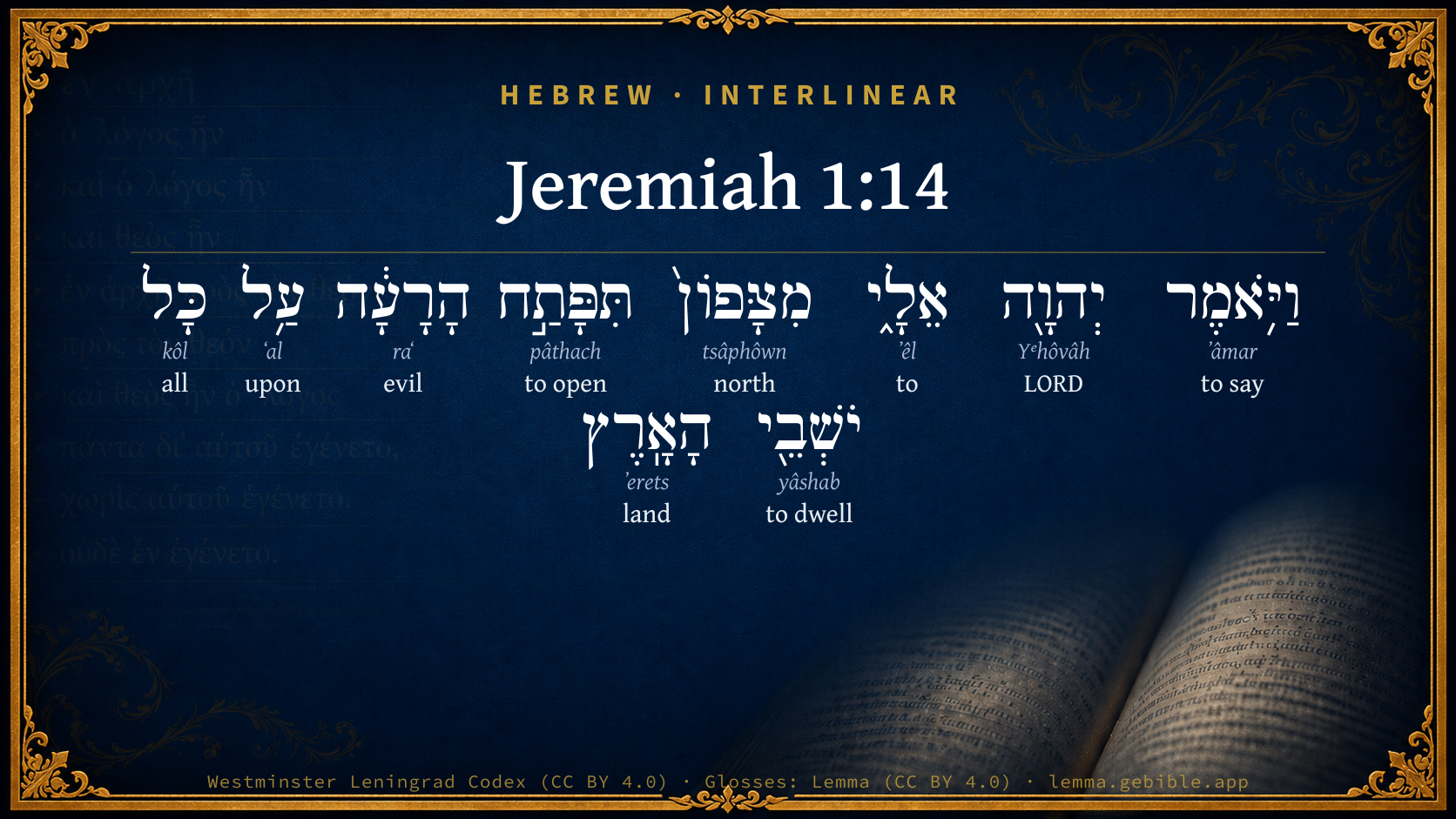
Hebrew (Westminster Leningrad Codex) Jeremiah 1:14 appears in the Hebrew Old Testament. The text above is from the Westminster Leningrad Codex. Each word links to its Strong’s number, a concise gloss, and parsing drawn from the Open Scriptures Hebrew Bible morphology. Click any word for its full Brown-Driver-Briggs (BDB) entry.
Download image
Cite this verse

Jeremiah 1:14 (World English Bible). Public Domain. Lemma interlinear Bible study tool, https://lemma.gebible.app/v/jeremiah/1/14.

Show BibTeX & RIS
BibTeX
RIS
English Translation
Then Yahweh said to me, Out of the north evil shall break forth on all the inhabitants of the land.
World English Bible · Public Domain
Download a study sheet

One document with this verse’s original text, its word-by-word gloss line, the meaning frame, cross-references with their text, attributed commentary, and full source and license credits — printable, and it pastes into notes with its structure intact.

This verse Autodidact and up

Study sheet (.html) Plain text (.txt)

A passage Seminary Student

Up to 50 verses in one chapter. A passage sheet keeps up to 6 commentary sources and 12 cross-references per verse, in the order this page ranks them, and says so on the sheet whenever that leaves anything out. Ask for a single verse and you get the Autodidact verse sheet above.

Everything on this page stays free to read, with no account — the sheet is a download of what is already on screen, not access to it.

Want to remove ads? Support Godless Engineer
Compare translations 3

The same verse in 3 English versions, stacked beneath the original-language interlinear above. Click any original word for its lexicon entry.

Each is an independent rendering of the whole verse — the interlinear is not word-aligned to these translations.

Highlighted words mark where these versions differ — a whole-verse word diff, not a word-by-word alignment.

  • World English Bible Public Domain
    Then Yahweh said to me, Out of the north evil shall break forth on all the inhabitants of the land.
  • King James Version Public Domain
    Then the LORD said unto me, Out of the north an evil shall break forth upon all the inhabitants of the land.
  • unfoldingWord Literal Text CC BY-SA 4.0
    And Yahweh said to me, “From the north disaster will be released on all the inhabitants of the land.

unfoldingWord Literal Text — © unfoldingWord, licensed CC BY-SA 4.0. Word-aligned USFM3 via Door43 (git.door43.org/unfoldingWord/en_ult).

Versions to compare (up to 4)

3 of 4 selected

Show all 18 translations

Every available English version of this verse, each an independent rendering of the whole verse.

  • World English Bible Public Domain
    Then Yahweh said to me, Out of the north evil shall break forth on all the inhabitants of the land.
  • Berean Standard Bible Public Domain
    Then the LORD said to me, “Disaster from the north will be poured out on all who live in the land.
  • Majority Standard Bible Public Domain
    Then the LORD said to me, “Disaster from the north will be poured out on all who live in the land.
  • King James Version Public Domain
    Then the LORD said unto me, Out of the north an evil shall break forth upon all the inhabitants of the land.
  • American Standard Version (1901) Public Domain
    Then Jehovah said unto me, Out of the north evil shall break forth upon all the inhabitants of the land.
  • Revised Version (1885) Public Domain
    Then the LORD said unto me, Out of the north evil shall break forth upon all the inhabitants of the land.
  • Geneva Bible (1599) Public Domain
    Then saide the Lord vnto me, Out of the North shall a plague be spred vpon all the inhabitants of the land.
  • Douay-Rheims (1899) Public Domain
    And the Lord said to me: from the north shall an evil break forth upon all the inhabitants of the land.
  • Young's Literal Translation Public Domain
    And Jehovah saith unto me, `From the north is the evil loosed against all inhabitants of the land.
  • Literal Standard Version CC BY-SA 4.0
    And YHWH says to me, “From the north the evil is loosed against all inhabitants of the land.
  • Unlocked Literal Bible CC BY-SA 4.0
    Yahweh said to me, “Disaster will be opened up out of the north on all who live in this land.
  • unfoldingWord Literal Text CC BY-SA 4.0
    And Yahweh said to me, “From the north disaster will be released on all the inhabitants of the land.
  • Darby Bible Public Domain
    And Jehovah said unto me, Out of the north shall evil break forth upon all the inhabitants of the land.
  • World Messianic Bible Public Domain
    Then the LORD said to me, “Out of the north, evil will break out on all the inhabitants of the land.
  • Webster's Bible Public Domain
    Then the LORD said to me, Out of the north an evil shall break forth upon all the inhabitants of the land.
  • Free Bible Version CC BY-SA 4.0
    Then the Lord told me, “Trouble brewing from the north will sweep out over everyone living in the country.
  • Bible in Basic English Public Domain
    Then the Lord said to me, Out of the north evil will come, bursting out on all the people of the land.
  • JPS Tanakh (1917) Public Domain
    Then the LORD said unto me: 'Out of the north the evil shall break forth upon all the inhabitants of the land.

Literal Standard Version (2020), Covenant Press — licensed CC BY-SA 4.0. Text via the HelloAO Bible API (eBible.org). Unlocked Literal Bible (unfoldingWord) — licensed CC BY-SA 4.0. Text via the HelloAO Bible API (eBible.org). unfoldingWord Literal Text — © unfoldingWord, licensed CC BY-SA 4.0. Word-aligned USFM3 via Door43 (git.door43.org/unfoldingWord/en_ult). Free Bible Version, Dr. Jonathan Gallagher — licensed CC BY-SA 4.0. Text via the HelloAO Bible API (eBible.org).

Word by word

More ways to search: Search by grammar → Find every occurrence → Compare this word →

Practice this passage: Drill this verse → Learn its vocabulary →

תִּפָּתַ֣ח
pâthach
H6605
“to open”
Verb, Niphal, Imperfect, 3rd Person, Feminine, Singular
Part of Speech
Verb
Stem
Niphal
Form
Imperfect
Person
3rd Person
Gender
Feminine
Number
Singular
Full BDB Definition

Origin: a primitive root

TWOT: 1854 , 1855

to open - (Qal) to open - (Niphal) to be opened, be let loose, be thrown open - (Piel) - to free - to loosen - to open, open oneself - (Hithpael) to loose oneself - to carve, engrave - (Piel) to engrave - (Pual) to be engraved
  1. וַיֹּ֥אמֶר ʼâmar H559 “and · to say” Conjunction + Verb, Qal, Sequential Imperfect, 3rd Person, Masculine, Singular
  2. יְהוָ֖ה Yᵉhôvâh H3068 “LORD” Noun, Proper
  3. אֵלָ֑י ʼêl H413 “to · me” Preposition + Suffix, Personal, 1st Person, Common, Singular
  4. מִצָּפוֹן֙ tsâphôwn H6828 “from · north” Preposition + Noun, Common, Feminine, Singular, Absolute
  5. הָרָעָ֔ה raʻ H7451 “the · evil” Particle, Definite Article + Noun, Common, Feminine, Singular, Absolute
  6. עַ֥ל ʻal H5921 “upon” Preposition
  7. כָּל kôl H3605 “all of” Noun, Common, Masculine, Singular, Construct
  8. יֹשְׁבֵ֖י yâshab H3427 “dwelling” Verb, Qal, Participle Active, Masculine, Plural, Construct
  9. הָאָֽרֶץ ʼerets H776 “the · land” Particle, Definite Article + Noun, Common, Both, Singular, Absolute

About this verse

These counts appear in no published source. They are computed here, from the morphology-tagged text and Lemma’s own curated glosses. What Lemma adds →

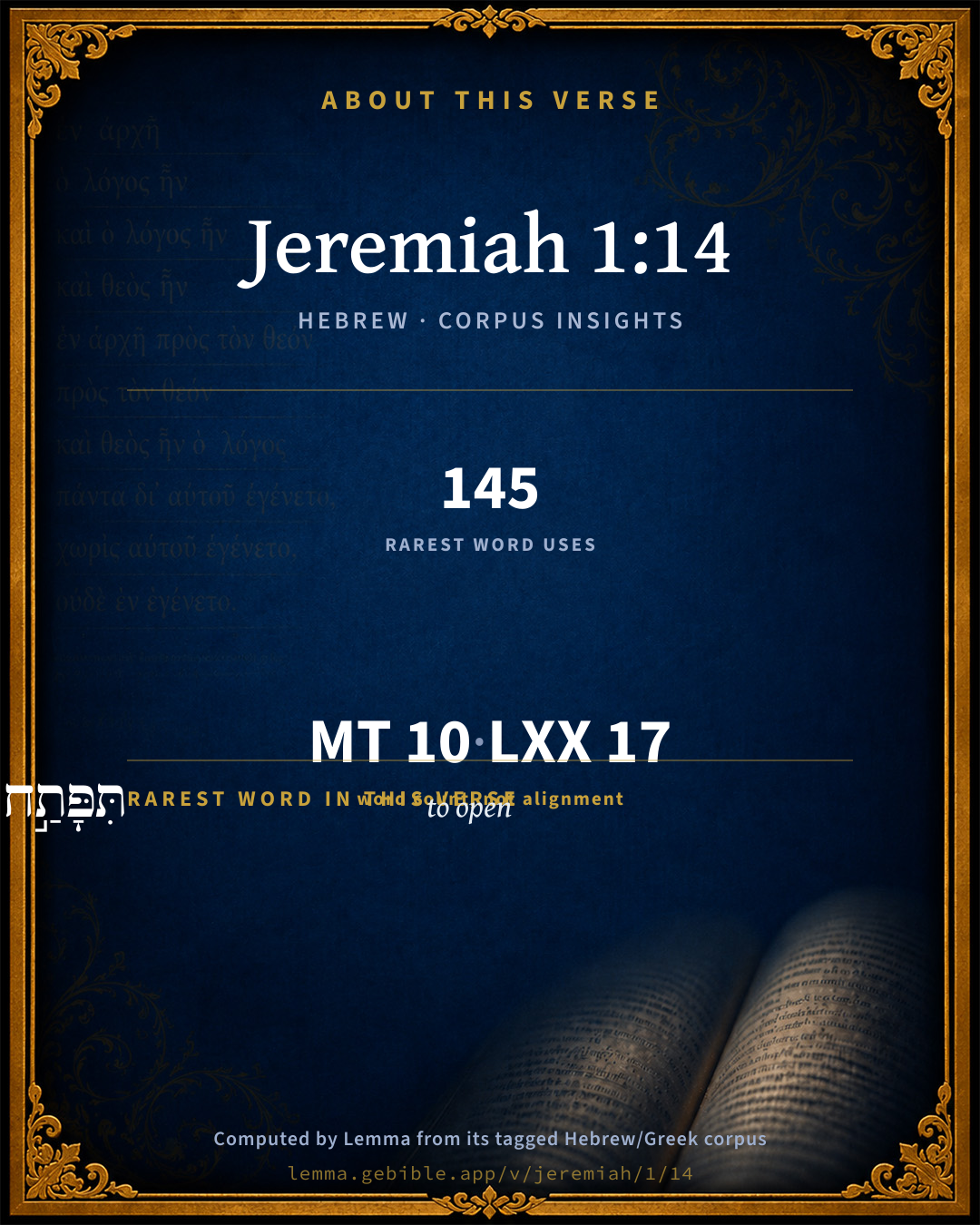
10
words
10
distinct lemmas
Prophets
section

Grammatical profile

  • 3 verbs
  • 5 nouns
  • 2 prepositions

Verb forms

  • וַיֹּ֥אמֶר Qal · Sequential Imperfect
  • תִּפָּתַ֣ח Niphal · Imperfect
  • יֹשְׁבֵ֖י Qal · Participle Active

Hebrew & Septuagint length

In the original languages it is 10 Hebrew tokens and 17 Greek tokens — but the two are counted differently (Hebrew bundles its prefixes and suffixes into one token; the Greek is in lemma form), so that isn’t a like-for-like length.

Cross-references

10

Topical passages linked to Jeremiah 1:14 in the Treasury of Scripture Knowledge — connected by theme and wording, ordered by reader-vote popularity; previews shown in the World English Bible.

  • Isaiah 41:25 I have raised up one from the north, and he has come; from the rising of the sun one who calls on my name: and he shall come on rulers as on mortar, and as the potter treads clay.
  • Jeremiah 4:6 Set up a standard toward Zion: flee for safety, don't stay; for I will bring evil from the north, and a great destruction.
  • Jeremiah 6:1 Flee for safety, you children of Benjamin, out of the midst of Jerusalem, and blow the trumpet in Tekoa, and raise up a signal on Beth Haccherem; for evil looks forth from the north, and a great destruction.
  • Jeremiah 10:22 The voice of news, behold, it comes, and a great commotion out of the north country, to make the cities of Judah a desolation, a dwelling-place of jackals.
  • Jeremiah 6:22 Thus says Yahweh, Behold, a people comes from the north country; and a great nation shall be stirred up from the uttermost parts of the earth.
  • Jeremiah 31:8 Behold, I will bring them from the north country, and gather them from the uttermost parts of the earth, [and] with them the blind and the lame, the woman with child and her who travails with child together: a great company shall they return here.
  • Jeremiah 46:20 Egypt is a very beautiful heifer; [but] destruction out of the north is come, it is come.
  • Jeremiah 50:9 For, behold, I will stir up and cause to come up against Babylon a company of great nations from the north country; and they shall set themselves in array against her; from there she shall be taken: their arrows shall be as of an expert mighty man; none shall return in vain.
  • Jeremiah 50:41 Behold, a people comes from the north; and a great nation and many kings shall be stirred up from the uttermost parts of the earth.
  • Ezekiel 1:4 I looked, and, behold, a stormy wind came out of the north, a great cloud, with flashing lightning, and a brightness round about it, and out of the midst of it as it were glowing metal, out of the midst of the fire.

Cross-references courtesy of OpenBible.info (CC BY 4.0).

Hebrew and Greek witnesses Masoretic Hebrew ↔ Greek Septuagint

The same verse in the two great witnesses to the Old Testament, shown verse-for-verse.

These are two independent witnesses, not word-aligned to each other, and the Septuagint is shown in lemma (dictionary) form.

Hebrew Jeremiah 1:14 Masoretic · Westminster Leningrad Codex

וַיֹּ֥אמֶר יְהוָ֖ה אֵלָ֑י מִצָּפוֹן֙ תִּפָּתַ֣ח הָרָעָ֔ה עַ֥ל כָּל יֹשְׁבֵ֖י הָאָֽרֶץ

Then Yahweh said to me, Out of the north evil shall break forth on all the inhabitants of the land.

World English Bible · Public Domain

Greek LXX Structure differs

In the Septuagint, Jeremiah is about an eighth shorter than the Hebrew and arranges its material differently — the Oracles Against the Nations (Hebrew chapters 46–51) appear in the middle of the Greek book, after 25:13. Because the chapter and verse boundaries do not line up, a verse-for-verse comparison with the Hebrew is not shown.

A verse-for-verse comparison isn’t shown here because the chapters and verses don’t line up. Switch to the LXX edition with the MT / LXX toggle above to read the Greek directly.

Hebrew: Westminster Leningrad Codex (CC BY 4.0). Greek: Septuagint (public domain); English from a public-domain English Septuagint. How the Septuagint differs from the Hebrew →

Targum (Aramaic paraphrase)

1

The Targum is the ancient Jewish Aramaic paraphrase of the Hebrew Scriptures — an interpretive translation, not the Hebrew text itself. Onkelos (literal) and Pseudo-Jonathan (expansive) render the Torah, and Jonathan the Prophets. Coverage is partial: where no permissively-licensed English translation exists for a verse, only the Aramaic is shown. This is verse-level text, not a word-by-word alignment to the Hebrew.

  1. Targum Jonathan Prophets (Joshua–Malachi)
    וַאֲמַר יְיָ לִי מִצִיפּוּנָא תְּשָׁרֵי בִישְׁתָא לְמֵיתֵי עַל כָּל יַתְבֵי אַרְעָא:

    (no public-domain English translation for this verse)

    Targum Jonathan — Aramaic: “Mikraot Gedolot” (public domain). English: “Sefaria Community Translation” (CC0 1.0 (public-domain dedication)); “London "Chaldee Paraphrase," 1871” (public domain). Text via Sefaria.

Commentary

Notes on Jeremiah 1:14 from classic Christian and Jewish commentators (each source and its license shown beneath its notes). The classic Christian expositions comment on the surrounding passage and are grouped to its opening verse, so a note may address several verses; the Jewish commentaries on the Tanakh (Rashi and others) are per-verse, so they appear only where the commentator wrote on this verse.

Lemma curates 59 commentaries, every one of them public domain or Creative Commons licensed, each selected and text-cleaned for this edition rather than reprinted as found. About our sources →

Trapp's Complete Commentary

John Trapp

Jer 1:14 Then the LORD said unto me, Out of the north an evil shall break forth upon all the inhabitants of the land.

Ver. 14. Out of the north an evil shall break forth,] i.e., From Chaldea, which is north from Judea. Gregory moraliseth the text thus: Man’s mind is this pot; that which from the north sets it on fire is the devil, by inflaming it with evil lusts, and then he sets up his throne therein. {a} As,

{a} Aquilo est sedes diabolo. - Aug.

John Trapp, A Commentary or Exposition upon All the Books of the Old and New Testament (1647–1656) — public domain. Text from a community e-Sword module.

Geneva Bible (1599)

Geneva Bible translators

Syria and Assyria were Northward in respect of Jerusalem, which were the Chaldeans’ dominion.

Geneva Bible (1599) marginal notes — public domain. Text via Bolls.life.

Jamieson, Fausset & Brown

Robert Jamieson, A. R. Fausset & David Brown

break forth--"shall disclose itself."

Out of the north-- (Jer 4:6; Jer 6:1, Jer 6:22; Jer 10:22; Jer 25:9; Eze 26:7). The Chaldeans did not cast off the yoke of Assyria till several years after, under Nabopolassar, 625 B.C.; but long previously they had so increased as to threaten Assyria, which was now grown weak, and other neighboring peoples.

Jamieson, Fausset & Brown — Commentary Critical and Explanatory on the Whole Bible (1871) — public domain (CC PDM 1.0). Text via the HelloAO Bible API.

Adam Clarke's Commentary

Verse 14. Shall break forth] תפתח tippathach, shall be opened. The door shall be thrown abroad, that these calamities may pass out freely.

Adam Clarke's Commentary on the Bible (1810–1826) — public domain. Text from a community e-Sword/MySword module.

John Calvin's Commentaries

And thus God testifies that the fire was already kindled in Chaldea and Assyria, which was not only to boil the Jews, but also reduce them to nothing. And then he expresses the same in other words — that evil would come from the north upon all the Jews. We shall hereafter see that there is presented here a brief summary of the truth which was committed to Jeremiah; at least it is a summary of one half of it; for God designed also to provide for his own elect; and he thus terrified them, that they might be subdued, and submit to him, and not that they might abandon themselves to despair. At the same time, this half of the prediction was — that there was no hope of pardon, because the Jews had with extreme obstinacy provoked God’s wrath, and had so abused his patience, that their impiety could no longer be tolerated. Hence, what other prophets had denounced Jeremiah now confirms more strongly, and points it out, as it were, by the finger. It afterwards follows —

John Calvin's Commentaries (1540-1563) — public domain. Text from the Calvin Translation Society English edition (1840s-50s) via the Christian Classics Ethereal Library (ccel.org). Calvin's coverage is partial (roughly two-thirds of the Bible); uncommented books and verses are honest gaps, never fabricated. The 19th-century editor's footnotes and remarks are omitted so the notes are faithfully Calvin's own voice.

Ellicott's Commentary for English Readers

(14) Out of the north an evil.—Literally, the evil, long foretold, as in Mic_3:12, and elsewhere, and long expected.

A Bible Commentary for English Readers, edited by Charles John Ellicott (1878–1897) — public domain. Text from a community e-Sword module.

The Cambridge Bible for Schools and Colleges

gen. ed. J. J. S. Perowne

14. evil] the evil—the evil which was to be expected, foretold by all the prophets as the result of national sin.

shall break forth] shall be opened, shall disclose itself. But it is best by a slight change in the Hebrew to render shall be blown (as in Jer_1:13), i.e. kindled.

The Cambridge Bible for Schools and Colleges (gen. ed. J. J. S. Perowne; Cambridge University Press, 1878–1918) — public domain. Text from a community e-Sword module.

John Gill's Exposition

Then the Lord said unto me,.... Explaining the above vision:

out of the north an evil shall break forth upon all the inhabitants of the land; that is, out of Babylon, which lay north, as Jarchi says, and so the Talmud (t); or north east, as Kimchi and Ben Melech, to the land of Israel; from hence came Nebuchadnezzar and his army, which are meant by "the evil" that should break forth, or "be opened" (u) and loosed, which before were bound and hindered by the providence of God; see Rev 9:14 and come upon all the inhabitants of the land of Israel; and who are signified by the boiling pot to the north; or, however, by the fire under it, which came from thence; for rather by the pot is meant Jerusalem; and, by the boiling of it, its destruction by the Chaldeans; see Eze 11:3.

(t) T. Bab. Gittin, fol. 6. 1. and Bava Bathra, fol. 25. 2. (u) "aperietur", Munster, Tigurine version, Cocceius; "pandetur", V. L. Pagninus, Montanus.

John Gill's Exposition of the Whole Bible (1746–1763) — public domain (CC PDM 1.0). Text via the HelloAO Bible API.

Albert Barnes' Notes on the Bible

Out of the north ... - The caldron represents the great military empires upon the Euphrates. In Hezekiah’s time, Nineveh was at their head; but stormed by the armies of Cyaxares and Nabopalassar it is itself now the victim whose limbs are seething in the caldron, and the seat of empire has been transferred to Babylon. But whoever may for the time prevail, the tide of passion and carnage is sure finally to pour itself upon Judaea.

An evil shall break forth - “The evil shall be opened,” shall show itself, be disclosed from the north: that special evil, which from the days of Micah Mic 3:12 all the prophets had denounced upon the Jews if they lapsed into idolatry. At present the caldron is fiercely boiling upon the Euphrates. As soon as either of the parties struggling there gains the victory it will pour the whole seething mass over other countries in the shape of an invading army (see Jer 25:17-26).

Albert Barnes' Notes on the Bible (1834–1885) — public domain. Text from a community e-Sword/MySword module.

Haydock's Catholic Bible Commentary

North. The tributary kings were forced to attend, Judith ii. 7., and 3 Kings xx. 1. --- About. The princes thus took Sedecias, and sent him to Reblatha, chap. xxxix. 3. (Calmet)

George Leo Haydock (1774–1849), Haydock's Catholic Family Bible and Commentary, 1859 edition — public domain. Excludes Psalms (Douay-Rheims chapter numbering differs from Protestant) and Deuterocanonical books (Catholic canon only).

Matthew Poole's English Annotations

The Lord said; explained this vision.

Out of the north, i.e. from Babylon, a metonymy of the subject; for though it lie eastward, yet it is north from Jerusalem, as lying four degrees more from the equinoctial. See Jer 1:13.

Shall break forth; it shall be withheld or restrained no longer in my treasure; I will let it out, viz. that evil of punishment represented by the fire.

Of the land: though God gave almost all the then known world to the king of Babylon, yet here he understands the land of Judea, Jer 25:9.

Matthew Poole's English Annotations on the Holy Bible (1683–1685) — public domain. Text from a community e-Sword/MySword module.

Whedon's Commentary on the Bible

Daniel D. Whedon

14. Shall break forth — Literally, shall be opened.

All the inhabitants of the land — Of Judea. The language suggests the universality of the evil.

Daniel D. Whedon (gen. ed.), Commentary on the Old and New Testaments (1874–1909) — public domain. Text from a community e-Sword module.

The Pulpit Commentary

Out of the north. Previously to the battle of Carchemish, the Babylonians are only mentioned vaguely as a northern people. (see Jer_4:6 Jer_6:1, 22 10:22) Strictly speaking, they were an eastern people from the point of view of Palestine; but the caravan-road which the Chaldaean armies had to take entered Palestine at Dan, (comp. Jer_4:15 Jer_8:16) and then proceeded southward. (On the question whether a Scythian invasion is referred to, at least conjointly with the Babylonian, see Introduction.) An evil; rather, the evil; viz. the calamity which in deepening gloom forms the burden of the prophet"s discourses. Shall break forth; literally, shall open; i.e. let loose by opening (comp. the use of the same verb in Isa_14:17, literally, "looseth not his prisoners homewards;" and Amo_8:5, literally, "that we may open," i.e. "bring forth wheat"). There is, however, some difficulty in explaining the choice of this expression. We might indeed suppose that the caldron had a lid, and that the removal or falling off of this lid is the "opening" referred to by the phrase.

The Pulpit Commentary (1880–1919), ed. H.D.M. Spence-Jones & Joseph S. Exell — public domain. Text from a community e-Sword module.

John Wesley's Explanatory Notes

North - From Babylon.

John Wesley, Explanatory Notes Upon the Whole Bible (1754–1765) — public domain. Text via the GEBible commentary corpus.

Rashi

Rabbi Shlomo Yitzchaki (Rashi)

From the north the misfortune will break forth Babylon is on the north of Eretz Israel.

Rashi on the Tanakh — English translations: “The Judaica Press complete Tanach with Rashi, translated by A. J. Rosenberg” (CC BY 4.0); “Pentateuch with Rashi's commentary by M. Rosenbaum and A.M. Silbermann, 1929-1934” (public domain); “The Metsudah Tanach series, Lakewood, N.J” (CC BY 4.0); and “The Book of Joshua, Metsudah Publications, 1997” (CC BY 4.0). Text via Sefaria.

Lesson kit

Teaching starters — assembled from the data on this page, not authored interpretation. Every prompt links to the verse data it draws on. Edit before teaching.

Jeremiah, in the Prophets, opens this verse with 10 words (10 distinct Hebrew lemmas). Its most distinctive word is pâthach (“to open”). A historical commentator’s framing appears above. Read the whole chapter for the surrounding context.

Discussion questions

  1. The word pâthach carries the sense “to open.” How does it shape the verse?
  2. How does Isaiah 41:25, which shares this passage’s theme, read alongside this verse?
  3. These translations render this verse differently. What is at stake in choosing one wording over another?
  4. «וַיֹּ֥אמֶר» is a Qal Sequential Imperfect verb. How does that grammatical form shape the action described?
  5. Compare how Trapp's Complete Commentary and Geneva Bible (1599) read this verse. Where do they agree or differ?

Things to notice

Reading settings

Reading text

Shown beneath each verse's original-language words.

Old Testament
Old Testament edition

Read the OT as the Masoretic Hebrew (MT) or the Greek Septuagint (LXX).

English shown for the Greek Septuagint (in the Hebrew ↔ Greek comparison).

Comparing translations? Open the Compare panel on any verse page to stack up to four side by side.