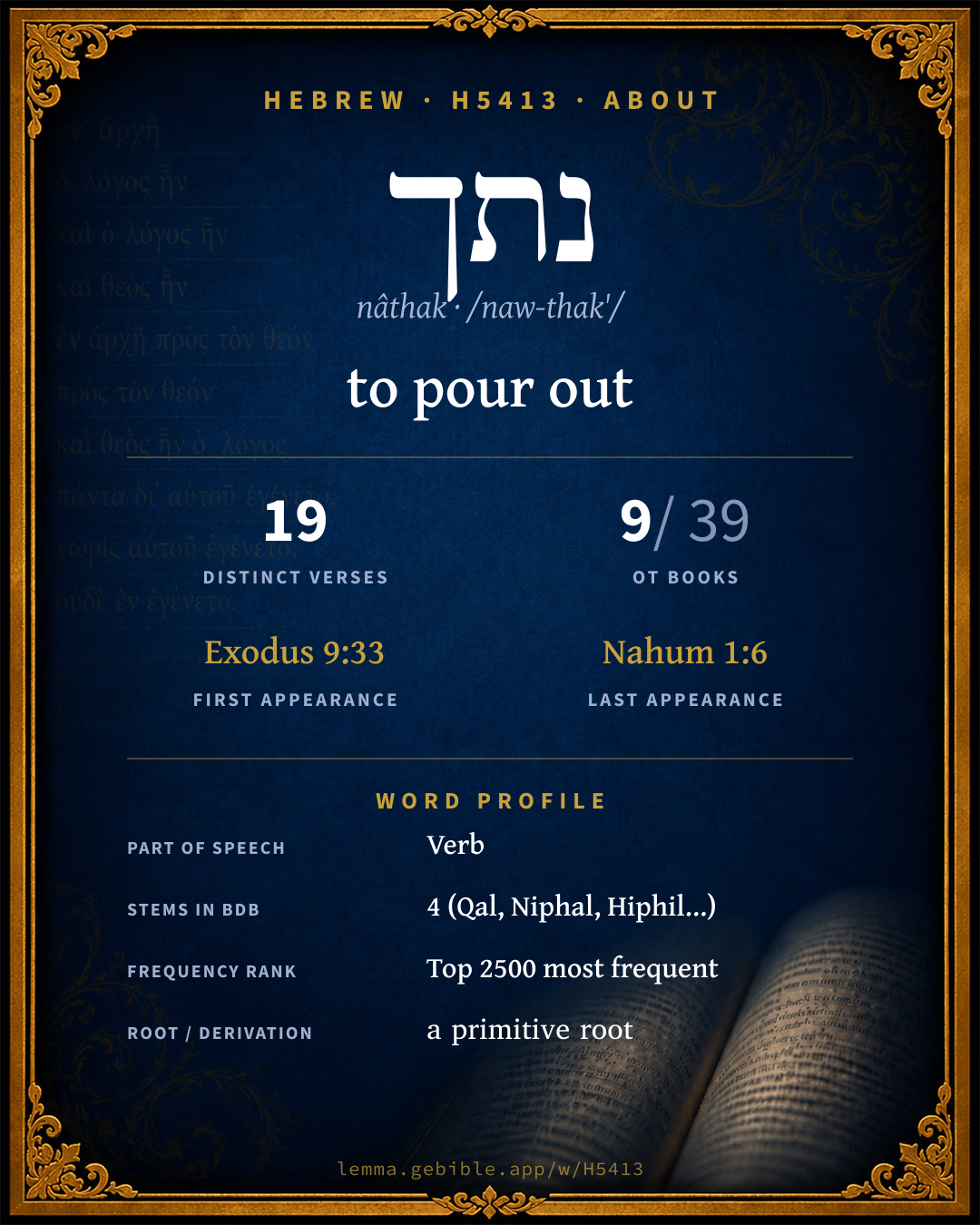
נָתַךְ
to pour out
‘to pour out’ is one of 5 main senses fuller range ↓
Full lexicon entry — Brown-Driver-Briggs (BDB)
From Brown-Driver-Briggs (BDB)
Where this word appears
See every Niphal verb in the Hebrew Bible →
Grammar key — what these labels mean
Part of speech
- Verb
- An action or state-of-being word.
Stem
- Niphal
- Usually the simple passive or reflexive of the Qal (“he was written”).
- Qal
- The basic, simple active stem — the plain form of the verb (“he wrote”).
- Hiphil
- The causative active stem (“he caused / brought about”).
- Hophal
- The passive counterpart of the Hiphil (“he was caused to…”).
Form
- Perfect
- A completed action or state — Hebrew marks aspect (completeness) more than strict tense (“he wrote”).
- Imperfect
- An incomplete, ongoing, or future action (“he will / would write”).
- Sequential Imperfect
- An imperfect with prefixed waw — the standard past-narrative form (waw-consecutive imperfect).
- Sequential Perfect
- A perfect with prefixed waw continuing a preceding imperfect or command (waw-consecutive perfect).
- Infinitive Construct
- A bound verbal noun, frequently with prepositions (“to write / in writing”).
- Participle Passive
- A verbal adjective expressing action received (“written”).
State
- Absolute
- The independent form of a noun, not bound to a following word.
Person
- 3rd Person
- The one spoken about (“he / she / it / they”).
- 2nd Person
- The one addressed (“you”).
- 1st Person
- The speaker (“I / we”).
Gender
- Masculine
- Grammatically masculine.
- Feminine
- Grammatically feminine.
- Common
- Either gender — not distinguished for this form.
Number
- Singular
- One.
- Plural
- More than one (in Hebrew, generally three or more).
Grammatical forms 14 distinct
- Verb, Qal, Imperfect, 3rd Person, Feminine, Singular 4 times (19%)
- Verb, Niphal, Perfect, 3rd Person, Masculine, Singular 3 times (14%)
- Verb, Qal, Sequential Imperfect, 3rd Person, Feminine, Singular 2 times (10%)
- Verb, Niphal, Perfect, 3rd Person, Feminine, Singular 2 times (10%)
- Verb, Niphal, Sequential Perfect, 2nd Person, Masculine, Plural 1 time (5%)
- Verb, Niphal, Sequential Perfect, 3rd Person, Feminine, Singular 1 time (5%)
- Verb, Hiphil, Sequential Perfect, 1st Person, Common, Singular 1 time (5%)
- Verb, Hiphil, Sequential Imperfect, 3rd Person, Masculine, Plural 1 time (5%)
+6 more forms (6 occurrences)
Parsed forms decoded from the imported morphology (morphhb / Westminster Leningrad Codex — WLC text public domain, morphhb tagging CC BY 4.0), counted across 21 parsed occurrences — not distinct verses.
Every verse where H5413 appears — 19 distinct verses across 9 books. Click any verse to open its interlinear word-by-word view. Verse text shown in the World English Bible for context — . Each verse’s Hebrew form is shown with its reference; the English is not keyword-highlighted, since the data carries no word-level English alignment. Use “Compare translations” on any verse to read it across multiple English versions. This concordance covers the Hebrew Bible; Septuagint (Greek Old Testament) occurrences are not indexed here.
Exodus 1 verse
2 Samuel 1 verse
2 Kings 1 verse
2 Chronicles 4 verses
- 2 Chronicles 12:7 תִתַּ֧ךְ Qal impf 3fs When Yahweh saw that they humbled themselves, the word of Yahweh came to Shemaiah, saying, They have humbled themselves: I will not destroy them; but I will grant them some deliverance, and my wrath shall not be poured out on Jerusalem by the hand of Shishak.
- 2 Chronicles 34:17 וַ/יַּתִּ֕יכוּ conj + Hiphil wimpf 3mp They have emptied out the money that was found in the house of Yahweh, and have delivered it into the hand of the overseers, and into the hand of the workmen.
- 2 Chronicles 34:21 נִתְּכָ֣ה Niphal pf 3fs Go you, inquire of Yahweh for me, and for those who are left in Israel and in Judah, concerning the words of the book that is found; for great is the wrath of Yahweh that is poured out on us, because our fathers have not kept the word of Yahweh, to do according to all that is written in this book.
- 2 Chronicles 34:25 וְ/תִתַּ֧ךְ conj + Qal impf 3fs Because they have forsaken me, and have burned incense to other gods, that they might provoke me to anger with all the works of their hands; therefore is my wrath poured out on this place, and it shall not be quenched.
Job 2 verses
Jeremiah 3 verses
- Jeremiah 7:20 נִתֶּ֨כֶת֙ Niphal ptcp.pass fs Therefore thus says the Lord Yahweh: Behold, my anger and my wrath shall be poured out on this place, on man, and on animal, and on the trees of the field, and on the fruit of the ground; and it shall burn, and shall not be quenched.
- Jeremiah 42:18 נִתַּ֨ךְ תִּתַּ֤ךְ Niphal pf 3ms Qal impf 3fs For thus says Yahweh of Hosts, the God of Israel: As my anger and my wrath has been poured forth on the inhabitants of Jerusalem, so shall my wrath be poured forth on you, when you shall enter into Egypt; and you shall be an object of horror, and an astonishment, and a curse, and a reproach; and you shall see this place no more.
- Jeremiah 44:6 וַ/תִּתַּ֤ךְ conj + Qal wimpf 3fs Therefore my wrath and my anger was poured forth, and was kindled in the cities of Judah and in the streets of Jerusalem; and they are wasted and desolate, as it is this day.
Ezekiel 4 verses
- Ezekiel 22:20 לְ/הַנְתִּ֑יךְ וְ/הִתַּכְתִּ֖י prep + Hiphil inf.cs conj + Hiphil wpf 1cs As they gather silver and brass and iron and lead and tin into the midst of the furnace, to blow the fire on it, to melt it; so will I gather you in my anger and in my wrath, and I will lay you there, and melt you.
- Ezekiel 22:21 וְ/נִתַּכְתֶּ֖ם conj + Niphal wpf 2mp Yes, I will gather you, and blow on you with the fire of my wrath, and you shall be melted in the midst of it.
- Ezekiel 22:22 תֻּתְּכ֣וּ Hophal impf 2mp As silver is melted in the midst of the furnace, so shall you be melted in the midst of it; and you shall know that I, Yahweh, have poured out my wrath on you.
- Ezekiel 24:11 וְ/נִתְּכָ֤ה conj + Niphal wpf 3fs Then set it empty on the coals of it, that it may be hot, and the brass of it may burn, and that the filthiness of it may be molten in it, that the rust of it may be consumed.
Daniel 2 verses
- Daniel 9:11 וַ/תִּתַּ֨ךְ conj + Qal wimpf 3fs Yes, all Israel have transgressed your law, even turning aside, that they should not obey your voice: therefore has the curse been poured out on us, and the oath that is written in the law of Moses the servant of God; for we have sinned against him.
- Daniel 9:27 תִּתַּ֖ךְ Qal impf 3fs He shall make a firm covenant with many for one week: and in the midst of the week he shall cause the sacrifice and the offering to cease; and on the wing of abominations [shall come] one who makes desolate; and even to the full end, and that determined, shall [wrath] be poured out on the desolate.
Nahum 1 verse
About this entry
At a glance — auto-summarized from this page’s data, not written by a person. Every figure links to its source below. This summary describes the numbers; it doesn’t interpret them.
נתך — transliterated nâthak — is a Hebrew verb carrying the sense “to pour out.” Different stems carry different senses — BDB groups them under 4 stems, among them Qal and Niphal. The Hebrew Bible uses it across 19 verses — uncommon. It first appears in Exodus 9:33. Related forms include התוך. See the sense tree, 19-verse concordance, and the renderings breakdown below.
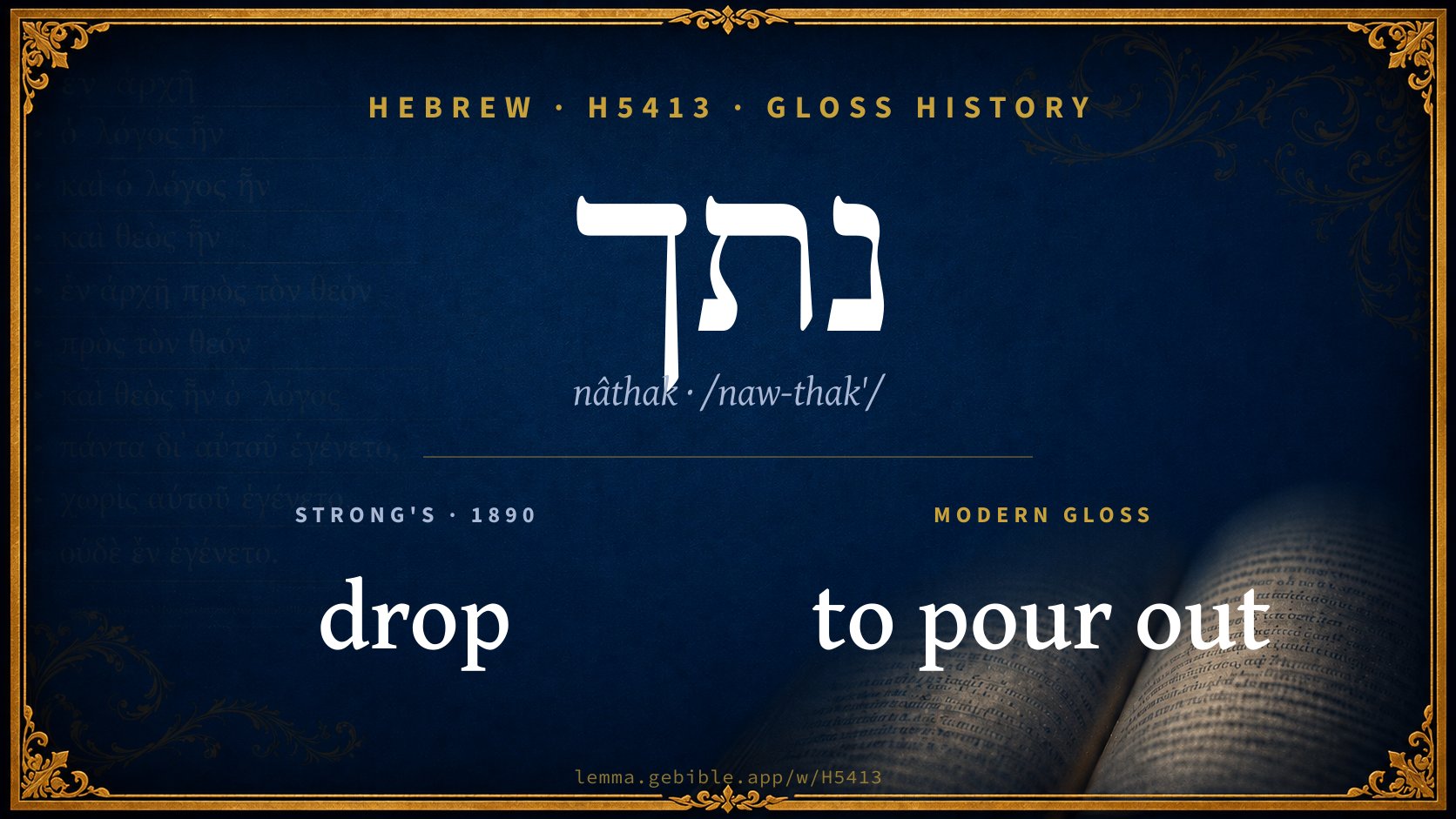
Gloss history
Strong's 1890 vs modern scholarship
About this word
Strong's H5413 catalogs a Hebrew word from the Hebrew Old Testament.
These counts are not copied from any lexicon or concordance. They are computed here, from the morphology-tagged Hebrew Old Testament. What Lemma adds →
- 19
- distinct verses
- The word appears in 19 distinct verses.
- 9 / 39
- OT books
- The word appears in 9 of 39 Old Testament books.
- #1,462
- by frequency
- Top 2500 most frequent Hebrew words (rank 1,462 of 8,640 Hebrew words by occurrence).
View all 19 occurrences in the concordance →
Most concentrated in
- 2 Chronicles 4 verses 21%
- Ezekiel 4 verses 21%
- Jeremiah 3 verses 16%
By section of the Old Testament
By traditional corpus
Conventional, traditional groupings — biblical authorship is debated, so this is a traditional corpus grouping, not an authorship claim. Each share is this word’s portion of its verses in that division of the Hebrew canon. Each figure is a share of the word’s 19 distinct verses.
- Prophets (Nevi'im) 10 verses · 53%
- Writings (Ketuvim) 8 verses · 42%
- Torah (Pentateuch) 1 verse · 5%
How translations render this word
Counts come from each version’s own published word-to-Strong’s tagging or interlinear alignment — an approximate guide to how each version renders this word, not a word-level alignment the data otherwise carries. Because each total is that version’s own tagged count, the per-version totals vary from one another and need not match the appearance or distinct-verse counts above. These counts may also differ from a printed concordance because Lemma counts each distinctly tagged rendering and does not collapse phrase taggings into a single head-word total. This is a fixed set of word-tagged versions (KJV, ASV, BSB, ULT) and does not change with the reading translation you choose elsewhere. Each version’s license is shown beside its name below (and on Sources).
- King James Version: Is poured out 2×, Shall be poured out 2×
- American Standard Version: Is poured out 2×
- Berean Standard Bible: Be poured out 2×, Has been poured out 2×, Is poured out 2×
- unfoldingWord Literal Text: Is poured out 3×, Rage 2×, You will be melted 2×
King James Version Public Domain
Renders H5413 across 21 tagged occurrences — most commonly:
Plus 17 renderings that appear only once — usually multi-word phrases or single function words the recovered tagging swept in, not distinct renderings.
American Standard Version Public Domain
Renders H5413 across 21 tagged occurrences — most commonly:
Plus 19 renderings that appear only once — usually multi-word phrases or single function words the recovered tagging swept in, not distinct renderings.
Berean Standard Bible Public Domain
Renders H5413 across 21 tagged occurrences — most commonly:
Plus 9 renderings that appear only once — usually multi-word phrases or single function words the recovered tagging swept in, not distinct renderings.
unfoldingWord Literal Text CC BY-SA 4.0
Renders H5413 across 20 tagged occurrences — most commonly:
Plus 13 renderings that appear only once — usually multi-word phrases or single function words the recovered tagging swept in, not distinct renderings.
Senses in the full BDB
Hebrew verbs can shift meaning by stem (binyan): Qal is the basic action, Niphal is often passive or reflexive, Piel often intensifies or makes it factitive, and Hiphil is typically causative. The senses below are grouped under the stem BDB assigns to each. This entry also uses Hophal (the passive of Hiphil).
What do BDB’s symbols mean?
BDB uses these scholarly abbreviations:
| Symbol | Meaning |
|---|---|
| 𝔊 | the Septuagint (the ancient Greek translation, LXX) |
| 𝔙 | the Vulgate (the Latin translation) |
| 𝔖 | the Syriac version (the Peshitta) |
| 𝔗 | the Targum (the Aramaic translation) |
| ψ | the Psalms |
| √ | root (the underlying root or stem) |
| ‖ | parallel passage (a synonymous or contrasted parallel) |
| † | the dagger: every passage where the word occurs is cited |
The 4 senses and sub-senses the full Brown-Driver-Briggs lexicon distinguishes for this word, in lexicon order (not ranked by frequency), with BDB’s own verbatim wording and sub-sense lettering. Shown in Hebrew script with BDB’s own scholarly abbreviations. The condensed entry is in the Lexicon Entry tab. See also the Forms in the corpus table below.
Qal
- Impf. 3 fs. תִּתַּךְ Je 42:18 + 3 times, וַתִּתַּךְ Je 44:6 Dn 9:11; 3 mpl. וַיִּתְּכוּ Jb 3:24;—pour forth, always fig., וַיִּתּ׳ כַמַּיִם שַׁאֲגֹתָ֑י Jb 3:24 and my groans have poured forth like water; usually of divine wrath (חֵמָה) Je 42:18 (c. עַל־ pers.), 44:6 (abs.), 2 Ch 12:7; 34:25 (both c. בְּ loc. against); cf. also Dn 9:11 v 27 (both c. עַל־ pers.). e.g. Jeremiah 42:18
Niphal
- Pf. 3 ms. נִתַּךְ Ex 9:33 + 2 times; 3 fs. נִתְּכָה Na 1:6 2 Ch 34:21, וְנִתְּכָה consec. Ez 24:11; 2 mpl. וְנִתַּכְתֶּם Ez 22:21; Pt. f. נִתֶּ֫כֶת Je 7:20;—be poured, of rain, אָ֑רְצָה Ex 9:33 (J), cf. נ׳ מַיִם עֲלֵיהֶם 2 S 21:10; be poured out, of wrath of י׳ Na 1:6 (abs.), Je 7:20 (c. אֶל־ loc.), 42:18 (c. עַל־ pers.), 2 Ch 34:21 (c. בְּ pers.); be poured forth i.e. melted, annihilated in the midst of (בְּתוֹךְ) the fire of י׳’s fury Ez 22:21 (subj. persons), so 24:11 (subj. impurity, fig. of caldron). e.g. Exodus 9:33
Hiphil
- Pf. 3 mpl. הִתִּיכוּ עֲבָדֶיךָ אֶת־הַכֶּסֶף 2 K 22:9 thy servants have poured out the money (‖ 2 Ch 34:12 infr.); 1 s. וְהִתַּכְתִּ֫י אֶתְכֶם consec. Ez 22:20 and I will melt you (fig. of judgment); Inf. cstr. לְהַנְתִּיךְ Ez 22:20 in order to melt it (i.e. metal in furnace; Co after 𝔊 𝔖 reads לְהִנָּתֵךְ Niph. Inf., so Berthol, cf. Toy); Impf. 3 mpl. וַיַּתִּיכוּ 2 Ch 34:17 (‖ 2 K 22:9 supr.); הֲלֹא כֶחָלָב תַּתִּיכֵנִי Jb 10:10 dost (= didst) thou not pour me out like milk? (of beginnings of life). e.g. 2 Kings 22:9
Hophal
- Impf. 2 mpl. כֵּן תֻּתְּכוּ Ez 22:22 so shall ye be melted (fig. of judgment). e.g. Ezekiel 22:22
Senses from the full Brown-Driver-Briggs lexicon (Brown, Driver, Briggs; Oxford 1906 — public domain), digitized via Sefaria, supplemented by the OpenScriptures HebrewLexicon (CC BY 4.0). Full attribution on Sources.
Word origin
vb. pour forth (intrans.), be poured out (NH id., Niph. flow, Hiph. melt (trans.); Assyrian natâku, flow DlHWB 487 Jäger BAS ii. 292; 𝔗 Aph. pour out, especially melt; Zinj. ליתכה (Haph.) Nö ZMG xlvii (1893), 98 Cook 83; Syriac ܢܬܰܟ (rare) PS 2480);—
— Brown-Driver-Briggs (Oxford 1906, public domain), digitized via Sefaria, supplemented by the OpenScriptures HebrewLexicon (CC BY 4.0). See Sources.
Origin: a primitive root
Jastrow Dictionary
A second Hebrew/Aramaic lexicon for comparison, covering Aramaic and post-biblical (Talmudic, Targumic, Midrashic) usage that the biblical-Hebrew BDB does not. Matched by lemma rather than by Strong’s number, so a lemma may carry more than one Jastrow headword (shown separately below), and the entries cover usage well beyond the Bible.
נָתַךְ
- to cut, reduce, smelt. [Tosef. Shebi. III, 19 לתוך, יתוך Var. ed. Zuck., v. נָתַק.]
- to be smelted, reduced to slags. Zeb. XII, 6 נ׳ הבשר if the flesh in the fire is burned to hard lumps; ib. 106ᵃ, contrad. to נעשין אפר; v. חֲרוֹכָא.
- to smelt, cast, pour. Ex. R. s. 15 של כסף … הִתִּיכָן וכ׳ the idols of silver …, he caused to melt and be shapeless as before they were cast. Y. Sabb. X, 10ᵇ bot. המַתִּיךְ אבר he who casts lead (on the Sabbath). Naz. 50ᵇ והִתִּיכוֹ and he melted it (the fat); Tosef. Ohol. IV, 3 וחיתכו, וחתכו (corr. acc.); Y. Naz. VII, 56ᵇ bot. Y. Ab. Zar. III, 43ᵇ; ib. IV, 44ᵇ top המתיך כוס לע"ז he who casts a cup for an idol.—[Pesik. R. s. 31 מנתכי׳ אחוריה, read: מכופתים לאחוריהם; v. ed. Fr. note 49.]
- to be molten; to be reduced to slags. Meïl. II, 3 (9ᵃ) עד שיוּתַּךְ הבשר (Talm. ed. שיתיך, corr. acc.) until the flesh is charred in small lumps; Zeb. 35ᵇ; 104ᵇ.—Part. מוּתָּךְ. Sabb. 21ᵃ, a. fr. חלב מ׳ Ar. (ed. מְהוּתָּךְ, v. התך) molten fat.
נְתַךְ I
- ; Af. אַתֵּיךְ to melt, cast, pour. Targ. Job X, 10 Ms. (ed. סנן). Targ. Ex. XXV, 12; a. fr.—Part. pass. מַתַּךְ. Targ. II Chr. IV, 2, sq.—Midr. Till. to Ps. II, 6 (expl. נסכתי ib.) אַתִּיכְתֵּיה I cast him (made him strong, cmp. יָצַק Hof.); Yalk. ib. 620.
- same. Targ. II Chr. XXXII, 21.
*נְתַךְ II
- (v. P. Sm. 2480; cmp. נָתַח Pi.
- 2. to distrain, fine. Targ. Prov. XVII, 26 (h. text ענש).
A Dictionary of the Targumim, the Talmud Babli and Yerushalmi, and the Midrashic Literature (Marcus Jastrow; London, Luzac, 1903) — Public Domain. Digitized via Sefaria. Digitized via Sefaria. Full attribution on Sources.
Forms in the corpus
The 20 distinct written forms H5413 takes in the Hebrew Bible, most frequent first — each parse links to that stem’s occurrences in the concordance. Hebrew forms include their vowel points and cantillation, so a single lemma takes many written forms.
Same root — word family
Other BDB entries built from the same root as H5413, grouped by Strong’s listed origin. These share a root / origin per the lexicon — not necessarily a shared meaning. Each links to that word’s own entry.
Derived from this word
Compare all same-root words → They share a root, not necessarily a meaning.
Septuagint verse parallels
This word appears in 19 verses that also exist in the Greek Old Testament (Septuagint), out of the 19 Hebrew verses it occurs in. You can read those verses in Greek by switching the Old Testament edition to the Septuagint.
Read these verses in the Septuagint
- Exodus 9:33
- 2 Samuel 21:10
- 2 Kings 22:9
- 2 Chronicles 12:7
- Job 3:24
- Jeremiah 7:20
- Ezekiel 22:20
- Daniel 9:11
- Nahum 1:6
This is a verse-level parallel only — the same verses exist in both the Hebrew and Greek Old Testaments. No word-level Hebrew↔Greek correspondence is claimed: the data carries no such alignment, so no Greek word is shown as this Hebrew word’s translation. Coverage is not total — the Septuagint omits the deuterocanon and renumbers the Psalms, so some Hebrew verses have no direct Greek parallel.