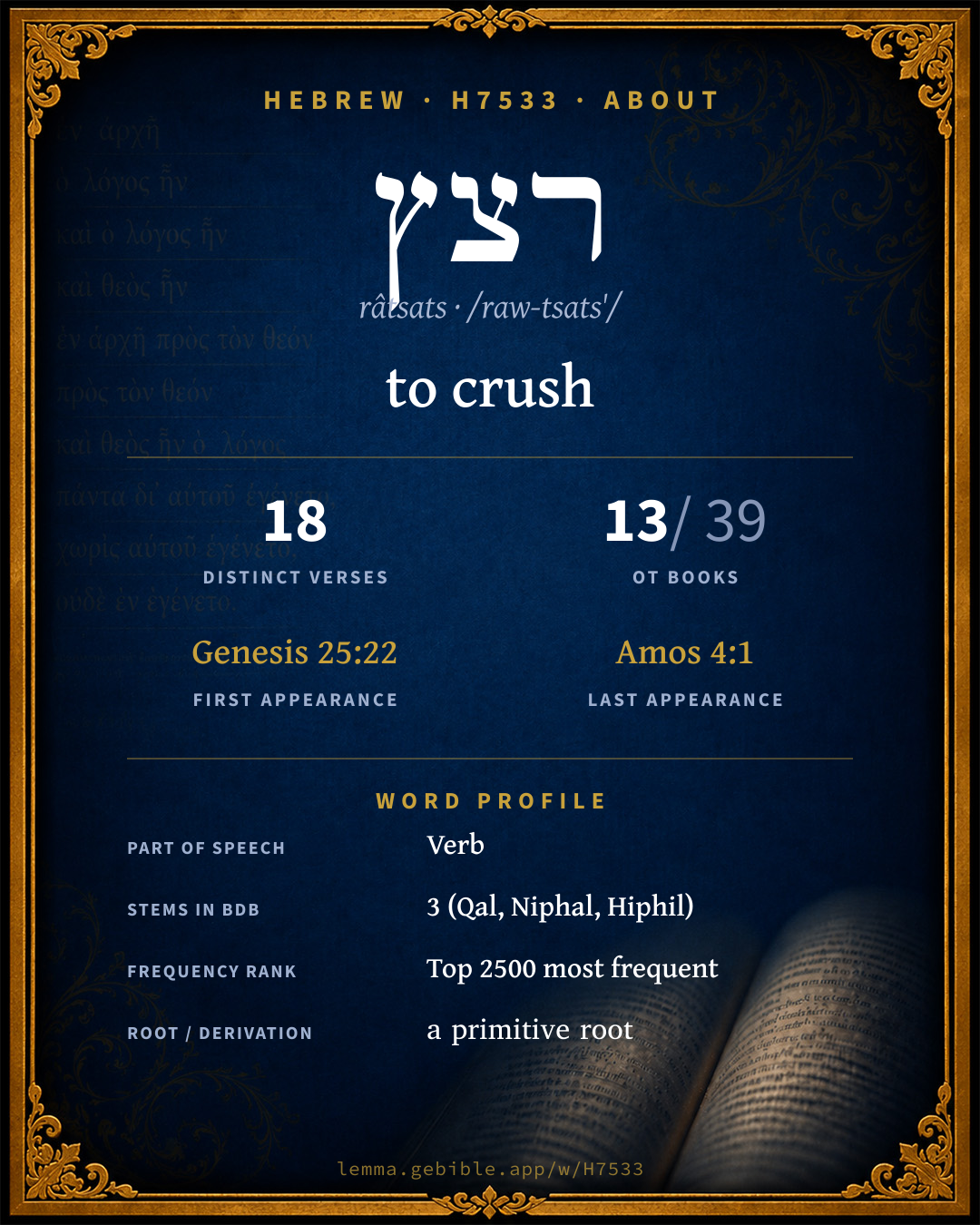
רָצַץ
to crush
‘to crush’ is one of 5 main senses fuller range ↓
Full lexicon entry — Brown-Driver-Briggs (BDB)
From Brown-Driver-Briggs (BDB)
Where this word appears
See every Qal verb in the Hebrew Bible →
Grammar key — what these labels mean
Part of speech
- Verb
- An action or state-of-being word.
Stem
- Qal
- The basic, simple active stem — the plain form of the verb (“he wrote”). Here: ‘lit.’
- Niphal
- Usually the simple passive or reflexive of the Qal (“he was written”). Here: ‘be crushed’
- Hiphil
- The causative active stem (“he caused / brought about”).
- Piel
- An intensive or resultative active stem.
- Hithpolel
- The reflexive counterpart of the Polel.
Form
- Participle Passive
- A verbal adjective expressing action received (“written”).
- Sequential Perfect
- A perfect with prefixed waw continuing a preceding imperfect or command (waw-consecutive perfect).
- Sequential Imperfect
- An imperfect with prefixed waw — the standard past-narrative form (waw-consecutive imperfect).
- Imperfect
- An incomplete, ongoing, or future action (“he will / would write”).
- Participle Active
- A verbal adjective expressing ongoing or characteristic action (“writing / one who writes”).
- Perfect
- A completed action or state — Hebrew marks aspect (completeness) more than strict tense (“he wrote”).
State
- Absolute
- The independent form of a noun, not bound to a following word.
- Construct
- A noun bound to a following noun in a possessive / “of” relationship (the construct chain).
Person
- 3rd Person
- The one spoken about (“he / she / it / they”).
- 2nd Person
- The one addressed (“you”).
- 1st Person
- The speaker (“I / we”).
Gender
- Masculine
- Grammatically masculine.
- Feminine
- Grammatically feminine.
- Common
- Either gender — not distinguished for this form.
Number
- Singular
- One.
- Plural
- More than one (in Hebrew, generally three or more).
Grammatical forms 16 distinct
- Verb, Qal, Participle Passive, Masculine, Singular, Absolute 4 times (21%)
- Verb, Niphal, Sequential Perfect, 3rd Person, Masculine, Singular 1 time (5%)
- Verb, Hiphil, Sequential Imperfect, 3rd Person, Feminine, Singular 1 time (5%)
- Verb, Poel, Sequential Imperfect, 3rd Person, Masculine, Plural 1 time (5%)
- Verb, Piel, Sequential Imperfect, 3rd Person, Masculine, Singular 1 time (5%)
- Verb, Qal, Imperfect, 3rd Person, Feminine, Singular 1 time (5%)
- Verb, Hithpolel, Sequential Imperfect, 3rd Person, Masculine, Plural 1 time (5%)
- Verb, Qal, Participle Active, Feminine, Plural, Absolute 1 time (5%)
+8 more forms (8 occurrences)
Parsed forms decoded from the imported morphology (morphhb / Westminster Leningrad Codex — WLC text public domain, morphhb tagging CC BY 4.0), counted across 19 parsed occurrences — not distinct verses.
Every verse where H7533 appears — 18 distinct verses across 13 books. Click any verse to open its interlinear word-by-word view. Verse text shown in the World English Bible for context — . Each verse’s Hebrew form is shown with its reference; the English is not keyword-highlighted, since the data carries no word-level English alignment. Use “Compare translations” on any verse to read it across multiple English versions. This concordance covers the Hebrew Bible; Septuagint (Greek Old Testament) occurrences are not indexed here.
Genesis 1 verse
Deuteronomy 1 verse
Judges 2 verses
- Judges 9:53 וַ/תָּ֖רִץ conj + Hiphil wimpf 3fs A certain woman cast an upper millstone on Abimelech's head, and broke his skull.
- Judges 10:8 וַ/יְרֹֽצְצוּ֙ conj + Poel wimpf 3mp They vexed and oppressed the children of Israel that year: eighteen years [oppressed they] all the children of Israel that were beyond the Jordan in the land of the Amorites, which is in Gilead.
1 Samuel 2 verses
- 1 Samuel 12:3 רַצּ֔וֹתִי Qal pf 1cs Here I am: witness against me before Yahweh, and before his anointed: whose ox have I taken? or whose donkey have I taken? or whom have I defrauded? whom have I oppressed? or of whose hand have I taken a ransom to blind my eyes therewith? and I will restore it you.
- 1 Samuel 12:4 רַצּוֹתָ֑/נוּ Qal pf 2ms + sfx pers 1cp They said, You have not defrauded us, nor oppressed us, neither have you taken anything of any man's hand.
2 Kings 1 verse
2 Chronicles 1 verse
Job 1 verse
Psalms 1 verse
Ecclesiastes 1 verse
Isaiah 4 verses
- Isaiah 36:6 הָ/רָצ֤וּץ ptcl def.art + Qal ptcp.pass ms Behold, you trust on the staff of this bruised reed, even on Egypt, whereon if a man lean, it will go into his hand, and pierce it: so is Pharaoh king of Egypt to all who trust on him.
- Isaiah 42:3 רָצוּץ֙ Qal ptcp.pass ms A bruised reed will he not break, and a dimly burning wick will he not quench: he will bring forth justice in truth.
- Isaiah 42:4 יָר֔וּץ Qal impf 3ms He will not fail nor be discouraged, until he have set justice in the earth; and the isles shall wait for his law.
- Isaiah 58:6 רְצוּצִים֙ Qal ptcp.pass mp Isn't this the fast that I have chosen: to loose the bonds of wickedness, to undo the bands of the yoke, and to let the oppressed go free, and that you break every yoke?
Ezekiel 1 verse
Hosea 1 verse
Amos 1 verse
About this entry
At a glance — auto-summarized from this page’s data, not written by a person. Every figure links to its source below. This summary describes the numbers; it doesn’t interpret them.
רצץ (râtsats) is a Hebrew verb most often rendered “to crush.” Debuting at Genesis 25:22, it then recurs through the corpus. The Hebrew Bible uses it across 18 verses — uncommon. As a verb its force shifts by stem, across 3 stems (Qal, Niphal, and more). Related forms include מרצה and רץ. For the data behind this summary, explore the sense tree and the renderings breakdown below.
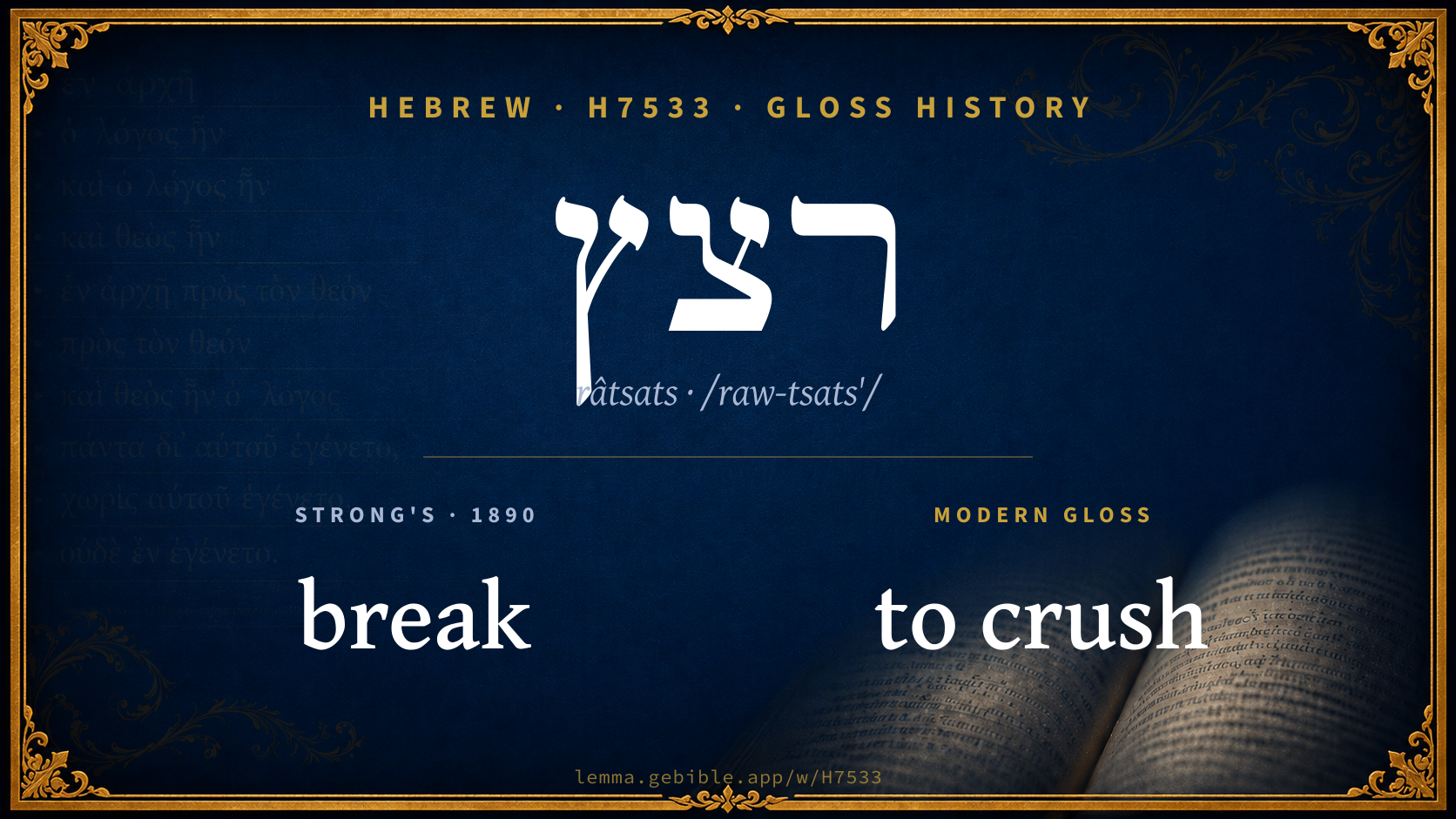
Gloss history
Strong's 1890 vs modern scholarship
About this word
Strong's H7533 catalogs a Hebrew word from the Hebrew Old Testament.
These counts are not copied from any lexicon or concordance. They are computed here, from the morphology-tagged Hebrew Old Testament. What Lemma adds →
- 18
- distinct verses
- The word appears in 18 distinct verses.
- 13 / 39
- OT books
- The word appears in 13 of 39 Old Testament books.
- #1,563
- by frequency
- Top 2500 most frequent Hebrew words (rank 1,563 of 8,640 Hebrew words by occurrence).
View all 18 occurrences in the concordance →
By section of the Old Testament
By traditional corpus
Conventional, traditional groupings — biblical authorship is debated, so this is a traditional corpus grouping, not an authorship claim. Each share is this word’s portion of its verses in that division of the Hebrew canon. Each figure is a share of the word’s 18 distinct verses.
- Prophets (Nevi'im) 12 verses · 67%
- Writings (Ketuvim) 4 verses · 22%
- Torah (Pentateuch) 2 verses · 11%
How translations render this word
Counts come from each version’s own published word-to-Strong’s tagging or interlinear alignment — an approximate guide to how each version renders this word, not a word-level alignment the data otherwise carries. Because each total is that version’s own tagged count, the per-version totals vary from one another and need not match the appearance or distinct-verse counts above. These counts may also differ from a printed concordance because Lemma counts each distinctly tagged rendering and does not collapse phrase taggings into a single head-word total. This is a fixed set of word-tagged versions (KJV, ASV, BSB, ULT) and does not change with the reading translation you choose elsewhere. Each version’s license is shown beside its name below (and on Sources).
- King James Version: Broken 3×, Oppressed 3×, Bruised 2×
- American Standard Version: Bruised 3×, Is broken 2×
- Berean Standard Bible: Crushed 3×, Oppressed 3×, Splintered 2×
- unfoldingWord Literal Text: Crushed 5×, And 4×, Broken 2×
King James Version Public Domain
Renders H7533 across 19 tagged occurrences — most commonly:
Plus 11 renderings that appear only once — usually multi-word phrases or single function words the recovered tagging swept in, not distinct renderings.
American Standard Version Public Domain
Renders H7533 across 19 tagged occurrences — most commonly:
Plus 14 renderings that appear only once — usually multi-word phrases or single function words the recovered tagging swept in, not distinct renderings.
Berean Standard Bible Public Domain
Renders H7533 across 19 tagged occurrences — most commonly:
Plus 11 renderings that appear only once — usually multi-word phrases or single function words the recovered tagging swept in, not distinct renderings.
unfoldingWord Literal Text CC BY-SA 4.0
Renders H7533 across 26 tagged occurrences — most commonly:
Plus 15 renderings that appear only once — usually multi-word phrases or single function words the recovered tagging swept in, not distinct renderings.
9 senses and sub-senses in the full BDB
Hebrew verbs can shift meaning by stem (binyan): Qal is the basic action, Niphal is often passive or reflexive, Piel often intensifies or makes it factitive, and Hiphil is typically causative. The senses below are grouped under the stem BDB assigns to each.
What do BDB’s symbols mean?
BDB uses these scholarly abbreviations:
| Symbol | Meaning |
|---|---|
| 𝔊 | the Septuagint (the ancient Greek translation, LXX) |
| 𝔙 | the Vulgate (the Latin translation) |
| 𝔖 | the Syriac version (the Peshitta) |
| 𝔗 | the Targum (the Aramaic translation) |
| ψ | the Psalms |
| √ | root (the underlying root or stem) |
| ‖ | parallel passage (a synonymous or contrasted parallel) |
| † | the dagger: every passage where the word occurs is cited |
The 9 senses and sub-senses the full Brown-Driver-Briggs lexicon distinguishes for this word, in lexicon order (not ranked by frequency), with BDB’s own verbatim wording and sub-sense lettering. Shown in Hebrew script with BDB’s own scholarly abbreviations. The condensed entry is in the Lexicon Entry tab. See also the Forms in the corpus table below.
Qal
- Pf. 2 ms. sf. רַצּוֹתָנוּ 1 S 12:4; 1 s. רַצּוֹתִי v 3; Impf. 3 ms. יָרוּץ (Ges§ 67 q) Is 42:4 (Cod. Bab. יֵרוֹץ, Niph., so SS here and Ec 12:6 a), 3 fs. תָּרוּץ Ec 12: 6 a, 1 s. אָרֻץ ψ 18:30 = אָרוּץ 2 S 22:30 (v. רוּץ); Pt. act. fpl. רֹצְצוֹת Am 4:1; pass. רָצוּץ Is 42:3 +, cstr. רְצוּץ Ho 5:11; pl. רְצוּצִים Is 58:6;—crush: e.g. 1 Samuel 12:4
- 1. lit.,
- a. pt. pass. in (הַ)קָּנֶה (הַ)רָצוּץ 2 K 18:21; = Is 36:6, Is 42:3 (all metaph. of weak pers.). e.g. 2 Kings 18:21
- b. impf. intrans.get crushed (read תֵּרוֹץ?), of bowl Ec 12:6 a (in metaph.). e.g. Ecclesiastes 12:6
- 2. fig. crush, oppress, acc. pers. 1 S 12:3, 4; Am 4:1; pt. pass. Dt 28:33, as subst. the oppressed Is 58:6; רְצוּץ מִשְׁפָּט Ho 5:11 (We Now רֹצֵץ, i.e. suppressing judgment, but dub.); intrans. get crushed (read יֵרוֹץ?), of servant of י׳, under fig. of wick, Is 42:4 (+ יִכְהֶה) he shall not grow dim or be crushed out. e.g. 1 Samuel 12:3
Niphal
- be crushed, broken: Pf. 3 ms. consec. וְנָרֹץ (Ges§ 67 t) Ec 12:6 b (of wheel at cistern); Impf. 2 ms. תֵּרוֹץ Ez 29:7 (of Pharaoh as reed, cf. Qal 1 a); Jb 20:10 read perhaps יֵרֹצּוּ (for יְרַצּוּ, v. רצה Pi.), are crushed (as) poor men, Bu, cf. Hoffm SS Gerber.—Is 42:4 Ec 12:6 a v. Qal. Pi. crush in pieces: e.g. Ecclesiastes 12:6
- 1. lit. (in metaph.) Pf. 2 ms. רִצַּצְתָּ ψ 74:14 c. acc. rei e.g. Psalms 74:14
- 2. fig. = grievously oppress, 3 ms. רִצַּץ Jb 20:19; Impf. 3 ms. וַיְרַצֵּץ מִן הָעָם 2 Ch 16:10. Pōʿēl Impf. 3 mpl. וַיְרֹצְצוּ Ju 10:8, acc. pers. (= Pi. 2; ‖ רעץ; רצץ here perhaps doublet, so GFMHpt, cf. Bu Now). e.g. Job 20:19
Hiphil
- Impf. 3 fs. וַתָּ֫רִץ (Köi. 352; BaZMG xliii (1889), 181 thinks Qal) Ju 9:53 she crushed his skull. Hithpōʿ. recipr., Impf. 3 mpl. וַיִּתְרֹצֲצוּ הַבָּנִים בְּקִרְבָּהּ (ץְ Gi) Gn 25:22 (J) the children crushed one another within her. e.g. Judges 9:53
Senses from the full Brown-Driver-Briggs lexicon (Brown, Driver, Briggs; Oxford 1906 — public domain), digitized via Sefaria, supplemented by the OpenScriptures HebrewLexicon (CC BY 4.0). Full attribution on Sources.
Word origin
vb. crush (NH = BH; Arabic رَضَّ bruise, bray, crush; Aramaic רְעַע, ܪܰܥ crush, shatter);—
— Brown-Driver-Briggs (Oxford 1906, public domain), digitized via Sefaria, supplemented by the OpenScriptures HebrewLexicon (CC BY 4.0). See Sources.
Origin: a primitive root
Jastrow Dictionary
A second Hebrew/Aramaic lexicon for comparison, covering Aramaic and post-biblical (Talmudic, Targumic, Midrashic) usage that the biblical-Hebrew BDB does not. Matched by lemma rather than by Strong’s number, so a lemma may carry more than one Jastrow headword (shown separately below), and the entries cover usage well beyond the Bible.
רָצַץ
- (b. h.) to press, squeeze, crush. Tanḥ. Ḥuck. 20 נכנסו … ורָצְצוּ וכ׳ the rocks were moved into the caves and crushed all those warriors; Num. R. s. 19. Cant. R. to I, 6 (play on רִצְפָּה, Is. VI, 6) רוֹץ פֶּה רְצוֹץ פה וכ׳ ritspah means rots peh, crush the mouth of him (Isaiah) who spoke ill of my children; Tanḥ. Vayishl. 2; Pesik. R. s. 33 רֹץ פה; Yalk. Num. 764; Yalk. Is. 273 רַצֵּץ (Pi.); Yalk. Kings 218 רצץ. Cant. R. l. c. (play on רְצָפִים I Kings XIX, 6) [read:] רץ פים רצוץ פיות וכ׳ crush the mouths of all who (like Elijah) speak ill of my children. Y. Ab. Zar. II, 40ᶜ bot. שלא יָרוֹץ את וכ׳ lest he (the gentile) break his (the Jew’s) skull. Y. Macc. II, beg. 31ᶜ והושיט … ורְצָצָהּ and a child put forth his hand (under the roller), and he crushed it. Bets. 34ᵃ רְצָצַתָּהּ בהמה a beast squeezed it (an animal, against a wall); Ḥull. III, 3 (56ᵃ) Ms. M. (ed. רִיצְּצַתָּהּ, Pi.). Ex. R. s. 3017 רָצְצוּ גפנים they crushed the vines; a. fr.—Gen. R. s. 63 (ref. to Gen. XXV, 22) שזה רַץ להרוג וכ׳ this one pressed to kill that one &c. Ib. עשו רץ ומפרכס וכ׳ Esau pressed and struggled to get out. e.g. Isaiah 6:6
- 1. same. Ḥull. l. c., v. supra. Y. Kidd. IV, end, 66ᶜ הטוב … רַצֵּץ את מוחו the best of the serpents—crush its brain. Yalk. Kings l. c.; Yalk. Is. l. c., v. supra. Midr. Till. to Ps. CXXXVII; Yalk. ib. 884 they put their thumbs into their mouths ומְרַצְּצִים אותם and crushed them (with their teeth); Pesik. R. s. 31 ומרצצים ומקצצים אותם crushed and bit them off; a. e.
- 2. to push, struggle. Midr. Till. to Ps. LVIII (ref. to ויתרצצו, Gen. XXV, 22) שהיה מְרַצֵּץ עם וכ׳ he (Esau) struggled with his brother in his mother’s womb. e.g. Genesis 25:22
- same,
- 1. to crush. Y. Yeb. I, 3ᵃ bot. הרי אתם … בשביל שיָרֵיצּוּ את מוחי you place my head between two high mountains …, that they may crush my brain (you want me to decide between two great authorities); Tosef. Ohol. XVIII, 18.
- 2. to press, rush in a crowd. Tanḥ. Balak 4; Num. R. s. 20 like the money-changer שהכל מְרִיצִּים לו to whom all rush (to have their coins examined).
- , Nithpol. נִתְרוֹצֵץ to press one another, struggle. Tanḥ. Vayḥi 15 כיון שנתְרוֹצְצוּ וכ׳ when the children struggled together within her.
רְצַץ
- Pa. רַצֵּץ same, to squeeze, crush. Targ. Lam. III, 16 רִיצֵּץ (Hebraism; h. text ויגרס). Targ. Y. II, Ex. XV, 6 (ed. Vien. מַרְצְצָא, Af.; h. text תרעץ).
A Dictionary of the Targumim, the Talmud Babli and Yerushalmi, and the Midrashic Literature (Marcus Jastrow; London, Luzac, 1903) — Public Domain. Digitized via Sefaria. Digitized via Sefaria. Full attribution on Sources.
Forms in the corpus
The 18 distinct written forms H7533 takes in the Hebrew Bible, most frequent first — each parse links to that stem’s occurrences in the concordance. Hebrew forms include their vowel points and cantillation, so a single lemma takes many written forms.
Same root — word family
Other BDB entries built from the same root as H7533, grouped by Strong’s listed origin. These share a root / origin per the lexicon — not necessarily a shared meaning. Each links to that word’s own entry.
Derived from this word
Compare all same-root words → They share a root, not necessarily a meaning.
Septuagint verse parallels
This word appears in 17 verses that also exist in the Greek Old Testament (Septuagint), out of the 18 Hebrew verses it occurs in. You can read those verses in Greek by switching the Old Testament edition to the Septuagint.
Read these verses in the Septuagint
- Genesis 25:22
- Deuteronomy 28:33
- Judges 9:53
- 1 Samuel 12:3
- 2 Kings 18:21
- 2 Chronicles 16:10
- Job 20:19
- Ecclesiastes 12:6
- Isaiah 36:6
- Ezekiel 29:7
- Hosea 5:11
- Amos 4:1
This is a verse-level parallel only — the same verses exist in both the Hebrew and Greek Old Testaments. No word-level Hebrew↔Greek correspondence is claimed: the data carries no such alignment, so no Greek word is shown as this Hebrew word’s translation. Coverage is not total — the Septuagint omits the deuterocanon and renumbers the Psalms, so some Hebrew verses have no direct Greek parallel.