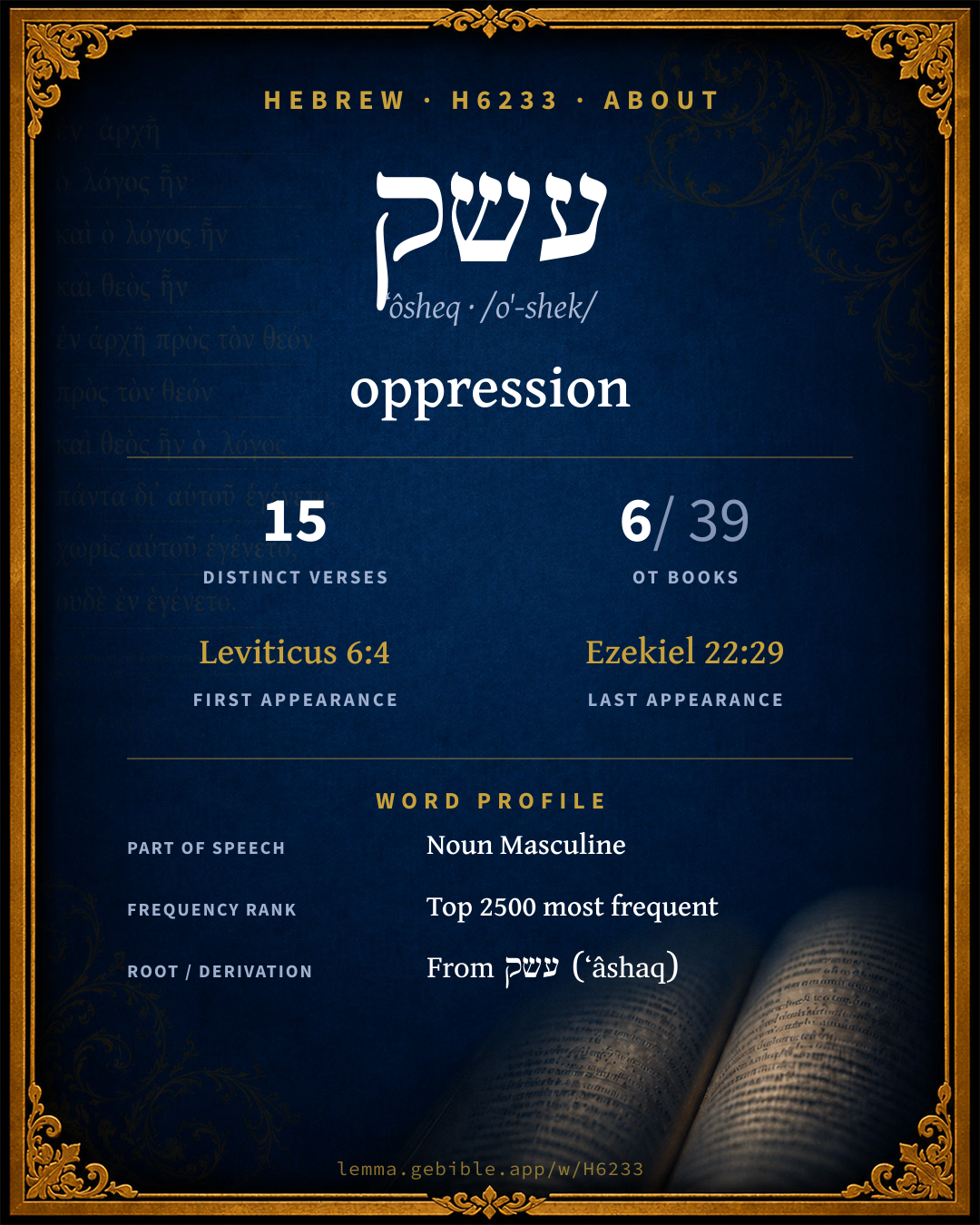
עֹ֫שֶׁק
oppression
also: extortion, injury fuller range ↓
Full lexicon entry — Brown-Driver-Briggs (BDB)
From Brown-Driver-Briggs (BDB)
Where this word appears
See every Absolute-state word in the Hebrew Bible →
Grammar key — what these labels mean
Part of speech
- Noun
- A naming word — a person, place, thing, or idea.
Noun type
- Common
- A common noun — a general class of person, place, or thing (“king,” “city,” “water”), not a specific name.
State
- Absolute
- The independent form of a noun, not bound to a following word.
- Construct
- A noun bound to a following noun in a possessive / “of” relationship (the construct chain).
Gender
- Masculine
- Grammatically masculine.
Number
- Singular
- One.
Grammatical forms
- Noun, Common, Masculine, Singular, Absolute 13 times (87%)
- Noun, Common, Masculine, Singular, Construct 2 times (13%)
Parsed forms decoded from the imported morphology (morphhb / Westminster Leningrad Codex — WLC text public domain, morphhb tagging CC BY 4.0), counted across 15 parsed occurrences — not distinct verses.
Every verse where H6233 appears — 15 distinct verses across 6 books. Click any verse to open its interlinear word-by-word view. Verse text shown in the World English Bible for context — . Each verse’s Hebrew form is shown with its reference; the English is not keyword-highlighted, since the data carries no word-level English alignment. Use “Compare translations” on any verse to read it across multiple English versions. This concordance covers the Hebrew Bible; Septuagint (Greek Old Testament) occurrences are not indexed here.
Leviticus 1 verse
Psalms 3 verses
- Psalms 62:10 בְ/עֹשֶׁק֮ prep + n c ms Don't trust in oppression. Don't become vain in robbery. If riches increase, Don't set your heart on them.
- Psalms 73:8 עֹ֑שֶׁק n c ms They scoff and speak with malice. In arrogance, they threaten oppression.
- Psalms 119:134 מֵ/עֹ֣שֶׁק prep + n c ms cs Redeem me from the oppression of man, So I will observe your precepts.
Ecclesiastes 2 verses
- Ecclesiastes 5:8 עֹ֣שֶׁק n c ms cs If you see the oppression of the poor, and the violent taking away of justice and righteousness in a district, don't marvel at the matter: for one official is eyed by a higher one; and there are officials over them.
- Ecclesiastes 7:7 הָ/עֹ֖שֶׁק ptcl def.art + n c ms Surely extortion makes the wise man foolish; and a bribe destroys the understanding.
Isaiah 3 verses
- Isaiah 30:12 בְּ/עֹ֣שֶׁק prep + n c ms Therefore thus says the Holy One of Israel, "Because you despise this word, and trust in oppression and perverseness, and rely thereon;
- Isaiah 54:14 מֵ/עֹ֨שֶׁק֙ prep + n c ms In righteousness shall you be established: you shall be far from oppression, for you shall not be afraid; and from terror, for it shall not come near you.
- Isaiah 59:13 עֹ֣שֶׁק n c ms transgressing and denying Yahweh, and turning away from following our God, speaking oppression and revolt, conceiving and uttering from the heart words of falsehood.
Jeremiah 2 verses
- Jeremiah 6:6 עֹ֥שֶׁק n c ms For thus has Yahweh of Hosts said, Hew you down trees, and cast up a mound against Jerusalem: this is the city to be visited; she is wholly oppression in the midst of her.
- Jeremiah 22:17 הָ/עֹ֥שֶׁק ptcl def.art + n c ms But your eyes and your heart are not but for your covetousness, and for shedding innocent blood, and for oppression, and for violence, to do it.
Ezekiel 4 verses
- Ezekiel 18:18 עֹ֗שֶׁק n c ms As for his father, because he cruelly oppressed, robbed his brother, and did that which is not good among his people, behold, he shall die in his iniquity.
- Ezekiel 22:7 בַ/עֹ֖שֶׁק prep det + n c ms In you have they set light by father and mother; in the midst of you have they dealt by oppression with the foreigner; in you have they wronged the fatherless and the widow.
- Ezekiel 22:12 בַּ/עֹ֔שֶׁק prep det + n c ms In you have they taken bribes to shed blood; you have taken interest and increase, and you have greedily gained of your neighbors by oppression, and have forgotten me, says the Lord Yahweh.
- Ezekiel 22:29 עֹ֔שֶׁק n c ms The people of the land have used oppression, and exercised robbery; yes, they have vexed the poor and needy, and have oppressed the foreigner wrongfully.
About this entry
At a glance — auto-summarized from this page’s data, not written by a person. Every figure links to its source below. This summary describes the numbers; it doesn’t interpret them.
The Hebrew noun עשק centers on the idea of “oppression.” Alongside “oppression” the lexicon also lists “extortion” and “injury” — part of its full sense range. It turns up in 15 verses across 6 books, an uncommon footprint. The word gravitates to Ezekiel (27%), then Psalms and Isaiah. Its earliest occurrence is Leviticus 6:4. Dig into 15-verse concordance and the renderings breakdown below.
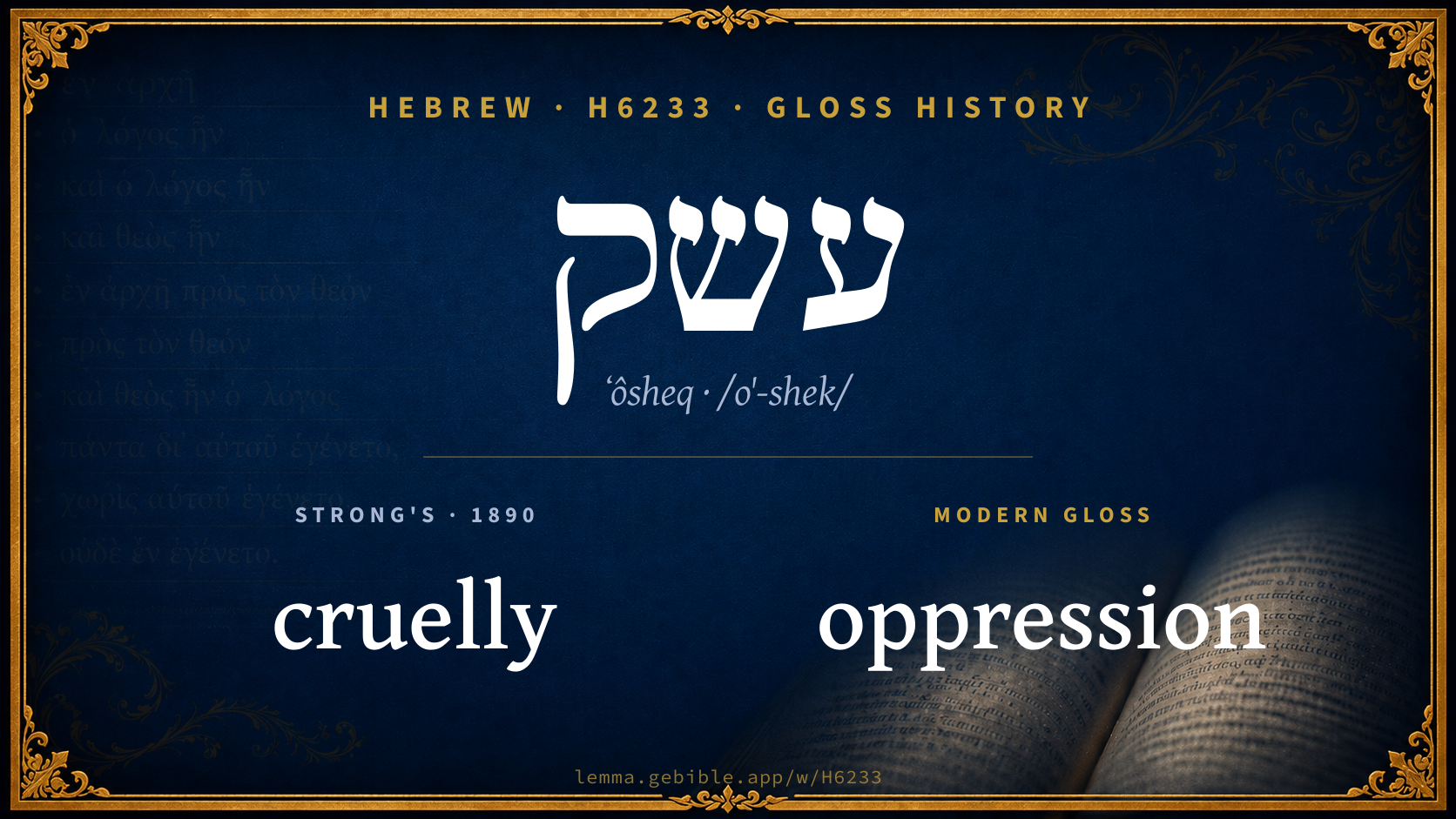
Gloss history
Strong's 1890 vs modern scholarship
About this word
Strong's H6233 catalogs a Hebrew word from the Hebrew Old Testament.
These counts are not copied from any lexicon or concordance. They are computed here, from the morphology-tagged Hebrew Old Testament. What Lemma adds →
- 15
- distinct verses
- The word appears in 15 distinct verses.
- 6 / 39
- OT books
- The word appears in 6 of 39 Old Testament books.
- #1,836
- by frequency
- Top 2500 most frequent Hebrew words (rank 1,836 of 8,640 Hebrew words by occurrence).
View all 15 occurrences in the concordance →
By section of the Old Testament
By traditional corpus
Conventional, traditional groupings — biblical authorship is debated, so this is a traditional corpus grouping, not an authorship claim. Each share is this word’s portion of its verses in that division of the Hebrew canon. Each figure is a share of the word’s 15 distinct verses.
- Prophets (Nevi'im) 9 verses · 60%
- Writings (Ketuvim) 5 verses · 33%
- Torah (Pentateuch) 1 verse · 7%
How translations render this word
Counts come from each version’s own published word-to-Strong’s tagging or interlinear alignment — an approximate guide to how each version renders this word, not a word-level alignment the data otherwise carries. Because each total is that version’s own tagged count, the per-version totals vary from one another and need not match the appearance or distinct-verse counts above. These counts may also differ from a printed concordance because Lemma counts each distinctly tagged rendering and does not collapse phrase taggings into a single head-word total. This is a fixed set of word-tagged versions (KJV, ASV, BSB, ULT) and does not change with the reading translation you choose elsewhere. Each version’s license is shown beside its name below (and on Sources).
- King James Version: Oppression 8×
- American Standard Version: Oppression 10×
- Berean Standard Bible: Oppression 7×, Extortion 5×
- unfoldingWord Literal Text: Oppression 7×, Extortion 2×
King James Version Public Domain
Renders H6233 across 14 tagged occurrences — most commonly:
Plus 6 renderings that appear only once — usually multi-word phrases or single function words the recovered tagging swept in, not distinct renderings. Not rendered by a distinct English word in 1 further occurrence.
American Standard Version Public Domain
Renders H6233 across 14 tagged occurrences — most commonly:
Plus 4 renderings that appear only once — usually multi-word phrases or single function words the recovered tagging swept in, not distinct renderings.
Berean Standard Bible Public Domain
Renders H6233 across 13 tagged occurrences — most commonly:
Plus 1 rendering that appears only once — usually multi-word phrases or single function words the recovered tagging swept in, not distinct renderings. Not rendered by a distinct English word in 2 further occurrences.
unfoldingWord Literal Text CC BY-SA 4.0
Renders H6233 across 15 tagged occurrences — most commonly:
Plus 6 renderings that appear only once — usually multi-word phrases or single function words the recovered tagging swept in, not distinct renderings.
Senses in the full BDB
What do BDB’s symbols mean?
BDB uses these scholarly abbreviations:
| Symbol | Meaning |
|---|---|
| 𝔊 | the Septuagint (the ancient Greek translation, LXX) |
| 𝔙 | the Vulgate (the Latin translation) |
| 𝔖 | the Syriac version (the Peshitta) |
| 𝔗 | the Targum (the Aramaic translation) |
| ψ | the Psalms |
| √ | root (the underlying root or stem) |
| ‖ | parallel passage (a synonymous or contrasted parallel) |
| † | the dagger: every passage where the word occurs is cited |
The 3 senses and sub-senses the full Brown-Driver-Briggs lexicon distinguishes for this word, in lexicon order (not ranked by frequency), with BDB’s own verbatim wording and sub-sense lettering. Shown in Hebrew script with BDB’s own scholarly abbreviations. The condensed entry is in the Lexicon Entry tab. See also the Forms in the corpus table below.
- 1. Je 6:6; 22:17; Ez 22:7, 12 ψ 73:8; c. genit. subj. 119:134, obj. Ec 5:7; as acc. cogn. c. עָשַׁק (q.v.) Ez 18:18; 22:29. e.g. Jeremiah 6:6
- 2. national oppression, Is 54:14. e.g. Isaiah 54:14
- 3. concr., gain of extortion ψ 62:11, so perhaps Ec 7:7; as acc. cogn. Lv 5:23 (‖ גָּזֵל).—Is 30:12; 59:13 read עִקֵּשׁ Lag Gr al. e.g. Psalms 62:11
Senses from the full Brown-Driver-Briggs lexicon (Brown, Driver, Briggs; Oxford 1906 — public domain), digitized via Sefaria, supplemented by the OpenScriptures HebrewLexicon (CC BY 4.0). Full attribution on Sources.
Word origin
n.m. Ec 7:7 oppression, extortion;—ע׳ abs. Je 6:6 +, cstr. ψ 119:134 Ec 5:7;—
— Brown-Driver-Briggs (Oxford 1906, public domain), digitized via Sefaria, supplemented by the OpenScriptures HebrewLexicon (CC BY 4.0). See Sources.
Derived from עשק (ʻâshaq) (H6231) — to oppress.
Jastrow Dictionary
A second Hebrew/Aramaic lexicon for comparison, covering Aramaic and post-biblical (Talmudic, Targumic, Midrashic) usage that the biblical-Hebrew BDB does not. Matched by lemma rather than by Strong’s number, so a lemma may carry more than one Jastrow headword (shown separately below), and the entries cover usage well beyond the Bible.
עוֹשֶׁק
- withholding what is due to one’s neighbor, oppression. Sifra K’dosh., ch. III, Par. 2 (ref. to Lev. XIX, 13) אף ע׳ דבר של ממון ‘osheḳ likewise (like גזל) refers to money matters (not to personal injury). B. Mets. 111ᵃ (interch. with עשק) לך ושוב … זהו ע׳ וכ׳ saying, go and come again (for thy wages &c.), that is ‘osheḳ; I have what is due to thee, but I will not give it thee, that is gazel (robbery). Ib. איזהו ע׳ שחייבה וכ׳ what withholding is it for which the Law requires a sacrifice (Lev. V, 21 sq.)? דכפר ליה ממונא when one denies owing money. Ib. זהו ע׳ זהו גזל ‘osheḳ and gazel are the same; Yalk. Lev. 605. B. Mets. 48ᵃ יחד לו כלי לעשקו he assigned to him an object (as security) for the wages withheld from him; Yalk. Lev. 479 לעושקו; a. fr. e.g. Leviticus 19:13
עָשַׁק
- (b. h.) [to press, twist,] to wrong, esp. to withhold what is due to a fellowman; to deny a debt. B. Mets. 111ᵃ (ref. to Lev. V, 21) או עשק כתיב שעֲשָׁקוֹ כבר we read, ‘or if he have withheld’, which means that he had wronged him ere this (when he denied his indebtedness). Koh. R. to IV, 6 טוב … גוזל וחומס ועוֹשֵׁק ועושה וכ׳ better is he who does a little good with what is his own, than he who robs and does violence and oppresses, and does much good with what belongs to others. Succ. 29ᵇ עוֹשְׁקֵי שכר שכיר those who withhold the hired man’s wages, different from כובשי וכ׳ (v. כָּבַשׁ) who defer paying &c.; a. e. e.g. Leviticus 5:21
עֲשַׁק
- 1. same. Targ. O. Lev. V, 21 עשק ed. Berl. (oth. ed. אנס). Ib. 23. Targ. Am. IV, 1; a. fr.—Part. pass. עָשִׁיק.
- 2. to pervert, v. עָשִׁיק I. I.
- 3. (cmp. יקר) to be outrageously dear, v. עָשִׁיק II.
עשֶׁק
- , v. עוֹשֶׁק, עוּשְׁקָא.
A Dictionary of the Targumim, the Talmud Babli and Yerushalmi, and the Midrashic Literature (Marcus Jastrow; London, Luzac, 1903) — Public Domain. Digitized via Sefaria. Digitized via Sefaria. Full attribution on Sources.
Forms in the corpus
The 14 distinct written forms H6233 takes in the Hebrew Bible, most frequent first — each parse links to that state’s occurrences in the concordance. Hebrew forms include their vowel points and cantillation, so a single lemma takes many written forms.
Same root — word family
Other BDB entries built from the same root as H6233, grouped by Strong’s listed origin. These share a root / origin per the lexicon — not necessarily a shared meaning. Each links to that word’s own entry.
Derives from
Shares the same root
- מעשקה maʻăshaqqâh H4642 extortion
- עשוק ʻâshôwq H6216 oppressor
- עשוק ʻâshûwq H6217 oppression
- עשק ʻâsaq H6229 to quarrel
Derived from this word
Proper names from this root
People and places named from this root — a name, not an additional meaning of the word.
Compare all same-root words → Showing 4 of 8 — not the complete family. 1 of the same-root words is a proper name (a person or place). They share a root, not necessarily a meaning.
Septuagint verse parallels
This word appears in 14 verses that also exist in the Greek Old Testament (Septuagint), out of the 15 Hebrew verses it occurs in. You can read those verses in Greek by switching the Old Testament edition to the Septuagint.
Read these verses in the Septuagint
This is a verse-level parallel only — the same verses exist in both the Hebrew and Greek Old Testaments. No word-level Hebrew↔Greek correspondence is claimed: the data carries no such alignment, so no Greek word is shown as this Hebrew word’s translation. Coverage is not total — the Septuagint omits the deuterocanon and renumbers the Psalms, so some Hebrew verses have no direct Greek parallel.