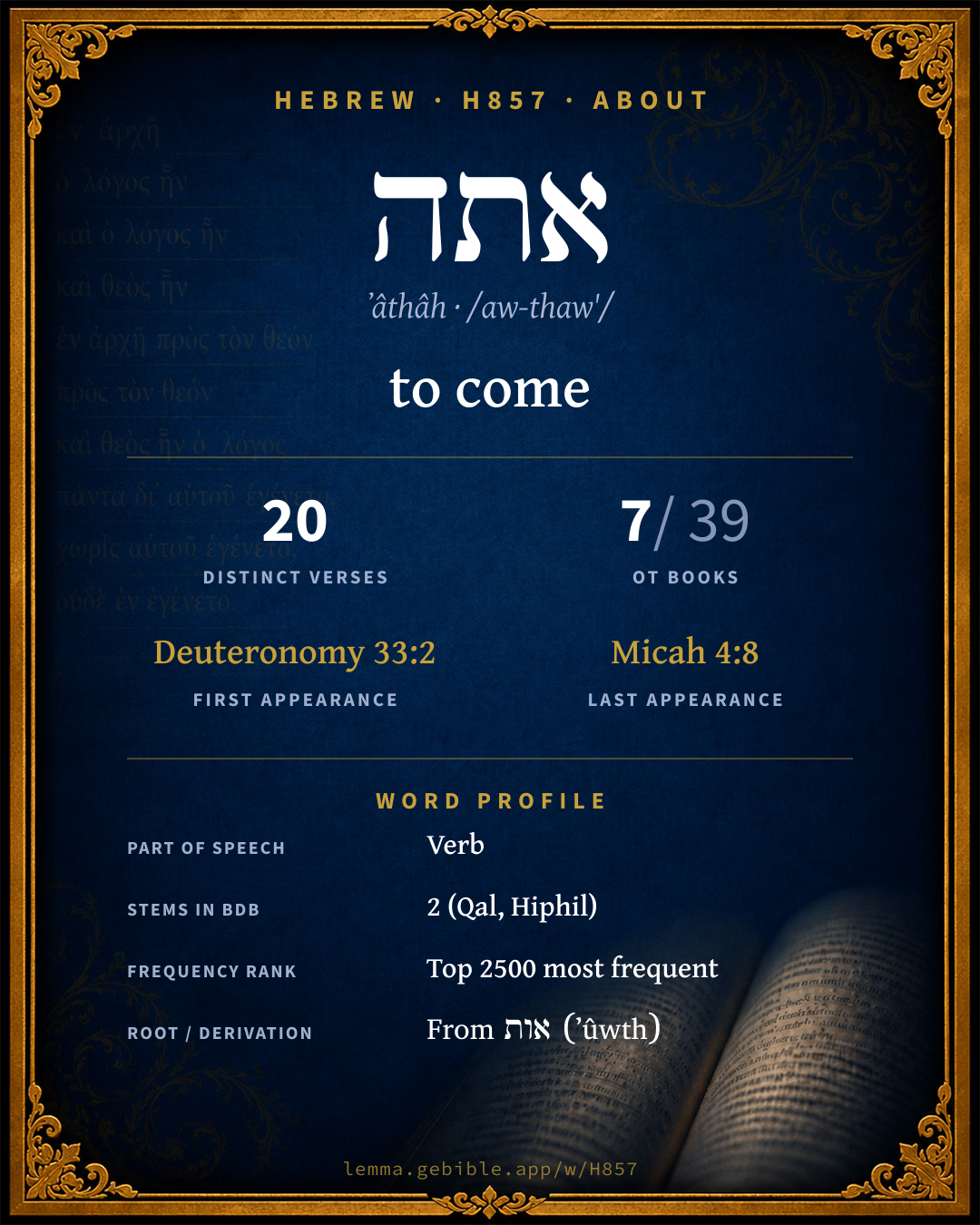
אָתָה
to come
‘to come’ is one of 3 main senses fuller range ↓
Full lexicon entry — Brown-Driver-Briggs (BDB)
From Brown-Driver-Briggs (BDB)
Where this word appears
See every Qal verb in the Hebrew Bible →
Grammar key — what these labels mean
Part of speech
- Verb
- An action or state-of-being word.
Stem
- Qal
- The basic, simple active stem — the plain form of the verb (“he wrote”).
- Hiphil
- The causative active stem (“he caused / brought about”). Here: ‘bring’
Form
- Imperfect
- An incomplete, ongoing, or future action (“he will / would write”).
- Imperative
- A direct command (“write!”).
- Sequential Imperfect
- An imperfect with prefixed waw — the standard past-narrative form (waw-consecutive imperfect).
- Participle Active
- A verbal adjective expressing ongoing or characteristic action (“writing / one who writes”).
- Sequential Perfect
- A perfect with prefixed waw continuing a preceding imperfect or command (waw-consecutive perfect).
- Perfect
- A completed action or state — Hebrew marks aspect (completeness) more than strict tense (“he wrote”).
State
- Absolute
- The independent form of a noun, not bound to a following word.
Person
- 3rd Person
- The one spoken about (“he / she / it / they”).
- 2nd Person
- The one addressed (“you”).
- 1st Person
- The speaker (“I / we”).
Gender
- Masculine
- Grammatically masculine.
- Feminine
- Grammatically feminine.
- Common
- Either gender — not distinguished for this form.
Number
- Plural
- More than one (in Hebrew, generally three or more).
- Singular
- One.
Grammatical forms 11 distinct
- Verb, Qal, Imperfect, 3rd Person, Masculine, Plural 3 times (14%)
- Verb, Qal, Imperative, 2nd Person, Masculine, Plural 3 times (14%)
- Verb, Qal, Sequential Imperfect, 3rd Person, Masculine, Singular 3 times (14%)
- Verb, Qal, Participle Active, Feminine, Plural, Absolute 3 times (14%)
- Verb, Hiphil, Imperative, 2nd Person, Masculine, Plural 2 times (10%)
- Verb, Qal, Imperfect, 3rd Person, Masculine, Singular 2 times (10%)
- Verb, Qal, Sequential Perfect, 3rd Person, Masculine, Singular 1 time (5%)
- Verb, Qal, Sequential Imperfect, 3rd Person, Masculine, Plural 1 time (5%)
+3 more forms (3 occurrences)
Parsed forms decoded from the imported morphology (morphhb / Westminster Leningrad Codex — WLC text public domain, morphhb tagging CC BY 4.0), counted across 21 parsed occurrences — not distinct verses.
Every verse where H857 appears — 20 distinct verses across 7 books. Click any verse to open its interlinear word-by-word view. Verse text shown in the World English Bible for context — . Each verse’s Hebrew form is shown with its reference; the English is not keyword-highlighted, since the data carries no word-level English alignment. Use “Compare translations” on any verse to read it across multiple English versions. This concordance covers the Hebrew Bible; Septuagint (Greek Old Testament) occurrences are not indexed here.
Deuteronomy 2 verses
- Deuteronomy 33:2 וְ/אָתָ֖ה conj + Qal wpf 3ms He said, Yahweh came from Sinai, Rose from Seir to them; He shined forth from Mount Paran, He came from the ten thousands of holy ones: At his right hand was a fiery law for them.
- Deuteronomy 33:21 וַ/יֵּתֵא֙ conj + Qal wimpf 3ms He provided the first part for himself, For there was the lawgiver's portion reserved; He came [with] the heads of the people; He executed the righteousness of Yahweh, His ordinances with Israel.
Job 4 verses
- Job 3:25 וַ/יֶּאֱתָיֵ֑/נִי conj + Qal wimpf 3ms + sfx pers 1cs For the thing which I fear comes on me, That which I am afraid of comes to me.
- Job 16:22 יֶאֱתָ֑יוּ Qal impf 3mp For when a few years are come, I shall go the way from whence I shall not return.
- Job 30:14 יֶאֱתָ֑יוּ Qal impf 3mp As through a wide breach they come, In the midst of the ruin they roll themselves in.
- Job 37:22 יֶֽאֱתֶ֑ה Qal impf 3ms Out of the north comes golden splendor; With God is awesome majesty.
Psalms 1 verse
Proverbs 1 verse
Isaiah 9 verses
- Isaiah 21:12 אָתָ֥ה אֵתָֽיוּ Qal pf 3ms Qal impv 2mp The watchman said, "The morning comes, and also the night. If you will inquire, inquire. Come back again."
- Isaiah 21:14 הֵתָ֣יוּ Hiphil impv 2mp To him who was thirsty they brought water; the inhabitants of the land of Tema did meet the fugitives with their bread.
- Isaiah 41:5 וַ/יֶּאֱתָיֽוּ/ן conj + Qal wimpf 3mp + sfx n The isles have seen, and fear; the ends of the earth tremble; they draw near, and come.
- Isaiah 41:23 הָ/אֹתִיּ֣וֹת ptcl def.art + Qal ptcp.act fp Declare the things that are to come hereafter, that we may know that you are gods: yes, do good, or do evil, that we may be dismayed, and see it together.
- Isaiah 41:25 וַ/יַּ֔את conj + Qal wimpf 3ms I have raised up one from the north, and he has come; from the rising of the sun one who calls on my name: and he shall come on rulers as on mortar, and as the potter treads clay.
- Isaiah 44:7 וְ/אֹתִיּ֛וֹת conj + Qal ptcp.act fp Who, as I, shall call, and shall declare it, and set it in order for me, since I established the ancient people? and the things that are coming, and that shall happen, let them declare.
- Isaiah 45:11 הָ/אֹתִיּ֣וֹת ptcl def.art + Qal ptcp.act fp Thus says Yahweh, the Holy One of Israel, and his Maker: Ask me of the things that are to come; concerning my sons, and concerning the work of my hands, command you me.
- Isaiah 56:9 אֵתָ֕יוּ Qal impv 2mp All you animals of the field, come to devour, [yes], all you animals in the forest.
- Isaiah 56:12 אֵתָ֥יוּ Qal impv 2mp Come you, [say they], I will get wine, and we will fill ourselves with strong drink; and tomorrow shall be as this day, [a day] great beyond measure.
Jeremiah 2 verses
- Jeremiah 3:22 אָתָ֣נוּ Qal pf 1cp Return, you backsliding children, I will heal your backsliding. Behold, we are come to you; for you are Yahweh our God.
- Jeremiah 12:9 הֵתָ֥יוּ Hiphil impv 2mp Is my heritage to me as a speckled bird of prey? are the birds of prey against her round about? go you, assemble all the animals of the field, bring them to devour.
Micah 1 verse
About this entry
At a glance — auto-summarized from this page’s data, not written by a person. Every figure links to its source below. This summary describes the numbers; it doesn’t interpret them.
אתה (ʼâthâh) is a Hebrew verb most often rendered “to come.” Debuting at Deuteronomy 33:2, it then recurs through the corpus. The Hebrew Bible uses it across 20 verses — uncommon. Isaiah dominates its distribution — 9 of 20 verses. The verb spans 2 stems, from Qal to Hiphil. The sections below give every sense, occurrence, and version rendering.
Gloss history
Strong's 1890 vs modern scholarship
About this word
Strong's H857 catalogs a Hebrew word from the Hebrew Old Testament.
These counts are not copied from any lexicon or concordance. They are computed here, from the morphology-tagged Hebrew Old Testament. What Lemma adds →
- 20
- distinct verses
- The word appears in 20 distinct verses.
- 7 / 39
- OT books
- The word appears in 7 of 39 Old Testament books.
- #1,462
- by frequency
- Top 2500 most frequent Hebrew words (rank 1,462 of 8,640 Hebrew words by occurrence).
View all 20 occurrences in the concordance →
Most concentrated in
- Isaiah 9 verses 45%
- Job 4 verses 20%
- Deuteronomy 2 verses 10%
By section of the Old Testament
By traditional corpus
Conventional, traditional groupings — biblical authorship is debated, so this is a traditional corpus grouping, not an authorship claim. Each share is this word’s portion of its verses in that division of the Hebrew canon. Each figure is a share of the word’s 20 distinct verses.
- Prophets (Nevi'im) 12 verses · 60%
- Writings (Ketuvim) 6 verses · 30%
- Torah (Pentateuch) 2 verses · 10%
How translations render this word
Counts come from each version’s own published word-to-Strong’s tagging or interlinear alignment — an approximate guide to how each version renders this word, not a word-level alignment the data otherwise carries. Because each total is that version’s own tagged count, the per-version totals vary from one another and need not match the appearance or distinct-verse counts above. These counts may also differ from a printed concordance because Lemma counts each distinctly tagged rendering and does not collapse phrase taggings into a single head-word total. This is a fixed set of word-tagged versions (KJV, ASV, BSB, ULT) and does not change with the reading translation you choose elsewhere. Each version’s license is shown beside its name below (and on Sources).
- King James Version: Come 4×, Cometh 3×, He came 2×
- American Standard Version: Cometh 4×, Come 3×, He came 2×
- Berean Standard Bible: Come 2×
- unfoldingWord Literal Text: Come 4×, Comes 2×, Will come 2×
King James Version Public Domain
Renders H857 across 21 tagged occurrences — most commonly:
Plus 12 renderings that appear only once — usually multi-word phrases or single function words the recovered tagging swept in, not distinct renderings.
American Standard Version Public Domain
Renders H857 across 21 tagged occurrences — most commonly:
Plus 10 renderings that appear only once — usually multi-word phrases or single function words the recovered tagging swept in, not distinct renderings.
Berean Standard Bible Public Domain
Renders H857 across 20 tagged occurrences — most commonly:
Plus 18 renderings that appear only once — usually multi-word phrases or single function words the recovered tagging swept in, not distinct renderings. Not rendered by a distinct English word in 1 further occurrence.
unfoldingWord Literal Text CC BY-SA 4.0
Renders H857 across 22 tagged occurrences — most commonly:
Plus 14 renderings that appear only once — usually multi-word phrases or single function words the recovered tagging swept in, not distinct renderings.
Senses in the full BDB
Hebrew verbs can shift meaning by stem (binyan): Qal is the basic action, Niphal is often passive or reflexive, Piel often intensifies or makes it factitive, and Hiphil is typically causative. The senses below are grouped under the stem BDB assigns to each.
What do BDB’s symbols mean?
BDB uses these scholarly abbreviations:
| Symbol | Meaning |
|---|---|
| 𝔊 | the Septuagint (the ancient Greek translation, LXX) |
| 𝔙 | the Vulgate (the Latin translation) |
| 𝔖 | the Syriac version (the Peshitta) |
| 𝔗 | the Targum (the Aramaic translation) |
| ψ | the Psalms |
| √ | root (the underlying root or stem) |
| ‖ | parallel passage (a synonymous or contrasted parallel) |
| † | the dagger: every passage where the word occurs is cited |
The 2 senses and sub-senses the full Brown-Driver-Briggs lexicon distinguishes for this word, in lexicon order (not ranked by frequency), with BDB’s own verbatim wording and sub-sense lettering. Shown in Hebrew script with BDB’s own scholarly abbreviations. The condensed entry is in the Lexicon Entry tab. See also the Forms in the corpus table below.
Qal
- Pf. א׳ Dt 33:2; אָתָא Is 21:12 v. Ges§ 75 R. 22; 1 pl. אָתָנוּ Je 3:22; Impf. יֶאֱתֶה Jb 37:22 Pr 1:27; וַיֵּתֵא Dt 33:21 (= וַיֶּאֱתֶה cf. Di Köi. 577), וַיַּאת Is 41:25; sf. וַיֶּאֱתָיֵנִי Jb 3:25; 3 fs. תֵּאתֶה Mi 4:8; 3 mpl. יֶאֱתָ֫יוּ Jb 16:22 + 2 times; וַיֶּאֱתָיוּ֑ן Is 41:5; Imv. mpl. אֵתָ֫יוּ Is 21:12 + 2 times; Pt. fpl. אֹתִיּוֹת Is 41:23 + 2 times;—come, of men Dt 33:21 ψ 68:32 Is 41:25; 56:12 Imv. = come now, with hostile purpose Jb 30:14, of men unto י׳ Je 3:22 (sq. לְ) cf. Is 21:12; of י׳ Dt 33:2; of ends of earth, etc., personif. Is 41:5; of time, morning Is 21:12, years Jb 16:22; of weather Jb 37:22; of beasts, to devour Is 56:9 (sq. inf.), of calamity Pr 1:27 Jb 3:25 come upon, c. sf., of dominion Mi 4:8 (sq. עַד). Pt. pl. fem. as subst. things to come, future things Is 41:23; 44:7; 45:11. e.g. Deuteronomy 33:2
Hiphil
- bring, Imv. הֵתָ֫יוּ מַיִם Is 21:14 bring water (on form, for הֶאֱתוּ cf. Di Ew§ 141 a Ges§ 68, 2 R. 1, § 76. 2 (c1)); Je 12:9 bring beasts, to devour. e.g. Isaiah 21:14
Senses from the full Brown-Driver-Briggs lexicon (Brown, Driver, Briggs; Oxford 1906 — public domain), digitized via Sefaria, supplemented by the OpenScriptures HebrewLexicon (CC BY 4.0). Full attribution on Sources.
Word origin
vb. come (in Heb. only poet.) (Arabic أَتَى, Sab. אתו DHMZMG 1875, 597; 1883, 343, Aramaic אֲתָא, ܐܶܬܳܐ )—
— Brown-Driver-Briggs (Oxford 1906, public domain), digitized via Sefaria, supplemented by the OpenScriptures HebrewLexicon (CC BY 4.0). See Sources.
Derived from אות (ʼûwth) (H225) — to agree.
Jastrow Dictionary
A second Hebrew/Aramaic lexicon for comparison, covering Aramaic and post-biblical (Talmudic, Targumic, Midrashic) usage that the biblical-Hebrew BDB does not. Matched by lemma rather than by Strong’s number, so a lemma may carry more than one Jastrow headword (shown separately below), and the entries cover usage well beyond the Bible.
אַתָּה
- ,, v. אָנֹכִי) thou. Ber. 11ᵃ; a. fr.—אתה אומר, v. אַתְּ.—Pl. אַתֶּם, אַתֶּן ye. Ber. I, 1; a. fr.—R. Hash. 25ᵃ א׳ א׳ א׳ ג׳ פעמים וכ׳ three times attem is written (אֹתָם, without ו); v. אֲפִילּוּ. Sifra Emor IX, 9; a. fr.
A Dictionary of the Targumim, the Talmud Babli and Yerushalmi, and the Midrashic Literature (Marcus Jastrow; London, Luzac, 1903) — Public Domain. Digitized via Sefaria. Digitized via Sefaria. Full attribution on Sources.
Forms in the corpus
The 19 distinct written forms H857 takes in the Hebrew Bible, most frequent first — each parse links to that stem’s occurrences in the concordance. Hebrew forms include their vowel points and cantillation, so a single lemma takes many written forms.
Same root — word family
Other BDB entries built from the same root as H857, grouped by Strong’s listed origin. These share a root / origin per the lexicon — not necessarily a shared meaning. Each links to that word’s own entry.
Derives from
Shares the same root
Derived from this word
Compare all same-root words → Showing 4 of 5 — not the complete family. They share a root, not necessarily a meaning.
Septuagint verse parallels
This word appears in 19 verses that also exist in the Greek Old Testament (Septuagint), out of the 20 Hebrew verses it occurs in. You can read those verses in Greek by switching the Old Testament edition to the Septuagint.
Read these verses in the Septuagint
This is a verse-level parallel only — the same verses exist in both the Hebrew and Greek Old Testaments. No word-level Hebrew↔Greek correspondence is claimed: the data carries no such alignment, so no Greek word is shown as this Hebrew word’s translation. Coverage is not total — the Septuagint omits the deuterocanon and renumbers the Psalms, so some Hebrew verses have no direct Greek parallel.