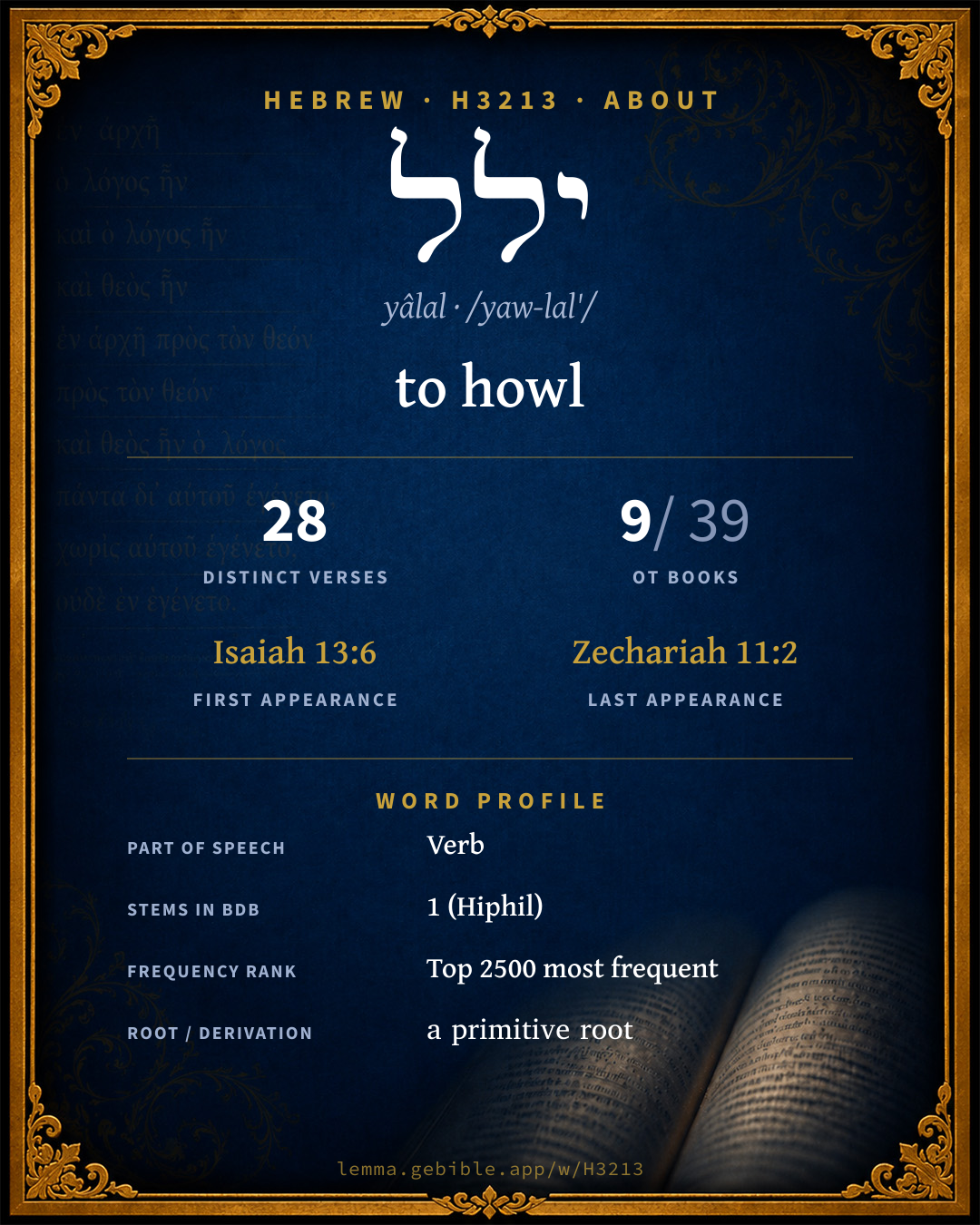
יָלַל
to howl
Full lexicon entry — Brown-Driver-Briggs (BDB)
From Brown-Driver-Briggs (BDB)
Where this word appears
Grammar key — what these labels mean
Part of speech
- Verb
- An action or state-of-being word.
Stem
- Hiphil
- The causative active stem (“he caused / brought about”).
Form
- Imperative
- A direct command (“write!”).
- Imperfect
- An incomplete, ongoing, or future action (“he will / would write”).
- Cohortative
- A first-person volitional form expressing wish or resolve (“let me / let us write”).
- Sequential Perfect
- A perfect with prefixed waw continuing a preceding imperfect or command (waw-consecutive perfect).
- Perfect
- A completed action or state — Hebrew marks aspect (completeness) more than strict tense (“he wrote”).
Person
- 2nd Person
- The one addressed (“you”).
- 3rd Person
- The one spoken about (“he / she / it / they”).
- 1st Person
- The speaker (“I / we”).
Gender
- Masculine
- Grammatically masculine.
- Feminine
- Grammatically feminine.
- Common
- Either gender — not distinguished for this form.
Number
- Plural
- More than one (in Hebrew, generally three or more).
- Singular
- One.
Grammatical forms 11 distinct
- Verb, Hiphil, Imperative, 2nd Person, Masculine, Plural 14 times (45%)
- Verb, Hiphil, Imperfect, 3rd Person, Masculine, Singular 4 times (13%)
- Verb, Hiphil, Imperative, 2nd Person, Feminine, Singular 3 times (10%)
- Verb, Hiphil, Imperfect, 3rd Person, Masculine, Plural 2 times (6%)
- Verb, Hiphil, Imperative, 2nd Person, Masculine, Singular 2 times (6%)
- Verb, Hiphil, Cohortative, 1st Person, Common, Singular 1 time (3%)
- Verb, Hiphil, Sequential Perfect, 3rd Person, Common, Plural 1 time (3%)
- Verb, Hiphil, Sequential Perfect, 3rd Person, Masculine, Singular 1 time (3%)
+3 more forms (3 occurrences)
Parsed forms decoded from the imported morphology (morphhb / Westminster Leningrad Codex — WLC text public domain, morphhb tagging CC BY 4.0), counted across 31 parsed occurrences — not distinct verses.
Every verse where H3213 appears — 28 distinct verses across 9 books. Click any verse to open its interlinear word-by-word view. Verse text shown in the World English Bible for context — . Each verse’s Hebrew form is shown with its reference; the English is not keyword-highlighted, since the data carries no word-level English alignment. Use “Compare translations” on any verse to read it across multiple English versions. This concordance covers the Hebrew Bible; Septuagint (Greek Old Testament) occurrences are not indexed here.
Isaiah 10 verses
- Isaiah 13:6 הֵילִ֕ילוּ Hiphil impv 2mp Wail; for the day of Yahweh is at hand; as destruction from the Almighty shall it come.
- Isaiah 14:31 הֵילִ֤ילִֽי Hiphil impv 2fs Howl, gate; cry, city; you are melted away, Philistia, all of you; for there comes a smoke out of the north, and there is no straggler in his ranks.
- Isaiah 15:2 יְיֵלִ֔יל Hiphil impf 3ms They are gone up to Bayith, and to Dibon, to the high places, to weep: Moab wails over Nebo, and over Medeba; on all their heads is baldness, every beard is cut off.
- Isaiah 15:3 יְיֵלִ֖יל Hiphil impf 3ms In their streets they gird themselves with sackcloth; on their housetops, and in their broad places, everyone wails, weeping abundantly.
- Isaiah 16:7 יְיֵלִ֥יל יְיֵלִ֑יל Hiphil impf 3ms Hiphil impf 3ms Therefore shall Moab wail for Moab, everyone shall wail: for the raisin-cakes of Kir Hareseth shall you mourn, utterly stricken.
- Isaiah 23:1 הֵילִ֣ילוּ Hiphil impv 2mp The burden of Tyre. Howl, you ships of Tarshish; for it is laid waste, so that there is no house, no entering in: from the land of Kittim it is revealed to them.
- Isaiah 23:6 הֵילִ֖ילוּ Hiphil impv 2mp Pass over to Tarshish; wail, you inhabitants of the coast.
- Isaiah 23:14 הֵילִ֖ילוּ Hiphil impv 2mp Howl, you ships of Tarshish; for your stronghold is laid waste.
- Isaiah 52:5 יְהֵילִ֨ילוּ֙ Hiphil impf 3mp Now therefore, what do I here, says Yahweh, seeing that my people is taken away for nothing? those who rule over them do howl, says Yahweh, and my name continually all the day is blasphemed.
- Isaiah 65:14 תְּיֵלִֽילוּ Hiphil impf 2mp behold, my servants shall sing for joy of heart, but you shall cry for sorrow of heart, and shall wail for vexation of spirit.
Jeremiah 8 verses
- Jeremiah 4:8 וְ/הֵילִ֑ילוּ conj + Hiphil impv 2mp For this gird you with sackcloth, lament and wail; for the fierce anger of Yahweh hasn't turned back from us.
- Jeremiah 25:34 הֵילִ֨ילוּ Hiphil impv 2mp Wail, you shepherds, and cry; and wallow [in ashes], you principal of the flock; for the days of your slaughter and of your dispersions are fully come, and you shall fall like a goodly vessel.
- Jeremiah 47:2 וְ/הֵילִ֕ל conj + Hiphil wpf 3ms Thus says Yahweh: Behold, waters rise up out of the north, and shall become an overflowing stream, and shall overflow the land and all that is therein, the city and those who dwell therein; and the men shall cry, and all the inhabitants of the land shall wail.
- Jeremiah 48:20 הילילי הֵילִ֣ילוּ Hiphil impv 2fs Hiphil impv 2mp Moab is disappointed; for it is broken down: wail and cry; tell you it by the Arnon, that Moab is laid waste.
- Jeremiah 48:31 אֲיֵלִ֔יל Hiphil impf 1cs Therefore will I wail for Moab; yes, I will cry out for all Moab: for the men of Kir Heres shall they mourn.
- Jeremiah 48:39 הֵילִ֔ילוּ Hiphil pf 3cp How is it broken down! [how] do they wail! how has Moab turned the back with shame! so shall Moab become a derision and a terror to all who are round about him.
- Jeremiah 49:3 הֵילִ֨ילִי Hiphil impv 2fs Wail, Heshbon, for Ai is laid waste; cry, you daughters of Rabbah, gird you with sackcloth: lament, and run back and forth among the fences; for Malcam shall go into captivity, his priests and his princes together.
- Jeremiah 51:8 הֵילִ֣ילוּ Hiphil impv 2mp Babylon is suddenly fallen and destroyed: wail for her; take balm for her pain, if so be she may be healed.
Ezekiel 2 verses
- Ezekiel 21:12 וְ/הֵילֵל֙ conj + Hiphil impv 2ms Cry and wail, son of man; for it is on my people, it is on all the princes of Israel: they are delivered over to the sword with my people; strike therefore on your thigh.
- Ezekiel 30:2 הֵילִ֖ילוּ Hiphil impv 2mp Son of man, prophesy, and say, Thus says the Lord Yahweh: Wail, Alas for the day!
Hosea 1 verse
Joel 3 verses
- Joel 1:5 וְ/הֵילִ֖לוּ conj + Hiphil impv 2mp Wake up, you drunkards, and weep! Wail, all you drinkers of wine, because of the sweet wine; For it is cut off from your mouth.
- Joel 1:11 הֵילִ֨ילוּ֙ Hiphil impv 2mp Be confounded, you farmers! Wail, you vineyard keepers; For the wheat and for the barley; For the harvest of the field has perished.
- Joel 1:13 הֵילִ֨ילוּ֙ Hiphil impv 2mp Put on sackcloth and mourn, you priests! Wail, you ministers of the altar. Come, lie all night in sackcloth, you ministers of my God, For the meal offering and the drink offering are withheld from your God's house.
Amos 1 verse
Micah 1 verse
Zephaniah 1 verse
Zechariah 1 verse
About this entry
At a glance — auto-summarized from this page’s data, not written by a person. Every figure links to its source below. This summary describes the numbers; it doesn’t interpret them.
“to howl” is the headline sense of the Hebrew verb ילל (yâlal). Translators differ — “howl” in the King James Version, then “wail” (Berean Standard Bible), as the renderings breakdown shows. It turns up in 28 verses across 9 books, a moderately common footprint. It concentrates in Isaiah, which alone accounts for 36% of its uses. First canonically at Isaiah 13:6, it enters the text early. See the sense tree, 28-verse concordance, and the renderings breakdown below.
Gloss history
Strong's 1890 vs modern scholarship
About this word
Strong's H3213 catalogs a Hebrew word from the Hebrew Old Testament.
These counts are not copied from any lexicon or concordance. They are computed here, from the morphology-tagged Hebrew Old Testament. What Lemma adds →
- 28
- distinct verses
- The word appears in 28 distinct verses.
- 9 / 39
- OT books
- The word appears in 9 of 39 Old Testament books.
- #1,120
- by frequency
- Top 2500 most frequent Hebrew words (rank 1,120 of 8,640 Hebrew words by occurrence).
View all 28 occurrences in the concordance →
By section of the Old Testament
By traditional corpus
Conventional, traditional groupings — biblical authorship is debated, so this is a traditional corpus grouping, not an authorship claim. Each share is this word’s portion of its verses in that division of the Hebrew canon. Each figure is a share of the word’s 28 distinct verses.
- Prophets (Nevi'im) 28 verses · 100%
How translations render this word
Counts come from each version’s own published word-to-Strong’s tagging or interlinear alignment — an approximate guide to how each version renders this word, not a word-level alignment the data otherwise carries. Because each total is that version’s own tagged count, the per-version totals vary from one another and need not match the appearance or distinct-verse counts above. These counts may also differ from a printed concordance because Lemma counts each distinctly tagged rendering and does not collapse phrase taggings into a single head-word total. This is a fixed set of word-tagged versions (KJV, ASV, BSB, ULT) and does not change with the reading translation you choose elsewhere. Each version’s license is shown beside its name below (and on Sources).
- King James Version: Howl 20×, Shall howl 3×, Every one shall howl 2×
- American Standard Version: Wail 16×, Howl 3×, Shall wail 2×
- Berean Standard Bible: Wail 22×
- unfoldingWord Literal Text: Wail 13×, Lament 2×, Wails 2×
King James Version Public Domain
Renders H3213 across 30 tagged occurrences — most commonly:
Plus 5 renderings that appear only once — usually multi-word phrases or single function words the recovered tagging swept in, not distinct renderings. Not rendered by a distinct English word in 1 further occurrence.
American Standard Version Public Domain
Renders H3213 across 29 tagged occurrences — most commonly:
Plus 8 renderings that appear only once — usually multi-word phrases or single function words the recovered tagging swept in, not distinct renderings.
Berean Standard Bible Public Domain
Renders H3213 across 30 tagged occurrences — most commonly:
Plus 8 renderings that appear only once — usually multi-word phrases or single function words the recovered tagging swept in, not distinct renderings.
unfoldingWord Literal Text CC BY-SA 4.0
Renders H3213 across 24 tagged occurrences — most commonly:
Plus 5 renderings that appear only once — usually multi-word phrases or single function words the recovered tagging swept in, not distinct renderings.
Senses in the full BDB
What do BDB’s symbols mean?
BDB uses these scholarly abbreviations:
| Symbol | Meaning |
|---|---|
| 𝔊 | the Septuagint (the ancient Greek translation, LXX) |
| 𝔙 | the Vulgate (the Latin translation) |
| 𝔖 | the Syriac version (the Peshitta) |
| 𝔗 | the Targum (the Aramaic translation) |
| ψ | the Psalms |
| √ | root (the underlying root or stem) |
| ‖ | parallel passage (a synonymous or contrasted parallel) |
| † | the dagger: every passage where the word occurs is cited |
The 1 sense the full Brown-Driver-Briggs lexicon distinguishes for this word, in lexicon order (not ranked by frequency), with BDB’s own verbatim wording and sub-sense lettering. Shown in Hebrew script with BDB’s own scholarly abbreviations. The condensed entry is in the Lexicon Entry tab. See also the Forms in the corpus table below.
Hiphil
- Pf. וְהֵילִל Je 47:2; וְהֵילִי֫לוּ consec. Am 8:3; Impf. יְיֵלִיל Is 15:2 + 3 times (Ges§ 70, 2, R. 2 Köi 437, 421); אֲיֵלִיל Je 48:31; וְאֵילִי֫לָה Mi 1:8; יְיֵלִי֫לוּ Ho 7:14 (Köi 421); יְהֵילִי֫לוּ Is 52:5; תְּיֵלִי֫לוּ Is 65:14; Imv. הֵילֵל Ez 21:17; Zc 11:2; הֵילִי֫לִי Is 14:31; 49:3 + Je 48:20 Kt; הֵילִי֫לוּ Is 13:6 + 13 times + Je 48:20 Qr, + Ez 30:2 (del. 𝔊 Co);—utter or make a howling, give a howl, in distress, ‖ זעק Ho 7:14; Je 47:2; Is 14:31; Je 25:34; 48:20, 31 (sq. על), Ez 21:17; ‖ צעק Is 65:14 (sq. מִן of occasion, source); ‖ ספד Mi 1:8 Je 4:8; Jo 1:13; ‖ הֹבִישׁ Jo 1:11; ‖ בכה 1:5 (cf. Is 15:2, 3 + בֶּ֑כִי); sq. על Je 51:8; Is 15:2, 3; We proposes ילילו for יגילו Ho 10:5 (others יחילו, v. גיל supr. p. 162); sq. לְ Is 16:7; abs. והילילו שׁירות היכל Am 8:3 and palace-songs shall become howlings, Is 13:6; 16:7; 23:1, 6, 14; Je 48:39; 49:3 (Ez 30:2 v supr.), Zp 1:11; Zc 11:2(×2); in cruel exultation Is 52:5 cf. De Che Di.—On הֵילֵל בֶּן־שָׁ֑חַר Is 14:12 cf. sub I. הלל supr. p. 237. e.g. Jeremiah 47:2
Senses from the full Brown-Driver-Briggs lexicon (Brown, Driver, Briggs; Oxford 1906 — public domain), digitized via Sefaria, supplemented by the OpenScriptures HebrewLexicon (CC BY 4.0). Full attribution on Sources.
Word origin
vb.Hiph. howl, make a howling (onomatop.)—
— Brown-Driver-Briggs (Oxford 1906, public domain), digitized via Sefaria, supplemented by the OpenScriptures HebrewLexicon (CC BY 4.0). See Sources.
Origin: a primitive root
Jastrow Dictionary
A second Hebrew/Aramaic lexicon for comparison, covering Aramaic and post-biblical (Talmudic, Targumic, Midrashic) usage that the biblical-Hebrew BDB does not. Matched by lemma rather than by Strong’s number, so a lemma may carry more than one Jastrow headword (shown separately below), and the entries cover usage well beyond the Bible.
יָלַל I
- Pi. יִלֵּל (= אָלַל, אִילֵּל) to espy. Yalk. Prov. 955 אחר ד"ת יִלַּלְתָּ, v. אָלַל.—Cant. R. to I, 10 (play on תורים, ib., v. תּוּר, תַּיָּיר) בשעה שמְיַילְּלִין ההלכה וכ׳ when they go out together (like spies) to espy the true decision.—Ch. v. יָלֵיל.
יָלַל II
- (b. h.), Pi. יִלֵּל to howl, hollow. Gen. R. s. 19; 20 (מְיַלֶּלֶת) התחילה מְיַילֶּלֶת וכ׳ she began to cry after him with her full voice. Pirké d’R. El. ch. XXXII; a. e.
יְלֵל
- Targ. Jer. XLVII, 2.
- same. Targ. Ez. XXVII, 32. Targ. Is. XXIII, 1; a. e.
- same. Ib. XV, 4; a. e.—Lam. R. to I, 1 שריית מְיַילְּלָא (חדא אתתא) רבתי she began to lament. R. Hash. 33ᵇ, sq. יַלּוּלֵי יַלֵּיל, v. גְּנַח I
A Dictionary of the Targumim, the Talmud Babli and Yerushalmi, and the Midrashic Literature (Marcus Jastrow; London, Luzac, 1903) — Public Domain. Digitized via Sefaria. Digitized via Sefaria. Full attribution on Sources.
Forms in the corpus
The 24 distinct written forms H3213 takes in the Hebrew Bible, most frequent first — each parse links to that stem’s occurrences in the concordance. Hebrew forms include their vowel points and cantillation, so a single lemma takes many written forms.
| Form | Parsing | Example | Uses |
|---|---|---|---|
| הֵילִ֖ילוּ | Verb, Hiphil, Imperative, 2nd Person, Masculine, Plural | Ezekiel 30:2 | 4 |
| הֵילִ֣ילוּ | Verb, Hiphil, Imperative, 2nd Person, Masculine, Plural | Isaiah 23:1 | 3 |
| הֵילִ֨ילוּ֙ | Verb, Hiphil, Imperative, 2nd Person, Masculine, Plural | Joel 1:11 | 3 |
| אֲיֵלִ֔יל | Verb, Hiphil, Imperfect, 1st Person, Common, Singular | Jeremiah 48:31 | 1 |
| הֵילִ֔ילוּ | Verb, Hiphil, Perfect, 3rd Person, Common, Plural | Jeremiah 48:39 | 1 |
| הֵילִ֕ילוּ | Verb, Hiphil, Imperative, 2nd Person, Masculine, Plural | Isaiah 13:6 | 1 |
| הֵילִ֤ילִֽי | Verb, Hiphil, Imperative, 2nd Person, Feminine, Singular | Isaiah 14:31 | 1 |
| הֵילִ֨ילִי | Verb, Hiphil, Imperative, 2nd Person, Feminine, Singular | Jeremiah 49:3 | 1 |
| הֵילִ֨ילוּ | Verb, Hiphil, Imperative, 2nd Person, Masculine, Plural | Jeremiah 25:34 | 1 |
| הֵילֵ֤ל | Verb, Hiphil, Imperative, 2nd Person, Masculine, Singular | Zechariah 11:2 | 1 |
| הילילי | Verb, Hiphil, Imperative, 2nd Person, Feminine, Singular | Jeremiah 48:20 | 1 |
| וְ/אֵילִ֔ילָה | Verb, Hiphil, Cohortative, 1st Person, Common, Singular | Micah 1:8 | 1 |
| וְ/הֵילִ֑ילוּ | Verb, Hiphil, Imperative, 2nd Person, Masculine, Plural | Jeremiah 4:8 | 1 |
| וְ/הֵילִ֕ל | Verb, Hiphil, Sequential Perfect, 3rd Person, Masculine, Singular | Jeremiah 47:2 | 1 |
| וְ/הֵילִ֖לוּ | Verb, Hiphil, Imperative, 2nd Person, Masculine, Plural | Joel 1:5 | 1 |
| וְ/הֵילִ֜ילוּ | Verb, Hiphil, Sequential Perfect, 3rd Person, Common, Plural | Amos 8:3 | 1 |
| וְ/הֵילֵל֙ | Verb, Hiphil, Imperative, 2nd Person, Masculine, Singular | Ezekiel 21:12 | 1 |
| יְהֵילִ֨ילוּ֙ | Verb, Hiphil, Imperfect, 3rd Person, Masculine, Plural | Isaiah 52:5 | 1 |
| יְיֵלִ֑יל | Verb, Hiphil, Imperfect, 3rd Person, Masculine, Singular | Isaiah 16:7 | 1 |
| יְיֵלִ֔יל | Verb, Hiphil, Imperfect, 3rd Person, Masculine, Singular | Isaiah 15:2 | 1 |
| יְיֵלִ֖יל | Verb, Hiphil, Imperfect, 3rd Person, Masculine, Singular | Isaiah 15:3 | 1 |
| יְיֵלִ֖ילוּ | Verb, Hiphil, Imperfect, 3rd Person, Masculine, Plural | Hosea 7:14 | 1 |
| יְיֵלִ֥יל | Verb, Hiphil, Imperfect, 3rd Person, Masculine, Singular | Isaiah 16:7 | 1 |
| תְּיֵלִֽילוּ | Verb, Hiphil, Imperfect, 2nd Person, Masculine, Plural | Isaiah 65:14 | 1 |
Same root — word family
Other BDB entries built from the same root as H3213, grouped by Strong’s listed origin. These share a root / origin per the lexicon — not necessarily a shared meaning. Each links to that word’s own entry.
Derived from this word
Compare all same-root words → They share a root, not necessarily a meaning.
Septuagint verse parallels
This word appears in 24 verses that also exist in the Greek Old Testament (Septuagint), out of the 28 Hebrew verses it occurs in. You can read those verses in Greek by switching the Old Testament edition to the Septuagint.
Read these verses in the Septuagint
- Isaiah 13:6
- Jeremiah 4:8
- Ezekiel 21:12
- Hosea 7:14
- Joel 1:5
- Amos 8:3
- Micah 1:8
- Zephaniah 1:11
- Zechariah 11:2
This is a verse-level parallel only — the same verses exist in both the Hebrew and Greek Old Testaments. No word-level Hebrew↔Greek correspondence is claimed: the data carries no such alignment, so no Greek word is shown as this Hebrew word’s translation. Coverage is not total — the Septuagint omits the deuterocanon and renumbers the Psalms, so some Hebrew verses have no direct Greek parallel.