
Psalms 69:29

Hebrew (Westminster Leningrad Codex) Psalms 69:29 appears in the Hebrew Old Testament. The text above is from the Westminster Leningrad Codex. Each word links to its Strong’s number, a concise gloss, and parsing drawn from the Open Scriptures Hebrew Bible morphology. Click any word for its full Brown-Driver-Briggs (BDB) entry.
Download image
Cite this verse

Psalms 69:29 (World English Bible). Public Domain. Lemma interlinear Bible study tool, https://lemma.gebible.app/v/psalms/69/29.

Show BibTeX & RIS
BibTeX
RIS
English Translation
But I am in pain and distress. Let your salvation, God, protect me.
World English Bible · Public Domain
Download a study sheet

One document with this verse’s original text, its word-by-word gloss line, the meaning frame, cross-references with their text, attributed commentary, and full source and license credits — printable, and it pastes into notes with its structure intact.

This verse Autodidact and up

Study sheet (.html) Plain text (.txt)

A passage Seminary Student

Up to 50 verses in one chapter. A passage sheet keeps up to 6 commentary sources and 12 cross-references per verse, in the order this page ranks them, and says so on the sheet whenever that leaves anything out. Ask for a single verse and you get the Autodidact verse sheet above.

Everything on this page stays free to read, with no account — the sheet is a download of what is already on screen, not access to it.

Want to remove ads? Support Godless Engineer
Compare translations 3

The same verse in 3 English versions, stacked beneath the original-language interlinear above. Click any original word for its lexicon entry.

Each is an independent rendering of the whole verse — the interlinear is not word-aligned to these translations.

Highlighted words mark where these versions differ — a whole-verse word diff, not a word-by-word alignment.

  • World English Bible Public Domain
    But I am in pain and distress. Let your salvation, God, protect me.
  • King James Version Public Domain
    But I am poor and sorrowful: let thy salvation, O God, set me up on high.
  • unfoldingWord Literal Text CC BY-SA 4.0
    But I poor and feeling pain; may your salvation, God, set me on high.

unfoldingWord Literal Text — © unfoldingWord, licensed CC BY-SA 4.0. Word-aligned USFM3 via Door43 (git.door43.org/unfoldingWord/en_ult).

Versions to compare (up to 4)

3 of 4 selected

Show all 18 translations

Every available English version of this verse, each an independent rendering of the whole verse.

  • World English Bible Public Domain
    But I am in pain and distress. Let your salvation, God, protect me.
  • Berean Standard Bible Public Domain
    But I am in pain and distress; let Your salvation protect me, O God.
  • Majority Standard Bible Public Domain
    But I am in pain and distress; let Your salvation protect me, O God.
  • King James Version Public Domain
    But I am poor and sorrowful: let thy salvation, O God, set me up on high.
  • American Standard Version (1901) Public Domain
    But I am poor and sorrowful: Let thy salvation, O God, set me up on high.
  • Revised Version (1885) Public Domain
    But I am poor and sorrowful: let thy salvation, O God, set me up on high.
  • Geneva Bible (1599) Public Domain
    When I am poore and in heauinesse, thine helpe, O God, shall exalt me.
  • Douay-Rheims (1899) Public Domain
    Let them be blotted out of the book of the living; and with the just let them not be written.
  • Young's Literal Translation Public Domain
    And I `am' afflicted and pained, Thy salvation, O God, doth set me on high.
  • Literal Standard Version CC BY-SA 4.0
    And I [am] afflicted and pained, || Your salvation, O God, sets me on high.
  • Unlocked Literal Bible CC BY-SA 4.0
    But I am poor and sorrowful; let your salvation, God, set me up on high.
  • unfoldingWord Literal Text CC BY-SA 4.0
    But I poor and feeling pain; may your salvation, God, set me on high.
  • Darby Bible Public Domain
    But I am afflicted and sorrowful: let thy salvation, O God, set me secure on high.
  • World Messianic Bible Public Domain
    But I am in pain and distress. Let your salvation, God, protect me.
  • Webster's Bible Public Domain
    \\69:28\\Let them be blotted out of the book of the living, and not be written with the righteous.
  • Free Bible Version CC BY-SA 4.0
    But I am suffering and in physical pain. God, please save me and keep me safe.
  • Bible in Basic English Public Domain
    But I am poor and full of sorrow; let me be lifted up by your salvation, O Lord.
  • JPS Tanakh (1917) Public Domain
    (69-30) But I am afflicted and in pain; let Thy salvation, O God, set me up on high.

Literal Standard Version (2020), Covenant Press — licensed CC BY-SA 4.0. Text via the HelloAO Bible API (eBible.org). Unlocked Literal Bible (unfoldingWord) — licensed CC BY-SA 4.0. Text via the HelloAO Bible API (eBible.org). unfoldingWord Literal Text — © unfoldingWord, licensed CC BY-SA 4.0. Word-aligned USFM3 via Door43 (git.door43.org/unfoldingWord/en_ult). Free Bible Version, Dr. Jonathan Gallagher — licensed CC BY-SA 4.0. Text via the HelloAO Bible API (eBible.org).

Word by word

More ways to search: Search by grammar → Find every occurrence → Compare this word →

Practice this passage: Drill this verse → Learn its vocabulary →

וְכוֹאֵ֑ב
kâʼab
H3510
“and · being in pain”
Conjunction + Verb, Qal, Participle Active, Masculine, Singular, Absolute
Part of Speech
Conjunction + Verb
Stem
Qal
Form
Participle Active
Gender
Masculine
Number
Singular
State
Absolute
Full BDB Definition

Origin: a primitive root

TWOT: 940

to be in pain, be sore, have pain, be sorrowful - (Qal) - to be in pain (physical) - to be in pain (mental) - (Hiphil) - to cause pain, hurt, mar - pain, mar (participle)
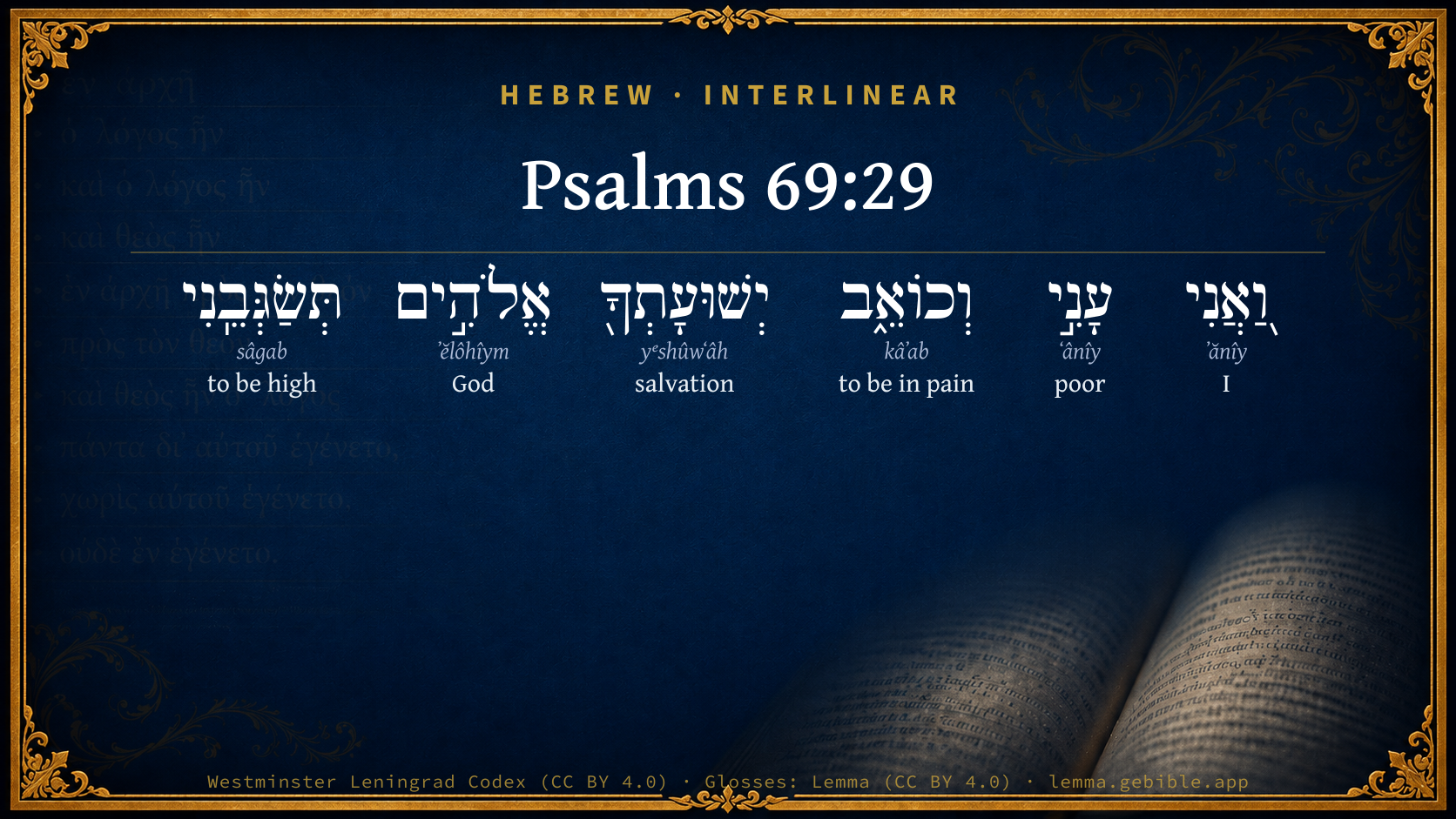
  1. וַ֭אֲנִי ʼănîy H589 “and · I” Conjunction + Pronoun, Personal, 1st Person, Common, Singular
  2. עָנִ֣י ʻânîy H6041 “poor” Adjective, Adjective, Masculine, Singular, Absolute
  3. יְשׁוּעָתְךָ֖ yᵉshûwʻâh H3444 “salvation · your” Noun, Common, Feminine, Singular, Construct + Suffix, Personal, 2nd Person, Masculine, Singular
  4. אֱלֹהִ֣ים ʼĕlôhîym H430 “God(s)” Noun, Common, Masculine, Plural, Absolute
  5. תְּשַׂגְּבֵֽנִי sâgab H7682 “to be high · me” Verb, Piel, Imperfect, 3rd Person, Feminine, Singular + Suffix, Personal, 1st Person, Common, Singular

About this verse

These counts appear in no published source. They are computed here, from the morphology-tagged text and Lemma’s own curated glosses. What Lemma adds →

6
words
6
distinct lemmas
Wisdom
section

Notable vocabulary

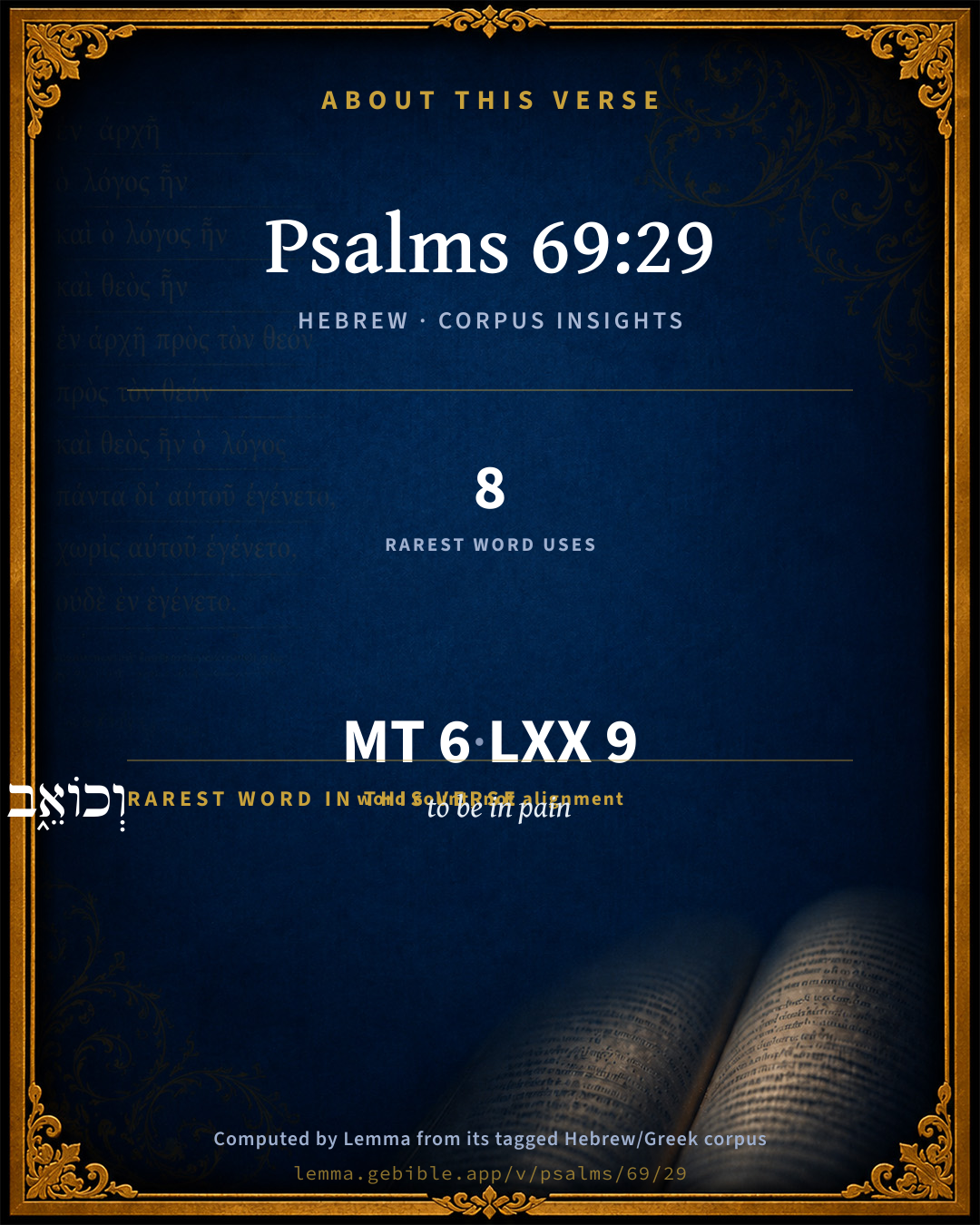
The rarest word here is וְכוֹאֵ֑ב to be in pain H3510 — appearing just 8 times in the whole Hebrew Bible.

Shared distinctive vocabulary

וְכוֹאֵ֑ב to be in pain H3510 occurs in 8 verses of the Hebrew Bible. Also found in:

Grammatical profile

  • 2 verbs
  • 2 nouns
  • 1 adjective
  • 1 pronoun

Verb forms

  • וְכוֹאֵ֑ב Qal · Participle Active
  • תְּשַׂגְּבֵֽנִי Piel · Imperfect

Hebrew & Septuagint length

In English translation the verse runs 13 words from the Hebrew and 14 from the Septuagint (LXX English) — closely comparable.

A rough comparison of the two English renderings, which tokenize alike — not a word-level alignment.

Word counts can differ between the Hebrew and the Greek without any difference in meaning — e.g. the Hebrew direct-object marker אֵת has no separate Greek word, and Greek often adds the article ὁ.

In the original languages it is 6 Hebrew tokens and 9 Greek tokens — but the two are counted differently (Hebrew bundles its prefixes and suffixes into one token; the Greek is in lemma form), so that isn’t a like-for-like length.

Cross-references

15

Topical passages linked to Psalms 69:29 in the Treasury of Scripture Knowledge — connected by theme and wording, ordered by reader-vote popularity; previews shown in the World English Bible.

  • Psalms 91:14–16 "Because he has set his love on me, therefore I will deliver him. I will set him on high, because he has known my name.
  • Psalms 40:17 But I am poor and needy; May the Lord think about me. You are my help and my deliverer. Don't delay, my God.
  • Psalms 70:5 But I am poor and needy. Come to me quickly, God. You are my help and my deliverer. Yahweh, don't delay.
  • Psalms 109:22 For I am poor and needy. My heart is wounded within me.
  • Psalms 18:48 He rescues me from my enemies. Yes, you lift me up above those who rise up against me. You deliver me from the violent man.
  • Psalms 20:1 May Yahweh answer you in the day of trouble. May the name of the God of Jacob set you up on high,
  • Isaiah 53:2–3 For he grew up before him as a tender plant, and as a root out of a dry ground: he has no form nor comeliness; and when we see him, there is no beauty that we should desire him.
  • 2 Corinthians 8:9 For you know the grace of our Lord Jesus Christ, that, though he was rich, yet for your sakes he became poor, that you through his poverty might become rich.
  • Ephesians 1:21–22 far above all rule, and authority, and power, and dominion, and every name that is named, not only in this age, but also in that which is to come.
  • Philippians 2:9–11 Therefore God also highly exalted him, and gave to him the name which is above every name;
  • Psalms 59:1 Deliver me from my enemies, my God. Set me on high from those who rise up against me.
  • Psalms 109:31 For he will stand at the right hand of the needy, To save him from those who judge his soul.
  • Psalms 22:27–31 All the ends of the earth shall remember and turn to Yahweh. All the relatives of the nations shall worship before you.
  • Psalms 89:26–27 He will call to me, 'You are my Father, My God, and the rock of my salvation!'
  • Matthew 8:20 Jesus said to him, "The foxes have holes, and the birds of the sky have nests, but the Son of Man has nowhere to lay his head."

Cross-references courtesy of OpenBible.info (CC BY 4.0).

Hebrew and Greek witnesses Masoretic Hebrew ↔ Greek Septuagint

The same verse in the two great witnesses to the Old Testament, shown verse-for-verse.

You’re reading Greek Psalm 68 (Hebrew Psalm 69). The Septuagint counts the superscription, so verse numbers can differ from the Hebrew — chapter-level alignment, not verse-by-verse. Numbering follows Rahlfs.

These are two independent witnesses, not word-aligned to each other, and the Septuagint is shown in lemma (dictionary) form.

Hebrew Psalms 69:29 Masoretic · Westminster Leningrad Codex

וַ֭אֲנִי עָנִ֣י וְכוֹאֵ֑ב יְשׁוּעָתְךָ֖ אֱלֹהִ֣ים תְּשַׂגְּבֵֽנִי

But I am in pain and distress. Let your salvation, God, protect me.

World English Bible · Public Domain

Greek LXX Greek Psalm 68:29 Septuagint · lemma form

ἐκἀλείφω ἐκ βίβλος ζάω καί μετά δίκαιος μή γράφω

I am poor and sorrowful; but the salvation of your countenance has helped me.

LXX2012 (modern English Septuagint) · Public Domain

Hebrew: Westminster Leningrad Codex (CC BY 4.0). Greek: Septuagint (public domain); English from LXX2012 (modern English Septuagint) (Public Domain). How the Septuagint differs from the Hebrew →

Commentary

Notes on Psalms 69:29 from classic Christian and Jewish commentators (each source and its license shown beneath its notes). The classic Christian expositions comment on the surrounding passage and are grouped to its opening verse, so a note may address several verses; the Jewish commentaries on the Tanakh (Rashi and others) are per-verse, so they appear only where the commentator wrote on this verse.

Lemma curates 59 commentaries, every one of them public domain or Creative Commons licensed, each selected and text-cleaned for this edition rather than reprinted as found. About our sources →

Trapp's Complete Commentary

John Trapp

Psa 69:29 But I [am] poor and sorrowful: let thy salvation, O God, set me up on high.

Ver. 29. But I am poor and sorrowful] The Church is usually so, and may sing, as here, Vaani gnani, &c., but her comfort is, 1. That Christ saith unto her, as Rev 2:9, I know thy sorrow and poverty (but that is nothing), thou art rich. 2. That her poverty is not penal, but medicinal; God’s dispensation to fit her for better riches; as a wise physician purgeth a foul hody till he bring it almost to skin and bone; but why? that, having made it poor, there may be a spring of better blood and spirits.

John Trapp, A Commentary or Exposition upon All the Books of the Old and New Testament (1647–1656) — public domain. Text from a community e-Sword module.

Joseph Benson's Commentary

Psa 69:29-31. But I am poor, &c. — Bishop Hare reads it, “But as for me, though I am low and full of pain,” (Hebrew, כואב, choeeb; rendered, in the plural, they were sore, Gen 34:25,) “thy salvation, O God, shall protect me.” I will praise, &c. — I will not be unmindful of the benefit, but praise thy power and goodness in joyful hymns. This shall please the Lord better than an ox, &c. — This sincere and hearty sacrifice of praise is, and shall be, more acceptable to God than the most costly legal sacrifices. So such moral and spiritual services ever were, (1Sa 15:22; Hos 6:6,) and such were to be offered, and would be accepted, when those ritual ones should be abolished. That hath horns and hoofs — “These are mentioned as being conspicuous in an ox going to be sacrificed; being probably gilded and adorned with flowers, as among the Romans and other people.” — Dodd.

Joseph Benson's Commentary on the Old and New Testaments (1811–1818) — public domain. Text from a community e-Sword module.

J. A. Alexander on Psalms

Joseph Addison Alexander

30. (Psa 69:29). And I (am) afflicted and suffering; let thy salvation, 0 God, set me on high, beyond the reach of danger, which is tantamount to saying, in a place of safety. See above, on Psa 20:1; Psa 59:1. The verb might also be translated as a future proper, expressive of a confident anticipation, thy salvation will secure me. But it seems more natural to understand it as a prayer for himself, subjoined to the foregoing series of prayers for the destruction of his enemies. As if he had said, "Remember, Lord, that I am suffering, and interpose for my deliverance, as well as for their punishment."

Joseph Addison Alexander, The Psalms Translated and Explained (1850) — public domain. Text from a community e-Sword module.

Tyndale Open Study Notes

Tyndale Open Resources

69:29-33 The psalmist prays that his pain will turn to praise.

Tyndale Open Study Notes — © Tyndale Open Resources, licensed CC BY-SA 4.0. Text via the HelloAO Bible API.

Jamieson, Fausset & Brown

Robert Jamieson, A. R. Fausset & David Brown

poor and sorrowful--the afflicted pious, often denoted by such terms (compare Psa 10:17; Psa 12:5).

set me . . . high--out of danger.

Jamieson, Fausset & Brown — Commentary Critical and Explanatory on the Whole Bible (1871) — public domain (CC PDM 1.0). Text via the HelloAO Bible API.

Adam Clarke's Commentary

Verse 29. I am poor and sorrowful] Literally, I an laid low, and full of pain or grief. Hence the prayer, "Let thy salvation, O God set me on high!" My oppression has laid me low; thy salvation shall make me high!

Adam Clarke's Commentary on the Bible (1810–1826) — public domain. Text from a community e-Sword/MySword module.

John Calvin's Commentaries

29. As for me, I am poor and sorrowful. From this verse we perceive more distinctly how David cast away from him the swelling and raging passion of those who, with ungovernable fury, pour forth imprecation and vengeance. He here, without doubt, offers himself to God with the sacrifice of a broken and humble heart, that by this meekness of spirit he may obtain favor with him. He therefore adds immediately after, Thy salvation shall exalt me. Those assuredly who are impelled to avenge themselves by their own ungovernable spirits are so far from being humbled, that they exalt themselves to a position to which they are not entitled. There is here a mutual relation stated between the sorrow with which he was oppressed, and the help of God by which he hoped to be lifted up. At the same time, he assures himself that the very thing which others considered as a ground for despair, would prove to him the cause of his salvation. This sentence might also be explained adversatively thus: Although I now mourn under the pressure of affliction, yet shall thy salvation, O Lord! exalt me. But for my part, I consider it certain that David brings forward his own affliction as a plea for obtaining mercy at the hand of God. Nor does he say simply that he will be raised up, but he expressly speaks of being exalted; and in this he alludes to fortresses which are set upon high places; for this is the proper signification of the Hebrew word שגב, sagab, here employed.

John Calvin's Commentaries (1540-1563) — public domain. Text from the Calvin Translation Society English edition (1840s-50s) via the Christian Classics Ethereal Library (ccel.org). Calvin's coverage is partial (roughly two-thirds of the Bible); uncommented books and verses are honest gaps, never fabricated. The 19th-century editor's footnotes and remarks are omitted so the notes are faithfully Calvin's own voice.

Ellicott's Commentary for English Readers

(29) Set me up on high.—Or, lift me up, i.e., into a secure place out of the reach of enemies.

A Bible Commentary for English Readers, edited by Charles John Ellicott (1878–1897) — public domain. Text from a community e-Sword module.

The Cambridge Bible for Schools and Colleges

gen. ed. J. J. S. Perowne

29. But as for me, who am afflicted and sore pained,

Thy salvation, O God, shall set me up on high.

The verb may be rendered as a prayer (A.V.), or as an expression of confidence (P.B.V.). God’s deliverance will set him as it were in a high fortress, out of the reach of his enemies. Cp. Psa_59:1 note.

29–36. In contrast to the fate which his enemies deserve, the Psalmist looks forward to his own deliverance, and predicts the restoration of Jerusalem and the reestablishment there of the true people of God. Such a sudden change of tone is quite characteristic of Jeremiah, e.g. Jer_20:13.

The Cambridge Bible for Schools and Colleges (gen. ed. J. J. S. Perowne; Cambridge University Press, 1878–1918) — public domain. Text from a community e-Sword module.

John Gill's Exposition

But I am poor and sorrowful,.... The Messiah was poor in a literal sense, as it was foretold he should, Zac 9:9; so he was in his private life; born of poor parents, and brought up in a mean way: and in his public life, having no certain dwelling place, and ministered to by others; and when on the cross, being stripped of his garments; and nothing to eat and drink but gall and vinegar; and nothing to leave to his mother, but commits her to the care of his beloved disciple. Though this phrase in general may denote the low estate of Christ in his humiliation, being in the form of a servant, humbled and obedient to death; and the character of "sorrowful" well agrees with him, who was a man of sorrows all his days; and in the garden his soul was exceeding sorrowful, even unto death; and when on the cross he had sorrow enough; what with the sins of his people on him, the flouts and jeers of his enemies at him; the pains of body he endured, the wrath of God, the hidings of his face, and the curses of his righteous law. After this declaration of his low and distressed state, a petition follows:

let thy salvation, O God, set me up on high: meaning either the salvation of the Lord's people, so called, because concerted and appointed of God, and is what he sent his Son to effect, and he approves of; this being wrought out was the way and, means of the exaltation of Christ; both by his divine Father, who on this account exalted him at his right hand; and by his people, who exalt him in their hearts, and with their tongues, and give him all the glory of their salvation. Or else this means the salvation of Christ out of the hands of all his enemies, whom he conquered on the cross; and particularly death, from which he was saved by his resurrection, and was the first step to his exaltation and glory; after which he ascended on high, and sat down at the right hand of God; where no mere creature, angels or men, were ever admitted; and where angels, principalities, and powers, are subject to him. The whole may be rendered thus; "though I am poor and sorrowful, thy salvation, O God, will set me up on high" (o); and so is expressive of the Messiah's faith in his resurrection and exaltation, notwithstanding his sorrows and sufferings; on account of which he determines to praise the Lord, as follows.

(o) "elevabit me", Pagninus, Montanus; so Gejerus, Michaelis.

John Gill's Exposition of the Whole Bible (1746–1763) — public domain (CC PDM 1.0). Text via the HelloAO Bible API.

Albert Barnes' Notes on the Bible

But I am poor and sorrowful - I am afflicted and suffering. The word here rendered “poor” often means “afflicted.”

Let thy salvation, O God, set me up on high - Let thy help raise me up from my low condition, and exalt me to a place of safety.

Albert Barnes' Notes on the Bible (1834–1885) — public domain. Text from a community e-Sword/MySword module.

Matthew Poole's English Annotations

Out of the reach of mine enemies; or, lift me out of the deep waters, and the mire, in which I was sinking, Psa 69:14.

Matthew Poole's English Annotations on the Holy Bible (1683–1685) — public domain. Text from a community e-Sword/MySword module.

The Treasury of David

Charles H. Spurgeon

Ver. 29. But I am poor and sorrowful. The psalmist was afflicted very much, but his faith was in God. The poor in spirit and mourners are both blessed under the gospel, so that here is a double reason for the Lord to smile on his suppliant. No man was ever poorer or more sorrowful than Jesus of Nazareth, yet his cry out of the depths was heard, and he was uplifted to the highest glory.

Let thy salvation, O God, set me up on high. How fully has this been answered in our great Master's case, for he not only escaped his foes personally, but he has become the author of eternal salvation to all who obey him, and this continues to glorify him more and more. O ye poor and sorrowful ones, lift up your heads, for as with your Lord so shall it be with you. You are trodden down today as the mire of the streets, but you shall ride upon the high places of the earth ere long; and even now ye are raised up together, and made to sit together in the heavenlies in Christ Jesus.

None.

Ver. 29.

I. The humiliation that precedes exaltation.

1. Deep: I am poor and sorrowful.

2. Confessed: I am poor, etc. II. The exaltation that follows humiliation.

1. Divine: Thy salvation, O Lord. Though the Lord be high, etc.

2. Complete: God does nothing by halves.

3. Preeminent: Set me up on high. G. R.

Psalms 69:30*

Charles H. Spurgeon's The Treasury of David (1869–1885) — public domain. Psalms only. Text from a community e-Sword/MySword module.

The Pulpit Commentary

But I am poor and sorrowful; let thy salvation, O God, set me up on high. The psalmist adds to his list of imprecations, by way of contrast, an invocation of blessing on himself. As his present condition is in strong contrast with that of his ungodly enemies, as be is "poor and sorrowful," while they are prosperous and self-satisfied, so let their future conditions be. While they are depressed and disgraced, let him be "set up on high.

Vers. 29-36. The psalm closes with Joyful hopes and vows of thanksgiving for salvation.

These consequences flow from his confidence in God"s salvation.

I HIS OWN PERSONAL GRATITUDE AND SERVICE.

1. The thanksgiving of a grateful heart will show itself in song and service. (Ver. 30)

2. Spiritual service is more acceptable to God than ceremonial. (Ver. 31)

II HIS SALVATION WILL STRENGTHEN THE FAITH OF ALL RIGHTEOUS SUFFERERS. (Vers. 32, 33)

1. The humble, the afflicted, will see in it the pledge of their own deliverance. (Ver. 32) God will make a difference between all the righteous and the wicked.

2. The experience of the righteous warrants the utmost trust in God. (Ver. 33) "For the Lord heareth the poor, and despiseth not his prisoners." That is a truth of experience as well as of faith and hope.

III ZION AND THE CITIES OF JUDAH SHALL BE REBUILT. The revelations of God to his own experience gave him the hope of a wide and general deliverance; and in the distinction made by God between him and his enemies, security for the victory of the whole Church of God. He calls upon the heavens, the earth, and seas to praise God on this account (vers. 34-36). S.

The Pulpit Commentary (1880–1919), ed. H.D.M. Spence-Jones & Joseph S. Exell — public domain. Text from a community e-Sword module.

John Wesley's Explanatory Notes

On high - Out of the reach of mine enemies.

John Wesley, Explanatory Notes Upon the Whole Bible (1754–1765) — public domain. Text via the GEBible commentary corpus.

Lesson kit

Teaching starters — assembled from the data on this page, not authored interpretation. Every prompt links to the verse data it draws on. Edit before teaching.

Psalms, in the Wisdom, opens this verse with 6 words (6 distinct Hebrew lemmas). Its most distinctive word is kâʼab (“to be in pain”). A historical commentator’s framing appears above. Read the whole chapter for the surrounding context.

Discussion questions

  1. How does “to be in pain” (kâʼab) shape what this verse is saying?
  2. Genesis 34:25 shares the word «to be in pain» with this verse. How do the two illuminate each other?
  3. These translations render this verse differently. What is at stake in choosing one wording over another?
  4. The verb «וְכוֹאֵ֑ב» is Qal Participle Active. How does its form color the action?
  5. Reading how Trapp's Complete Commentary and Joseph Benson's Commentary read this verse, where do the two commentators agree and where do they part?

Things to notice

Reading settings

Reading text

Shown beneath each verse's original-language words.

Old Testament
Old Testament edition

Read the OT as the Masoretic Hebrew (MT) or the Greek Septuagint (LXX).

English shown for the Greek Septuagint (in the Hebrew ↔ Greek comparison).

Comparing translations? Open the Compare panel on any verse page to stack up to four side by side.