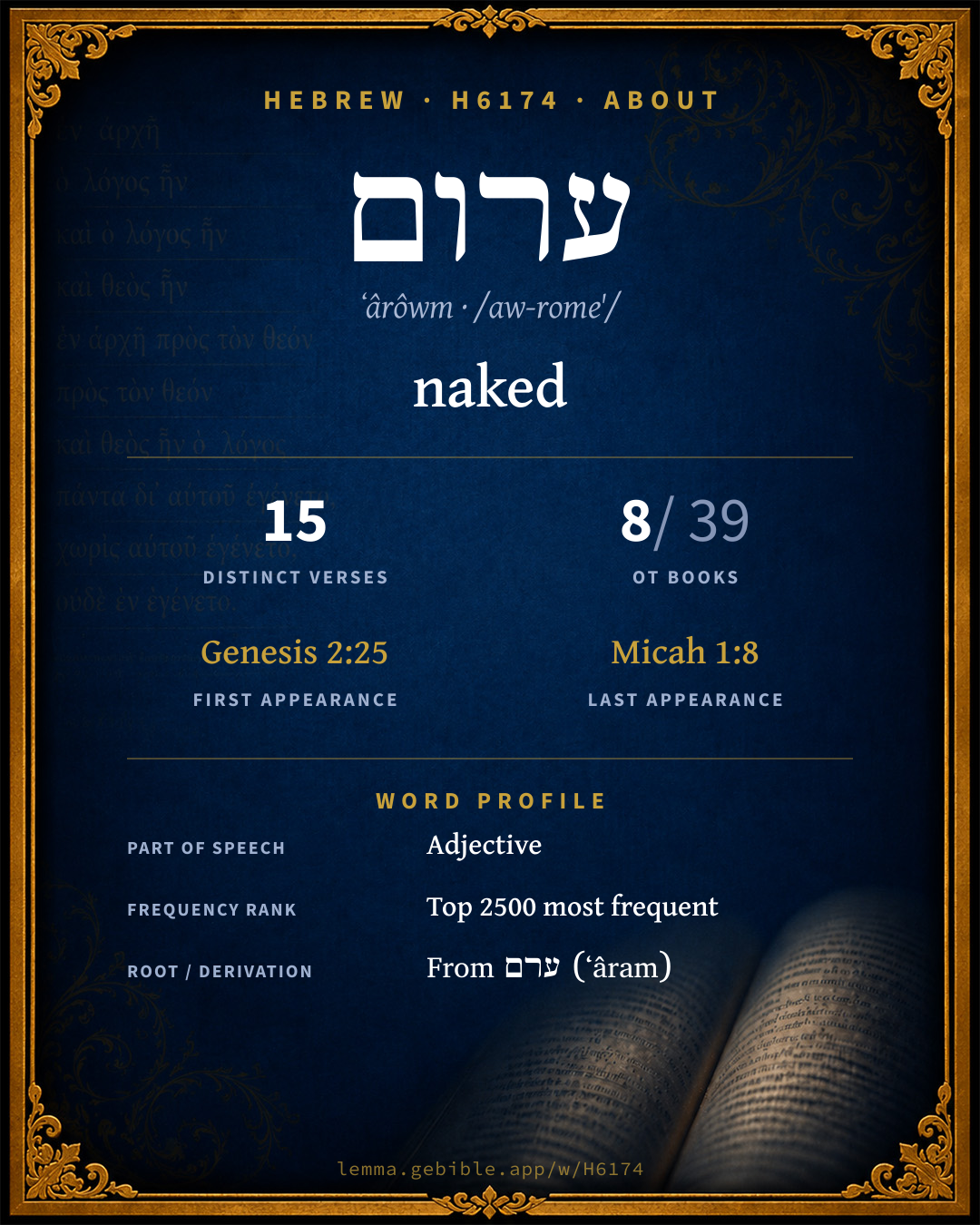
עָרוֹם
naked
Full lexicon entry — Brown-Driver-Briggs (BDB)
From Brown-Driver-Briggs (BDB)
Where this word appears
Grammar key — what these labels mean
Part of speech
- Adjective
- A word that describes or qualifies a noun.
State
- Absolute
- The independent form of a noun, not bound to a following word.
Gender
- Masculine
- Grammatically masculine.
- Feminine
- Grammatically feminine.
Number
- Singular
- One.
- Plural
- More than one (in Hebrew, generally three or more).
Grammatical forms
- Adjective, Adjective, Masculine, Singular, Absolute 13 times (81%)
- Adjective, Adjective, Masculine, Plural, Absolute 2 times (13%)
- Adjective, Adjective, Feminine, Singular, Absolute 1 time (6%)
Parsed forms decoded from the imported morphology (morphhb / Westminster Leningrad Codex — WLC text public domain, morphhb tagging CC BY 4.0), counted across 16 parsed occurrences — not distinct verses.
Every verse where H6174 appears — 15 distinct verses across 8 books. Click any verse to open its interlinear word-by-word view. Verse text shown in the World English Bible for context — . Each verse’s Hebrew form is shown with its reference; the English is not keyword-highlighted, since the data carries no word-level English alignment. Use “Compare translations” on any verse to read it across multiple English versions. This concordance covers the Hebrew Bible; Septuagint (Greek Old Testament) occurrences are not indexed here.
Genesis 1 verse
1 Samuel 1 verse
Job 5 verses
- Job 1:21 עָרֹ֨ם וְ/עָרֹם֙ adj Adjective ms conj + Adjective Adjective ms He said, "Naked I came out of my mother's womb, and naked shall I return there. Yahweh gave, and Yahweh has taken away. Blessed be the name of Yahweh."
- Job 22:6 עֲרוּמִּ֣ים adj Adjective mp For you have taken pledges from your brother for nothing, And stripped the naked of their clothing.
- Job 24:7 עָר֣וֹם adj Adjective ms They lie all night naked without clothing, And have no covering in the cold.
- Job 24:10 עָר֣וֹם adj Adjective ms So that they go around naked without clothing. Being hungry, they carry the sheaves.
- Job 26:6 עָר֣וֹם adj Adjective ms Sheol is naked before God, And Abaddon has no covering.
Ecclesiastes 1 verse
Isaiah 4 verses
- Isaiah 20:2 עָר֥וֹם adj Adjective ms at that time Yahweh spoke by Isaiah the son of Amoz, saying, Go, and loose the sackcloth from off your loins, and put your shoe from off your foot. He did so, walking naked and barefoot.
- Isaiah 20:3 עָר֣וֹם adj Adjective ms Yahweh said, Like as my servant Isaiah has walked naked and barefoot three years for a sign and a wonder concerning Egypt and concerning Ethiopia;
- Isaiah 20:4 עָר֣וֹם adj Adjective ms so shall the king of Assyria lead away the captives of Egypt, and the exiles of Ethiopia, young and old, naked and barefoot, and with buttocks uncovered, to the shame of Egypt.
- Isaiah 58:7 עָרֹם֙ adj Adjective ms Isn't it to deal your bread to the hungry, and that you bring the poor who are cast out to your house? when you see the naked, that you cover him; and that you not hide yourself from your own flesh?
Hosea 1 verse
Amos 1 verse
Micah 1 verse
About this entry
At a glance — auto-summarized from this page’s data, not written by a person. Every figure links to its source below. This summary describes the numbers; it doesn’t interpret them.
ערום — transliterated ʻârôwm — is a Hebrew adjective carrying the sense “naked.” Its earliest occurrence is Genesis 2:25. It appears 15 verses across 8 books of the Hebrew Bible, among its uncommon vocabulary. More than a third of its appearances fall in Job. It shares a root with ערם, מערם and עירם. See the sense tree, 15-verse concordance, and the renderings breakdown below.
Gloss history
Strong's 1890 vs modern scholarship
About this word
Strong's H6174 catalogs a Hebrew word from the Hebrew Old Testament.
These counts are not copied from any lexicon or concordance. They are computed here, from the morphology-tagged Hebrew Old Testament. What Lemma adds →
- 15
- distinct verses
- The word appears in 15 distinct verses.
- 8 / 39
- OT books
- The word appears in 8 of 39 Old Testament books.
- #1,752
- by frequency
- Top 2500 most frequent Hebrew words (rank 1,752 of 8,640 Hebrew words by occurrence).
View all 15 occurrences in the concordance →
By section of the Old Testament
By traditional corpus
Conventional, traditional groupings — biblical authorship is debated, so this is a traditional corpus grouping, not an authorship claim. Each share is this word’s portion of its verses in that division of the Hebrew canon. Each figure is a share of the word’s 15 distinct verses.
- Prophets (Nevi'im) 8 verses · 53%
- Writings (Ketuvim) 6 verses · 40%
- Torah (Pentateuch) 1 verse · 7%
How translations render this word
Counts come from each version’s own published word-to-Strong’s tagging or interlinear alignment — an approximate guide to how each version renders this word, not a word-level alignment the data otherwise carries. Because each total is that version’s own tagged count, the per-version totals vary from one another and need not match the appearance or distinct-verse counts above. These counts may also differ from a printed concordance because Lemma counts each distinctly tagged rendering and does not collapse phrase taggings into a single head-word total. This is a fixed set of word-tagged versions (KJV, ASV, BSB, ULT) and does not change with the reading translation you choose elsewhere. Each version’s license is shown beside its name below (and on Sources).
BDB lists this Strong’s number as 2 distinct words (homographs). Each count above pools all of them and is not split by sense — see the Senses section below. A low-frequency rendering may belong to a different one of those words, not the primary meaning.
- King James Version†: Naked 14×
- American Standard Version†: Naked 14×
- Berean Standard Bible†: Naked 14×
- unfoldingWord Literal Text†: Naked 15×
King James Version Public Domain
Renders H6174 across 16† tagged occurrences — most commonly:
Plus 2 renderings that appear only once — usually multi-word phrases or single function words the recovered tagging swept in, not distinct renderings.
American Standard Version Public Domain
Renders H6174 across 16† tagged occurrences — most commonly:
Plus 2 renderings that appear only once — usually multi-word phrases or single function words the recovered tagging swept in, not distinct renderings.
Berean Standard Bible Public Domain
Renders H6174 across 16† tagged occurrences — most commonly:
Plus 2 renderings that appear only once — usually multi-word phrases or single function words the recovered tagging swept in, not distinct renderings.
unfoldingWord Literal Text CC BY-SA 4.0
Renders H6174 across 16† tagged occurrences — most commonly:
Plus 1 rendering that appears only once — usually multi-word phrases or single function words the recovered tagging swept in, not distinct renderings.
Senses in BDB
The 1 sense BDB distinguishes for this word, in lexicon order (not ranked by frequency or importance). The full entry — with sub-senses — is in the Lexicon Entry tab.
- naked, bare
Word origin
adj. naked (perhaps secondary form from עֵירֹם Ew§ 163 c Sta§ 327 a; or from √ עָרָה, q.v.);—abs. עָרוֹם Am 2:16 + 8 times, עָרֹם 1 S 19:24 + 3 times; f. עֲרֻמָּה Ho 2:5; pl. עֲרוּמִּים Gn 2:25 Jb 22:6;—naked Gn 2:25 (J) 1 S 19:24 Ho 2:5; adverb. (Ges§ 118 n) c. הָלַךְ Is 20:2, 3, 4 Mi 1:8, cf. Am 2:16 Jb 24:7, 10; = subst. concr. Is 58:7 Jb 22:6; = without possessions Jb 1:21(×2) = Ec 5:14; of Sheʾôl. open before י׳ Jb 26:6.
— Brown-Driver-Briggs (Oxford 1906, public domain), digitized via Sefaria, supplemented by the OpenScriptures HebrewLexicon (CC BY 4.0). See Sources.
Derived from ערם (ʻâram) (H6191) — to be crafty.
Jastrow Dictionary
A second Hebrew/Aramaic lexicon for comparison, covering Aramaic and post-biblical (Talmudic, Targumic, Midrashic) usage that the biblical-Hebrew BDB does not. Matched by lemma rather than by Strong’s number, so a lemma may carry more than one Jastrow headword (shown separately below), and the entries cover usage well beyond the Bible.
עָרוּם
- [rubbed, bright, cmp. Lat. tritus,] prudent, deliberate, wise; (in an evil sense) subtle, cunning. Ber. 17ᵃ לעולם יהא אדם ע׳ ביראה man should always be deliberate in the fear of the Lord (consider in what manner he can best serve the Lord). Sot. III, 4 רשע ע׳ a wicked man that is subtle, expl. ib. 21ᵇ זה המטעים וכ׳, v. טָעַם; Tanḥ. Mishp. 6. Sot. l. c. במי שמשים עצמו ע׳ Var. in Rashi, v. next w.; a. fr.—Pesik. Shimʿu, p. 118ᵇ, sq. (in Chald. dict.) לית עיסקא דע׳ מהלך עם שטיא the sane has no business to walk with the fool; (Yalk. Jer. 265 דעָרִים).—Pl. עֲרוּמִים, עֲרוּמִין. Ḥull. 5ᵇ (ref. to Ps. XXXVI, 7) אלו בני אדם שהן ע׳ בדעת וכ׳ that means those men who are clever in knowledge and yet conduct themselves humbly like a domestic animal; a. e. e.g. Psalms 36:7
עָרוֹם
- v. preced.; cmp. עָרָה) stripped, naked, bare. Dem. I, 4 מפרישין אותו ע׳ ובין וכ׳ Y. ed. a. Ms. M. (ed. בין, incorr.) you may separate the priest’s gift there from without being dressed (because it requires no benediction), and at twilight (on the eve of the Sabbath); Sabb. 23ᵃ. Ib. 14ᵃ האוחז ס"ת ע׳ נקבר ע׳ he who handles a naked scroll of the Law (touches it directly with his bare hand), will he buried naked, expl. ע׳ בלא אותה מצוה bare of the merit of that act (of studying or of rolling and dressing it). Tosef. Keth. VI, 7 פסק … שיעמד ע׳ וילבישנה (not וילבשנו) if he agreed with his son-in-law that he will go naked (deprive himself, if necessary) and dress her, אין אומ׳ יעמד ע׳ וילבישנה וכ׳ (not וילבישנו) we do not say, let him become destitute, and he must dress her (make the outfit for her), but he (her father) must cover her as is proper for her; Y. ib. VI, 30ᵈ. Sot. 21ᵇ (play on ערמה, Prov. VIII, 12) אין … אלא במי שמעמיד עצמו ע׳ עליהן the words of the Law remain only with him who makes himself destitute for their sake (who sacrifices comforts for them); (Var. quot. in Rashi: שמשים עצמו עָרוּם עליה who makes himself cunning about it, i.e. goes to work deliberately, studies systematically); a. fr.—Pl. עֲרוּמִּים, עֲרוּמִּין. Snh. 90ᵇ כשהן עומדין עומדין ע׳ וכ׳ when they (the dead) rise, will they rise naked or dressed? Yeb. 63ᵇ אנשי … שמהלכין ע׳ בשוק those of Barbaria … who walk naked in the street; Sifré Deut. 320; a. fr.—Fem. עֲרוּמָּה. Keth. 111ᵇ; Snh. l. c. ומה חיטה שנקברה ע׳ וכ׳ if the wheat-grain, which is buried naked, comes forth wrapped in many dresses, how much more will the righteous dead rise &c. Ib. VI, 3 אין האשה נסקלת ע׳ a woman convict must not be stoned (executed) undressed. Meg. 12ᵇ ובלבד שתהא ע׳ provided she (Vashti) will appear undressed. Snh. 75ᵃ ימות ולא תעמוד לפניו ע׳ let him (the love-sick man) die, but she must not stand undressed before him. Keth. VI, 5 פסק להכניסה ע׳ if the father made an agreement that he (the bridegroom) will take her to his house without the customary outfit; a. fr.—Pl. עֲרוּמּוֹת. Meg. l. c. מפשיטתן ע׳ (not מפשיטן) she forced them to appear undressed; a. e. e.g. Proverbs 8:12
A Dictionary of the Targumim, the Talmud Babli and Yerushalmi, and the Midrashic Literature (Marcus Jastrow; London, Luzac, 1903) — Public Domain. Digitized via Sefaria. Digitized via Sefaria. Full attribution on Sources.
Forms in the corpus
The 11 distinct written forms H6174 takes in the Hebrew Bible, most frequent first — each parse links to that state’s occurrences in the concordance. Hebrew forms include their vowel points and cantillation, so a single lemma takes many written forms.
| Form | Parsing | Example | Uses |
|---|---|---|---|
| עָר֣וֹם | Adjective, Adjective, Masculine, Singular, Absolute | Isaiah 20:3 | 5 |
| עָר֛וֹם | Adjective, Adjective, Masculine, Singular, Absolute | Amos 2:16 | 2 |
| וְ/עָר֑וֹם | Adjective, Adjective, Masculine, Singular, Absolute | Micah 1:8 | 1 |
| וְ/עָרֹם֙ | Adjective, Adjective, Masculine, Singular, Absolute | Job 1:21 | 1 |
| עֲרֻמָּ֔ה | Adjective, Adjective, Feminine, Singular, Absolute | Hosea 2:3 | 1 |
| עֲרוּמִּ֔ים | Adjective, Adjective, Masculine, Plural, Absolute | Genesis 2:25 | 1 |
| עֲרוּמִּ֣ים | Adjective, Adjective, Masculine, Plural, Absolute | Job 22:6 | 1 |
| עָר֥וֹם | Adjective, Adjective, Masculine, Singular, Absolute | Isaiah 20:2 | 1 |
| עָרֹ֔ם | Adjective, Adjective, Masculine, Singular, Absolute | 1 Samuel 19:24 | 1 |
| עָרֹ֨ם | Adjective, Adjective, Masculine, Singular, Absolute | Job 1:21 | 1 |
| עָרֹם֙ | Adjective, Adjective, Masculine, Singular, Absolute | Isaiah 58:7 | 1 |
Same root — word family
Other BDB entries built from the same root as H6174, grouped by Strong’s listed origin. These share a root / origin per the lexicon — not necessarily a shared meaning. Each links to that word’s own entry.
Derives from
Shares the same root
- מערם maʻărôm H4636 nakedness
- עירם ʻêyrôm H5903 naked
- ערום ʻârûwm H6175 crafty
- ערם ʻôrem H6193 craftiness
- ערמון ʻarmôwn H6196 plane tree
Compare all same-root words → Showing 4 of 7 — not the complete family. They share a root, not necessarily a meaning.
Septuagint verse parallels
This word appears in 15 verses that also exist in the Greek Old Testament (Septuagint), out of the 15 Hebrew verses it occurs in. You can read those verses in Greek by switching the Old Testament edition to the Septuagint.
Read these verses in the Septuagint
This is a verse-level parallel only — the same verses exist in both the Hebrew and Greek Old Testaments. No word-level Hebrew↔Greek correspondence is claimed: the data carries no such alignment, so no Greek word is shown as this Hebrew word’s translation. Coverage is not total — the Septuagint omits the deuterocanon and renumbers the Psalms, so some Hebrew verses have no direct Greek parallel.