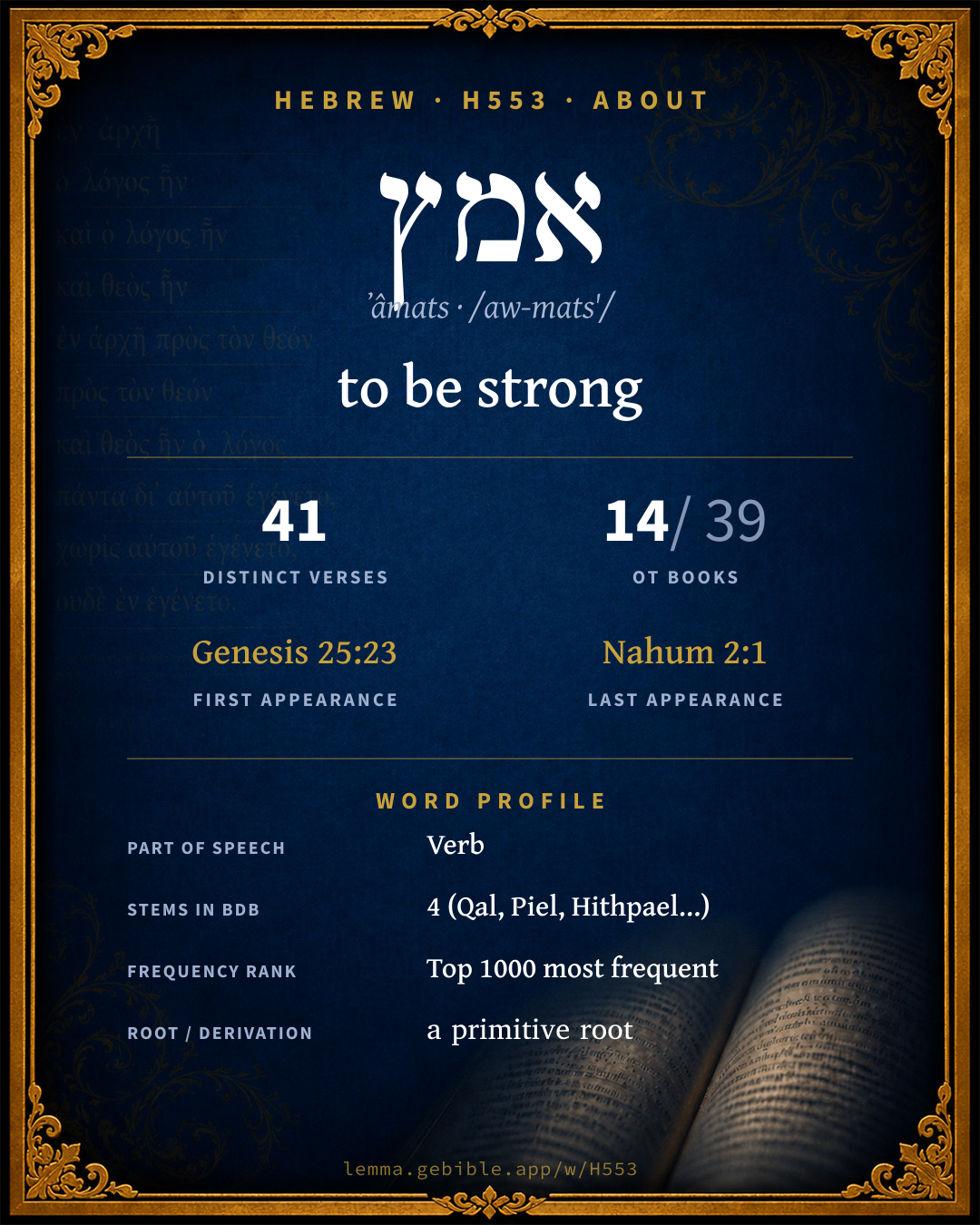
אָמֵץ
to be strong
also: alert, courageous, brave, stout fuller range ↓
Full lexicon entry — Brown-Driver-Briggs (BDB)
From Brown-Driver-Briggs (BDB)
Where this word appears
See every Piel verb in the Hebrew Bible →
Grammar key — what these labels mean
Part of speech
- Verb
- An action or state-of-being word.
Stem
- Qal
- The basic, simple active stem — the plain form of the verb (“he wrote”). Here: ‘be strong’
- Hiphil
- The causative active stem (“he caused / brought about”).
- Piel
- An intensive or resultative active stem. Here: ‘make firm’
- Hithpael
- The reflexive or reciprocal stem (the subject acts on itself). Here: ‘strengthen oneself’
Form
- Imperative
- A direct command (“write!”).
- Perfect
- A completed action or state — Hebrew marks aspect (completeness) more than strict tense (“he wrote”).
- Imperfect
- An incomplete, ongoing, or future action (“he will / would write”).
- Sequential Imperfect
- An imperfect with prefixed waw — the standard past-narrative form (waw-consecutive imperfect).
- Infinitive Construct
- A bound verbal noun, frequently with prepositions (“to write / in writing”).
- Participle Active
- A verbal adjective expressing ongoing or characteristic action (“writing / one who writes”).
State
- Absolute
- The independent form of a noun, not bound to a following word.
Person
- 2nd Person
- The one addressed (“you”).
- 3rd Person
- The one spoken about (“he / she / it / they”).
- 1st Person
- The speaker (“I / we”).
Gender
- Masculine
- Grammatically masculine.
- Common
- Either gender — not distinguished for this form.
- Feminine
- Grammatically feminine.
Number
- Singular
- One.
- Plural
- More than one (in Hebrew, generally three or more).
Grammatical forms 23 distinct
- Verb, Qal, Imperative, 2nd Person, Masculine, Singular 8 times (20%)
- Verb, Qal, Imperative, 2nd Person, Masculine, Plural 3 times (7%)
- Verb, Qal, Perfect, 3rd Person, Common, Plural 3 times (7%)
- Verb, Hiphil, Imperfect, 3rd Person, Masculine, Singular 2 times (5%)
- Verb, Piel, Sequential Imperfect, 3rd Person, Masculine, Singular 2 times (5%)
- Verb, Piel, Imperfect, 2nd Person, Masculine, Singular 2 times (5%)
- Verb, Piel, Perfect, 2nd Person, Masculine, Singular 2 times (5%)
- Verb, Hithpael, Perfect, 3rd Person, Masculine, Singular 2 times (5%)
+15 more forms (17 occurrences)
Parsed forms decoded from the imported morphology (morphhb / Westminster Leningrad Codex — WLC text public domain, morphhb tagging CC BY 4.0), counted across 41 parsed occurrences — not distinct verses.
Every verse where H553 appears — 41 distinct verses across 14 books. Click any verse to open its interlinear word-by-word view. Verse text shown in the World English Bible for context — . Each verse’s Hebrew form is shown with its reference; the English is not keyword-highlighted, since the data carries no word-level English alignment. Use “Compare translations” on any verse to read it across multiple English versions. This concordance covers the Hebrew Bible; Septuagint (Greek Old Testament) occurrences are not indexed here.
Genesis 1 verse
Deuteronomy 6 verses
- Deuteronomy 2:30 וְ/אִמֵּץ֙ conj + Piel pf 3ms But Sihon king of Heshbon would not let us pass by him; for Yahweh your God hardened his spirit, and made his heart obstinate, that he might deliver him into your hand, as at this day.
- Deuteronomy 3:28 וְ/אַמְּצֵ֑/הוּ conj + Piel impv 2ms + sfx pers 3ms But charge Joshua, and encourage him, and strengthen him; for he shall go over before this people, and he shall cause them to inherit the land which you shall see.
- Deuteronomy 15:7 תְאַמֵּ֣ץ Piel impf 2ms If there be with you a poor man, one of your brothers, within any of your gates in your land which Yahweh your God gives you, you shall not harden your heart, nor shut your hand from your poor brother;
- Deuteronomy 31:6 וְ/אִמְצ֔וּ conj + Qal impv 2mp Be strong and of good courage, don't be afraid, nor be scared of them: for Yahweh your God, he it is who does go with you; he will not fail you, nor forsake you.
- Deuteronomy 31:7 וֶ/אֱמָץ֒ conj + Qal impv 2ms Moses called to Joshua, and said to him in the sight of all Israel, Be strong and of good courage: for you shall go with this people into the land which Yahweh has sworn to their fathers to give them; and you shall cause them to inherit it.
- Deuteronomy 31:23 וֶֽ/אֱמָץ֒ conj + Qal impv 2ms He gave Joshua the son of Nun a charge, and said, Be strong and of good courage; for you shall bring the children of Israel into the land which I swore to them: and I will be with you.
Joshua 5 verses
- Joshua 1:6 וֶ/אֱמָ֑ץ conj + Qal impv 2ms Be strong and of good courage; for you shall cause this people to inherit the land which I swore to their fathers to give them.
- Joshua 1:7 וֶֽ/אֱמַ֜ץ conj + Qal impv 2ms Only be strong and very courageous, to observe to do according to all the law, which Moses my servant commanded you: don't turn from it to the right hand or to the left, that you may have good success wherever you go.
- Joshua 1:9 וֶ/אֱמָ֔ץ conj + Qal impv 2ms Haven't I commanded you? Be strong and of good courage; don't be afraid, neither be dismayed: for Yahweh your God is with you wherever you go.
- Joshua 1:18 וֶ/אֱמָֽץ conj + Qal impv 2ms Whoever he be who shall rebel against your commandment, and shall not listen to your words in all that you command him, he shall be put to death: only be strong and of good courage.
- Joshua 10:25 וְ/אִמְצ֔וּ conj + Qal impv 2mp Joshua said to them, Don't be afraid, nor be dismayed; be strong and of good courage: for thus shall Yahweh do to all your enemies against whom you fight.
Ruth 1 verse
2 Samuel 1 verse
1 Kings 1 verse
1 Chronicles 2 verses
- 1 Chronicles 22:13 וֶ/אֱמָ֔ץ conj + Qal impv 2ms Then shall you prosper, if you observe to do the statutes and the ordinances which Yahweh gave Moses concerning Israel. Be strong, and of good courage. Don't be afraid, neither be dismayed.
- 1 Chronicles 28:20 וֶ/אֱמַץ֙ conj + Qal impv 2ms David said to Solomon his son, Be strong and of good courage, and do it: don't be afraid, nor be dismayed; for Yahweh God, even my God, is with you; he will not fail you, nor forsake you, until all the work for the service of the house of Yahweh is finished.
2 Chronicles 7 verses
- 2 Chronicles 10:18 הִתְאַמֵּץ֙ Hithpael pf 3ms Then king Rehoboam sent Hadoram, who was over the men subject to forced labor; and the children of Israel stoned him to death with stones. King Rehoboam made speed to get him up to his chariot, to flee to Jerusalem.
- 2 Chronicles 11:17 וַֽ/יְאַמְּצ֛וּ conj + Piel wimpf 3mp So they strengthened the kingdom of Judah, and made Rehoboam the son of Solomon strong, three years; for they walked three years in the way of David and Solomon.
- 2 Chronicles 13:7 וַ/יִּֽתְאַמְּצ֖וּ conj + Hithpael wimpf 3mp There were gathered to him worthless men, base fellows, who strengthened themselves against Rehoboam the son of Solomon, when Rehoboam was young and tender-hearted, and could not withstand them.
- 2 Chronicles 13:18 וַ/יֶּֽאֶמְצוּ֙ conj + Qal wimpf 3mp Thus the children of Israel were brought under at that time, and the children of Judah prevailed, because they relied on Yahweh, the God of their fathers.
- 2 Chronicles 24:13 וַֽ/יְאַמְּצֻֽ/הוּ conj + Piel wimpf 3mp + sfx pers 3ms So the workmen worked, and the work of repairing went forward in their hands, and they set up the house of God in its state, and strengthened it.
- 2 Chronicles 32:7 וְ/אִמְצ֔וּ conj + Qal impv 2mp Be strong and of good courage, don't be afraid nor dismayed for the king of Assyria, nor for all the multitude who is with him; for there is a greater with us than with him:
- 2 Chronicles 36:13 וַ/יְאַמֵּ֣ץ conj + Piel wimpf 3ms He also rebelled against king Nebuchadnezzar, who had made him swear by God: but he stiffened his neck, and hardened his heart against turning to Yahweh, the God of Israel.
Job 2 verses
Psalms 7 verses
- Psalms 18:17 אָמְצ֥וּ Qal pf 3cp He delivered me from my strong enemy, From those who hated me; for they were too mighty for me.
- Psalms 27:14 וְ/יַאֲמֵ֣ץ conj + Hiphil impf 3ms Wait for Yahweh. Be strong, and let your heart take courage. Yes, wait for Yahweh.
- Psalms 31:24 וְ/יַאֲמֵ֣ץ conj + Hiphil impf 3ms Be strong, and let your heart take courage, All you who hope in Yahweh.
- Psalms 80:15 אִמַּ֥צְתָּה Piel pf 2ms The stock which your right hand planted, The branch that you made strong for yourself.
- Psalms 80:17 אִמַּ֥צְתָּ Piel pf 2ms Let your hand be on the man of your right hand, On the son of man whom you made strong for yourself.
- Psalms 89:21 תְאַמְּצֶֽ/נּוּ Piel impf 3fs + sfx pers 3ms With whom my hand shall be established. My arm will also strengthen him.
- Psalms 142:6 אָמְצ֣וּ Qal pf 3cp Listen to my cry, For I am in desperate need. Deliver me from my persecutors, For they are stronger than me.
Proverbs 3 verses
- Proverbs 8:28 בְּ/אַמְּצ֣/וֹ prep + Piel inf.cs + sfx pers 3ms When he established the clouds above, When the springs of the deep became strong,
- Proverbs 24:5 מְאַמֶּץ Piel ptcp.act ms A wise man has great power; And a knowledgeable man increases strength;
- Proverbs 31:17 וַ֝/תְּאַמֵּ֗ץ conj + Piel wimpf 3fs She girds her loins with strength, And makes her arms strong.
Isaiah 3 verses
- Isaiah 35:3 אַמֵּֽצוּ Piel impv 2mp Strengthen you the weak hands, and confirm the feeble knees.
- Isaiah 41:10 אִמַּצְתִּ֨י/ךָ֙ Piel pf 1cs + sfx pers 2ms Don't you be afraid, for I am with you; don't be dismayed, for I am your God; I will strengthen you; yes, I will help you; yes, I will uphold you with the right hand of my righteousness.
- Isaiah 44:14 וַ/יְאַמֶּץ conj + Piel wimpf 3ms He cuts down cedars for himself, and takes the cypress and the oak, and strengthens for himself one among the trees of the forest: he plants a fir tree, and the rain nourishes it.
Amos 1 verse
Nahum 1 verse
About this entry
At a glance — auto-summarized from this page’s data, not written by a person. Every figure links to its source below. This summary describes the numbers; it doesn’t interpret them.
The Hebrew verb אמץ centers on the idea of “to be strong.” Older and newer Bibles part ways — “good courage” in the King James Version, “be courageous” (unfoldingWord Literal Text) in modern versions. See the renderings breakdown. It appears 41 verses across 14 books of the Hebrew Bible, among its moderately common vocabulary. Its earliest occurrence is Genesis 25:23. The verb spans 4 stems, from Qal to Piel. Dig into 41-verse concordance and the renderings breakdown below.
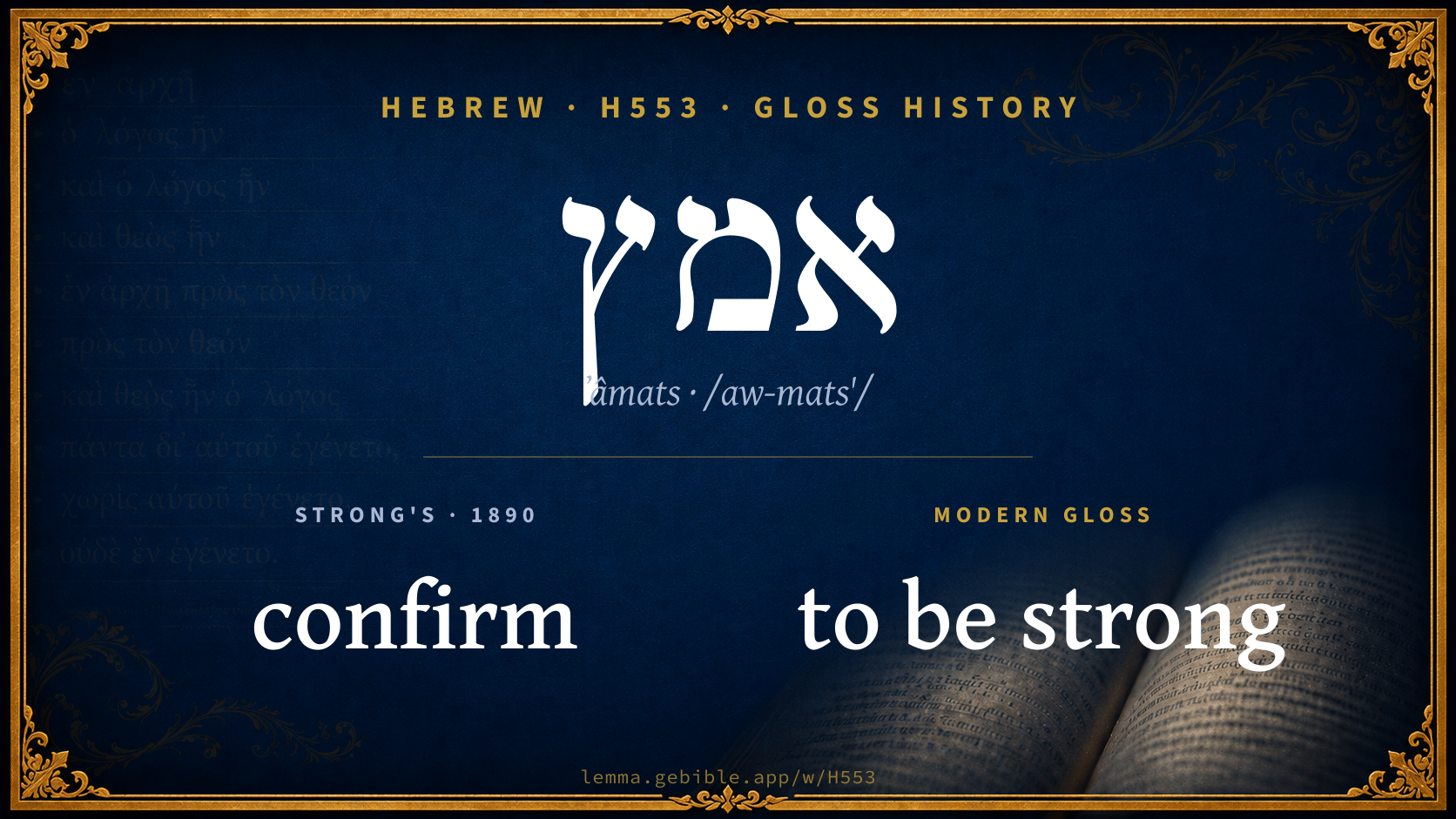
Gloss history
Strong's 1890 vs modern scholarship
About this word
Strong's H553 catalogs a Hebrew word from the Hebrew Old Testament.
These counts are not copied from any lexicon or concordance. They are computed here, from the morphology-tagged Hebrew Old Testament. What Lemma adds →
- 41
- distinct verses
- The word appears in 41 distinct verses.
- 14 / 39
- OT books
- The word appears in 14 of 39 Old Testament books.
- #891
- by frequency
- Top 1000 most frequent Hebrew words (rank 891 of 8,640 Hebrew words by occurrence).
View all 41 occurrences in the concordance →
Most concentrated in
- 2 Chronicles 7 verses 17%
- Psalms 7 verses 17%
- Deuteronomy 6 verses 15%
By section of the Old Testament
By traditional corpus
Conventional, traditional groupings — biblical authorship is debated, so this is a traditional corpus grouping, not an authorship claim. Each share is this word’s portion of its verses in that division of the Hebrew canon. Each figure is a share of the word’s 41 distinct verses.
- Writings (Ketuvim) 22 verses · 54%
- Prophets (Nevi'im) 12 verses · 29%
- Torah (Pentateuch) 7 verses · 17%
How translations render this word
Counts come from each version’s own published word-to-Strong’s tagging or interlinear alignment — an approximate guide to how each version renders this word, not a word-level alignment the data otherwise carries. Because each total is that version’s own tagged count, the per-version totals vary from one another and need not match the appearance or distinct-verse counts above. These counts may also differ from a printed concordance because Lemma counts each distinctly tagged rendering and does not collapse phrase taggings into a single head-word total. This is a fixed set of word-tagged versions (KJV, ASV, BSB, ULT) and does not change with the reading translation you choose elsewhere. Each version’s license is shown beside its name below (and on Sources).
- King James Version: Good courage 9×, Courageous 2×, He shall strengthen 2×
- American Standard Version: Good courage 9×, Be strong 2×, Made speed 2×
- Berean Standard Bible: Courageous 13×, Haste 2×, Too mighty 2×
- unfoldingWord Literal Text: Be courageous 9×, Courageous 4×, Let 2×
King James Version Public Domain
Renders H553 across 41 tagged occurrences — most commonly:
Plus 22 renderings that appear only once — usually multi-word phrases or single function words the recovered tagging swept in, not distinct renderings.
American Standard Version Public Domain
Renders H553 across 39 tagged occurrences — most commonly:
Plus 22 renderings that appear only once — usually multi-word phrases or single function words the recovered tagging swept in, not distinct renderings.
Berean Standard Bible Public Domain
Renders H553 across 41 tagged occurrences — most commonly:
Plus 22 renderings that appear only once — usually multi-word phrases or single function words the recovered tagging swept in, not distinct renderings.
unfoldingWord Literal Text CC BY-SA 4.0
Renders H553 across 50 tagged occurrences — most commonly:
Plus 25 renderings that appear only once — usually multi-word phrases or single function words the recovered tagging swept in, not distinct renderings.
12 senses and sub-senses in the full BDB
Hebrew verbs can shift meaning by stem (binyan): Qal is the basic action, Niphal is often passive or reflexive, Piel often intensifies or makes it factitive, and Hiphil is typically causative. The senses below are grouped under the stem BDB assigns to each. This entry also uses Hithpael (reflexive or reciprocal).
What do BDB’s symbols mean?
BDB uses these scholarly abbreviations:
| Symbol | Meaning |
|---|---|
| 𝔊 | the Septuagint (the ancient Greek translation, LXX) |
| 𝔙 | the Vulgate (the Latin translation) |
| 𝔖 | the Syriac version (the Peshitta) |
| 𝔗 | the Targum (the Aramaic translation) |
| ψ | the Psalms |
| √ | root (the underlying root or stem) |
| ‖ | parallel passage (a synonymous or contrasted parallel) |
| † | the dagger: every passage where the word occurs is cited |
The 12 senses and sub-senses the full Brown-Driver-Briggs lexicon distinguishes for this word, in lexicon order (not ranked by frequency), with BDB’s own verbatim wording and sub-sense lettering. Shown in Hebrew script with BDB’s own scholarly abbreviations. The condensed entry is in the Lexicon Entry tab. See also the Forms in the corpus table below.
Qal
- Pf. 3 pl. אָֽמְצוּ 2 S 22:18; + 2 times; Impf. יֶאֱמָ֑ץ Gn 25:23; וַיֶּאֶמְצוּ 2 Ch 13:18; Imv. אֱמַץ Jos 1:7 1 Ch 28:20; אֱמַ֑ץ Jos 1:6; אֱמָ֑ץ Dt 31:7 + 3 times; אִמְצוּ Dt 31:6 + 2 times— e.g. 2 Samuel 22:18
- 1. be strong, of a people Gn 25:23 (J); of personal enemies 2 S 22:18 = ψ 18:18; ψ 142:7 (all sq. מִן of compar.); also (without מן) prevail 2 Ch 13:18. e.g. Genesis 25:23
- 2. Imv. be bold (always ‖ חֲזַק, חִזְקוּ) Dt 31:7, 23 Jos 1:6, 7, 18; (‖ id. + אַל־תִּירְאוּ וְאַל־תַּעַרְצוּ) Dt 31:6; ‖ id. + אַל־תַּעֲרֹץ וְאַל תֵּחָת) Jos 1:9; (‖ id. + אַל תִּירְאוּ וְאַל תֵּחָ֑תּוּ) Jos 10:25 1 Ch 22:13; 28:20 2 Ch 32:7. e.g. Deuteronomy 31:7
Piel
- Pf. אִמֵּץ Dt 2:30 etc.; Impf. יְאַמֵּץ Am 2:14 etc.; וַיְאַמֶּץ־לוֹ Is 44:14 3 fs. sf. 3 ms. תְּאַמְּצֶנּוּ ψ 89:22; 1 s. sf. אֲאַמִּצְכֶם Jb 16:5 etc.; Imv. אַמֵּץ Na 2:2; אַמֵּ֑צוּ Is 35:3; אַמְּצֵ֑הוּ Dt 3:28; Inf. sf. אַמְּצוֹ Pr 8:28; Pt. מְאַמֶּץ־ Pr 24:5;— e.g. Deuteronomy 2:30
- 1. make firm, strengthen, sq. acc., of giving clouds their place Pr 8:28 (subj. י׳); of repairing temple 2 Ch 24:13; of physical vigour Pr 31:17 חָֽגְרָה בְעוֹז מָתְנֶי֑הָ וַתְּא׳ זְרוֹעֹתֶֽיהָ ׃ (subj. אֵשֶׁת חַיִל); of strength for war א׳ כֹּחַ Na 2:2 (‖ חִזֵּק מָתְנַיִם) Am 2:14 (subj. חָזָק); cf. Pr 24:5; of royal power 2 Ch 11:17 (‖ חִזֵּק); cf. א׳ בִּרְכַּיִם כֹּשְׁלוֹת Is 35:3; א׳ בּ׳ כֹּרְעוֹת Jb 4:4 (both ‖ חִזֵּק יָדַיִם רָפוֹת) fig. of encouragement; so א׳ alone Dt 3:28 (‖ חִזֵּק) Jb 16:5 (‖ חשׂך q.v.); ψ 89:22 (subj. זְרוֹעַ י׳); of support Is 41:10 (subj. י׳; ‖ עזר, תמך;—De Che sub 2). e.g. Proverbs 8:28
- 2. assure, secure for one’s self, always sq. ל + sf.; of carpenter appropr. tree Is 44:14; cf. of י׳ appropriating Isr. under fig. of bough ψ 80:16; under fig. of chosen man v. 18. e.g. Isaiah 44:14
- 3. sq. לֵבָב harden, make obstinate Dt 2:30; (subj. י׳; ‖ הִקְשָׁה רוּחוֹ) Dt 15:7 (of unkind man); 2 Ch 36:13 (of king Zedekiah, ‖ הִקְשָׁה אֶת־עָרְפּוֹ). e.g. Deuteronomy 2:30
Hithpael
- Pf. הִתְאַמֵּץ 1 K 12:18 = 2 Ch 10:18; Impf. וַיִּתְאַמְּצוּ 2 Ch 13:7; Pt. מִתְאַמֶּצֶת Ru 1:18; e.g. 1 Kings 12:18
- 1. strengthen oneself, of conspirators 2 Ch 13:7 (sq. עַל). e.g. 2 Chronicles 13:7
- 2. confirm oneself in a purpose, be determined Ru 1:18 (sq. ל + Inf.) e.g. Ruth 1:18
- 3. make oneself alert, make haste 1 K 12:18 = 2 Ch 10:18 (sq. ל + Inf.) e.g. 1 Kings 12:18
Hiphil
- Impf. Juss. exhibit strength, be strong וְיַאֲמֵץ, חֲזַק ויא׳ לִבֶּ֑ךָ ψ 27:14, so also 31:25. e.g. Psalms 27:14
Senses from the full Brown-Driver-Briggs lexicon (Brown, Driver, Briggs; Oxford 1906 — public domain), digitized via Sefaria, supplemented by the OpenScriptures HebrewLexicon (CC BY 4.0). Full attribution on Sources.
Word origin
vb. be stout, strong, bold, alert (according to LagBN 28 f. from earlier אָמֹץ cf. אֹמֶץ)—
— Brown-Driver-Briggs (Oxford 1906, public domain), digitized via Sefaria, supplemented by the OpenScriptures HebrewLexicon (CC BY 4.0). See Sources.
Origin: a primitive root
Jastrow Dictionary
A second Hebrew/Aramaic lexicon for comparison, covering Aramaic and post-biblical (Talmudic, Targumic, Midrashic) usage that the biblical-Hebrew BDB does not. Matched by lemma rather than by Strong’s number, so a lemma may carry more than one Jastrow headword (shown separately below), and the entries cover usage well beyond the Bible.
אָמַץ
- to press, harden. אוֹמְצֵי הלב hard-hearted. Tosef. Sot. XIV, 7; v. infra.
- 1. to make strong, to strengthen. Y. Taan. III, 66ᵈ all shall be מְאַמְּצִין כחך strengthening thy power (assist thee). Snh. 44ᵇ מאמץ עצמו וכ׳ who concentrates his energies for prayer.
- 2. to press, close; to make impervious. Sot. 47ᵇ מאַמְּצֵי הלב those who close their hearts, the hard-hearted; v. supra. [Sabb. XXIII, 5 מאמצין את המת Y. ed. (Mish. מעמ׳, Bab. ib. 151ᵇ מעצמין, Ms. M. מעמ׳) to close the eyes of a deceased person. Tosef. ib. XVII (XVIII), 19 לעַמֵּץ ed. Zuck. (Var. לאַמֵּץ). Sabb. 77ᵇ מעמצין או מאמצין וכ׳ is m’amm’tsin (l. c.) spelt with ע or with א? Answer by ref. to עוצם Is. XXXIII, 15(!).] V. אוּמְצָא. e.g. Isaiah 33:15
- to be closed. Tosef. l. c. מִתְאַמְּצוֹת מאיליהן they will be closed of themselves.
A Dictionary of the Targumim, the Talmud Babli and Yerushalmi, and the Midrashic Literature (Marcus Jastrow; London, Luzac, 1903) — Public Domain. Digitized via Sefaria. Digitized via Sefaria. Full attribution on Sources.
Forms in the corpus
The 36 distinct written forms H553 takes in the Hebrew Bible, most frequent first — each parse links to that stem’s occurrences in the concordance. Hebrew forms include their vowel points and cantillation, so a single lemma takes many written forms.
Same root — word family
Other BDB entries built from the same root as H553, grouped by Strong’s listed origin. These share a root / origin per the lexicon — not necessarily a shared meaning. Each links to that word’s own entry.
Derived from this word
- אמיץ ʼammîyts H533 strong
- אמץ ʼâmôts H554 strong
- אמץ ʼômets H555 strength
- אמצה ʼamtsâh H556 strength
- מאמץ maʼămâts H3981 strength
Proper names from this root
People and places named from this root — a name, not an additional meaning of the word.
Compare all same-root words → Showing 4 of 9 — not the complete family. 3 of the same-root words are proper names (people or places). They share a root, not necessarily a meaning.
Septuagint verse parallels
This word appears in 37 verses that also exist in the Greek Old Testament (Septuagint), out of the 41 Hebrew verses it occurs in. You can read those verses in Greek by switching the Old Testament edition to the Septuagint.
Read these verses in the Septuagint
- Genesis 25:23
- Deuteronomy 2:30
- Joshua 1:6
- Ruth 1:18
- 2 Samuel 22:18
- 1 Kings 12:18
- 1 Chronicles 22:13
- 2 Chronicles 10:18
- Job 4:4
- Psalms 80:15
- Proverbs 8:28
- Isaiah 35:3
This is a verse-level parallel only — the same verses exist in both the Hebrew and Greek Old Testaments. No word-level Hebrew↔Greek correspondence is claimed: the data carries no such alignment, so no Greek word is shown as this Hebrew word’s translation. Coverage is not total — the Septuagint omits the deuterocanon and renumbers the Psalms, so some Hebrew verses have no direct Greek parallel.