
Jeremiah 7:30

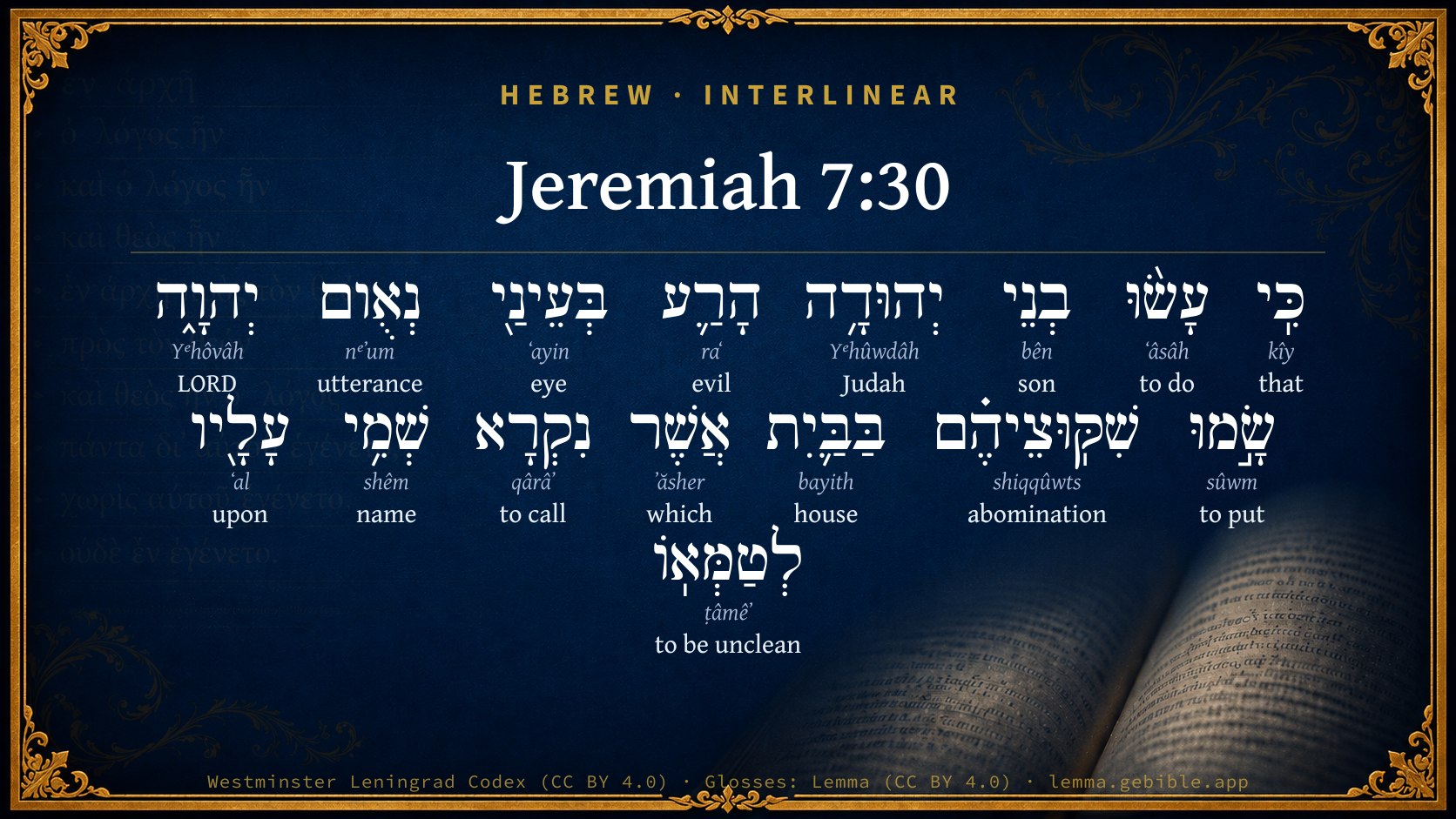
Hebrew (Westminster Leningrad Codex) Jeremiah 7:30 appears in the Hebrew Old Testament. The text above is from the Westminster Leningrad Codex. Each word links to its Strong’s number, a concise gloss, and parsing drawn from the Open Scriptures Hebrew Bible morphology. Click any word for its full Brown-Driver-Briggs (BDB) entry.
Download image
Cite this verse

Jeremiah 7:30 (World English Bible). Public Domain. Lemma interlinear Bible study tool, https://lemma.gebible.app/v/jeremiah/7/30.

Show BibTeX & RIS
BibTeX
RIS
English Translation
For the children of Judah have done that which is evil in my sight, says Yahweh: they have set their abominations in the house which is called by my name, to defile it.
World English Bible · Public Domain
Download a study sheet

One document with this verse’s original text, its word-by-word gloss line, the meaning frame, cross-references with their text, attributed commentary, and full source and license credits — printable, and it pastes into notes with its structure intact.

This verse Autodidact and up

Study sheet (.html) Plain text (.txt)

A passage Seminary Student

Up to 50 verses in one chapter. A passage sheet keeps up to 6 commentary sources and 12 cross-references per verse, in the order this page ranks them, and says so on the sheet whenever that leaves anything out. Ask for a single verse and you get the Autodidact verse sheet above.

Everything on this page stays free to read, with no account — the sheet is a download of what is already on screen, not access to it.

Want to remove ads? Support Godless Engineer
Compare translations 3

The same verse in 3 English versions, stacked beneath the original-language interlinear above. Click any original word for its lexicon entry.

Each is an independent rendering of the whole verse — the interlinear is not word-aligned to these translations.

Highlighted words mark where these versions differ — a whole-verse word diff, not a word-by-word alignment.

  • World English Bible Public Domain
    For the children of Judah have done that which is evil in my sight, says Yahweh: they have set their abominations in the house which is called by my name, to defile it.
  • King James Version Public Domain
    For the children of Judah have done evil in my sight, saith the LORD: they have set their abominations in the house which is called by my name, to pollute it.
  • unfoldingWord Literal Text CC BY-SA 4.0
    For the sons of Judah have done evil in my eyes”—the declaration of Yahweh—“they have set their detestable things in the house over which my name is called, to defile it.

unfoldingWord Literal Text — © unfoldingWord, licensed CC BY-SA 4.0. Word-aligned USFM3 via Door43 (git.door43.org/unfoldingWord/en_ult).

Versions to compare (up to 4)

3 of 4 selected

Show all 18 translations

Every available English version of this verse, each an independent rendering of the whole verse.

  • World English Bible Public Domain
    For the children of Judah have done that which is evil in my sight, says Yahweh: they have set their abominations in the house which is called by my name, to defile it.
  • Berean Standard Bible Public Domain
    For the people of Judah have done evil in My sight, declares the LORD. They have set up their abominations in the house that bears My Name, and so have defiled it.
  • Majority Standard Bible Public Domain
    For the people of Judah have done evil in My sight, declares the LORD. They have set up their abominations in the house that bears My Name, and so have defiled it.
  • King James Version Public Domain
    For the children of Judah have done evil in my sight, saith the LORD: they have set their abominations in the house which is called by my name, to pollute it.
  • American Standard Version (1901) Public Domain
    For the children of Judah have done that which is evil in my sight, saith Jehovah: they have set their abominations in the house which is called by my name, to defile it.
  • Revised Version (1885) Public Domain
    For the children of Judah have done that which is evil in my sight, saith the LORD: they have set their abominations in the house which is called by my name, to defile it.
  • Geneva Bible (1599) Public Domain
    For the children of Iudah haue done euill in my sight, sayth the Lord: they haue set their abominations in the House, whereupon my Name is called, to pollute it.
  • Douay-Rheims (1899) Public Domain
    Because the children of Juda have done evil in my eyes, saith the Lord. They have set their abominations in the house in which my name is called upon, to pollute it;
  • Young's Literal Translation Public Domain
    For the sons of Judah Have done the evil thing in Mine eyes, An affirmation of Jehovah, They have set their abominations in the house On which My name is called -- to defile it,
  • Literal Standard Version CC BY-SA 4.0
    For the sons of Judah || Have done evil in My eyes,” || A declaration of YHWH, || “They have set their abominations in the house || On which My Name is called—to defile it,
  • Unlocked Literal Bible CC BY-SA 4.0
    For the sons of Judah have done evil in my eye—this is Yahweh's declaration—they have set their detestable things in the house that is called by my name, in order to defile it.
  • unfoldingWord Literal Text CC BY-SA 4.0
    For the sons of Judah have done evil in my eyes”—the declaration of Yahweh—“they have set their detestable things in the house over which my name is called, to defile it.
  • Darby Bible Public Domain
    For the children of Judah have done evil in my sight, saith Jehovah; they have set their abominations in the house which is called by my name, to defile it.
  • World Messianic Bible Public Domain
    “For the children of Judah have done that which is evil in my sight,” says the LORD. “They have set their abominations in the house which is called by my name, to defile it.
  • Webster's Bible Public Domain
    For the children of Judah have done evil in my sight, saith the LORD: they have set their abominations in the house which is called by my name, to pollute it.
  • Free Bible Version CC BY-SA 4.0
    For the people of Judah have done what is evil in my sight, declares the Lord. They have placed their offensive idols in my own Temple, making it unclean.
  • Bible in Basic English Public Domain
    For the children of Judah have done what is evil in my eyes, says the Lord: they have put their disgusting images in the house which is named by my name, making it unclean.
  • JPS Tanakh (1917) Public Domain
    For the children of Judah have done that which is evil in My sight, saith the LORD; they have set their detestable things in the house whereon My name is called, to defile it.

Literal Standard Version (2020), Covenant Press — licensed CC BY-SA 4.0. Text via the HelloAO Bible API (eBible.org). Unlocked Literal Bible (unfoldingWord) — licensed CC BY-SA 4.0. Text via the HelloAO Bible API (eBible.org). unfoldingWord Literal Text — © unfoldingWord, licensed CC BY-SA 4.0. Word-aligned USFM3 via Door43 (git.door43.org/unfoldingWord/en_ult). Free Bible Version, Dr. Jonathan Gallagher — licensed CC BY-SA 4.0. Text via the HelloAO Bible API (eBible.org).

Word by word

More ways to search: Search by grammar → Find every occurrence → Compare this word →

Practice this passage: Drill this verse → Learn its vocabulary →

שִׁקּֽוּצֵיהֶ֗ם
shiqqûwts
H8251
“abominations · their”
Noun, Common, Masculine, Plural, Construct + Suffix, Personal, 3rd Person, Masculine, Plural
Part of Speech
Noun
Type
Common
Gender
Masculine
Number
Plural
State
Construct
Full BDB Definition

Origin: from H8262

TWOT: 2459b

detestable thing or idol, abominable thing, abomination, idol, detested thing
  1. כִּֽי kîy H3588 “that” Conjunction
  2. עָשׂ֨וּ ʻâsâh H6213 “to do” Verb, Qal, Perfect, 3rd Person, Common, Plural
  3. בְנֵי bên H1121 “sons of” Noun, Common, Masculine, Plural, Construct
  4. יְהוּדָ֥ה Yᵉhûwdâh H3063 “Judah” Noun, Proper
  5. הָרַ֛ע raʻ H7451 “the · evil” Particle, Definite Article + Adjective, Adjective, Masculine, Singular, Absolute
  6. בְּעֵינַ֖י ʻayin H5869 “in/at · eyes · my” Preposition + Noun, Common, Both, Dual, Construct + Suffix, Personal, 1st Person, Common, Singular
  7. נְאֻום nᵉʼum H5002 “utterance of” Noun, Common, Masculine, Singular, Construct
  8. יְהוָ֑ה Yᵉhôvâh H3068 “LORD” Noun, Proper
  9. שָׂ֣מוּ sûwm H7760 “to put” Verb, Qal, Perfect, 3rd Person, Common, Plural
  10. בַּבַּ֛יִת bayith H1004 “in/at the · house” Preposition, Determined + Noun, Common, Masculine, Singular, Absolute
  11. אֲשֶׁר ʼăsher H834 “which” Particle, Relative
  12. נִקְרָא qârâʼ H7121 “to call” Verb, Niphal, Perfect, 3rd Person, Masculine, Singular
  13. שְׁמִ֥י shêm H8034 “name · my” Noun, Common, Masculine, Singular, Construct + Suffix, Personal, 1st Person, Common, Singular
  14. עָלָ֖יו ʻal H5921 “upon · him” Preposition + Suffix, Personal, 3rd Person, Masculine, Singular
  15. לְטַמְּאֽוֹ ṭâmêʼ H2930 “to be unclean · him” Preposition + Verb, Piel, Infinitive Construct + Suffix, Personal, 3rd Person, Masculine, Singular

About this verse

These counts appear in no published source. They are computed here, from the morphology-tagged text and Lemma’s own curated glosses. What Lemma adds →

16
words
16
distinct lemmas
Prophets
section

Shared distinctive vocabulary

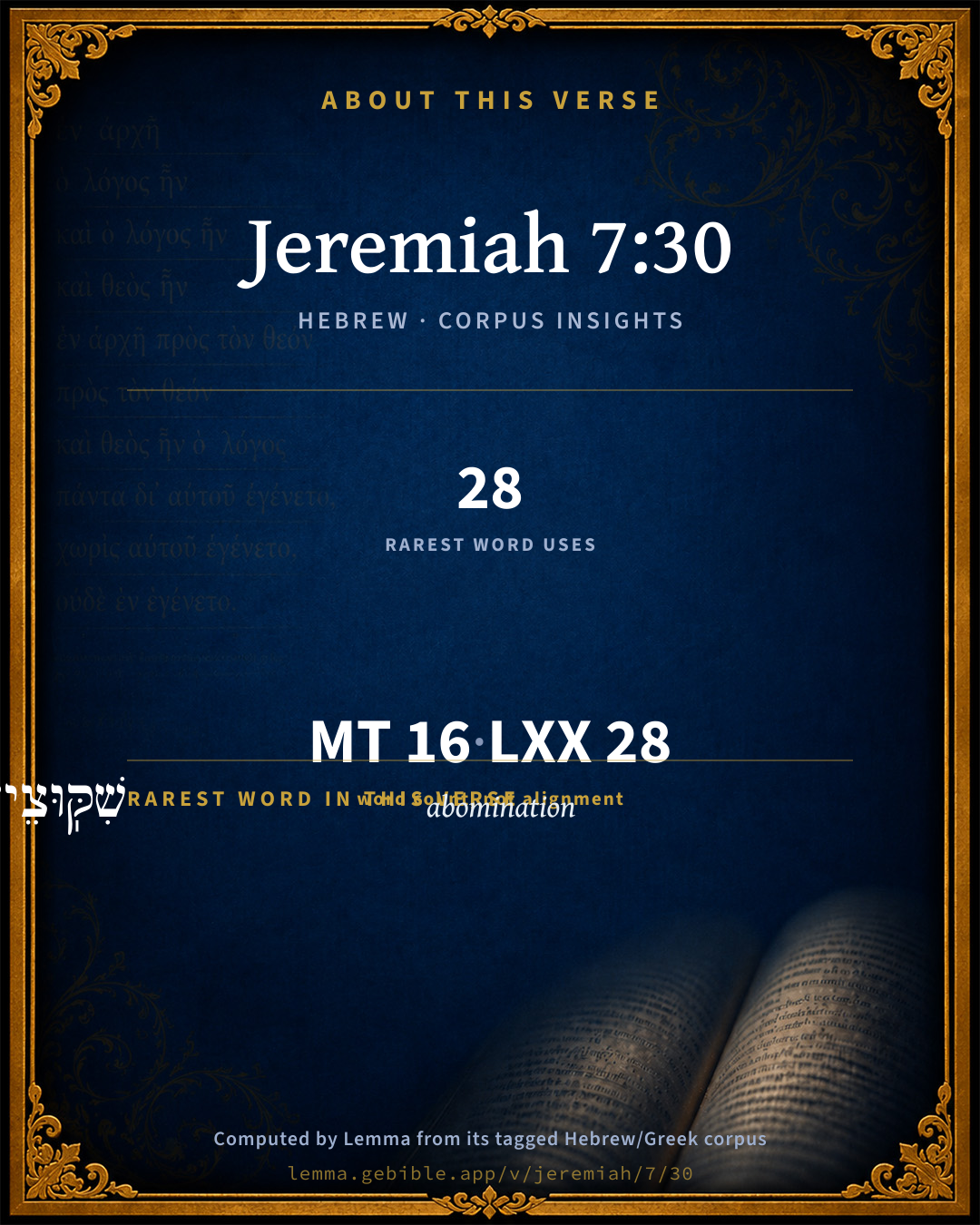
שִׁקּֽוּצֵיהֶ֗ם abomination H8251 occurs in 26 verses of the Hebrew Bible. Also found in:

Grammatical profile

  • 4 verbs
  • 8 nouns
  • 1 adjective
  • 1 preposition
  • 1 conjunction
  • 1 particle

Verb forms

  • עָשׂ֨וּ Qal · Perfect
  • שָׂ֣מוּ Qal · Perfect
  • נִקְרָא Niphal · Perfect
  • לְטַמְּאֽוֹ Piel · Infinitive Construct

Hebrew & Septuagint length

In the original languages it is 16 Hebrew tokens and 28 Greek tokens — but the two are counted differently (Hebrew bundles its prefixes and suffixes into one token; the Greek is in lemma form), so that isn’t a like-for-like length.

Cross-references

13

Topical passages linked to Jeremiah 7:30 in the Treasury of Scripture Knowledge — connected by theme and wording, ordered by reader-vote popularity; previews shown in the World English Bible.

  • Jeremiah 32:34 But they set their abominations in the house which is called by my name, to defile it.
  • Ezekiel 7:20 As for the beauty of his ornament, he set it in majesty; but they made the images of their abominations [and] their detestable things therein: therefore have I made it to them as an unclean thing.
  • Daniel 9:27 He shall make a firm covenant with many for one week: and in the midst of the week he shall cause the sacrifice and the offering to cease; and on the wing of abominations [shall come] one who makes desolate; and even to the full end, and that determined, shall [wrath] be poured out on the desolate.
  • 2 Kings 21:4 He built altars in the house of Yahweh, of which Yahweh said, In Jerusalem will I put my name.
  • 2 Kings 21:7 He set the engraved image of Asherah, that he had made, in the house of which Yahweh said to David and to Solomon his son, In this house, and in Jerusalem, which I have chosen out of all the tribes of Israel, will I put my name forever;
  • 2 Chronicles 33:4–5 He built altars in the house of Yahweh, of which Yahweh said, In Jerusalem shall my name be forever.
  • 2 Chronicles 33:7 He set the engraved image of the idol, which he had made, in the house of God, of which God said to David and to Solomon his son, In this house, and in Jerusalem, which I have chosen out of all the tribes of Israel, will I put my name forever:
  • 2 Kings 23:4–6 The king commanded Hilkiah the high priest, and the priests of the second order, and the keepers of the threshold, to bring forth out of the temple of Yahweh all the vessels that were made for Baal, and for the Asherah, and for all the host of the sky, and he burned them outside of Jerusalem in the fields of the Kidron, and carried the ashes of them to Bethel.
  • 2 Kings 23:12 The altars that were on the roof of the upper chamber of Ahaz, which the kings of Judah had made, and the altars which Manasseh had made in the two courts of the house of Yahweh, did the king break down, and beat [them] down from there, and cast the dust of them into the brook Kidron.
  • 2 Chronicles 33:15 He took away the foreign gods, and the idol out of the house of Yahweh, and all the altars that he had built in the mountain of the house of Yahweh, and in Jerusalem, and cast them out of the city.
  • Jeremiah 23:11 for both prophet and priest are profane; yes, in my house have I found their wickedness, says Yahweh.
  • Ezekiel 8:5–17 Then said he to me, Son of man, lift up your eyes now the way toward the north. So I lifted up my eyes the way toward the north, and see, northward of the gate of the altar this image of jealousy in the entry.
  • Ezekiel 43:7–8 He said to me, Son of man, [this is] the place of my throne, and the place of the soles of my feet, where I will dwell in the midst of the children of Israel forever. The house of Israel shall no more defile my holy name, neither they, nor their kings, by their prostitution, and by the dead bodies of their kings [in] their high places;

Cross-references courtesy of OpenBible.info (CC BY 4.0).

Hebrew and Greek witnesses Masoretic Hebrew ↔ Greek Septuagint

The same verse in the two great witnesses to the Old Testament, shown verse-for-verse.

These are two independent witnesses, not word-aligned to each other, and the Septuagint is shown in lemma (dictionary) form.

Hebrew Jeremiah 7:30 Masoretic · Westminster Leningrad Codex

כִּֽי עָשׂ֨וּ בְנֵי יְהוּדָ֥ה הָרַ֛ע בְּעֵינַ֖י נְאֻום יְהוָ֑ה שָׂ֣מוּ שִׁקּֽוּצֵיהֶ֗ם בַּבַּ֛יִת אֲשֶׁר נִקְרָא שְׁמִ֥י עָלָ֖יו לְטַמְּאֽוֹ

For the children of Judah have done that which is evil in my sight, says Yahweh: they have set their abominations in the house which is called by my name, to defile it.

World English Bible · Public Domain

Greek LXX Structure differs

In the Septuagint, Jeremiah is about an eighth shorter than the Hebrew and arranges its material differently — the Oracles Against the Nations (Hebrew chapters 46–51) appear in the middle of the Greek book, after 25:13. Because the chapter and verse boundaries do not line up, a verse-for-verse comparison with the Hebrew is not shown.

A verse-for-verse comparison isn’t shown here because the chapters and verses don’t line up. Switch to the LXX edition with the MT / LXX toggle above to read the Greek directly.

Hebrew: Westminster Leningrad Codex (CC BY 4.0). Greek: Septuagint (public domain); English from a public-domain English Septuagint. How the Septuagint differs from the Hebrew →

Targum (Aramaic paraphrase)

1

The Targum is the ancient Jewish Aramaic paraphrase of the Hebrew Scriptures — an interpretive translation, not the Hebrew text itself. Onkelos (literal) and Pseudo-Jonathan (expansive) render the Torah, and Jonathan the Prophets. Coverage is partial: where no permissively-licensed English translation exists for a verse, only the Aramaic is shown. This is verse-level text, not a word-by-word alignment to the Hebrew.

  1. Targum Jonathan Prophets (Joshua–Malachi)
    אֲרֵי עֲבָדוּ בְנֵי יְהוּדָה דְבִישׁ קֳדָמַי אֲמַר יְיָ שַׁוִיאוּ שִׁקוּצֵיהוֹן בְּבֵיתָא דְאִתְקְרֵי שְׁמִי עֲלוֹהִי לְסַאֲבוּתֵיהּ:

    (no public-domain English translation for this verse)

    Targum Jonathan — Aramaic: “Mikraot Gedolot” (public domain). English: “Sefaria Community Translation” (CC0 1.0 (public-domain dedication)); “London "Chaldee Paraphrase," 1871” (public domain). Text via Sefaria.

Commentary

Notes on Jeremiah 7:30 from classic Christian and Jewish commentators (each source and its license shown beneath its notes). The classic Christian expositions comment on the surrounding passage and are grouped to its opening verse, so a note may address several verses; the Jewish commentaries on the Tanakh (Rashi and others) are per-verse, so they appear only where the commentator wrote on this verse.

Lemma curates 59 commentaries, every one of them public domain or Creative Commons licensed, each selected and text-cleaned for this edition rather than reprinted as found. About our sources →

Trapp's Complete Commentary

John Trapp

Jer 7:30 For the children of Judah have done evil in my sight, saith the LORD: they have set their abominations in the house which is called by my name, to pollute it.

Ver. 30. They have set their abominations in the house.] So do those now that broach heresies in the Church.

John Trapp, A Commentary or Exposition upon All the Books of the Old and New Testament (1647–1656) — public domain. Text from a community e-Sword module.

Joseph Benson's Commentary

Jer 7:30-31. They have set up their abominations, &c. — They have set up images and altars for idolatrous worship even in my temple, and the courts near it. This seems to be spoken of what was done in the times of Manasseh, or Amon, 2Ki 21:4; 2Ki 21:7; 2Ch 33:4. And they have built the high places of Tophet — To burn their sons and their daughters in the fire. Concerning this unnatural and cruel custom of burning their children, by way of sacrifice to Moloch, which was derived from the Canaanites, see notes on Lev 18:21; 2Ki 23:10; Isa 30:33. Which I commanded them not — But, on the contrary, expressed the greatest detestation of it, and forbade it under the severest penalties: see Lev 20:1-5. The words are spoken by the figure called meiosis, by which a great deal less is expressed than is implied; a way of speaking frequent in Scripture. Thus, Deu 17:3, God, speaking of the worship of the host of heaven, adds, Which I have not commanded, meaning, which I expressly forbade. So God, reproving the idolatry of the Jews, says, Isa 65:12, They choose things wherein I delighted not, that is, which I utterly abhorred. And Jeremiah (Jer 2:8) calls idols, things that do not profit, meaning, that their worship was not only insignificant, but likewise extremely wicked and destructive. Thus St. Paul expresses the vilest sins, by calling them things which are not convenient, Rom 1:28.

Joseph Benson's Commentary on the Old and New Testaments (1811–1818) — public domain. Text from a community e-Sword module.

Tyndale Open Study Notes

Tyndale Open Resources

7:30–8:3 This message decreed death for the people of Judah. It was finally fulfilled in the destruction of Jerusalem (586 BC).

7:30-34 The valley of Ben-Hinnom began on the west side of Jerusalem and continued around the south side. This narrow, steep-sided valley opened into the Kidron Valley and was the city’s combined garbage dump and graveyard. The bodies of the poor who were murdered or died of disease were dumped there, and child sacrifice (a practice totally abhorrent to the Lord; see 2 Chr 28:3; 33:6) was performed there. The valley was also known as Topheth (2 Kgs 23:10; Isa 30:33), perhaps referring to the ritual drums (Hebrew top) or to the sacrificial fires (tap) that were used there. In the New Testament it is called Gehenna, and Jesus compared hell to the fire that burned continuously in that valley (see study note on Matt 5:29). Before long, it would be known as the Valley of Slaughter, because the siege and destruction of Jerusalem (588–586 BC) would fill the valley to overflowing with the bodies of the slain.

Tyndale Open Study Notes — © Tyndale Open Resources, licensed CC BY-SA 4.0. Text via the HelloAO Bible API.

Jamieson, Fausset & Brown

Robert Jamieson, A. R. Fausset & David Brown

set their abominations in the house-- (Jer 32:34; Kg2 21:4, Kg2 21:7; Kg2 23:4; Eze 8:5-14).

Jamieson, Fausset & Brown — Commentary Critical and Explanatory on the Whole Bible (1871) — public domain (CC PDM 1.0). Text via the HelloAO Bible API.

John Calvin's Commentaries

Lest the Jews should murmur and complain that God was too rigorous, the Prophet adds, that they were not given up to destruction without the justest reasons. How so? They had done evil To do evil here means, that they had not offended in one thing, but had given themselves up to wickedness and evil doings. It is the same as though he had said, that they were so corrupt that they were wholly inured to the doing of evil, and had by long use contracted evil habits; for they continually provoked God. But as they flattered themselves, the Prophet reminds them here of God’s judgment: “It is enough, “he says, “that the Judge condemns you; for if ye see not your wickedness nor acknowledge your sin, yet this will not avail you; for God declares that you are guilty in his sight.”

We see that there is an implied contrast between the sight of God and the delusions by which hypocrites soothed themselves, while they made evasions or perversely excused their sins, or sought to escape by circuitous windings. God then shews that his own sight, or knowledge, is sufficient, how blind soever man may be, and however the whole world may connive at their sins.

He adds one kind of sin, that they had set up their abominations in the Temple. This refers to superstitions. But as we have seen elsewhere, and shall often have to observe, the Prophets frequently reproved sins by mentioning only one sin for the whole. Then what was especially wicked in the people he states, and that was, that the Temple was polluted with superstitions. We have already said, that it was an intolerable sacrilege to pollute the Temple with abominations, which was then the only true Temple in the world: for it was God’s will that sacrifices should be offered to him in that one place; and he had carefully described everything necessary for a right worship. When, therefore, the Jews polluted that very Temple, how abominable was such a profanation? It was not then without reason that the Prophet brings forward what was especially wicked in the people, — that God’s house was polluted with superstitious and many spurious ceremonies, and that there his whole worship was vitiated. The rest to-morrow.

John Calvin's Commentaries (1540-1563) — public domain. Text from the Calvin Translation Society English edition (1840s-50s) via the Christian Classics Ethereal Library (ccel.org). Calvin's coverage is partial (roughly two-thirds of the Bible); uncommented books and verses are honest gaps, never fabricated. The 19th-century editor's footnotes and remarks are omitted so the notes are faithfully Calvin's own voice.

Ellicott's Commentary for English Readers

(30) In the house which is called by my name.—This had been done by Ahaz (2Ch_28:2), and after the Temple had been cleansed by Hezekiah (2Ch_29:5) had been repeated by Manasseh (2Ki_21:4-7; 2Ch_33:3-7). Josiah’s reformation again checked the tendency to idolatry (2Ki_23:4; 2Ch_34:3); but it is quite possible that the pendulum swung back again when his death left the idolatrous party in Judah free to act, and that this special aggravation of the evil, the desecration of the Temple of Jehovah by “abominations” of idol-worship, re-appeared together with the worship of the Queen of Heaven and the sacrifices to Molech.

A Bible Commentary for English Readers, edited by Charles John Ellicott (1878–1897) — public domain. Text from a community e-Sword module.

The Cambridge Bible for Schools and Colleges

gen. ed. J. J. S. Perowne

30. they have set their abominations] as Manasseh had done (2Ki_21:5; 2Ki_21:7).

The Cambridge Bible for Schools and Colleges (gen. ed. J. J. S. Perowne; Cambridge University Press, 1878–1918) — public domain. Text from a community e-Sword module.

John Gill's Exposition

For the children of Judah have done evil in my sight, saith the Lord,.... Meaning not a single action only, but a series, a course of evil actions; and those openly, in a daring manner, not only before men, but in the sight of God, and in contempt of him, like the men of Sodom, Gen 13:13,

they have set their abominations in the house which is called by my name, to defile it; that is, set their idols in the temple; here Manasseh set up a graven image of the grove, Kg2 21:7 which was done, as if it was done on purpose to defile it.

John Gill's Exposition of the Whole Bible (1746–1763) — public domain (CC PDM 1.0). Text via the HelloAO Bible API.

Haydock's Catholic Bible Commentary

Abominations. Hebrew. We have literally, "stumbling-blocks," offendicula. (Haydock) --- Manasses placed idols in the very temple, as the last kings of Juda did, 4 Kings xxiii. 4., and Ezechiel viii. 3.

George Leo Haydock (1774–1849), Haydock's Catholic Family Bible and Commentary, 1859 edition — public domain. Excludes Psalms (Douay-Rheims chapter numbering differs from Protestant) and Deuterocanonical books (Catholic canon only).

Matthew Poole's English Annotations

The children of Judah; either Judah’s posterity, Jos 14:6, or Judah’s inhabitants, which are often called their children; so Jer 2:16. In my sight, i.e. though they will not see it, yet I see it, and they shall know that it is in my sight, i.e. that it displeaseth me.

They have set their abominations in the house which is called by my name: here he instanceth in one species of their abominations for all the rest, whereby it appears they were grown to a great height of impiety. It was not enough to have their idols and superstitions abroad in the hills and groves, nor in private in their own houses, Isa 57:6-8; Jer 19:13; but they must bring them into God’s house, as Manasseh did, 2Ki 21:4; God having but one house in the world, as it were, to confront him, 2Ch 36:14; Jer 32:31; Eze 43:8.

Matthew Poole's English Annotations on the Holy Bible (1683–1685) — public domain. Text from a community e-Sword/MySword module.

Whedon's Commentary on the Bible

Daniel D. Whedon

30. Have set their abominations in the house… called by my name — Probably alluding to the profanation of the temple by Manasseh. 2Ki_21:5; 2Ki_21:7.

Daniel D. Whedon (gen. ed.), Commentary on the Old and New Testaments (1874–1909) — public domain. Text from a community e-Sword module.

The Pulpit Commentary

They have set their abominations, etc.; alluding, doubtless, to the altars which Manasseh built "for all the host of heaven in the two courts of the house of Jehovah," and especially to the image of the Canaanitish goddess Asherah, which he set up in the temple itself. (2Ki_21:5, 2Ki_21:7)

The Pulpit Commentary (1880–1919), ed. H.D.M. Spence-Jones & Joseph S. Exell — public domain. Text from a community e-Sword module.

John Wesley's Explanatory Notes

In the house - It was not enough to have their idols abroad in the hills and groves, but they must bring them into God's house.

John Wesley, Explanatory Notes Upon the Whole Bible (1754–1765) — public domain. Text via the GEBible commentary corpus.

Lesson kit

Teaching starters — assembled from the data on this page, not authored interpretation. Every prompt links to the verse data it draws on. Edit before teaching.

Jeremiah, in the Prophets, opens this verse with 16 words (16 distinct Hebrew lemmas). Its most distinctive word is shiqqûwts (“abomination”). A historical commentator’s framing appears above. Read the whole chapter for the surrounding context.

Discussion questions

  1. How does “abomination” (shiqqûwts) shape what this verse is saying?
  2. How does Deuteronomy 29:17, which shares the word «abomination», read alongside this verse?
  3. The translations on this page render this verse differently — a whole-verse word diff, not a word-by-word alignment. What might account for the different wordings?
  4. «עָשׂ֨וּ» is a Qal Perfect verb. How does that grammatical form shape the action described?
  5. Compare how Trapp's Complete Commentary and Joseph Benson's Commentary read this verse. Where do they agree or differ?

Things to notice

Reading settings

Reading text

Shown beneath each verse's original-language words.

Old Testament
Old Testament edition

Read the OT as the Masoretic Hebrew (MT) or the Greek Septuagint (LXX).

English shown for the Greek Septuagint (in the Hebrew ↔ Greek comparison).

Comparing translations? Open the Compare panel on any verse page to stack up to four side by side.