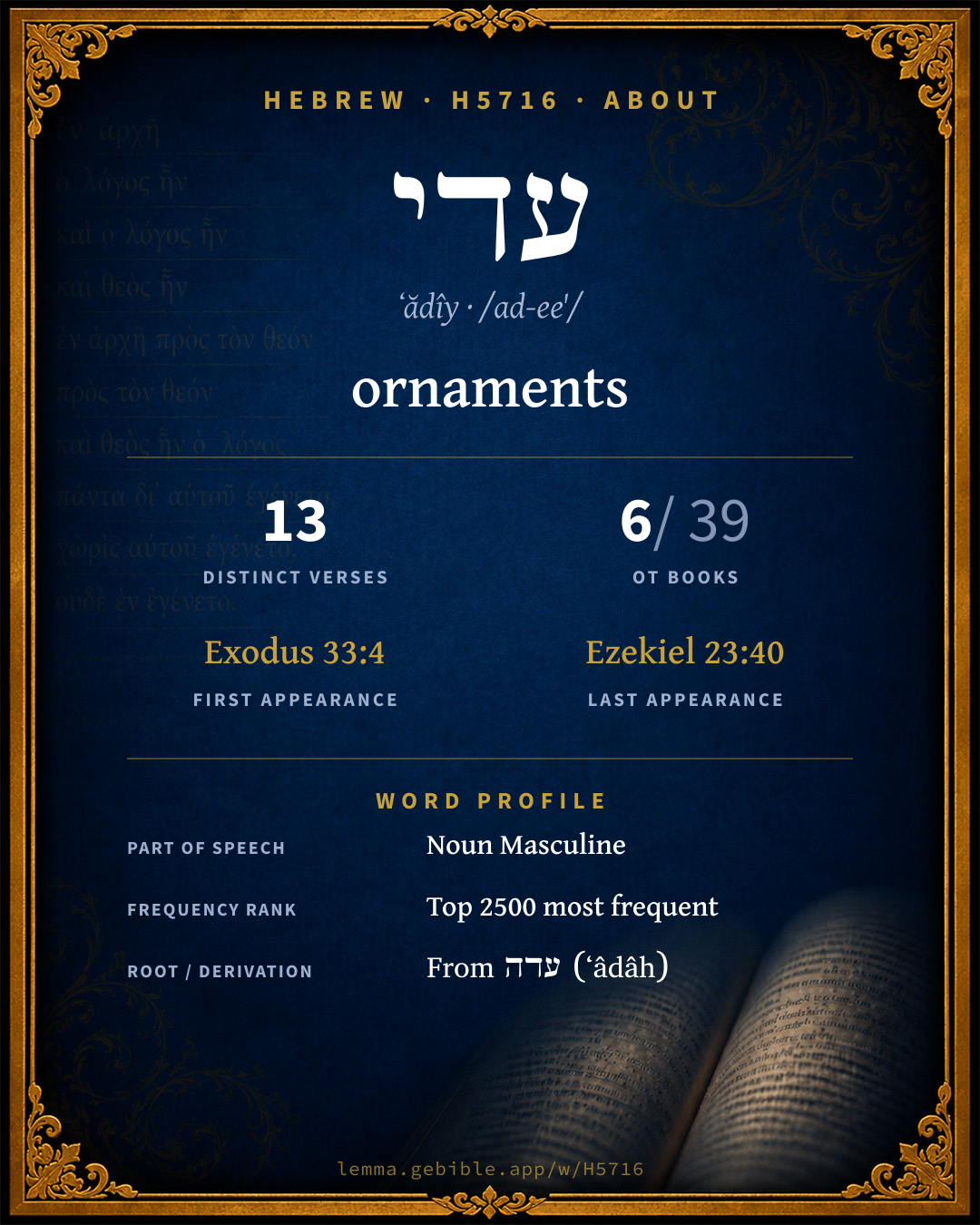
עֲדִי
ornaments
‘ornaments’ is one of 2 main senses fuller range ↓
Full lexicon entry — Brown-Driver-Briggs (BDB)
From Brown-Driver-Briggs (BDB)
Where this word appears
See every Construct-state word in the Hebrew Bible →
Grammar key — what these labels mean
Part of speech
- Noun
- A naming word — a person, place, thing, or idea.
Noun type
- Common
- A common noun — a general class of person, place, or thing (“king,” “city,” “water”), not a specific name.
State
- Construct
- A noun bound to a following noun in a possessive / “of” relationship (the construct chain).
- Absolute
- The independent form of a noun, not bound to a following word.
Gender
- Masculine
- Grammatically masculine.
Number
- Singular
- One.
- Plural
- More than one (in Hebrew, generally three or more).
Grammatical forms
- Noun, Common, Masculine, Singular, Construct 10 times (71%)
- Noun, Common, Masculine, Singular, Absolute 3 times (21%)
- Noun, Common, Masculine, Plural, Absolute 1 time (7%)
Parsed forms decoded from the imported morphology (morphhb / Westminster Leningrad Codex — WLC text public domain, morphhb tagging CC BY 4.0), counted across 14 parsed occurrences — not distinct verses.
Every verse where H5716 appears — 13 distinct verses across 6 books. Click any verse to open its interlinear word-by-word view. Verse text shown in the World English Bible for context — . Each verse’s Hebrew form is shown with its reference; the English is not keyword-highlighted, since the data carries no word-level English alignment. Use “Compare translations” on any verse to read it across multiple English versions. This concordance covers the Hebrew Bible; Septuagint (Greek Old Testament) occurrences are not indexed here.
Exodus 3 verses
- Exodus 33:4 עֶדְי֖/וֹ n c ms cs + sfx pers 3ms When the people heard this evil news, they mourned: and no one put on his jewelry.
- Exodus 33:5 עֶדְיְ/ךָ֙ n c ms cs + sfx pers 2ms Yahweh said to Moses, "Tell the children of Israel, 'You are a stiff-necked people. If I were to go up into your midst for one moment, I would consume you. Therefore now take off your jewelry from you, that I may know what to do to you."
- Exodus 33:6 עֶדְיָ֖/ם n c ms cs + sfx pers 3mp The children of Israel stripped themselves of their jewelry from Mount Horeb onward.
2 Samuel 1 verse
Psalms 2 verses
- Psalms 32:9 עֶדְי֣/וֹ n c ms cs + sfx pers 3ms Don't be like the horse, or like the mule, which have no understanding, Who are controlled by bit and bridle, or else they will not come near to you.
- Psalms 103:5 עֶדְיֵ֑/ךְ n c ms cs + sfx pers 2fs Who satisfies your desire with good things, So that your youth is renewed like the eagle's.
Isaiah 1 verse
Jeremiah 2 verses
- Jeremiah 2:32 עֶדְיָ֔/הּ n c ms cs + sfx pers 3fs Can a virgin forget her ornaments, or a bride her attire? yet my people have forgotten me days without number.
- Jeremiah 4:30 עֲדִי n c ms cs You, when you are made desolate, what will you do? Though you clothe yourself with scarlet, though you deck you with ornaments of gold, though you enlarge your eyes with paint, in vain do you make yourself beautiful; [your] lovers despise you, they seek your life.
Ezekiel 4 verses
- Ezekiel 7:20 עֶדְי/וֹ֙ n c ms cs + sfx pers 3ms As for the beauty of his ornament, he set it in majesty; but they made the images of their abominations [and] their detestable things therein: therefore have I made it to them as an unclean thing.
- Ezekiel 16:7 בַּ/עֲדִ֣י עֲדָיִ֑ים prep + n c ms cs n c mp I caused you to multiply as that which grows in the field, and you increased and grew great, and you attained to excellent ornament; your breasts were fashioned, and your hair was grown; yet you were naked and bare.
- Ezekiel 16:11 עֶ֑דִי n c ms I decked you with ornaments, and I put bracelets on your hands, and a chain on your neck.
- Ezekiel 23:40 עֶֽדִי n c ms Furthermore you have sent for men who come from far, to whom a messenger was sent, and, behold, they came; for whom you did wash yourself, paint your eyes, and deck yourself with ornaments,
About this entry
At a glance — auto-summarized from this page’s data, not written by a person. Every figure links to its source below. This summary describes the numbers; it doesn’t interpret them.
The Hebrew noun עדי centers on the idea of “ornaments.” Its English rendering has broadened — “ornaments” classically, “jewelry” (Berean Standard Bible) in modern versions; see the renderings breakdown. Spanning 13 verses in 6 books, it ranks among the uncommon words of the Hebrew Bible. Ezekiel dominates its distribution — 4 of 13 verses. Its meaning spans more than one sense — see its full sense range. Dig into 13-verse concordance and the renderings breakdown below.
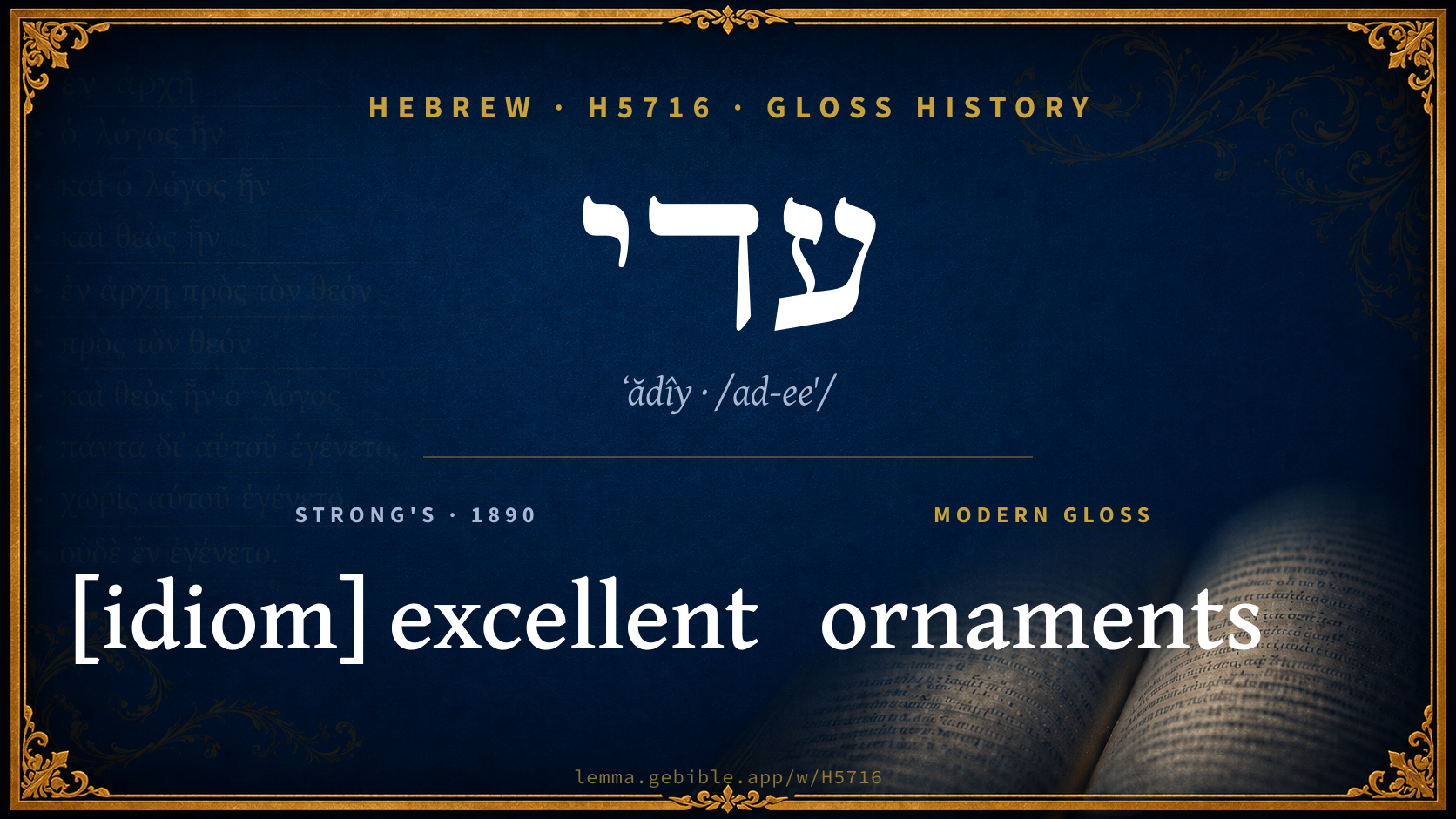
Gloss history
Strong's 1890 vs modern scholarship
About this word
Strong's H5716 catalogs a Hebrew word from the Hebrew Old Testament.
These counts are not copied from any lexicon or concordance. They are computed here, from the morphology-tagged Hebrew Old Testament. What Lemma adds →
- 13
- distinct verses
- The word appears in 13 distinct verses.
- 6 / 39
- OT books
- The word appears in 6 of 39 Old Testament books.
- #1,910
- by frequency
- Top 2500 most frequent Hebrew words (rank 1,910 of 8,640 Hebrew words by occurrence).
View all 13 occurrences in the concordance →
By section of the Old Testament
By traditional corpus
Conventional, traditional groupings — biblical authorship is debated, so this is a traditional corpus grouping, not an authorship claim. Each share is this word’s portion of its verses in that division of the Hebrew canon. Each figure is a share of the word’s 13 distinct verses.
- Prophets (Nevi'im) 8 verses · 62%
- Torah (Pentateuch) 3 verses · 23%
- Writings (Ketuvim) 2 verses · 15%
How translations render this word
Counts come from each version’s own published word-to-Strong’s tagging or interlinear alignment — an approximate guide to how each version renders this word, not a word-level alignment the data otherwise carries. Because each total is that version’s own tagged count, the per-version totals vary from one another and need not match the appearance or distinct-verse counts above. These counts may also differ from a printed concordance because Lemma counts each distinctly tagged rendering and does not collapse phrase taggings into a single head-word total. This is a fixed set of word-tagged versions (KJV, ASV, BSB, ULT) and does not change with the reading translation you choose elsewhere. Each version’s license is shown beside its name below (and on Sources).
BDB lists this Strong’s number as 2 distinct words (homographs). Each count above pools all of them and is not split by sense — see the Senses section below. A low-frequency rendering may belong to a different one of those words, not the primary meaning.
- King James Version†: Ornaments 5×, Mouth 2×
- American Standard Version†: Ornaments 3×, Ornament 2×, Thee with ornaments 2×
- Berean Standard Bible†: Jewelry 6×, Ornaments 2×
- unfoldingWord Literal Text†: Ornaments 4×, Jewelry 2×
King James Version Public Domain
Renders H5716 across 14† tagged occurrences — most commonly:
Plus 7 renderings that appear only once — usually multi-word phrases or single function words the recovered tagging swept in, not distinct renderings.
American Standard Version Public Domain
Renders H5716 across 14† tagged occurrences — most commonly:
Plus 7 renderings that appear only once — usually multi-word phrases or single function words the recovered tagging swept in, not distinct renderings.
Berean Standard Bible Public Domain
Renders H5716 across 12† tagged occurrences — most commonly:
Plus 4 renderings that appear only once — usually multi-word phrases or single function words the recovered tagging swept in, not distinct renderings. Not rendered by a distinct English word in 2 further occurrences.
unfoldingWord Literal Text CC BY-SA 4.0
Renders H5716 across 14† tagged occurrences — most commonly:
Plus 8 renderings that appear only once — usually multi-word phrases or single function words the recovered tagging swept in, not distinct renderings.
Senses in the full BDB
What do BDB’s symbols mean?
BDB uses these scholarly abbreviations:
| Symbol | Meaning |
|---|---|
| 𝔊 | the Septuagint (the ancient Greek translation, LXX) |
| 𝔙 | the Vulgate (the Latin translation) |
| 𝔖 | the Syriac version (the Peshitta) |
| 𝔗 | the Targum (the Aramaic translation) |
| ψ | the Psalms |
| √ | root (the underlying root or stem) |
| ‖ | parallel passage (a synonymous or contrasted parallel) |
| † | the dagger: every passage where the word occurs is cited |
The 4 senses and sub-senses the full Brown-Driver-Briggs lexicon distinguishes for this word, in lexicon order (not ranked by frequency), with BDB’s own verbatim wording and sub-sense lettering. Shown in Hebrew script with BDB’s own scholarly abbreviations. The condensed entry is in the Lexicon Entry tab. See also the Forms in the corpus table below.
- 1. of women 2 S 1:24 (ע׳ זָהָב), Je 2:32; of Jerus. under fig. of woman 4:30 (ע׳ זָהָב), Ez 16:11; 23:40 (all acc. cogn. c. עָדָה), Is 49:18 (sim.).—עֲדִי עֲדָיִים Ez 16:7, read prob. עַד עִדִּים unto menstruation (maturity), JDMich Co Berthol (reading בְּעֵת עִדּ׳), Toy. עֶדְיֵךְ ψ 103:5 [sf. ref. to נַפְשִׁי] is dub., 𝔊 τ. ἐπιθυμίαν σου (reading אַוָּתֵךְ? this usually c. נֶפֶשׁ]; thine age, prime (cf. 1. עַד) JDMich Thes; conject. in Hup-Now Che Du. e.g. 2 Samuel 1:24
- 2. of men Ex 33:4, 5, 6 (JE). e.g. Exodus 33:4
- 3. in gen., as feeding pride Ez 7:20 (צְבִי עֶדְיוֹ, sf. ref. to silver and gold, v 19). e.g. Ezekiel 7:20
- 4. trappings of horse ψ 32:9 (De Hup, cf. Du), si vera l., but prob. corrupt; Che (after v. Ortenb.) לִבְלֹ֑ם עַד יוּבַל אֵלֶיךָ must be curbed till he can be brought, etc. e.g. Psalms 32:9
Senses from the full Brown-Driver-Briggs lexicon (Brown, Driver, Briggs; Oxford 1906 — public domain), digitized via Sefaria, supplemented by the OpenScriptures HebrewLexicon (CC BY 4.0). Full attribution on Sources.
Word origin
n.[m.] coll. ornaments (with which one is decked);—ע׳ abs. Is 49:18, עֶדִ֑י Ez 16:11; 23:40; cstr. 2 S 1:24 +; sf. עֶדְיוֹ Ex 33:4 +, עֶדְיְךָ Ex 33:5, etc.;—ornaments:
— Brown-Driver-Briggs (Oxford 1906, public domain), digitized via Sefaria, supplemented by the OpenScriptures HebrewLexicon (CC BY 4.0). See Sources.
Derived from עדה (ʻâdâh) (H5710) — to pass on.
Jastrow Dictionary
A second Hebrew/Aramaic lexicon for comparison, covering Aramaic and post-biblical (Talmudic, Targumic, Midrashic) usage that the biblical-Hebrew BDB does not. Matched by lemma rather than by Strong’s number, so a lemma may carry more than one Jastrow headword (shown separately below), and the entries cover usage well beyond the Bible.
עדי
- [to turn, pass; cmp. סוּר and חוּל,] to pass by; to pass away, v. next w.
- to be passed, be caught in passing. Lev. R. s. 26 (ref. to I Sam. XXIV, 11, a. XXVI, 14) בכנף אמרת בסירה ה׳ … בסירה הוּעֲדוּ as to the skirt (of Saul’s cloak) thou saidst, it was caught in a bush: have the spear and the cruise also been caught in the bush?; Num. R. s. 19 הוּעֲדַת (read the second time הועדו); Midr. Till. to Ps. VII; Yalk. Sam. 133, a. e.; (Y. Peah I, 16ᵃ bot.; Y. Sot. I, 17ᵇ הוערת, הוערו, הערת, v. עָרָה). e.g. 1 Samuel 24:11
עֲדֵי
- 1. (corresp. to h. עָבַר) to pass by, between &c. Targ. O. Gen. XV, 17 עָדָא ed. Berl. (ed. Vien. די עֲדָא; ed. Amst. עברא). Targ. Is. XLV, 14 יֶעְדּוּן (ed. Lag. יעידון). Targ. II Kings IV, 8 מֵיעִידוֹהִי ed. Lag. (oth. ed. מְעִיד׳; fr. עוּד); a. fr.—Part. עָדֵי, עֲדֵי; pl. עָדָן. Targ. Is. XLIV, 22. Targ. Jer. IX, 11 ed. Lag. (oth. ed. יתיב, corr. acc.). Targ. Ez. XXXIX, 14, sq.; a. fr.—Kidd. 33ᵃ כמה … עֲדוּ עלייהו וכ׳ how many vicissitudes have passed over these (old men); R. Hash. 16ᵃ, v. הַרְפַּתְקָא.
- 2. (corresp. to h. סוּר מ־) to pass away, cease. Targ. O. Gen. XLIX, 10. Targ. II Chr. XXXV, 15. Targ. O. Deut. IV, 9 יְעִידּוֹן ed. Berl. (oth. יְעִידוּן); a. fr.—Yoma 53ᵇ לא יַעְדֵּי וכ׳ (fr. Gen. XLIX, 10). e.g. Genesis 49:10
- 3. to carry, become pregnant, v. infra. Gen. R. s. 23 (play on עדה, Gen. IV, 19) דעֲדָה מיניה because she was with child of him. e.g. Genesis 4:19
- 1. to remove. Bets. 32ᵇ עַדּוּיֵי חושכא, v. מָחַט.
- 2. (cmp. עָבַר Pi.) to carry, be pregnant, conceive. Targ. O. Gen. IV, 1 (Y. Af.). Targ. O. Lev. XII, 2 (ed. Ber. תַעְדֵּי Af.; ed. Vien. תְעָדֵי; Y. תָּעֲדֵי, corr. acc.); a. fr.—Part. pass. f. מְעַדְיָא; pl. מְעַדְיָאתָא, מְעַדְיָיתָא [made to carry,] pregnant. Targ. O. Gen. XVI, 11. Targ. Jer. IV, 31. Targ. Am. I, 13. Targ. Lam. I, 16; a. fr.
- , Ittaf. אִתַּעְדָּא, אִתַּעְדֵּי (corresp. to h. הוסר) to be removed. Targ. O. Lev. IV, 31 (Y. אִתְעָדָא). Ib. 35 (Y. אִתְעָדָא; ed. Amst. אִתְעֲדָא). Targ. Is. XVII, 1. Targ. II Esth. I, 1, beg.; a. e.
עדי ²
- to strip.
- same, to take off. Lam. R. introd. (R. Ḥan. 1) יום … ה׳ מהן וכ׳ on the day Nebuchadnezzar came in conflict with Israel, he deprived them of two garments, the garment of priesthood and the garment of royalty.
עֲדֵי ²
- , to strip, tear; to make spoil. Targ. Is. X, 6. Targ. Ez. XXXVIII, 12, sq.; a. e.
עֲדִי I
- (preced.) spoil. Targ. Is. XXXIII, 23 (ed. Wil. עָדֵי). Targ. Josh. XI, 14 (ed. Wil. עֲדֵי constr.); a. e.—V. עֲדָאָה, עֲדִיתָא.—[V. עָדֵי II.]
עֲדִי II
- that which is carried or put on, cloak, ornament. Meg. 12ᵇ bot., v. כָּתַר. Esth. R. to V, 1 ע׳ תפארתה her cloak of state. Ib. סומכת עֶדְיָהּ supporting her cloak (trail); a. e.—Pl. עֲדָיִים. Ab. Zar. 24ᵇ מפוארת בעדי ע׳ adorned with the choicest ornaments.
עָדִי
- ‘Adi. Ab. Zar. 33ᵃ; Men. 69ᵇ, v. טַיְיעָא.
עָדֵי I
- (v. עָדָא I) here is, here are. Ber. 42ᵃ ע׳ כפנא this is (what we call) hunger. Gitt. 45ᵃ, v. גּוּבְרָא. Men. 34ᵃ ע׳ פצימין Ms. M. (ed. פצימו, read: פצימיו) here (these extremities of the wall) are its posts.
עָדֵי II
- (עֲדֵי I), sub נהורא, passing light, flash. Targ. Zech. XIV, 6 (some ed. עֲדִי; h. text יקרות, v. Rashi a. l.; Pesh. עריא cold, P. Sm. 2977).—V. עֲדִי I.]
A Dictionary of the Targumim, the Talmud Babli and Yerushalmi, and the Midrashic Literature (Marcus Jastrow; London, Luzac, 1903) — Public Domain. Digitized via Sefaria. Digitized via Sefaria. Full attribution on Sources.
Forms in the corpus
The 14 distinct written forms H5716 takes in the Hebrew Bible, most frequent first — each parse links to that state’s occurrences in the concordance. Hebrew forms include their vowel points and cantillation, so a single lemma takes many written forms.
| Form | Parsing | Example | Uses |
|---|---|---|---|
| בַּ/עֲדִ֣י | Noun, Common, Masculine, Singular, Construct | Ezekiel 16:7 | 1 |
| כָּ/עֲדִ֣י | Noun, Common, Masculine, Singular, Absolute | Isaiah 49:18 | 1 |
| עֲדִ֣י | Noun, Common, Masculine, Singular, Construct | 2 Samuel 1:24 | 1 |
| עֲדִי | Noun, Common, Masculine, Singular, Construct | Jeremiah 4:30 | 1 |
| עֲדָיִ֑ים | Noun, Common, Masculine, Plural, Absolute | Ezekiel 16:7 | 1 |
| עֶ֑דִי | Noun, Common, Masculine, Singular, Absolute | Ezekiel 16:11 | 1 |
| עֶֽדִי | Noun, Common, Masculine, Singular, Absolute | Ezekiel 23:40 | 1 |
| עֶדְי/וֹ֙ | Noun, Common, Masculine, Singular, Construct | Ezekiel 7:20 | 1 |
| עֶדְי֖/וֹ | Noun, Common, Masculine, Singular, Construct | Exodus 33:4 | 1 |
| עֶדְי֣/וֹ | Noun, Common, Masculine, Singular, Construct | Psalms 32:9 | 1 |
| עֶדְיְ/ךָ֙ | Noun, Common, Masculine, Singular, Construct | Exodus 33:5 | 1 |
| עֶדְיֵ֑/ךְ | Noun, Common, Masculine, Singular, Construct | Psalms 103:5 | 1 |
| עֶדְיָ֔/הּ | Noun, Common, Masculine, Singular, Construct | Jeremiah 2:32 | 1 |
| עֶדְיָ֖/ם | Noun, Common, Masculine, Singular, Construct | Exodus 33:6 | 1 |
Same root — word family
Other BDB entries built from the same root as H5716, grouped by Strong’s listed origin. These share a root / origin per the lexicon — not necessarily a shared meaning. Each links to that word’s own entry.
Derives from
Shares the same root
Proper names from this root
People and places named from this root — a name, not an additional meaning of the word.
- מעדי Maʻăday H4572 Maadai
- מעדיה Maʻădyâh H4573 Maadiah
- עדה ʻÂdâh H5711 Adah
- עדו ʻIddôw H5714 Iddo
- עדיה ʻĂdâyâh H5718 Adaiah
- עדיאל ʻĂdîyʼêl H5717 Adiel
Compare all same-root words → Showing 4 of 11 — not the complete family. 6 of the same-root words are proper names (people or places). They share a root, not necessarily a meaning.
Septuagint verse parallels
This word appears in 13 verses that also exist in the Greek Old Testament (Septuagint), out of the 13 Hebrew verses it occurs in. You can read those verses in Greek by switching the Old Testament edition to the Septuagint.
Read these verses in the Septuagint
This is a verse-level parallel only — the same verses exist in both the Hebrew and Greek Old Testaments. No word-level Hebrew↔Greek correspondence is claimed: the data carries no such alignment, so no Greek word is shown as this Hebrew word’s translation. Coverage is not total — the Septuagint omits the deuterocanon and renumbers the Psalms, so some Hebrew verses have no direct Greek parallel.