
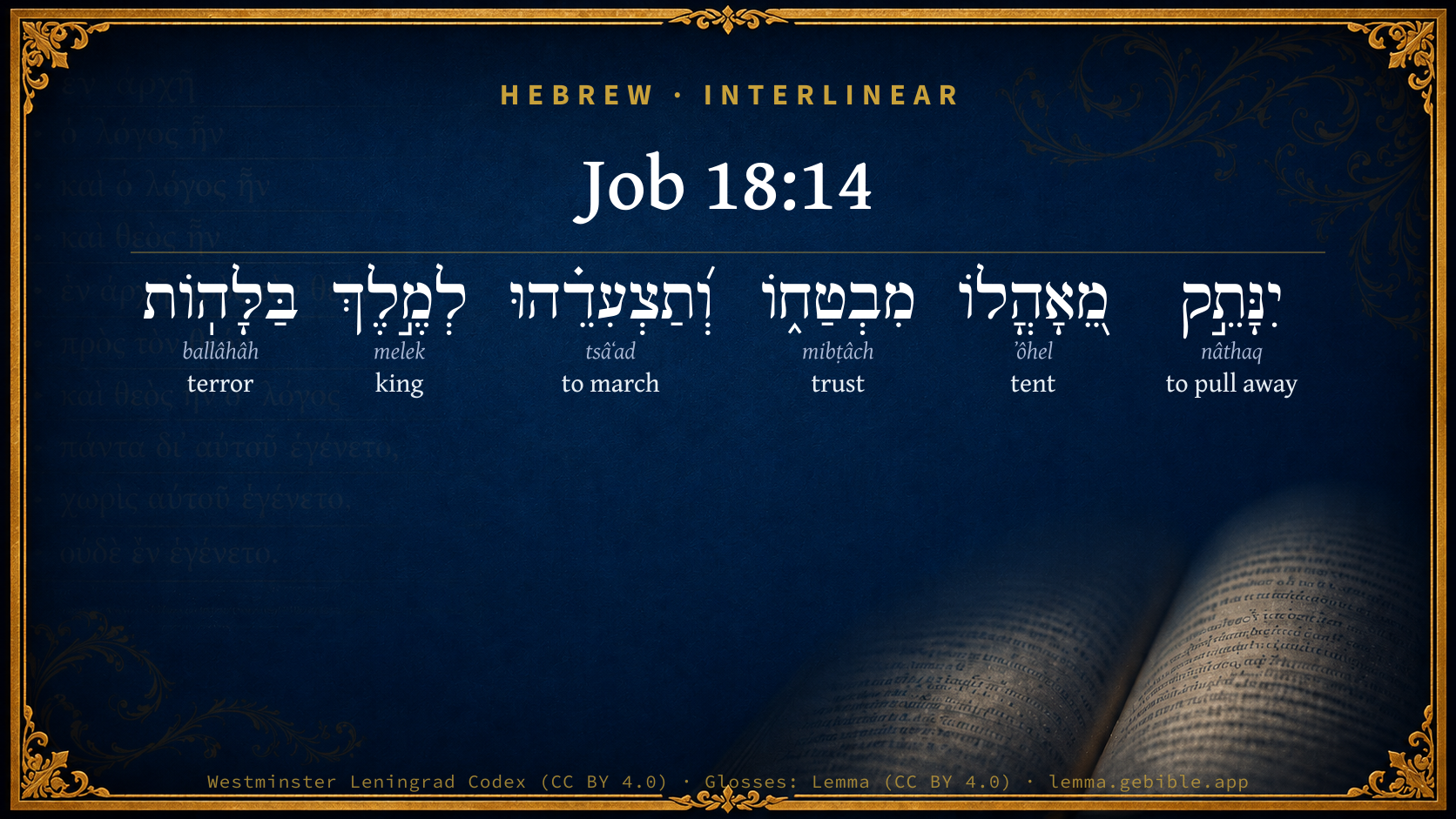
Job 18:14

Hebrew (Westminster Leningrad Codex) Job 18:14 appears in the Hebrew Old Testament. The text above is from the Westminster Leningrad Codex. Each word links to its Strong’s number, a concise gloss, and parsing drawn from the Open Scriptures Hebrew Bible morphology. Click any word for its full Brown-Driver-Briggs (BDB) entry.
Download image
Cite this verse

Job 18:14 (World English Bible). Public Domain. Lemma interlinear Bible study tool, https://lemma.gebible.app/v/job/18/14.

Show BibTeX & RIS
BibTeX
RIS
English Translation
He shall be rooted out of his tent where he trusts. He shall be brought to the king of terrors.
World English Bible · Public Domain
Download a study sheet

One document with this verse’s original text, its word-by-word gloss line, the meaning frame, cross-references with their text, attributed commentary, and full source and license credits — printable, and it pastes into notes with its structure intact.

This verse Autodidact and up

Study sheet (.html) Plain text (.txt)

A passage Seminary Student

Up to 50 verses in one chapter. A passage sheet keeps up to 6 commentary sources and 12 cross-references per verse, in the order this page ranks them, and says so on the sheet whenever that leaves anything out. Ask for a single verse and you get the Autodidact verse sheet above.

Everything on this page stays free to read, with no account — the sheet is a download of what is already on screen, not access to it.

Want to remove ads? Support Godless Engineer
Compare translations 3

The same verse in 3 English versions, stacked beneath the original-language interlinear above. Click any original word for its lexicon entry.

Each is an independent rendering of the whole verse — the interlinear is not word-aligned to these translations.

Highlighted words mark where these versions differ — a whole-verse word diff, not a word-by-word alignment.

  • World English Bible Public Domain
    He shall be rooted out of his tent where he trusts. He shall be brought to the king of terrors.
  • King James Version Public Domain
    His confidence shall be rooted out of his tabernacle, and it shall bring him to the king of terrors.
  • unfoldingWord Literal Text CC BY-SA 4.0
    He is pulled from his tent, his safety, and one marches him to the king of terrors.

unfoldingWord Literal Text — © unfoldingWord, licensed CC BY-SA 4.0. Word-aligned USFM3 via Door43 (git.door43.org/unfoldingWord/en_ult).

Versions to compare (up to 4)

3 of 4 selected

Show all 18 translations

Every available English version of this verse, each an independent rendering of the whole verse.

  • World English Bible Public Domain
    He shall be rooted out of his tent where he trusts. He shall be brought to the king of terrors.
  • Berean Standard Bible Public Domain
    He is torn from the shelter of his tent and is marched off to the king of terrors.
  • Majority Standard Bible Public Domain
    He is torn from the shelter of his tent and is marched off to the king of terrors.
  • King James Version Public Domain
    His confidence shall be rooted out of his tabernacle, and it shall bring him to the king of terrors.
  • American Standard Version (1901) Public Domain
    He shall be rooted out of his tent where he trusteth; And he shall be brought to the king of terrors.
  • Revised Version (1885) Public Domain
    He shall be rooted out of his tent wherein he trusteth; and he shall be brought to the king of terrors.
  • Geneva Bible (1599) Public Domain
    His hope shalbe rooted out of his dwelling, and shall cause him to go to the King of feare.
  • Douay-Rheims (1899) Public Domain
    Let his confidence be rooted out of his tabernacle, and let destruction tread upon him like a king.
  • Young's Literal Translation Public Domain
    Drawn from his tent is his confidence, And it causeth him to step to the king of terrors.
  • Literal Standard Version CC BY-SA 4.0
    His confidence is drawn from his tent, || And it causes him to step to the king of terrors.
  • Unlocked Literal Bible CC BY-SA 4.0
    He is torn from the safety of his tent and marched off to the king of terrors.
  • unfoldingWord Literal Text CC BY-SA 4.0
    He is pulled from his tent, his safety, and one marches him to the king of terrors.
  • Darby Bible Public Domain
    His confidence shall be rooted out of his tent, and it shall lead him away to the king of terrors:
  • World Messianic Bible Public Domain
    He will be rooted out of the security of his tent. He will be brought to the king of terrors.
  • Webster's Bible Public Domain
    His confidence shall be rooted out of his tabernacle, and it shall bring him to the king of terrors.
  • Free Bible Version CC BY-SA 4.0
    They are torn from the homes they trusted in and taken to the king of terrors.
  • Bible in Basic English Public Domain
    He is pulled out of his tent where he was safe, and he is taken away to the king of fears.
  • JPS Tanakh (1917) Public Domain
    That wherein he trusteth shall be plucked out of his tent; and he shall be brought to the king of terrors.

Literal Standard Version (2020), Covenant Press — licensed CC BY-SA 4.0. Text via the HelloAO Bible API (eBible.org). Unlocked Literal Bible (unfoldingWord) — licensed CC BY-SA 4.0. Text via the HelloAO Bible API (eBible.org). unfoldingWord Literal Text — © unfoldingWord, licensed CC BY-SA 4.0. Word-aligned USFM3 via Door43 (git.door43.org/unfoldingWord/en_ult). Free Bible Version, Dr. Jonathan Gallagher — licensed CC BY-SA 4.0. Text via the HelloAO Bible API (eBible.org).

Word by word

More ways to search: Search by grammar → Find every occurrence → Compare this word →

Practice this passage: Drill this verse → Learn its vocabulary →

וְ֝תַצְעִדֵ֗הוּ
tsâʻad
H6805
“and · to march · him”
Conjunction + Verb, Hiphil, Imperfect, 3rd Person, Feminine, Singular + Suffix, Personal, 3rd Person, Masculine, Singular
Part of Speech
Conjunction + Verb
Stem
Hiphil
Form
Imperfect
Person
3rd Person
Gender
Feminine
Number
Singular
Full BDB Definition

Origin: a primitive root

TWOT: 1943

to step, march, stride - (Qal) to step, march - (Hiphil) to cause to march
  1. יִנָּתֵ֣ק nâthaq H5423 “to pull away” Verb, Niphal, Imperfect, 3rd Person, Masculine, Singular
  2. מֵ֭אָהֳלוֹ ʼôhel H168 “from · tent · his” Preposition + Noun, Common, Masculine, Singular, Construct + Suffix, Personal, 3rd Person, Masculine, Singular
  3. מִבְטַח֑וֹ mibṭâch H4009 “trust · his” Noun, Common, Masculine, Singular, Construct + Suffix, Personal, 3rd Person, Masculine, Singular
  4. לְמֶ֣לֶךְ melek H4428 “to/for · king of” Preposition + Noun, Common, Masculine, Singular, Construct
  5. בַּלָּהֽוֹת ballâhâh H1091 “terrors” Noun, Common, Feminine, Plural, Absolute

About this verse

These counts appear in no published source. They are computed here, from the morphology-tagged text and Lemma’s own curated glosses. What Lemma adds →

6
words
6
distinct lemmas
Wisdom
section

Notable vocabulary

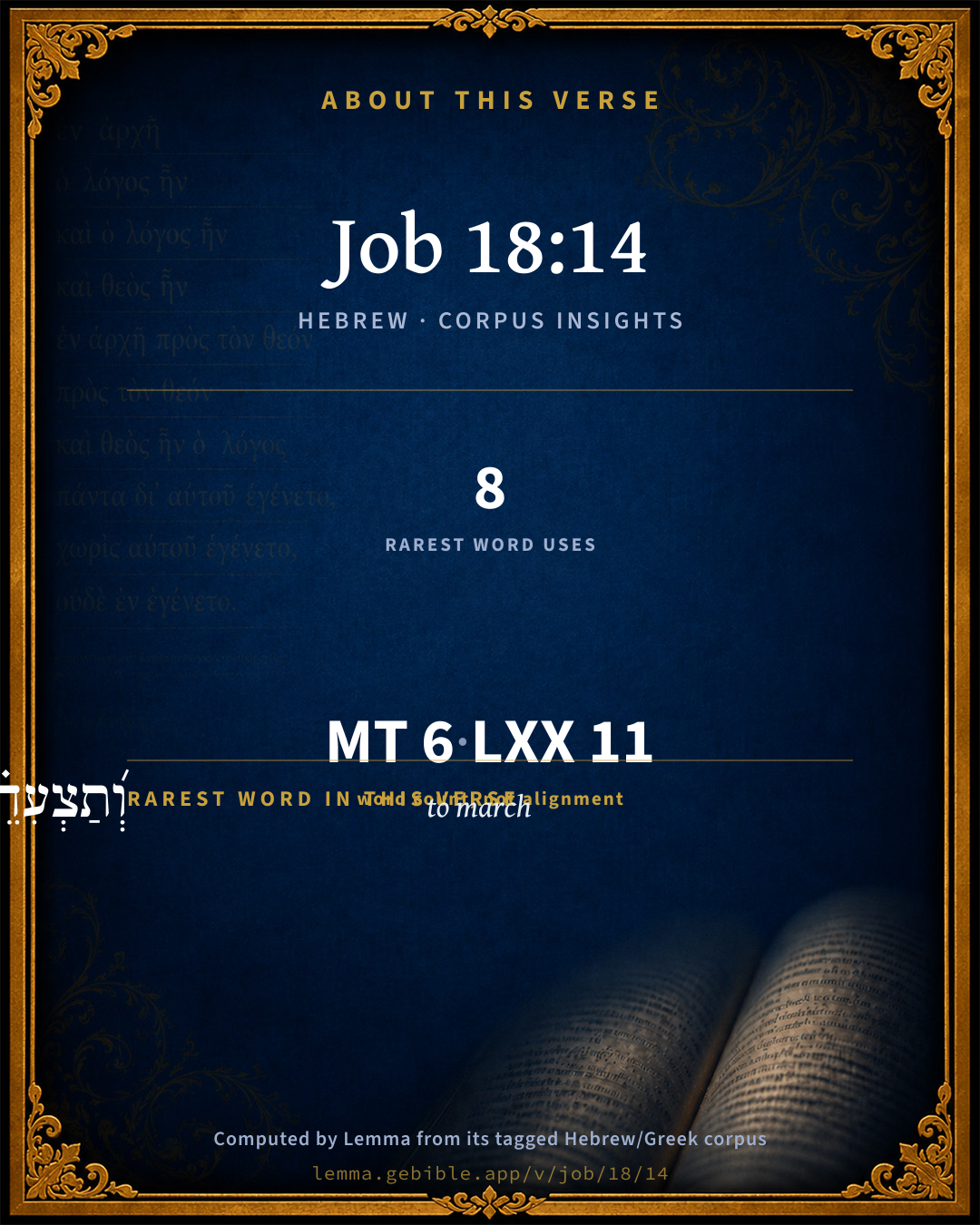
The rarest word here is וְ֝תַצְעִדֵ֗הוּ to march H6805 — appearing just 8 times in the whole Hebrew Bible.

Shared distinctive vocabulary

וְ֝תַצְעִדֵ֗הוּ to march H6805 occurs in 8 verses of the Hebrew Bible. Also found in:

Grammatical profile

  • 2 verbs
  • 4 nouns

Verb forms

  • יִנָּתֵ֣ק Niphal · Imperfect
  • וְ֝תַצְעִדֵ֗הוּ Hiphil · Imperfect

Hebrew & Septuagint length

In English translation the verse runs 20 words from the Hebrew and 21 from the Septuagint (LXX English) — closely comparable.

A rough comparison of the two English renderings, which tokenize alike — not a word-level alignment.

Word counts can differ between the Hebrew and the Greek without any difference in meaning — e.g. the Hebrew direct-object marker אֵת has no separate Greek word, and Greek often adds the article ὁ.

In the original languages it is 6 Hebrew tokens and 11 Greek tokens — but the two are counted differently (Hebrew bundles its prefixes and suffixes into one token; the Greek is in lemma form), so that isn’t a like-for-like length.

Cross-references

12

Topical passages linked to Job 18:14 in the Treasury of Scripture Knowledge — connected by theme and wording, ordered by reader-vote popularity; previews shown in the World English Bible.

  • Proverbs 10:28 The prospect of the righteous is joy, But the hope of the wicked will perish.
  • Job 8:14 Whose confidence shall break apart, Whose trust is a spider's web.
  • Job 8:22 Those who hate you shall be clothed with shame. The tent of the wicked shall be no more."
  • Job 11:20 But the eyes of the wicked shall fail, They shall have no way to flee; Their hope shall be the giving up of the spirit."
  • Job 24:17 For the morning is to all of them like thick darkness, For they know the terrors of the thick darkness.
  • Job 41:34 He sees everything that is high: He is king over all the sons of pride."
  • Psalms 55:4 My heart is severely pained within me. The terrors of death have fallen on me.
  • Psalms 112:10 The wicked will see it, and be grieved. He shall gnash with his teeth, and melt away. The desire of the wicked will perish.
  • Proverbs 14:32 The wicked is brought down in his calamity, But in death, the righteous has a refuge.
  • Matthew 7:26–27 Everyone who hears these words of mine, and doesn't do them will be like a foolish man, who built his house on the sand.
  • 1 Corinthians 15:55–56 "Death, where is your sting? Hades, where is your victory?"
  • Hebrews 2:15 and might deliver all of them who through fear of death were all their lifetime subject to bondage.

Cross-references courtesy of OpenBible.info (CC BY 4.0).

Hebrew and Greek witnesses Masoretic Hebrew ↔ Greek Septuagint

The same verse in the two great witnesses to the Old Testament, shown verse-for-verse.

These are two independent witnesses, not word-aligned to each other, and the Septuagint is shown in lemma (dictionary) form.

Hebrew Job 18:14 Masoretic · Westminster Leningrad Codex

יִנָּתֵ֣ק מֵ֭אָהֳלוֹ מִבְטַח֑וֹ וְ֝תַצְעִדֵ֗הוּ לְמֶ֣לֶךְ בַּלָּהֽוֹת

He shall be rooted out of his tent where he trusts. He shall be brought to the king of terrors.

World English Bible · Public Domain

Greek LXX Job 18:14 Septuagint · lemma form

δέ ἐκ δίαιτα αὐτός ἴασις ἔχω δέ αὐτός ἀνάγκη αἰτία βασιλικός

And let health be utterly banished from his tabernacle, and let distress seize upon him with a charge from the king.

LXX2012 (modern English Septuagint) · Public Domain

On this verse, Albert Barnes' Notes on the Bible discusses the Septuagint’s reading. Read the note in Commentary ↓

Hebrew: Westminster Leningrad Codex (CC BY 4.0). Greek: Septuagint (public domain); English from LXX2012 (modern English Septuagint) (Public Domain). How the Septuagint differs from the Hebrew →

Commentary

Notes on Job 18:14 from classic Christian and Jewish commentators (each source and its license shown beneath its notes). The classic Christian expositions comment on the surrounding passage and are grouped to its opening verse, so a note may address several verses; the Jewish commentaries on the Tanakh (Rashi and others) are per-verse, so they appear only where the commentator wrote on this verse.

Lemma curates 59 commentaries, every one of them public domain or Creative Commons licensed, each selected and text-cleaned for this edition rather than reprinted as found. About our sources →

Trapp's Complete Commentary

John Trapp

Job 18:14 His confidence shall be rooted out of his tabernacle, and it shall bring him to the king of terrors.

Ver. 14. And his confidence shall be rooted out of his tabernacle] Whatsoever he trusteth in about his house shall be pulled up by the roots, or grubbed up. Thus it befell Doeg, Psa 52:7. And this disappointment, this broken confidence of his, shall bring him, or make him go, to the king of terrors; i.e. to death, that most terrible of terribles, as the philosopher calleth it (Aristot.). Or the devil (as R. Solomon interpreteth it), that black prince, Eph 6:12, to whom wicked men are brought by death, which to them is not only nature’s slaughterman, but God’s curse, and hell’s purveyor. Hence Rev 6:8, death haleth hell at the heels of it.

John Trapp, A Commentary or Exposition upon All the Books of the Old and New Testament (1647–1656) — public domain. Text from a community e-Sword module.

The Biblical Illustrator

Joseph S. Exell

Job_18:14

His confidence shall be rooted out of his tabernacle, and it shall bring him to the king of terrors.

The confidence of the wicked

The world understands by the word wicked one who offends against the law of conscience,--one who breaks the second table of the law, the only table which it thinks important. Scripture means by it one who violates his relationship to God,--who transgresses the first table of the law. The term wicked has much more reference to the state of their hearts towards God than their state before man. Bildad shows the effects of wickedness.

I. On the wicked man himself (Job_18:7-8). The great point in these verses is the certainty with which he brings misery upon himself. His very sins are made his chastisement.

II. On his family (Job_18:6). The light shall be darkened in his tabernacle. In some Eastern countries a lamp is suspended from the ceiling of each room, and kept burning all the night, so that the house is full of light. And so, in the dwellings of the godly, there is light--the light of Gods presence. But in the dwellings of the ungodly there is no such light, and no blessing. And with the absence of this there is also, very often, the absence of family union and love. Very different is the Christians confidence. It rests upon a faithful and unchanging Saviour. Its roots strike deep into the everlasting hills. (George Wagner.)

It shall bring him to the king of terrors.

Death is terrible

Under a threefold consideration.

1. If we consider the antecedents, the forerunners or harbingers of death, which are pains, sicknesses, and diseases.

2. If we consider the nature of death. What is death? Death is a disunion; all disunions are troublesome, and some are terrible. Those are most terrible which rend that from us which is nearest to us. Death is also a privation, and a total privation. Death is such a privation, as from which there can be no return to nature.

3. In regard of the consequents. Rottenness and corruption consume the dead, and darkness covers them in the grave. We may ranks a threefold gradation of the terribleness of death.

(1) To a godly man, when his spiritual state is unsettled.

(2) When his worldly estate is well settled, when he hath deeply engaged in the creature, and his earthly mountain apparently stands strong.

(3) Death is most terrible to those who, though they have the knowledge of God, and outwardly profess the Gospel of Christ, yet walk contrary to it. It should be our study, as it is our wisdom, to make this king of terrors a kind of king of comfort to us. Many believers have attained to this.

A believer moves on these principles.

1. That death cannot break the bond of the covenant between God and us.

2. Death may break the union between the soul and the body, but it cannot break the union between the soul and Christ. This outlives death.

3. The apostle asserts that the sting of death is out.

4. Scripture calls death a sleep or rest.

5. Death puts a period to our earthly sorrows, and we have no reason to be sorry for that.

6. It is called a going to God, in whom we shall have an eternal enjoyment.

7. It is a dying to live, as well as a dying from life. (Joseph Caryl.)

.

The Biblical Illustrator, edited by Joseph S. Exell (c. 1880s–1900s) — public domain. Text from a community e-Sword module.

Joseph Benson's Commentary

Job 18:14. His confidence — That is, all the matter of his confidence, his riches, children, &c.; shall be rooted out of his tabernacle — That is, out of his habitation. And it — Namely, the loss of his confidence; shall bring him to the king of terrors — Either, 1st, Into extreme fears and horrors of mind; or, 2d, To death, which even Aristotle called the most terrible of all terribles. And this it will do, either because it will expose him to his enemies, who will kill him; or, because the sense of his disappointments, and losses, and dangers, will break his heart.

Joseph Benson's Commentary on the Old and New Testaments (1811–1818) — public domain. Text from a community e-Sword module.

Geneva Bible (1599)

Geneva Bible translators

That is, with most great fear.

Geneva Bible (1599) marginal notes — public domain. Text via Bolls.life.

Jamieson, Fausset & Brown

Robert Jamieson, A. R. Fausset & David Brown

confidence--all that the father trusted in for domestic happiness, children, fortune, &c., referring to Job's losses.

rooted out--suddenly torn away, it shall bring--that is, he shall be brought; or, as UMBREIT better has, "Thou (God) shalt bring him slowly." The Hebrew expresses, "to stride slowly and solemnly." The godless has a fearful death for long before his eyes, and is at last taken by it. Alluding to Job's case. The King of terrors, not like the heathen Pluto, the tabled ruler of the dead, but Death, with all its terrors to the ungodly, personified.

Jamieson, Fausset & Brown — Commentary Critical and Explanatory on the Whole Bible (1871) — public domain (CC PDM 1.0). Text via the HelloAO Bible API.

Adam Clarke's Commentary

Verse 14. His confidence shall be rooted out] His dwelling-place, how well soever fortified, shall now he deemed utterly insecure.

And it shall bring him to the king of terrors.] Or, as Mr. Good translates, "And dissolution shall invade him as a monarch." He shall be completely and finally overpowered.

The phrase king of terrors has been generally thought to mean death; but it is not used in any such way in the text. For למלך בלהות lemelech ballahoth, to the king of destructions, one of De Rossi's MSS. has כמלך kemelech, "as a king;" and one, instead of בלהות ballahoth, with ו vau holem, to indicate the plural, terrors or destructions, has בלהות ballahuth, with ו vau shurek, which is singular, and signifies terror, destruction. So the Vulgate seems to have read, as it translates, Et calcet super eum, quasi rex, interitis; "And shall tread upon him as a king or destroyer. Or as a king who is determined utterly to destroy him." On this verse the bishop of Killala, Dr. Stock, says, "I am sorry to part with a beautiful phrase in our common version, the king of terrors, as descriptive of death; but there is no authority for it in the Hebrew text."

It may however be stated that death has been denominated by similar epithets both among the Greeks and Romans,

So Virgil, AEn. vi., ver. 100.

________Quando hic inferni janua regis

Dicitur.

"The gates of the king of hell are reported to be here."

And OVID, Metam. lib. v., ver. 356, 359.

Inde tremit tellus: et rex pavit ipse silentum.

Hanc metuens cladem, tenebrosa sede tyrannus

Exierat.

"Earth's inmost bowels quake, and nature groans;

His terrors reach the direful KING of HELL.

Fearing this destruction, the tyrant left his

gloomy court."

And in SOPHOCLES, (OEdip. Colon., ver. 1628, edit. Johnson.)

Εννυχιων αναξ,

Αιδωνευ.

"O Pluto, king of shades." That is, the invisible demon, who dwells in darkness impenetrable.

Old COVERDALE translates: Very fearfulnesse shall bringe him to the kynge.

Adam Clarke's Commentary on the Bible (1810–1826) — public domain. Text from a community e-Sword/MySword module.

Ellicott's Commentary for English Readers

(14) His confidence shall be rooted out.—Rather, he shall be rooted out of his tent which he trusted was his own.

The king of terrors.—Perhaps the most remarkable personification of unseen forces to be found in the Bible.

A Bible Commentary for English Readers, edited by Charles John Ellicott (1878–1897) — public domain. Text from a community e-Sword module.

The Cambridge Bible for Schools and Colleges

gen. ed. J. J. S. Perowne

14. The meaning is,

He shall be plucked out of his tent wherein he trusted,

And he shall be brought to the king of terrors.

In the phrase “his tent wherein he trusted” Bildad goes back to his former figure of the sinner’s house which he grasps to maintain himself, ch. Job_8:15. The “king of terrors” is death. In Psa_49:14 a somewhat different figure is employed, that of a shepherd: The wicked “like sheep are put in Sheol, Death herds them,” cf. Isa_28:15. Death is personified as rex tremendus, Virg. Geo. 4:469 (Hitzig); there is no reference to Satan, who has rule in the realm of death, Heb_2:14, nor to any mythical personage like the Pluto of classical antiquity. The last scenes of the sinner’s fate have been described: he sought to flee from terrors, he is brought at last to the king of them. Then the fate of those belonging to him is stated.

The Cambridge Bible for Schools and Colleges (gen. ed. J. J. S. Perowne; Cambridge University Press, 1878–1918) — public domain. Text from a community e-Sword module.

John Gill's Exposition

It shall dwell in his tabernacle,.... What shall dwell in it is not said; there are various conjectures about it, and different supplements are made; the Targum is,

"his wife shall dwell in a tabernacle not his;''

and to the same purpose Jarchi; as if it was one part of the punishment of a wicked man, that he should leave a widow behind him, and no house of his own for her to dwell in; but this is the case of the widows of many good men, who themselves, in their lifetime, have no houses of their own, and some no certain dwelling places, yea, have lived in caves and dens of the earth; the mother of our Lord, who seems to have been a widow at his death, was taken by one of his disciples to his own home, which shows she had none of her own. The Vulgate Latin version is,

"his neighbours shall dwell in his tabernacle;''

which some understand of their coming into it after his death, to mourn and bewail him; but as such a visit of his family upon his decease cannot be called dwelling, so this is rather a benefit and favour to his family, than a distress: rather it may signify, that such neighbours whom he had oppressed, and who hated him for his tyranny and cruelty, now should dwell in his house; what he had built, strangers should inhabit, which is a punishment of sin and sinners, Deu 28:30. Aben Ezra supplies it thus, a strange or evil beast shall dwell in it, as they do in desolate places; and it is frequently given as a sign and token of desolation in countries, cities, and palaces, that they are become the habitations of wild and savage creatures, see Isa 13:19; but it seems best to supply it from the context, either thus, famine, hunger, want of food, shall dwell in it; poverty and want shall come like an armed man into it, and take possession; there shall appear all the marks and signs of penury and distress; or destruction ready at his side shall take up its abode in it, and it shall be called the house of destruction, as a certain city is called the city of destruction, because devoted to it, Isa 19:18; or the firstborn of death, some deadly disease, as the pestilence; or death itself, the king of terrors, who is sometimes represented as a person coming up into the windows of a palace, and entering it, and cutting off great numbers; so that it goes ill with him that is left in a tabernacle, where he has his habitation, Jer 9:21; or terror, as Ben Gersom; everyone of the terrors before mentioned, so that no body will care to dwell in it, but forsake it as an haunted house: in short, from the whole it may be gathered, that the curse of God should alight upon it, and remain in it, as it does in the house of the wicked; the same with the flying roll in the vision of Zechariah, the curse of God's righteous law, which enters into the house of the thief and perjurer, and consumes it, Pro 3:33; the reason follows,

because it is none of his; not by right, being bought or built with mammon of unrighteousness, with money not honestly got, and therefore shall not prosper; or because it is no longer his, he being taken from it by death, the king of terrors, and that not knowing or owning him any more as its master or proprietor, and therefore strangers shall dwell in it; or because there is none that shall be after him, because he shall have none left, or he shall have no survivor (h), all his family being taken away by death; and therefore nothing but desolation and destruction shall be seen in it, see Amo 6:9;

brimstone shall be scattered upon his habitation; that is, his house should be burnt down by lightning, which is often sulphurous, and sometimes very sensibly has the smell of brimstone in it (i). Bildad may refer either to the fire of heaven that destroyed Job's sheep, which was of this kind; or rather to the destruction of Sodom and Gomorrah, by a shower of fire and brimstone from heaven, a fact well known in those times. Moreover, brimstone scattered upon the wicked man's dwelling place may denote the desolation of it, that it should lie in ruins, and be unfit to be inhabited; and the desolation of places is sometimes signified by their being salt, brimstone and burning pitch, Deu 29:23; yea, this may be carried further, and denote the eternal damnation of all in his house, seeing the burning of Sodom with brimstone was an example to ungodly men suffering the vengeance of eternal fire, Jde 1:7; and which is sometimes expressed by brimstone, and a lake burning with fire and brimstone, Rev 20:10. Some (k) think respect is had to the purifying of houses with sulphur, to drive away demons, and remove impurity, to make them fit to dwell in (l); and others think it refers to the burning of sulphur in houses at funerals, to testify and exaggerate mourning (m).

(h) So Syr. Ar & Schmidt. (i) Plin. Nat. Hist. l. 35. c. 35. (k) Scheuchzer. Physic. Sacr. vol. 4. p. 709, 710. (l) Vid. Plin. Nat. Hist. l. 35. c. 15. Theocrit. Idyll. 25. ver. 95. Homer. Odyss. 22. prope finem. (m) Vid. Menochium de Repub. Heb. l. 8. c. 6. col. 792.

John Gill's Exposition of the Whole Bible (1746–1763) — public domain (CC PDM 1.0). Text via the HelloAO Bible API.

Albert Barnes' Notes on the Bible

His confidence shall be rooted out of his tabernacle - Security shall forsake his dwelling, and he shall be subject to constant alarms. There shall be nothing there in which he can confide, and all that he relied on as sources of safety shall have fled.

And it shall bring him - That is, he shall be brought.

To the king of terrors - There has been much variety in the explanation of this verse. Dr. Noyes renders it, “Terror pursues him like a king.” Dr. Good, “Dissolution shall invade him like a monarch.” Dr. Stock says. “I am sorry to part with a beautiful phrase in our common version, the king of terrors, as descriptive of death, but there is no authority for it in the Hebrew text.” Wemyss renders it, “Terror shall seize him as a king.” So Schultens translates it, “Gradientur in eum, instar regis, terrores.” Rosenmuller renders it as it is in our version. The Vulgate: Et calcet super eum, quasi rex, interitus - “destruction shall tread upon him as a king.” The Septuagint “and distress shall lay hold on him with the authority of a king” - αἰτίᾳ βασιλικῃ satia basilikē. The Chaldee renders it, “shall be brought to the king of terrors” - רגושתא למלך is not evident, therefore, that we are to give up the beautiful phrase, “king of terrors.”

The fair construction of the Hebrew, as it seems to me, is that which is conveyed in our common version - meaning, that the wicked man would be conducted, not merely to death, but to that kind of death where a fearful king would preside - a monarch infusing terrors into his soul. There is something singularly beautiful and appropriate in the phrase, “the king of terrors.” Death is a fearful monarch. All dread him. He presides in regions of chilliness and gloom. All fear to enter those dark regions where he dwells and reigns, and an involuntary shudder seizes the soul on approaching the confines of his kingdom. Yet all must be brought there; and though man dreads the interview with that fearful king, there is no release. The monarch reigns from age to age - reigns over all. There is but one way in which he will cease to appear as a terrific king. - It is by confidence in Him who came to destroy death; that great Redeemer who has taken away his “sting,” and who can enable man to look with calmness and peace even on the chilly regions where he reigns. The idea here is not precisely that of the Roman and Grecian mythologists, of a terrific king, like Rhadamanthus, presiding over the regions of the dead but it is of death personified - of death represented as a king fitted to inspire awe and terror.

Albert Barnes' Notes on the Bible (1834–1885) — public domain. Text from a community e-Sword/MySword module.

Haydock's Catholic Bible Commentary

Confidence. Septuagint, "health." --- Let. Protestants, "and it shall bring him to the king of terrors;" (Haydock) or, "thou (O God) shalt," &c. Septuagint, "let him be in the greatest (Calmet) want, on account of a royal accusation," (Haydock) of high treason. (Calmet)

George Leo Haydock (1774–1849), Haydock's Catholic Family Bible and Commentary, 1859 edition — public domain. Excludes Psalms (Douay-Rheims chapter numbering differs from Protestant) and Deuterocanonical books (Catholic canon only).

Matthew Poole's English Annotations

His confidence, i.e. all the matter of his confidence, his riches, children, &c.

Out of his tabernacle, i.e. out of his habitation.

It shall bring him, to wit, the loss of his confidence.

To the king of terrors; either,

1. Into extreme fears and horrors of mind. Or,

2. To death, which even Aristotle called the most terrible of all terribles. And this it will do, either because it will expose him to his enemies, who will kill him; or because the sense of his disappointments, and losses, and dangers will oppress his spirits, and break his heart.

Matthew Poole's English Annotations on the Holy Bible (1683–1685) — public domain. Text from a community e-Sword/MySword module.

Whedon's Commentary on the Bible

Daniel D. Whedon

14. His confidence… his tabernacle — He shall be torn from his tent, his confidence; that on which he relies. As with us, his tent (house) may have been his castle; or, perhaps, the poet means his home, his children, which are the right arm of a man. Hitzig understands by TENT his body, (2Pe_1:13; Isa_38:12,) “his strong, sound body, which promised a long life.” But the use of the same word in the next verse, as a habitation for others, is fatal to this view.

It shall bring — It, the dark, unseen, unnamed power, shall make him to march. “Slowly march,” says Umbreit, with a view to the idea that the godless man has a fearful death before his eyes for a length of time — an evident allusion to the case of Job. The Assyrian monuments give striking pictures of captives bound in chains, marching in procession to death. “The Psalm of Life” has a like figure of “funeral marches to the grave.”

King of terrors — Death, whose first-born has done his work. This personification of death rests, probably, upon an instinctive feeling that, for the wicked, death is no mere privation of consciousness, but the entrance into a state of unknown horror. (Canon Cook.) It has been conjectured by some that in this term “king of terrors.” (comp. Heb_2:14,) there is an allusion to Satan, who has “the power of death.” In Jewish theology, Satan is called the prince over thohu, or chaos.

Daniel D. Whedon (gen. ed.), Commentary on the Old and New Testaments (1874–1909) — public domain. Text from a community e-Sword module.

The Pulpit Commentary

His confidence shall be rooted out of his tabernacle; rather, he shall be rooted out of his tabernacle (or, tent), which is his confidence, or wherein he trusteth; i.e. he shall be torn from the home, where he thought himself secure as in a stronghold. And it shall bring him; rather, one shall bring him"or, he shall be brought. To the king of terrors. Probably death, rather than Satan, is intended. None of Job"s "comforters" seems to have had any conception of Satan as a personal being, nor even Job himself. It is only the author. or arranger, of the book who recognizes the personality and power of the prince of darkness.

The king of terrors.

Men regard death as the king of terrors. Let us consider first the grounds of this notion, and then how it may be dispelled.

I LET US CONSIDER WHY DEATH IS REGARDED AS THE KING OF TERRORS. Men instinctively think of death as "the grisly terror." "I fled, and cried out, "Death!" Hell trembled at the hideous name, and sighed From all her caves, and back resounded, "Death!

1. It is opposed to the natural love of life. "All that a man hath win he give for his life." Therefore death appears as his enemy. Every living creature shuns it. The fear of it makes a tragedy of the chase.

2. It is irresistible. A veritable monarch. We may maintain a state of siege for a time, but we know we must all capitulate at last. When death storms the citadel in real earnest, no power can keep it out.

3. Its territory is unknown. The mystery of death adds to its terrors. If we saw more we might fear less. We launch our vessel on a dark sea, not knowing what surges beat on the further shore.

4. It comes in pain. We often say that the worst is over with the poor sufferer before the end has come. The bitterness of death has passed before death itself has been reached. Still there is suffering at the end of most lives, and we instinctively shrink from this. We cannot bring ourselves to face the thought of the death-struggle.

5. It takes us from all the light and joy of earth. The natural love of life is confirmed by experience. To die is "to lie in cold obstruction." All the sunshine and flowers of this fair world are gone, all the sweetness of companionship with the loved on earth. The soul is severed from its earthly delights.

6. It comes to each singly. Each soul must venture alone into the dread unknown.

7. It ushers us into future judgment. "After death the judgment" The sinner who dares not give an account of himself before God dreads to hear the summons from the messenger of the unseen. "The sting of death is sin.

II LET US SEE HOW DEATH CAN BE SOBBED OF ITS TERRORS. Christ dethrones the king of terrors, and wrests his dark kingdom away, flooding it with the light of his grace. The Christian can do more than the Roman hero and the Stoic philosopher who had learnt to me, t death "with an equal mind." He can say, "To me... to die is gain.

1. Christ removes the causes of the fear of death. He does not lull the fear as with an opiate, He dissipates it by abolishing its source, as one dissipates a malicious fog by draining the marsh from which it rises. He goes to the root by conquering sin, which is the most fundamental cause of the terror of death. Bringing pardon for past sin, he dispels the alarm of future judgment; and bringing purification of soul, he removes the indwelling sin that always shrinks from death as the foe of man. Then Christ helps us to face the pain, the darkness, and the mystery of death, by assuring us of his own supporting presence: "It is I; be not afraid.

2. Christ throws light on the region beyond death. He would not have us fix our attention on death. That is but a transient experience. At the worst it is a dark door to be passed through. The Christian will never dwell in the kingdom of death. To him death is "That golden key That open the palace of eternity. There is a triumph over death for those who, sleeping in Christ, wake to the life eternal. For them the king of terrors has ceased to be. "The last enemy that shall be destroyed is death". W.F.A. (1Co_15:26)

The Pulpit Commentary (1880–1919), ed. H.D.M. Spence-Jones & Joseph S. Exell — public domain. Text from a community e-Sword module.

John Wesley's Explanatory Notes

Confidence - All the matter of his confidence, his riches, and children. Terrors - To death, which even Aristotle called, The most terrible of all terribles. And this it will do, either because it will expose him to his enemies, who will kill him; or because the sense of his disappointments, and losses, and dangers, will break his heart.

John Wesley, Explanatory Notes Upon the Whole Bible (1754–1765) — public domain. Text via the GEBible commentary corpus.

unfoldingWord translationNotes

Door43 World Missions Community

General Information:

Bildad continues to describe the wicked person.

He is torn from the safety of his tent

This can be stated in active form. AT: "Disaster rips him out of his tent, where he is safe" (See: Active or Passive)

marched off

This can be stated in active form. AT: "it marches him off" or "it forces him to go" (See: Active or Passive)

the king of terrors

This is a reference to "King Death," a pagan god who was believed to rule over death. AT: "the one who rules over the dead" or "the king of death" (See: Assumed Knowledge and Implicit Information)

People not his own

"People who are not his family"

after they see that sulfur is scattered within his home

People used sulfur to get rid of any diseases from a dying person. This can be stated in active form. AT: "after they spread sulfur all over his home" (See: Active or Passive)

translationWords

tent

king

terror

life

sulfur

unfoldingWord translationNotes — © Distant Shores Media and the Door43 World Missions Community, licensed CC BY-SA 4.0. Source: git.door43.org/Door43/en_tn.

Rashi

Rabbi Shlomo Yitzchaki (Rashi)

He shall be torn away from his wife Heb. מאהלו, lit. from his tent.

who trusted him Heb. מבטחו, his trust, who trusted him. (His trust), that she trusted him.

she will cause him to walk. yet she will cause him to walk and will send him away (from her) to the grave, to the king of the demons.

Rashi on the Tanakh — English translations: “The Judaica Press complete Tanach with Rashi, translated by A. J. Rosenberg” (CC BY 4.0); “Pentateuch with Rashi's commentary by M. Rosenbaum and A.M. Silbermann, 1929-1934” (public domain); “The Metsudah Tanach series, Lakewood, N.J” (CC BY 4.0); and “The Book of Joshua, Metsudah Publications, 1997” (CC BY 4.0). Text via Sefaria.

Lesson kit

Teaching starters — assembled from the data on this page, not authored interpretation. Every prompt links to the verse data it draws on. Edit before teaching.

Job, in the Wisdom, opens this verse with 6 words (6 distinct Hebrew lemmas). Its most distinctive word is tsâʻad (“to march”). A historical commentator’s framing appears above. Read the whole chapter for the surrounding context.

Discussion questions

  1. What does “to march” (tsâʻad) contribute to the verse as a whole?
  2. How does Genesis 49:22, which shares the word «to march», read alongside this verse?
  3. The translations on this page render this verse differently — a whole-verse word diff, not a word-by-word alignment. What might account for the different wordings?
  4. «יִנָּתֵ֣ק» is a Niphal Imperfect verb. How does that grammatical form shape the action described?
  5. Compare how Trapp's Complete Commentary and The Biblical Illustrator read this verse. Where do they agree or differ?

Things to notice

Reading settings

Reading text

Shown beneath each verse's original-language words.

Old Testament
Old Testament edition

Read the OT as the Masoretic Hebrew (MT) or the Greek Septuagint (LXX).

English shown for the Greek Septuagint (in the Hebrew ↔ Greek comparison).

Comparing translations? Open the Compare panel on any verse page to stack up to four side by side.