
Ezekiel 26:3

Hebrew (Westminster Leningrad Codex) Ezekiel 26:3 appears in the Hebrew Old Testament. The text above is from the Westminster Leningrad Codex. Each word links to its Strong’s number, a concise gloss, and parsing drawn from the Open Scriptures Hebrew Bible morphology. Click any word for its full Brown-Driver-Briggs (BDB) entry.
Download image
Cite this verse

Ezekiel 26:3 (World English Bible). Public Domain. Lemma interlinear Bible study tool, https://lemma.gebible.app/v/ezekiel/26/3.

Show BibTeX & RIS
BibTeX
RIS
English Translation
therefore thus says the Lord Yahweh, Behold, I am against you, Tyre, and will cause many nations to come up against you, as the sea causes its waves to come up.
World English Bible · Public Domain
Download a study sheet

One document with this verse’s original text, its word-by-word gloss line, the meaning frame, cross-references with their text, attributed commentary, and full source and license credits — printable, and it pastes into notes with its structure intact.

This verse Autodidact and up

Study sheet (.html) Plain text (.txt)

A passage Seminary Student

Up to 50 verses in one chapter. A passage sheet keeps up to 6 commentary sources and 12 cross-references per verse, in the order this page ranks them, and says so on the sheet whenever that leaves anything out. Ask for a single verse and you get the Autodidact verse sheet above.

Everything on this page stays free to read, with no account — the sheet is a download of what is already on screen, not access to it.

Want to remove ads? Support Godless Engineer
Compare translations 3

The same verse in 3 English versions, stacked beneath the original-language interlinear above. Click any original word for its lexicon entry.

Each is an independent rendering of the whole verse — the interlinear is not word-aligned to these translations.

Highlighted words mark where these versions differ — a whole-verse word diff, not a word-by-word alignment.

  • World English Bible Public Domain
    therefore thus says the Lord Yahweh, Behold, I am against you, Tyre, and will cause many nations to come up against you, as the sea causes its waves to come up.
  • King James Version Public Domain
    Therefore thus saith the Lord GOD; Behold, I am against thee, O Tyrus, and will cause many nations to come up against thee, as the sea causeth his waves to come up.
  • unfoldingWord Literal Text CC BY-SA 4.0
    Therefore the Lord Yahweh says this, ‘Behold! I am against you, Tyre, and I will raise up many nations against you like the sea raises its waves.

unfoldingWord Literal Text — © unfoldingWord, licensed CC BY-SA 4.0. Word-aligned USFM3 via Door43 (git.door43.org/unfoldingWord/en_ult).

Versions to compare (up to 4)

3 of 4 selected

Show all 18 translations

Every available English version of this verse, each an independent rendering of the whole verse.

  • World English Bible Public Domain
    therefore thus says the Lord Yahweh, Behold, I am against you, Tyre, and will cause many nations to come up against you, as the sea causes its waves to come up.
  • Berean Standard Bible Public Domain
    therefore this is what the Lord GOD says: ‘Behold, O Tyre, I am against you, and I will raise up many nations against you, as the sea brings up its waves.
  • Majority Standard Bible Public Domain
    therefore this is what the Lord GOD says: ‘Behold, O Tyre, I am against you, and I will raise up many nations against you, as the sea brings up its waves.
  • King James Version Public Domain
    Therefore thus saith the Lord GOD; Behold, I am against thee, O Tyrus, and will cause many nations to come up against thee, as the sea causeth his waves to come up.
  • American Standard Version (1901) Public Domain
    therefore thus saith the Lord Jehovah, Behold, I am against thee, O Tyre, and will cause many nations to come up against thee, as the sea causeth its waves to come up.
  • Revised Version (1885) Public Domain
    therefore thus saith the Lord GOD: Behold, I am against thee, O Tyre, and will cause many nations to come up against thee, as the sea causeth his waves to come up.
  • Geneva Bible (1599) Public Domain
    Therefore thus sayth the Lord God, Beholde, I come against thee, O Tyrus, and I will bring vp many nations against thee, as the sea mounteth vp with his waues.
  • Douay-Rheims (1899) Public Domain
    Therefore thus saith the Lord God: Behold I come against thee, O Tyre, and I will cause many nations to come up to thee, as the waves of the sea rise up.
  • Young's Literal Translation Public Domain
    Therefore, thus said the Lord Jehovah: Lo, I `am' against thee, O Tyre, And have caused to come up against thee many nations, As the sea causeth its billows to come up.
  • Literal Standard Version CC BY-SA 4.0
    Therefore, thus said Lord YHWH: Behold, I [am] against you, O Tyre, || And have caused many nations to come up against you, || As the sea causes its billows to come up.
  • Unlocked Literal Bible CC BY-SA 4.0
    Therefore the Lord Yahweh says this, 'Behold! I am against you, Tyre, and I will raise up many nations against you like the sea raises its waves.
  • unfoldingWord Literal Text CC BY-SA 4.0
    Therefore the Lord Yahweh says this, ‘Behold! I am against you, Tyre, and I will raise up many nations against you like the sea raises its waves.
  • Darby Bible Public Domain
    therefore thus saith the Lord Jehovah: Behold, I am against thee, Tyre, and will cause many nations to come up against thee, as the sea causeth its waves to come up.
  • World Messianic Bible Public Domain
    therefore the Lord GOD says, ‘Behold, I am against you, Tyre, and will cause many nations to come up against you, as the sea causes its waves to come up.
  • Webster's Bible Public Domain
    Therefore thus saith the Lord GOD; Behold, I am against thee, O Tyre, and will cause many nations to come up against thee, as the sea causeth its waves to come up.
  • Free Bible Version CC BY-SA 4.0
    this is why the Lord God says: Watch out, Tyre! I'm condemning you, and I will have many nations come and attack you, just like the sea that sends its waves crashing against the shore.
  • Bible in Basic English Public Domain
    For this cause the Lord has said, See, I am against you, O Tyre, and will send up a number of nations against you as the sea sends up its waves.
  • JPS Tanakh (1917) Public Domain
    Therefore thus saith the Lord GOD: Behold, I am against thee, O Tyre, and will cause many nations to come up against thee, as the sea causeth its waves to come up.

Literal Standard Version (2020), Covenant Press — licensed CC BY-SA 4.0. Text via the HelloAO Bible API (eBible.org). Unlocked Literal Bible (unfoldingWord) — licensed CC BY-SA 4.0. Text via the HelloAO Bible API (eBible.org). unfoldingWord Literal Text — © unfoldingWord, licensed CC BY-SA 4.0. Word-aligned USFM3 via Door43 (git.door43.org/unfoldingWord/en_ult). Free Bible Version, Dr. Jonathan Gallagher — licensed CC BY-SA 4.0. Text via the HelloAO Bible API (eBible.org).

Word by word

More ways to search: Search by grammar → Find every occurrence → Compare this word →

Practice this passage: Drill this verse → Learn its vocabulary →

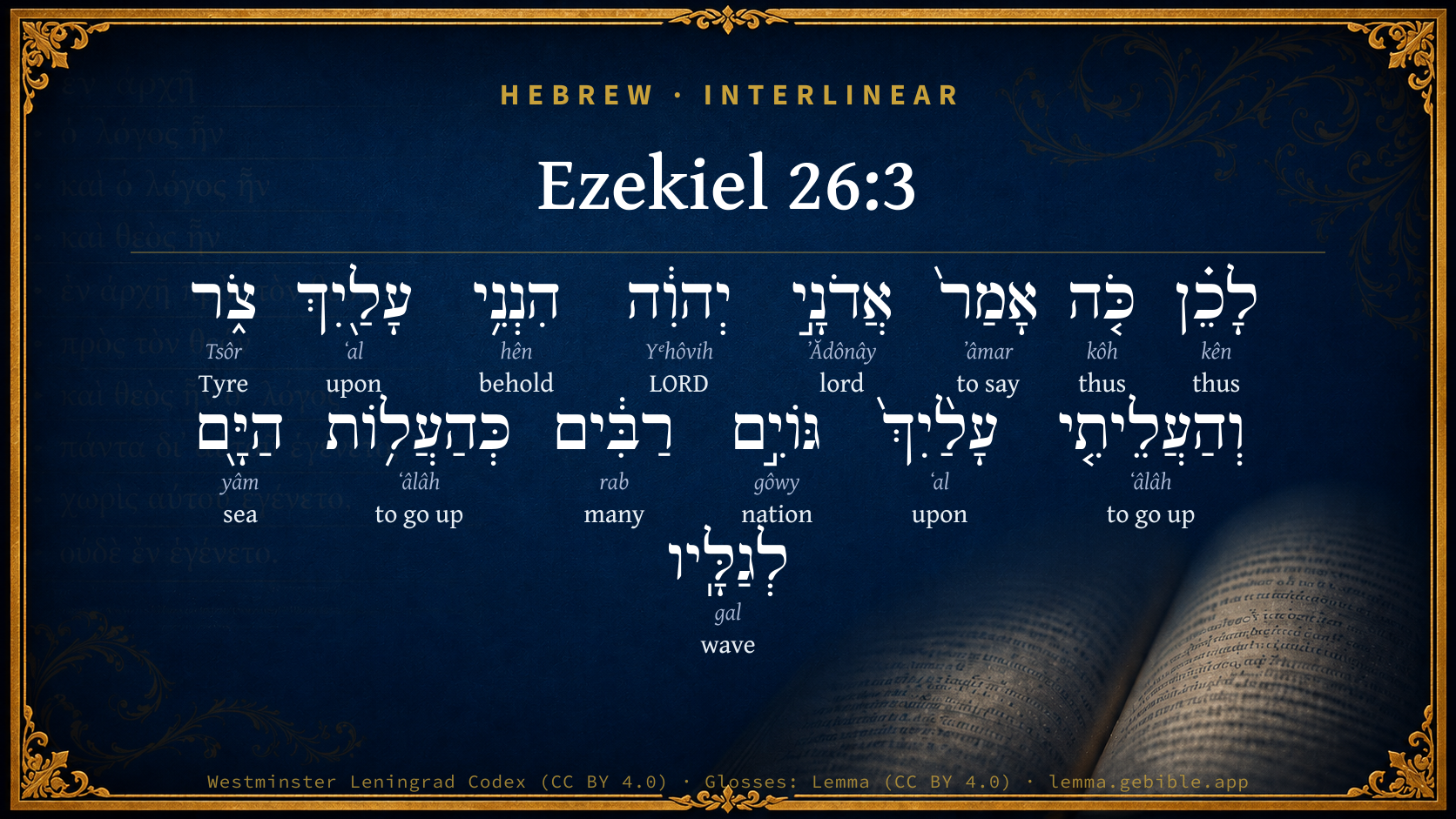
לְגַלָּֽיו
gal
H1530
“to/for · waves · his”
Preposition + Noun, Common, Masculine, Plural, Construct + Suffix, Personal, 3rd Person, Masculine, Singular
Part of Speech
Preposition + Noun
Type
Common
Gender
Masculine
Number
Plural
State
Construct
Full BDB Definition

Origin: from H1556

TWOT: 353a

heap, spring, wave, billow - heap (of stones) - over dead body - alone - used in ratifying a covenant - waves (figuratively of chastisement of Jehovah) - spring
  1. לָכֵ֗ן kên H3651 “to/for · thus” Preposition + Adverb
  2. כֹּ֤ה kôh H3541 “thus” Adverb
  3. אָמַר֙ ʼâmar H559 “to say” Verb, Qal, Perfect, 3rd Person, Masculine, Singular
  4. אֲדֹנָ֣י ʼĂdônây H136 “Lord · my” Noun, Common, Masculine, Plural, Construct + Suffix, Personal, 1st Person, Common, Singular
  5. יְהוִ֔ה Yᵉhôvih H3069 “LORD” Noun, Proper
  6. הִנְנִ֥י hên H2005 “behold · me” Particle, Demonstrative + Suffix, Personal, 1st Person, Common, Singular
  7. עָלַ֖יִךְ ʻal H5921 “upon · you” Preposition + Suffix, Personal, 2nd Person, Feminine, Singular
  8. צֹ֑ר Tsôr H6865 “Tyre” Noun, Proper
  9. וְהַעֲלֵיתִ֤י ʻâlâh H5927 “and · to go up” Conjunction + Verb, Hiphil, Sequential Perfect, 1st Person, Common, Singular
  10. עָלַ֨יִךְ֙ ʻal H5921 “upon · you” Preposition + Suffix, Personal, 2nd Person, Feminine, Singular
  11. גּוֹיִ֣ם gôwy H1471 “nations” Noun, Common, Masculine, Plural, Absolute
  12. רַבִּ֔ים rab H7227 “many” Adjective, Adjective, Masculine, Plural, Absolute
  13. כְּהַעֲל֥וֹת ʻâlâh H5927 “like/as · to go up” Preposition + Verb, Hiphil, Infinitive Construct
  14. הַיָּ֖ם yâm H3220 “the · sea” Particle, Definite Article + Noun, Common, Masculine, Singular, Absolute

About this verse

These counts appear in no published source. They are computed here, from the morphology-tagged text and Lemma’s own curated glosses. What Lemma adds →

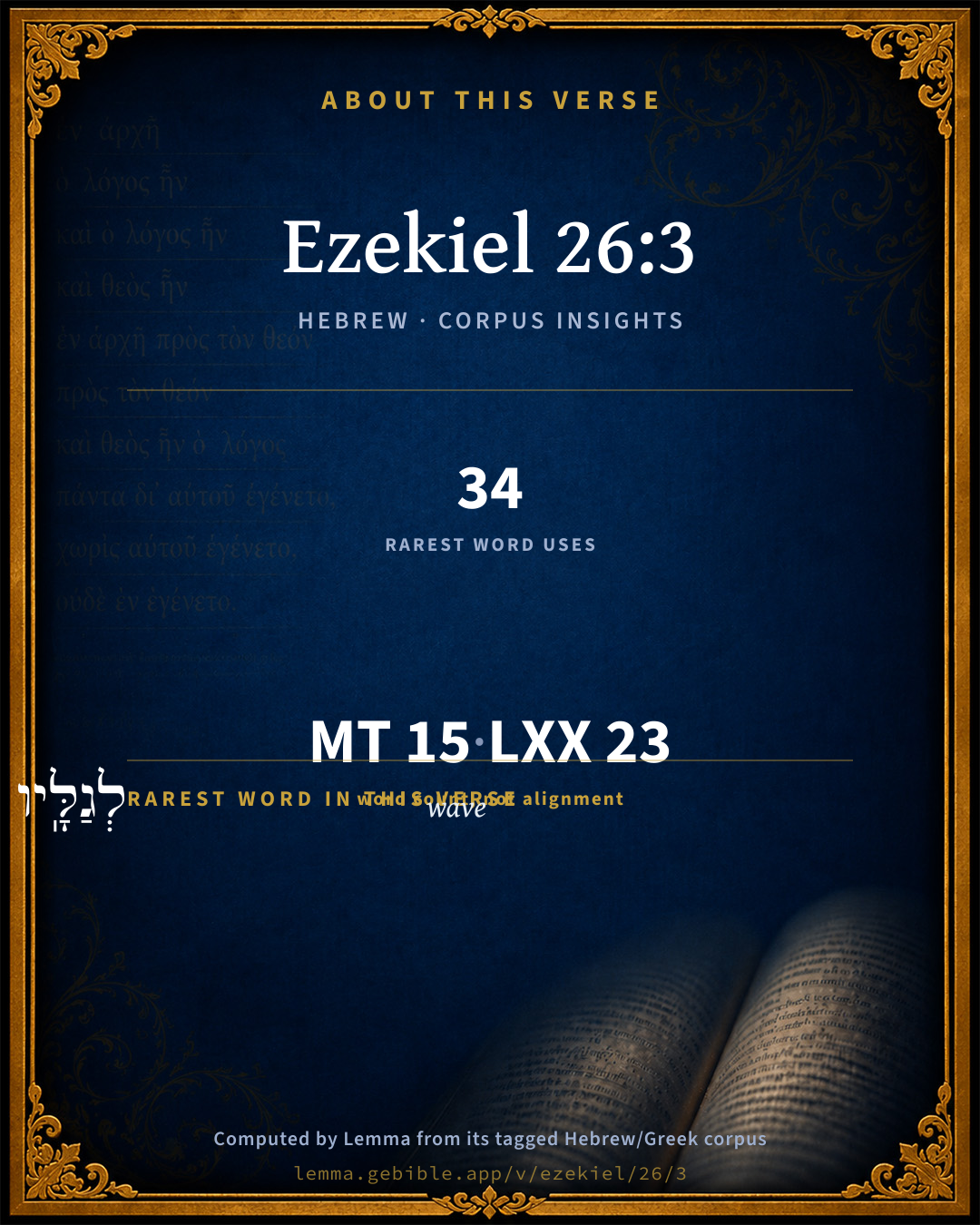
15
words
13
distinct lemmas
Prophets
section

Shared distinctive vocabulary

לְגַלָּֽיו wave H1530 occurs in 31 verses of the Hebrew Bible. Also found in:

Grammatical profile

  • 3 verbs
  • 6 nouns
  • 1 adjective
  • 2 prepositions
  • 2 adverbs
  • 1 particle

Verb forms

  • אָמַר֙ Qal · Perfect
  • וְהַעֲלֵיתִ֤י Hiphil · Sequential Perfect
  • כְּהַעֲל֥וֹת Hiphil · Infinitive Construct

Repetition

Words recur within this verse — often emphatic in Hebrew:

  • עָלַ֖יִךְ upon H5921 ×2
  • וְהַעֲלֵיתִ֤י to go up H5927 ×2

Hebrew & Septuagint length

In English translation the verse runs 31 words from the Hebrew and 29 from the Septuagint (LXX English) — closely comparable.

A rough comparison of the two English renderings, which tokenize alike — not a word-level alignment.

Word counts can differ between the Hebrew and the Greek without any difference in meaning — e.g. the Hebrew direct-object marker אֵת has no separate Greek word, and Greek often adds the article ὁ.

In the original languages it is 15 Hebrew tokens and 23 Greek tokens — but the two are counted differently (Hebrew bundles its prefixes and suffixes into one token; the Greek is in lemma form), so that isn’t a like-for-like length.

Cross-references

18

Topical passages linked to Ezekiel 26:3 in the Treasury of Scripture Knowledge — connected by theme and wording, ordered by reader-vote popularity; previews shown in the World English Bible.

  • Jeremiah 51:42 The sea is come up on Babylon; she is covered with the multitude of the waves of it.
  • Isaiah 5:30 They will roar against them in that day like the roaring of the sea. If one looks to the land, behold, darkness and distress. The light is darkened in its clouds.
  • Ezekiel 27:32–34 In their wailing they shall take up a lamentation for you, and lament over you, [saying], Who is there like Tyre, like her who is brought to silence in the midst of the sea?
  • Micah 4:11 Now many nations have assembled against you, that say, 'Let her be defiled, And let our eye gloat over Zion.'
  • Psalms 93:3–4 The floods have lifted up, Yahweh, The floods have lifted up their voice. The floods lift up their waves.
  • Psalms 107:25 For he commands, and raises the stormy wind, Which lifts up its waves.
  • Jeremiah 6:23 They lay hold on bow and spear; they are cruel, and have no mercy; their voice roars like the sea, and they ride on horses, everyone set in array, as a man to the battle, against you, daughter of Zion.
  • Jeremiah 21:13 Behold, I am against you, O inhabitant of the valley, [and] of the rock of the plain, says Yahweh; you that say, Who shall come down against us? or who shall enter into our habitations?
  • Jeremiah 50:31 Behold, I am against you, you proud one, says the Lord, Yahweh of Hosts; for your day is come, the time that I will visit you.
  • Jeremiah 50:42 They lay hold on bow and spear; they are cruel, and have no mercy; their voice roars like the sea; and they ride on horses, everyone set in array, as a man to the battle, against you, daughter of Babylon.
  • Ezekiel 5:8 therefore thus says the Lord Yahweh: Behold, I, even I, am against you; and I will execute judgments in the midst of you in the sight of the nations.
  • Ezekiel 21:3 and tell the land of Israel, Thus says Yahweh: Behold, I am against you, and will draw forth my sword out of its sheath, and will cut off from you the righteous and the wicked.
  • Ezekiel 27:26 Your rowers have brought you into great waters: the east wind has broken you in the heart of the seas.
  • Ezekiel 28:22 and say, Thus says the Lord Yahweh: Behold, I am against you, Sidon; and I will be glorified in the midst of you; and they shall know that I am Yahweh, when I shall have executed judgments in her, and shall be sanctified in her.
  • Ezekiel 38:3 and say, Thus says the Lord Yahweh: Behold, I am against you, Gog, prince of Rosh, Meshech, and Tubal:
  • Nahum 2:12 The lion tore in pieces enough for his cubs, and strangled for his lionesses, and filled his caves with the kill, and his dens with prey.
  • Zechariah 14:2 For I will gather all nations against Jerusalem to battle; and the city will be taken, the houses rifled, and the women ravished. half of the city will go out into captivity, and the rest of the people will not be cut off from the city.
  • Luke 21:25 There will be signs in the sun, moon, and stars; and on the earth anxiety of nations, in perplexity for the roaring of the sea and the waves;

Cross-references courtesy of OpenBible.info (CC BY 4.0).

Hebrew and Greek witnesses Masoretic Hebrew ↔ Greek Septuagint

The same verse in the two great witnesses to the Old Testament, shown verse-for-verse.

These are two independent witnesses, not word-aligned to each other, and the Septuagint is shown in lemma (dictionary) form.

Hebrew Ezekiel 26:3 Masoretic · Westminster Leningrad Codex

לָכֵ֗ן כֹּ֤ה אָמַר֙ אֲדֹנָ֣י יְהוִ֔ה הִנְנִ֥י עָלַ֖יִךְ צֹ֑ר וְהַעֲלֵיתִ֤י עָלַ֨יִךְ֙ גּוֹיִ֣ם רַבִּ֔ים כְּהַעֲל֥וֹת הַיָּ֖ם לְגַלָּֽיו

therefore thus says the Lord Yahweh, Behold, I am against you, Tyre, and will cause many nations to come up against you, as the sea causes its waves to come up.

World English Bible · Public Domain

Greek LXX Ezekiel 26:3 Septuagint · lemma form

διά οὗτος ὅδε λέγω κύριος ἰδού ἐγώ ἐπί σύ σορ καί ἀναἄγω ἐπί σύ ἔθνος πολύς ὡς ἀναβαίνω ὁ θάλασσα ὁ κῦμα αὐτός

therefore thus says the Lord; Behold, I am against you, O Sor, and I will bring up many nations against you, as the sea comes up with its waves.

LXX2012 (modern English Septuagint) · Public Domain

Hebrew: Westminster Leningrad Codex (CC BY 4.0). Greek: Septuagint (public domain); English from LXX2012 (modern English Septuagint) (Public Domain). How the Septuagint differs from the Hebrew →

Targum (Aramaic paraphrase)

1

The Targum is the ancient Jewish Aramaic paraphrase of the Hebrew Scriptures — an interpretive translation, not the Hebrew text itself. Onkelos (literal) and Pseudo-Jonathan (expansive) render the Torah, and Jonathan the Prophets. Coverage is partial: where no permissively-licensed English translation exists for a verse, only the Aramaic is shown. This is verse-level text, not a word-by-word alignment to the Hebrew.

  1. Targum Jonathan Prophets (Joshua–Malachi)
    בְּכֵן כִּדְנַן אֲמַר יְיָ אֱלֹהִים הָא אֲנָא שָׁלַח רוּגְזִי עֲלָךְ צוֹר וְאֶסַק עֲלָךְ מַשִׁרְיַת עַמְמִין סַגִיאִין כְּמֵיסַק יַמָא בְּאִתְרְגוּשַׁת גַלוֹהִי:

    (no public-domain English translation for this verse)

    Targum Jonathan — Aramaic: “Mikraot Gedolot” (public domain). English: “Sefaria Community Translation” (CC0 1.0 (public-domain dedication)); “London "Chaldee Paraphrase," 1871” (public domain). Text via Sefaria.

Commentary

Notes on Ezekiel 26:3 from classic Christian and Jewish commentators (each source and its license shown beneath its notes). The classic Christian expositions comment on the surrounding passage and are grouped to its opening verse, so a note may address several verses; the Jewish commentaries on the Tanakh (Rashi and others) are per-verse, so they appear only where the commentator wrote on this verse.

Lemma curates 59 commentaries, every one of them public domain or Creative Commons licensed, each selected and text-cleaned for this edition rather than reprinted as found. About our sources →

The Cambridge Bible for Schools and Colleges

gen. ed. J. J. S. Perowne

3. The punishment of Tyre. Many nations shall be brought up against her (Eze_26:3); her dust shall be scraped from her into the sea, leaving her a naked rock, a place for drying nets (Eze_26:4-5), and her dependent cities on the mainland shall be laid waste (Eze_26:6).

3. the sea causeth his waves] The comparison is powerful. It is not the succession, but the multitude and overwhelming power of the waves that is referred to.

The Cambridge Bible for Schools and Colleges (gen. ed. J. J. S. Perowne; Cambridge University Press, 1878–1918) — public domain. Text from a community e-Sword module.

Trapp's Complete Commentary

John Trapp

Eze 26:3 Therefore thus saith the Lord GOD; Behold, I [am] against thee, O Tyrus, and will cause many nations to come up against thee, as the sea causeth his waves to come up.

Ver. 3. Therefore thus saith the Lord God.] And thy merchants will soon do thee word of it; for they are great newsmongers, and ill news is swift of foot. {a}

Behold, I am against them.] Neither can thine Apollo help or deliver thee out of my hands; no, though thou chain that idol and nail him to a post, that thou mayest be sure of him; for so these Tyrians did when Alexander besieged their city and took it.

{a} αι γλαγαι ποδωκεις. - Pindar.

John Trapp, A Commentary or Exposition upon All the Books of the Old and New Testament (1647–1656) — public domain. Text from a community e-Sword module.

Fairbairn on Ezekiel, Jonah & the Pastoral Epistles

Patrick Fairbairn

This coming doom of Tyre is described with graphic energy, and, in respect to its last issues, in four simple verses:

Eze 26:3. Therefore, thus saith the Lord Jehovah, Behold, I am against thee, Tyre, and will cause many nations to come up against thee, as the sea makes his waves to come up.

Eze 26:4. And they shall destroy the walls of Tyre, and break down her towers: and I will sweep off her dust from her, and render her a bare rock.

Eze 26:5. A spreading-ground for nets shall she be in the midst of the sea; for I have spoken, saith the Lord Jehovah; and she shall become a spoil to the nations.

Eze 26:6. And her daughters that are in the field (I the filial or dependent towns and villages on the Phœnician coast) shall be slain by the sword; and they shall know that I am Jehovah (Eze 26:3-6).

There is nowhere to be found in prophecy so striking and minute a description of the melancholy reverse which was to take place in the fortunes of Tyre, and of the utter prostration to which she was to be reduced. But before looking at the particular parts of the description, and inquiring how far it corresponds with the facts of history, we must bring into view the next section, which connects with the coming desolation the instruments that were to be employed in producing it.

Patrick Fairbairn — An Exposition of Ezekiel (1851), Jonah (1849), and The Pastoral Epistles (1874) — public domain. Text from a community e-Sword module.

Tyndale Open Study Notes

Tyndale Open Resources

26:3-6 The many nations with which Tyre wanted to trade would instead come against her equipped for war, and like Jerusalem, she would become plunder for their armies. • waves of the sea crashing against your shoreline: This is a particularly apt metaphor for an assault on Tyre, which lay on a small coastal island.

Tyndale Open Study Notes — © Tyndale Open Resources, licensed CC BY-SA 4.0. Text via the HelloAO Bible API.

Jamieson, Fausset & Brown

Robert Jamieson, A. R. Fausset & David Brown

nations . . . as the sea . . . waves--In striking contrast to the boasting of Tyre, God threatens to bring against her Babylon's army levied from "many nations," even as the Mediterranean waves that dashed against her rock-founded city on all sides.

scrape her dust . . . make her . . . top of . . . rock--or, "a bare rock" [GROTIUS]. The soil which the Tyrians had brought together upon the rock on which they built their city, I will scrape so clean away as to leave no dust, but only the bare rock as it was. An awful contrast to her expectation of filling herself with all the wealth of the East now that Jerusalem has fallen.

Jamieson, Fausset & Brown — Commentary Critical and Explanatory on the Whole Bible (1871) — public domain (CC PDM 1.0). Text via the HelloAO Bible API.

Adam Clarke's Commentary

Verse 3. Will cause many nations to come up against thee] We have already seen that the empire of the Chaldeans was composed of many different provinces, and that Nebuchadnezzar's army was composed of soldiers from different nations: these may be the people meant; but I doubt whether this may not refer to the different nations which in successive ages fought against Tyre. It was at last finally destroyed in the sixteenth century of the Christian era.

Adam Clarke's Commentary on the Bible (1810–1826) — public domain. Text from a community e-Sword/MySword module.

Ellicott's Commentary for English Readers

(3) Many nations.—The prophet here, at the outset, glances down through the ages of Tyre’s future history. He has in mind not merely the conquest by Nebuchadnezzar, of which he will speak more particularly presently (Eze_26:7-11), but all the successive conquests until the proud city should be reduced to utter desolation. Most appropriate to the situation and habits of Tyre is the illustration, “as the sea causeth his waves to come up”: God will bring nation after nation to the destruction of Tyre as the sea throws wave after wave against her rock.

A Bible Commentary for English Readers, edited by Charles John Ellicott (1878–1897) — public domain. Text from a community e-Sword module.

John Gill's Exposition

Therefore thus saith the Lord God,.... Who knew the thoughts of the inhabitants of Tyre, and what joy possessed their hearts, and which their lips expressed; and who informs the prophet of it, though at a great distance, and declares his resentment at it:

behold, I am against thee, O Tyrus; and nothing can be more dreadful and formidable than to have God against a nation, city, or a particular person: Tyre was a type of antichrist, who will express a like joy at the death of the witnesses; thinking that the merchandise of Rome will be increased greatly, and there will be nothing to interrupt it, Rev 11:10, but God will show his displeasure, and bring sudden destruction on it:

and will cause many nations to come up against thee, as the sea causeth his waves to come up; the Chaldean army, consisting of soldiers of many nations; who for their number, noise, and fury, are compared to the raging waves of the sea. So the Targum,

"I will bring up against thee an army of many people, as the sea ascendeth in the raging of its waves;''

the ten kings shall hate the whore, and destroy her, even those very people she reigns over, compared to many waters, Rev 17:15.

John Gill's Exposition of the Whole Bible (1746–1763) — public domain (CC PDM 1.0). Text via the HelloAO Bible API.

Haydock's Catholic Bible Commentary

Up. Nabuchodonosor besieged the city for thirteen years. The profane historians read by St. Jerome took no notice of this; but Josephus quotes several. (Antiquities x. 11., and contra Apion i.) (Calmet)

George Leo Haydock (1774–1849), Haydock's Catholic Family Bible and Commentary, 1859 edition — public domain. Excludes Psalms (Douay-Rheims chapter numbering differs from Protestant) and Deuterocanonical books (Catholic canon only).

Matthew Poole's English Annotations

I am against thee; and if God be against them, they will soon have enemies enough too against them: God purposeth, threateneth, and assureth them he is and will be against them.

Many nations, for number, and mighty for strength, riches, authority, and feats of war already done.

As the sea causeth his waves to come up, with such violence, constancy, swelling in height, and making thee fear the issue, so shall the Babylonians come.

Matthew Poole's English Annotations on the Holy Bible (1683–1685) — public domain. Text from a community e-Sword/MySword module.

Whedon's Commentary on the Bible

Daniel D. Whedon

3. As the sea causeth his waves to come up — This figure would be particularly vivid and frightful to the inhabitants of an island city. (See Eze_28:2.)

Daniel D. Whedon (gen. ed.), Commentary on the Old and New Testaments (1874–1909) — public domain. Text from a community e-Sword module.

The Pulpit Commentary

As the sea causeth, etc. We note the special appropriateness of the comparison to the position of the island city.

Divine antagonism.

I IT IS POSSIBLE FOR GOD TO BE IN ANTAGONISM TO MEN. We have come to regard the quarrel between man and God as one-sided. Now, it is one-sided in its origin, its evil, and its malice. God never wishes to be at war with men, and never originates any breach of the peace. His conduct throughout is just, considerate, marvelously long-suffering. Even when the conflict is forced on to an extremity, God never ceases to love his foolish, fallen children. He is ever waiting to be gracious, longing for signs of contrition and a door of reconciliation. The origin of the quarrel, its evil, and its malice are all on our side. But this does not mean that God takes no part in it, that he only stands before us as an impassive and immobile granite wall that we may dash our heads against, but that never moves an inch against us; much less that he gives way before our rebellious onslaught, and weakly yields to willful opposition on our part. We can provoke the Lord to anger. (Psa_78:58) "God is angry with the wicked every day". (Psa_7:11) As Lord and Judge, he executes sentence. By necessity of righteousness, he sets himself in array against his sinful creatures.

II SIN PROVOKES THE ANTAGONISM OF GOD. God was angry with Tyre for its wickedness, and his anger was not mitigated by the fact that the greedy were rejoicing over the calamities of their neighbors. All sin rouses the anger and active opposition of God. He is not opposed to any one from prejudice, as men are too often opposed to their neighbors. But sin, which is opposition to the will of God, must needs be opposed by him if that will is to be done on earth as it is in heaven. This, then, is not a question for a few rare souls in the awful condition of victims of Divine displeasure. Every sinner has God for his opponent. The fatal punishment of others ought to be a warning. It was not so taken by Tyre. Instead of seeing a dreadful lesson in the ruin of Jerusalem, the Tyrians rejoiced over it. Such wickedness the more stirred up the antagonism of God. Now, these Tyrians were heathen people, judged only according to their light. Yet they were condemned, for the ground of judgment was moral evil, not defective theology. But much more must God be in antagonism to those who have fuller light and yet rebel against him. "Therefore thou art inexcusable," etc.. (Rom_2:1)

III CHRIST HAS COME TO PUT AN END TO THE DIVINE ANTAGONISM. This does not mean that God is reluctant to sheathe his sword, till Christ succeeds in persuading him to do so; for our Lord was sent by his Father for the express purpose of making peace. But the cause of the antagonism had to be removed, and Christ came to effect that end by making his great atonement for sin. Through this also he brought men into a new state of repentance, and reconciled them to God. Now, we are under the doom of Divine antagonism, so long as we live in unrepented sin. But the offer of the gospel shows the way of escape from it in free forgiveness and perfect restoration to the favor of God.

Vers. 3-6. The fate of Type.

From such obscure peoples as the Ammonites, Moabites, and Edomites, who except for their occasional association with Israel are quite aside from the world"s history, the prophet passes to deal with Tyre, one of the greatest and most commanding cities whose deeds and fame adorn the annals of mankind. The Ruler of men does not, indeed, allow the meanest to defy his authority with impunity; his sway extends to the most insignificant of peoples, of tribes. But on the other hand, the proudest and the mightiest are subject to his control, and, when rebellious and defiant, must feel the weight of his irresistible hand.

I THE GREATNESS OF TYRE. The elements of this greatness, the causes which conspired to produce it, were many and various. There may be noticed:

1. Its commanding maritime situation. Partly upon a rock, partly upon the mainland, Tyre sat a queen. To the east, the north, the south, were countries which poured their produce into the Phoenician port; before her, to the west, were the waters of the great sea, upon whose shores lay the great states and cities of the ancient world. Tyre was thus the highway of the nations.

2. Its commerce. This was carried on with all the known countries accessible to the Tyrian fleets. Her supremacy upon the sea gave Tyre a foremost position among the nations; her adventurous mariners not only visited every port of the Mediterranean, they passed the Pillars of Hercules, and traded with "the islands of the West.

3. Its wealth. Every nation paid tribute to Tyre. The exchange, the mart, of the world, it acquired and retained riches scarcely equaled.

4. Its splendor such as is described by Ezekiel was the natural result of the opulence of its enterprising merchants and sea-captains.

5. Its political power was out of all proportion to its territory, its population; its alliance was sought, and its hostility was dreaded.

II THE ENEMIES OF TYRE. These were many and formidable. It is a sad symptom of human depravity that unusual prosperity should excite general dislike, jealousy, envy, and ill will. "Many nations came up against Tyre, as the sea causeth his waves to come up." But some of these adversaries Tyre could treat with derision or contempt. This was not so, however, with Babylon. A different type of civilization and national life was no doubt exhibited in the great kingdom of the East; but the population and armies of Babylonia were enormous, and the resources of the kingdom all but inexhaustible. When the King of Babylon turned his arms against Tyre, brave and powerful as was the regal city by the sea, there was no disguising the fact that the time of trial and of danger had come.

III THE SIEGE AND CONQUEST OF TYRE. It is matter of history that the prophet"s predictions were fulfilled. Nebuchadnezzar King of Babylon came up against Tyre, and, notwithstanding its boasted impregnability, laid siege to it, and directed against it all the vast military resources of his kingdom. For long years the siege was maintained. The besieged, having open communication by sea, were able to withstand the assaults of the enemy; and it was only the patience and indomitable perseverance of the Babylonians that gave them the final victory.

IV THE DESTRUCTION AND DESOLATION OF TYRE. A more striking and detailed prediction than this was never uttered; and never was prediction more strikingly and literally fulfilled. The downfall of Tyre was complete. The walls and towers of the city were broken down. The rock upon which she stood a stronghold of defiance was left bare and desolate. The nets of the solitary fisher were spread where magnificence and revelry had reigned. Tyre became a spoil to the nations. Her dependencies were vanquished and destroyed with her; in her they had trusted, in her favor they had basked, and in her ruin they were overwhelmed. The destruction and desolation were in awful contrast to the light and glory, the splendor and power, of bygone days.

APPLICATION. The time of national greatness and prosperity is to any people a time of trial. Then especially does it behoove a nation to beware of pride and self-confidence. For the rebellious, contumacious, and ungodly there is assuredly retribution prepared. The King of all is God of hosts, and he never wants means and agencies to carry out his own righteous and judicial purposes. Resistance to God is vain; it can last but for a short time. And every nation must learn that the Lord is God alone. T.

The Pulpit Commentary (1880–1919), ed. H.D.M. Spence-Jones & Joseph S. Exell — public domain. Text from a community e-Sword module.

unfoldingWord translationNotes

Door43 World Missions Community

Behold!

"Look!" or "Listen!" or "Pay attention to what I am about to tell you!"

I will raise up many nations against you like the sea raises its waves

Here the word "nations" refers to their armies. AT: "I will gather armies from many nations that will beat against you like the waves in the raging sea" (See: Metonymy and Simile)

I will sweep her dust away and make her like a bare rock

Yahweh speaks of how he will cause Tyre to be completely destroyed. AT: "I will cause the armies to completely destroy the city, and they will leave nothing there" (See: Simile)

translationWords

Lord Yahweh

raise

nation

watchtower

unfoldingWord translationNotes — © Distant Shores Media and the Door43 World Missions Community, licensed CC BY-SA 4.0. Source: git.door43.org/Door43/en_tn.

Lesson kit

Teaching starters — assembled from the data on this page, not authored interpretation. Every prompt links to the verse data it draws on. Edit before teaching.

Ezekiel, in the Prophets, opens this verse with 15 words (13 distinct Hebrew lemmas). Its most distinctive word is gal (“wave”). A historical commentator’s framing appears above. Read the whole chapter for the surrounding context.

Discussion questions

  1. How does “wave” (gal) shape what this verse is saying?
  2. Genesis 31:46 shares the word «wave» with this verse. How do the two illuminate each other?
  3. “upon” occurs 2× in this one verse. What is the effect of the repetition?
  4. These translations render this verse differently; the difference is in the English rendering, not the original. What questions does that raise?
  5. The verb «אָמַר֙» is Qal Perfect. How does its form color the action?
  6. Reading how The Cambridge Bible for Schools and Colleges and Trapp's Complete Commentary read this verse, where do the two commentators agree and where do they part?

Things to notice

Reading settings

Reading text

Shown beneath each verse's original-language words.

Old Testament
Old Testament edition

Read the OT as the Masoretic Hebrew (MT) or the Greek Septuagint (LXX).

English shown for the Greek Septuagint (in the Hebrew ↔ Greek comparison).

Comparing translations? Open the Compare panel on any verse page to stack up to four side by side.