Ezekiel 18:29

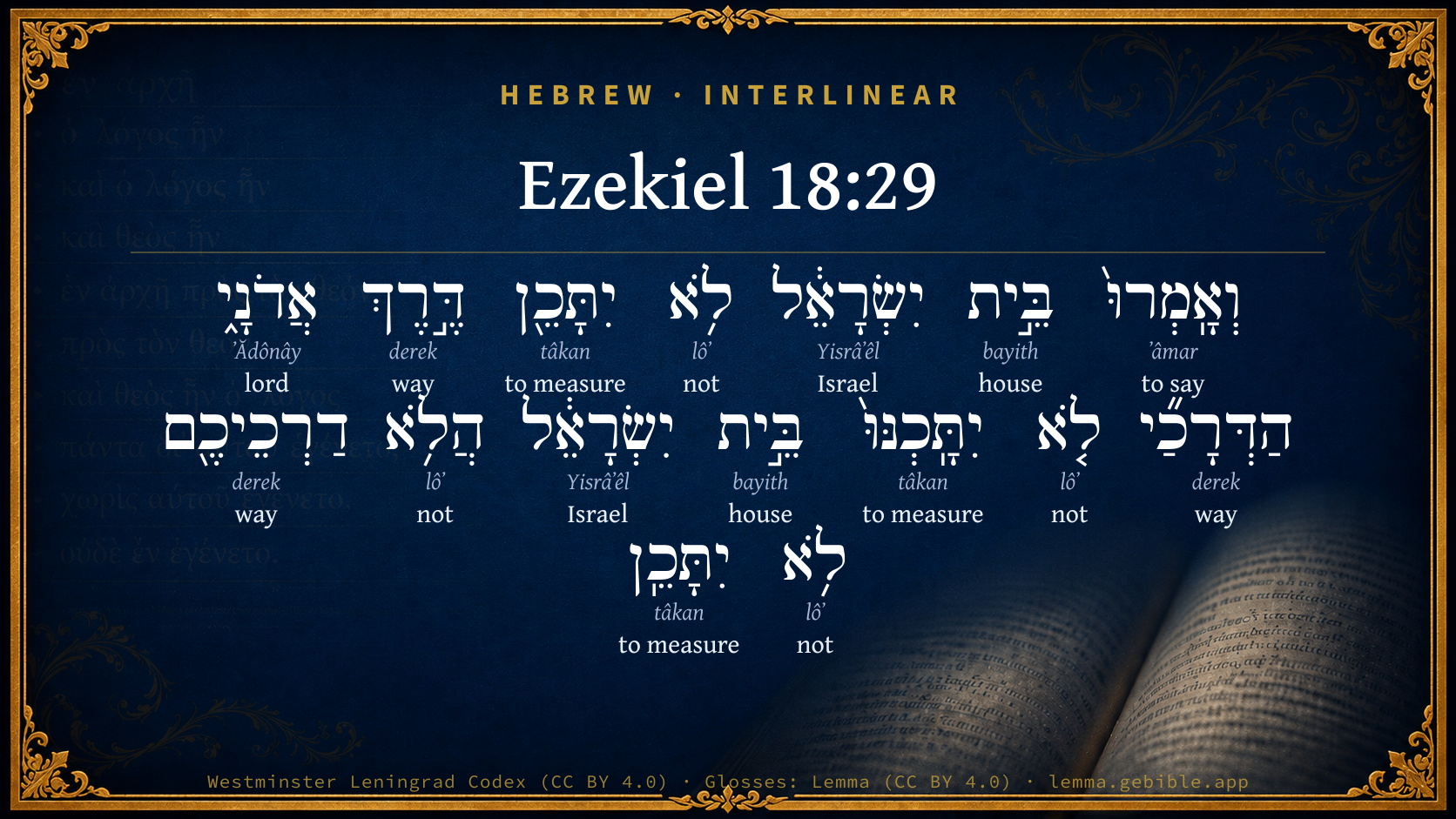
Hebrew (Westminster Leningrad Codex) Ezekiel 18:29 appears in the Hebrew Old Testament. The text above is from the Westminster Leningrad Codex. Each word links to its Strong’s number, a concise gloss, and parsing drawn from the Open Scriptures Hebrew Bible morphology. Click any word for its full Brown-Driver-Briggs (BDB) entry.
Download image
Cite this verse

Ezekiel 18:29 (World English Bible). Public Domain. Lemma interlinear Bible study tool, https://lemma.gebible.app/v/ezekiel/18/29.

Show BibTeX & RIS
BibTeX
RIS
English Translation
Yet says the house of Israel, The way of the Lord is not equal. house of Israel, are not my ways equal? are not your ways unequal?
World English Bible · Public Domain
Download a study sheet

One document with this verse’s original text, its word-by-word gloss line, the meaning frame, cross-references with their text, attributed commentary, and full source and license credits — printable, and it pastes into notes with its structure intact.

This verse Autodidact and up

Study sheet (.html) Plain text (.txt)

A passage Seminary Student

Up to 50 verses in one chapter. A passage sheet keeps up to 6 commentary sources and 12 cross-references per verse, in the order this page ranks them, and says so on the sheet whenever that leaves anything out. Ask for a single verse and you get the Autodidact verse sheet above.

Everything on this page stays free to read, with no account — the sheet is a download of what is already on screen, not access to it.

Want to remove ads? Support Godless Engineer
Compare translations 3

The same verse in 3 English versions, stacked beneath the original-language interlinear above. Click any original word for its lexicon entry.

Each is an independent rendering of the whole verse — the interlinear is not word-aligned to these translations.

Highlighted words mark where these versions differ — a whole-verse word diff, not a word-by-word alignment.

  • World English Bible Public Domain
    Yet says the house of Israel, The way of the Lord is not equal. house of Israel, are not my ways equal? are not your ways unequal?
  • King James Version Public Domain
    Yet saith the house of Israel, The way of the LORD is not equal. O house of Israel, are not my ways equal? are not your ways unequal?
  • unfoldingWord Literal Text CC BY-SA 4.0
    But the house of Israel says, ‘The way of the Lord is not fair!’ How is my way not fair, house of Israel? It is your ways that are not fair.

unfoldingWord Literal Text — © unfoldingWord, licensed CC BY-SA 4.0. Word-aligned USFM3 via Door43 (git.door43.org/unfoldingWord/en_ult).

Versions to compare (up to 4)

3 of 4 selected

Show all 18 translations

Every available English version of this verse, each an independent rendering of the whole verse.

  • World English Bible Public Domain
    Yet says the house of Israel, The way of the Lord is not equal. house of Israel, are not my ways equal? are not your ways unequal?
  • Berean Standard Bible Public Domain
    Yet the house of Israel says, ‘The way of the Lord is not just.’ Are My ways unjust, O house of Israel? Is it not your ways that are unjust?
  • Majority Standard Bible Public Domain
    Yet the house of Israel says, ‘The way of the Lord is not just.’ Are My ways unjust, O house of Israel? Is it not your ways that are unjust?
  • King James Version Public Domain
    Yet saith the house of Israel, The way of the LORD is not equal. O house of Israel, are not my ways equal? are not your ways unequal?
  • American Standard Version (1901) Public Domain
    Yet saith the house of Israel, The way of the Lord is not equal. O house of Israel, are not my ways equal? are not your ways unequal?
  • Revised Version (1885) Public Domain
    Yet saith the house of Israel, The way of the Lord is not equal. O house of Israel, are not my ways equal? are not your ways unequal?
  • Geneva Bible (1599) Public Domain
    Yet saith ye house of Israel, The way of the Lord is not equall. O house of Israel, are not my wayes equall? or are not your wayes vnequall?
  • Douay-Rheims (1899) Public Domain
    And the children of Israel say: The way of the Lord is not right. Are not my ways right, O house of Israel, and are not rather your ways perverse?
  • Young's Literal Translation Public Domain
    And the house of Israel have said, Not pondered is the way of the Lord, My ways -- are they not pondered? O house of Israel -- are not your ways unpondered?
  • Literal Standard Version CC BY-SA 4.0
    And the house of Israel has said, The way of the Lord is not pondered, || My ways—are they not pondered? O house of Israel—are not your ways unpondered?
  • Unlocked Literal Bible CC BY-SA 4.0
    But the house of Israel says, 'The way of the Lord is not fair!' How is my way not fair, house of Israel? It is your ways that are not fair.
  • unfoldingWord Literal Text CC BY-SA 4.0
    But the house of Israel says, ‘The way of the Lord is not fair!’ How is my way not fair, house of Israel? It is your ways that are not fair.
  • Darby Bible Public Domain
    But the house of Israel say, The way of the Lord is not equal. O house of Israel, are not my ways equal? Is it not your ways that are unequal?
  • World Messianic Bible Public Domain
    Yet the house of Israel says, ‘The way of the Lord is not fair.’ House of Israel, aren’t my ways fair? Aren’t your ways unfair?
  • Webster's Bible Public Domain
    Yet saith the house of Israel, The way of the Lord is not equal. O house of Israel, are not my ways equal? are not your ways unequal?
  • Free Bible Version CC BY-SA 4.0
    But the people of Israel say, ‘The Lord's way isn't right.’ Are my ways unfair, people of Israel? Isn't it your ways that aren't fair?
  • Bible in Basic English Public Domain
    But still the children of Israel say, The way of the Lord is not equal. O children of Israel, are my ways not equal? are not your ways unequal?
  • JPS Tanakh (1917) Public Domain
    Yet saith the house of Israel: The way of the Lord is not equal. O house of Israel, is it My ways that are not equal? is it not your ways that are unequal?

Literal Standard Version (2020), Covenant Press — licensed CC BY-SA 4.0. Text via the HelloAO Bible API (eBible.org). Unlocked Literal Bible (unfoldingWord) — licensed CC BY-SA 4.0. Text via the HelloAO Bible API (eBible.org). unfoldingWord Literal Text — © unfoldingWord, licensed CC BY-SA 4.0. Word-aligned USFM3 via Door43 (git.door43.org/unfoldingWord/en_ult). Free Bible Version, Dr. Jonathan Gallagher — licensed CC BY-SA 4.0. Text via the HelloAO Bible API (eBible.org).

Word by word

More ways to search: Search by grammar → Find every occurrence → Compare this word →

Practice this passage: Drill this verse → Learn its vocabulary →

יִתָּכֵ֖ן
tâkan
H8505
“to measure”
Verb, Niphal, Imperfect, 3rd Person, Masculine, Singular
Part of Speech
Verb
Stem
Niphal
Form
Imperfect
Person
3rd Person
Gender
Masculine
Number
Singular
Full BDB Definition

Origin: a primitive root

TWOT: 2511

to regulate, measure, estimate, ponder, balance, make even, level, weigh, be equal, be weighed out, test, prove - (Qal) estimate (participle) - (Niphal) - to be estimated - to be made even or right, be adjusted to the standard - (Piel) to weigh out, mete out - (Pual) - to be weighed out, be measured out - measured out (participle)
  1. וְאָֽמְרוּ֙ ʼâmar H559 “and · to say” Conjunction + Verb, Qal, Sequential Perfect, 3rd Person, Common, Plural
  2. בֵּ֣ית bayith H1004 “house of” Noun, Common, Masculine, Singular, Construct
  3. יִשְׂרָאֵ֔ל Yisrâʼêl H3478 “Israel” Noun, Proper
  4. לֹ֥א lôʼ H3808 “not” Particle, Negative
  5. דֶּ֣רֶךְ derek H1870 “way of” Noun, Common, Both, Singular, Construct
  6. אֲדֹנָ֑י ʼĂdônây H136 “Lord · my” Noun, Common, Masculine, Plural, Construct + Suffix, Personal, 1st Person, Common, Singular
  7. הַדְּרָכַ֞י derek H1870 “ways · my” Particle, Interrogative + Noun, Common, Both, Plural, Construct + Suffix, Personal, 1st Person, Common, Singular
  8. לֹ֤א lôʼ H3808 “not” Particle, Negative
  9. יִתָּֽכְנּוּ֙ tâkan H8505 “to measure” Verb, Niphal, Imperfect, 3rd Person, Masculine, Plural
  10. בֵּ֣ית bayith H1004 “house of” Noun, Common, Masculine, Singular, Construct
  11. יִשְׂרָאֵ֔ל Yisrâʼêl H3478 “Israel” Noun, Proper
  12. הֲלֹ֥א lôʼ H3808 “not” Particle, Interrogative + Particle, Negative
  13. דַרְכֵיכֶ֖ם derek H1870 “ways · your” Noun, Common, Both, Plural, Construct + Suffix, Personal, 2nd Person, Masculine, Plural
  14. לֹ֥א lôʼ H3808 “not” Particle, Negative
  15. יִתָּכֵֽן tâkan H8505 “to measure” Verb, Niphal, Imperfect, 3rd Person, Masculine, Singular

About this verse

These counts appear in no published source. They are computed here, from the morphology-tagged text and Lemma’s own curated glosses. What Lemma adds →

16
words
7
distinct lemmas
Prophets
section

Notable vocabulary

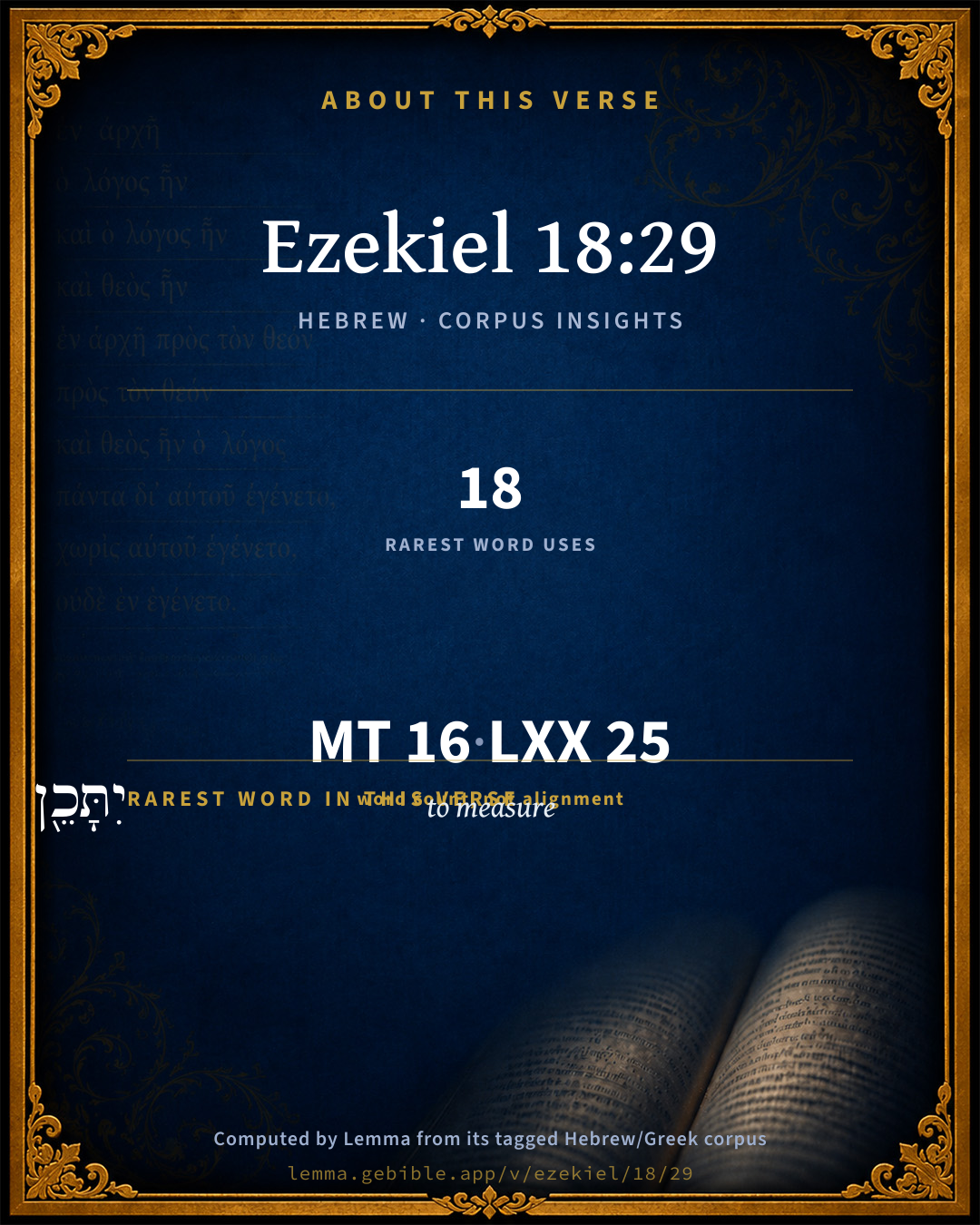
The rarest word here is יִתָּכֵ֖ן to measure H8505 — appearing just 18 times in the whole Hebrew Bible.

Shared distinctive vocabulary

יִתָּכֵ֖ן to measure H8505 occurs in 13 verses of the Hebrew Bible. Also found in:

Grammatical profile

  • 4 verbs
  • 8 nouns
  • 4 particles

Verb forms

  • וְאָֽמְרוּ֙ Qal · Sequential Perfect
  • יִתָּכֵ֖ן Niphal · Imperfect
  • יִתָּֽכְנּוּ֙ Niphal · Imperfect
  • יִתָּכֵֽן Niphal · Imperfect

Repetition

Words recur within this verse — often emphatic in Hebrew:

  • יִתָּכֵ֖ן to measure H8505 ×3
  • דֶּ֣רֶךְ way H1870 ×3
  • בֵּ֣ית house H1004 ×2
  • יִשְׂרָאֵ֔ל Israel H3478 ×2
  • לֹ֥א not H3808 ×4

Hebrew & Septuagint length

In English translation the verse runs 27 words from the Hebrew and 28 from the Septuagint (LXX English) — closely comparable.

A rough comparison of the two English renderings, which tokenize alike — not a word-level alignment.

Word counts can differ between the Hebrew and the Greek without any difference in meaning — e.g. the Hebrew direct-object marker אֵת has no separate Greek word, and Greek often adds the article ὁ.

In the original languages it is 16 Hebrew tokens and 25 Greek tokens — but the two are counted differently (Hebrew bundles its prefixes and suffixes into one token; the Greek is in lemma form), so that isn’t a like-for-like length.

Cross-references

3

Topical passages linked to Ezekiel 18:29 in the Treasury of Scripture Knowledge — connected by theme and wording, ordered by reader-vote popularity; previews shown in the World English Bible.

  • Ezekiel 18:25 Yet you say, The way of the Lord is not equal. Hear now, house of Israel: Is my way not equal? Aren't your ways unequal?
  • Proverbs 19:3 The foolishness of man subverts his way; His heart rages against Yahweh.
  • Ezekiel 18:2 What do you mean, that you use this proverb concerning the land of Israel, saying, The fathers have eaten sour grapes, and the children's teeth are set on edge?

Cross-references courtesy of OpenBible.info (CC BY 4.0).

Hebrew and Greek witnesses Masoretic Hebrew ↔ Greek Septuagint

The same verse in the two great witnesses to the Old Testament, shown verse-for-verse.

These are two independent witnesses, not word-aligned to each other, and the Septuagint is shown in lemma (dictionary) form.

Hebrew Ezekiel 18:29 Masoretic · Westminster Leningrad Codex

וְאָֽמְרוּ֙ בֵּ֣ית יִשְׂרָאֵ֔ל לֹ֥א יִתָּכֵ֖ן דֶּ֣רֶךְ אֲדֹנָ֑י הַדְּרָכַ֞י לֹ֤א יִתָּֽכְנּוּ֙ בֵּ֣ית יִשְׂרָאֵ֔ל הֲלֹ֥א דַרְכֵיכֶ֖ם לֹ֥א יִתָּכֵֽן

Yet says the house of Israel, The way of the Lord is not equal. house of Israel, are not my ways equal? are not your ways unequal?

World English Bible · Public Domain

Greek LXX Ezekiel 18:29 Septuagint · lemma form

καί λέγω ὁ οἶκος ὁ ἰσραήλ οὐ καταὀρθόω ὁ ὁδός κύριος μή ὁ ὁδός ἐγώ οὐ καταὀρθόω οἶκος ἰσραήλ οὐ ὁ ὁδός σύ οὐ καταὀρθόω

Yet the house of Israel say, The way of the Lord is not right. Is not my way right, O house of Israel? is not your way wrong?

LXX2012 (modern English Septuagint) · Public Domain

Hebrew: Westminster Leningrad Codex (CC BY 4.0). Greek: Septuagint (public domain); English from LXX2012 (modern English Septuagint) (Public Domain). How the Septuagint differs from the Hebrew →

Targum (Aramaic paraphrase)

1

The Targum is the ancient Jewish Aramaic paraphrase of the Hebrew Scriptures — an interpretive translation, not the Hebrew text itself. Onkelos (literal) and Pseudo-Jonathan (expansive) render the Torah, and Jonathan the Prophets. Coverage is partial: where no permissively-licensed English translation exists for a verse, only the Aramaic is shown. This is verse-level text, not a word-by-word alignment to the Hebrew.

  1. Targum Jonathan Prophets (Joshua–Malachi)
    וַאֲמָרוּ בֵּית יִשְׂרָאֵל לָא מַפְרְשָׁן לָנָא אוֹרְחַת טוּבָא דַייָ הֲאוֹרְחַת טוּבִי לָא מַפְרְשַׁן לְכוֹן בֵּית יִשְׂרָאֵל הֲלָא אוֹרְחַתְכוֹן דִילְכוֹן לָא תַקְנָן:

    (no public-domain English translation for this verse)

    Targum Jonathan — Aramaic: “Mikraot Gedolot” (public domain). English: “Sefaria Community Translation” (CC0 1.0 (public-domain dedication)); “London "Chaldee Paraphrase," 1871” (public domain). Text via Sefaria.

Commentary

Notes on Ezekiel 18:29 from classic Christian and Jewish commentators (each source and its license shown beneath its notes). The classic Christian expositions comment on the surrounding passage and are grouped to its opening verse, so a note may address several verses; the Jewish commentaries on the Tanakh (Rashi and others) are per-verse, so they appear only where the commentator wrote on this verse.

Lemma curates 59 commentaries, every one of them public domain or Creative Commons licensed, each selected and text-cleaned for this edition rather than reprinted as found. About our sources →

Trapp's Complete Commentary

John Trapp

Eze 18:29 Yet saith the house of Israel, The way of the Lord is not equal. O house of Israel, are not my ways equal? are not your ways unequal?

Ver. 29. Yet saith the house of Israel.] Yet; for all that I can say to the contrary. They will still hold their own; they will be dicti sui domini, &c., such was their impudence and petulance. God therefore gives over the confutation, and comes to the conclusion of this contestation.

John Trapp, A Commentary or Exposition upon All the Books of the Old and New Testament (1647–1656) — public domain. Text from a community e-Sword module.

The Biblical Illustrator

Joseph S. Exell

Eze_18:29

O house of Israel, are not My ways equal?

Scripture appealing to the reason and conscience of man

This is one among the many instances to be found in Scripture where the rational and moral nature of man is appealed to in justification of the Divine conduct. Christianity must be felt by us to be true before it can be felt by us to be binding on our consciences. And who is to be the judge of its truth or falsehood? Where and what is the tribunal before which its credentials are to be produced, examined, and decided on? What is it, or what can it be, but the reason of man,--Reason in her high seat of purity and power, lifted up above the tainted and corrupting atmosphere of worldly passions and prejudices, and calmly and serenely engaged in the consideration and contemplation of truth. This is one of the first and plainest rules to be adopted for our intellectual guidance. It is regarded as an axiom by all sober thinkers, that every proposition or statement which is found to be self-contradictory or irrational is at once to be regarded as incredible. This, of course, imposes upon man the heavy responsibility of using his reason fairly, of judging not according to the appearance, but of judging righteous judgment. With this condition it will be the surest and safest light to our feet and lamp to our path. There is another and a similar proposition to the one just mentioned, which I shall now proceed to enforce, having respect not so much to our intellectual as to our moral nature. In the Scriptures, appeal is not only made to our reason, our understanding, for the truth of their declarations, but to our moral feelings and convictions, And accordingly I would lay down this principle as akin to the one already touched upon, namely, that any representations of God, and of the character of God, which went to the subversion or destruction of those primary and essential distinctions of truth, justice and goodness, which have been established by the common consent of the wise and good of all ages,--any such representations, assuming what pretensions they may, are to be met with instant and utter rejection. When the Scriptures address our consciences, when they speak of the law written on the heart, when they ask us to judge of ourselves what is right, and when God appeals to us for the justice of His proceedings, saying, Are not My ways equal?--they take for granted that we have that within us which is capable of forming sound moral judgments, and of coming to right moral conclusions. So again, when the Scriptures speak to us of the goodness and the loving kindness and the mercy of God, they do not begin with defining the sense in which they use these terms. They suppose that we have already a general and sufficiently accurate knowledge of them. They take for granted the existence of these qualities among men, as arising out of the very constitution of their moral nature, wherever the faculties of that nature have been suffered in any degree to develop and expand themselves. What is goodness in man is the same that we mean by goodness in God. And so with justice, faithfulness, and mercy. These qualities, which we ascribe to God, we have first gotten a knowledge of by our own feelings and experience as human beings. If the Divine mercy and benignity mean not something like this, if they have no resemblance to kindred qualities existing in our own bosoms, what are we to understand by them? They become mere sounds and nothing else, words to which there attaches no significance, and all our conceptions of the character of God are reduced to the greatest possible vagueness and obscurity. Once overrule and bid defiance to the clearest dictates of the understanding, once set at naught and despise the deepest and most universal of our moral sentiments, and the mind is fitted and prepared for the belief of any opinion, however absurd, for the reception of any sentiment, however cruel and revolting. Demand of me anything but the surrender of my intellectual and moral guides. Require of me to give heed to the evidence you may tender in favour of a proposition, however strange, however remote from my present views and apprehensions, and it may be my duty to attend, to ponder, and at length to believe. But require me to give audience to assertions and statements in behalf of self-evident contradictions and palpable moral incongruities, and I revolt from the rashness of the attempt. I feel it to be an affront to the nature which God has given me. If we have no faith in the fundamental principles of human reason, and in the primary and essential moral feelings of the human heart, the foundations of all rational conviction are destroyed, and we are let loose to be driven about by every wind of doctrine, to be the victims of the wretchedest fanaticism, or of the most deadening and depressing scepticism. I am aware that, in answer to these remarks, we shall be reminded of our profound ignorance of the nature of God, and of the utter inadequacy of the human intellect to take unto itself the measure of the Divine. Most true it is that there is much belonging to the nature of God of which, in this dim twilight of our being, we have scarcely more than a mere glimpse. This is especially the case with what are called the natural attributes of God. We know but little, and can know but little, of what Infinity is, and Omnipotence and Eternity. Our apprehension of them may not come up to the fulness and completeness that distinguish them; but still, as far as it goes, it seems to be clear, definite, and exact. While much obscurity, perhaps, attaches to what we may term our metaphysical notions of God, we have no resting place on which the mind can repose, but the moral conceptions of God. That resting place, therefore, let us never abandon. Rather let us cleave to it, and guard and protect it as the home of our affections and the sanctuary of our consolations. But it may be asked, Do you mean, then, to exalt reason and conscience above the Word of God? Do you mean that that Word should submit itself to our erring human judgments? What we contend for is simply this, that no doctrine deduced from Scripture by human interpretation, which is at war with the intellectual and moral nature of man, which is at variance with the first and plainest directions of the understanding and the conscience, can be the Word of God, and entitled to the authority thence arising. We have no ideas of God clearer than those belonging to our moral conceptions of Him. When we say, Lo, God is good, we have a distinct understanding of what we mean by it. And so we have when we say that He is just and kind and merciful. These are properties with which reason and Scripture agree to invest Him. Fortified by these authorities, we take into our minds, and cherish as our greatest treasure, corresponding moral views of the Divine character. There they are lodged firmly and abidingly. From them our thoughts and hopes should never be separated. If, therefore, I perceive anything in the Scriptures which at first sight appears to be discordant with these views of the character of God I endeavour, by wider inquiry and deeper search, to find out a more consistent sense; but if that cannot be found, I say not that God is not the benignant and merciful Being that I took Him to be, but that from some cause or other I understand not the passage before me. In this way it is that I would meet and object to the doctrines of Calvinism. They begin with setting aside the clearest deductions of reason, and then with sweeping away every notion of justice and goodness that had fixed its habitation in my soul. Why are the most impressive appeals made to us in the Scriptures in behalf of the loving kindness and tender mercy of our God, if neither the reason nor the conscience of man can understand and feel what, as respects the Divine Being, goodness and mercy are? In that case goodness and mercy may mean anything or nothing; and to draw from them any reasons for consolation and trust must be vain and useless. Our belief will be a belief in a God unknown, and our worship will be the worship of we know not what. Fear not, then, to use your reason, your understandings, on the subject of religion; but beware of using them for purposes of display, for the gratification of your vanity, and the exercise of your skill. Consider them as talents, for the faithful employment of which you will have to render an account at the bar of Almighty Justice. Feed the immortal lamp within you by meditation and prayer, and elevate your souls to heaven; and then reason, in union with the Word of God, will guide you into the ways of wisdom, and her ways are the ways of pleasantness, and her paths are the paths of peace. (T. Madge.)

The Biblical Illustrator, edited by Joseph S. Exell (c. 1880s–1900s) — public domain. Text from a community e-Sword module.

Jamieson, Fausset & Brown

Robert Jamieson, A. R. Fausset & David Brown

Though God's justice is so plainly manifested, sinners still object to it because they do not wish to see it (Mic 2:7; Mat 11:18-19).

Jamieson, Fausset & Brown — Commentary Critical and Explanatory on the Whole Bible (1871) — public domain (CC PDM 1.0). Text via the HelloAO Bible API.

John Calvin's Commentaries

Here God briefly shows how furious those are who dare to rebel against him even when his justice is manifest: for what can be desired more justly than that God should punish all the transgressors of his law? and also, if sinners repent, that he should be prepared to pardon them? But if it seems hard that punishment should overtake the just if they fall away, common sense dictates that no virtue can be approved without perseverance. Since, therefore, it is very clear throughout this course of action, that God is just and without blame, what madness it is to vomit forth blasphemies against him, as if his ways were unjust! But God shows in one word, as I have mentioned, that the Israelites had no excuse for such dishonesty and impudence; and he repeats what he had formerly said, that men would always be guilty of rashness in insolently cursing God when their own ways are found oblique and perverse: but God will sufficiently vindicate his own ways. But we must add what follows —

John Calvin's Commentaries (1540-1563) — public domain. Text from the Calvin Translation Society English edition (1840s-50s) via the Christian Classics Ethereal Library (ccel.org). Calvin's coverage is partial (roughly two-thirds of the Bible); uncommented books and verses are honest gaps, never fabricated. The 19th-century editor's footnotes and remarks are omitted so the notes are faithfully Calvin's own voice.

John Gill's Exposition

Therefore will I judge you, O house of Israel,.... The case being fairly stated, the charge removed, instances to the contrary given, the Lord, as Judge, proceeds to bring the controversy to an issue, and to pass the definitive sentence, and to deal with them in the way of his providence as they deserved:

everyone according to his ways, saith the Lord God; not according to the ways of their father, but according to their own ways: this refers, not to the last and general judgment, but to some sore temporal punishment, which God, as the righteous Judge, would inflict upon them for their sins, according to the just desert of them; but whereas, notwithstanding all their wickedness, insolence, and blasphemy, the Lord was desirous of showing mercy to them, rather than proceed to strict justice; he exhorts and advises them to the following things:

repent, and turn yourselves from all your transgressions; this is to be understood of a national repentance for national sins, to prevent national judgments, being an address to the whole house of Israel; and not of evangelical repentance, which is the gift of God, and of an external reformation, as the fruit of it; and not of the first work of internal conversion, which is by the powerful and efficacious grace of God; though, were both exhorted to, it would not prove that these are in the power of men, only show the want and necessity of them, and so be the means of God's bringing his chosen people to them. The phrase, "yourselves", is not in the original; both words used signify "to turn"; and may be rendered and explained thus, "turn" yourselves, and "cause others to turn" (p); let every man turn himself from his evil courses, and do all he can to turn his brother, or his neighbour, from the same; so Jarchi, Kimchi, and Ben Melech interpret them. The Targum is,

"turn you to my worship, and remove from you the worship of idols:''

so iniquity shall not be your ruin; meaning temporal ruin, as it deserved, and they were threatened with; and which might be prevented by repentance and reformation: or, "shall not be a stumbling block to you" (q); an hinderance, an obstruction in the way of their enjoyment of temporal blessings.

(p) "convertimini et facite converti", Pagninus, Montanus, "sub. proximos"; so some in Calvin; "quisque suam fratrem", Munster, Vatablus. (q) "et non erit vobis in offendiculum", Pagninus, Montanus, Piscator.

John Gill's Exposition of the Whole Bible (1746–1763) — public domain (CC PDM 1.0). Text via the HelloAO Bible API.

Matthew Poole's English Annotations

This is the third or fourth appeal to the very consciences of Israel, on whose side the injustice lieth: the words are already unfolded Eze 18:25, and the justice of God and the wickedness of such quarrellers declared.

Matthew Poole's English Annotations on the Holy Bible (1683–1685) — public domain. Text from a community e-Sword/MySword module.

unfoldingWord translationNotes

Door43 World Missions Community

General Information:

Yahweh continues to teach the people of Israel why his way is fair.

house of Israel

The word "house" is a metonym for the family that lives in the house, in this case the Israelites, the descendants of Jacob over many years. See how you translated this in Ezekiel 3:1. AT: "the Israelite people group" (See: Metonymy)

The way of the Lord is not fair ... How is my way not fair ... It is your ways that are not fair

Actions or behaviors are spoken of as if they were a way or path that a person travels. AT: "The Lord does not act fairly ... How do I not act fairly ... It is you who do not act fairly" (See: Metaphor)

according to his ways

Yahweh speaks of a person's actions as if the person were walking along a path. AT: "according to his actions" (See: Metaphor)

turn away from all your transgressions so that they will not be stumbling blocks of iniquity against you

Yahweh speaks of "transgressions" causing people to rebel against him as if they were blocks over which the people stumble. (See: Metaphor)

stumbling blocks of iniquity against you

Possible meanings are 1) the stumbling blocks cause the person to commit more iniquity. AT: "stumbling blocks that cause you to commit more iniquity" or 2) The word "iniquity" is a metonym for the punishment that a person receives for his iniquity. AT: "stumbling blocks that lead to your punishment" (See: Metonymy)

translationWords

lord

judge

Lord Yahweh

declare

repent

turn

transgress

stumbling block

iniquity

unfoldingWord translationNotes — © Distant Shores Media and the Door43 World Missions Community, licensed CC BY-SA 4.0. Source: git.door43.org/Door43/en_tn.

Rashi

Rabbi Shlomo Yitzchaki (Rashi)

is not right Heb. יִתָּכֵן, like יִתָּקֵן, afetes in Old French; just, correct, right.

Rashi on the Tanakh — English translations: “The Judaica Press complete Tanach with Rashi, translated by A. J. Rosenberg” (CC BY 4.0); “Pentateuch with Rashi's commentary by M. Rosenbaum and A.M. Silbermann, 1929-1934” (public domain); “The Metsudah Tanach series, Lakewood, N.J” (CC BY 4.0); and “The Book of Joshua, Metsudah Publications, 1997” (CC BY 4.0). Text via Sefaria.

Lesson kit

Teaching starters — assembled from the data on this page, not authored interpretation. Every prompt links to the verse data it draws on. Edit before teaching.

Ezekiel, in the Prophets, opens this verse with 16 words (7 distinct Hebrew lemmas). Its most distinctive word is tâkan (“to measure”). A historical commentator’s framing appears above. Read the whole chapter for the surrounding context.

Discussion questions

  1. The word tâkan carries the sense “to measure.” How does it shape the verse?
  2. How does 1 Samuel 2:3, which shares the word «to measure», read alongside this verse?
  3. What does the repetition of “to measure” (3× in this one verse) do in this verse?
  4. These translations render this verse differently; the difference is in the English rendering, not the original. What questions does that raise?
  5. «וְאָֽמְרוּ֙» is a Qal Sequential Perfect verb. How does that grammatical form shape the action described?
  6. Compare how Trapp's Complete Commentary and The Biblical Illustrator read this verse. Where do they agree or differ?

Things to notice

Reading settings

Reading text

Shown beneath each verse's original-language words.

Old Testament
Old Testament edition

Read the OT as the Masoretic Hebrew (MT) or the Greek Septuagint (LXX).

English shown for the Greek Septuagint (in the Hebrew ↔ Greek comparison).

Comparing translations? Open the Compare panel on any verse page to stack up to four side by side.