
Ezekiel 12:17

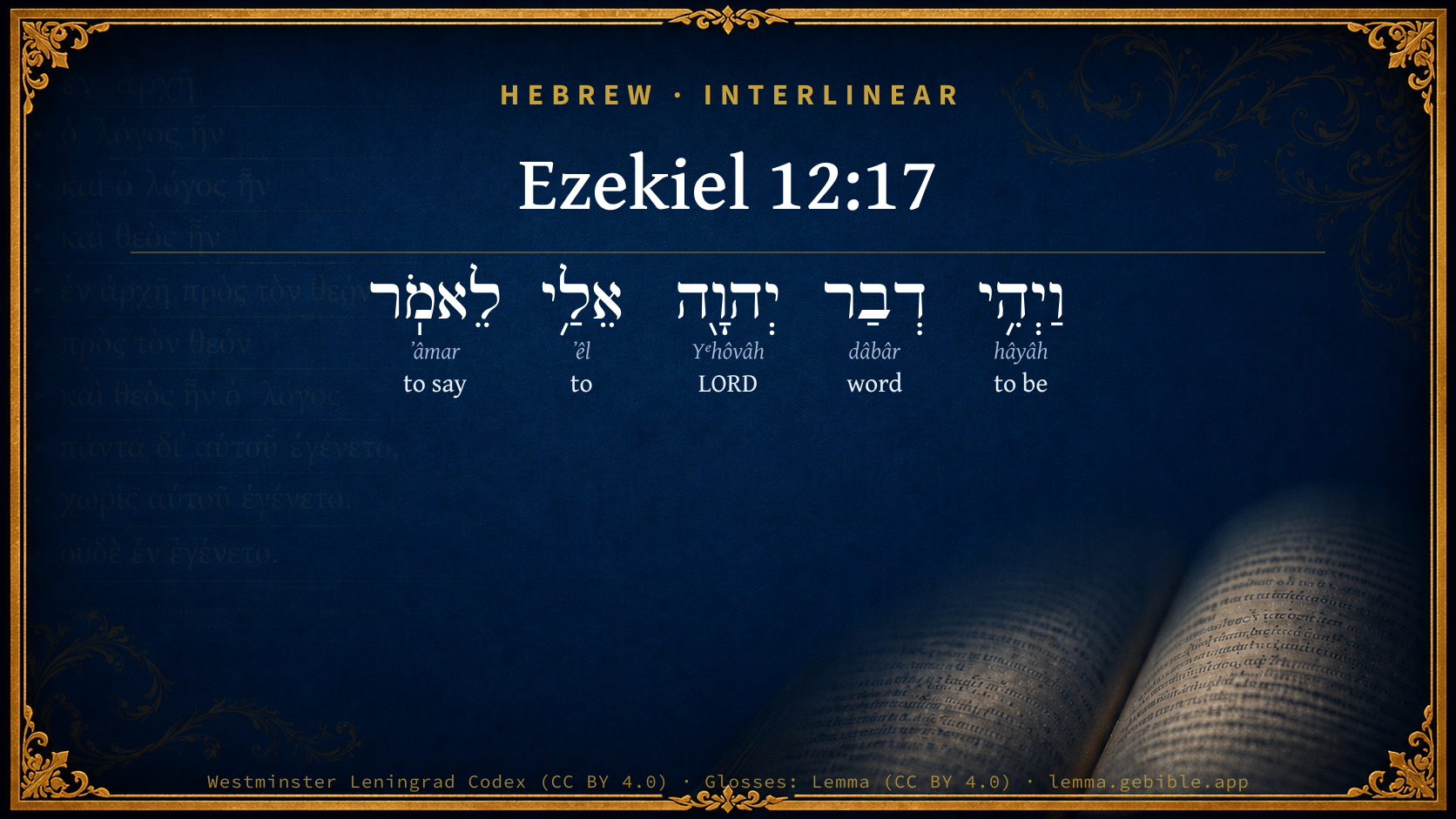
Hebrew (Westminster Leningrad Codex) Ezekiel 12:17 appears in the Hebrew Old Testament. The text above is from the Westminster Leningrad Codex. Each word links to its Strong’s number, a concise gloss, and parsing drawn from the Open Scriptures Hebrew Bible morphology. Click any word for its full Brown-Driver-Briggs (BDB) entry.
Download image
Cite this verse

Ezekiel 12:17 (World English Bible). Public Domain. Lemma interlinear Bible study tool, https://lemma.gebible.app/v/ezekiel/12/17.

Show BibTeX & RIS
BibTeX
RIS
English Translation
Moreover the word of Yahweh came to me, saying,
World English Bible · Public Domain
Download a study sheet

One document with this verse’s original text, its word-by-word gloss line, the meaning frame, cross-references with their text, attributed commentary, and full source and license credits — printable, and it pastes into notes with its structure intact.

This verse Autodidact and up

Study sheet (.html) Plain text (.txt)

A passage Seminary Student

Up to 50 verses in one chapter. A passage sheet keeps up to 6 commentary sources and 12 cross-references per verse, in the order this page ranks them, and says so on the sheet whenever that leaves anything out. Ask for a single verse and you get the Autodidact verse sheet above.

Everything on this page stays free to read, with no account — the sheet is a download of what is already on screen, not access to it.

Want to remove ads? Support Godless Engineer
Compare translations 3

The same verse in 3 English versions, stacked beneath the original-language interlinear above. Click any original word for its lexicon entry.

Each is an independent rendering of the whole verse — the interlinear is not word-aligned to these translations.

Highlighted words mark where these versions differ — a whole-verse word diff, not a word-by-word alignment.

  • World English Bible Public Domain
    Moreover the word of Yahweh came to me, saying,
  • King James Version Public Domain
    Moreover the word of the LORD came to me, saying,
  • unfoldingWord Literal Text CC BY-SA 4.0
    The word of Yahweh came to me, saying,

unfoldingWord Literal Text — © unfoldingWord, licensed CC BY-SA 4.0. Word-aligned USFM3 via Door43 (git.door43.org/unfoldingWord/en_ult).

Versions to compare (up to 4)

3 of 4 selected

Show all 18 translations

Every available English version of this verse, each an independent rendering of the whole verse.

  • World English Bible Public Domain
    Moreover the word of Yahweh came to me, saying,
  • Berean Standard Bible Public Domain
    Moreover, the word of the LORD came to me, saying,
  • Majority Standard Bible Public Domain
    Moreover, the word of the LORD came to me, saying,
  • King James Version Public Domain
    Moreover the word of the LORD came to me, saying,
  • American Standard Version (1901) Public Domain
    Moreover the word of Jehovah came to me, saying,
  • Revised Version (1885) Public Domain
    Moreover the word of the LORD came to me, saying,
  • Geneva Bible (1599) Public Domain
    Moreouer, the worde of the Lord came vnto me, saying,
  • Douay-Rheims (1899) Public Domain
    And the word of the Lord came to me, saying:
  • Young's Literal Translation Public Domain
    And there is a word of Jehovah unto me, saying,
  • Literal Standard Version CC BY-SA 4.0
    And there is a word of YHWH to me, saying,
  • Unlocked Literal Bible CC BY-SA 4.0
    The word of Yahweh came to me, saying,
  • unfoldingWord Literal Text CC BY-SA 4.0
    The word of Yahweh came to me, saying,
  • Darby Bible Public Domain
    And the word of Jehovah came to me, saying,
  • World Messianic Bible Public Domain
    Moreover the LORD’s word came to me, saying,
  • Webster's Bible Public Domain
    Moreover the word of the LORD came to me, saying,
  • Free Bible Version CC BY-SA 4.0
    A message from the Lord came to me, saying,
  • Bible in Basic English Public Domain
    Then the word of the Lord came to me, saying,
  • JPS Tanakh (1917) Public Domain
    Moreover the word of the LORD came to me, saying:

Literal Standard Version (2020), Covenant Press — licensed CC BY-SA 4.0. Text via the HelloAO Bible API (eBible.org). Unlocked Literal Bible (unfoldingWord) — licensed CC BY-SA 4.0. Text via the HelloAO Bible API (eBible.org). unfoldingWord Literal Text — © unfoldingWord, licensed CC BY-SA 4.0. Word-aligned USFM3 via Door43 (git.door43.org/unfoldingWord/en_ult). Free Bible Version, Dr. Jonathan Gallagher — licensed CC BY-SA 4.0. Text via the HelloAO Bible API (eBible.org).

Word by word

More ways to search: Search by grammar → Find every occurrence → Compare this word →

Practice this passage: Drill this verse → Learn its vocabulary →

About this verse

These counts appear in no published source. They are computed here, from the morphology-tagged text and Lemma’s own curated glosses. What Lemma adds →

5
words
5
distinct lemmas
Prophets
section

Grammatical profile

  • 2 verbs
  • 2 nouns
  • 1 preposition

Verb forms

  • וַיְהִ֥י Qal · Sequential Imperfect
  • לֵאמֹֽר Qal · Infinitive Construct

Hebrew & Septuagint length

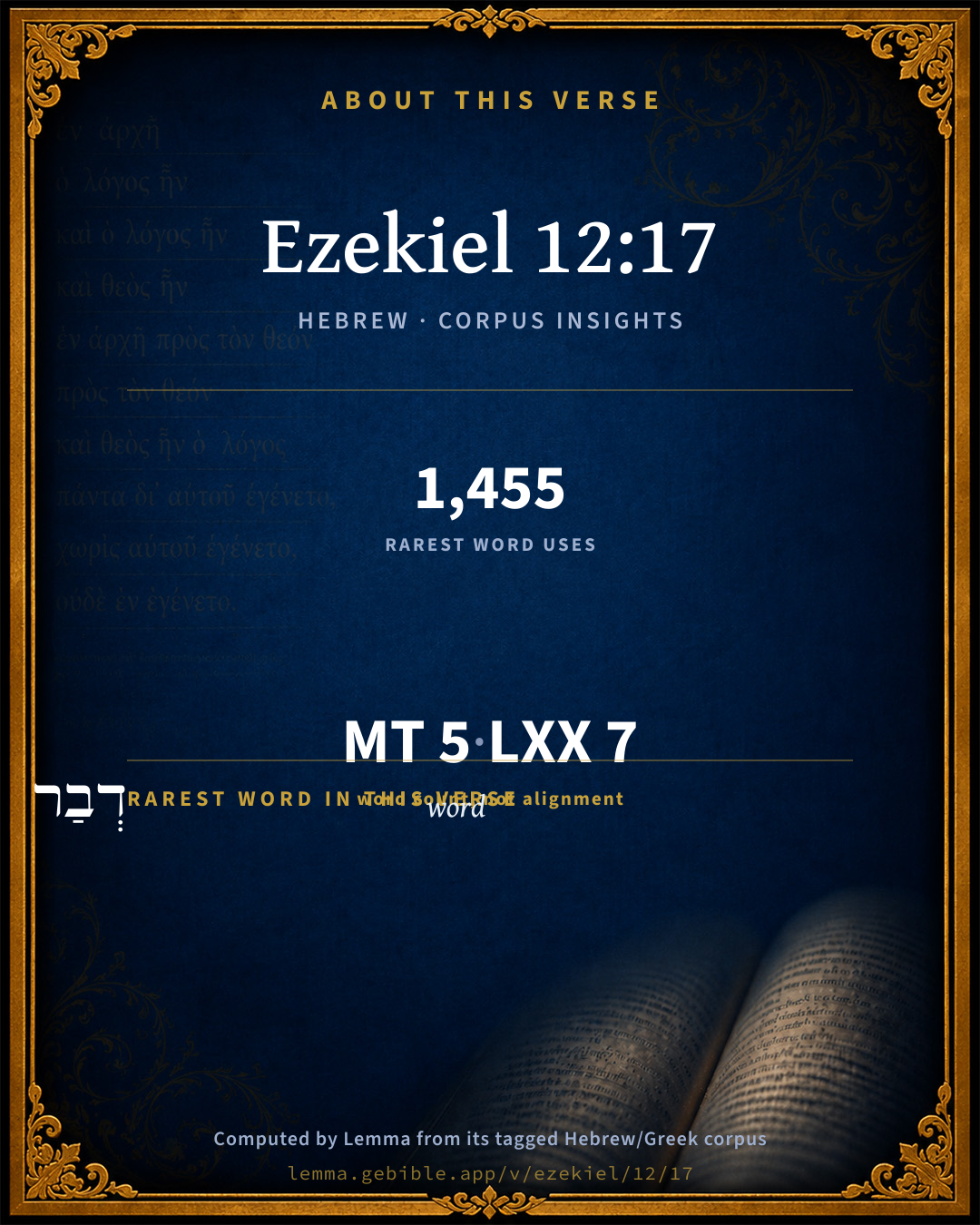
In English translation the verse runs 9 words from the Hebrew and 10 from the Septuagint (LXX English) — closely comparable.

A rough comparison of the two English renderings, which tokenize alike — not a word-level alignment.

Word counts can differ between the Hebrew and the Greek without any difference in meaning — e.g. the Hebrew direct-object marker אֵת has no separate Greek word, and Greek often adds the article ὁ.

In the original languages it is 5 Hebrew tokens and 7 Greek tokens — but the two are counted differently (Hebrew bundles its prefixes and suffixes into one token; the Greek is in lemma form), so that isn’t a like-for-like length.

Hebrew and Greek witnesses Masoretic Hebrew ↔ Greek Septuagint

The same verse in the two great witnesses to the Old Testament, shown verse-for-verse.

These are two independent witnesses, not word-aligned to each other, and the Septuagint is shown in lemma (dictionary) form.

Hebrew Ezekiel 12:17 Masoretic · Westminster Leningrad Codex

וַיְהִ֥י דְבַר יְהוָ֖ה אֵלַ֥י לֵאמֹֽר

Moreover the word of Yahweh came to me, saying,

World English Bible · Public Domain

Greek LXX Ezekiel 12:17 Septuagint · lemma form

καί γίγνομαι λόγος κύριος πρός ἐγώ λέγω

And the word of the Lord came to me, saying,

LXX2012 (modern English Septuagint) · Public Domain

Hebrew: Westminster Leningrad Codex (CC BY 4.0). Greek: Septuagint (public domain); English from LXX2012 (modern English Septuagint) (Public Domain). How the Septuagint differs from the Hebrew →

Targum (Aramaic paraphrase)

1

The Targum is the ancient Jewish Aramaic paraphrase of the Hebrew Scriptures — an interpretive translation, not the Hebrew text itself. Onkelos (literal) and Pseudo-Jonathan (expansive) render the Torah, and Jonathan the Prophets. Coverage is partial: where no permissively-licensed English translation exists for a verse, only the Aramaic is shown. This is verse-level text, not a word-by-word alignment to the Hebrew.

  1. Targum Jonathan Prophets (Joshua–Malachi)
    וַהֲוָה פִּתְגָם נְבוּאָה מִן קֳדָם יְיָ עִמִי לְמֵימָר:

    (no public-domain English translation for this verse)

    Targum Jonathan — Aramaic: “Mikraot Gedolot” (public domain). English: “Sefaria Community Translation” (CC0 1.0 (public-domain dedication)); “London "Chaldee Paraphrase," 1871” (public domain). Text via Sefaria.

Commentary

Notes on Ezekiel 12:17 from classic Christian and Jewish commentators (each source and its license shown beneath its notes). The classic Christian expositions comment on the surrounding passage and are grouped to its opening verse, so a note may address several verses; the Jewish commentaries on the Tanakh (Rashi and others) are per-verse, so they appear only where the commentator wrote on this verse.

Lemma curates 59 commentaries, every one of them public domain or Creative Commons licensed, each selected and text-cleaned for this edition rather than reprinted as found. About our sources →

Matthew Henry's Commentary

Here again the prophet is made a sign to them of the desolations that were coming on Judah and Jerusalem. 1. He must himself eat and drink in care and fear, especially when he was in company, Eze 12:17, Eze 12:18. Though he was under no apprehension of danger to himself, but lived in safety and plenty, yet he must eat his bread with quaking (the bread of sorrows, Psa 127:2) and drink his water with trembling and with carefulness, that he might express the calamitous condition of those that should be in Jerusalem during the siege; not that he must dissemble and pretend to be in fear and care when really he was not; but having to foretel this judgment, to show that he firmly believed it himself, and yet was far from desiring it, in the prospect of it he was himself affected with grief and fear. Note, When ministers speak of the ruin coming upon impenitent sinners they must endeavour to speak feelingly, as those that know the terrors of the Lord; and they must be content to endure hardness, so that they may but do good. 2. He must tell them that the inhabitants of Jerusalem should in like manner eat and drink with care and fear, Eze 12:19, Eze 12:20. Both those that have their home in Jerusalem and those of the land of Israel that come to shelter themselves there, shall eat their bread with carefulness and drink their water with astonishment, either because they are afraid it will not hold out, but they shall want shortly, or because they are continually expecting the alarms of the enemy, their life hanging in doubt before them (Deu 28:66), so that what they have they shall have no enjoyment of nor will it do them any good. Note, Care and fear, if they prevail, are enough to embitter all our comforts and are themselves very sore judgments. They shall be reduced to these straits that thus by degrees, and by the hand of those that thus straiten them, both city and country may be laid in ruins; for it is no less than an utter destruction of both that is aimed at in these judgments - that her land may be desolate from all the fulness thereof, may be stripped of all its ornaments and robbed of all its fruits, and then of course the cities that are inhabited shall be laid waste, for they are served by the field. This universal desolation was coming upon them, and then no wonder that they eat their bread with care and fear. Now we are here told, (1.) How bad the cause of this judgment was; it is because of the violence of all those that dwell therein, their injustice and oppression, and the mischief they did one another, for which God would reckon with them, as well as for the affronts put upon him in his worship. Note, The decay of virtue in a nation brings on a decay of every thing else; and when neighbours devour one another it is just with God to bring enemies upon them to devour them all. (2.) How good the effect of this judgment should be: You shall know that I am the Lord; and if, by these judgments, they learn to know him aright, that will make up the loss of all they are deprived of by these desolations. Those are happy afflictions, how grievous soever to flesh and blood, that help to introduce us into and improve us in an acquaintance with God.

Matthew Henry's Commentary on the Whole Bible (1708–1710) — public domain (CC PDM 1.0). Text via the HelloAO Bible API.

Trapp's Complete Commentary

John Trapp

Eze 12:17 Moreover the word of the LORD came to me, saying,

Ver. 17. Moreover the word, &c.] See on Eze 12:1.

John Trapp, A Commentary or Exposition upon All the Books of the Old and New Testament (1647–1656) — public domain. Text from a community e-Sword module.

Joseph Benson's Commentary

Eze 12:17-19. Moreover, &c. — As he was a sign to them in digging through the wall and carrying out his stuff, so he must now be a sign to them in another way. Eat thy bread with quaking, &c. — Show all the signs of anxiety and consternation when thou takest thy common sustenance. This he was to do that he might express the calamitous condition of those that should be in Jerusalem during the siege. And say unto the people — Thy fellow-captives; Thus saith the Lord of the inhabitants of Jerusalem — This was designed to inform the captives that they were not in a worse condition than those that were left behind in Judea. They shall eat their bread with carefulness, &c. — See note on Eze 4:16-17. That her land may be desolate — Rather, because her land shall be desolate, namely, the land of Jerusalem, or the country, of which it was the head city, which was shortly to be laid waste, emptied of its inhabitants, wealth, and plenty. Because of the violence, &c. — The injustice, oppression, and tyranny of the Jews toward one another.

Joseph Benson's Commentary on the Old and New Testaments (1811–1818) — public domain. Text from a community e-Sword module.

The Preacher's Complete Homiletical Commentary

Joseph S. Exell (gen. ed.)

(2.) THE SYMBOL FROM BREAD AND WATER (Eze_12:17-20)

EXEGETICAL NOTES.—The prophet is commanded to take his ordinary meals as a man under great apprehensions. It is not, as in chap. Eze_4:16, that he is thus to indicate a dreadful scarcity approaching, but rather the felt pressure of that calamity, as if the evil threatened would take away all relish for sustenance to the body (Eze_12:18). Ezekiel speaks in the Word of the Lord “of the inhabitants of Jerusalem, in the country of Israel;” a message is to be forwarded to the people who had not been carried into captivity, to declare that they should be affected with anxiety and surprise, “because its land,” i.e., ferusalenis, “becomes desolate from its fulness;” where once were life and plenty, the supply of population, animals, grain, &c., would be grievously and surprisingly diminished.

HOMILETICS

(Eze_12:17-20)

When the evil consequences of sins have to be encountered then there may be trouble.

I. On men.

1. An apparently foolish course may be appointed by the Lord, but “the foolishness of God is wiser than men.”

2. Hard service may have to be undertaken for the gracious Master, but “most gladly will I glory in infirmities if the power of Christ rest upon me.”

II. On the necessaries of life. Supplies for the body may become not sources of comfort but of suffering. Food and drink shall cause a strain and pain. The bread be bread of affliction.

III. On population, agriculture, commerce. Depression and decrease ensue. A nation no more than an individual can escape from the due reward of its deeds.

The Preacher's Complete Homiletical Commentary (gen. ed. Joseph S. Exell; Funk & Wagnalls, c. 1892) — public domain (pre-1929). A full-Bible homiletical/sermon-outline anthology covering 65 of 66 books (2 John is absent from the source module). Text from a community e-Sword module.

Keil & Delitzsch

C. F. Keil & F. Delitzsch

Sign Depicting the Terrors and Consequences of the Conquest of Jerusalem

Eze 12:17. And the word of Jehovah came to me, saying, Eze 12:18. Son of man, thou shalt eat thy bread with quaking, and drink thy water with trembling and trouble; Eze 12:19. And say to the people of the land, Thus saith the Lord Jehovah to the inhabitants of Jerusalem, in the land of Israel, They will eat their bread in trouble, and drink their water in amazement, because her land is laid waste of all its fulness for the wickedness of all who dwell therein. Eze 12:20. And the inhabited cities become desolate, and the land will be laid waste; that ye may learn that I am Jehovah. - The carrying out of this sign is not mentioned; not that there is any doubt as to its having been done, but that it is simply taken for granted. The trouble and trembling could only be expressed by means of gesture. רעשׁ, generally an earthquake or violent convulsion; here, simply shaking, synonymous with רגזה, trembling. "Bread and water" is the standing expression for food; so that even here the idea of scanty provisions is not to be sought therein. This idea is found merely in the signs of anxiety and trouble with which Ezekiel was to eat his food. אל־אדמת = 'על־אד, "upon the land," equivalent to "in the land." This is appended to show that the prophecy does not refer to those who had already been carried into exile, but to the inhabitants of Jerusalem who were still in the land. For the subject-matter, compare Eze 4:16-17. למען indicates not the intention, "in order that," but the motive, "because."

Keil & Delitzsch — Biblical Commentary on the Old Testament (1861–1891) — public domain (CC PDM 1.0). Text via the HelloAO Bible API. (Old Testament only.)

Tyndale Open Study Notes

Tyndale Open Resources

12:17-20 For Ezekiel to tremble and shake while eating and drinking was a sign act that reflected the terrible anxiety of the inhabitants of Jerusalem and Judah as they saw their inevitable doom approaching. When the exiles learned that their former homeland had been destroyed, they would realize that they were not castoffs from God’s plan, but rather the fortunate ones who had escaped his comprehensive judgment (see Jer 24:1-8).

Tyndale Open Study Notes — © Tyndale Open Resources, licensed CC BY-SA 4.0. Text via the HelloAO Bible API.

John Calvin's Commentaries

The Prophet is now ordered to represent the famine which awaited the Jews in both the siege and exile. But this prophecy ought to be especially referred to the time of the siege; for the Jews were in continual fear, and thought that by means of their garrison they would be impregnable. But as the Lord had often removed this trust from them, so he does now: hence therefore that miserable anxiety and fear, so that they never ate their bread but in fear, nor drank their water but in confusion. For a besieged city always fears for itself, and then the enemy so harasses them that fatigue at length compels the besieged to surrender. And it is probable, since the army of the Chaldees could often attempt to take the city with ease and without any great loss, that the Jews would daily be subject to fresh terrors, so that they could neither eat bread nor drink water except in anxiety and confusion. But because simple and unadorned teaching would not have been effective among the ten tribes and the Jews, hence an outward symbol is added. The Prophet therefore is the image of the besieged people, and hence he is ordered to eat his bread with trembling, that the spectacle might the more affect these slow and slothful men. By and bye the application follows, thou shalt say to the people of the land I do not doubt that he here means the ten tribes: hence the land signifies Chaldea, and those regions through which the exiles were dispersed. As we have before seen, it was to their advantage to hear this, because they thought that the Jews remaining at home were treated well, and themselves miserably. Hence not only their complaint but even their outcry against God and his servants, especially Jeremiah. This then is the reason why the Prophet is obliged to utter his discourse to the captives.

But afterwards it follows, Thus saith the Lord Jehovah to the inhabitants of Jerusalem concerning the land of Israel, that is, those remaining in the land of Israel. We here see that the land of Israel is distinguished from the other land, of which mention was lately made. Those who dwelt at Jerusalem remained quiet in their own inheritance; and hence their condition was esteemed better, because nothing is more sad than exile and captivity. But God pronounces them more miserable than the captives, who had already been relieved from the principal part of their miseries. They shall eat, says he, their bread in pain, or torture, and shall drink their water in desolation: he does not repeat the same words which he had formerly used, but shortly shows that the Jews boasted in vain that they were still in safety: because very soon the enemy will press upon them, so that they should not be able to eat a mouthful of bread in peace. That the land may be reduced, says he, from plenty to devastation: some translate, after its plenty, which is forced and far-fetched; for the Prophet means that the land would be desert and empty through exhaustion: for plenty, as we well know, means an abundance of all things. Judea was then reduced from plenty to want, when the enemies plundered whatever it contained, and so the region was despoiled of its wealth. The reason follows, through the violence of those who dwell in it. Some explain this erroneously of the Chaldees, because they lost the whole land through their rapacity. For the Prophet rather advises that this vengeance of God was just, because in truth all the Jews were given up to violence, cruelty, and rapacity. חמס, chemes, signifies all kinds of injury, but usually means violence and rapine. Hence we understand the Prophet’s intention, namely, that the Jews suffered this slaughter deservedly, because the just reward of their wickedness was measured out to them. And thus Ezekiel represses all complaints, in which they too freely indulged, as if God was treating them too roughly and hardly. Therefore he shortly teaches them that he would not spare them any longer. It follows —

John Calvin's Commentaries (1540-1563) — public domain. Text from the Calvin Translation Society English edition (1840s-50s) via the Christian Classics Ethereal Library (ccel.org). Calvin's coverage is partial (roughly two-thirds of the Bible); uncommented books and verses are honest gaps, never fabricated. The 19th-century editor's footnotes and remarks are omitted so the notes are faithfully Calvin's own voice.

The Cambridge Bible for Schools and Colleges

gen. ed. J. J. S. Perowne

17–20. A new symbol of the terror and violence and desolation about to come upon the land.

The Cambridge Bible for Schools and Colleges (gen. ed. J. J. S. Perowne; Cambridge University Press, 1878–1918) — public domain. Text from a community e-Sword module.

John Gill's Exposition

And the cities that are inhabited shall be laid waste,.... Not only the city of Jerusalem, but the other cities of Judea; as they were by the Chaldeans, which were then full of inhabitants:

and the land shall be desolate; the whole land of Judea be destitute of men and cattle, and lie uncultivated, and become barren and unfruitful:

and ye shall know that I am the Lord; who were then captives in Babylon, as well as those who should be dispersed among the nations would; see Eze 12:15.

John Gill's Exposition of the Whole Bible (1746–1763) — public domain (CC PDM 1.0). Text via the HelloAO Bible API.

Matthew Poole's English Annotations

He was a sign to them in digging and bearing his stuff, now he must be a sign to them in another manner.

Matthew Poole's English Annotations on the Holy Bible (1683–1685) — public domain. Text from a community e-Sword/MySword module.

Whedon's Commentary on the Bible

Daniel D. Whedon

17-19. Eat thy bread with quaking, etc. — This is the same symbolic act, indicating the famished condition of the population of Jerusalem together with their fear and shuddering, which Ezekiel had previously performed during his long and toilsome siege of the mimic city (Eze_4:9-12; Eze_4:16). Recent events may have made the repetition of this picture-sermon more impressive than it had been previously. Desolate from all that is therein [literally, from its fullness], because, etc. — That is, the land now so full of people and of riches shall become desolate, and the reason for this is not agricultural or political, but moral. It is the wickedness and violence of the people that have brought upon them their calamity (Eze_7:11).

Daniel D. Whedon (gen. ed.), Commentary on the Old and New Testaments (1874–1909) — public domain. Text from a community e-Sword module.

The Pulpit Commentary

The opening words, The worn of the Lord came to me, imply an interval of passivity and silence. One conscious burst of inspiration came to an end, and was followed, after a time, by another.

Vers. 17-20. Deprivations caused by sin.

the word of the Lord came to me, saying, Son of man, eat thy bread with quaking," etc. This paragraph was addressed to Ezekiel"s fellow exiles. "Say unto the people of the land;" i.e. of Chaldea. The design was to discourage the false expectations of the captives, who were looking forward to an early season of prosperity for their native land, in which they hoped to share. To this end the prophet shows to them that, in respect to their fellow countrymen in Jerusalem, there would be a cutting off of the physical comforts of life, great anxiety and distress of mind, and sad devastation of both cities and country, and all these things because of the sins of the people, or "for the violence of all who dwell in it." Several things call for attention.

I SIN DEPRIVING SINNERS OF THE PHYSICAL COMFORTS OF LIFE. "Son of man, eat thy bread with quaking, and drink thy water with trembling and with carefulness; and say unto the people of the land, Thus saith the Lord God of the inhabitants of Jerusalem, and of the land of Israel or, "in the land of Israel"; They shall eat their bread with carefulness, and drink their water with astonishment." These words point to the cutting off of the comforts of life, and the possession of the mere necessaries thereof. But not always does sin produce consequences such as this. Sin and secular prosperity have often gone hand in hand. (cf. Gen_13:10, Gen_13:13; Psa_73:3-12; Luk_12:16-20 Luk_16:19-26) But in these cases the prosperity was precedent to the Divine judgment or to the full development of sin. When that development had taken place, and that judgment was being exercised, there was a striking reversal of circumstances in each case. In the siege of Jerusalem, to which our text points, physical comforts and luxuries disappeared, and long before its close men deemed themselves fortunate if they could secure bread and water. And in our age the wicked may prosper in the world and increase in riches; but in the time of retribution, whenever it arrives, sin will be found injurious to all the true interests of man. Sin often strips the sinner of physical comforts, and even of the bare necessaries of life. Drunkenness, gluttony, indolence, wastefulness, bring many a person and many a family to abject poverty and want. (cf. Pro_6:9-11 Pro_19:15 Pro_23:21 Pro_24:30-34)

II SIN DEPRIVING SINNERS OF PEACE AND SERENITY OF SPIRIT. "Son of man, eat thy bread with quaking, and drink thy water with trembling and with carefulness. They shall eat their bread with carefulness, and drink their water with astonishment." They would eat even the necessaries of life, not in peace and comfort, but in anxiety and alarm. Their distress may have arisen from tear lest their scanty supplies of food should fail them, and so they ate "their bread with carefulness." And to this was joined terror of their enemies who surrounded them, causing them to take of the sustenance of life "with quaking, trembling, and astonishment." It is of the nature of sin, when it is developed, to destroy peace and calmness of mind, and to produce terror and distress. "The wicked are like the troubled sea," etc.. (Isa_57:20, Isa_57:21) Without doubt we may often find the wicked in their sad career untroubled either by guilt or fear; but forevery one the time of awakening comes, and with it security departs and terror arrives. "When the pleasure has been tasted and is gone," says Mr. Froude, "and nothing is left of the crime but the ruin which it has wrought, then the furies take their seats upon the midnight pillow." "The wicked flee when no man pursueth." "The sound of a shaken leaf shall chase them; and they shall flee as fleeing from a sword; and they shall fall when none pursueth.

III SIN DESOLATING THE LAND IN WHICH IT WAS COMMITTED. "That her land may be desolate from all that is therein, because of the violence of all them that dwell therein. And the cities that are inhabited shall be laid waste, and the land shall be desolate." Instead of "That her land may be desolate from all that is therein," the margin reads, "from the fulness thereof." The meaning seems to be that the land would be "stripped of all its inhabitants and of all its wealth." The land of Israel was once fair and fertile good land, a land of brooks of water, of fountains and depths that spring out of valleys and hills," etc. (Deu_8:7-9) In the time of Solomon the Tyrians received large quantities of corn and wine and oil from this fruitful land. (2Ch_2:10) But what is its condition now? And what has been its condition for ages past? "He turneth a fruitful land into barrenness, for the wickedness of them that dwell therein." "The plain of Jordan, well watered everywhere, and as the garden of the Lord (Gen_13:10) is not the only example of fertility, being changed into barrenness because of the sins of the people. Other lands have had a similar fate, but by a different process. There are sins by which lands are still laid waste. Indolence, effeminacy, self-indulgence, delight in war, and social oppression, in every age produce impoverishment and desolation in any country where they prevail.

IV DIVINE JUDGMENT BECAUSE OF SIN LEADING SINNERS TO KNOW THAT JEHOVAH IS THE ONE LIVING AND TRUE GOD. "And ye shall know that I am the Lord" (see our notes on these words in. W.J. (Eze_6:7, 10 11:10)

The Pulpit Commentary (1880–1919), ed. H.D.M. Spence-Jones & Joseph S. Exell — public domain. Text from a community e-Sword module.

Kretzmann's Popular Commentary

Paul E. Kretzmann

The Sign of Bread and Water

v. 17. Moreover, the word of the Lord came to me, saying,

v. 18. Son of man, eat thy bread with quaking and drink thy water with trembling and with carefulness, his entire bearing, as he partook of his scanty meal, of the barest necessaries of life, being one of anxiety in the presence of an impending calamity;

v. 19. and say unto the people of the land, the Jews among the captives of Chaldea, Thus saith the Lord God of the inhabitants of Jerusalem and of the land of Israel, of all the people who were still left in their native country, They shall eat their bread with carefulness, with anxiety, and drink their water with astonishment, with worry and pain, that her land may be desolate from all that is therein, stripped of both its inhabitants and the abundance of all its products, because of the violence of all them that dwell therein, since they had become guilty of wickedness in such an unusual degree.

v. 20. And the cities that are inhabited shall be laid waste, and the land shall be desolate, the entire country sharing the fate of the capital city; and ye shall know that I am the Lord, whose words are not spoken in vain.

v. 21. And the word of the Lord came unto me, saying,

v. 22. Son of man, what is that proverb that ye have in the land of Israel, saying, The days are prolonged, more and more time is passing, and every vision faileth? that is, the prophecy threatening destruction is not fulfilled. Cf 2Pe 3:3-4. That is a common saying of mocking blasphemers, that none of the divine threats come true, that they are spoken merely to frighten men into submission.

v. 23. Tell them therefore, Thus saith the Lord God, I will make this proverb to cease, making an end of its blasphemous mockery, and they shall no more use it as a proverb in Israel; but say unto them, The days are at hand, the time of the fulfillment of the Lord’s words, and the effect of every vision, so that every predicted word would be realized.

v. 24. For there shall be no more any vain vision, the false prophets being confounded by the fulfillment of the true prediction, nor flattering divination within the house of Israel, for the false prophets tried to gain credence for their falsehoods by predictions and statements of smooth flattery.

v. 25. For I am the Lord; I will speak, and the word that I shall speak shall come to pass, it shall be no more prolonged, literally, "For I, Jehovah, will speak that which I will speak, and it shall come to pass, it shall be no more drawn out"; for in your days, during their lifetime, O rebellious house, will I say the word and will perform it, saith the Lord God. He has uncontrolled power to speak, and He possesses almighty power to carry out his threats.

v. 26. Again the word of the Lord came to me, saying,

v. 27. Son of man, behold, they of the house of Israel, again those dwelling in exile in Chaldea, say, The vision that he seeth is for many days to come, and he prophesieth of the times that are far off, thus refusing to believe that the catastrophe was near at hand.

v. 28. Therefore say unto them, Thus saith the Lord God, There shall none of My words be prolonged any more, that is, their fulfillment put off indefinitely, but the word which I have spoken shall be done, saith the Lord God, the sovereign God of the covenant. It is true also in our days that the Lord may delay the fulfillment of some word, but He will eventually bring every one of His predictions to pass.

Paul E. Kretzmann, Popular Commentary of the Bible (1921–1924) — public domain. Text from a community e-Sword module.

unfoldingWord translationNotes

Door43 World Missions Community

The word of Yahweh came

This is an idiom that is used to introduce something that God told his prophets or his people. See how you translated this in Ezekiel 3:16. AT: "Yahweh spoke this message" or "Yahweh spoke these words" (See: Idiom)

translationWords

word of God

Son of Man

bread

unfoldingWord translationNotes — © Distant Shores Media and the Door43 World Missions Community, licensed CC BY-SA 4.0. Source: git.door43.org/Door43/en_tn.

Lesson kit

Teaching starters — assembled from the data on this page, not authored interpretation. Every prompt links to the verse data it draws on. Edit before teaching.

Ezekiel, in the Prophets, opens this verse with 5 words (5 distinct Hebrew lemmas). Its most distinctive word is dâbâr (“word”). A historical commentator’s framing appears above. Read the whole chapter for the surrounding context.

Discussion questions

  1. What does “word” (dâbâr) contribute to the verse as a whole?
  2. These translations render this verse differently; the difference is in the English rendering, not the original. What questions does that raise?
  3. The verb «וַיְהִ֥י» is Qal Sequential Imperfect. How does its form color the action?
  4. Reading how Matthew Henry's Commentary and Trapp's Complete Commentary read this verse, where do the two commentators agree and where do they part?

Things to notice

Reading settings

Reading text

Shown beneath each verse's original-language words.

Old Testament
Old Testament edition

Read the OT as the Masoretic Hebrew (MT) or the Greek Septuagint (LXX).

English shown for the Greek Septuagint (in the Hebrew ↔ Greek comparison).

Comparing translations? Open the Compare panel on any verse page to stack up to four side by side.