
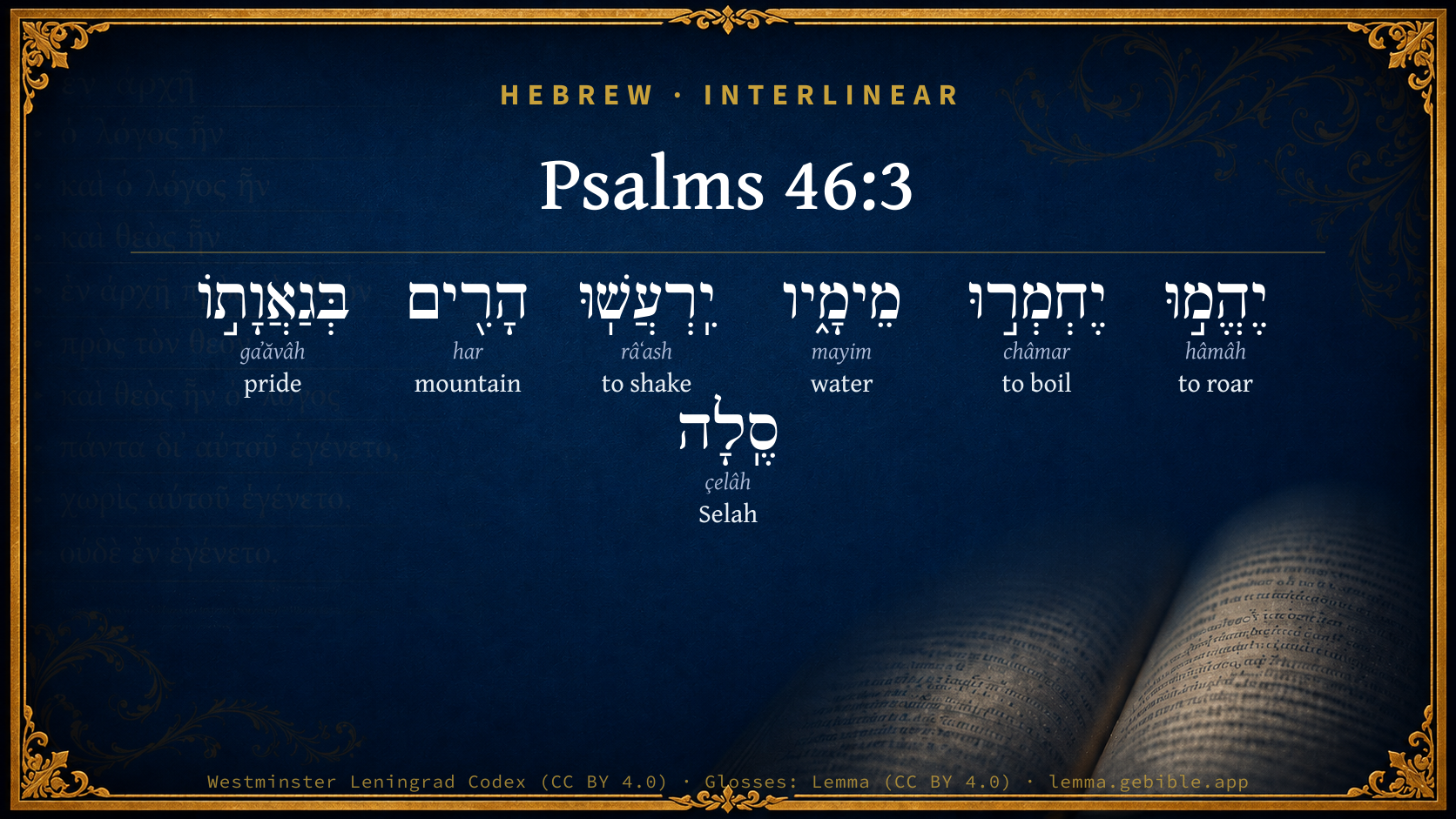
Psalms 46:3

Hebrew (Westminster Leningrad Codex) Psalms 46:3 appears in the Hebrew Old Testament. The text above is from the Westminster Leningrad Codex. Each word links to its Strong’s number, a concise gloss, and parsing drawn from the Open Scriptures Hebrew Bible morphology. Click any word for its full Brown-Driver-Briggs (BDB) entry.
Download image
Cite this verse

Psalms 46:3 (World English Bible). Public Domain. Lemma interlinear Bible study tool, https://lemma.gebible.app/v/psalms/46/3.

Show BibTeX & RIS
BibTeX
RIS
English Translation
Though the waters of it roar and are troubled, Though the mountains tremble with their swelling. Selah.
World English Bible · Public Domain
Download a study sheet

One document with this verse’s original text, its word-by-word gloss line, the meaning frame, cross-references with their text, attributed commentary, and full source and license credits — printable, and it pastes into notes with its structure intact.

This verse Autodidact and up

Study sheet (.html) Plain text (.txt)

A passage Seminary Student

Up to 50 verses in one chapter. A passage sheet keeps up to 6 commentary sources and 12 cross-references per verse, in the order this page ranks them, and says so on the sheet whenever that leaves anything out. Ask for a single verse and you get the Autodidact verse sheet above.

Everything on this page stays free to read, with no account — the sheet is a download of what is already on screen, not access to it.

Want to remove ads? Support Godless Engineer
Compare translations 3

The same verse in 3 English versions, stacked beneath the original-language interlinear above. Click any original word for its lexicon entry.

Each is an independent rendering of the whole verse — the interlinear is not word-aligned to these translations.

Highlighted words mark where these versions differ — a whole-verse word diff, not a word-by-word alignment.

  • World English Bible Public Domain
    Though the waters of it roar and are troubled, Though the mountains tremble with their swelling. Selah.
  • King James Version Public Domain
    Though the waters thereof roar and be troubled, though the mountains shake with the swelling thereof. Selah.
  • unfoldingWord Literal Text CC BY-SA 4.0
    should its waters roar and foam, should the mountains quake at its swelling. Selah

unfoldingWord Literal Text — © unfoldingWord, licensed CC BY-SA 4.0. Word-aligned USFM3 via Door43 (git.door43.org/unfoldingWord/en_ult).

Versions to compare (up to 4)

3 of 4 selected

Show all 18 translations

Every available English version of this verse, each an independent rendering of the whole verse.

  • World English Bible Public Domain
    Though the waters of it roar and are troubled, Though the mountains tremble with their swelling. Selah.
  • Berean Standard Bible Public Domain
    though their waters roar and foam and the mountains quake in the surge. Selah
  • Majority Standard Bible Public Domain
    though their waters roar and foam and the mountains quake in the surge. Selah
  • King James Version Public Domain
    Though the waters thereof roar and be troubled, though the mountains shake with the swelling thereof. Selah.
  • American Standard Version (1901) Public Domain
    Though the waters thereof roar and be troubled, Though the mountains tremble with the swelling thereof. Selah
  • Revised Version (1885) Public Domain
    Though the waters thereof roar and be troubled, though the mountains shake with the swelling thereof. Selah
  • Geneva Bible (1599) Public Domain
    Though the waters thereof rage and be troubled, and the mountaines shake at the surges of the same. Selah,
  • Douay-Rheims (1899) Public Domain
    Therefore we will not fear, when the earth shall be troubled; and the mountains shall be removed into the heart of the sea.
  • Young's Literal Translation Public Domain
    Roar -- troubled are its waters, Mountains they shake in its pride. Selah.
  • Literal Standard Version CC BY-SA 4.0
    Roar—troubled are its waters, || Mountains shake in its pride. Selah.
  • Unlocked Literal Bible CC BY-SA 4.0
    though its waters roar and rage, and though the mountains tremble with their swelling. Selah
  • unfoldingWord Literal Text CC BY-SA 4.0
    should its waters roar and foam, should the mountains quake at its swelling. Selah
  • Darby Bible Public Domain
    Though the waters thereof roar [and] foam, though the mountains shake with the swelling thereof. Selah.
  • World Messianic Bible Public Domain
    though its waters roar and are troubled, though the mountains tremble with their swelling. Selah.
  • Webster's Bible Public Domain
    \\46:2\\Therefore will we not fear, though the earth shall be removed, and though the mountains shall be carried into the midst of the sea;
  • Free Bible Version CC BY-SA 4.0
    though the waters roar and foam, though the mountains tremble as the waters surge violently! Selah.
  • Bible in Basic English Public Domain
    Though its waters are sounding and troubled, and though the mountains are shaking with their violent motion. (Selah.)
  • JPS Tanakh (1917) Public Domain
    (46-4) Though the waters thereof roar and foam, though the mountains shake at the swelling thereof. Selah

Literal Standard Version (2020), Covenant Press — licensed CC BY-SA 4.0. Text via the HelloAO Bible API (eBible.org). Unlocked Literal Bible (unfoldingWord) — licensed CC BY-SA 4.0. Text via the HelloAO Bible API (eBible.org). unfoldingWord Literal Text — © unfoldingWord, licensed CC BY-SA 4.0. Word-aligned USFM3 via Door43 (git.door43.org/unfoldingWord/en_ult). Free Bible Version, Dr. Jonathan Gallagher — licensed CC BY-SA 4.0. Text via the HelloAO Bible API (eBible.org).

Word by word

More ways to search: Search by grammar → Find every occurrence → Compare this word →

Practice this passage: Drill this verse → Learn its vocabulary →

About this verse

These counts appear in no published source. They are computed here, from the morphology-tagged text and Lemma’s own curated glosses. What Lemma adds →

7
words
7
distinct lemmas
Wisdom
section

Notable vocabulary

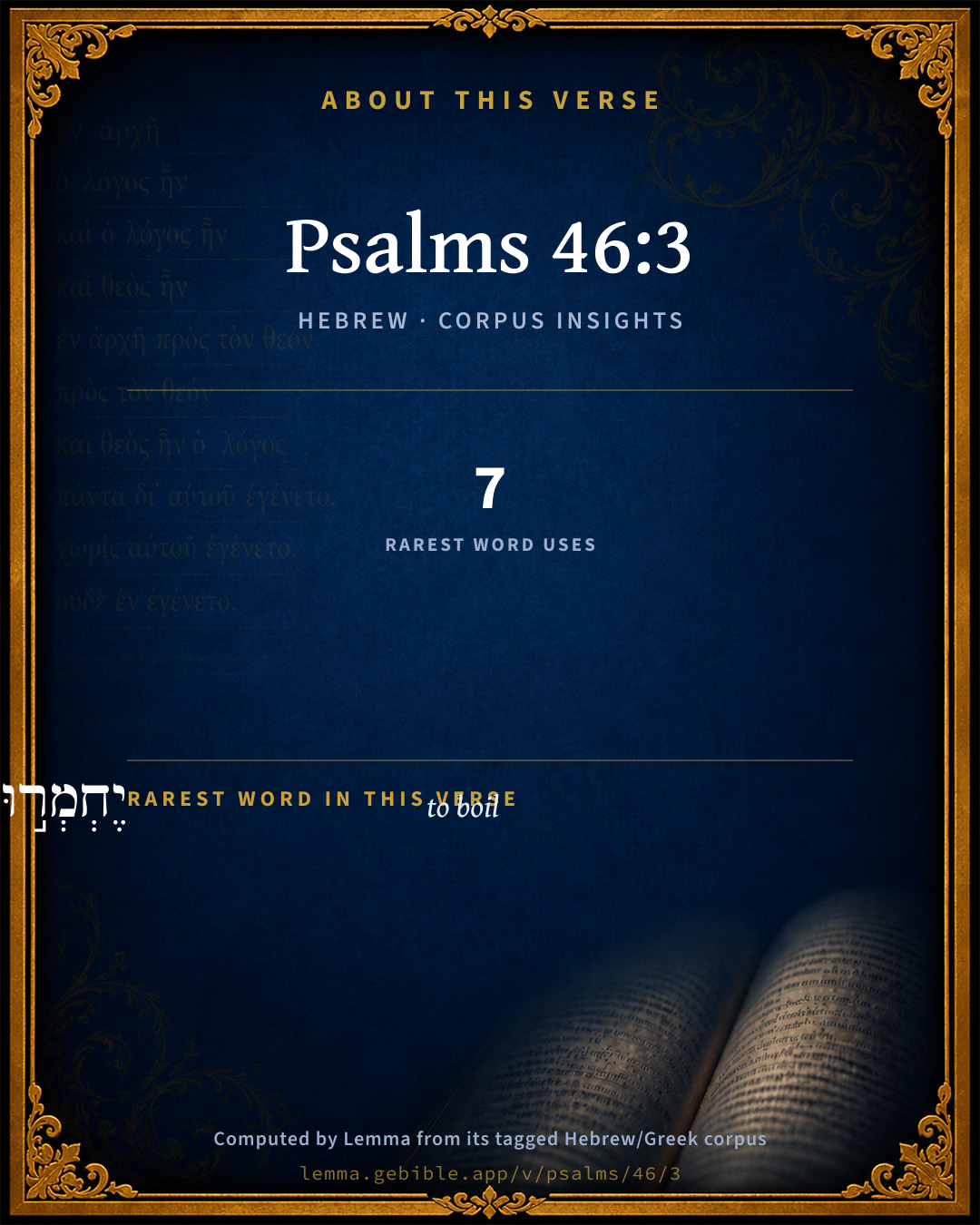
The rarest word here is יֶחְמְר֣וּ to boil H2560 — appearing just 7 times in the whole Hebrew Bible.

Shared distinctive vocabulary

יֶחְמְר֣וּ to boil H2560 occurs in 6 verses of the Hebrew Bible. Also found in:

Grammatical profile

  • 3 verbs
  • 3 nouns
  • 1 particle

Verb forms

  • יֶהֱמ֣וּ Qal · Imperfect
  • יֶחְמְר֣וּ Qal · Imperfect
  • יִֽרְעֲשֽׁוּ Qal · Imperfect

Hebrew & Septuagint length

In English translation the verse runs 17 words from the Hebrew and 16 from the Septuagint (LXX English) — closely comparable.

A rough comparison of the two English renderings, which tokenize alike — not a word-level alignment.

Word counts can differ between the Hebrew and the Greek without any difference in meaning — e.g. the Hebrew direct-object marker אֵת has no separate Greek word, and Greek often adds the article ὁ.

Cross-references

16

Topical passages linked to Psalms 46:3 in the Treasury of Scripture Knowledge — connected by theme and wording, ordered by reader-vote popularity; previews shown in the World English Bible.

  • Psalms 93:3–4 The floods have lifted up, Yahweh, The floods have lifted up their voice. The floods lift up their waves.
  • Jeremiah 5:22 Don't you fear me? says Yahweh: won't you tremble at my presence, who have placed the sand for the bound of the sea, by a perpetual decree, that it can't pass it? and though the waves of it toss themselves, yet they can't prevail; though they roar, yet they can't pass over it.
  • Job 9:5–6 Who removes the mountains, and they don't know it, When he overturns them in his anger
  • Judges 5:4–5 Yahweh, when you went forth out of Seir, When you marched out of the field of Edom, The earth trembled, the sky also dropped, Yes, the clouds dropped water.
  • Micah 1:4 The mountains melt under him, And the valleys split apart, Like wax before the fire, Like waters that are poured down a steep place.
  • Nahum 1:5 The mountains quake before him, and the hills melt away. The earth trembles at his presence, yes, the world, and all who dwell in it.
  • Psalms 114:4–7 The mountains skipped like rams, The little hills like lambs.
  • Revelation 16:20 Every island fled away, and the mountains were not found.
  • Job 38:11 And said, 'Here you may come, but no further; Here shall your proud waves be stayed?'
  • Psalms 18:4 The cords of death surrounded me. The floods of ungodliness made me afraid.
  • Isaiah 5:3 "Now, inhabitants of Jerusalem and men of Judah, Please judge between me and my vineyard.
  • Matthew 7:25 The rain came down, the floods came, and the winds blew, and beat on that house; and it didn't fall, for it was founded on the rock.
  • 1 Kings 19:11 He said, Go forth, and stand on the mountain before Yahweh. Behold, Yahweh passed by, and a great and strong wind tore the mountains, and broke in pieces the rocks before Yahweh; but Yahweh was not in the wind: and after the wind an earthquake; but Yahweh was not in the earthquake:
  • Isaiah 17:12–13 Ah, the uproar of many peoples, who roar like the roaring of the seas; and the rushing of nations, that rush like the rushing of mighty waters!
  • Jeremiah 4:24 I saw the mountains, and, behold, they trembled, and all the hills moved back and forth.
  • Revelation 17:15 He said to me, "The waters which you saw, where the prostitute sits, are peoples, multitudes, nations, and languages.

Cross-references courtesy of OpenBible.info (CC BY 4.0).

Hebrew and Greek witnesses Masoretic Hebrew ↔ Greek Septuagint

The same verse in the two great witnesses to the Old Testament, shown verse-for-verse.

You’re reading Greek Psalm 45 (Hebrew Psalm 46). The Septuagint counts the superscription, so verse numbers can differ from the Hebrew — chapter-level alignment, not verse-by-verse. Numbering follows Rahlfs.

These are two independent witnesses, not word-aligned to each other, and the Septuagint is shown in lemma (dictionary) form.

Hebrew Psalms 46:3 Masoretic · Westminster Leningrad Codex

יֶהֱמ֣וּ יֶחְמְר֣וּ מֵימָ֑יו יִֽרְעֲשֽׁוּ הָרִ֖ים בְּגַאֲוָת֣וֹ סֶֽלָה

Though the waters of it roar and are troubled, Though the mountains tremble with their swelling. Selah.

World English Bible · Public Domain

Greek LXX Greek Psalm 45:3 Septuagint · lemma form

διά οὗτος οὐ φοβέω ἐν ὁ ταράσσω ὁ γῆ καί μετατίθημι ὄρος ἐν καρδία θάλασσα

Their waters have roared and been troubled, the mountains have been troubled by his might. Pause.

LXX2012 (modern English Septuagint) · Public Domain

Hebrew: Westminster Leningrad Codex (CC BY 4.0). Greek: Septuagint (public domain); English from LXX2012 (modern English Septuagint) (Public Domain). How the Septuagint differs from the Hebrew →

Commentary

Notes on Psalms 46:3 from classic Christian and Jewish commentators (each source and its license shown beneath its notes). The classic Christian expositions comment on the surrounding passage and are grouped to its opening verse, so a note may address several verses; the Jewish commentaries on the Tanakh (Rashi and others) are per-verse, so they appear only where the commentator wrote on this verse.

Lemma curates 59 commentaries, every one of them public domain or Creative Commons licensed, each selected and text-cleaned for this edition rather than reprinted as found. About our sources →

Trapp's Complete Commentary

John Trapp

Psa 46:3 [Though] the waters thereof roar [and] be troubled, [though] the mountains shake with the swelling thereof. Selah.

Ver. 3. Though the waters thereof roar and be troubled] Heb. Be mudded; yet we will not fear, viz. with base distrustful fear, Ut omnes procellae horribili cum boatu circumsonent. Tauti est experientiam sensumque auxilii divini habere. The tempestuous rising and roaring of the sea is so terrible, that Aristotle saith, whosoever feareth it not is either mad or senseless (Ethic. 3. 7). Fear not, saith the angel to St Paul himself in that dreadful storm, Act 27:24, which implieth that be was afraid with a natural fear; and he might be so without sin. An awful fear of God is consistent with faith; neither is any believer guilty of a stoic apathy. The very devils believe and tremble, Jas 2:19. The apostle’s word there implieth that they roar as the sea roareth, and shriek horribly.

Though the mountains shake, &c.] As sometimes promontories fall with the force and impetuous beating of the sea upon them. Admit all this and more (whether in a sense literal or alle. gorical; set forth it is in a strain high and hyperbolic), yet we will bear up, and be bold to believe that all shall go well with us. Id quod Propheta miris verborum figuris additis iilustrat (Beza).

John Trapp, A Commentary or Exposition upon All the Books of the Old and New Testament (1647–1656) — public domain. Text from a community e-Sword module.

J. A. Alexander on Psalms

Joseph Addison Alexander

4. (Psa 46:3). Let its waters roar and foam, let mountains tremble in its swelling. Selah. The singular pronoun refers to the sea, which is only poetically plural in the preceding verse. The verb translated roar occurs above in Psa 39:7 (6). The one translated foam means strictly to ferment or effervesce. As the word rendered swelling is also used elsewhere in the figurative sense of pride, it is peculiarly appropriate to the commotions of the world, occasioned by the pride of man. The verbs in this verse may also be explained as proper futures. Its waters shall (indeed) roar and foam, the hills shall tremble at its swelling; but the people of God shall still be safe, as promised in the next verse. The selah, as usual, indicates a pause in the performance, and at the same time marks the close of the first stanza or strophe.

Joseph Addison Alexander, The Psalms Translated and Explained (1850) — public domain. Text from a community e-Sword module.

Geneva Bible (1599)

Geneva Bible translators

Though the afflictions rage never so much, yet the rivers of God’s mercies bring sufficient comfort to his.

Geneva Bible (1599) marginal notes — public domain. Text via Bolls.life.

Jamieson, Fausset & Brown

Robert Jamieson, A. R. Fausset & David Brown

swelling--well represents the pride and haughtiness of insolent foes.

Jamieson, Fausset & Brown — Commentary Critical and Explanatory on the Whole Bible (1871) — public domain (CC PDM 1.0). Text via the HelloAO Bible API.

Adam Clarke's Commentary

Verse 3. Though the waters thereof roar] Waters, in prophetic language, signify people; and, generally, people in a state of political commotion, here signified by the term roar. And by these strong agitations of the people, the mountains - the secular rulers, shake with the swelling thereof - tremble, for fear that these popular tumults should terminate in the subversion of the state. This very people had seen all Asia in a state of war. The Persians had overturned Asia Minor, and destroyed the Babylonian empire: they had seen Babylon itself sacked and entered by the Persians; and Cyrus, its conqueror, had behaved to them as a father and deliverer. While their oppressors were destroyed, themselves were preserved, and permitted to return to their own land.

Adam Clarke's Commentary on the Bible (1810–1826) — public domain. Text from a community e-Sword/MySword module.

John Calvin's Commentaries

3 Though the waters thereof roar, etc This verse ought to be read in connection with the verse which follows, because it is necessary to complete the sense, as if it had been said: Though the waters of the sea roar and swell, and by their fierce impetuosity shake the very mountains — even in the midst of these dreadful tumults, the holy city of God will continue to enjoy comfort and peace, satisfied with her small streams. The relative pronoun her, according to the common usage of the Hebrew language, is superfluous in this place. The prophet intended simply to say, that the small streams of a river would afford to the holy city abundant cause of rejoicing, though the whole world should be moved and destroyed. I have already mentioned shortly before how profitable is the doctrine taught us in this place, that our faith is really and truly tested only when we are brought into very severe conflicts, and when even hell itself seems opened to swallow us up. In like manner, we have portrayed to us the victory of faith over the whole world, when, in the midst of the utmost confusion, it unfolds itself, and begins to raise its head in such a manner as that although the whole creation seem to be banded together, and to have conspired for the destruction of the faithful, it nevertheless triumphs over all fear. Not that the children of God, when placed in peril, indulge in jesting or make a sport of death, but the help which God has promised them more than overbalances, in their estimation, all the evils which inspire them with fear. The sentiment of Horace is very beautiful, when, speaking of the righteous man and the man who feels conscious of no guilt, he says, (Car., Lib. iii., Od. 3,)

“Dux inquieti turbidus Adriae, Nec fulminantis magna Jovis manus, Si fractus illabitur orbis, Impavidum ferient ruinae.”

“Let the wild winds that rule the seas, Tempestuous, all their horrors raise; Let Jove’s dread arm with thunders rend the spheres; Beneath the crush of worlds undaunted he appears.”

But as no such person as he imagines could ever be found, he only trifles in speaking as he does. Their fortitude, therefore, has its foundation in the assurance of the divine protection alone, so that they who rely upon God, and put their trust in him, may truly boast, not only that they shall be undismayed, but also that they shall be preserved in security and safety amidst the ruins of a falling world.

John Calvin's Commentaries (1540-1563) — public domain. Text from the Calvin Translation Society English edition (1840s-50s) via the Christian Classics Ethereal Library (ccel.org). Calvin's coverage is partial (roughly two-thirds of the Bible); uncommented books and verses are honest gaps, never fabricated. The 19th-century editor's footnotes and remarks are omitted so the notes are faithfully Calvin's own voice.

Ellicott's Commentary for English Readers

(3) Though the waters . . .—The original is very expressive in its conciseness:

“They roar, they foam, its waters.”

Comp. Homer’s equally concise description, including in three words the “rush,” the “swell,” and the “roar” of ocean (Iliad, xxiii. 230).

Swelling.—Or, pride. (Comp. Job_38:11.) The change in construction in this verse seems to confirm the suspicion that the refrain has dropped away.

A Bible Commentary for English Readers, edited by Charles John Ellicott (1878–1897) — public domain. Text from a community e-Sword module.

The Cambridge Bible for Schools and Colleges

gen. ed. J. J. S. Perowne

3. As the text stands this verse must be treated, as in the A.V. and R.V., as a continuation of Psa_46:2. But the symmetrical structure of the Ps., resembling that of Psalms 42-43, makes it probable that the refrain (Psa_46:7; Psa_46:11) has been lost. If it is restored, we may render:

Let the waters thereof rage and foam I

Let the mountains quake at the proud swelling thereof!

Jehovah of hosts is with us,

The God of Jacob is our high fortress.

Be all around us never so threatening, we are secure in the presence and protection of Jehovah. For the ‘proud swelling’ of the sea cp. Psa_89:9.

The Cambridge Bible for Schools and Colleges (gen. ed. J. J. S. Perowne; Cambridge University Press, 1878–1918) — public domain. Text from a community e-Sword module.

John Gill's Exposition

Though the waters thereof roar and be troubled,.... The noise of which causes men's hearts to fail them for fear, Luk 21:25;

though the mountains shake with the swelling thereof. All these figurative expressions denote the hurlyburlies, confusions, and disorders that have been or will be in the world; amidst all which the people of God have no reason to fear; for it is always well with the righteous, let it go how it will with others. The passage may be applied to the destruction of Jerusalem, and the wars preceding it, and the dispersion of the Jews upon it; when true believers in Christ found him to be their refuge, strength, and help in that time of trouble, such as never was the like, and were safe and without fear; and Aben Ezra, a Jewish commentator, thinks it is right to interpret this psalm concerning the wars of Jerusalem: moreover, these words may be applied to any other time of calamity, through war or persecution, that has been since; as also to any that is to come; as to the slaying of the witnesses, the hour of temptation that will try all that are upon the earth; and even to the day of judgment, when heaven and earth shall flee away from the face of the Judge; when the heavens shall be folded up as a garment, and the earth, and all that is therein, shall be burnt up, and the whole world of the ungodly shall be thrown into the utmost panic, the saints will be safe with Christ, and ever happy with him; and, in the worst of times in this world, God is always their covenant God, their shield, portion, and exceeding great reward; Christ is their Redeemer and Saviour, their city of refuge, and strong hold; and though they may be plundered of their goods and property, they have a better and a more enduring substance in heaven; an estate, an inheritance there, that can never be taken away; and even should their enemies kill the body, that is the utmost they can do; their souls are safe in the hands of Christ; their life is hid with him; and when he shall appear, they shall appear with him in glory; and therefore they may well say, "we will not fear" (w).

Selah; on this word; see Gill on Psa 3:2.

(w) "Si fractus illabatur orbis", &c. Horat. Carmin. l. 3. Ode. 3. v. 7.

John Gill's Exposition of the Whole Bible (1746–1763) — public domain (CC PDM 1.0). Text via the HelloAO Bible API.

Albert Barnes' Notes on the Bible

Though the waters thereof roar and be troubled - The waters of the sea. The idea is, that they would not be afraid though everything should be in commotion, and be as unsettled as the restless waves of the ocean. The earth might be changed, the mountains removed, the agitated sea roar and dash against the shore, but their minds would be calm. The word rendered “be troubled” means to boil; to ferment; to foam; and here it refers to the ocean as agitated and lashed into foam. Nothing is more sublime and fearful than the ocean in a storm; nothing furnishes a better illustration of the peace produced by confidence in God amid the agitations which occur in the world, than the mind of a seaman that is calm when the ocean is heaved in wild commotion.

Though the mountains shake with the swelling thereof - The rolling ocean breaking against; the sides of the mountains on its shore, and seeming to shake them to their foundation. The word rendered “swelling” means properly majesty, glory; then pride, haughtiness, insolence. Literally, “though the mountains tremble through their pride.” Compare Psa 124:5. On the word “Selah,” see the notes at Psa 3:2.

Albert Barnes' Notes on the Bible (1834–1885) — public domain. Text from a community e-Sword/MySword module.

Matthew Poole's English Annotations

Though the sea be very tempestuous, and its waters (by which a multitude of people is oft signified, as Rev 17:1,15) rage, to Wit, against us, as appears from the following verses. Though its raging waves assault mighty princes and kingdoms, and make them shake and be ready to fall down.

Matthew Poole's English Annotations on the Holy Bible (1683–1685) — public domain. Text from a community e-Sword/MySword module.

The Treasury of David

Charles H. Spurgeon

Ver. 3. Though the waters thereof roar and be troubled. When all things are excited to fury, and reveal their utmost power to disturb, faith smiles serenely. She is not afraid of noise, nor even of real force, she knows that the Lord stilleth the raging of the sea, and holdeth the waves in the hollow of his hand. Though the mountains shake with the swelling thereof. Alps and Andes may tremble, but faith rests on a firmer basis, and is not to be moved by swelling seas. Evil may ferment, wrath may boil, and pride may foam, but the brave heart of holy confidence trembles not. Great men who are like mountains may quake for fear in times of great calamity, but the man whose trust is in God needs never to be dismayed.

Selah. In the midst of such a hurly burly the music may well come to a pause, both to give the singers breath, and ourselves time for meditation. We are in no hurry, but can sit us down and wait while earth dissolves, and mountains rock, and oceans roar. Ours is not the headlong rashness which passes for courage, we can calmly confront the danger, and meditate upon terror, dwelling on its separate items and united forces. The pause is not an exclamation of dismay, but merely a rest in music; we do not suspend our song in alarm, but tune our harps again with deliberation amidst the tumult of the storm. It were well if all of us could say, Selah, under tempestuous trials, but alas! too often we speak in our haste, lay our trembling hands bewildered among the strings, strike the lyre with a rude crash, and mar the melody of our life song.

Ver. 3. Selah. See "Treasury of David, "Vol. I., pages 25, 29, 346, 382; and Vol. II., pages 249-252.

Charles H. Spurgeon's The Treasury of David (1869–1885) — public domain. Psalms only. Text from a community e-Sword/MySword module.

The Pulpit Commentary

Though the waters thereof roar and be troubled; or, roar and foam (Hengstenberg, Kay, Cheyne). Though the mountains shake with the swelling thereof. (comp. Psa_93:3, 4 Jer_46:8, 9 47:2)

The Pulpit Commentary (1880–1919), ed. H.D.M. Spence-Jones & Joseph S. Exell — public domain. Text from a community e-Sword module.

Rashi

Rabbi Shlomo Yitzchaki (Rashi)

when the earth changes in the future, on the day concerning which Scripture states (Isa. 51: 6): “and the earth shall rot away like a garment.” The sons of Korah saw the miracle that was performed for them, that all those around them were swallowed up while they [the sons of Korah] stood in the air and said to Israel, through the holy spirit, that a similar miracle would be performed for them in the future.

Rashi on the Tanakh — English translations: “The Judaica Press complete Tanach with Rashi, translated by A. J. Rosenberg” (CC BY 4.0); “Pentateuch with Rashi's commentary by M. Rosenbaum and A.M. Silbermann, 1929-1934” (public domain); “The Metsudah Tanach series, Lakewood, N.J” (CC BY 4.0); and “The Book of Joshua, Metsudah Publications, 1997” (CC BY 4.0). Text via Sefaria.

Lesson kit

Teaching starters — assembled from the data on this page, not authored interpretation. Every prompt links to the verse data it draws on. Edit before teaching.

Psalms, in the Wisdom, opens this verse with 7 words (7 distinct Hebrew lemmas). Its most distinctive word is châmar (“to boil”). A historical commentator’s framing appears above. Read the whole chapter for the surrounding context.

Discussion questions

  1. How does “to boil” (châmar) shape what this verse is saying?
  2. How does Exodus 2:3, which shares the word «to boil», read alongside this verse?
  3. These translations render this verse differently; the difference is in the English rendering, not the original. What questions does that raise?
  4. «יֶהֱמ֣וּ» is a Qal Imperfect verb. How does that grammatical form shape the action described?
  5. Compare how Trapp's Complete Commentary and J. A. Alexander on Psalms read this verse. Where do they agree or differ?

Things to notice

Reading settings

Reading text

Shown beneath each verse's original-language words.

Old Testament
Old Testament edition

Read the OT as the Masoretic Hebrew (MT) or the Greek Septuagint (LXX).

English shown for the Greek Septuagint (in the Hebrew ↔ Greek comparison).

Comparing translations? Open the Compare panel on any verse page to stack up to four side by side.