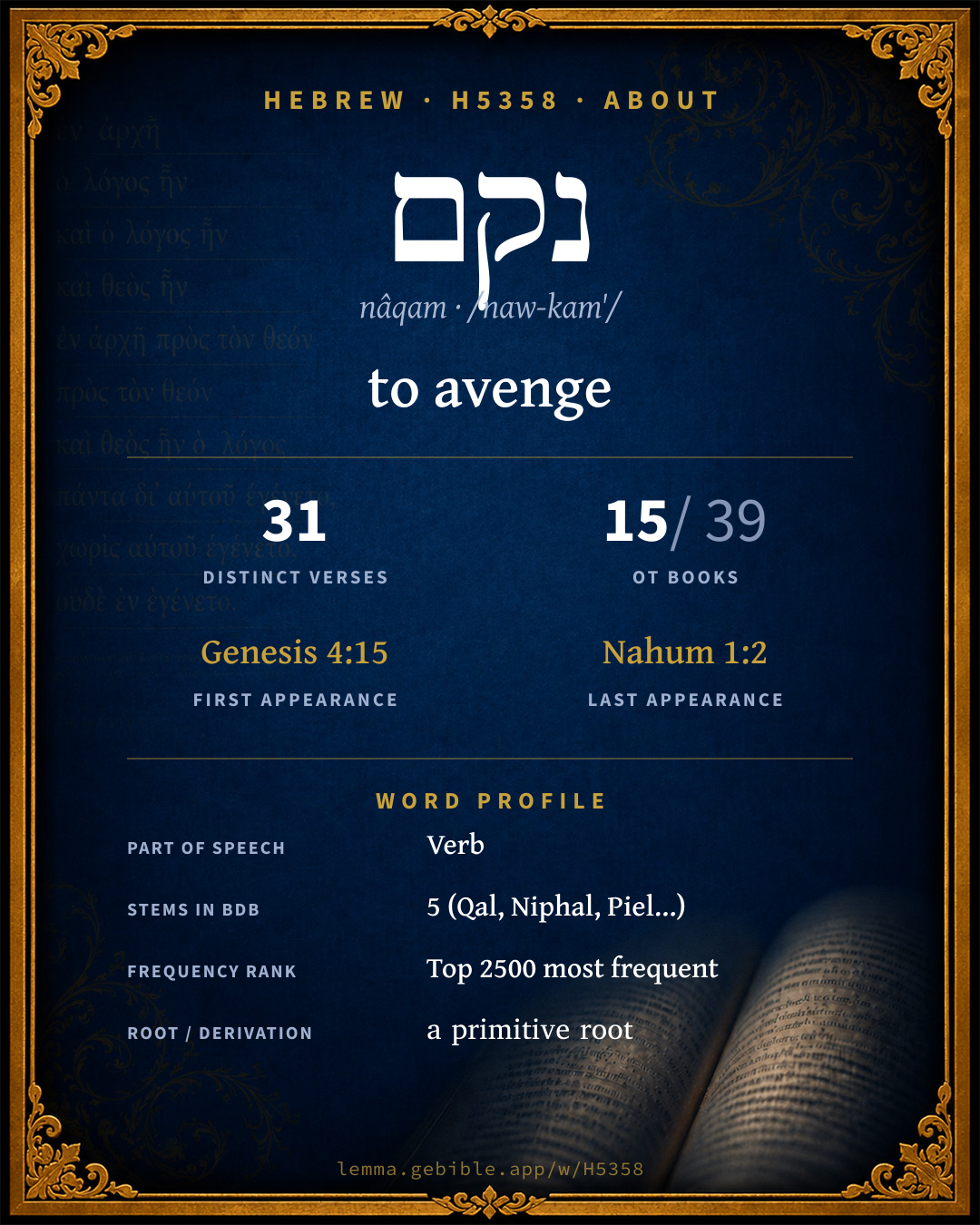
נָקַם
to avenge
also: take vengeance, revenge, avenge oneself, be avenged fuller range ↓
Full lexicon entry — Brown-Driver-Briggs (BDB)
From Brown-Driver-Briggs (BDB)
Where this word appears
See every Niphal verb in the Hebrew Bible →
Grammar key — what these labels mean
Part of speech
- Verb
- An action or state-of-being word.
Stem
- Niphal
- Usually the simple passive or reflexive of the Qal (“he was written”). Here: ‘avenge oneself’
- Hophal
- The passive counterpart of the Hiphil (“he was caused to…”).
- Hithpael
- The reflexive or reciprocal stem (the subject acts on itself).
- Piel
- An intensive or resultative active stem.
- Qal
- The basic, simple active stem — the plain form of the verb (“he wrote”). Here: ‘avenge’
Form
- Infinitive Construct
- A bound verbal noun, frequently with prepositions (“to write / in writing”).
- Imperfect
- An incomplete, ongoing, or future action (“he will / would write”).
- Sequential Perfect
- A perfect with prefixed waw continuing a preceding imperfect or command (waw-consecutive perfect).
- Participle Active
- A verbal adjective expressing ongoing or characteristic action (“writing / one who writes”).
- Cohortative
- A first-person volitional form expressing wish or resolve (“let me / let us write”).
- Perfect
- A completed action or state — Hebrew marks aspect (completeness) more than strict tense (“he wrote”).
- Imperative
- A direct command (“write!”).
- Sequential Imperfect
- An imperfect with prefixed waw — the standard past-narrative form (waw-consecutive imperfect).
- Infinitive Absolute
- An unbound verbal noun, often intensifying or standing in for a finite verb.
State
- Absolute
- The independent form of a noun, not bound to a following word.
Person
- 3rd Person
- The one spoken about (“he / she / it / they”).
- 1st Person
- The speaker (“I / we”).
- 2nd Person
- The one addressed (“you”).
Gender
- Masculine
- Grammatically masculine.
- Feminine
- Grammatically feminine.
- Common
- Either gender — not distinguished for this form.
Number
- Singular
- One.
- Plural
- More than one (in Hebrew, generally three or more).
Grammatical forms 22 distinct
- Verb, Qal, Participle Active, Masculine, Singular, Absolute 4 times (11%)
- Verb, Niphal, Infinitive Construct 3 times (9%)
- Verb, Hophal, Imperfect, 3rd Person, Masculine, Singular 3 times (9%)
- Verb, Hithpael, Imperfect, 3rd Person, Feminine, Singular 3 times (9%)
- Verb, Piel, Sequential Perfect, 1st Person, Common, Singular 2 times (6%)
- Verb, Hithpael, Participle Active, Masculine, Singular, Absolute 2 times (6%)
- Verb, Qal, Infinitive Construct 2 times (6%)
- Verb, Qal, Imperfect, 3rd Person, Masculine, Singular 2 times (6%)
+14 more forms (14 occurrences)
Parsed forms decoded from the imported morphology (morphhb / Westminster Leningrad Codex — WLC text public domain, morphhb tagging CC BY 4.0), counted across 35 parsed occurrences — not distinct verses.
Every verse where H5358 appears — 31 distinct verses across 15 books. Click any verse to open its interlinear word-by-word view. Verse text shown in the World English Bible for context — . Each verse’s Hebrew form is shown with its reference; the English is not keyword-highlighted, since the data carries no word-level English alignment. Use “Compare translations” on any verse to read it across multiple English versions. This concordance covers the Hebrew Bible; Septuagint (Greek Old Testament) occurrences are not indexed here.
Genesis 2 verses
- Genesis 4:15 יֻקָּ֑ם Hophal impf 3ms Yahweh said to him, "Therefore whoever slays Cain, vengeance will be taken on him sevenfold." Yahweh appointed a sign for Cain, lest any finding him should strike him.
- Genesis 4:24 יֻקַּם Hophal impf 3ms If Cain will be avenged seven times, Truly Lamech seventy-seven times."
Exodus 2 verses
- Exodus 21:20 נָקֹ֖ם יִנָּקֵֽם Qal inf.abs Niphal impf 3ms "If a man strikes his servant or his maid with a rod, and he dies under his hand, he shall surely be punished.
- Exodus 21:21 יֻקַּ֔ם Hophal impf 3ms Notwithstanding, if he gets up after a day or two, he shall not be punished, for he is his property.
Leviticus 2 verses
- Leviticus 19:18 תִקֹּ֤ם Qal impf 2ms You shall not take vengeance, nor bear any grudge against the children of your people; but you shall love your neighbor as yourself. I am Yahweh.
- Leviticus 26:25 נֹקֶ֨מֶת֙ Qal ptcp.act fs I will bring a sword upon you, that will execute the vengeance of the covenant; and you will be gathered together within your cities: and I will send the pestilence among you; and you will be delivered into the hand of the enemy.
Numbers 1 verse
Deuteronomy 1 verse
Joshua 1 verse
Judges 2 verses
- Judges 15:7 נִקַּ֥מְתִּי Niphal pf 1cs Samson said to them, If you do after this manner, surely I will be avenged of you, and after that I will cease.
- Judges 16:28 וְ/אִנָּקְמָ֧ה conj + Niphal impf 1cs Samson called to Yahweh, and said, Lord Yahweh, remember me, Please, and strengthen me, Please, only this once, God, that I may be at once avenged of the Philistines for my two eyes.
1 Samuel 3 verses
- 1 Samuel 14:24 וְ/נִקַּמְתִּי֙ conj + Niphal wpf 1cs The men of Israel were distressed that day; for Saul had adjured the people, saying, Cursed be the man who eats any food until it be evening, and I be avenged on my enemies. So none of the people tasted food.
- 1 Samuel 18:25 לְ/הִנָּקֵ֖ם prep + Niphal inf.cs Saul said, Thus shall you tell David, The king desires no dowry except one hundred foreskins of the Philistines, to be avenged of the king's enemies. Now Saul thought to make David fall by the hand of the Philistines.
- 1 Samuel 24:12 וּ/נְקָמַ֥/נִי conj + Qal wpf 3ms + sfx pers 1cs Yahweh judge between me and you, and Yahweh avenge me of you; but my hand shall not be on you.
2 Kings 1 verse
Esther 1 verse
Psalms 3 verses
- Psalms 8:2 וּ/מִתְנַקֵּֽם conj + Hithpael ptcp.act ms From the lips of babes and infants you have established strength, Because of your adversaries, that you might silence the enemy and the avenger.
- Psalms 44:16 וּ/מִתְנַקֵּֽם conj + Hithpael ptcp.act ms At the taunt of one who reproaches and verbally abuses, Because of the enemy and the avenger.
- Psalms 99:8 וְ֝/נֹקֵ֗ם conj + Qal ptcp.act ms You answered them, Yahweh our God. You are a God who forgave them, Although you took vengeance for their doings.
Isaiah 1 verse
Jeremiah 7 verses
- Jeremiah 5:9 תִתְנַקֵּ֖ם Hithpael impf 3fs Shall I not visit for these things? says Yahweh; and shall not my soul be avenged on such a nation as this?
- Jeremiah 5:29 תִתְנַקֵּ֖ם Hithpael impf 3fs Shall I not visit for these things? says Yahweh; shall not my soul be avenged on such a nation as this?
- Jeremiah 9:9 תִתְנַקֵּ֖ם Hithpael impf 3fs Shall I not visit them for these things? says Yahweh; shall not my soul be avenged on such a nation as this?
- Jeremiah 15:15 וְ/הִנָּ֤קֶם conj + Niphal impv 2ms Yahweh, you know; remember me, and visit me, and avenge me of my persecutors; don't take me away in your longsuffering: know that for your sake I have suffered reproach.
- Jeremiah 46:10 לְ/הִנָּקֵ֣ם prep + Niphal inf.cs For that day is [a day] of the Lord, Yahweh of Hosts, a day of vengeance, that he may avenge him of his adversaries: and the sword shall devour and be satiate, and shall drink its fill of their blood; for the Lord, Yahweh of hosts, has a sacrifice in the north country by the river Euphrates.
- Jeremiah 50:15 הִנָּ֣קְמוּ Niphal impv 2mp Shout against her round about: she has submitted herself; her bulwarks are fallen, her walls are thrown down; for it is the vengeance of Yahweh: take vengeance on her; as she has done, do to her.
- Jeremiah 51:36 וְ/נִקַּמְתִּ֖י conj + Piel wpf 1cs Therefore thus says Yahweh: Behold, I will plead your cause, and take vengeance for you; and I will dry up her sea, and make her fountain dry.
Ezekiel 3 verses
- Ezekiel 24:8 לִ/נְקֹ֣ם prep + Qal inf.cs That it may cause wrath to come up to take vengeance, I have set her blood on the bare rock, that it should not be covered.
- Ezekiel 25:12 בִּ/נְקֹ֥ם וְ/נִקְּמ֥וּ prep + Qal inf.cs conj + Niphal pf 3cp Thus says the Lord Yahweh: Because Edom has dealt against the house of Judah by taking vengeance, and has greatly offended, and revenged himself on them;
- Ezekiel 25:15 וַ/יִּנָּקְמ֤וּ conj + Niphal wimpf 3mp Thus says the Lord Yahweh: Because the Philistines have dealt by revenge, and have taken vengeance with despite of soul to destroy with perpetual enmity;
Nahum 1 verse
About this entry
At a glance — auto-summarized from this page’s data, not written by a person. Every figure links to its source below. This summary describes the numbers; it doesn’t interpret them.
At its core, נקם (nâqam) means “to avenge.” Different stems carry different senses — BDB groups them under 5 stems, among them Qal and Niphal. With 31 verses in 15 books, it is a moderately common word in the Hebrew Bible. First canonically at Genesis 4:15, it enters the text early. From the same root come נקם. Each statement above links to its evidence; the full detail follows below.
Gloss history
Strong's 1890 vs modern scholarship
About this word
Strong's H5358 catalogs a Hebrew word from the Hebrew Old Testament.
These counts are not copied from any lexicon or concordance. They are computed here, from the morphology-tagged Hebrew Old Testament. What Lemma adds →
- 31
- distinct verses
- The word appears in 31 distinct verses.
- 15 / 39
- OT books
- The word appears in 15 of 39 Old Testament books.
- #1,023
- by frequency
- Top 2500 most frequent Hebrew words (rank 1,023 of 8,640 Hebrew words by occurrence).
View all 31 occurrences in the concordance →
By section of the Old Testament
By traditional corpus
Conventional, traditional groupings — biblical authorship is debated, so this is a traditional corpus grouping, not an authorship claim. Each share is this word’s portion of its verses in that division of the Hebrew canon. Each figure is a share of the word’s 31 distinct verses.
- Prophets (Nevi'im) 19 verses · 61%
- Torah (Pentateuch) 8 verses · 26%
- Writings (Ketuvim) 4 verses · 13%
How translations render this word
Counts come from each version’s own published word-to-Strong’s tagging or interlinear alignment — an approximate guide to how each version renders this word, not a word-level alignment the data otherwise carries. Because each total is that version’s own tagged count, the per-version totals vary from one another and need not match the appearance or distinct-verse counts above. These counts may also differ from a printed concordance because Lemma counts each distinctly tagged rendering and does not collapse phrase taggings into a single head-word total. This is a fixed set of word-tagged versions (KJV, ASV, BSB, ULT) and does not change with the reading translation you choose elsewhere. Each version’s license is shown beside its name below (and on Sources).
- King James Version: Avenge 4×, Be avenged 4×, Avenger 2×
- American Standard Version: Be avenged 4×, Avenge 3×, Avenger 2×
- Berean Standard Bible: Take vengeance 4×, Avenge 3×, Avenger 2×
- unfoldingWord Literal Text: Avenge 3×, Avenging 3×, Be avenged 3×
King James Version Public Domain
Renders H5358 across 35 tagged occurrences — most commonly:
Plus 21 renderings that appear only once — usually multi-word phrases or single function words the recovered tagging swept in, not distinct renderings.
American Standard Version Public Domain
Renders H5358 across 35 tagged occurrences — most commonly:
Plus 22 renderings that appear only once — usually multi-word phrases or single function words the recovered tagging swept in, not distinct renderings.
Berean Standard Bible Public Domain
Renders H5358 across 34 tagged occurrences — most commonly:
Plus 25 renderings that appear only once — usually multi-word phrases or single function words the recovered tagging swept in, not distinct renderings. Not rendered by a distinct English word in 1 further occurrence.
unfoldingWord Literal Text CC BY-SA 4.0
Renders H5358 across 39 tagged occurrences — most commonly:
Plus 23 renderings that appear only once — usually multi-word phrases or single function words the recovered tagging swept in, not distinct renderings.
16 senses and sub-senses in the full BDB
Hebrew verbs can shift meaning by stem (binyan): Qal is the basic action, Niphal is often passive or reflexive, Piel often intensifies or makes it factitive, and Hiphil is typically causative. The senses below are grouped under the stem BDB assigns to each. This entry also uses Hophal (the passive of Hiphil) and Hithpael (reflexive or reciprocal).
What do BDB’s symbols mean?
BDB uses these scholarly abbreviations:
| Symbol | Meaning |
|---|---|
| 𝔊 | the Septuagint (the ancient Greek translation, LXX) |
| 𝔙 | the Vulgate (the Latin translation) |
| 𝔖 | the Syriac version (the Peshitta) |
| 𝔗 | the Targum (the Aramaic translation) |
| ψ | the Psalms |
| √ | root (the underlying root or stem) |
| ‖ | parallel passage (a synonymous or contrasted parallel) |
| † | the dagger: every passage where the word occurs is cited |
The 16 senses and sub-senses the full Brown-Driver-Briggs lexicon distinguishes for this word, in lexicon order (not ranked by frequency), with BDB’s own verbatim wording and sub-sense lettering. Shown in Hebrew script with BDB’s own scholarly abbreviations. The condensed entry is in the Lexicon Entry tab. See also the Forms in the corpus table below.
Qal
- Pf. 3 ms. sf. נְקָמַ֫נִי 1 S 24:13; Impf. יִקּוֹם Dt 32:43; יִקֹּם Jos 10:13; 2 ms. תִּקֹּם Lv 19:18; Inf. abs. נָקֹם Ex 21:20; cstr. נְקֹם Ez 24:8; 25:12; Imv. נְקֹם Nu 31:2; Pt. נֹקֵם Na 1:2 + 3 times; f. נֹקֶ֫מֶת Lv 26:25;— e.g. 1 Samuel 24:13
- 1. avenge, take vengeance:
- a. God subj. דַּם עֲבָדָיו יִקּוֹם Dt 32:43 the blood of his servants he avengeth (against those who slew them) (+ 1 K 2:5 𝔊L Klo); נ׳ abs. Na 1:2(×2) c. לְ (agst. Nineveh) Na 1:2; נ׳ נָקָם (agst. Jerus.) Ez 24:8; עַל־עֲלִילוֹתָם on their doings (his people’s) ψ 99:8; נ׳ נְקַם בְּרִית Lv 26:25 (H) the vengeance of the covenant (against those who break it); נְקָמַנִי, 1 S 24:13, c. מִן of pers. from whom vengeance is taken (cp. Je 20:10). e.g. Deuteronomy 32:43
- b. Israel and its leaders against their enemies, נ׳ נקמה c. מִן against whom Nu 31:2 (P); c. acc. יִקֹּם אֹיְבָיו Jos 10:13 (poem). e.g. Numbers 31:2
- c. Edom against Judah נ׳ נקם לְ Ez 25:12. e.g. Ezekiel 25:12
- d. in administration of justice agst. murder Ex 21:20 (E). e.g. Exodus 21:20
- 2. entertain revengeful feelings (opp. אהב) against neighbour forbidden Lv 19:18 (H). e.g. Leviticus 19:18
Niphal
- Pf. 1 s. נִקַּ֫מְתִּי Ju 15:7; 1 S 14:24; 3 mpl. נִקְּמוּ Ez 25:12; Impf. יִנָּקֵם Ex 21:20; 1 s. אִנָּֽקְמָה Ju 16:28; Is 1:24; 3 mpl. יִנָּֽקְמוּ Ez 25:15; Inf. הִנָּקֵם Je 46:10 + 2 times; Imv. הִנָּ֫קֶם Je 15:15; pl. הִנָּֽקְמוּ Je 50:15:— e.g. Judges 15:7
- 1. avenge oneself,
- a. י׳ subj. c. מִן of adversary Is 1:24; Je 46:10; c. מִן advers., לְ for whom Je 15:15; c. בְּ adversary Je 50:15. e.g. Isaiah 1:24
- b. of Israel and champions c. מִן Ju 16:28; 1 S 14:24; Est 8:13; c. בְּ Ju 15:7; 1 S 18:25. e.g. Judges 16:28
- c. of enemies against Israel נ׳ נקם Ez 25:15; c. בְּ Ez 25:12. e.g. Ezekiel 25:15
- 2. suffer vengeance (of law against murder) Ex 21:20 (E). e.g. Exodus 21:20
Piel
- Pf. 1 s. נִקַּ֫מְתִּי 2 K 9:7 Je 51:36;—avenge, י׳ subj. דָּמִים מיד 2 K 9:7 blood at hands of; נ׳ נִקְמָתֵךָ Je 51:36 take vengeance for thee. e.g. 2 Kings 9:7
Hophal
- Impf. יֻקַּם Gn 4:24; Ex 21:21, יֻקָּ֑ם Gn 4:15 be avenged, vengeance be taken (for blood). e.g. Genesis 4:24
Hithpael
- Impf. תִּתְנַקֵּם Je 5:9, 29; 9:8; Pt. מִתְנַקֵּם ψ 8:3; 44:17; avenge oneself, י׳ subj. לֹא תִתְנַקֵּם נַפְשִׁי בְּ׳ Je 5:9, 29; 9:8; of Israel’s enemies אוֹיֵב וּמִתְנַקֵּם ψ 8:3; 44:17. e.g. Jeremiah 5:9
Senses from the full Brown-Driver-Briggs lexicon (Brown, Driver, Briggs; Oxford 1906 — public domain), digitized via Sefaria, supplemented by the OpenScriptures HebrewLexicon (CC BY 4.0). Full attribution on Sources.
Word origin
vb. avenge, take vengeance (Ecclus 461 e להנקם נקמי אויב (Niph. + acc. cogn.); נקם n. also 12:6 (cf. Dt 32:41), 39:30; 48:7; NH נָקַם especially in deriv.; Aramaic נְקַם (rare), ܢܩܰܡ in der. species; Arabic نَقَمَ take vengeance (عَلَ upon), Lane3037; cf. Ethiopic ቂም Di458 vindictae studium, ultionis cupido; Assyrian iḳḳimu, vengeance, requital, is poss. from √ אקם JägerBAS ii. 279);—
— Brown-Driver-Briggs (Oxford 1906, public domain), digitized via Sefaria, supplemented by the OpenScriptures HebrewLexicon (CC BY 4.0). See Sources.
Origin: a primitive root
Jastrow Dictionary
A second Hebrew/Aramaic lexicon for comparison, covering Aramaic and post-biblical (Talmudic, Targumic, Midrashic) usage that the biblical-Hebrew BDB does not. Matched by lemma rather than by Strong’s number, so a lemma may carry more than one Jastrow headword (shown separately below), and the entries cover usage well beyond the Bible.
נָקַם
- 1. to take revenge. Sabb. 63ᵃ נוֹקֵם ונוטר כנחש revengeful and grudge-bearing like a serpent. Yoma 23ᵃ; a. fr.
- 2. to be hostile, do evil. Midr. Till. to Ps. CXLIX, 7 מה שנָקְמוּ, v. נְקָמָה.
נְקַם
- Targ. Lev. XIX, 18.
- to be punished. Targ. Y. II, Ex. XXI, 20.
A Dictionary of the Targumim, the Talmud Babli and Yerushalmi, and the Midrashic Literature (Marcus Jastrow; London, Luzac, 1903) — Public Domain. Digitized via Sefaria. Digitized via Sefaria. Full attribution on Sources.
Forms in the corpus
The 31 distinct written forms H5358 takes in the Hebrew Bible, most frequent first — each parse links to that stem’s occurrences in the concordance. Hebrew forms include their vowel points and cantillation, so a single lemma takes many written forms.
Same root — word family
Other BDB entries built from the same root as H5358, grouped by Strong’s listed origin. These share a root / origin per the lexicon — not necessarily a shared meaning. Each links to that word’s own entry.
Derived from this word
Compare all same-root words → They share a root, not necessarily a meaning.
Septuagint verse parallels
This word appears in 26 verses that also exist in the Greek Old Testament (Septuagint), out of the 31 Hebrew verses it occurs in. You can read those verses in Greek by switching the Old Testament edition to the Septuagint.
Read these verses in the Septuagint
- Genesis 4:15
- Exodus 21:20
- Leviticus 19:18
- Numbers 31:2
- Deuteronomy 32:43
- Joshua 10:13
- Judges 15:7
- 1 Samuel 14:24
- 2 Kings 9:7
- Esther 8:13
- Psalms 8:2
- Isaiah 1:24
This is a verse-level parallel only — the same verses exist in both the Hebrew and Greek Old Testaments. No word-level Hebrew↔Greek correspondence is claimed: the data carries no such alignment, so no Greek word is shown as this Hebrew word’s translation. Coverage is not total — the Septuagint omits the deuterocanon and renumbers the Psalms, so some Hebrew verses have no direct Greek parallel.