
Isaiah 7:25

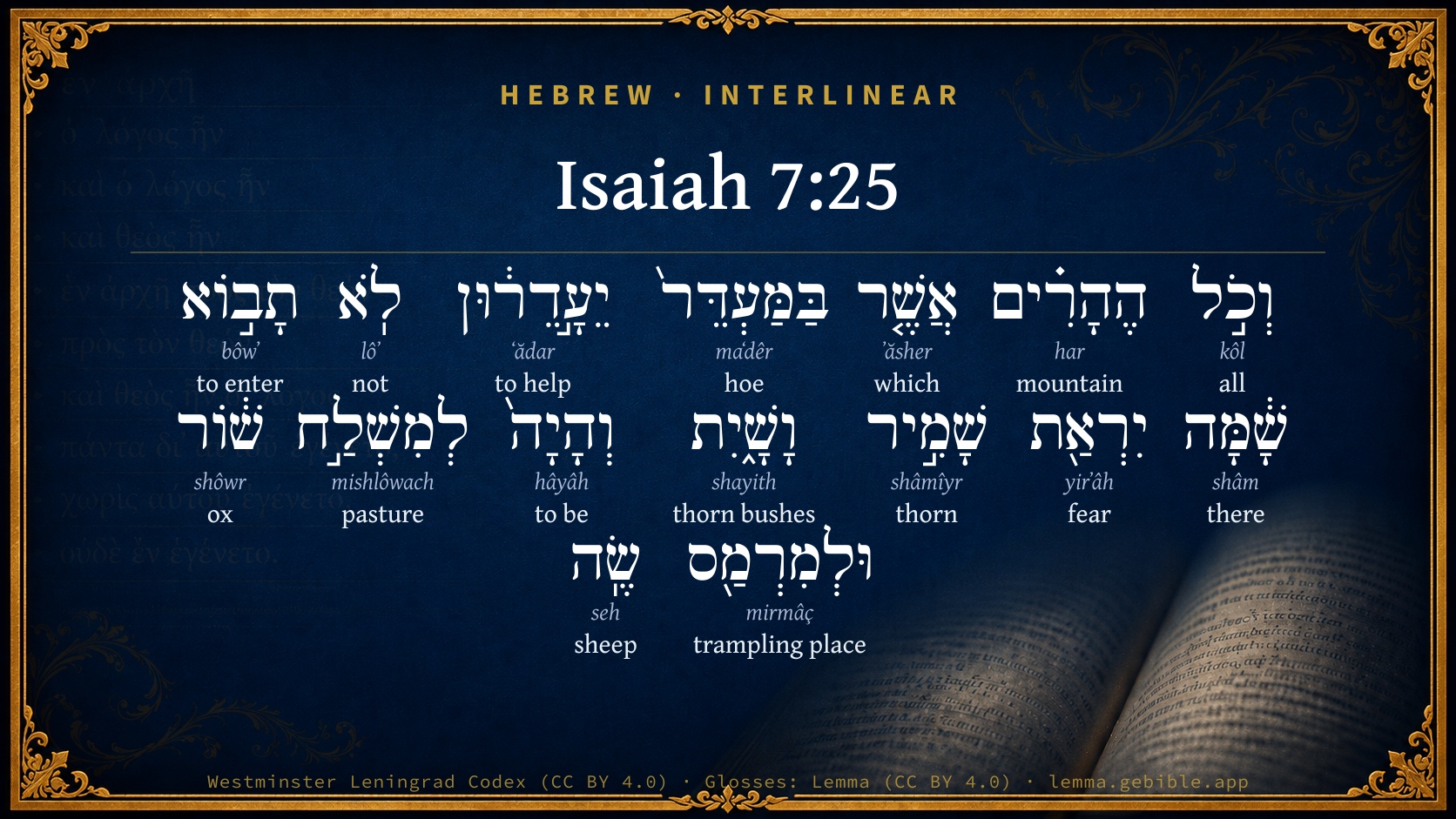
Hebrew (Westminster Leningrad Codex) Isaiah 7:25 appears in the Hebrew Old Testament. The text above is from the Westminster Leningrad Codex. Each word links to its Strong’s number, a concise gloss, and parsing drawn from the Open Scriptures Hebrew Bible morphology. Click any word for its full Brown-Driver-Briggs (BDB) entry.
Download image
Cite this verse

Isaiah 7:25 (World English Bible). Public Domain. Lemma interlinear Bible study tool, https://lemma.gebible.app/v/isaiah/7/25.

Show BibTeX & RIS
BibTeX
RIS
English Translation
All the hills that were cultivated with the hoe, you shall not come there for fear of briers and thorns; but it shall be for the sending forth of oxen, and for the treading of sheep."
World English Bible · Public Domain
Highlights
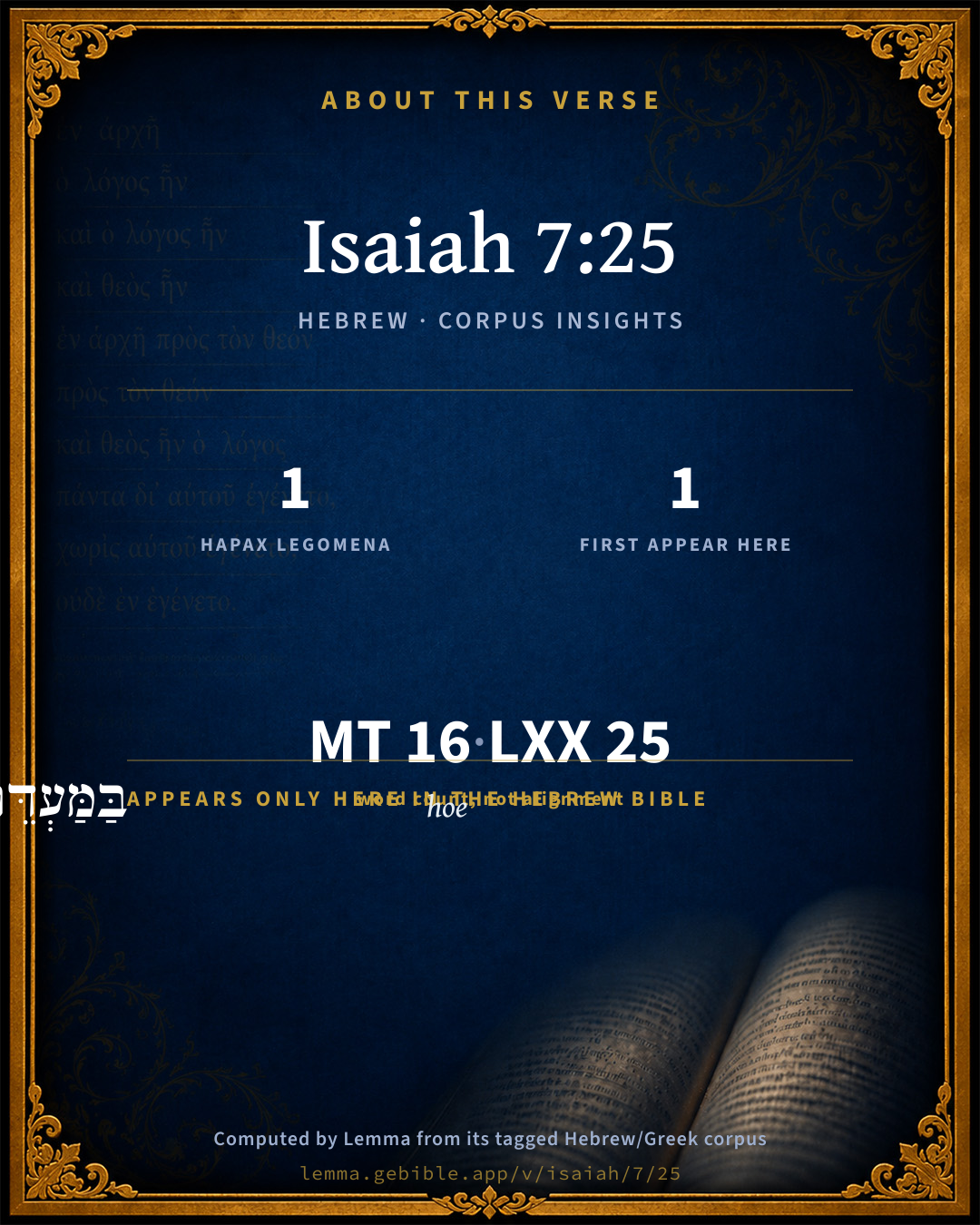
  • 1 hapax legomenon — only here in the Hebrew Bible
  • 1 first appearance in the Hebrew Bible
Full analysis ↓
Download a study sheet

One document with this verse’s original text, its word-by-word gloss line, the meaning frame, cross-references with their text, attributed commentary, and full source and license credits — printable, and it pastes into notes with its structure intact.

This verse Autodidact and up

Study sheet (.html) Plain text (.txt)

A passage Seminary Student

Up to 50 verses in one chapter. A passage sheet keeps up to 6 commentary sources and 12 cross-references per verse, in the order this page ranks them, and says so on the sheet whenever that leaves anything out. Ask for a single verse and you get the Autodidact verse sheet above.

Everything on this page stays free to read, with no account — the sheet is a download of what is already on screen, not access to it.

Want to remove ads? Support Godless Engineer
Compare translations 3

The same verse in 3 English versions, stacked beneath the original-language interlinear above. Click any original word for its lexicon entry.

Each is an independent rendering of the whole verse — the interlinear is not word-aligned to these translations.

Highlighted words mark where these versions differ — a whole-verse word diff, not a word-by-word alignment.

  • World English Bible Public Domain
    All the hills that were cultivated with the hoe, you shall not come there for fear of briers and thorns; but it shall be for the sending forth of oxen, and for the treading of sheep."
  • King James Version Public Domain
    And on all hills that shall be digged with the mattock, there shall not come thither the fear of briers and thorns: but it shall be for the sending forth of oxen, and for the treading of lesser cattle.
  • unfoldingWord Literal Text CC BY-SA 4.0
    And all of the hills that were hoed with a hoe, you will not go there fear of briar and thorn. And it will be for the sending out of the ox and for the trampling of the sheep.

unfoldingWord Literal Text — © unfoldingWord, licensed CC BY-SA 4.0. Word-aligned USFM3 via Door43 (git.door43.org/unfoldingWord/en_ult).

Versions to compare (up to 4)

3 of 4 selected

Show all 18 translations

Every available English version of this verse, each an independent rendering of the whole verse.

  • World English Bible Public Domain
    All the hills that were cultivated with the hoe, you shall not come there for fear of briers and thorns; but it shall be for the sending forth of oxen, and for the treading of sheep."
  • Berean Standard Bible Public Domain
    For fear of the briers and thorns, you will no longer traverse the hills once tilled by the hoe; they will become places for oxen to graze and sheep to trample.
  • Majority Standard Bible Public Domain
    For fear of the briers and thorns, you will no longer traverse the hills once tilled by the hoe; they will become places for oxen to graze and sheep to trample.
  • King James Version Public Domain
    And on all hills that shall be digged with the mattock, there shall not come thither the fear of briers and thorns: but it shall be for the sending forth of oxen, and for the treading of lesser cattle.
  • American Standard Version (1901) Public Domain
    And all the hills that were digged with the mattock, thou shalt not come thither for fear of briers and thorns; but it shall be for the sending forth of oxen, and for the treading of sheep.
  • Revised Version (1885) Public Domain
    And all the hills that were digged with the mattock; thou shalt not come thither for fear of briers and thorns, but it shall be for the sending forth of oxen, and for the treading of sheep.
  • Geneva Bible (1599) Public Domain
    But on all the mountaines, which shalbe digged with the mattocke, there shall not come thither the feare of briers and thornes: but they shalbe for the sending out of bullocks, and for the treading of sheepe.
  • Douay-Rheims (1899) Public Domain
    And as for all the hills that shall be raked with a rake, the fear of thorns and briers shall not come thither, but they shall be for the ox to feed on, and the lesser cattle to tread upon.
  • Young's Literal Translation Public Domain
    And all the hills that with a mattock are kept in order, Thither cometh not the fear of brier and thorn, And it hath been for the sending forth of ox, And for the treading of sheep!'
  • Literal Standard Version CC BY-SA 4.0
    And all the hills that are kept in order with a mattock, || There does not come [for] fear of brier and thorn, || And it has been for the sending forth of ox, || And for the treading of sheep!
  • Unlocked Literal Bible CC BY-SA 4.0
    They will stay away from all the hills that were cultivated with the hoe, for fear of the briers and thorns; but it will be a place where cattle and sheep graze.
  • unfoldingWord Literal Text CC BY-SA 4.0
    And all of the hills that were hoed with a hoe, you will not go there fear of briar and thorn. And it will be for the sending out of the ox and for the trampling of the sheep.
  • Darby Bible Public Domain
    And all mountains that have been dug up with the hoe -- thither will they not come, from fear of briars and thorns; and they shall be for the sending forth of oxen, and for the treading of small cattle.
  • World Messianic Bible Public Domain
    All the hills that were cultivated with the hoe, you shall not come there for fear of briers and thorns; but it shall be for the sending out of oxen, and for sheep to tread on.”
  • Webster's Bible Public Domain
    And on all hills that shall be digged with the mattock, there shall not come thither the fear of briers and thorns: but it shall be for the sending forth of oxen, and for the treading of lesser cattle.
  • Free Bible Version CC BY-SA 4.0
    In fact, all the hills that were once tilled by the hoe you won't want to go to because you'll worry about the brambles and thorns there. They'll just be where cattle are let loose and where sheep roam.
  • Bible in Basic English Public Domain
    And they will send out the oxen and the sheep on all the hills which before were worked with the spade,... fear of blackberries and thorns.
  • JPS Tanakh (1917) Public Domain
    And all the hills that were digged with the mattock, thou shalt not come thither for fear of briers and thorns, but it shall be for the sending forth of oxen, and for the treading of sheep.

Literal Standard Version (2020), Covenant Press — licensed CC BY-SA 4.0. Text via the HelloAO Bible API (eBible.org). Unlocked Literal Bible (unfoldingWord) — licensed CC BY-SA 4.0. Text via the HelloAO Bible API (eBible.org). unfoldingWord Literal Text — © unfoldingWord, licensed CC BY-SA 4.0. Word-aligned USFM3 via Door43 (git.door43.org/unfoldingWord/en_ult). Free Bible Version, Dr. Jonathan Gallagher — licensed CC BY-SA 4.0. Text via the HelloAO Bible API (eBible.org).

Word by word

More ways to search: Search by grammar → Find every occurrence → Compare this word →

Practice this passage: Drill this verse → Learn its vocabulary →

בַּמַּעְדֵּר֙
maʻdêr
H4576
“in/at the · hoe”
Preposition, Determined + Noun, Common, Masculine, Singular, Absolute
Part of Speech
Preposition + Noun
Type
Common
Gender
Masculine
Number
Singular
State
Absolute
Full BDB Definition

Origin: from H5737

TWOT: 1571a

hoe
  1. וְכֹ֣ל kôl H3605 “and · all of” Conjunction + Noun, Common, Masculine, Singular, Construct
  2. הֶהָרִ֗ים har H2022 “the · mountains” Particle, Definite Article + Noun, Common, Masculine, Plural, Absolute
  3. אֲשֶׁ֤ר ʼăsher H834 “which” Particle, Relative
  4. יֵעָ֣דֵר֔וּן ʻădar H5737 “to help” Verb, Niphal, Imperfect, 3rd Person, Masculine, Plural + Suffix, n
  5. לֹֽא lôʼ H3808 “not” Particle, Negative
  6. תָב֣וֹא bôwʼ H935 “to enter” Verb, Qal, Imperfect, 2nd Person, Masculine, Singular
  7. שָׁ֔מָּה shâm H8033 “there · toward” Adverb + Suffix, Demonstrative
  8. יִרְאַ֖ת yirʼâh H3374 “fear of” Noun, Common, Feminine, Singular, Construct
  9. שָׁמִ֣יר shâmîyr H8068 “thorn” Noun, Common, Masculine, Singular, Absolute
  10. וָשָׁ֑יִת shayith H7898 “and · thorn bushes” Conjunction + Noun, Common, Masculine, Singular, Absolute
  11. וְהָיָה֙ hâyâh H1961 “and · to be” Conjunction + Verb, Qal, Sequential Perfect, 3rd Person, Masculine, Singular
  12. לְמִשְׁלַ֣ח mishlôwach H4916 “to/for · pasture of” Preposition + Noun, Common, Masculine, Singular, Construct
  13. שׁ֔וֹר shôwr H7794 “ox” Noun, Common, Masculine, Singular, Absolute
  14. וּלְמִרְמַ֖ס mirmâç H4823 “and · to/for · trampling place of” Conjunction + Preposition + Noun, Common, Masculine, Singular, Construct
  15. שֶֽׂה seh H7716 “sheep” Noun, Common, Both, Singular, Absolute

About this verse

These counts appear in no published source. They are computed here, from the morphology-tagged text and Lemma’s own curated glosses. What Lemma adds →

16
words
16
distinct lemmas
Prophets
section

Notable vocabulary

1 hapax legomenon — a word that appears only here in the entire Hebrew Bible:

  • בַּמַּעְדֵּר֙ hoe H4576

First appearance in Scripture

This word makes its first canonical appearance in the Hebrew Bible here:

  • בַּמַּעְדֵּר֙ hoe H4576

Shared distinctive vocabulary

וָשָׁ֑יִת thorn bushes H7898 occurs in 7 verses of the Hebrew Bible. Also found in:

Grammatical profile

  • 3 verbs
  • 10 nouns
  • 1 adverb
  • 2 particles

Verb forms

  • יֵעָ֣דֵר֔וּן Niphal · Imperfect
  • תָב֣וֹא Qal · Imperfect
  • וְהָיָה֙ Qal · Sequential Perfect

Hebrew & Septuagint length

In English translation the verse runs 36 words from the Hebrew and 33 from the Septuagint (LXX English) — closely comparable.

A rough comparison of the two English renderings, which tokenize alike — not a word-level alignment.

Word counts can differ between the Hebrew and the Greek without any difference in meaning — e.g. the Hebrew direct-object marker אֵת has no separate Greek word, and Greek often adds the article ὁ.

In the original languages it is 16 Hebrew tokens and 25 Greek tokens — but the two are counted differently (Hebrew bundles its prefixes and suffixes into one token; the Greek is in lemma form), so that isn’t a like-for-like length.

Cross-references

5

Topical passages linked to Isaiah 7:25 in the Treasury of Scripture Knowledge — connected by theme and wording, ordered by reader-vote popularity; previews shown in the World English Bible.

  • Isaiah 5:17 Then the lambs will graze as in their pasture, And strangers will eat the ruins of the rich.
  • Isaiah 7:21–22 It shall happen in that day that a man shall keep alive a young cow, and two sheep;
  • Isaiah 13:20–22 It shall never be inhabited, neither shall it be lived in from generation to generation: neither shall the Arabian pitch tent there; neither shall shepherds make their flocks to lie down there.
  • Isaiah 17:2 The cities of Aroer are forsaken; they shall be for flocks, which shall lie down, and none shall make them afraid.
  • Zephaniah 2:6 The sea coast will be pastures, with cottages for shepherds and folds for flocks.

Cross-references courtesy of OpenBible.info (CC BY 4.0).

Hebrew and Greek witnesses Masoretic Hebrew ↔ Greek Septuagint

The same verse in the two great witnesses to the Old Testament, shown verse-for-verse.

These are two independent witnesses, not word-aligned to each other, and the Septuagint is shown in lemma (dictionary) form.

Hebrew Isaiah 7:25 Masoretic · Westminster Leningrad Codex

וְכֹ֣ל הֶהָרִ֗ים אֲשֶׁ֤ר בַּמַּעְדֵּר֙ יֵעָ֣דֵר֔וּן לֹֽא תָב֣וֹא שָׁ֔מָּה יִרְאַ֖ת שָׁמִ֣יר וָשָׁ֑יִת וְהָיָה֙ לְמִשְׁלַ֣ח שׁ֔וֹר וּלְמִרְמַ֖ס שֶֽׂה

All the hills that were cultivated with the hoe, you shall not come there for fear of briers and thorns; but it shall be for the sending forth of oxen, and for the treading of sheep."

World English Bible · Public Domain

Greek LXX Isaiah 7:25 Septuagint · lemma form

καί πᾶς ὄρος ἀροτριάω ἀροτριάω καί οὐ μή ἐπιἔρχομαι ἐκεῖ φόβος εἰμί γάρ ἀπό ὁ χέρσος καί ἄκανθα εἰς βόσκημα πρόβατον καί εἰς καταπάτημα βοῦς

And every mountain shall be certainly plowed: there shall no fear come there: for there shall be from among the barren ground and thorns that whereon cattle shall feed and oxen shall tread.

LXX2012 (modern English Septuagint) · Public Domain

On this verse, John Gill's Exposition discusses the Septuagint’s reading. Read the note in Commentary ↓

Hebrew: Westminster Leningrad Codex (CC BY 4.0). Greek: Septuagint (public domain); English from LXX2012 (modern English Septuagint) (Public Domain). How the Septuagint differs from the Hebrew →

Targum (Aramaic paraphrase)

1

The Targum is the ancient Jewish Aramaic paraphrase of the Hebrew Scriptures — an interpretive translation, not the Hebrew text itself. Onkelos (literal) and Pseudo-Jonathan (expansive) render the Torah, and Jonathan the Prophets. Coverage is partial: where no permissively-licensed English translation exists for a verse, only the Aramaic is shown. This is verse-level text, not a word-by-word alignment to the Hebrew.

  1. Targum Jonathan Prophets (Joshua–Malachi)
    וְּכָל טוּרַיָא דְבֵית יְהוּדָה דִי בְמַעְדֵר יִתְפַּלְחוּן לָא תֵיעוּל לְתַמָן דַחֲלַת הוֹבָאִי וּבוּר וִיהֵי לְבֵית אַרְבָּעָה בַקְרָן דְתוֹרִין וּלְבֵית מַשְׁרֵי עֶדְרִין דְעָן:

    And all the hills of the house of Judah, which shall be digged with the mattock, there shall not come thither the fear of briers and thorns: but it shall be for a place of crouching down of oxen, and for a place of dwelling of flocks and of sheep.

    Targum Jonathan — Aramaic: “Mikraot Gedolot” (public domain). English: “Sefaria Community Translation” (CC0 1.0 (public-domain dedication)); “London "Chaldee Paraphrase," 1871” (public domain). Text via Sefaria.

Commentary

Notes on Isaiah 7:25 from classic Christian and Jewish commentators (each source and its license shown beneath its notes). The classic Christian expositions comment on the surrounding passage and are grouped to its opening verse, so a note may address several verses; the Jewish commentaries on the Tanakh (Rashi and others) are per-verse, so they appear only where the commentator wrote on this verse.

Lemma curates 59 commentaries, every one of them public domain or Creative Commons licensed, each selected and text-cleaned for this edition rather than reprinted as found. About our sources →

Trapp's Complete Commentary

John Trapp

Isa 7:25 And [on] all hills that shall be digged with the mattock, there shall not come thither the fear of briers and thorns: but it shall be for the sending forth of oxen, and for the treading of lesser cattle.

Ver. 24. And on all the hills that shall be digged, &c.] A good translation of a text is instead of a good commentary. Some very learned {a} render the words thus: And on the hills that had wont to be digged with mattock or spade, that no fear of brier or thorn might come thither, shall a place also be for sending in of oxen and the treading of lesser cattle; which shall range and graze freely, say they by way of gloss, after their wonted manner in those places, from whence they and their owners had formerly been ejected and excluded by the violent oppressions and undue enclosures of the richer and greater sort. {Isa 5:17}

{a} Assemb. Annot.

John Trapp, A Commentary or Exposition upon All the Books of the Old and New Testament (1647–1656) — public domain. Text from a community e-Sword module.

Geneva Bible (1599)

Geneva Bible translators

The mountains contrary to their wont, shall be tilled by such as shall flee to them for succor.

Geneva Bible (1599) marginal notes — public domain. Text via Bolls.life.

Jamieson, Fausset & Brown

Robert Jamieson, A. R. Fausset & David Brown

shall be--rather, "were once."

digged--in order to plant and rear vines (Isa 5:6).

there shall not come--that is, none shall come who fear thorns, seeing that thorns shall abound on all sides [MAURER]. Otherwise, "Thou shalt not come for fear of thorns" [GESENIUS]. Only cattle shall be able to penetrate the briery ground.

lesser cattle--sheep and goats.

The first seven verses of the ninth chapter belong to this section. The eighth chapter continues the subject of the seventh chapter, but at a later period (compare Isa 8:4 with Isa 7:16); implying that the interval till the accomplishment is shorter now than then. The tone of Isa 8:17, Isa 8:21-22, expresses calamity more immediate and afflictive than Isa 7:4, Isa 7:15, Isa 7:22.

Next: Isaiah Chapter 8

Jamieson, Fausset & Brown — Commentary Critical and Explanatory on the Whole Bible (1871) — public domain (CC PDM 1.0). Text via the HelloAO Bible API.

Ellicott's Commentary for English Readers

(25) And on all hills that shall be digged . . .—Better, “that are digged” or that used to be digged with the hoe. The picture of devastation is completed. On the hill-sides, every inch of which was once brought under careful vine culture, “Thou wilt not enter for fear of thorns and briars” i.e., thou wilt not venture on the task of tilling the soil in face of such disarrangements. What would be the use of hoeing such a tangled mass of brushwood? At the best it must be left for such pasturage as oxen and sheep might find there as they browsed, and they by their trampling should but increase the mischief. The rendering of the Authorised version conveys the thought that where there was the careful culture thus described, there should be an exception to the general desolation. Below this, if we accept it, there may be a spiritual meaning like that of Jer_4:3 (Kay).

A Bible Commentary for English Readers, edited by Charles John Ellicott (1878–1897) — public domain. Text from a community e-Sword module.

The Cambridge Bible for Schools and Colleges

gen. ed. J. J. S. Perowne

25. a thousand vines at a thousand silverlings] i.e. “silver shekels.” Schrader reckons the silver shekel as equal to about half-a-crown of our money, which would make the price of the vineyard about £125. But the estimate neglects the important element of variation in the purchasing power of money. The traveller Burckhardt, who found it the custom in Syria to estimate the value of a vineyard according to the number of vines, tells us that good vines are valued at less than three pence each.

25. And on all hills … mattock] And as for all the hills that used to be hoed with the mattock. Such hills were the best sites for vineyards (ch. Isa_5:2).

there shall not come thither the fear …] This could only mean, in the present connexion, that there would be no more anxiety about thorns, &c., because the place was hopelessly overgrown by them. It is better to render with R.V. thou shalt not come thither for fear of, &c., although the construction is certainly harsh. Or the words might be taken as a continuation of the relative clause, thus: “And as for … mattock, whither no fear of thorns, &c. used to come, it shall be, &c.” This is perhaps preferable.

for the sending forth of oxen] i.e. a place where oxen are sent forth (cf. ch. Isa_32:20). the treading (ch. Isa_5:5) of lesser cattle (R.V. sheep).

The Cambridge Bible for Schools and Colleges (gen. ed. J. J. S. Perowne; Cambridge University Press, 1878–1918) — public domain. Text from a community e-Sword module.

John Gill's Exposition

And on all hills that shall be digged with the mattock,.... Which could not be ploughed with a plough, but used to be dug with a mattock or spade, and then sowed with corn:

there shall not come thither the fear of briers and thorns; where thorns and briers used not to grow, and where there was no fear or danger of being overrun with them, as the vineyards in the valleys and champaign country; yet those places should become desolate in another way; or rather, there shall be now no fences made of briers and thorns, which deter cattle from entering into fields and vineyards thus fenced:

but it shall be for the setting forth of oxen, and for the treading of lesser cattle; there being no fence of briers and thorns to keep them out, cattle both of the greater and lesser sort should get into the corn, and feed upon it, and make such places desolate, where much pains were taken to cultivate them. The Targum is,

"it shall be for a place of lying down of oxen, and for a place of dwelling of flocks of sheep;''

not for pastures, but for folds for them; though the Septuagint, Vulgate Latin, Syriac, and Arabic versions, suggest these places should become pastures; and therefore some understand this as a prophecy of a change in the country for the better, and of the great fruitfulness of it after the Jews' return from the Babylonish captivity.

Next: Isaiah Chapter 8

John Gill's Exposition of the Whole Bible (1746–1763) — public domain (CC PDM 1.0). Text via the HelloAO Bible API.

Albert Barnes' Notes on the Bible

And on all hills ... - All the fertile places in the mountains that used to be cultivated with the spade. Vineyards were often planted on the sides of hills; and those places were among the most productive and fertile in the land; see Isa 5:1.

The mattock - The spade; the garden hoe; or the weeding-hook. An instrument chiefly used, probably, in vineyards.

There shall not come thither - There shall not be.

The fear of briers and thorns - This does not make sense; or if it does, it is not a sense consistent with the connection. The idea of the whole passage is, that the land, even the most fertile parts of it, should be given up to briers and thorns; that is, to desolation. The Hebrew here, is ambiguous. It may mean, ‘thou shalt not come there, for fear of the briers and thorns.’ That is, the place that was formerly so fertile, that was cultivated with the spade, shall now be so completely covered with thorns, and shall furnish so convenient a resting place for wild beasts and reptiles, as to deter a man from going there. The Septuagint, and the Syriac, however, understand it differently - as denoting that those places should be still cultivated. But this is evidently a departure from the sense of the connection. Lowth understands it in the past tense; ‘where the fear of briers and thorns never came.’ The general idea of the passage is plain, that those places, once so highly cultivated, would now be desolate.

Shall be for the sending forth ... - Shall be wild, uncultivated, and desolate - vast commons on which oxen and sheep shall feed at large. “Lesser cattle.” Hebrew ‘Sheep, or the flock.’ Sheep were accustomed to range in deserts and uncultivated places, and to obtain there, under the guidance of the shepherd, their subsistence. The description, therefore, in these verses, is one of extensive and wide desolation; and one that was accomplished in the calamities that came upon the land in the invasions by the Egyptians and Assyrians.

Albert Barnes' Notes on the Bible (1834–1885) — public domain. Text from a community e-Sword/MySword module.

Matthew Poole's English Annotations

That shall be digged; or, that were digged, to wit, formerly; that used to be digged and dressed for the planting of vines, or other choice fruit trees.

There shall not come thither the fear of briers and thorns: the words thus rendered sound like a promise, but that doth no way agree with the scope of the place. And they may be, and are by some, understood not of briers and thorns growing in those grounds, which would hinder the feeding of cattle there, but of such wherewith they were fenced, and by which the cattle were affrighted or hindered from breaking into them, which cause of their fear being now removed by the general devastation, they might now enter there, and feed at pleasure, as the next words imply. Or they may be rendered thus, as they are by a late learned interpreter,

that there might not come thither, & c., which is mentioned as the reason why they were digged and dressed, that they might be freed from briers and thorns. And so there is only a defect of the Hebrew particle asher, which is frequent, and that not only as it signifies which, but as it is taken finally for that, as Isa 5:11; 10:2, and elsewhere.

It shall be; or, even (as this particle is oft rendered) there shall be, to wit, a place; which word is understood, 2Sa 7:1; 1Ki 18:12. Or the words may be thus rendered, and all hills that shall be digged—and thorns, even they or each of them shall be; the singular being taken collectively, as is very usual.

For the sending forth of oxen, and for the treading of lesser cattle; all sorts of cattle may fairly enter, and feed there, the fences being broken down, and the owners generally slain, or carried into captivity.

Matthew Poole's English Annotations on the Holy Bible (1683–1685) — public domain. Text from a community e-Sword/MySword module.

The Pulpit Commentary

On all hills that shall be digged; rather, that shall have been digged in former times, whether for corn cultivation or for any other. There shall not come thither the fear of briers (so Ewald and Kay). But almost all other commentators translate, "Thou shalt not come thither for fear of briers," etc. The briers and thorns of the East tear the clothes and the flesh. It shall be; i.e. "each such place shall be." For the sending forth of oxen; rather, for the sending in of oxen. Men shall send their cattle into them, as alone able to penetrate the jungle without hurt.

The Pulpit Commentary (1880–1919), ed. H.D.M. Spence-Jones & Joseph S. Exell — public domain. Text from a community e-Sword module.

John Wesley's Explanatory Notes

Digged - That used to be digged and dressed for the planting of vines, or other choice fruit-trees. The fear - That they might be freed from briars and thorns. Cattle - All sorts of cattle may enter, and feed there, the fences being broken down, and the owners slain, or carried into captivity.

John Wesley, Explanatory Notes Upon the Whole Bible (1754–1765) — public domain. Text via the GEBible commentary corpus.

J. A. Alexander on Isaiah

Joseph Addison Alexander

Not only the fields, not only the vineyards, shall be overrun with thorns and briers, but the very hills, now laboriously cultivated with the hand, shall be given up to like desolation. “And all the hills (i.e., even all the hills) which are digged with the hoe (because inaccessible to the plough), thou shalt not go (even) there, for fear of briers and thorns, and (being thus uncultivated) they shall be for a sending-place of cattle and a trampling-place of sheep” (i.e., a place where cattle may be sent to pasture, and which may be trodden down by sheep). The reference is probably to the hills of Judea, anciently cultivated to the very top, by means of terraces that still exist, for an account of which by eye-witnesses, see Keith’s Land of Israel, chapter xii., and Robinson’s Palestine, vol. II p. 187. Thus understood, the verse merely strengthens the foregoing description, by declaring that even the most carefully cultivated portions of the land should not escape the threatened desolation.

This verse continues and completes the description of the general desolation, as manifested first by the people’s living upon milk and honey, then by the growth of thorns and briers in the choicest vineyards and the terraced hills, and by the conversion of these carefully tilled spots into dangerous solitudes, hunting-grounds, and pastures.

Joseph Addison Alexander, The Prophecies of Isaiah (1846–1847; New York: Scribner, 1870–1878) — public domain. Text from a community e-Sword module.

Rashi

Rabbi Shlomo Yitzchaki (Rashi)

And all the mountains where there are wheat fields fit for grain.

that will be dug with a spade It is a kind of shovel called fosojjr in O.F.

the fear of worms and thorns For in them they will engage to sow grain for food, for it is impossible without grain, but the vines will be neglected, for that generation of Hezekiah will return to Me to engage in the Torah, and not to drink wine, as it is [stated] in [the chapter of] “Chelek” (San. 94b): They searched from Dan to Beer-sheba, and did not find any man who was not well-versed in the laws of prohibition and permissibility and ritual defilement and purity. And concerning that generation, Scripture says: And it shall come to pass, that every place, etc. This is what is stated (Prov. 25:1): “Which the men of Hezekiah, king of Judah, strengthened.”

and it shall be for the pasture of oxen There their cattle will graze on fat pastureland.

Rashi on the Tanakh — English translations: “The Judaica Press complete Tanach with Rashi, translated by A. J. Rosenberg” (CC BY 4.0); “Pentateuch with Rashi's commentary by M. Rosenbaum and A.M. Silbermann, 1929-1934” (public domain); “The Metsudah Tanach series, Lakewood, N.J” (CC BY 4.0); and “The Book of Joshua, Metsudah Publications, 1997” (CC BY 4.0). Text via Sefaria.

Ibn Ezra

Rabbi Abraham ibn Ezra

And on all hills, etc. And all the hills, where vineyards have formerly been carefully dressed, will now again be prepared; for there will be no thorns, and God will give such a blessing on the vineyards of the mountains, that people will send the cattle there; comp. He bindeth his foal to the vine (Gen. 49:4). The prophet says that from one cow and two sheep there will be obtained a plentiful supply of milk; and the vineyards of the mountains, that will alone remain undamaged, will enjoy a boundless blessing from the Almighty.

Ibn Ezra on the Tanakh — English translations: “Sefaria Community Translation” (CC0 1.0 (public-domain dedication)); “Yalkut, Sifsei Chachomim Chumash, Metsudah Publications, 2009” (CC BY 4.0); and “Commentary of Ibn Ezra on Isaiah - trans. by M. Friedlander, 1873” (public domain). Text via Sefaria.

Lesson kit

Teaching starters — assembled from the data on this page, not authored interpretation. Every prompt links to the verse data it draws on. Edit before teaching.

Isaiah, in the Prophets, opens this verse with 16 words (16 distinct Hebrew lemmas). Its most distinctive word is maʻdêr (“hoe”). A historical commentator’s framing appears above. Read the whole chapter for the surrounding context.

Discussion questions

  1. How does “hoe” (maʻdêr) shape what this verse is saying?
  2. 1 word here appears nowhere else in the Hebrew Bible. Why might the author reach for such rare wording?
  3. This is the first place “hoe” appears in Scripture (first appears here). What does its debut here establish?
  4. How does Isaiah 5:6, which shares the word «thorn bushes», read alongside this verse?
  5. These translations render this verse differently; the difference is in the English rendering, not the original. What questions does that raise?
  6. «יֵעָ֣דֵר֔וּן» is a Niphal Imperfect verb. How does that grammatical form shape the action described?
  7. Compare how Trapp's Complete Commentary and Geneva Bible (1599) read this verse. Where do they agree or differ?

Things to notice

Reading settings

Reading text

Shown beneath each verse's original-language words.

Old Testament
Old Testament edition

Read the OT as the Masoretic Hebrew (MT) or the Greek Septuagint (LXX).

English shown for the Greek Septuagint (in the Hebrew ↔ Greek comparison).

Comparing translations? Open the Compare panel on any verse page to stack up to four side by side.