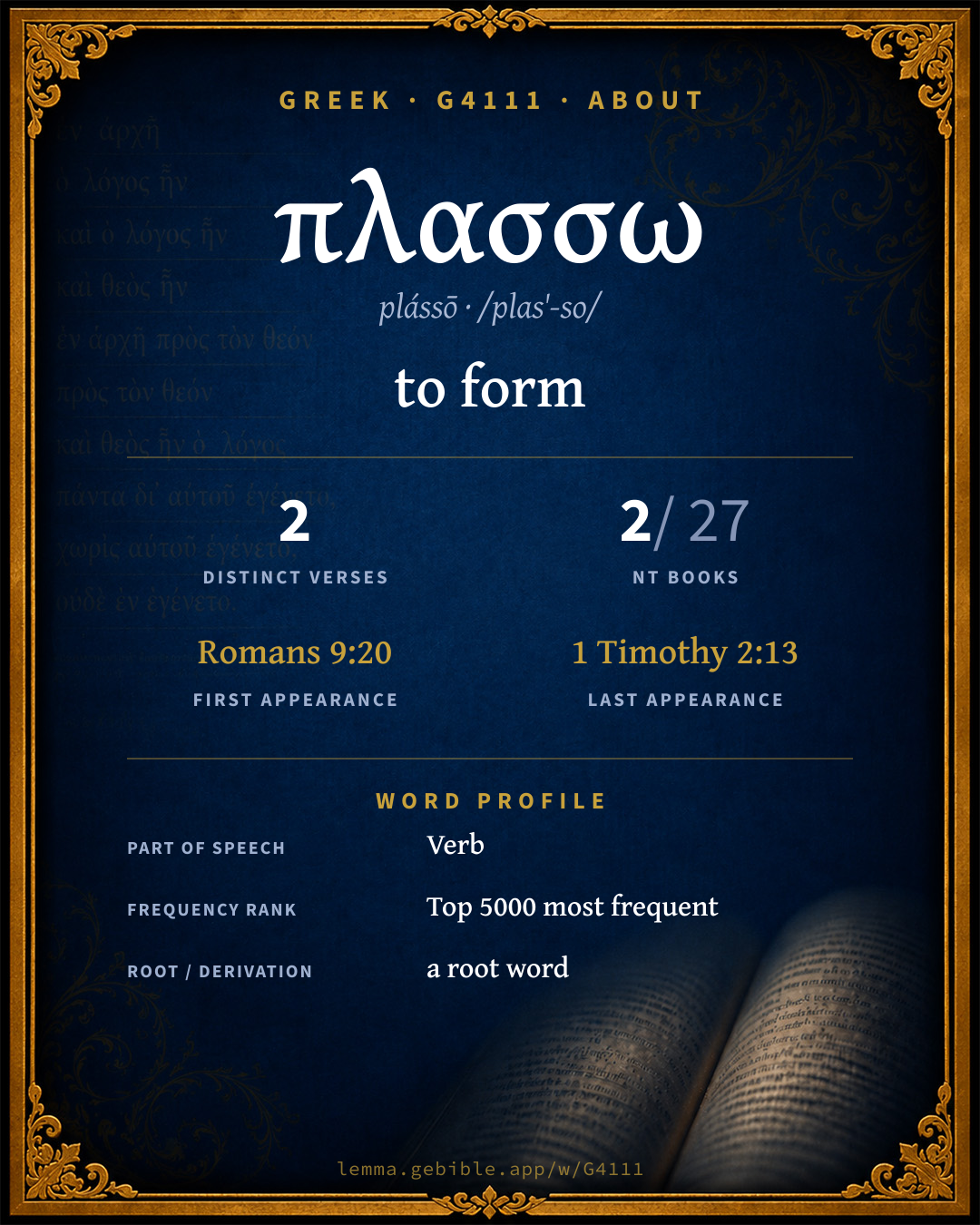
πλάσσω
to form
Full lexicon entry — Thayer's Greek Lexicon
From Thayer's Greek Lexicon
Where this word appears
Grammar key — what these labels mean
Part of speech
- Verb
- An action or state-of-being word.
Tense
- Aorist
- Action viewed as a simple whole, without regard to duration — often past (perfective aspect).
Voice
- Active
- The subject performs the action.
- Passive
- The subject receives the action.
Mood
- Participle
- A verbal adjective (“writing,” “having written”).
- Indicative
- States a fact or asks a factual question (the mood of reality).
Case
- Dative
- The case of the indirect object, means, or location — “to / for / with / in.”
Person
- 3rd person
- The one spoken about (“he / she / it / they”).
Gender
- Masculine
- Grammatically masculine.
Number
- Singular
- One.
Grammatical forms
- Verb, Aorist, Active, Participle, Dative, Singular, Masculine 1 time (50%)
- Verb, Aorist, Passive, Indicative, 3rd person, Singular 1 time (50%)
Parsed forms decoded from the imported morphology (Robinson–Tischendorf, public domain), counted across 2 parsed occurrences — not distinct verses.
Every verse where G4111 appears — 2 distinct verses across 2 books. Click any verse to open its interlinear word-by-word view. Verse text shown in the World English Bible for context — . Each verse’s Greek form is shown with its reference; the English is not keyword-highlighted, since the data carries no word-level English alignment. Use “Compare translations” on any verse to read it across multiple English versions. This concordance covers the Greek New Testament; Septuagint (Greek Old Testament) occurrences of this word are not indexed here.
Romans 1 verse
1 Timothy 1 verse
About this entry
At a glance — auto-summarized from this page’s data, not written by a person. Every figure links to its source below. This summary describes the numbers; it doesn’t interpret them.
“to form” is the headline sense of the Greek verb πλασσω (plássō). It is rare — just 2 verses in the entire Greek New Testament. More than half of its appearances fall in Romans. Scripture first uses it in Romans 9:20. It shares a root with πλαξ, πλασμα and πλαστος. See the sense tree, 2-verse concordance, and the renderings breakdown below.
Gloss history
Strong's 1890 vs modern scholarship
About this word
Strong's G4111 catalogs a Greek word from the Greek New Testament.
These counts are not copied from any lexicon or concordance. They are computed here, from the morphology-tagged Greek New Testament. What Lemma adds →
- 2
- distinct verses
- The word appears in 2 distinct verses.
- 2 / 27
- NT books
- The word appears in 2 of 27 New Testament books.
- #2,678
- by frequency
- Top 5000 most frequent Greek words (rank 2,678 of 5,347 Greek words by occurrence).
View all 2 occurrences in the concordance →
By traditional corpus
Conventional, traditional groupings — biblical authorship is debated, so this is a traditional corpus grouping, not an authorship claim. Some books belong to more than one corpus (Luke is in both the Gospels and the Lukan corpus, and so on), so these shares overlap and need not total 100%. Each figure is a share of the word’s 2 distinct verses.
- Pauline corpus 2 verses · 100%
How translations render this word
Counts come from each version’s own published word-to-Strong’s tagging or interlinear alignment — an approximate guide to how each version renders this word, not a word-level alignment the data otherwise carries. Because each total is that version’s own tagged count, the per-version totals vary from one another and need not match the appearance or distinct-verse counts above. These counts may also differ from a printed concordance because Lemma counts each distinctly tagged rendering and does not collapse phrase taggings into a single head-word total. This is a fixed set of word-tagged versions (KJV, ASV, BSB, ULT) and does not change with the reading translation you choose elsewhere. Each version’s license is shown beside its name below (and on Sources).
- King James Version: Formed 2×
- American Standard Version: Formed 2×
- Berean Standard Bible: Formed 1×, Was formed 1×
- unfoldingWord Literal Text: Having molded 1×, It 1×, Was formed 1×
King James Version Public Domain
Renders G4111 across 3 tagged occurrences — most commonly:
Plus 1 rendering that appears only once — usually multi-word phrases or single function words the recovered tagging swept in, not distinct renderings.
American Standard Version Public Domain
Renders G4111 across 3 tagged occurrences — most commonly:
Plus 1 rendering that appears only once — usually multi-word phrases or single function words the recovered tagging swept in, not distinct renderings.
Berean Standard Bible Public Domain
Renders G4111 across 2 tagged occurrences — most commonly:
unfoldingWord Literal Text CC BY-SA 4.0
Renders G4111 across 3 tagged occurrences — most commonly:
Senses in Thayer's
The 1 sense Thayer's distinguishes for this word, in lexicon order (not ranked by frequency or importance). The full entry — with sub-senses — is in the Lexicon Entry tab.
- to form, mould (something from clay, wax, etc.)
Word origin
Origin: a root word
A primary verb; to mould that is shape or fabricate : - form.
— Strong’s Exhaustive Concordance (1890), public domain.
Forms in the corpus
The 2 distinct written forms G4111 takes in the Greek New Testament, most frequent first — each parse links to that tense’s occurrences in the concordance.
| Form | Parsing | Example | Uses |
|---|---|---|---|
| πλάσαντι plásanti | Verb, Aorist, Active, Participle, Dative, Singular, Masculine | Romans 9:20 | 1 |
| ἐπλάσθη eplásthē | Verb, Aorist, Passive, Indicative, 3rd person, Singular | 1 Timothy 2:13 | 1 |
Same root — word family
Other Thayer's entries built from the same root as G4111, grouped by Strong’s listed origin. These share a root / origin per the lexicon — not necessarily a shared meaning. Each links to that word’s own entry.
Derived from this word
- πλαξ pláx G4109 flat surface
- πλασμα plásma G4110 formed object
- πλαστος plastós G4112 formed
- πλατυς platýs G4116 broad
- πλησσω plḗssō G4141 to strike
Compare all same-root words → Showing 4 of 6 — not the complete family. They share a root, not necessarily a meaning.
Septuagint usage
The same Greek word πλασσω appears 44 times in the Greek Old Testament (Septuagint), across 42 verses in 11 books.
- 44
- LXX occurrences
- Tagged occurrences of this Greek word in the Septuagint.
- 42
- verses
- Distinct Septuagint verses containing this word.
- 11 / 39
- OT books
- The word appears in 11 of the 39 Old Testament books.
Sample Septuagint occurrences
- Genesis 2:7 πλάσσω
- Exodus 32:4 πλάσσω
- 1 Kings 12:33 πλάσσω
- 2 Kings 19:25 πλάσσω
- Job 10:8 πλάσσω
- Psalms 32:15 πλάσσω
- Proverbs 24:12 πλάσσω
- Isaiah 27:11 πλάσσω
- Jeremiah 1:5 πλάσσω
- Habakkuk 1:12 πλάσσω
- Zechariah 12:1 πλάσσω
Septuagint occurrences (same lexeme)
Every verse where the same Strong’s number (G4111) appears in the Greek Septuagint. Verse text shown in the World English Bible for context; the Greek form is the matched word — the English is not keyword-highlighted.
- Genesis 2:7 πλάσσω Yahweh God formed man from the dust of the ground, and breathed into his nostrils the breath of life; and man became a living soul.
- Genesis 2:8 πλάσσω Yahweh God planted a garden eastward, in Eden, and there he put the man whom he had formed.
- Genesis 2:15 πλάσσω Yahweh God took the man, and put him into the garden of Eden to dress it and to keep it.
- Genesis 2:19 πλάσσω Out of the ground Yahweh God formed every animal of the field, and every bird of the sky, and brought them to the man to see what he would call them. Whatever the man called every living creature, that was its name.
- Exodus 32:4 πλάσσω He received what they handed him, and fashioned it with an engraving tool, and made it a molten calf; and they said, "These are your gods, Israel, which brought you up out of the land of Egypt."
- 1 Kings 12:33 πλάσσω He went up to the altar which he had made in Bethel on the fifteenth day in the eighth month, even in the month which he had devised of his own heart: and he ordained a feast for the children of Israel, and went up to the altar, to burn incense.
- 2 Kings 19:25 πλάσσω Haven't you heard how I have done it long ago, and formed it of ancient times? now have I brought it to pass, that it should be yours to lay waste fortified cities into ruinous heaps.
- Job 10:8 πλάσσω 'Your hands have framed me and fashioned me altogether; Yet you destroy me.
- Job 10:9 πλάσσω Remember, I beg you, that you have fashioned me as clay. Will you bring me into dust again?
- Job 34:15 πλάσσω All flesh would perish together, And man would turn again to dust.
- Job 38:14 πλάσσω It is changed as clay under the seal, And stands forth as a garment.
- Psalms 32:15 πλάσσω
- Psalms 73:17 πλάσσω Until I entered God's sanctuary, And considered their latter end.
- Psalms 89:2 πλάσσω I indeed declare, "Love stands firm forever. You established the heavens. Your faithfulness is in them."
- Psalms 93:9 πλάσσω
- Psalms 93:20 πλάσσω
- Psalms 94:5 πλάσσω They break your people in pieces, Yahweh, And afflict your heritage.
- Psalms 103:26 πλάσσω
- Psalms 118:73 πλάσσω
- Psalms 138:5 πλάσσω Yes, they will sing of the ways of Yahweh; For great is Yahweh's glory.
- Psalms 138:16 πλάσσω
- Proverbs 24:12 πλάσσω If you say, "Behold, we didn't know this;" Doesn't he who weighs the hearts consider it? He who keeps your soul, doesn't he know it? Shall he not render to every man according to his work?
- Isaiah 27:11 πλάσσω When the boughs of it are withered, they shall be broken off; the women shall come, and set them on fire; for it is a people of no understanding: therefore he who made them will not have compassion on them, and he who formed them will show them no favor.
- Isaiah 29:16 πλάσσω You turn things upside down! Shall the potter be esteemed as clay; that the thing made should say of him who made it, He didn't make me; or the thing formed say of him who formed it, He has no understanding?
- Isaiah 43:1 πλάσσω But now thus says Yahweh who created you, Jacob, and he who formed you, Israel: Don't be afraid, for I have redeemed you; I have called you by your name, you are mine.
- Isaiah 43:7 πλάσσω everyone who is called by my name, and whom I have created for my glory, whom I have formed, yes, whom I have made.
- Isaiah 44:2 πλάσσω Thus says Yahweh who made you, and formed you from the womb, who will help you: Don't be afraid, Jacob my servant; and you, Jeshurun, whom I have chosen.
- Isaiah 44:9 πλάσσω Those who fashion an engraved image are all of them vanity; and the things that they delight in shall not profit; and their own witnesses don't see, nor know: that they may be disappointed.
- Isaiah 44:10 πλάσσω Who has fashioned a god, or molten an image that is profitable for nothing?
- Isaiah 44:21 πλάσσω Remember these things, Jacob, and Israel; for you are my servant: I have formed you; you are my servant: Israel, you shall not be forgotten by me.
- Isaiah 44:24 πλάσσω Thus says Yahweh, your Redeemer, and he who formed you from the womb: I am Yahweh, who makes all things; who stretches forth the heavens alone; who spreads abroad the earth (who is with me?);
- Isaiah 49:5 πλάσσω Now says Yahweh who formed me from the womb to be his servant, to bring Jacob again to him, and that Israel be gathered to him (for I am honorable in the eyes of Yahweh, and my God is become my strength);
- Isaiah 53:11 πλάσσω He shall see of the travail of his soul, [and] shall be satisfied: by the knowledge of himself shall my righteous servant justify many; and he shall bear their iniquities.
- Jeremiah 1:5 πλάσσω Before I formed you in the belly I knew you, and before you came forth out of the womb I sanctified you; I have appointed you a prophet to the nations.
- Jeremiah 10:16 πλάσσω The portion of Jacob is not like these; for he is the former of all things; and Israel is the tribe of his inheritance: Yahweh of Hosts is his name.
- Jeremiah 18:11 πλάσσω Now therefore, speak to the men of Judah, and to the inhabitants of Jerusalem, saying, Thus says Yahweh: Behold, I frame evil against you, and devise a device against you: return you now everyone from his evil way, and amend your ways and your doings.
- Jeremiah 19:1 πλάσσω Thus said Yahweh, Go, and buy a potter's earthen bottle, and [take] of the elders of the people, and of the elders of the priests;
- Jeremiah 28:19 πλάσσω
- Jeremiah 40:2 πλάσσω The captain of the guard took Jeremiah, and said to him, Yahweh your God pronounced this evil on this place;
- Habakkuk 1:12 πλάσσω Aren't you from everlasting, Yahweh my God, my Holy One? We will not die. Yahweh, you have appointed him for judgment. You, Rock, have established him to punish.
- Habakkuk 2:18 πλάσσω "What value does the engraved image have, that its maker has engraved it; the molten image, even the teacher of lies, that he who fashions its form trusts in it, to make mute idols?
- Zechariah 12:1 πλάσσω An oracle. The word of Yahweh concerning Israel. Yahweh, who stretches out the heavens, and lays the foundation of the earth, and forms the spirit of man within him says:
These are occurrences of the same Greek lexeme (G4111) in the Septuagint — not a translation of any one Hebrew word. The store carries no word-level Hebrew↔Greek alignment, so no Hebrew original is asserted here. Counts come from the recovered LXX Strong's tagging — high-frequency vocabulary is well covered, while rare or late forms may be untagged — so they reflect tagged occurrences and may slightly undercount.