
1 Thessalonians 2:5

Greek (Tischendorf 8th ed.) 1 Thessalonians 2:5 appears in the Greek New Testament. The text above is from the Tischendorf 8th edition. Each word links to its Strong’s number and a concise gloss. Click any word for its full Thayer’s Greek Lexicon entry.
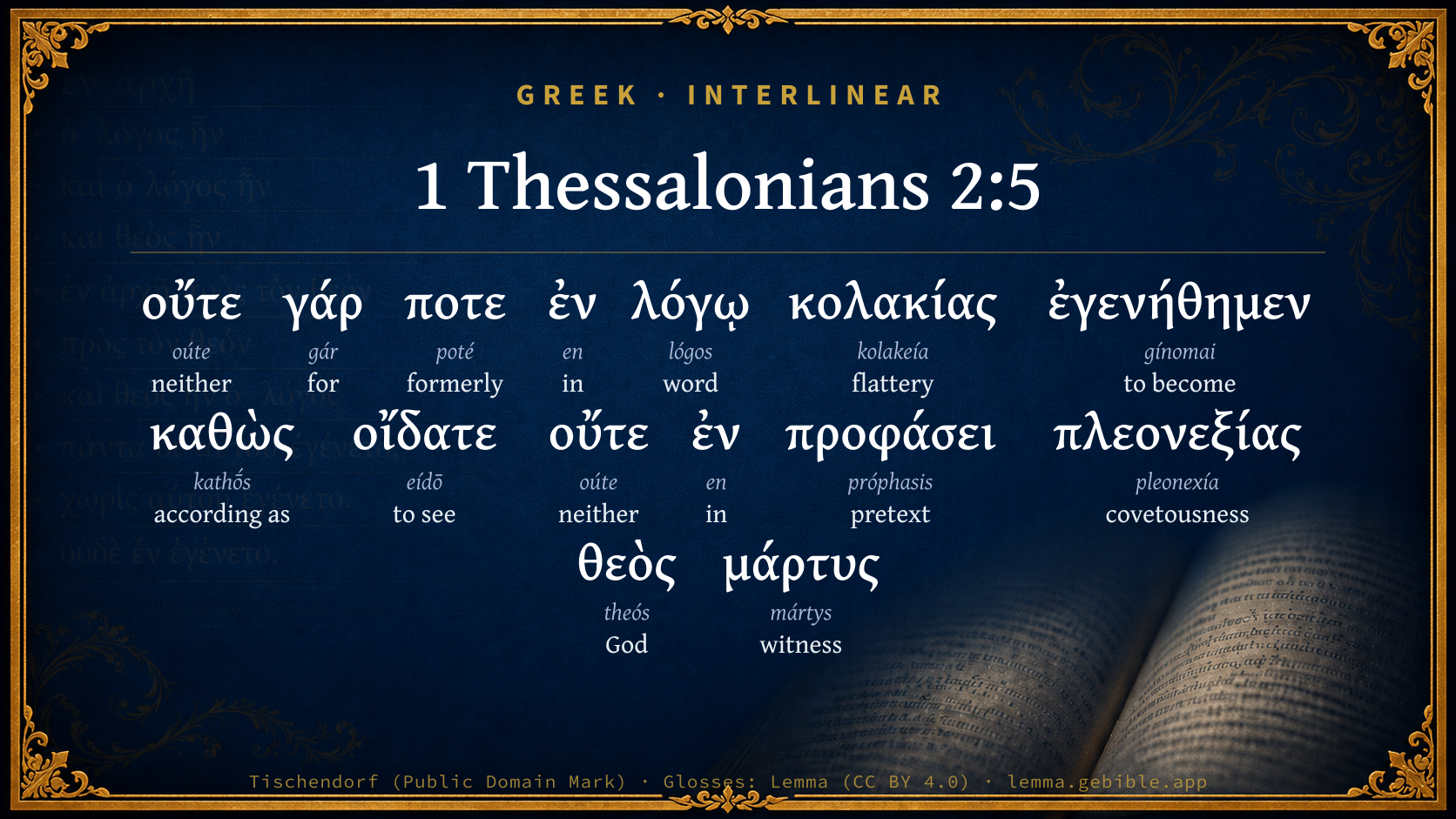
Download image
Cite this verse

1 Thessalonians 2:5 (World English Bible). Public Domain. Lemma interlinear Bible study tool, https://lemma.gebible.app/v/1-thessalonians/2/5.

Show BibTeX & RIS
BibTeX
RIS
English Translation
For neither were we at any time found using words of flattery, as you know, nor a cloak of covetousness (God is witness),
World English Bible · Public Domain
Highlights
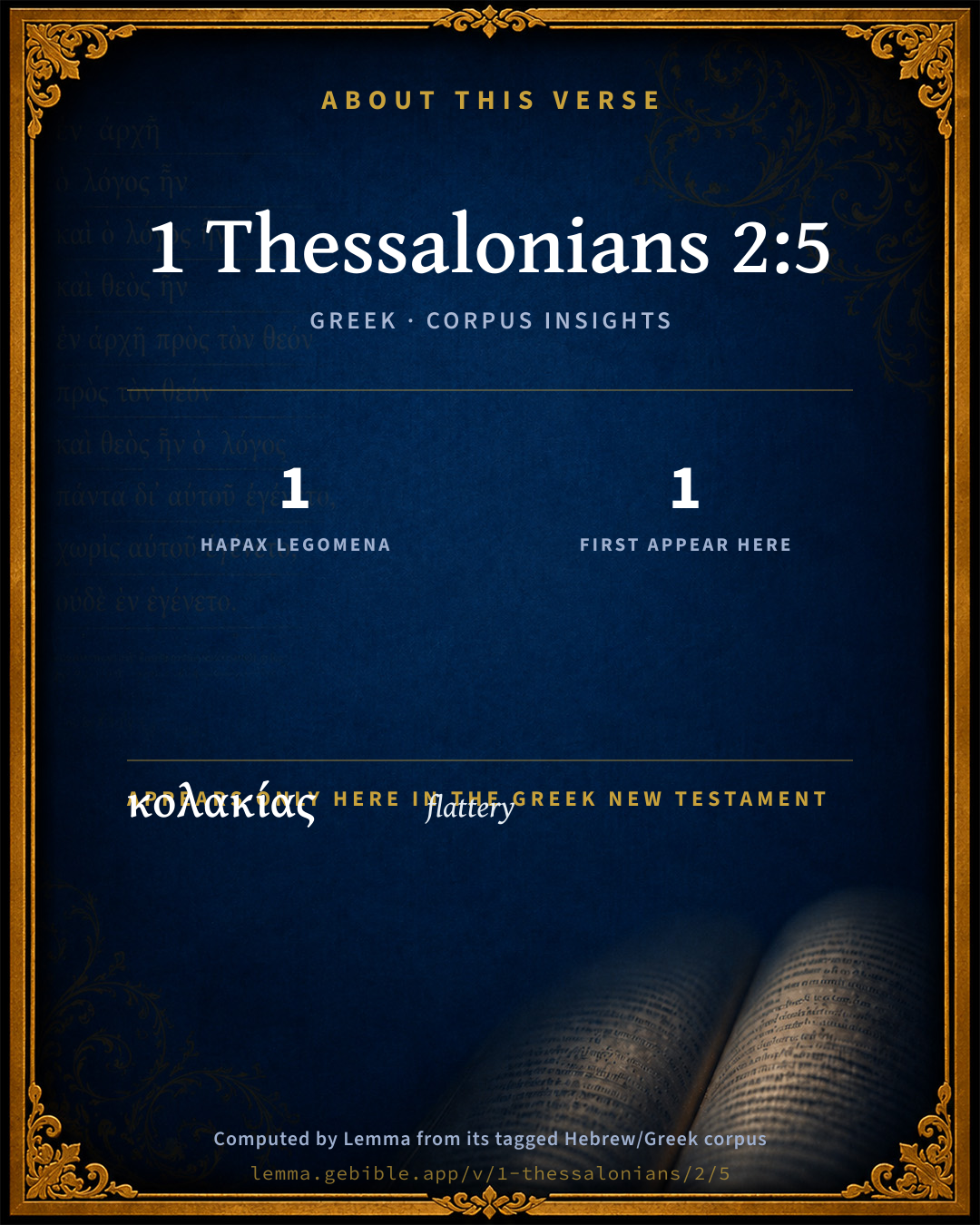
  • 1 hapax legomenon — only here in the Greek New Testament
  • 1 first appearance in the Greek New Testament
Full analysis ↓
Download a study sheet

One document with this verse’s original text, its word-by-word gloss line, the meaning frame, cross-references with their text, attributed commentary, and full source and license credits — printable, and it pastes into notes with its structure intact.

This verse Autodidact and up

Study sheet (.html) Plain text (.txt)

A passage Seminary Student

Up to 50 verses in one chapter. A passage sheet keeps up to 6 commentary sources and 12 cross-references per verse, in the order this page ranks them, and says so on the sheet whenever that leaves anything out. Ask for a single verse and you get the Autodidact verse sheet above.

Everything on this page stays free to read, with no account — the sheet is a download of what is already on screen, not access to it.

Want to remove ads? Support Godless Engineer
Compare translations 3

The same verse in 3 English versions, stacked beneath the original-language interlinear above. Click any original word for its lexicon entry.

Each is an independent rendering of the whole verse — the interlinear is not word-aligned to these translations.

Highlighted words mark where these versions differ — a whole-verse word diff, not a word-by-word alignment.

  • World English Bible Public Domain
    For neither were we at any time found using words of flattery, as you know, nor a cloak of covetousness (God is witness),
  • King James Version Public Domain
    For neither at any time used we flattering words, as ye know, nor a cloke of covetousness; God is witness:
  • unfoldingWord Literal Text CC BY-SA 4.0
    For we were not at that time in a word of flattery, just as you know, nor in a pretext of greed—God witness—

unfoldingWord Literal Text — © unfoldingWord, licensed CC BY-SA 4.0. Word-aligned USFM3 via Door43 (git.door43.org/unfoldingWord/en_ult).

Versions to compare (up to 4)

3 of 4 selected

Show all 19 translations

Every available English version of this verse, each an independent rendering of the whole verse.

  • World English Bible Public Domain
    For neither were we at any time found using words of flattery, as you know, nor a cloak of covetousness (God is witness),
  • Berean Standard Bible Public Domain
    As you know, we never used words of flattery or any pretext for greed. God is our witness!
  • Majority Standard Bible Public Domain
    As you know, we never used words of flattery or any pretext for greed. God is our witness!
  • King James Version Public Domain
    For neither at any time used we flattering words, as ye know, nor a cloke of covetousness; God is witness:
  • American Standard Version (1901) Public Domain
    For neither at any time were we found using words of flattery, as ye know, nor a cloak of covetousness, God is witness;
  • Revised Version (1885) Public Domain
    For neither at any time were we found using words of flattery, as ye know, nor a cloke of covetousness, God is witness;
  • Geneva Bible (1599) Public Domain
    Neither yet did we euer vse flattering wordes, as ye knowe, nor coloured couetousnes, God is recorde.
  • Douay-Rheims (1899) Public Domain
    For neither have we used, at any time, the speech of flattery, as you know; nor taken an occasion of covetousness, God is witness:
  • Young's Literal Translation Public Domain
    for at no time did we come with speech of flattery, (as ye have known,) nor in a pretext for covetousness, (God `is' witness!)
  • Literal Standard Version CC BY-SA 4.0
    for at no time did we come with speech of flattery (as you have known), nor in a pretext for covetousness (God [is] witness),
  • Unlocked Literal Bible CC BY-SA 4.0
    For we never used words of flattery, as you know, nor as an excuse to cover up greed— God is our witness.
  • unfoldingWord Literal Text CC BY-SA 4.0
    For we were not at that time in a word of flattery, just as you know, nor in a pretext of greed—God witness—
  • Darby Bible Public Domain
    For we have not at any time been [among you] with flattering discourse, even as ye know, nor with a pretext for covetousness, God [is] witness;
  • World Messianic Bible Public Domain
    For neither were we at any time found using words of flattery, as you know, nor a cloak of covetousness (God is witness),
  • Webster's Bible Public Domain
    For neither at any time used we flattering words, as ye know, nor a cloke of covetousness; God is witness:
  • Free Bible Version CC BY-SA 4.0
    As you know, we've never used flattering words. Nor were we covering up some greedy, selfish attitude—as God is our witness!
  • Bible in Basic English Public Domain
    For it is common knowledge among you that we never made use of smooth-sounding false words, and God is witness that at no time were we secretly desiring profit for ourselves,
  • Text-Critical English NT CC BY 4.0
    God is our witness that we never came with words of flattery or with a pretext for greed, as you well know.
  • Tyndale New Testament (1534) Public Domain
    Nether was oure conversacion at eny tyme with flatterynge wordes as ye well knowe nether in cloked coveteousnes God is recorde:

Literal Standard Version (2020), Covenant Press — licensed CC BY-SA 4.0. Text via the HelloAO Bible API (eBible.org). Unlocked Literal Bible (unfoldingWord) — licensed CC BY-SA 4.0. Text via the HelloAO Bible API (eBible.org). unfoldingWord Literal Text — © unfoldingWord, licensed CC BY-SA 4.0. Word-aligned USFM3 via Door43 (git.door43.org/unfoldingWord/en_ult). Free Bible Version, Dr. Jonathan Gallagher — licensed CC BY-SA 4.0. Text via the HelloAO Bible API (eBible.org).

Word by word

More ways to search: Search by grammar → Find every occurrence → Compare this word →

Practice this passage: Drill this verse → Learn its vocabulary →

κολακίας
kolakeía
G2850
“flattery”
Noun, Genitive, Singular, Feminine
Part of Speech
Noun
Case
Genitive
Number
Singular
Gender
Feminine
Full Thayer's Definition

Origin: from a derivative of kolax (a fawner)

TDNT: 16:37,5

1. flattery, flattering discourse
  1. οὔτε oúte G3777 “neither” Conjunction, Negative
  2. γάρ gár G1063 “for” Conjunction
  3. ποτε poté G4218 “formerly” Particle
  4. ἐν en G1722 “in” Preposition
  5. λόγῳ lógos G3056 “word” Noun, Dative, Singular, Masculine
  6. ἐγενήθημεν gínomai G1096 “to become” Verb, Aorist, Passive deponent, Indicative, 1st person, Plural
  7. καθὼς kathṓs G2531 “according as” Adverb
  8. οἴδατε eídō G1492 “to see” Verb, Perfect, Active, Indicative, 2nd person, Plural
  9. οὔτε oúte G3777 “neither” Conjunction, Negative
  10. ἐν en G1722 “in” Preposition
  11. προφάσει próphasis G4392 “pretext” Noun, Dative, Singular, Feminine
  12. πλεονεξίας pleonexía G4124 “covetousness” Noun, Genitive, Singular, Feminine
  13. θεὸς theós G2316 “God” Noun, Nominative, Singular, Masculine
  14. μάρτυς mártys G3144 “witness” Noun, Nominative, Singular, Masculine

About this verse

These counts appear in no published source. They are computed here, from the morphology-tagged text and Lemma’s own curated glosses. What Lemma adds →

15
words
13
distinct lemmas
Pauline Epistles
section

Notable vocabulary

1 hapax legomenon — a word that appears only here in the entire Greek New Testament:

  • κολακίας flattery G2850

First appearance in Scripture

This word makes its first canonical appearance in the Greek New Testament here:

  • κολακίας flattery G2850

Shared distinctive vocabulary

προφάσει pretext G4392 occurs in 6 verses of the Greek New Testament. Also found in:
Repetition

Words recur within this verse:

Cross-references

33

Topical passages linked to 1 Thessalonians 2:5 in the Treasury of Scripture Knowledge — connected by theme and wording, ordered by reader-vote popularity; previews shown in the World English Bible.

  • Romans 1:9 For God is my witness, whom I serve in my spirit in the Gospel of his Son, how unceasingly I make mention of you always in my prayers,
  • 2 Corinthians 12:17 Did I take advantage of you by anyone of them whom I have sent to you?
  • Acts 20:33 I coveted no one's silver, or gold, or clothing.
  • Galatians 1:20 Now about the things which I write to you, behold, before God, I'm not lying.
  • 2 Peter 2:3 In covetousness they will exploit you with deceptive words: whose sentence now from of old doesn't linger, and their destruction will not slumber.
  • 2 Corinthians 7:2 Open your hearts to us. We wronged no one. We corrupted no one. We took advantage of no one.
  • 1 Thessalonians 2:10 You are witnesses with God, how holy, righteously, and blamelessly we behaved ourselves toward you who believe.
  • Titus 1:7 For the overseer must be blameless, as God's steward; not self-pleasing, not easily angered, not given to wine, not violent, not greedy for dishonest gain;
  • 1 Peter 5:2 Shepherd the flock of God which is among you, exercising the oversight, not under compulsion, but voluntarily, not for dishonest gain, but willingly;
  • 2 Peter 2:14–15 having eyes full of adultery, and who can't cease from sin; enticing unsettled souls; having a heart trained in greed; children of cursing;
  • Revelation 18:12–13 merchandise of gold, silver, precious stones, pearls, fine linen, purple, silk, scarlet, all expensive wood, every vessel of ivory, every vessel made of most precious wood, and of brass, and iron, and marble;
  • Job 17:5 He who denounces his friends for a prey, Even the eyes of his children shall fail.
  • Psalms 12:2–3 Everyone lies to his neighbor. They speak with flattering lips, and with a double heart.
  • Proverbs 20:19 He who goes about as a tale-bearer reveals secrets; Therefore don't keep company with him who opens wide his lips.
  • Proverbs 28:23 One who rebukes a man will afterward find more favor Than one who flatters with the tongue.
  • Isaiah 30:10 who tell the seers, "Don't see;" and to the prophets, "Don't prophesy to us right things, speak to us smooth things, prophesy deceits,
  • Isaiah 56:11 Yes, the dogs are greedy, they can never have enough; and these are shepherds who can't understand: they have all turned to their own way, each one to his gain, from every quarter.
  • Jeremiah 6:13 For from the least of them even to the greatest of them everyone is given to covetousness; and from the prophet even to the priest everyone deals falsely.
  • Jeremiah 8:10 Therefore will I give their wives to others, and their fields to those who shall possess them: for everyone from the least even to the greatest is given to covetousness; from the prophet even to the priest every one deals falsely.
  • Micah 3:5 Thus says Yahweh concerning the prophets who lead my people astray; for those who feed their teeth, they proclaim, "Peace!" and whoever doesn't provide for their mouths, they prepare war against him:
  • Malachi 1:10 "Oh that there were one among you who would shut the doors, that you might not kindle fire on my altar in vain! I have no pleasure in you," says Yahweh of hosts, "neither will I accept an offering at your hand.
  • Matthew 22:16 They sent their disciples to him, along with the Herodians, saying, "Teacher, we know that you are honest, and teach the way of God in truth, no matter who you teach, for you aren't partial to anyone.
  • Matthew 23:13 "Woe to you, scribes and Pharisees, hypocrites! For you devour widows' houses, and as a pretense you make long prayers. Therefore you will receive greater condemnation.
  • Romans 9:1 I tell the truth in Christ. I am not lying, my conscience testifying with me in the Holy Spirit,
  • Romans 16:18 For those who are such don't serve our Lord, Jesus Christ, but their own belly; and by their smooth and flattering speech, they deceive the hearts of the innocent.
  • 2 Corinthians 2:17 For we are not as so many, peddling the word of God. But as of sincerity, but as of God, in the sight of God, we speak in Christ.
  • 2 Corinthians 4:2 But we have renounced the hidden things of shame, not walking in craftiness, nor handling the word of God deceitfully; but by the manifestation of the truth commending ourselves to every man's conscience in the sight of God.
  • 1 Timothy 3:3 not a drinker, not violent, not greedy for money, but gentle, not quarrelsome, not covetous;
  • 1 Timothy 3:8 Deacons, in the same way, must be reverent, not double-tongued, not addicted to much wine, not greedy for money;
  • 2 Peter 2:18 For, uttering great swelling words of emptiness, they entice in the lusts of the flesh, by licentiousness, those who are indeed escaping from those who live in error;
  • Job 32:21–22 Please don't let me respect any man's person, Neither will I give flattering titles to any man.
  • Proverbs 26:28 A lying tongue hates those it hurts; And a flattering mouth works ruin.
  • Jude 1:11 Woe to them! For they went in the way of Cain, and ran riotously in the error of Balaam for hire, and perished in Korah's rebellion.

Cross-references courtesy of OpenBible.info (CC BY 4.0).

Commentary

Notes on 1 Thessalonians 2:5 from classic Christian and Jewish commentators (each source and its license shown beneath its notes). The classic Christian expositions comment on the surrounding passage and are grouped to its opening verse, so a note may address several verses; the Jewish commentaries on the Tanakh (Rashi and others) are per-verse, so they appear only where the commentator wrote on this verse.

Lemma curates 59 commentaries, every one of them public domain or Creative Commons licensed, each selected and text-cleaned for this edition rather than reprinted as found. About our sources →

Tyndale Open Study Notes

Tyndale Open Resources

2:5 Flattery was a common means of getting financial gain from others. Paul denies that he flattered the Thessalonians in order to be given money. He again calls both the Thessalonians and God as witnesses (cp. 2:10; Deut 19:15; 2 Cor 13:1; 1 Tim 5:19).

Tyndale Open Study Notes — © Tyndale Open Resources, licensed CC BY-SA 4.0. Text via the HelloAO Bible API.

Bengel's Gnomon

Johann Albrecht Bengel

1Th 2:5. Ἐν λόγῳ κολακείας, in flattering words) The antithesis is in 1Th 2:7-8; even as a cloke of covetousness has its antithesis in 1Th 2:9; and the word glory, 1Th 2:6, has its antithesis in 1Th 2:10.—κολακείας, of flattery) which they chiefly use who are anxious to please men.—καθὼς οἴδατε—Θεὸς μάρτυς, even as ye know—God is witness) These two clauses [neither—ye know; nor—witness] correspond to each other, just as the double confirmation of the third member of the sentence [nor of men sought we glory], which is placed in the next verse, follows in the same 1Th 2:10. He appeals to men, as the witnesses of a matter generally known; to God, as the witness of a matter which is concealed in the heart; to men and God, as the witnesses of a matter in part generally known, and partly concealed.—προφάσει) with the specious pretext (cloke), under which we might cover avarice.

Bengel's Gnomon of the New Testament — English translation (T&T Clark, Edinburgh, 1860) — public domain. Text from a community e-Sword module.

Meyer's Critical & Exegetical Commentary

Heinrich August Wilhelm Meyer

1Th_2:5. Proof of the habitual character of the gospel preaching by an appeal to the character which it specially had in Thessalonica.

γάρ] refers to οὐχ ὡς ἀνθρώποις ἀρέσκοντες ἀλλὰ τῷ Θεῷ.

ἐγενήθημεν ἐν] we proved ourselves in, or we appeared as of such a character. The passive form ἐγενήθημεν (see on 1Th_1:5) denotes here also that the mode of appearance mentioned lay in the plan of God, was something appointed by Him.

κολακεία] comp. Theophrast. charact. c. 1 Thessalonians 2 : Τὴν δὲ κολακείαν ὑπολάβοι ἄν τις ὁμιλίαν αἰσχρὰν εἶναι, συμφέρουσαν δὲ τῷ κολακεύοντι. The word is not again found in the N. T. ἐν λόγῳ κολακείας cannot denote in a rumour (report) of flattery, according to which the sense would be: for never has one blamed us of flattery (so Heinsius, Hammond, Clericus, Michaelis). Against this is the context, for the point here is not what others said of the apostles conduct, but what it was in reality. Also it is inadmissible to take ἐν λόγῳ κολακείας, according to the analogy of the Hebrew דָּבָר with the following substantive, as a circumlocution for ἐν κολακείᾳ (so Pelt, who, however, when he renders the clause: in assentationis crimen incurri, involuntarily falls into the afore-mentioned explanation). For(1) the Hebrew use of דָּבָר is foreign to the N. T.; (2) it is overlooked that λόγος κολακείας finds in the context its full import and reference, inasmuch as the apostle, in complete conformity to the contents of the preceding verses (comp. λαλῆσαι 1Th_2:2; παράκλησις, 1Th_2:3; λαλοῦμεν, 1Th_2:4), in the beginning of 1Th_2:5 still speaks of a quality of his discourse, and only in 1Th_2:6 passes to describe his conduct in Thessalonica in general. Accordingly, the apostle denies that he appeared in Thessalonica with a mode of speech whose nature or contents was flattery (Schott falsely takes κολακείας as the genitive of origin), or that he showed himself infected with it. In Thessalonica, for this limitation of οὐ … ποτέ is demanded by the accessory appeal to the actual knowledge of the readers

καθὼς οἴδατε, as ye know.

οὔτε ἐν προφάσει πλεονεξίας] sc. ἐγενήθημεν. πρόφασις, from προφαίνω (not from πρόφημι), denotes that which one puts on for appearance, and with the definite design to colour or to cloak something else It therefore denotes pretext, the outward show, and has its contrast (comp. Php_1:18) in ἀλήθεια. See proofs in Raphel, Polyb. p. 354. The meaning accordingly is: we appeared not in a pretext for covetousness, i.e. our gospel preaching was not of this nature, that it was only a pretext or cloak to conceal our proper design, namely, covetousness. Without linguistic reason, and against the context, Heinsius and Hammond understand πρόφασις as accusatio; Pelt, weakening the idea, and not exhausting the fundamental import of πρόφασις (see below), nunquam ostendi avaritiam; Wolf also unsatisfactorily considers πρόφασις as equivalent to species; similarly Ewald, even in an appearance of covetousness; for the emphatic even (by which that interpretation is at all suitable, and by means of which there would be a reference to a supplementary clause, to say nothing of its being really covetousness) is interpolated, and the question at issue is not whether Paul and his associates avoided the appearance of πλεονεξία, but whether they actually kept themselves at a distance from πλεονεξία. Lastly, erroneously Clericus (so also the Vulg.): in occasione avaritiae, ita ut velit apostolus se nullam unquam occasionem praebuisse, ob quam posset insimulari avaritiae.

Θεὸς μάρτυς] comp. Rom_1:9; Php_1:8. Paul having just now appealed to the testimony of his readers that he was removed from κολακεία, now takes God for witness that the motive of his behaviour was not πλεονεξία. Naturally and rightly; for man can only judge of the character of an action when externally manifested, but God only knows the internal motives of acting.

Meyer — Critical and Exegetical Commentary on the New Testament — English translation by Peter Christie, edited by Frederick Crombie (T&T Clark, 1880) — public domain. Text from a community e-Sword module.

Expositor's Greek Testament

ed. W. Robertson Nicoll

1Th 2:5 . “Never did we resort to words of flattery” (in order to gain some private end); cf. Arist., Eth. Nik. , iv. 6. As self-interest is more subtle than the desire to please people (which may be one form of self-interest), the appeal is changed significantly from κ . ο . to θεὸς μάρτυς (Rom 1:9 ): “auaritia aut ambitio, duo sunt isti fontes ex quibus manat totius ministerii corruptio” (Calvin). Cf. Introduction, § 1 on θεός and ὁ θεός , cf. Kattenbusch, das Apost. Symbol , ii. 515 f.

The Expositor's Greek Testament, edited by W. Robertson Nicoll (1897–1910) — public domain. Text from a community e-Sword module.

Cambridge Greek Testament for Schools and Colleges

5. B precedes the later codd. in spelling κολακειας—its favourite itacism (-ει-). Etymologically -ει- is correct, the noun being derived from κολακευω: cf. βασιλευω, βασιλεια; see Winer-Schmiedel Grammatik, § 1Th 2:13 c, for this point of orthography.

The omission of εν before προφασει is based on Bאc 17 39 47, against all other witnesses—an attestation scarcely decisive. The shorter reading might be preferred, intrinsically, as the more difficult; on the other hand, as Weiss observes, the familiarity of the bare (adverbial) dative προφασει (pretendedly: cf. Php 1:18) would tend to the dropping of the preposition.

5. οὔτε γάρ ποτε ἐν λόγῳ κολακίας ἐγενήθημεν. For neither at any time did we fall into the use of speech of flattery—sermone assentatorio usi sumus (Beza); were we found using (employed in, Lightfoot) words of flattery (R.V.)—but “found” suggests detection, which is not in question. For γίνομαι ἐν, versari in, to be engaged in, see Liddell and Scott, s. 1 Thessalonians 2 :2 Thessalonians 3 b; and cf. 1Ti 2:14; Luk 22:44. The aorist, pointed by ποτέ, implies falling into or resorting to the practice in question; cf. note on ἐπαρρησιασάμεθα, 1Th 2:2. Bornemann notices how the use of the paraphrastic γίνομαι, so frequent in this context, enables the writer to combine the grammatically heterogeneous predicates of 1Th 2:5-6.

Κολακίας (classical spelling, κολακεία, from κολακεύω) is genitive of content rather than characteristic—“speech that flattered you” (cf. 1Co 12:8; 2Co 6:7, for similar genitives with λόγος). This term, hap. leg. in N.T., always implies sinister, self-interested compliment; Aristotle (Eth. Nic. iv. 12) defines the κόλαξ as ὁ ὅπως ὠφέλειά τις αὑτῷ γίγνηται εἰς χρήματα κ. ὅσα διὰ χρημάτων (sc. λέγων): accordingly the λόγος κολακίας would serve as a πρόφασις πλεονεξίας. The slander against the missionaries on this particular head is contradicted more distinctly in 1Th 2:10-12.

οὔτε (ἐγενήθημεν ἐν) προφάσει πλεονεξίας, nor (did we make use of) a cloak of covetousness—i.e. any pretext, whether in the shape of flattering speech or otherwise, serving to hide a selfish purpose. “Πρόφασις (from προφαίνω) signifies generally the ostensible reason for which a thing is done; sometimes in a good sense (Thuc. i. 23, vi. 6, ἀληθεστάτη πρόφασις), but generally otherwise, the false or pretended reason as opposed to the true” (Lightfoot): hence in Php 1:18 προφάσει is contrasted with ἐν ἀληθείᾳ; cf. Luk 20:47. Πλεονεξία means greed of any kind—oftenest, but not always, for money; it is the spirit of self-aggrandizement, selfishness as a ruling motive: see Trench’s Synon. § 24; and cf. Col 3:5; Eph 5:3; 2Co 9:5; Luk 12:15; also πλεονεκτέω in 1Th 4:6, and note; 2Co 12:17 f.

As to the λόγος κολακίας the readers were good judges (καθὼς οἴδατε: see note on 1Th 1:5); but “God” is cited as “witness” to the absence of πρόφ. πλεονεξίας, since this concerns “the hidden man of the heart” (see notes on 1Th 2:4): θεὸς (anarthrous) μάρτυς, (there is) God (as) witness; cf. Rom 1:9; Php 1:8. For the twofold sin repudiated, cf. Psa 12:2, “A flattering lip and a double heart.”

Cambridge Greek Testament for Schools and Colleges (Cambridge University Press, 1896; 21 vols, various authors incl. Carr, Maclear, Plummer, Farrar, Lumby, Moule, M. R. James, Simcox) — public domain. Text from a community e-Sword module.

Jamieson, Fausset & Brown

Robert Jamieson, A. R. Fausset & David Brown

used we flattering words--literally, "become (that is, have we been found) in (the use of) language of flattery"; the resource of those who try to "please men."

as ye know--"Ye know" as to whether I flattered you; as to "covetousness," GOD, the Judge of the heart, alone can be "my witness."

cloak of--that is, any specious guise under which I might cloak "covetousness."

Jamieson, Fausset & Brown — Commentary Critical and Explanatory on the Whole Bible (1871) — public domain (CC PDM 1.0). Text via the HelloAO Bible API.

Adam Clarke's Commentary

Verse 5. Flattering words] Though we proclaimed the Gospel or glad tidings, yet we showed that without holiness none should see the Lord.

Ye know] That while we preached the whole Gospel we never gave any countenance to sin.

For a cloak of covetousness] We did not seek temporal emolument; nor did we preach the Gospel for a cloak to our covetousness: God is witness that we did not; we sought you, not yours. Hear this, ye that preach the Gospel! Can ye call God to witness that in preaching it ye have no end in view by your ministry but his glory in the salvation of souls? Or do ye enter into the priesthood for a morsel of bread, or for what is ominously and impiously called a living, a benefice? In better days your place and office were called a cure of souls; what care have you for the souls of them by whose labours you are in general more than sufficiently supported? Is it your study, your earnest labour, to bring sinners to God; to preach among your heathen parishioners the unsearchable riches of Christ?

But I should speak to the thousands who have no parishes, but who have their chapels, their congregations, pew and seat rents, c., c. Is it for the sake of these that ye have entered or continue in the Gospel ministry? Is God witness that, in all these things, ye have no cloak of covetousness? Happy is the man who can say so, whether he has the provision which the law of the land allows him, or whether he lives on the free-will offerings of the people.

The faithful labourer is worthy of his hire for the ox that treads out the corn should not be muzzled and they that preach the Gospel should live, not riot, by the Gospel. But wo to that man who enters into the labour for the sake of the hire! he knows not Christ; and how can he preach him?

Adam Clarke's Commentary on the Bible (1810–1826) — public domain. Text from a community e-Sword/MySword module.

John Calvin's Commentaries

5 For neither have we ever. It is not without good reason that he repeats it so frequently, that the Thessalonians knew that what he states is true. For there is not a surer attestation, than the experience of those with whom we speak. And this was of the greatest importance to them, because Paul relates with what integrity he had conducted himself, with no other intention, than that his doctrine may have the greater respect, for the building up of their faith. It is, however, a confirmation of the foregoing statement, for he that is desirous to please men, must of necessity stoop shamefully to flattery, while he that is intent upon duty with an earnest and upright disposition, will keep at a distance from all appearance of flattery.

When he adds, nor for an occasion of covetousness, he means that he had not, in teaching among them, been in quest of anything in the way of personal gain. Πρόφασις is employed by the Greeks to mean both occasion and pretext, but the former signification suits better with the passage, so as to be, as it were, a trap. “I have not abused the gospel so as to make it an occasion of catching at gain.” As, however, the malice of men has so many winding retreats, that avarice and ambition frequently lie concealed, he on this account calls God to witness. Now, he makes mention here of two vices, from which he declares himself to be exempt, and, in doing so, teaches that the servants of Christ should stand aloof from them. Thus, if we would distinguish the genuine servants of Christ from those that are pretended and spurious, they must be tried according to this rule, and every one that would serve Christ aright must also conform his aims and his actions to the same rule. For where avarice and ambition reign, innumerable corruptions follow, and the whole man passes away into vanity, for these are the two sources from which the corruption of the whole ministry takes its rise.

John Calvin's Commentaries (1540-1563) — public domain. Text from the Calvin Translation Society English edition (1840s-50s) via the Christian Classics Ethereal Library (ccel.org). Calvin's coverage is partial (roughly two-thirds of the Bible); uncommented books and verses are honest gaps, never fabricated. The 19th-century editor's footnotes and remarks are omitted so the notes are faithfully Calvin's own voice.

Ellicott's Commentary for English Readers

(5) At any time.—Not only during the stay at Thessalonica, but neither at Thessalonica nor elsewhere, as the next verse shows. But as the Thessalonians can only be appealed to as evidence for their own experience, the writers therefore call God Himself to witness. At the same time, the absence of flattering words was a thing of which human witnesses could judge; the freedom from covetous designs was known to God alone.

Cloke of covetousness—i.e., some specious pretext, under cover of which we might gain a worldly advantage; so (though the Greek word is different) 1Pe_2:16, “a cloke of maliciousness.”

A Bible Commentary for English Readers, edited by Charles John Ellicott (1878–1897) — public domain. Text from a community e-Sword module.

The Cambridge Bible for Schools and Colleges

gen. ed. J. J. S. Perowne

5. For neither at any time used we flattering words] were we found using words of flattery (R. V.: same verb as in 1Th_2:1, “found vain”); or, did we fall into the use of flattering speech. “Found” might suggest detection, which is not in the Apostle’s mind. Lit., word of flattery, referring to the tenor and general style of the apostles’ speech. He adds a third time (see note on 1Th_2:1) “as ye know.” St Paul, as his friends well knew, was not one to

“crook the pregnant hinges of the knee,

Where thrift may follow fawning.”

In repudiating the cloak of covetousness he appeals to “God” as “witness” (comp. Rom_1:9, “God is my witness, whom I serve in my spirit in the gospel of His Son;” also Rom_2:15, Rom_9:1),—“God, Who proveth our hearts” (1Th_2:4). The “cloak” signifies the pretext of an affected self-devotion, such as might be used to conceal the “covetousness” of a selfish heart. “God is witness,” he says, “that no secret avarice was hidden behind our zeal for your salvation.”

The Greek word for “covetousness” denotes greed of any kind,—oftenest, but not always or necessarily, for money; it is the spirit of self-aggrandisement, selfishness as a ruling passion. (Comp. the note on “defraud,” ch. 1Th_4:6.) Such a motive in the servant of God would constitute the “uncleanness” denied in 1Th_2:3.

This verse gives double evidence of the pure zeal for God professed in 1Th_2:3-4—the one outward and of the lips, the other inward and known only to God in the heart. Contrast the opposite description of Psa_12:2 : “A flattering lip, and a double heart.”

The Cambridge Bible for Schools and Colleges (gen. ed. J. J. S. Perowne; Cambridge University Press, 1878–1918) — public domain. Text from a community e-Sword module.

John Gill's Exposition

For neither at any time used we flattering words,.... To introduce them into the affections, and gain the esteem and good will of men; they did not in their ministry deliver such things as flattered men with a good opinion of themselves: they did not preach up the purity of human nature, but on the contrary the doctrine of original sin, the imputation of Adam's transgression to his posterity, and the corruption of all human nature; they asserted the universal pollution of it, of all men, and of all the powers and faculties of their souls, that they are all under the power and dominion of sin, are involved in the guilt of it, and are all guilty before God, and liable to everlasting wrath and punishment; and that unless they repented of their sins and believed in Christ, they would perish eternally; thus they dealt roundly and freely with men's consciences, and plainly, openly, and faithfully told them their case as it was: nor did they cry up the power of man's free will, which would have been grateful to Jews and Gentiles; but they declared the reverse, they asserted the weakness and impotency of man, to anything that is spiritually good; and represented him as a weak and strengthless creature, and unable to do anything, even to think a good thought of himself; and ascribed all that a man is, or has, or does, that is good, to the grace and power of God, who works in him both to will and to do: nor did they plead for the sufficiency of man's righteousness to justify him before God, a doctrine very pleasing to human nature; but, on the contrary, they gave out that there was none righteous, no, not one of the sons of Adam, in and of themselves, or by virtue of any righteousness of their own; so far from it that they were full of all unrighteousness, and were not capable of working out a righteousness, or of attaining to the righteousness of the law; that what they did pretend to was not a justifying righteousness, and would give no right and title to eternal glory; and that the righteousness of Christ was the only righteousness, by which a man could be justified from all things, and in which he could be found safe. They did not blend and mix their doctrine to suit with the tastes of different men, but with all sincerity and plainness preached the truth, as it is in Jesus; they did not connive at the sins of men, cry Peace, Peace, when there was none, or sow pillows under their armholes, or promise them life, though they should not return from their wicked way; but they with great freedom inveighed against the sins of men, and exhorted them to repentance and reformation, as well as to faith in Christ for pardon and righteousness; nor did they wink at the sins of professors, or of one another, the Apostle Paul withstood Peter to the face because he was to be blamed; and when they praised men for their gifts and graces, and the exercise of them, they took care to ascribe them to the grace of God, and give him the glory, and prevent men from boasting in themselves; in short, they acted the reverse of the false teachers, who had men's persons in admiration because of advantage, and by good words and fair speeches deceived the hearts of the simple; but so did not the apostles of Christ, no, never, not "at any time": when they first came to Thessalonica during their stay there, either in public or in private: and though this was true of any other time and place, yet here must be confined to this, since the apostle appeals to this church for the truth of what he said,

as ye know; for flattering words may be discerned; a flatterer is known by his words; though in general such is the weakness of human nature, that men love to be flattered, though they know they are:

nor a cloak of covetousness; or "an occasion of" it, they did not take the opportunity or advantage by the ministry of the word, to indulge a covetous disposition, or to amass wealth and riches to themselves; or an "excuse" for covetousness, which covetous men are never at a loss to make, always pretending one thing or another to hide and cover their evil; but the apostles made no excuses, nor used any cloak, nor needed any to cover their covetousness, because they had not the thing; they did not pretend one thing and mean another; they did not, as the false apostles did, pretend to serve Christ, preach his Gospel, seek the glory of God and the good of souls, and mean themselves, and design their own worldly advantage; they did not make these a "pretence" for covetousness, they sincerely served Christ, faithfully preached his Gospel, truly sought the glory of God, and were heartily concerned for the good of souls without any mercenary and selfish views; for the truth of which they could appeal to the heart searching and rein-trying God, as the apostle here does, saying,

God is witness; which is properly an oath, a solemn appeal to God; for since covetousness is an internal and secret sin, and may be so coloured and disguised as not easily to be discerned, as flattering words may, the apostle therefore calls God to witness the truth of what he had said.

John Gill's Exposition of the Whole Bible (1746–1763) — public domain (CC PDM 1.0). Text via the HelloAO Bible API.

Trapp's Complete Commentary

John Trapp

5 For neither at any time used we flattering words, as ye know, nor a cloke of covetousness; God is witness:

Ver. 5. For neither at any time] Sinisterity of ends is here opposed to sincerity in God’s works. And flattery, covetousness, ambition declared to be the fountains of insincerity.

Nor a cloak of covetousness] This sin goes usually cloaked with the name and pretence of good husbandry. The ordinary language of the world is, "He is a man somewhat with the hardest, a little with the nearest, a little too much for the world, but yet a marvellously honest, a wondrously good man." Covetousness is seldom without feigned words, 2Pe 2:3, to hide it from others without, or subtle thoughts and evasions to blind fold the conscience within. Alcibiades embroidered a curtain with lions and eagles to cover his pictures of owls and apes; so all sin hath its vizard; neither is there any wool so coarse but will take some colour.

God is witness] That he flattered not; he reports himself to them, that he coveted not; he appeals to God, who is not mocked with masks or specious pretences, but will pull off the vizard, wash off the covetous man’s varnish with rivers of brimstone. Religion, as it is the best armour, so it is the worst cloak: and will serve self-seekers, as the disguise Ahab put on and perished, 1Ki 22:30. The covetousness of the court of Rome was anciently muttered forth in that saying, Curia Romana non petit ovem siue lana; and again, In parabola ovis, capras suas quaerunt. This the poor people were ever sensible of; but dare say little. There is a story of Walter Mapes (sometime archdeacon of Oxford), who relating the gross simony {a} of the pope for confirming the election of Reinold, bastard son to Jocelin, bishop of Sarum, into the see of Bath, concludeth his narration thus, Sit Domina tamen materque nostra Roma baculus in aqua fractus; et absit credere quae vidimus, i.e. Nevertheless let our lady and mother of Rome be as a staff in the water, that seems only to be broken; and far be it from us to believe our own eyes. They dared not see, or at least say what they saw; but now all is laid open, and shall be much more at the last day, when (as at a great fair) all fardels {b} shall be uncorded, and all packs opened.

{a} The act or practice of buying or selling ecclesiastical preferments, benefices, or emoluments; traffic in sacred things. ŒD

{b} A bundle, a little pack; a parcel. ŒD

John Trapp, A Commentary or Exposition upon All the Books of the Old and New Testament (1647–1656) — public domain. Text from a community e-Sword module.

Albert Barnes' Notes on the Bible

For neither at any time used we flattering words - see the Job 31:21-22 notes; and on 2Co 2:17 note. The word here rendered “flattering” - κολακείας kolakeias - occurs nowhere else in the New Testament. The meaning is, that the apostle did not deal in the language of adulation; he did not praise them for their beauty, wealth, talent, or accomplishments, and conceal from them the painful truths about their guilt and danger. He stated simple truth - not refusing to commend people if truth would admit of it, and never hesitating to declare his honest convictions about their guilt and danger. One of the principal arts of the deceiver on all subjects is flattery; and Paul says, that when preaching to the Thessalonians he had carefully avoided it. He now appeals to that fact as a proof of his own integrity. They knew that he had been faithful to their souls.

Nor a cloke of covetousness - The word rendered “cloke” here - πρόφασει prophasei - means, properly, “what is shown or appears before any one;” i. e., “show, pretence, pretext,” put forth in order to cover one’s real intent; Mat 22:14; Mar 12:40; Luk 20:47. The meaning here is, that he did not put on a pretence or appearance of piety for the sake of promoting the schemes of covetousness. The evidence of that was not only what they observed of the general spirit of the apostle, but also the fact that when with them he had actually labored with his own hands for a support; 1Th 2:9. It is obvious that there were those there, as sometimes there are now, who, under the pretence of great zeal for religion, were really seeking wealth, and it is possible that it may have been alleged against Paul and his fellow-laborers that they were such persons.

God is witness - This is a solemn appeal to God for the truth of what he had said. He refers not only to their own observation, but he calls God himself to witness his sincerity. God knew the truth in the case. There could have been no imposing on him; and the appeal, therefore, is to one who was intimately acquainted with the truth. Learn hence:

(1) That it is right, on important occasions, to appeal to God for the truth of what we say.

(2) We should always so live that we can properly make such an appeal to him.

Albert Barnes' Notes on the Bible (1834–1885) — public domain. Text from a community e-Sword/MySword module.

Haydock's Catholic Bible Commentary

Nor taken an occasion of covetousness. Not so as to make the gospel a cloak for gain-sake. (Witham)

George Leo Haydock (1774–1849), Haydock's Catholic Family Bible and Commentary, 1859 edition — public domain. Excludes Psalms (Douay-Rheims chapter numbering differs from Protestant) and Deuterocanonical books (Catholic canon only).

Matthew Poole's English Annotations

In the former verses the apostle had asserted his integrity more generally; here, and in the next verse, he instanceth in particulars. He vindicates his ministry from the guilt of three vices which too often attend it; flattery, covetousness, and vain-glory.

For neither at any time used we flattering words: first, flattery, εν λογω κολακειας; or, we were not, i.e. conversant, in a word of flattery, as in the Greek; our word was not a word of flattery, as if we sought to please men. When we ascribe to men good things that they have not, or above what they have, or when we applaud or extenuate the evil that is in them, we flatter them. This is reproved often in the false prophets of the Old Testament, Isa 30:10; Eze 13:10,18; and in the false teachers in the New. The flattery of ministers is, their preaching of smooth things, rather to please than profit; when they avoid just reproofs, and searching truths, and close applications, that they may not displease; and affect wisdom of words, and rhetorical discourses, that they may please: when they either conceal some part of truth, or pervert it, that people may think their doings better than they are, or their state better than it is.

As ye know: their words in preaching being an overt act, they themselves could judge of, and therefore the apostle doth appeal to their own knowledge in that.

Nor a cloak of covetousness, God is witness: in what they could not know, which was their inward aims and designs, he appeals to God, which is a form of swearing; and in all oaths men solemnly do concern God therein; the same in effect that is called protesting, 1Co 15:31. And that wherein he thus appeals is, that he had no covetous design in his ministry, which he calls a cloak of covetousness; which lies either in undue withholding what we have, or inordinate desire of more. The latter is here meant, as the Greek word imports. And the word cloak is a metaphor as the word is translated here, and Joh 15:22; as that covers the inner garments, so when bad designs are covered with specious pretexts, this we call a cloak. The word in the text, εν προθασει πλεονεζιας, is often used, Mat 23:14; Mar 12:40; Luk 20:47, and sometimes rendered occasion, but for the most part pretence, and so to be understood here; and in heathen authors sometimes used for accusation. And this is contrary to what is said of false prophets, 2Pe 2:3; Through covetousness shall they with feigned words make merchandise of you.

Matthew Poole's English Annotations on the Holy Bible (1683–1685) — public domain. Text from a community e-Sword/MySword module.

Whedon's Commentary on the Bible

Daniel D. Whedon

5. Flattering words—This solemn responsibility to God alone is attested by our words. Cloak, or pretext, covering a real covetousness, or purpose to make money by you.

God is witness—And the sincerity of this appeal to God you know as well as we.

Daniel D. Whedon (gen. ed.), Commentary on the Old and New Testaments (1874–1909) — public domain. Text from a community e-Sword module.

The Pulpit Commentary

For; confirming the statement that the preachers of the gospel did not seek to please men, but God. Neither at any time used we flattering words; endeavoring to gain you by flattery and praise; we did not pander to your feelings; we did not soften the demands of the gospel. As ye know, nor a cloak or pretextof covetousness. We did not use the gospel as a pretext to mask our real motive, which was covetousness, pretending to seek your spiritual good, whereas in reality we sought our own advantage. Paul could with perfect confidence appeal to his converts, and say, "I have coveted no man"s silver, or gold, or apparel". (Act_20:33) He was free from all sinister motives. "He did not use words such as flattery uses, or pretexts such as covetousness" (Jowett). God is witness. Paul appeals to the Thessalonians themselves that he had not used flattering words; so now he appeals to God that the motive of his conduct was not covetousness. Men can judge the external conduct, they can hear the flattering words; but God only can know the motive of action he only can discern the covetousness.

HOMILETICS.

Vers. 5, 6.

Motives of action,

Man judges us by our outward conduct; God by our internal disposition. The apostle appeals to God as a witness of the purity of his motives. He asserts that he was free from all desire of personal fame or interest. Can we make the same appeal and the same assertion?

1. Are we influenced by unworthy motives? Is covetousness, the desire of fame, or the love of power, the mainspring of our life?

2. Or are we influenced by worthy motives? Do we seek to please, not man, but God? Is the glory of God in Christ Jesus the chief end of our life and actions?

Vers. 5-8.

The spirit and method of apostolic labor.

The apostle sets it forth under two aspects.

I NEGATIVELY. "For neither at any time were we found using words of flattery, as ye know, nor a cloak of covetousness, God is witness; nor seeking glory of men.

1. The apostle and his colleagues did not attempt to win their way by flattery, either by setting forth high views of human nature, or by holding men"s persons in admiration for the sake of advantage; for their gospel tended rather to humble man and subdue his pride. Flattery is a gross dishonor both to God and man, for it implies untruthfulness, and may become fatal in its results to easily deluded sinners. The apostle appealed to the Thessalonians in confirmation of his statement.

2. They did not use their position as a cloak of covetousness, as God could testify, who knows the heart. The apostle might say now, as he afterwards said to the elders of Ephesus, "I coveted no man"s silver, nor gold, nor apparel." The false teachers were chargeable with cove tousness, for "through covetousness shall they with feigned words make merchandise of 2Pe_2:1, 2Pe_2:3. How emphatically the apostle insists upon ministers of the gospel being free from this vice! "Not greed, of filthy lucre.

3. They were not fond of vain-glory. "Nor seeking glory of men, neither from you, nor from others, when we might have been burdensome as apostles of Christ," or might have stood on their dignity as apostles of Christ. There is no allusion here to his claim to ministerial support, but rather to the position of magisterial dignity he might have assumed, with all its pomp and peremptoriness and sternness. His spirit at Thessalonica was not that of lordship over God"s heritage.

II POSITIVELY. "But we were gentle in the midst of you, as when a nurse cherisheth her own children.

1. They were gentle in their intercourse with their converts; unassuming and mild, with no haughty or imperious airs, challenging honor and homage. They acted in the very spirit of the good Shepherd. Long afterwards the apostle could remind one of his present colleagues that "the servant of the Lord must not strive, but be gentle to all men, apt to teach, patient, in meekness instructing those that oppose themselves". (2Ti_2:24-26) This gentleness, which is at once a fruit of the Spirit (Gal_5:22) and a characteristic of the "wisdom from above", (Jam_3:17) becomes all the more impressive when it is linked with the highest strength of character.

2. They were most affectionate in their intercourse with their converts. "Even so, being affectionately desirous of you, we were well pleased to impart to you, not the gospel of God only, but also our own souls, because ye were become very dear to us.

(1) Their yearning love was manifest:

(a) In their imparting the gospel to them. As their spiritual parents they travailed in birth till Christ was formed in them, and then they fed them thereafter with the sincere milk of the Word.

(b) In their readiness to risk their lives for the sake of their children in the faith. They verily carried their lives in their hands.

(2) This apostolic solicitude on their behalf sprung out of their deep love for the Thessalonians, as being at once the trophies of their ministry, and as being pre-eminently docile in their attitude toward the gospel and its preachers. There is hardly any stronger tie in this world than that which links together a spiritual father and his converts. T.C.

The Pulpit Commentary (1880–1919), ed. H.D.M. Spence-Jones & Joseph S. Exell — public domain. Text from a community e-Sword module.

John Wesley's Explanatory Notes

Flattering words - This ye know. Nor a cloak of covetousness - Of this God is witness. He calls men to witness an open fact; God, the secret intentions of the heart. In a point of a mixed nature, ver. 10, he appeals both to God and man.

John Wesley, Explanatory Notes Upon the Whole Bible (1754–1765) — public domain. Text via the GEBible commentary corpus.

Burkitt's Expository Notes on the New Testament

William Burkitt

Still our apostle sees fit to proceed in avouching his own sincerity in preaching the gospel, and disowning all flattery, covetousness, and vain-glory, to have any influence upon him in the discharge of his ministerial trust.

First, he used not flattering words, that is, speeches fitted to gratify the lusts and humours of men, or for gaining their favour, or courting their good opinion. Flattery in any is odious, in a minister it is monstrous; both because spiritual men ought to be most plain-hearted, and also because flattery about spiritual things is most fatal and pernicious, both to the giver and receiver.

Secondly, he used not a cloak of covetousness, that is, he had no covetous design in his ministry; his great end, in that administration, was not worldly or outward advantage to himself; and because a covetous design is secret, and man cannot judge of it, he appeals solemnly to God, that searcheth the heart, as a witness of his freedom from that design; I used no flattering words, as ye know, nor a cloak of covetousness:

God is witness: as if he had said, "Had I used flattering words, you might witness it: but I could have worn a cloak of covetousness so closely, that you could not have seen it, but God could; he can judge through the darkest cloud, and see him, whether I have put on such a cloak, or no." An oath then is lawful to a Christian; he may solemnly appeal to God, and call him to witness the truth of what he speaks, in and upon a just and great occasion; thus St. Paul here by oath, purges himself from covetousness of spirit.

Thirdly, he purges himself from all ostentation and vain-glory; he tells them plainly, he did not hunt after applause from others, nor sought so much as due respect in a fitting maintenance from themselves, though herein he assures them he did remit of his right; seeing, as an apostle of Christ, he might have been burdensome, that is, chargeable to them, by exacting maintenance from them.

Learn, 1. Though every man may (much more a minister) have a due respect to his own honour and just reputation, yet to hunt after respect and esteem, and to seek it with the full bent of our desires, doth savour of vanity and vain-glory.

Learn, 2. Though the ministers of the gospel have an undoubted right to an honourable maintenance, yet it may be a pious prudence in them, at a particular time, to remit their right: and when they do so, with an eye at the glory of God and the advantage of the gospel, God will recompense it to them.

William Burkitt's Expository Notes on the New Testament (1700–1703) — public domain. Text from a community e-Sword module.

McGarvey & Pendleton's Commentaries

J. W. McGarvey

For neither at any time were we found using words of flattery, as ye know, nor a cloak of covetousness, God is witness [As to his outward conduct (that it was without flattery) he calls the Thessalonians to witness, and as to his inward desires (that they were without covetousness) he calls God to witness. Self-seeking and flattery were the besetting sins of false teachers ( Rom_16:18 ). Paul had spoken plainly of the sins of his hearers, and had demanded immediate and thorough repentance];

J. W. McGarvey (with Philip Y. Pendleton), Commentaries on the New Testament (The Fourfold Gospel, 1914; Acts; and the epistles) — public domain. Text from a community e-Sword/MySword module.

The People's New Testament

B. W. Johnson

5–8. Flattering words. He would have used these if he had sought to please men, but he told them plainly of their sins. Nor a cloke of covetousness. Nor did he have a covetous motive and conceal it by fair pretences.

B. W. Johnson's The People's New Testament with Notes (1889–1891) — public domain. Electronic text from the Christian Classics Ethereal Library (CCEL) ThML edition.

unfoldingWord translationNotes

Door43 World Missions Community

General Information:

Paul tells the Thessalonian believers that his conduct was not based in flattery, greed, or self glory.

we never used words of flattery

"we never spoke to you with false praise"

nor as an excuse to cover up greed

The words "we use words" are understood from the previous phrase. Here "cover up" is a metaphor for keeping people from knowing something. AT: "nor did we use words to cover up greed" or "and we did not use words to hide an evil desire for your money" (See: Ellipsis and Metaphor)

could have claimed privileges

"could have insisted you give us money"

translationWords

God

testimony

glory

apostle

Christ

unfoldingWord translationNotes — © Distant Shores Media and the Door43 World Missions Community, licensed CC BY-SA 4.0. Source: git.door43.org/Door43/en_tn.

International Critical Commentary

5. γά parallel to γά in vv. 1, 3, resumes γά (v. 3) and further explains that what is true in general (vv. 3-4) of the principles of the missionaries, about which the readers could not know directly (hence no appeal to their knowledge in vv. 3-4), is also true of their behaviour in Thessalonica of which the readers are directly aware (hence the καθὼς οἴδατ as in VV. 1-2). As in vv. 1, 3, the γά clause is negative; and again as in v. 3, there are three separate charges denied, each one being phrased differently: not ἐνλόγῳ κολακία, not προφάσει πλεονεξία, and not ζητοῦντες δόξα. The points are similar to but not identical with those made in v. 3: ἐν λόγῳ κολακία corresponds, indeed, rather closely to ἐν δόλῳ, but προφάσει πλεονεξία is less specific than ἐξ ἀκαθαρσία and is distinct from it in meaning, and ζητοῦντες δόξα is quite different from ἐκ πλάνη. Following the γά clause (vv. 5-6) is the ἀλλαʼ clause (vv. 7-12; cf. vv. 2, 4) in which the three points of vv. 5-6, are positively answered,—ζητοῦντες δόξα in vv. 7-9, πλεονεξί in v. 10, and κολακί in vv. 11-12.

On οὔτ (vv. 5-6), cf. Rom 8:38 ff. 1Co 6:9 ff.; on οὔτε γά … οὔτ … ἀλλα cf. Gal 6:15.—ποτε = “ever” is common in Paul and Lxx—ἐγενήθημε governs first a dative with ἐ (λόγῳ), then a dative without ἐ (προφάσε), and finally a participle (ζητοῦντε). Since γίνεσθα = ἔρχεσθα (1:4), we may render: “Indeed we never came before you with cajoling address (ἐ as in 1:4), nor using (dative of means) a pretext inspired by greed, nor demanding honour,” etc. (participle of manner). —The ἐ before προφάσε which Tisch, Zim, Weiss retain, is probably to be omitted as conformation to the first ἐ (Bאc WH., Dob.).

ἐν λόγῳ κολακία. “With cajoling address.” λόγο is here (as 1:5) “speech,” as λαλῆσαι, παράκλησι and λαλοῦμε (vv. 2-4) demonstrate (Lün.). κολακί is either “flattery,” the subordination of one’s self to another for one’s own advantage; or, as ἐν δόλῳ intimates, “cajolery,” a word that carries with it the additional notion of deception. The genitive describes the character of the speech. The hearers could tell whether Paul’s address was straightforward or not; hence καθὼς οἴδατ.

ἐν λόγοις ἐκολάκευέ με καὶ μετὰ δόλου διὰ ῥημάτων ἐπαίνε (Test. xii, Jos 4:1). In classic usage (cf. Schmidt, Syn. 1879, III, 438 ff.), αἰκάλλει (not in Gk. Bib.) indicates flattery in the sense of complimentary remarks designed to please; θωπεύει (not in Gk. Bib.) means any kind of subordination by which one gets one’s own way with another; while κολακεύει (1 Esd. 4:31, Job 19:17 Sap. 14:17) hints at guile, a flattery calculated to deceive; cf. Aristophanes, Eq. 46. ff. ᾔκαλλʼ ἐθώπευʼ ἐκολάκευʼ ἐξηπάτα. κολακί is only here in Gk. Bib. Ell. notes Theophrastus (Char. 2) and Aristotle (Nic. Etk. 4:12 ad fin.): “he who aims at getting benefit for money and what comes through money is a κόλα”

προφάσει πλεονεξία. The “cloke of covetousness” is literally “pretext of greediness.” The point is that Paul did not use his message as a foil to cover selfish purposes (cf. ἐπικάλυμμ 1Pe 2:16). As the appeal to God (θεὸς μάρτυ) indicates, the motive is in question (cf. Chrys.). The genitive is subjective, “a pretext which greediness (Lft.) uses or inspires.” πρόφασι here is not excuse but specious excuse (cf. Php 1:18, Psa 140:4, Hos 10:4). πλεονεξί is more general than φιλαργυρί and denotes the self-seeking, greedy, covetous character of the πλεονέκτη

The context here does not allow a more specific meaning of πλεονεξί In the Lxx (Jdg 5:19 (A) Ps. 118:36, Hab 2:9, etc.), advantage in respect of money is sometimes intended, cupidity. In 4:6 below, it is joined with ἀκαθαρσί; but it “does not appear that πλεονεξί can be independently used in the sense of fleshly concupiscence” (Robinson on Eph 5:5; but see Hammond on Rom 1:29 and Abbott in ICC on Eph 5:5). Lft. (Col 3:5) translates: “‘greediness,’ an entire disregard for the rights of others.”—On θεὸς μάρτυ (sc. ἐστί as Rom 1:9), cf. not only Paul (Php 1:8, 2Co 1:23) but Jewish usage (e. g. Gen 31:44; Gen_1 Reg. 20:23. 42 Sap. 1:6 and especially Test. xii, Lev 19:3).

International Critical Commentary — older volumes (1896–1929), various authors — public domain. Text from a community e-Sword module.

Vincent's Word Studies in the New Testament

Marvin R. Vincent

Used we flattering words [εν λογω κολακιας εγενηθημεν] . Better, were we found using flattering discourse. Very literally and baldly it is, we came to pass in discourse of flattery. It means more than the mere fact that they were not flatterers : rather, they did not prove to be such in the course of their work. Similar periphrases with ejn are found, Luk 22:44; Act 22:17; 2Co 3:7; Phi 2:7; with eijv, Mt 21:42; Mr 12:10; Luk 20:17; Act 4:11; 1Th 3:5. Kolakia flattery, N. T. o. o LXX Rare in Class. Logw is explained by some as report or rumor. Common report did not charge us with being flatterers. This meaning is admissible, but the other is simpler. Paul says that they had not descended to flattery in order to make the gospel acceptable. They had not flattered men's self - complacency so as to blind them to their need of the radical work which the gospel demands.

Cloke of covetousness [προφασει πλεονεξιας] . For profasiv see on Joh 14:22. Properly pretext : pro before, fasiv a word or saying. Others, less probably, from profainein to cause to shine forth or before. Paul means that he had not used his apostolic office to disguise or conceal avaricious designs.

God is witness [θεος μαρτυς] . Comp. Rom 1:9; 2Co 1:23; Phi 1:8; 1Th 2:10. God or the Lord is witness is a common O. T. formula : see Gen 31:44, 50; 1Sa 12:5, 6; 1Sa 20:23, 42; Wisd. 1 6. For testimony to his conduct, he appeals to the Thessalonians (as ye know) : for testimony to his motives, he appeals to God. Comp. ver. 10, where there is the double appeal.

Marvin R. Vincent, Word Studies in the New Testament (1887–1900) — public domain. Text from a community e-Sword/MySword module.

Lesson kit

Teaching starters — assembled from the data on this page, not authored interpretation. Every prompt links to the verse data it draws on. Edit before teaching.

1 Thessalonians, in the Pauline Epistles, opens this verse with 15 words (13 distinct Greek lemmas). Its most distinctive word is kolakeía (“flattery”). A historical commentator’s framing appears above. Read the whole chapter for the surrounding context.

Discussion questions

  1. The word kolakeía carries the sense “flattery.” How does it shape the verse?
  2. This verse holds 1 word here found nowhere else in the Greek New Testament. What might the rare word draw attention to?
  3. The word “flattery” first appears here in Scripture. What is being introduced at this debut?
  4. Mark 12:40 shares the word «pretext» with this verse. How do the two illuminate each other?
  5. “neither” occurs 2× in this one verse. What is the effect of the repetition?
  6. These translations render this verse differently; the difference is in the English rendering, not the original. What questions does that raise?
  7. Reading how Tyndale Open Study Notes and Bengel's Gnomon read this verse, where do the two commentators agree and where do they part?

Things to notice

  • 1 word in this verse appears nowhere else in the Greek New Testament.
  • 1 word makes its first canonical appearance in Scripture here.
  • These translations choose different wording for 17 words in this verse.
  • “neither” occurs 2× in this single verse.
  • 13 distinct Greek lemmas span 15 words in this verse.

Reading settings

Reading text

Shown beneath each verse's original-language words.

Old Testament
Old Testament edition

Read the OT as the Masoretic Hebrew (MT) or the Greek Septuagint (LXX).

English shown for the Greek Septuagint (in the Hebrew ↔ Greek comparison).

Comparing translations? Open the Compare panel on any verse page to stack up to four side by side.