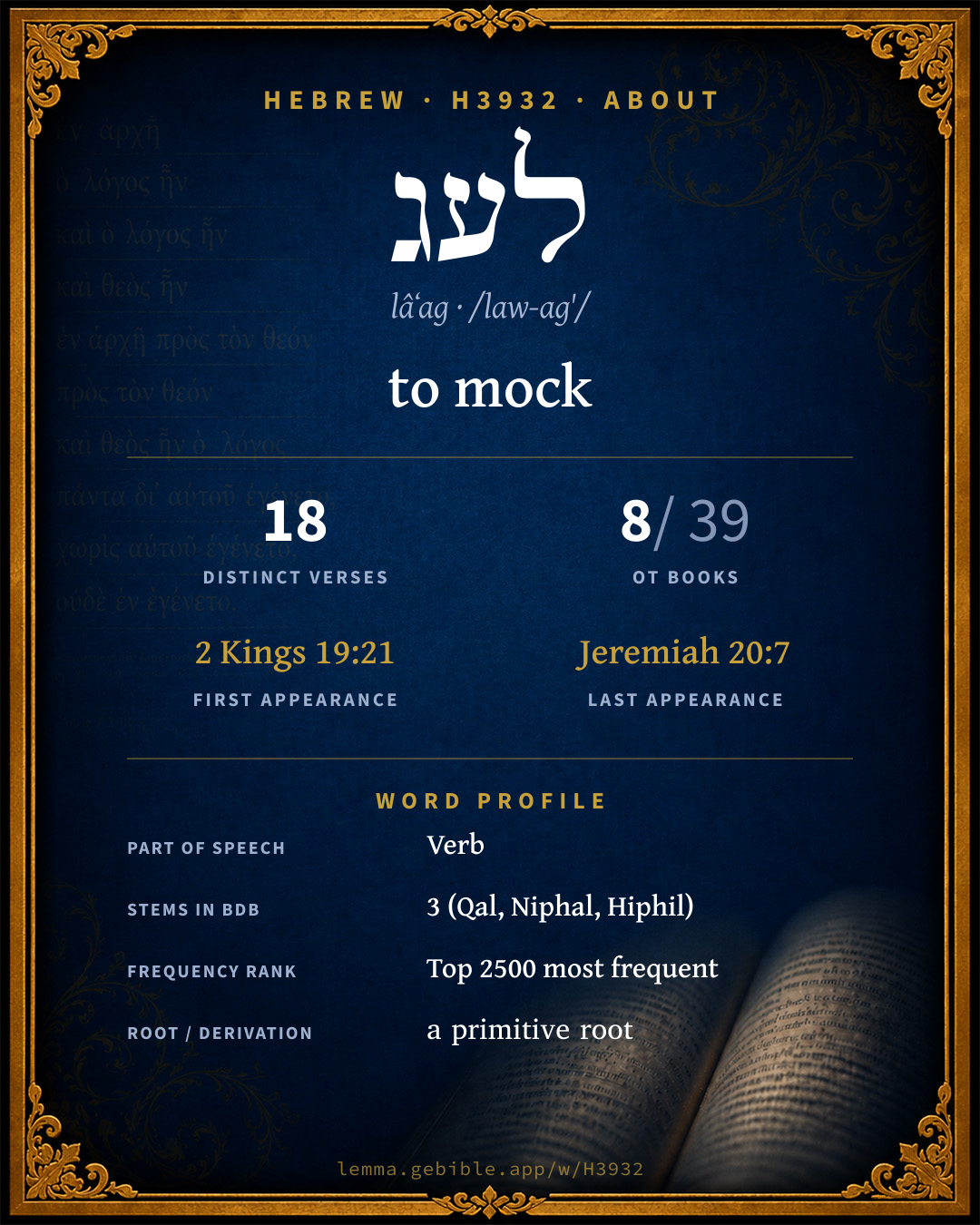
לָעַג
to mock
also: deride, ridicule fuller range ↓
Full lexicon entry — Brown-Driver-Briggs (BDB)
From Brown-Driver-Briggs (BDB)
Where this word appears
See every Qal verb in the Hebrew Bible →
Grammar key — what these labels mean
Part of speech
- Verb
- An action or state-of-being word.
Stem
- Qal
- The basic, simple active stem — the plain form of the verb (“he wrote”).
- Hiphil
- The causative active stem (“he caused / brought about”).
- Niphal
- Usually the simple passive or reflexive of the Qal (“he was written”).
Form
- Imperfect
- An incomplete, ongoing, or future action (“he will / would write”).
- Perfect
- A completed action or state — Hebrew marks aspect (completeness) more than strict tense (“he wrote”).
- Participle Active
- A verbal adjective expressing ongoing or characteristic action (“writing / one who writes”).
- Sequential Imperfect
- An imperfect with prefixed waw — the standard past-narrative form (waw-consecutive imperfect).
- Participle Passive
- A verbal adjective expressing action received (“written”).
State
- Absolute
- The independent form of a noun, not bound to a following word.
- Construct
- A noun bound to a following noun in a possessive / “of” relationship (the construct chain).
Person
- 3rd Person
- The one spoken about (“he / she / it / they”).
- 2nd Person
- The one addressed (“you”).
- 1st Person
- The speaker (“I / we”).
Gender
- Masculine
- Grammatically masculine.
- Feminine
- Grammatically feminine.
- Common
- Either gender — not distinguished for this form.
Number
- Singular
- One.
- Plural
- More than one (in Hebrew, generally three or more).
Grammatical forms 14 distinct
- Verb, Qal, Imperfect, 3rd Person, Masculine, Singular 3 times (17%)
- Verb, Qal, Perfect, 3rd Person, Feminine, Singular 2 times (11%)
- Verb, Qal, Participle Active, Masculine, Singular, Absolute 2 times (11%)
- Verb, Hiphil, Participle Active, Masculine, Plural, Absolute 1 time (6%)
- Verb, Hiphil, Sequential Imperfect, 3rd Person, Masculine, Plural 1 time (6%)
- Verb, Hiphil, Sequential Imperfect, 3rd Person, Masculine, Singular 1 time (6%)
- Verb, Qal, Sequential Imperfect, 2nd Person, Masculine, Singular 1 time (6%)
- Verb, Niphal, Participle Passive, Masculine, Singular, Construct 1 time (6%)
+6 more forms (6 occurrences)
Parsed forms decoded from the imported morphology (morphhb / Westminster Leningrad Codex — WLC text public domain, morphhb tagging CC BY 4.0), counted across 18 parsed occurrences — not distinct verses.
Every verse where H3932 appears — 18 distinct verses across 8 books. Click any verse to open its interlinear word-by-word view. Verse text shown in the World English Bible for context — . Each verse’s Hebrew form is shown with its reference; the English is not keyword-highlighted, since the data carries no word-level English alignment. Use “Compare translations” on any verse to read it across multiple English versions. This concordance covers the Hebrew Bible; Septuagint (Greek Old Testament) occurrences are not indexed here.
2 Kings 1 verse
2 Chronicles 1 verse
Nehemiah 2 verses
- Nehemiah 2:19 וַ/יַּלְעִ֣גוּ conj + Hiphil wimpf 3mp But when Sanballat the Horonite, and Tobiah the servant, the Ammonite, and Geshem the Arabian, heard it, they ridiculed us, and despised us, and said, What is this thing that you do? will you rebel against the king?
- Nehemiah 4:1 וַ/יַּלְעֵ֖ג conj + Hiphil wimpf 3ms But it happened that when Sanballat heard that we were building the wall, he was angry, and took great indignation, and mocked the Jews.
Job 4 verses
- Job 9:23 יִלְעָֽג Qal impf 3ms If the scourge kills suddenly, He will mock at the trial of the innocent.
- Job 11:3 וַ֝/תִּלְעַ֗ג conj + Qal wimpf 2ms Should your boastings make men hold their peace? When you mock, shall no man make you ashamed?
- Job 21:3 תַלְעִֽיג Hiphil impf 2ms Allow me, and I also will speak; After I have spoken, mock on.
- Job 22:19 יִלְעַג Qal impf 3ms The righteous see it, and are glad; The innocent ridicule them,
Psalms 4 verses
- Psalms 2:4 יִלְעַג Qal impf 3ms He who sits in the heavens will laugh. The Lord will have them in derision.
- Psalms 22:7 יַלְעִ֣גוּ Hiphil impf 3mp All those who see me mock me. They insult me with their lips. They shake their heads, saying,
- Psalms 59:8 תִּ֝לְעַ֗ג Qal impf 2ms But you, Yahweh, laugh at them. You scoff at all the nations.
- Psalms 80:6 יִלְעֲגוּ Qal impf 3mp You make us a source of contention to our neighbors. Our enemies laugh among themselves.
Proverbs 3 verses
- Proverbs 1:26 אֶ֝לְעַ֗ג Qal impf 1cs I also will laugh at your disaster. I will mock when calamity overtakes you;
- Proverbs 17:5 לֹעֵ֣ג Qal ptcp.act ms Whoever mocks the poor reproaches his Maker. He who is glad at calamity shall not be unpunished.
- Proverbs 30:17 תִּֽלְעַ֣ג Qal impf 3fs The eye that mocks at his father, And scorns obedience to his mother: The ravens of the valley shall pick it out, The young eagles shall eat it.
Isaiah 2 verses
- Isaiah 33:19 נִלְעַ֥ג Niphal ptcp.pass ms cs You shall not see the fierce people, a people of a deep speech that you can not comprehend, of a strange language that you can not understand.
- Isaiah 37:22 לָעֲגָ֣ה Qal pf 3fs this is the word which Yahweh has spoken concerning him: The virgin daughter of Zion has despised you and ridiculed you; the daughter of Jerusalem has shaken her head at you.
Jeremiah 1 verse
About this entry
At a glance — auto-summarized from this page’s data, not written by a person. Every figure links to its source below. This summary describes the numbers; it doesn’t interpret them.
לעג — transliterated lâʻag — is a Hebrew verb carrying the sense “to mock.” It first appears in 2 Kings 19:21. The Hebrew Bible uses it across 18 verses — uncommon. Read the stem: it spans 3 stems, including Qal and Niphal. Related forms include לעג and לעג. See the sense tree, 18-verse concordance, and the renderings breakdown below.
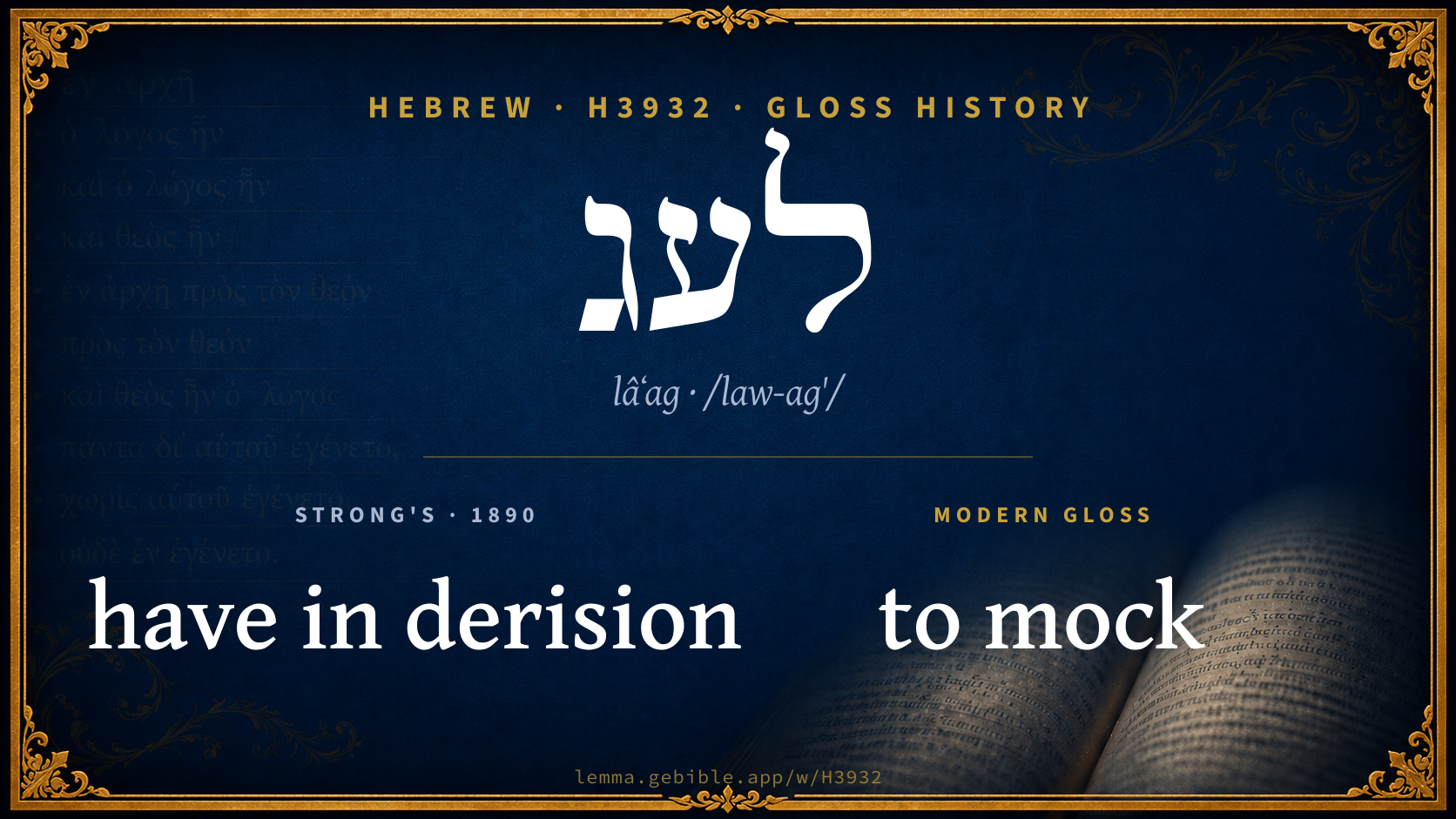
Gloss history
Strong's 1890 vs modern scholarship
About this word
Strong's H3932 catalogs a Hebrew word from the Hebrew Old Testament.
These counts are not copied from any lexicon or concordance. They are computed here, from the morphology-tagged Hebrew Old Testament. What Lemma adds →
- 18
- distinct verses
- The word appears in 18 distinct verses.
- 8 / 39
- OT books
- The word appears in 8 of 39 Old Testament books.
- #1,612
- by frequency
- Top 2500 most frequent Hebrew words (rank 1,612 of 8,640 Hebrew words by occurrence).
View all 18 occurrences in the concordance →
By section of the Old Testament
By traditional corpus
Conventional, traditional groupings — biblical authorship is debated, so this is a traditional corpus grouping, not an authorship claim. Each share is this word’s portion of its verses in that division of the Hebrew canon. Each figure is a share of the word’s 18 distinct verses.
- Writings (Ketuvim) 14 verses · 78%
- Prophets (Nevi'im) 4 verses · 22%
How translations render this word
Counts come from each version’s own published word-to-Strong’s tagging or interlinear alignment — an approximate guide to how each version renders this word, not a word-level alignment the data otherwise carries. Because each total is that version’s own tagged count, the per-version totals vary from one another and need not match the appearance or distinct-verse counts above. These counts may also differ from a printed concordance because Lemma counts each distinctly tagged rendering and does not collapse phrase taggings into a single head-word total. This is a fixed set of word-tagged versions (KJV, ASV, BSB, ULT) and does not change with the reading translation you choose elsewhere. Each version’s license is shown beside its name below (and on Sources).
- King James Version: Mocked 2×, Thee and laughed thee to scorn 2×
- American Standard Version: Thee and laughed thee to scorn 2×
- Berean Standard Bible: Mocks 4×, Mock 3×
- unfoldingWord Literal Text: Mock 2×, Mocks 2×, She derides 2×
King James Version Public Domain
Renders H3932 across 18 tagged occurrences — most commonly:
Plus 14 renderings that appear only once — usually multi-word phrases or single function words the recovered tagging swept in, not distinct renderings.
American Standard Version Public Domain
Renders H3932 across 18 tagged occurrences — most commonly:
Plus 16 renderings that appear only once — usually multi-word phrases or single function words the recovered tagging swept in, not distinct renderings.
Berean Standard Bible Public Domain
Renders H3932 across 18 tagged occurrences — most commonly:
Plus 11 renderings that appear only once — usually multi-word phrases or single function words the recovered tagging swept in, not distinct renderings.
unfoldingWord Literal Text CC BY-SA 4.0
Renders H3932 across 18 tagged occurrences — most commonly:
Plus 12 renderings that appear only once — usually multi-word phrases or single function words the recovered tagging swept in, not distinct renderings.
Senses in the full BDB
Hebrew verbs can shift meaning by stem (binyan): Qal is the basic action, Niphal is often passive or reflexive, Piel often intensifies or makes it factitive, and Hiphil is typically causative. The senses below are grouped under the stem BDB assigns to each.
What do BDB’s symbols mean?
BDB uses these scholarly abbreviations:
| Symbol | Meaning |
|---|---|
| 𝔊 | the Septuagint (the ancient Greek translation, LXX) |
| 𝔙 | the Vulgate (the Latin translation) |
| 𝔖 | the Syriac version (the Peshitta) |
| 𝔗 | the Targum (the Aramaic translation) |
| ψ | the Psalms |
| √ | root (the underlying root or stem) |
| ‖ | parallel passage (a synonymous or contrasted parallel) |
| † | the dagger: every passage where the word occurs is cited |
The 3 senses and sub-senses the full Brown-Driver-Briggs lexicon distinguishes for this word, in lexicon order (not ranked by frequency), with BDB’s own verbatim wording and sub-sense lettering. Shown in Hebrew script with BDB’s own scholarly abbreviations. The condensed entry is in the Lexicon Entry tab. See also the Forms in the corpus table below.
Qal
- Pf. 3 fs. לָֽעֲגָה 2 K 19:21 Is 37:22; Impf. יִלְעַג־ Jb 22:19 ψ 2:4, יִלְעָ֑ג Jb 9:23; 3 fs. תִּלְעַג Pr 30:17; 2 ms. תִּלְעַג ψ 59:9, וַתִּל׳ Jb 11:3; 1 s. אֶלְעַג Pr 1:26; 3 mpl. יִלְעֲגוּ־ ψ 80:7; Pt. לֹעֵג Pr 17:5; Je 20:7;—mock, deride, have in derision, of Jerus. triumphing over enemy (c. לְ pers. vel rei) 2 K 19:21 = Is 37:22 (‖ בזה); of the innocent Jb 22:19 (‖ שׂמח); of God (c. לְ) 9:23 ψ 2:4; 59:9; abs. of wisdom Pr 1:26 (‖ שׂחק); of wicked (c. לְ) Pr 17:5 (‖ שׂמח), 30:17 (‖ בוז), Je 20:7 (‖ שׂחק); so also perhaps ψ 80:7 (read לָנוּ for לָמוֹ with 𝔊 𝔖 𝔙), cf. (abs.) Jb 11:3. e.g. 2 Kings 19:21
Niphal
- Pt. עַם … נִלְעַג לָשׁוֹן Is 33:19 a people stammering of tongue (i.e. barbarians, cf. v a; but read נעלג [√ עלג] GrMonatsschr. 1884, 45; ‖ עִמְקֵי שָׂפָה). e.g. Isaiah 33:19
Hiphil
- (late; cf. NH) Impf. 3 ms. וַיַּלְעֵג Ne 3:33; 2 ms. תַּלְעִיג Jb 21:3; 3 mpl. יַלְעִגוּ ψ 22:8, וַיַּלְעִגוּ Ne 2:19; Pt. מַלְעִגִים 2 Ch 30:10;—mock, deride, always in bad sense: c. לְ pers. Ne 2:19 (‖ בזה), ψ 22:8; c. עַל־ pers. Ne 3:33; c. בְּ pers. 2 Ch 30:10 (‖ השׂחיק); abs. Jb 21:3.—So also יַלְעִיג (or יִלְעַג) Pr 18:1 for MT יִתְגַּלַּע Grl.c. (v. גלע, p. 166 supra). e.g. Nehemiah 3:33
Senses from the full Brown-Driver-Briggs lexicon (Brown, Driver, Briggs; Oxford 1906 — public domain), digitized via Sefaria, supplemented by the OpenScriptures HebrewLexicon (CC BY 4.0). Full attribution on Sources.
Word origin
vb. mock, deride; also (Niph.) stammer, poet. (NH Hiph. id.; 𝔗 לְעֵג Aph. id.; ܠܥܶܓ stutter (cf. NH לִגְלֵג mock, 𝔗 לַגְלֵג id.; Syriac ܠܰܓܠܶܓ stutter, Arabic لَجْلَجَ id.));—
— Brown-Driver-Briggs (Oxford 1906, public domain), digitized via Sefaria, supplemented by the OpenScriptures HebrewLexicon (CC BY 4.0). See Sources.
Origin: a primitive root
Jastrow Dictionary
A second Hebrew/Aramaic lexicon for comparison, covering Aramaic and post-biblical (Talmudic, Targumic, Midrashic) usage that the biblical-Hebrew BDB does not. Matched by lemma rather than by Strong’s number, so a lemma may carry more than one Jastrow headword (shown separately below), and the entries cover usage well beyond the Bible.
לָעַג
- cmp. preced. wds) to jest, mock. Pesik. R. s. 34 לשוא לָעַגְנוּ על וכ׳ in vain did we deride their words.
- same. Y. Peah I, 15ᵈ top (ref. to Prov. XXX, 17) עין שהִלְעִיגָה על וכ׳ the eye that mocked at the law commanding to honor father and mother and despised the law (Deut. XXII, 6) &c. Erub. 21ᵇ (ref. to להג, Koh. XII, 12) כל המַלְעִיג על וכ׳ whosoever derides the words of the wise, v. לַעַג. Gen. R. s. 94 מַלְעִיגִים בשפתותיהן spoke lasciviously. Esth. R. to III, 9 מַלְעִיגִין אותנו וכ׳ they deride us and our religion. Num. R. s. 16 הִלְעִיגוּ לי they spoke irreverently of me. Y. Naz. I, beg. 51ᵃ [read:] מהו זה מַלְעִיג עליהן או וכ׳ how is this? Does he mean it sarcastically, or does he mean to say, I will be a Nazir like them? Yalk. Ex. 250 ורוה"ק מַלְעֶגֶת עליו and the Spirit of Holiness laughs at him; a. e. e.g. Proverbs 30:17
לְעַג
- , Af. אַלְעֵיג, Pa. לַעֵיג ch. same. Targ. Jer. VIII, 18. Targ. Is. XXVIII, 11.
לַעַג
- preced.) sport, mockery. Erub. 21ᵇ (ref. to Koh. XII, 12, v. לָעַג) מי כתיב ל׳ וכ׳ does the text read laʿag (mockery)? does it not read lahag (thought)?; v. הָגָה. e.g. Ecclesiastes 12:12
לַעַג ²
- Targ. Jer. XX, 8 (ed. Lag. לְעֵיב); v. לְעֵב
A Dictionary of the Targumim, the Talmud Babli and Yerushalmi, and the Midrashic Literature (Marcus Jastrow; London, Luzac, 1903) — Public Domain. Digitized via Sefaria. Digitized via Sefaria. Full attribution on Sources.
Forms in the corpus
The 16 distinct written forms H3932 takes in the Hebrew Bible, most frequent first — each parse links to that stem’s occurrences in the concordance. Hebrew forms include their vowel points and cantillation, so a single lemma takes many written forms.
Same root — word family
Other BDB entries built from the same root as H3932, grouped by Strong’s listed origin. These share a root / origin per the lexicon — not necessarily a shared meaning. Each links to that word’s own entry.
Derived from this word
Compare all same-root words → They share a root, not necessarily a meaning.
Septuagint verse parallels
This word appears in 15 verses that also exist in the Greek Old Testament (Septuagint), out of the 18 Hebrew verses it occurs in. You can read those verses in Greek by switching the Old Testament edition to the Septuagint.
Read these verses in the Septuagint
This is a verse-level parallel only — the same verses exist in both the Hebrew and Greek Old Testaments. No word-level Hebrew↔Greek correspondence is claimed: the data carries no such alignment, so no Greek word is shown as this Hebrew word’s translation. Coverage is not total — the Septuagint omits the deuterocanon and renumbers the Psalms, so some Hebrew verses have no direct Greek parallel.