3 John 1:12

Greek (Tischendorf 8th ed.) 3 John 1:12 appears in the Greek New Testament. The text above is from the Tischendorf 8th edition. Each word links to its Strong’s number and a concise gloss. Click any word for its full Thayer’s Greek Lexicon entry.
Download image
Cite this verse

3 John 1:12 (World English Bible). Public Domain. Lemma interlinear Bible study tool, https://lemma.gebible.app/v/3-john/1/12.

Show BibTeX & RIS
BibTeX
RIS
English Translation
Demetrius has the testimony of all, and of the truth itself; yes, we also testify, and you know that our testimony is true.
World English Bible · Public Domain
Download a study sheet

One document with this verse’s original text, its word-by-word gloss line, the meaning frame, cross-references with their text, attributed commentary, and full source and license credits — printable, and it pastes into notes with its structure intact.

This verse Autodidact and up

Study sheet (.html) Plain text (.txt)

A passage Seminary Student

Up to 50 verses in one chapter. A passage sheet keeps up to 6 commentary sources and 12 cross-references per verse, in the order this page ranks them, and says so on the sheet whenever that leaves anything out. Ask for a single verse and you get the Autodidact verse sheet above.

Everything on this page stays free to read, with no account — the sheet is a download of what is already on screen, not access to it.

Want to remove ads? Support Godless Engineer
Compare translations 3

The same verse in 3 English versions, stacked beneath the original-language interlinear above. Click any original word for its lexicon entry.

Each is an independent rendering of the whole verse — the interlinear is not word-aligned to these translations.

Highlighted words mark where these versions differ — a whole-verse word diff, not a word-by-word alignment.

  • World English Bible Public Domain
    Demetrius has the testimony of all, and of the truth itself; yes, we also testify, and you know that our testimony is true.
  • King James Version Public Domain
    Demetrius hath good report of all men, and of the truth itself: yea, and we also bear record; and ye know that our record is true.
  • unfoldingWord Literal Text CC BY-SA 4.0
    Demetrius has been attested to by all and by the truth itself. And we ourselves also attest, and you know that our testimony is true.

unfoldingWord Literal Text — © unfoldingWord, licensed CC BY-SA 4.0. Word-aligned USFM3 via Door43 (git.door43.org/unfoldingWord/en_ult).

Versions to compare (up to 4)

3 of 4 selected

Show all 19 translations

Every available English version of this verse, each an independent rendering of the whole verse.

  • World English Bible Public Domain
    Demetrius has the testimony of all, and of the truth itself; yes, we also testify, and you know that our testimony is true.
  • Berean Standard Bible Public Domain
    Demetrius has received a good testimony from everyone, and from the truth itself. We also testify for him, and you know that our testimony is true.
  • Majority Standard Bible Public Domain
    Demetrius has received a good testimony from everyone, and from the truth itself. We also testify for him, and you know that our testimony is true.
  • King James Version Public Domain
    Demetrius hath good report of all men, and of the truth itself: yea, and we also bear record; and ye know that our record is true.
  • American Standard Version (1901) Public Domain
    Demetrius hath the witness of all `men', and of the truth itself: yea, we also bear witness: and thou knowest that our witness is true.
  • Revised Version (1885) Public Domain
    Demetrius hath the witness of all men, and of the truth itself: yea, we also bear witness; and thou knowest that our witness is true.
  • Geneva Bible (1599) Public Domain
    Demetrius hath good report of al men, and of the trueth it selfe: yea, and wee our selues beare recorde, and ye know that our record is true.
  • Douay-Rheims (1899) Public Domain
    To Demetrius testimony is given by all, and by the truth itself, yea and we also give testimony: and thou knowest that our testimony is true.
  • Young's Literal Translation Public Domain
    to Demetrius testimony hath been given by all, and by the truth itself, and we also -- we do testify, and ye have known that our testimony is true.
  • Literal Standard Version CC BY-SA 4.0
    testimony has been given to Demetrius by all, and by the truth itself, and we also—we testify, and you have known that our testimony is true.
  • Unlocked Literal Bible CC BY-SA 4.0
    Demetrius is borne witness to by all and by the truth itself. We also bear witness, and you know that our testimony is true.
  • unfoldingWord Literal Text CC BY-SA 4.0
    Demetrius has been attested to by all and by the truth itself. And we ourselves also attest, and you know that our testimony is true.
  • Darby Bible Public Domain
    Demetrius has witness borne to him by all, and by the truth itself; and *we* also bear witness, and thou knowest that our witness is true.
  • World Messianic Bible Public Domain
    Demetrius has the testimony of all, and of the truth itself; yes, we also testify, and you know that our testimony is true.
  • Webster's Bible Public Domain
    Demetrius hath good report by all men, and by the truth itself: and we also bear testimony; and ye know that our testimony is true.
  • Free Bible Version CC BY-SA 4.0
    Everyone speaks well of Demetrius—and the truth does so too! We also speak well of him, and you know we tell the truth.
  • Bible in Basic English Public Domain
    Demetrius has the approval of all men and of what is true: and we give the same witness, and you are certain that our witness is true.
  • Text-Critical English NT CC BY 4.0
    Demetrius is well spoken of by everyone—and even by the truth itself. We also speak well of him, and you know that our testimony is true.
  • Tyndale New Testament (1534) Public Domain
    Demetrius hath good reporte of all men and of the trueth: ye and we oure selves also beare recorde and ye knowe that oure recorde is true.

Literal Standard Version (2020), Covenant Press — licensed CC BY-SA 4.0. Text via the HelloAO Bible API (eBible.org). Unlocked Literal Bible (unfoldingWord) — licensed CC BY-SA 4.0. Text via the HelloAO Bible API (eBible.org). unfoldingWord Literal Text — © unfoldingWord, licensed CC BY-SA 4.0. Word-aligned USFM3 via Door43 (git.door43.org/unfoldingWord/en_ult). Free Bible Version, Dr. Jonathan Gallagher — licensed CC BY-SA 4.0. Text via the HelloAO Bible API (eBible.org).

Word by word

More ways to search: Search by grammar → Find every occurrence → Compare this word →

Practice this passage: Drill this verse → Learn its vocabulary →

Δημητρίῳ
Dēmḗtrios
G1216
“Demetrius”
Noun, Dative, Singular, Masculine
Part of Speech
Noun
Case
Dative
Number
Singular
Gender
Masculine
Full Thayer's Definition

Origin: from Demeter (Ceres)

TDNT: None

Demetrius = "belonging to Ceres" 1. a heathen silversmith at Ephesus 2. a certain Christian, 3Jo 12
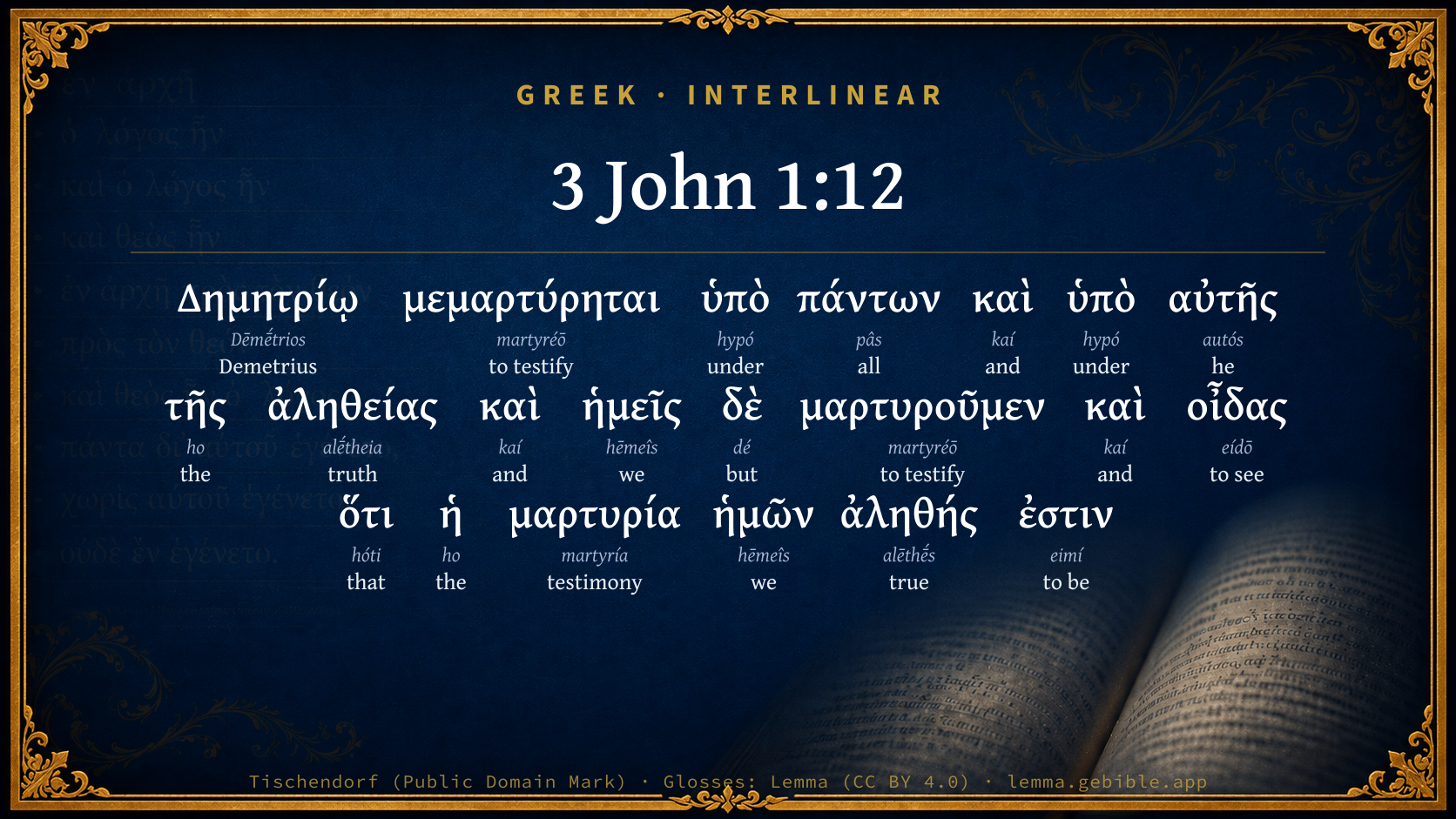
  1. μεμαρτύρηται martyréō G3140 “to testify” Verb, Perfect, Passive, Indicative, 3rd person, Singular
  2. ὑπὸ hypó G5259 “under” Preposition
  3. πάντων pâs G3956 “all” Adjective, Genitive, Plural, Masculine
  4. καὶ kaí G2532 “and” Conjunction
  5. ὑπὸ hypó G5259 “under” Preposition
  6. αὐτῆς autós G846 “he” Personal pronoun, Genitive, Singular, Feminine
  7. τῆς ho G3588 “the” Article, Genitive, Singular, Feminine
  8. ἀληθείας alḗtheia G225 “truth” Noun, Genitive, Singular, Feminine
  9. καὶ kaí G2532 “and” Conjunction
  10. ἡμεῖς hēmeîs G2249 “we” Personal pronoun, 1st person, Nominative, Plural
  11. δὲ dé G1161 “but” Conjunction
  12. μαρτυροῦμεν martyréō G3140 “to testify” Verb, Present, Active, Indicative, 1st person, Plural
  13. καὶ kaí G2532 “and” Conjunction
  14. οἶδας eídō G1492 “to see” Verb, Perfect, Active, Indicative, 2nd person, Singular
  15. ὅτι hóti G3754 “that” Conjunction
  16. ἡ ho G3588 “the” Article, Nominative, Singular, Feminine
  17. μαρτυρία martyría G3141 “testimony” Noun, Nominative, Singular, Feminine
  18. ἡμῶν hēmeîs G2249 “we” Personal pronoun, 1st person, Genitive, Plural
  19. ἀληθής alēthḗs G227 “true” Adjective, Nominative, Singular, Feminine
  20. ἐστιν eimí G1510 “to be” Verb, Present, Active, Indicative, 3rd person, Singular

About this verse

These counts appear in no published source. They are computed here, from the morphology-tagged text and Lemma’s own curated glosses. What Lemma adds →

21
words
15
distinct lemmas
General Epistles
section

Notable vocabulary

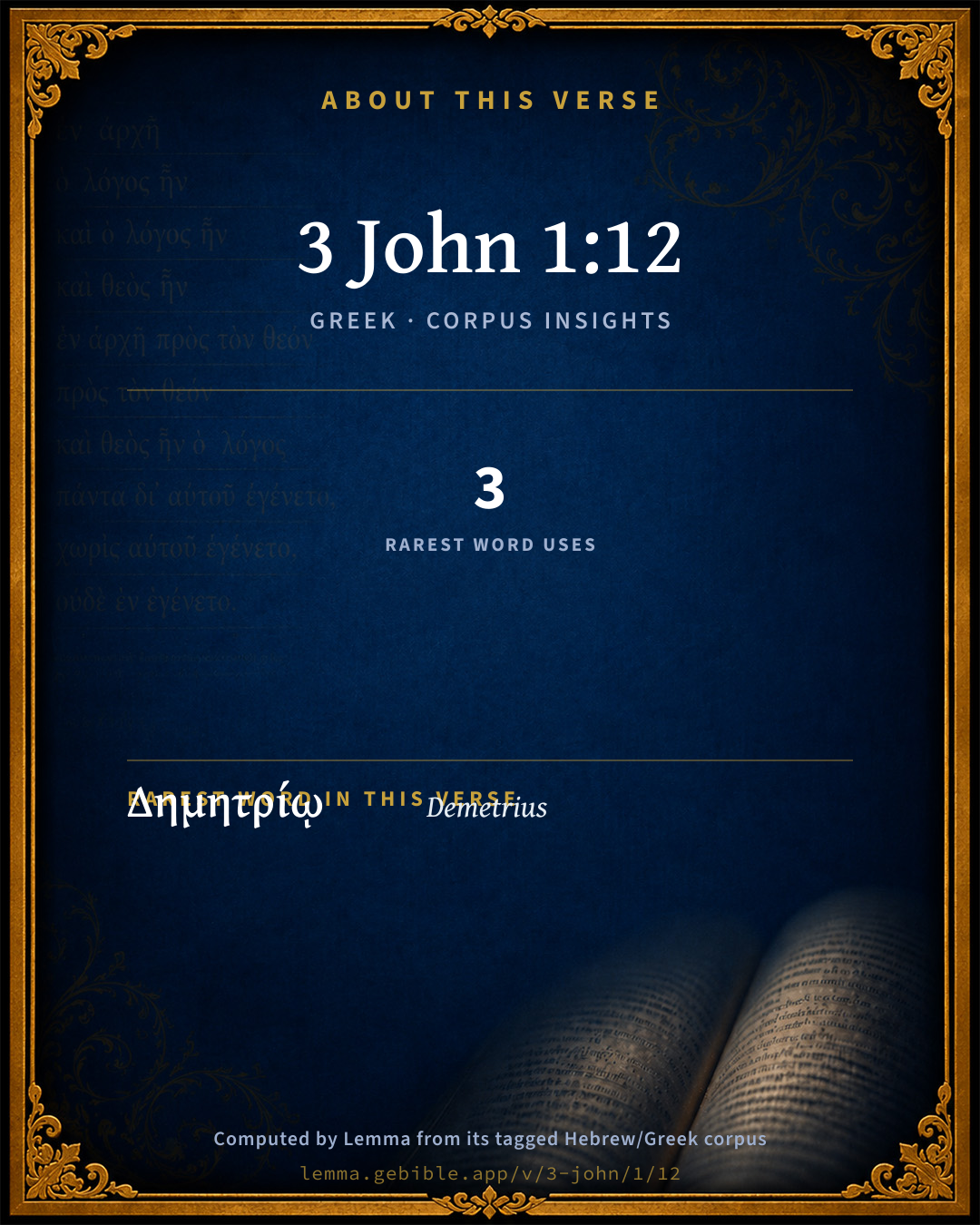
The rarest word here is Δημητρίῳ Demetrius G1216 — appearing just 3 times in the whole Greek New Testament.

Shared distinctive vocabulary

Δημητρίῳ Demetrius G1216 occurs in 3 verses of the Greek New Testament. Also found in:

Repetition

Words recur within this verse:

  • μεμαρτύρηται to testify G3140 ×2
  • ὑπὸ under G5259 ×2
  • καὶ and G2532 ×3
  • τῆς the G3588 ×2
  • ἡμεῖς we G2249 ×2

Cross-references

6

Topical passages linked to 3 John 1:12 in the Treasury of Scripture Knowledge — connected by theme and wording, ordered by reader-vote popularity; previews shown in the World English Bible.

  • 1 Timothy 3:7 Moreover he must have good testimony from those who are outside, to avoid falling into reproach and the snare of the devil.
  • John 21:24 This is the disciple who testifies about these things, and wrote these things. We know that his witness is true.
  • Acts 10:22 They said, "Cornelius, a centurion, a righteous man and one who fears God, and well spoken of by all the nation of the Jews, was directed by a holy angel to invite you to his house, and to listen to what you say."
  • Acts 22:12 One Ananias, a devout man according to the law, well reported of by all the Jews who lived in Damascus,
  • John 19:35 He who has seen has testified, and his testimony is true. He knows that he tells the truth, that you may believe.
  • 1 Thessalonians 4:12 that you may walk properly toward those who are outside, and may have need of nothing.

Cross-references courtesy of OpenBible.info (CC BY 4.0).

Commentary

Notes on 3 John 1:12 from classic Christian and Jewish commentators (each source and its license shown beneath its notes). The classic Christian expositions comment on the surrounding passage and are grouped to its opening verse, so a note may address several verses; the Jewish commentaries on the Tanakh (Rashi and others) are per-verse, so they appear only where the commentator wrote on this verse.

Lemma curates 59 commentaries, every one of them public domain or Creative Commons licensed, each selected and text-cleaned for this edition rather than reprinted as found. About our sources →

The Biblical Illustrator

Joseph S. Exell

3Jn_1:12

Demetrius hath good report of all men.

The Christian character will stand every test

1. The test of public opinion. All men had a good word for Demetrius. But there are antipathies in the worldly mind; how, then, can we expect an unbiassed judgment? We answer that truth must vanquish error as the light does the darkness. Dishonesty can only obtain a temporary triumph over integrity (1Pe_2:12).

2. The test of the Word of God. The standard of character is the law of the Lord. We use the Bible for comparison as well as for instruction. It is a mirror in which to see our true condition.

3. The test of Church fellowship. Christians know each other intimately, and as such they know each others failings; yea, and they know the difficulties which beset a holy life. To have a good word from those who thus know us testifies to the genuineness of our character.

4. The test of the final judgment. (The Weekly Pulpit.)

Demetrius

An evangelist, possibly a prophet, animated by a most self-sacrificing and disinterested spirit, which sprang from an ardent love for Christ the Saviour of men, Demetrius won for himself a threefold testimony.

1. He won the witness of all, says St. John, i.e., the witness of all good men, of all who were capable of appreciating goodness. Even those who rejected his message had nothing to allege against the man, save the sublime folly of a perilous and unprofitable enthusiasm; while those who accepted it from him, or had already accepted it from other lips, could not but admire the fineness of his spirit and the fire of his zeal.

2. More, and better still, he won the testimony of the truth itself. For he who daily sets his life upon the die that he may be true to his convictions, he who, moved by the grace and love of Christ, seeks not his own things, but the things of others; he who devotes himself with burning zeal and all-enduring courage to the service of truth and the salvation of men--to him the truth itself, which has made him what he is, bears witness. Men do not despise ease and a sure provision for their daily wants; they do not daily affront every form of danger and loss, for truths, or beliefs, which have no real, no vital, hold upon them. They who do such things as these declare plainly; they make it manifest that they are the servants of a truth, which they love more than they love them selves. It is the truth itself which speaks through them, and bears witness to them.

3. Last of all, St. John adds his own testimony to that of the previous witnesses: We also bear witness. And any man who has devoted himself to the service and spread of a truth which has not met with wide or general recognition will understand the special charm which this testimony would exert on Demetrius. A very noble character, on which, simply by describing it, St. John has pronounced a very noble eulogium. Let me also remind you that great as Demetrius looks to us--great in his disinterestedness, his devotion, his zeal--he was not a man of any great mark in the primitive Church. It is not some hero of distinction, some honoured and beloved man of spiritual genius, whom I have tried to place before you; but a man of whom we should never have heard but for the prating insubordination of Diotrephes. (S. Cox, D. D.)

A good name

There be two things which we ought all to procure--a good conscience in respect of God, and a good name in regard of men.

1. A good name is sweet and comfortable; it is preferred before the most precious things that men have in greatest estimation (Pro_22:3).

2. It is profitable. A good name maketh the bones fat. A good name maketh a man fat; he eats, he drinks, he sleeps the better for it.

3. It secures a man while he is alive; they that have a bad report for their injurious dealing are maligned; they go, in some sort, in danger of their lives; they that have a good report walk cheerfully and safely.

4. It is a consolation to a man, even on his deathbed; he hath the less, then, to vex and trouble his mind.

5. It leaves a sweet savour after us; when we be dead it is an odoriferous ointment; the house will smell of it a good while after. Therefore let us so live, that we may be well reported of, so far as it is possible of all men. I say, so far as it is possible; for in truth it is impossible; the best of us all must make account to pass through good report and ill report into the kingdom of heaven. (W. Jones, D. D.)

The Biblical Illustrator, edited by Joseph S. Exell (c. 1880s–1900s) — public domain. Text from a community e-Sword module.

Joseph Benson's Commentary

3Jn 1:12. Demetrius, on the contrary, hath good report — Hath a good testimony from all that know him; and of the truth — The gospel; itself — His temper and conduct being conformable to its precepts, and he having exerted himself greatly to propagate it. Yea, and we also bear record — I, and they that are with me; and ye know that our record is true — That every commendation I give is well founded.

Joseph Benson's Commentary on the Old and New Testaments (1811–1818) — public domain. Text from a community e-Sword module.

MacLaren's Expositions of Holy Scripture

Alexander MacLaren

3 John

THE CHRISTIAN’S WITNESSES TO CHARACTER

3Jn 1:12.

What a strange fate this Demetrius has had! He has narrowly escaped oblivion, yet he is remembered for ever and his name is known over all the world. But beyond the name nothing is certain. Who he was, where and when he lived, what he had done to earn the old Apostle’s commendation are unknown. All his surroundings are swallowed up in darkness, and there shines out only that one little point of light that he ‘hath a good report’-or, as the Revised Version better renders it,’ he hath the witness of all men, and of the truth itself.’ A great many brilliant reputations might be glad to exchange a fame that has filled the world for a little epitaph like that.

I said we did not know anything about him. What if he should be the Demetrius whose astute appeal to profit and religion roused the shrine-makers at Ephesus and imperiled Paul’s life? Of course, that is mere conjecture, and the identity of name is not a strong foundation to build on, for it was a very common one. If this disciple, thus praised by John, is our old acquaintance in Acts, what a change had come over him! Truly, to him, ‘ old things had passed away, all things were become new.’ If we remember John’s long connection with Ephesus, the conjecture will perhaps seem reasonable. At all events, we do no harm if, perhaps led by sentiment, we give as much weight as we can to the supposition that here we have, reappearing within the Church, the old antagonist, and that ‘this Paul’ had ‘persuaded’ him, too, that ‘they be no gods which are made with hands,’ and so had turned him to Jesus Christ. I wonder what became of his craft, and his silver shrines, if this is the same man as he who mustered the Ephesian silversmiths.

But be that as it may, I desire-keeping in mind the alteration of rendering that I have suggested-’hath witness of all men,’ and of the truth itself-to look at the sort of witnesses to character that a Christian man should be able to call.

I. The first witness is Common Opinion.

There is something wrong unless a Christian can put popular opinion into the witness-box in his favour. Of course there is a sense in which there is nothing more contemptible than seeking for that, and in which no heavier woe can come upon us, and no worse thing can be said about us, than that all men speak well of us. But, on the other hand, whether men speak well of us or not, there should be a distinctive characteristic plainly visible in us Christians which shall make all sorts of observers say to themselves, ‘ Well I that is a good man anyhow. I may not like him; I may not want to resemble him; but I cannot help seeing what sort of a man he is and that there is no mistake about his genuine goodness.’ That is a testimony which Christians ought to be more ambitious of possessing than many of them are, and to lay themselves out more consciously to get, than most of them do. For bad men generally know a good one when they see him and a great many of them

‘Compound for sins they are inclined to

By praising virtues they’ve no mind to,’

and substitute admiration of uncongenial goodness for imitation of it. It is nothing uncommon to find the drunkard praising the temperate man, and evil-livers of all sorts recognizing the beauty of their own opposites. The worst man in the world has an ideal of goodness in his conscience and mind, far purer and loftier than the best man has realized.

And, again, it is a very righteous and good thing that people who are not Christians should have such extremely lofty and strict standards for the conduct of people that are. We sometimes smile when we see in the newspapers, for instance, sensational paragraphs about the crime of some minister, or clergyman, or some representative religious man. No doubt a dash of malice is present in these; but they are an unconscious testimony to the high ideal of character which attaches to the profession of Christianity. No similar paragraphs appear about the immoralities or crimes of non-religious men. They are not expected to be saints. But we are, and it is right that we should be thus expected. The world does not demand of us more than it is entitled to do, or that our Lord has demanded. There is nothing more wholesome than that Christian people should feel that there are lynx eyes watching them, and hundreds who will have a malicious joy if they defile their garments, and bring discredit on their profession.

I have not the smallest objection to that; and I only wish that some of us who talk a great deal about the depth of our spiritual life could hear what is thought of us by our next-door neighbors, and our servants, and the tradesmen that we deal with, and all those other folk that have no sympathy with our religion, and are, therefore, rigid judges of our conduct.

Then there is another consideration which I suggest -that a great many good people think that it is their Christianity that makes folk speak ill of them, when it is their inconsistencies and not their Christianity that provoke the sarcasm. If you wrap up the treasure of your Christianity in a rough envelope of angularity, self-righteousness, sourness, censure, and criticism, you need not wonder that people do not think much of your Christianity. It is not because Christian professors are good, but because they are not better, that ninety-nine out of a hundred of the uncharitable things that are said about them are said, and truly said.

So, dear friends, let us-not in any cowardly spirit of trying to disarm censure, nor because we have an itch to be caressed, like a parrot to have its head scratched, nor because we are pleased that men shall think well of us, but because the judgment of the world is, in some degree, a more wholesome tribunal than the judgment of our own consciences, and is, in some sense, an anticipation, though with many mistakes, of the judgment of God-let us try to have a good report of ‘them that are without,’ and to he ‘living epistles, known and read of all men,’ who will recognize the handwriting, and say, ‘That is Christ’s.’

Remember Daniel in that court where luxury and vice and sensuality, and base intrigues of all sorts rioted, and how they said of him, ‘We shall find no occasion against him except it be concerning the law of his God.’ And let us try to earn the same kind of reputation; and be sure of this that, unless the world endorses our profession of Christianity, which it may do by disliking us-that is as it may be-there is grave reason to doubt whether the profession is a reality or not.

II. Then there is another witness here mentioned- ‘the truth itself.’

The Gospel of Jesus Christ witnesses for the man who witnesses for, and lives by it. A law broken testifies against the breaker; a law kept testifies for him. And so, if there be an approximation in the drift of our lives to the great ideal set forth in the law of God, that law will bear witness for us. But there must be in us the things that Christianity plainly requires before ‘the truth’ can be put into the witness box for us. There must be manifest self-surrender.

Let us go back to our supposition, which, of course, I freely admit is the only conjecture. If this is the Demetrius of the Acts, and he became a Christian, the first thing that ‘the truth’ required of him would be to shut up shop, to give up the lucrative occupation by which he had his wealth, and to cast in his lot with the men that were warring against idols. We, in our degree, will have, in some form or other, the same self-surrender to exercise.

I have a letter which tells me the story of a man, who for years has been trying to serve God, in the employ of some establishment where they sell wines and spirits, but now his conscience has smitten him, and he has had to give it up, and writes to ask me if I can find him a situation. Well! He is borne witness to by the truth itself, which he has loyally obeyed. We all, as Christians, have to do the like, and not only in the great acts of our lives to rid ourselves of everything that is contrary to the principles and commandments of the Word, but in the small things to be ever seeking to come nearer and nearer to the ideal which He requires.

When looking into the perfect law of liberty we see in its precepts our own characters reflected, if I may so say; because we keep these we may be sure that we are right. If we do not, we may be sure that we are wrong. The truth will bear witness against lives that are ordered in defiance of it and for those which are conformed to it. It is possible that even the lofty and perfect examples of conduct and character which are in the history of the Master, and the principles that are drawn from Him, may testify of us; and if so, what quiet blessedness will be ours!

III. But there is a last thought here. Christ Himself will be a witness.

I do not know that in these profound and mystical letters of the Apostle John, that great designation ‘the truth’ is ever employed to mean only the body of teaching contained in what we call the Gospel. I think that there is always trembling in the expression, and sometimes predominating in it, in these letters, the personal application of which our Lord, as reported by the same Apostle when he was playing the part of Evangelist, gives us the warrant, when He says, ‘I am the Truth.’ And if that personal meaning is, as I think it is, shimmering through these words, then we may venture to deal with it separately in conclusion, and to say that the third witness is Jesus Christ Himself.

‘With me,’ said Paul, ‘it is a very small matter to be judged of you, or of man’s judgment’; and that wholesome disregard of opinion is part of the attitude which we should bear towards popular or any human estimate-but’ he that judgeth me is the Lord".’

Now, notice Paul’s tenses. He does not say, ‘He that is going to judge me,’ away out yonder in the indefinite future, at some great Day of Judgment after death, but he says, ‘He that judgeth me’; and he means us to feel that, step by step, all through our lives, and in reference to each individual action at the time of its commission, there is an act of Christ’s judgment, in infallible determination by Him of the moral good or evil of our deed. So, moment by moment, we are at that tribunal, and act by act, we please or we displease Him; and of each feeling and thought, word, and deed, He says, ‘Well,’ or ‘ 111, is it done.’

We may have Him for our Witness as well as for our Judge. How does He witness? To-day, and all through our earthly days, He will witness by His voice in the inner man, enlightened and made sensitive to evil by His own gracious presence. I believe that conscience is always the irradiation of the ‘Light that lighteth every man that cometh into the world’; but I believe that the conscience of the man who is born again by faith in Jesus Christ is in a more special manner the voice of Christ Himself speaking within him. And when there rises in the heart that quiet glow which follows His approval, there is a Witness that no voices around, censuring or praising, have the smallest power to affect. Never mind what the world says if the voice within, which is the voice of Jesus Christ, testifies to integrity and to the desire to serve Him.

And covet this, dear friends, as by far the best and the happiest thing that we can possess in this world, when we hear Him, in the recesses of our hearts, saying to us, ‘Well done, good and faithful servant,’ then our thoughts are carried forward still further; and we may venture, with all our imperfections, to look onward to the day when again the Judge will be the Witness for us, even to the surprise of those whose acts He then attests. He Himself has taught us so, when He pictures the wondering servant saying, ‘Lord, when did I do all these things, which Thou hast discovered in me?’ And He has assured us that ‘never will He forget any of our works,’ and that at the last solemn hour, when we must be manifested before the Judgment-seat of Christ, He Himself will confess our deeds before the Father and before His holy angels. It is well to have the witness of man; it is heaven to have the witness of the Truth Himself.

Alexander MacLaren, Expositions of Holy Scripture (1904–1910) — public domain. Text from a community e-Sword module.

Tyndale Open Study Notes

Tyndale Open Resources

1:12 Demetrius was the very opposite of Diotrephes, a prime example of one who knows the truth and practices it (1:3). The placement of Demetrius’s name at the end of the letter suggests that he was the one who carried John’s letter to Gaius (cp. Col 4:7-9; 1 Pet 5:12). • you know we speak the truth: John wished to protect his honor as a reliable elder over these churches rather than being shamed by any possible usurpation by Diotrephes and other false teachers.

Tyndale Open Study Notes — © Tyndale Open Resources, licensed CC BY-SA 4.0. Text via the HelloAO Bible API.

Bengel's Gnomon

Johann Albrecht Bengel

3Jn 1:12. Δημητρίῳ, Demetrius) He seems to have been a minister who was a pattern of hospitality.—ἡμεῖς, we) I, and they who are with me.—δὲ) yet: although Demetrius is already supplied with many testimonies.—καὶ οἴδατε, and ye know) for we do not deceive in anything.

Bengel's Gnomon of the New Testament — English translation (T&T Clark, Edinburgh, 1860) — public domain. Text from a community e-Sword module.

Meyer's Critical & Exegetical Commentary

Heinrich August Wilhelm Meyer

3Jn_1:12. As the apostle, by μὴ μιμοῦ τὸ κακόν, has warned Caius against imitation of Diotrephes, so he now puts Demetrius before him as an example for imitationcorresponding to ἀλλὰ τὸ ἀγαθόν. Who this Demetrius was, however, and where he had his abode, is not stated. Ebrard thinks that he had been one of the βουλόμενοι (3Jn_1:10) in the Church of Diotrephes, and had perhaps been excommunicated by him; but in that case Caius must have known him, so that he did not require this strong testimony of the apostle in his favour; the view that he was the bearer of the Epistle (Düsterdieck. Lücke, etc.) is more probable.

μεμαρτύρηται refersin accordance with Johns usage of the perfectnot merely to a past, but also to a present record. μαρτυρεῖσθαι frequently appears in the same absolute way as here, especially in the Acts; comp. chap. Act_6:3; Act_10:22, and passim.

πάντων is not to be extended to the heathen, with Oecumenius and Theophylact, but refers to the Church to which Demetrius belonged; Ebrard incorrectly understands by it the brethren, 3Jn_1:10; 3Jn_1:7; 3Jn_1:5; the apostle would have distinctly mentioned them, and besides, the πάντων, which is clearly used emphatically, would be unsuitable in reference to them.

καὶ ὑπʼ αὐτῆς τῆς ἀληθείας] Whilst the commentators are agreed in this, that the truth is here personified, they deviate widely from one another in their more particular definition of the idea; most of them understand by it the life of Demetrius as that which testifies for him, whether they interpret ἀλήθεια = reality (Hornejus: ipsa rei veritas; Grotius: res ipsae) or as the life itself, in so far as it is a testimony to his virtue (Beausobre: cest à dire, que sa conduite est un témoin réel de sa vertu). This, however, is incorrect, as both the expression itself (αὐτὴ ἡ ἀλήθεια) and also its position (between πάντες and ἡμεῖς) indicate that the apostle meant by ἡ ἀλήθεια something objectively contrasted with Demetrius. Düsterdieck (with whom Braune agrees) has rightly perceived this; but as he at the same time retains the reference to the life, he finds the testimony of the objective Christian truth in the fact that it gives commandments to man, and that inasmuch as Demetrius fulfils them, it is by these commandments that the truth bears a good testimony to him. But apart from the fact that this introduction of the commandments cannot be justified, the whole interpretation has something too artificial to permit of its being regarded as correct. The hypothetical interpretation of Lücke: if the infallible Christian truth, comp. 3Jn_1:3, itself were asked, it would give him a good testimony (similarly Schlichting), does not suit the positive μεμαρτύρηται. It is too far-fetched, with Baumgarten-Crusius, to regard the result of the Christian activity of Demetrius as the testimony of the truth to him. A simple, clear idea would be brought out if, with Sander, we could regard it as a special testimony which John had received through the Holy Ghost in reference to Demetrius; but there is no justification for this. The correct way will be to interpret ὑπʼ αὐτῆς τῆς ἀληθείας in close connection with ὑπὸ πάντων, and to conclude that the apostle adds the former in order to bring out the fact that the good report of all has its origin not merely in their human judgment, but in the testimony of the ἀλήθεια which dwells in them (so also Brückner); and that the expression αὐτὴ ἡ ἀλήθεια is not merely a personification, but is a description of the Holy Ghost (comp. 1Jn_5:6 : τὸ πνεῦμά ἐστιν ἡ ἀλήθεια). The opinion that αὐτὴ ἡ ἀλήθεια, in contrast with πάντες, cannot be the truth that produces their testimony, and that testifies for Demetrius (Ebrard,[23] Braune), is refuted by Joh_15:26-27, as here, in a quite similar way, the testimony of the Spirit of truth is conjoined with the testimony of the disciples, the latter being produced and confirmed by the former.

To the testimony of all the apostle further specially adds his own: καὶ ἡμεῖς δὲ μαρτυροῦμεν] By καὶ … δέ a stronger emphasis is laid on ἡμεῖς.

With καὶ οἶδας κ.τ.λ., comp. Joh_19:35; Joh_21:24.

By the reading: οἴδατε, Caius and his friends are addressed together.

[23] Ebrards viewthat we are here to consider the truth as a power and might showing itself in the life of Demetrius; the truth which mightily showed itself in him in those days in the relations with Diotrephes, without doubt (!) in the fact that for the sake of the ἀλήθεια he endured serious ill-treatment or sufferingis clearly affected, apart from other defects, by arbitrary importations.

Meyer — Critical and Exegetical Commentary on the New Testament — English translation by Peter Christie, edited by Frederick Crombie (T&T Clark, 1880) — public domain. Text from a community e-Sword module.

Expositor's Greek Testament

ed. W. Robertson Nicoll

3Jn 1:12 . Application of the warning against evil example: Do not imitate Diotrephes, but imitate Demetrius. Demetrius was probably the bearer ( Ueber-bringer ) of the epistle. There is no reason for identifying him with Demetrius the silversmith of Ephesus (Act 19:24 ). B. Weiss ( Einleit .), supporting the ecclesiastical interpretation of 2 John (see Introd. p. 162) and finding a reference to it in 3Jn 1:9 , regards Demetrius as the recipient ( Empfänger ) of the former a member of the Church and a striking contrast to his fellow-member Diotrephes. But evidently he was a stranger to Gaius and needed introduction and commendation. St. John gives him a threefold testimony: (1) that of the whole community at Ephesus ( ὑπὸ πάντων ); (2) that of “the Truth” (see note on 1Jn 1:8 ): he fulfilled the requirements of the Gospel and exemplified its saving power; (3) that of the Apostle and his colleagues at Ephesus ( ἡμεῖς ): he has long been honoured by his community as an embodiment of the Truth ( μεμαρτύρηται ), and the Apostle testifies this when he is going among strangers ignorant of his past ( μαρτυροῦμεν ). καὶ … δὲ , see note on 1Jn 1:3 . οἶδας ὅτι , κ . τ . λ .: because St. John knew him so well. Demetrius belonged to the Church of Ephesus and was probably a convert of the Apostle.

The Expositor's Greek Testament, edited by W. Robertson Nicoll (1897–1910) — public domain. Text from a community e-Sword module.

Matthew Henry's Commentary

I. Demetrius, on the other hand, has a good report from all and of the truth itself. John and others also bear witness to his character, and Gaius can trust this testimony. Demetrius was likely well known to both John’s church and Gaius's. II. John closes the letter expressing a desire to see Gaius soon and wishing him peace. He also sends greetings from mutual friends and instructs Gaius to greet their friends by name, indicating a personal connection.

Matthew Henry's Commentary on the Whole Bible (1708–1710) — public domain (CC PDM 1.0). Text via the HelloAO Bible API.

Jamieson, Fausset & Brown

Robert Jamieson, A. R. Fausset & David Brown

of all men--who have had opportunity of knowing his character.

of the truth itself--The Gospel standard of truth bears witness to him that he walks conformably to it, in acts of real love, hospitality to the brethren (in contrast to Diotrephes), &c. Compare Joh 3:21 "He that doeth truth cometh to the light, that his deeds may be made manifest that they are wrought in God."

we also--besides the testimony of "all men," and "of the truth itself."

ye know--The oldest manuscripts read, "thou knowest."

Jamieson, Fausset & Brown — Commentary Critical and Explanatory on the Whole Bible (1871) — public domain (CC PDM 1.0). Text via the HelloAO Bible API.

Adam Clarke's Commentary

Verse 12. Demetrius hath good report] Perhaps another member of the Church where Caius was; or he might have been one of those whom the apostle recommends to Caius; or, possibly, the bearer of this letter from John to Caius. He seems to have been an excellent person: all testified of his righteousness; the truth - Christianity, itself bore testimony to him; and the apostles themselves added theirs also.

Adam Clarke's Commentary on the Bible (1810–1826) — public domain. Text from a community e-Sword/MySword module.

The Cambridge Bible for Schools and Colleges

gen. ed. J. J. S. Perowne

12. While Diotrephes sets an example to be abhorred, Demetrius sets one to be imitated. We know of him, as of Diotrephes, just what is told us here and no more. Perhaps he was the bearer of this letter. That Demetrius is the silversmith of Ephesus who once made silver shrines for Artemis (Act_19:24) is a conjecture, which is worth mentioning but cannot be said to be probable.

Demetrius hath good report, &c.] Literally, Witness hath been borne to Demetrius by all men and by the truth itself; or less stiffly, as R. V., Demetrius hath the witness of all men. See on 1Jn_1:2. ‘All men’ means chiefly those who belonged to the Church of the place where Demetrius lived, and the missionaries who had been there in the course of their labours. The force of the perfect is the common one of present result of past action: the testimony has been given and still abides.

and of the truth itself] A great deal has been written about this clause; and it is certainly a puzzling statement. Of the various explanations suggested these two seem to be best. 1. ‘The Truth’ means “the divine rule of the walk of all believers:” Demetrius walked according to this rule and his conformity was manifest to all who knew the rule: thus the rule bore witness to his Christian life. This is intelligible, but it is a little far-fetched. 2. ‘The Truth’ is the Spirit of truth (1Jn_5:6) which speaks in the disciples. The witness which ‘all men’ bear to the Christian conduct of Demetrius is not mere human testimony which may be the result of prejudice or of deceit: it is given under the direction of the Holy Spirit. This explanation is preferable. The witness given respecting Demetrius was that of disciples, who reported their own experience of him: but it was also that of the Spirit, who guided and illumined them in their estimate. See note on Joh_15:27, which is a remarkably parallel passage, and comp. Act_5:32; Act_15:28, where as here the human and Divine elements in Christian testimony are clearly marked.

yea, and we also bear record] Better, as R. V., yea, we also bear witness (see on 1Jn_1:2): the ‘and’ of A.V. is redundant. The Apostle mentions his own testimony in particular as corroborating the evidence of ‘all men.’

and ye know that our record is true] Rather, as R.V., and thou knowest that our witness is true. The evidence for the singular, οἶδας (אABC and most Versions), as against the plural, οἵδατε (KL), is quite decisive: a few authorities, under the influence of Joh_21:24, read ‘we know:’ comp. Joh_19:35. The plural has perhaps grown out of the belief that the Epistle is not private but Catholic.

John 21 is evidently an appendix to the Gospel, and was possibly written long after the first twenty chapters. It may have been written after this Epistle; and (if so) Joh_21:24 may be “an echo of this sentence” (Westcott).

The Cambridge Bible for Schools and Colleges (gen. ed. J. J. S. Perowne; Cambridge University Press, 1878–1918) — public domain. Text from a community e-Sword module.

John Gill's Exposition

Demetrius hath good report of all men, This man was of a quite different cast from Diotrephes, and therefore the apostle makes mention of him to Gaius, to be followed by him, and not the other; he was either the same with Demas, which is a contraction of this name, or the person that John sent from Ephesus with this letter: we read of an Ephesian of this name, Act 19:24; though not the same person; or else one that also was a member of the same church with Gaius and Diotrephes; and he being kind and beneficent, obtained a good report of the generality of men, not only of the brethren, but of those that were without; for a liberal man is universally respected. The Syriac version adds, "and of the church itself"; as distinct from all men, or the generality of the men of the world:

and of the truth itself; that is, whoever speaks truth must give him a good character, for this cannot be understood with any propriety of the Gospel, nor of Jesus Christ:

yea, and we also bear record; or a testimony to the character of Demetrius; that is, I, John, the apostle, and the saints at Ephesus:

and ye know that our record is true; faithful, and to be depended upon. The Alexandrian copy, and several others, read, "thou knowest", as does also the Vulgate Latin version, which seems most agreeable, since this epistle is directed to a single person; compare this with Joh 19:35; and it will give a further proof of this epistle being the Apostle John's.

John Gill's Exposition of the Whole Bible (1746–1763) — public domain (CC PDM 1.0). Text via the HelloAO Bible API.

Trapp's Complete Commentary

John Trapp

12 Demetrius hath good report of all men, and of the truth itself: yea, and we also bear record; and ye know that our record is true.

Ver. 12. Of all men] Of all good men; for God reckons of men according to their goodness. As a good name only is a name, Ecc 7:1, and a good wife only a wife, Pro 8:22.

And of the truth itself] That is enough. Doth the truth report well of a man? then he needs not care what the world can say.

And ye know that our record is true] This is one of John the Evangelist’s praises, Joh 21:24, and may confirm that he was the author of this and the two former Epistles. For this truth, we may better say of him than Sophronius doth of John Chrysostom, Nunquam eum mentitum fuisse, that he never told lie; and that he was eximium orbis terrarum luminare, as Theodoret styles him.

Yea, and we also] Which we do not use to do without special caution. It is a fault to be too forward to testify of any.

John Trapp, A Commentary or Exposition upon All the Books of the Old and New Testament (1647–1656) — public domain. Text from a community e-Sword module.

Albert Barnes' Notes on the Bible

Demetrius hath good report of all men - Little is known of Demetrius. Lucke supposes that he resided near the place where the author of this Epistle lived, and was connected with the church there, and was probably the bearer of this Epistle. It is impossible to determine with certainty on this point, but there is one circumstance which seems to make it probable that he was a member of the same church with Gaius, and had united with him in showing Christian hospitality to these strangers. It is the use of the phrase “hath good report of all,” implying that some testimony was borne to his character beyond what the writer personally knew. It is possible, indeed, that the writer would have used this term respecting him if he lived in the same place with himself, as expressing the fact that he bore a good character, but it is a phrase which would be more appropriately used if we suppose that he was a member of the same church with Gaius, and that John means to say than an honorable testimony was borne of his character by all those brethren, and by all others as far as he knew.

And of the truth itself - Not only by men, who might possibly be deceived in the estimate of character, but by fact. It was not merely a reputation founded on what “appeared” in his conduct, but in truth and reality. His deportment, his life, his deeds of benevolence, all concurred with the testimony which was borne by men to the excellency of his character. There is, perhaps, particular reference here to his kind and hospitable treatment of those brethren.

Yea, and we also bear record - John himself had personally known him. He had evidently visited the place where he resided on some former occasion, and could now add his own testimony, which no one would call in question, to his excellent character.

And ye know that our record is true - This is in the manner of John, who always spoke of himself as having such character for truth that no one who knew him would call it in question. Every Christian should have such a character; every man might if he would. Compare the notes at Joh 19:35; Joh 21:24.

Albert Barnes' Notes on the Bible (1834–1885) — public domain. Text from a community e-Sword/MySword module.

Matthew Poole's English Annotations

Some eminent Christian, whom he could with confidence recommend as a pattern.

Matthew Poole's English Annotations on the Holy Bible (1683–1685) — public domain. Text from a community e-Sword/MySword module.

Whedon's Commentary on the Bible

Daniel D. Whedon

12. Demetrius—Elder or pastor, as we suppose, of another congregation of the Pergamos Church.

Of the truth itself—He was certified by men as adhering to the truth; and the truth itself, by agreeing with his faith and doctrine, attested and bore record of his genuineness.

Our record is true—Being that of an original witness of Christ. See our notes on 1Jn_1:1.

Daniel D. Whedon (gen. ed.), Commentary on the Old and New Testaments (1874–1909) — public domain. Text from a community e-Sword module.

The Pulpit Commentary

Respecting Demetrius we know no more than is told us here. All that we can safely infer from what is stated is that he is a person of whom Gaius has not hitherto known much; otherwise this elaborate commendation would scarcely be necessary. Conjectures about him are

(1) that he was the bearer of this Epistle to Gaius, which is not improbable;

(2) that he was a member of the same Church as Diotrephes, and had done good service in opposing him, which is possible;

(3) that he is the silversmith of Artemis, (Act_19:24) now "preaching the faith of which he once made havoc, which is not probable. The name was a common one. It is not easy to determine the meaning of the statement that Demetrius hath the witness of all men, and of the truth itself. Perhaps it means that those who bore testimony to Demetrius were something more than a large body of unanimous human witnesses, strong as such testimony would be; in giving their witness they were guided by "the Spirit of truth." Or it may mean that the facts speak of themselves: as soon as Gaius knows Demetrius he will see that the universal commendation of him is amply justified. The true reading in what follows is, "and thou knowest that our witness is true". (comp. Joh_19:35 Joh_21:24) The calm confidence with which the writer asserts his authority, both over Diotrephes and also as a witness, confirms us in the belief that "the elder" is no less than the apostle.

The Pulpit Commentary (1880–1919), ed. H.D.M. Spence-Jones & Joseph S. Exell — public domain. Text from a community e-Sword module.

John Wesley's Explanatory Notes

And from the truth itself - That is, what they testify is the very truth. Yea, we also bear testimony - I and they that are with me.

John Wesley, Explanatory Notes Upon the Whole Bible (1754–1765) — public domain. Text via the GEBible commentary corpus.

Kretzmann's Popular Commentary

Paul E. Kretzmann

Commendation of Demetrius and conclusion:

v. 12. Demetrius hath good report of all men and of the truth itself; yea, and we also bear record; and ye know that our record is true.

v. 13. I had many things to write, but I will not with ink and pen write unto thee;

v. 14. but I trust I shall shortly see thee, and we shall speak face to face. Peace be to thee. Our friends salute thee. Greet the friends by name.

The apostle now commends Demetrius, who was apparently the bearer of this letter To Demetrius testimony has been borne by all and by the truth itself; and we also testify, and thou knowest that our testimony is true. Demetrius was held in the highest regard and esteem by all the brethren that knew him; everybody testified to the soundness of his Christian conduct. He fulfilled the requirements of the Gospel and testified to its saving truth. His faith in the Gospel-message was expressed in his entire life. But to make assurance doubly sure, St. John adds his own testimony, with the remark that, as Gaius knew, his testimony was reliable, he was writing the truth.

In conclusion John states that he indeed had many things to write to Gaius; his heart was so full of the Gospel-message and of its application under the varying circumstances of the congregations that he might have written a long letter with ink and pen. But he had the hope of seeing Gaius very soon, and it would be so much easier and more satisfactory to speak face to face. The ancient greeting, "Peace to thee," has now acquired a new meaning, since the peace of the Christians is in the merits of Jesus, in whom they put their only trust for salvation. Friends of Gaius in the congregation at Ephesus sent greetings by the apostle’s hand, for Christian fellowship in those days was very intimate and sincere. And John himself, as his last word, bids Gaius greet the friends by name in token of the fact that the apostle was thinking of them all in love. Such love ought to be a pattern and example for all Christians until the end of time.

Paul E. Kretzmann, Popular Commentary of the Bible (1921–1924) — public domain. Text from a community e-Sword module.

Burkitt's Expository Notes on the New Testament

William Burkitt

Having propounded the example of God in the former verse, he propounds in this the example of Demetrius, as a pattern to them for their imitation in works of piety and charity; not only common report, and the apostle’s testimony, but his own good works, did justly recommend him as an extraordinary pattern to their imitation.

Note, That the commendations, which our own good works do give us before the world, are more valuable than all the praises and applauses which can be given to us by men, yea, by the best of men. Demetrius has a good report of all men, yea, of the truth itself.

William Burkitt's Expository Notes on the New Testament (1700–1703) — public domain. Text from a community e-Sword module.

The People's New Testament

B. W. Johnson

12. Demetrius hath the witness of all. Of this Demetrius we know nothing more. Perhaps he was a member of the same church as Diotrephes, whose example is contrasted.

B. W. Johnson's The People's New Testament with Notes (1889–1891) — public domain. Electronic text from the Christian Classics Ethereal Library (CCEL) ThML edition.

Cambridge Greek Testament for Schools and Colleges

12. For οἴδατε ([993][994][995]) read οἶδας ([996][997][998][999]).

[993] 9th century. All three Epistles.

[994] 9th century. All three Epistles.

[995] 9th century. A palimpsest. All three Epistles excepting 1Jn 3:19 to 1Jn 5:1. There is a facsimile of a portion in Hammond’s Outlines of Textual Criticism showing the late leaning uncial letters of the 9th century (Act 4:10-15), with cursives of the 13th (Heb 7:17-25) written over them.

[996] 4th century. Discovered by Tischendorf in 1859 at the monastery of S. Catherine on Mount Sinai, and now at Petersburg. All three Epistles.

[997] 5th century. Brought by Cyril Lucar, Patriarch of Constantinople, from Alexandria, and afterwards presented by him to Charles I. in 1628. In the British Museum. All three Epistles.

[998] 4th century. Brought to Rome about 1460. It is entered in the earliest catalogue of the Vatican Library, 1475. All three Epistles.

[999] 5th century. A palimpsest: the original writing has been partially rubbed out and the works of Ephraem the Syrian have been written over it. In the National Library at Paris. Part of the First and Third Epistles; 1Jn 1:1 to 1Jn 4:2; 3Jn 1:3-14. Of the whole N.T. the only Books entirely missing are 2 John and 2 Thessalonians.

12. While Diotrephes sets an example to be abhorred, Demetrius sets one to be imitated. We know of him, as of Diotrephes, just what is told us here and no more. Perhaps he was the bearer of this letter. That Demetrius is the silversmith of Ephesus who once made silver shrines for Artemis (Act 19:24) is a conjecture, which is worth mentioning, but cannot be said to be probable.

Δημητρίῳ μεμαρτ. κ.τ.λ. Literally, Witness hath been borne to Demetrius by all men and by the truth itself; or less stiffly, as R. V., Demetrius hath the witness of all men. See on 1Jn 1:2. ‘All men’ means chiefly those who belonged to the Church of the place where Demetrius lived, and the missionaries who had been there in the course of their labours. The force of the perfect is the common one of present result of past action: the testimony has been given and still abides.

καὶ ὑπʼ αὐτῆς τῆς ἀληθείας. A great deal has been written about this clause; and it is certainly a puzzling statement. Of the various explanations suggested these two seem to be best. 1. ‘The Truth’ means “the divine rule of the walk of all believers”; Demetrius walked according to this rule and his conformity was manifest to all who knew the rule. Thus the rule bore witness to his Christian life. This is intelligible, but it is a little far-fetched. 2. ‘The Truth’ is the Spirit of truth (1Jn 5:6) which speaks in the disciples. The witness which ‘all men’ bear to the Christian conduct of Demetrius is not mere human testimony which may be the result of prejudice or of deceit: it is given under the direction of the Holy Spirit. This explanation is preferable. The witness given respecting Demetrius was that of disciples, who reported their own experience of him: but it was also that of the Spirit, who guided and illumined them in their estimate. See note on Joh 15:27, which is a remarkably parallel passage, and comp. Act 5:32; Act 15:28, where as here the human and Divine elements in Christian testimony are clearly marked.

καὶ ἡμεῖς δὲ μαρτ. As R.V., yea, we also bear witness (see on 1Jn 1:2): the ‘and’ of A.V. is redundant. The Apostle mentions his own testimony in particular as corroborating the evidence of ‘all men.’ For καὶ … δὲ … see on 1Jn 1:3.

καὶ οἶδας ὅτι κ.τ.λ. As R.V. and thou knowest that our witness is true. The evidence for the singular, οἶδας ([1033][1034][1035][1036] and most Versions), as against the plural, οἴδατε ([1037][1038]), is quite decisive; a few authorities, under the influence of Joh 21:24, read οἴδαμεν: comp. Joh 19:35. The plural has perhaps grown out of the belief that the Epistle is not private but Catholic. John 21 is evidently an appendix to the Gospel, and was possibly written long after the first twenty chapters. It may have been written after this Epistle; and (if so) Joh 21:24 may be “an echo of this sentence” (Westcott). The form οἶδας for οἶσθα is common in later Greek (Joh 21:15; 1Co 7:16), and occurs in Xenophon and Euripides. Similarly we have οἴδαμεν (Joh 3:2, &c.), οἴδατε (Mar 10:38, &c.), οἴδασιν (Joh 10:5, &c.).

[1033] 4th century. Discovered by Tischendorf in 1859 at the monastery of S. Catherine on Mount Sinai, and now at Petersburg. All three Epistles.

[1034] 5th century. Brought by Cyril Lucar, Patriarch of Constantinople, from Alexandria, and afterwards presented by him to Charles I. in 1628. In the British Museum. All three Epistles.

[1035] 4th century. Brought to Rome about 1460. It is entered in the earliest catalogue of the Vatican Library, 1475. All three Epistles.

[1036] 5th century. A palimpsest: the original writing has been partially rubbed out and the works of Ephraem the Syrian have been written over it. In the National Library at Paris. Part of the First and Third Epistles; 1Jn 1:1 to 1Jn 4:2; 3Jn 1:3-14. Of the whole N.T. the only Books entirely missing are 2 John and 2 Thessalonians.

[1037] 9th century. All three Epistles.

[1038] 9th century. All three Epistles.

Cambridge Greek Testament for Schools and Colleges (Cambridge University Press, 1896; 21 vols, various authors incl. Carr, Maclear, Plummer, Farrar, Lumby, Moule, M. R. James, Simcox) — public domain. Text from a community e-Sword module.

Alford’s Greek Testament

Henry Alford

12.] The praise of Demetrius. Testimony hath been borne to Demetrius by all (scil. who know him, and have brought report concerning him: “nemo qui non”), and by the truth itself (it is not very easy to explain this expression. If we understand it that the reality of facts themselves supports the testimony of the πάντες, we have abundance of authority for the expression in classical usage: Wetst. gives, from Demost. contra Neær. (qu. page?), δεῖ δʼ ὑμᾶς ἑξ αὐτῆς τῆς ἀληθείας τὴν ἀκρίβειαν ἀκούσαντας τῆς τε κατηργορίας καὶ τῆς ἀπολογίας οὕτως ἤδη τὴν ψῆφον φέρειν: de corona, p. 232, τούτων τοιούτων ὄντων καὶ ἐπʼ αὐτῆς τῆς ἀληθείας οὕτω δεικνυμένων. And from Æsch., contra Timarch., καταμεμαρτυρημένος ὑπὸ τοῦ ἑαυτοῦ βίου καὶ τῆς ἀληθείας. And thus Œc. (ὑπʼ αὐτῆς τῆς ἀλ., τοῦ ἐνεργοῦς λόγοι· εἰσὶ γάρ τινες οἷς μαρτυρεῖται μὲν ἀρετή, κατεψευσμένη δὲ ἐπὶ ἀπράκτῳ λόγῳ), Corn.-a-lap., Bart.-Petr., Grot., (“rebus ipsis”), Joach.-Lange, Carpzov., G. Lange, al., and Beausobre, who (Düsterd.) explains it “sa conduite est un témoin réel de sa vertu.” But there are two reasons against this view: 1) that it does not correspond to the objective fact asserted in the μεμαρτύρηται, nor to the parallelizing of this testimony with that of the πάντες and that of the Apostle: and 2) that thus the Christian and divine sense of ἡ ἀλήθεια which St. John seems always to put forward, would be entirely sunk. Nor is the former of these met either by Schlichting, who says, “si ipsa veritas loqui posset, homini isti præberet testimonium virtutis et probitatis,” or by Lücke, “if infallible Christian truth itself, cf. ver. 3, could be asked, it would bear favourable witness of him.” Against both there is the μεμαρτύρηται, as matter of fact, not of hypothesis. Baumg.-Crus. would understand that Demetrius had done much for the truth, and his deeds were his witness: but this is hardly a witness of ἡ ἀλήθεια to him. Sander takes refuge in the extraordinary supposition, that the Holy Spirit had revealed to the Apostle the truth respecting Demetrius. Huther regards the testimony borne by the truth to be that furnished by the πάντες, whose evidence was decisive, not from their credit as men, but because they all spoke of and from the truth of Christ dwelling in them. This would reduce this new μαρτυρία to the former, and would in fact besides include the following in it likewise. The best interpretation is that of Düsterdieck (from whom much of this note is derived). The objective Truth of God, which is the divine rule of the walk of all believers, gives a good testimony to him who really walks in the truth. This witness lies in the accordance of his walk with the requirement of God’s Truth. It was the mirror in which the walk of Demetrius was reflected: and his form, thus seen in the mirror of God’s Truth, in which the perfect form of Christ is held up to us (1Jn 2:6, 1Jn 2:3:3, 1Jn 2:16), appeared in the likeness of Christ; so that the mirror itself seemed to place in a clear light his Christian virtue and uprightness, and thus to bear witness to him): yea, we too (see ref. and note there. The contrast here is between his own personal testimony (for to that and not to any collective one does ἡμεῖς refer) and the two testimonies foregoing) bear testimony, and thou knowest that our testimony is true (see reff.).

Henry Alford, The Greek Testament (1849–1861) — public domain. Text from a community e-Sword module.

International Critical Commentary

12. Δημητρίῳ] Nothing is known of Demetrius except what can be gathered from the Epistle itself. The conjecture that he should he identified with the Demas mentioned in the Pauline Epistles (Col 4:14; Phm 1:24, and 2Ti 4:10), and the less improbable suggestion of his identity with the Ephesian silversmith whose opposition to S. Paul is recorded in Act 19:21 ff., have been referred to in the Introduction. Purely conjectural identification is hardly a branch of serious historical study. But the mention of Demetrius here may be interpreted in different ways. (i.) It is possible to regard him as a member of the Church of Gaius and Diotrephes, whose conduct had somehow or other given cause for suspicion, even if we cannot follow the ingenious attempts of Weiss to show that he must have been the leader of the Church to whom under the special circumstances of the case the Elder had sent his letter to the Church (ver. 9), and of whose attitude Gaius was uncertain, as he stood between the two parties (Weiss, p. 210).

(ii.) With greater probability he has been regarded as the bearer of the Epistle (3 Jn.). Wilamowitz and others are probably right in finding in this Epistle a commendatory letter on behalf of Demetrius and his companions. The special emphasis of ver. 12 is most easily explained, as Dom Chapman, Mr. Bartlet and others have seen, by the supposition that Demetrius had fallen under suspicion, though the grounds for such suspicion are altogether unknown. On the whole, the hypothesis which best suits the facts of the case which are known to us is that he was one of the Missionaries, perhaps their leader. The main object of the letter is to commend them to the hospitality of the Church of Gaius. This the Elder had already attempted to do in a letter written to the Church. But his object had been frustrated by the machinations of Diotrephes, who had succeeded in forcing his will upon the Church. Probably Diotrephes had found his task the easier because of suspicions felt about Demetrius, which were not altogether unwarranted. We cannot, however, say more than that of several possible hypotheses this is the most probable.ἀπʼ αὐτῆς τῆς ἀληθείας] Cf. Papias’ quotation of the words of the Elder (Eus. H. E. 3:39. 3), ἀπʼ αὐτῆς παραγινομένας τῆσἀληθείας. The tendency to personify the Truth is clearly marked in the Johannine writings. The relation of the Truth, as thus personified, to Christ and to the Spirit is not so clearly defined. In view of the language of the Farewell discourses in the Gospel (cf. especially Joh 16:13), and the statement of 1Jn 5:6, ὅτι τὸ πνεῦμά ἐστιν ἡ ἀλήθεια, there is much to be said in favour of Huther’s view, that the expression αὐτὴ ἡ ἀλήθεια is not merely a personification of Truth, but a description of the Holy Spirit. Against this, however, must be set the language of Joh 14:6, ἐγώ εἰμι… ἡ ἀλήθεια. With this want of clearness we naturally compare the difficulty which is so often found in the First Epistle of determining whether the writer is speaking of the Father or the Son. The writer does not think in the terms of modern conceptions of personality as applied to the Godhead, or of the more precise definitions which were the result of the Trinitarian controversies. His function is rather to provide the material out of which later thought developed clearer definition.

In what manner the “Truth” is said to bear witness to Demetrius is a different question. Probably it is in so far as his life and conduct show those who know him that the ideal of Christianity has been realized in him, that he “abides in the truth.”

ὑπὸ πάντων] If any qualification of the words is necessary, that of Oecumenius will serve the purpose, τῶν τὴν ἀλήθειαν ἐχόντων. And his further suggestion is appropriate, εἴ τις τὸ ὑπὸ πάντων καὶἐπὶ τῶν ἀπίστων ἐκλάβοι διὰ τὸ περιληπτικὸν τοῦ πᾶς μορίου, οὐκακῶς οὗτος ὑπολαμβάνων φωραθείη, and also his comparison of S. Paul’s πάντα πᾶσιν ἀρέσκω. But the natural exaggeration of this use of πάντων, where the meaning practically is “all whom the matter may concern,” or “all who might be expected to do the thing spoken of,” is common in all language, and is best left to explain itself.

καὶ ἡμεῖς δέ] For the construction, and also for the combination of the witness of men with the higher witness, cf. Joh 15:26 f. ἐκεῖνος μαρτυρήσει περὶ ἐμοῦ· καὶ ὑμεῖς δὲ μαρτυρεῖτε, ὅτιἀπʼ ἀρχῆς μετʼ ἐμοῦ ἐστέ. The meaning of ἡμεῖς in these Epistles is often difficult to determine,—a difficulty which is unnecessarily exaggerated by the attempt to discover one meaning which it must have throughout. It is certainly unsatisfactory to find in it an expression for the αὐτόπται of the Province of Asia as often as Dr. Zahn suggests, a fact which his critics are never tired of emphasizing. But there are several passages in which the writer would certainly seem to mean by ἡμεῖς himself and all who can speak with authority as to the truth of Christianity and the teaching of Christ, and where he is, perhaps, thinking primarily of a company, most of whose lives “have passed into the unseen.” At any rate, he means something more than “I and those who are like-minded with me.” It is not altogether fanciful to suppose that the words of Joh 15:26 f. are in his mind as he writes. In the present verse, however, there is nothing to suggest that he means more than “we who are personally acquainted with Demetrius.”

οἶδας κ.τ.λ.] The close connection of this clause with Joh 21:24, καὶ οἴδαμεν ὅτι ἀληθὴς αὐτοῦ ἡ μαρτυρία ἐστίν, is obvious. There is very little to determine which should be regarded as the echo of the other.

οἶδας] The plural of the Textus Receptus is not well supported, and the personal appeal to Gaius is more natural. Possibly the correction is due to the influence of the plural in Joh 21:24.

The writer apparently makes his appeal to Gaius’ knowledge of himself, and the trustworthy character of his witness in general. It is possible, however, that he is thinking of Gaius’ knowledge of Demetrius, which would help him to judge of the truth of the Elder’s witness in this particular case.

αυτης] om. boh. sah. | της αληθειας] pr. της εκκλησιας καιC syrbodl et p mg arm. (om. αυτης): της εκκλησιας A* | και οιδας א A B C al. plus 20 cat. d vg. sah. boh-ed. arm.] και οιδατε K L P al. longe. plur. syrbodl et p aeth. Thphyl. Oec.: και οιδαμεν14*. 38. 93. 104. 180 Rev_3 scr boh-codd.: om. ascr: om. καιHδ6 (Ψ) | η-εστιν] αληθης ημων εστιν (εστ. ημ.68) η μαρτυρια C 68: αληθης εστιν η μαρτ. ημ.31aeth.

International Critical Commentary — older volumes (1896–1929), various authors — public domain. Text from a community e-Sword module.

Vincent's Word Studies in the New Testament

Marvin R. Vincent

Demetrius hath good report [δημητριω μεμαρτυρηται] . Lit., unto Demetrius witness hath been born. See Joh 3:26.

Marvin R. Vincent, Word Studies in the New Testament (1887–1900) — public domain. Text from a community e-Sword/MySword module.

Lesson kit

Teaching starters — assembled from the data on this page, not authored interpretation. Every prompt links to the verse data it draws on. Edit before teaching.

3 John, in the General Epistles, opens this verse with 21 words (15 distinct Greek lemmas). Its most distinctive word is Dēmḗtrios (“Demetrius”). A historical commentator’s framing appears above. Read the whole chapter for the surrounding context.

Discussion questions

  1. How does “Demetrius” (Dēmḗtrios) shape what this verse is saying?
  2. Acts 19:24 shares the word «Demetrius» with this verse. How do the two illuminate each other?
  3. “to testify” occurs 2× in this one verse. What is the effect of the repetition?
  4. These translations render this verse differently. What is at stake in choosing one wording over another?
  5. Reading how The Biblical Illustrator and Joseph Benson's Commentary read this verse, where do the two commentators agree and where do they part?

Things to notice

  • These translations choose different wording for 15 words in this verse.
  • “to testify” occurs 2× in this single verse.
  • 15 distinct Greek lemmas span 21 words in this verse.

Reading settings

Reading text

Shown beneath each verse's original-language words.

Old Testament
Old Testament edition

Read the OT as the Masoretic Hebrew (MT) or the Greek Septuagint (LXX).

English shown for the Greek Septuagint (in the Hebrew ↔ Greek comparison).

Comparing translations? Open the Compare panel on any verse page to stack up to four side by side.