
Ephesians 4:27

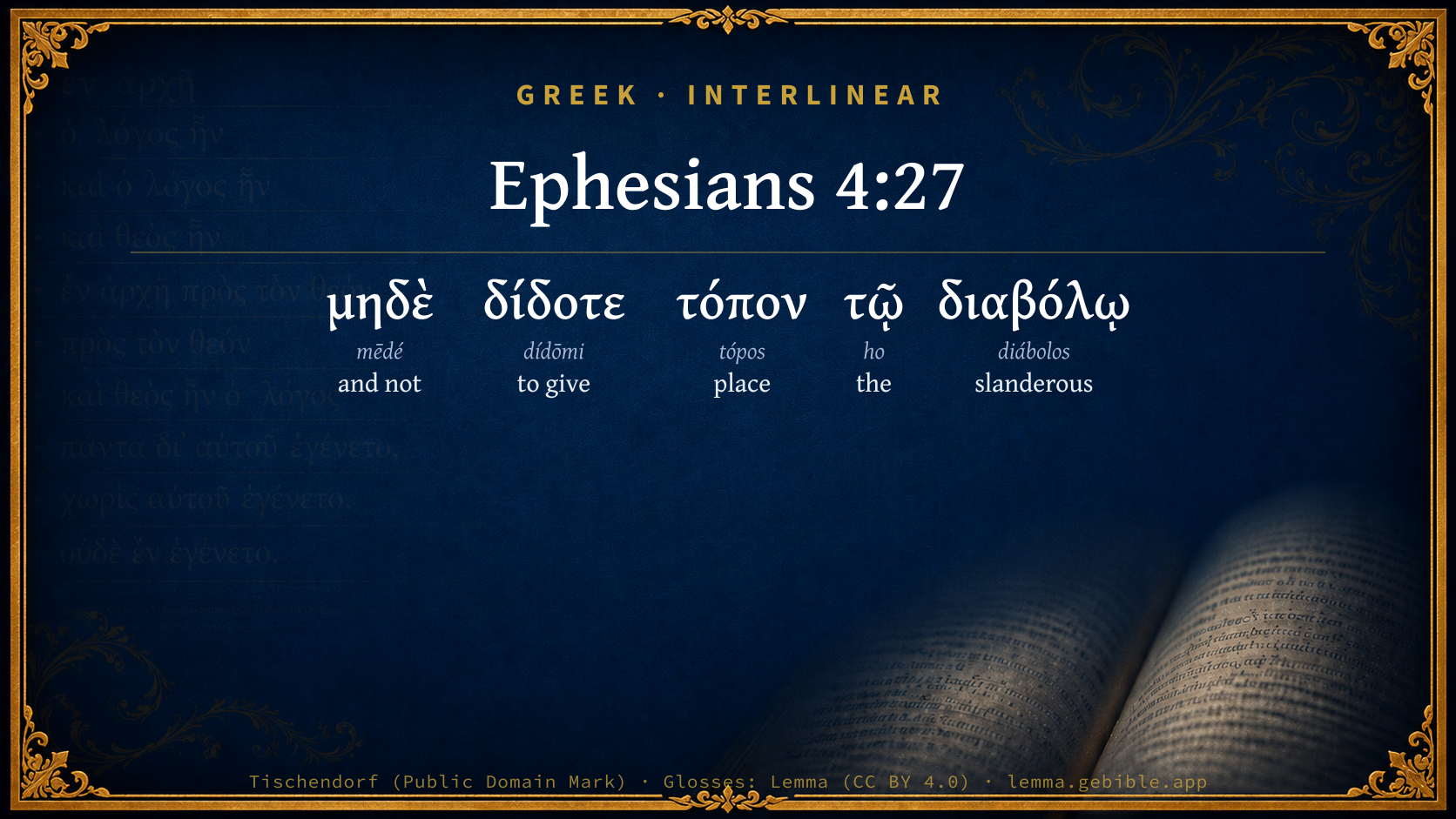
Greek (Tischendorf 8th ed.) Ephesians 4:27 appears in the Greek New Testament. The text above is from the Tischendorf 8th edition. Each word links to its Strong’s number and a concise gloss. Click any word for its full Thayer’s Greek Lexicon entry.
Download image
Cite this verse

Ephesians 4:27 (World English Bible). Public Domain. Lemma interlinear Bible study tool, https://lemma.gebible.app/v/ephesians/4/27.

Show BibTeX & RIS
BibTeX
RIS
English Translation
neither give place to the devil.
World English Bible · Public Domain
Download a study sheet

One document with this verse’s original text, its word-by-word gloss line, the meaning frame, cross-references with their text, attributed commentary, and full source and license credits — printable, and it pastes into notes with its structure intact.

This verse Autodidact and up

Study sheet (.html) Plain text (.txt)

A passage Seminary Student

Up to 50 verses in one chapter. A passage sheet keeps up to 6 commentary sources and 12 cross-references per verse, in the order this page ranks them, and says so on the sheet whenever that leaves anything out. Ask for a single verse and you get the Autodidact verse sheet above.

Everything on this page stays free to read, with no account — the sheet is a download of what is already on screen, not access to it.

Want to remove ads? Support Godless Engineer
Compare translations 3

The same verse in 3 English versions, stacked beneath the original-language interlinear above. Click any original word for its lexicon entry.

Each is an independent rendering of the whole verse — the interlinear is not word-aligned to these translations.

Highlighted words mark where these versions differ — a whole-verse word diff, not a word-by-word alignment.

  • World English Bible Public Domain
    neither give place to the devil.
  • King James Version Public Domain
    Neither give place to the devil.
  • unfoldingWord Literal Text CC BY-SA 4.0
    nor give an opportunity to the devil.

unfoldingWord Literal Text — © unfoldingWord, licensed CC BY-SA 4.0. Word-aligned USFM3 via Door43 (git.door43.org/unfoldingWord/en_ult).

Versions to compare (up to 4)

3 of 4 selected

Show all 19 translations

Every available English version of this verse, each an independent rendering of the whole verse.

  • World English Bible Public Domain
    neither give place to the devil.
  • Berean Standard Bible Public Domain
    and do not give the devil a foothold.
  • Majority Standard Bible Public Domain
    and do not give the devil a foothold.
  • King James Version Public Domain
    Neither give place to the devil.
  • American Standard Version (1901) Public Domain
    neither give place to the devil.
  • Revised Version (1885) Public Domain
    neither give place to the devil.
  • Geneva Bible (1599) Public Domain
    Neither giue place to the deuill.
  • Douay-Rheims (1899) Public Domain
    Give not place to the devil.
  • Young's Literal Translation Public Domain
    neither give place to the devil;
  • Literal Standard Version CC BY-SA 4.0
    neither give place to the Devil;
  • Unlocked Literal Bible CC BY-SA 4.0
    Do not give an opportunity to the devil.
  • unfoldingWord Literal Text CC BY-SA 4.0
    nor give an opportunity to the devil.
  • Darby Bible Public Domain
    neither give room for the devil.
  • World Messianic Bible Public Domain
    and don’t give place to the devil.
  • Webster's Bible Public Domain
    Neither give place to the devil.
  • Free Bible Version CC BY-SA 4.0
    and don't give the devil any opportunity.
  • Bible in Basic English Public Domain
    And do not give way to the Evil One.
  • Text-Critical English NT CC BY 4.0
    and do not give any opportunity to the devil.
  • Tyndale New Testament (1534) Public Domain
    nether geue place vnto the backbyter.

Literal Standard Version (2020), Covenant Press — licensed CC BY-SA 4.0. Text via the HelloAO Bible API (eBible.org). Unlocked Literal Bible (unfoldingWord) — licensed CC BY-SA 4.0. Text via the HelloAO Bible API (eBible.org). unfoldingWord Literal Text — © unfoldingWord, licensed CC BY-SA 4.0. Word-aligned USFM3 via Door43 (git.door43.org/unfoldingWord/en_ult). Free Bible Version, Dr. Jonathan Gallagher — licensed CC BY-SA 4.0. Text via the HelloAO Bible API (eBible.org).

Word by word

More ways to search: Search by grammar → Find every occurrence → Compare this word →

Practice this passage: Drill this verse → Learn its vocabulary →

διαβόλῳ
diábolos
G1228
“slanderous”
Adjective, Dative, Singular, Masculine
Part of Speech
Adjective
Case
Dative
Number
Singular
Gender
Masculine
Full Thayer's Definition

Origin: from G1225

TDNT: 03:12,1

1. prone to slander, slanderous, accusing falsely a. a calumniator, false accuser, slanderer, 2. metaph. applied to a man who, by opposing the cause of God, may be said to act the part of the devil or to side with him
  1. μηδὲ mēdé G3366 “and not” Conjunction, Negative
  2. δίδοτε dídōmi G1325 “to give” Verb, Present, Active, Imperative, 2nd person, Plural
  3. τόπον tópos G5117 “place” Noun, Accusative, Singular, Masculine
  4. τῷ ho G3588 “the” Article, Dative, Singular, Masculine

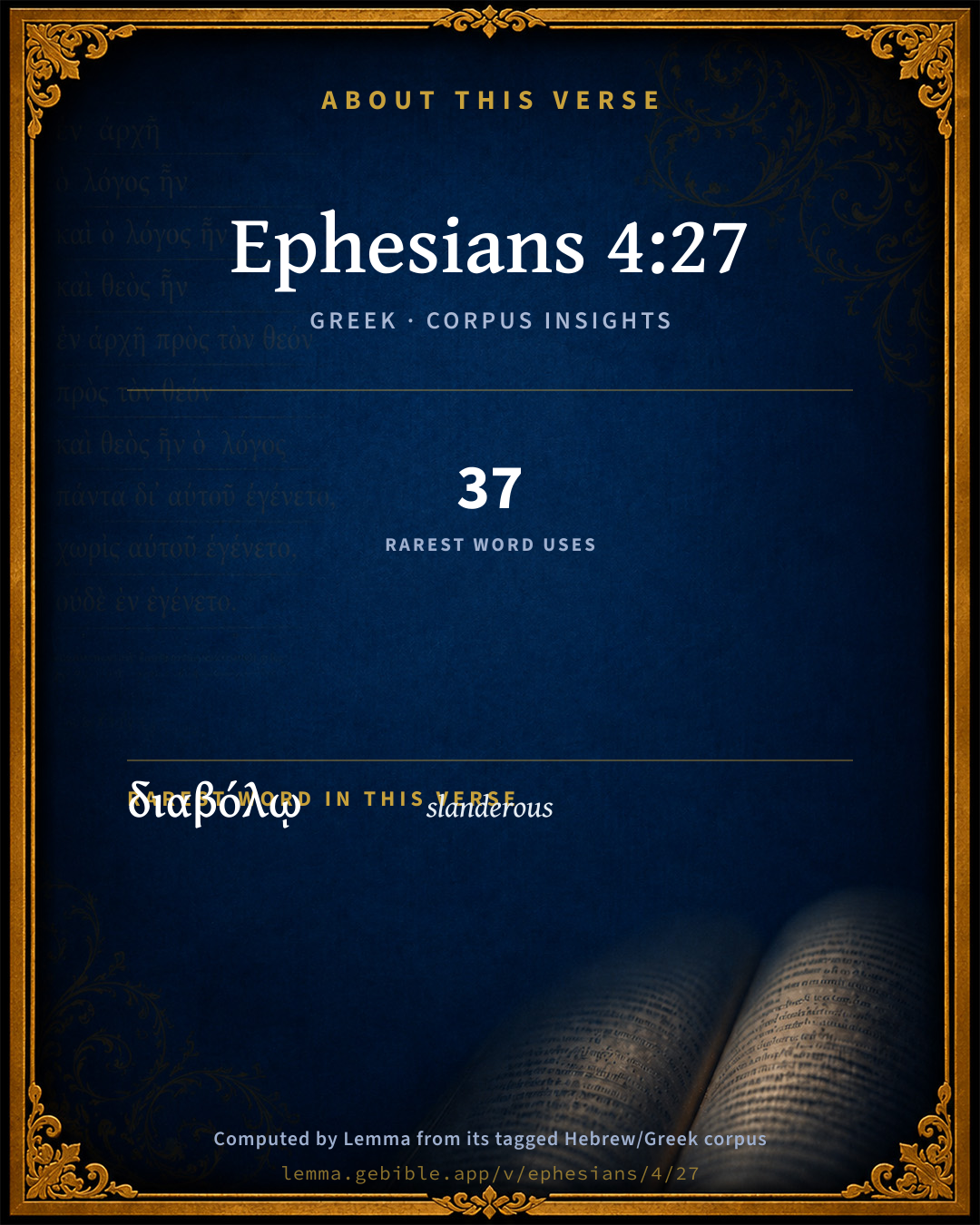
About this verse

These counts appear in no published source. They are computed here, from the morphology-tagged text and Lemma’s own curated glosses. What Lemma adds →

5
words
5
distinct lemmas
Pauline Epistles
section

Shared distinctive vocabulary

διαβόλῳ slanderous G1228 occurs in 35 verses of the Greek New Testament. Also found in:
Cross-references

6

Topical passages linked to Ephesians 4:27 in the Treasury of Scripture Knowledge — connected by theme and wording, ordered by reader-vote popularity; previews shown in the World English Bible.

  • James 4:7 Be subject therefore to God. But resist the devil, and he will flee from you.
  • Ephesians 6:16 above all, taking up the shield of faith, with which you will be able to quench all the fiery darts of the evil one.
  • 1 Peter 5:8 Be sober and self-controlled. Be watchful. Your adversary the devil, walks around like a roaring lion, seeking whom he may devour.
  • Ephesians 6:11 Put on the whole armor of God, that you may be able to stand against the wiles of the devil.
  • 2 Corinthians 2:10–11 Now I also forgive whomever you forgive anything. For if indeed I have forgiven anything, I have forgiven that one for your sakes in the presence of Christ,
  • Acts 5:3 But Peter said, "Ananias, why has Satan filled your heart to lie to the Holy Spirit, and to keep back part of the price of the land?

Cross-references courtesy of OpenBible.info (CC BY 4.0).

Commentary

Notes on Ephesians 4:27 from classic Christian and Jewish commentators (each source and its license shown beneath its notes). The classic Christian expositions comment on the surrounding passage and are grouped to its opening verse, so a note may address several verses; the Jewish commentaries on the Tanakh (Rashi and others) are per-verse, so they appear only where the commentator wrote on this verse.

Lemma curates 59 commentaries, every one of them public domain or Creative Commons licensed, each selected and text-cleaned for this edition rather than reprinted as found. About our sources →

The Biblical Illustrator

Joseph S. Exell

Eph_4:27

Neither give place to the devil.

The defeat to be dreaded

I. The devil strives to gain the mastery over man. He comes into actual contact with us, even against our will. He studies our character. When Napoleon entered fresh territory, he spread a map upon the ground, and upon his knees he pondered it until he made himself familiar with all its features; he knew the rivers with their bridges and fords, the villages and their position in relation to adjacent towns: he then planned his modes of attack. Our dread spiritual adversary has his wiles and stratagems. He watches his victim, acquaints himself with his constitutional infirmities, his temper, appetites, propensities; then constructs his assaults accordingly. In this collision of foeship he sternly resolves to conquer.

II. Man is to successfully resist the devil. He has the intercession of Christ, and the help of the Holy Spirit--two mighty forces.

III. The issue of the conflict.

1. If the devil gain the day, it means ruin to the soul.

2. Think of the importance of the strife, and strain every nerve for conquest. (J. D. Tetley.)

Danger of giving place to the devil

The devil is no myth nor bugbear to frighten bad children with, but a real being, and powerful. Most plausible and smooth of tongue, the devil makes the largest promises, but he is a poor paymaster. Old King Canute, the Dane, offered to make him the highest man in England who should murder his hated rival, King Edmund. The bloody deed was done, and the guilty wretch was hanged on the highest tower in London. So Satan promises to bestow upon his wining dupes anything and everything they ask, and the honour which they look for in return proves only shame, and the happiness ends in torment. Who is the most diligent bishop in all England? asks old Hugh Latimer, in one of his quaint sermons. I will tell you: it is the devil. He is the most diligent preacher of all others; he is never out of his diocese; he is ever applying to his business. His office is to hinder religion, to set up idolatry. It is well for us to remember that the Arch-Deceiver is the same that he always was, and he was never more to be dreaded than now. He has access to us in various ways, and he knows how to make the best of his opportunities. The devil is not omnipresent, but carries on his evil work by his countless agents. Here are some of the ways in which people give place to the devil.

1. The soul that is not filled with good thoughts and desires is left empty for the enemy to enter. One night, as St. Anthony sat in his cell, he heard a knocking at the door, and going to see who was there, he beheld a man of terrible aspect, and the monk asked, in alarm, who he was. The stranger answered, I am Satan; and I come to inquire how it is that thou and thy disciples, whenever ye stray into sin, or any evil befall ye, lay the blame on me, and load me with curses? St. Anthony answered, with some spirit, Have we not cause? Dost thou not go about seeking whom thou mayest devour, and tempt and torment us? The demon retorted, sharply, It is false; I do none of those things of which men accuse me; it is their own fault. They allure each other to sin; they torment and oppress each other; they go about seeking occasions to sin, and then they weakly lay the blame at my door. Since God came upon earth, and was made man to redeem man, I have no arms, no dwelling place. Let men complain of themselves, not of me. Ah, how mortifying the truth, my friends, that we as often tempt the devil as he tempts us!

2. Another way in which people put themselves in the power of the Great Adversary is by yielding to spiritual indolence. Industry and watchfulness distinguish all real Christians. As soon as they become indolent, they cease to be on their guard against the enemy of souls. Among the disciples of Hillel, the wise teacher of Israel, was one who gave himself up to idleness. The good rabbi was grieved, and resolved to cure him of it. He accordingly took him to the valley of Hinnom, by Jerusalem, where was a standing pool, full of loathsome reptiles, and covered with muddy weeds. Here, said Hillel, let us rest. Not here, cried the youth; dost thou not see what poisonous vapours it exhales? Thou art right, my son, replied the rabbi; and this bog is like the soul of the slothful! This is as true of things spiritual as of things temporal. Because iniquity shall abound, says our blessed Lord, the love of many shall wax cold (Mat_24:12). The atmosphere of sin is poisonous to everything sacred; but the first thing which it especially acts upon is love. Love is the tenderest of all plants of heaven.

3. Another favourable opportunity which Christians too often give to Satan to do them serious mischief, is the absorbing attention which they pay to their worldly business. I have just seen a beautiful picture, said one business man to another, after the cares of the day were done. What was it? It was a landscape. The conception is most beautiful, and the execution well nigh perfect. You must be sure to go and see it before it is removed. And so have I seen a fine picture today, said the other. Indeed! What was it? I received notice this morning that there was great suffering in a certain family, and as soon as I could leave my business, I went to see what could be done. I climbed up to the garret where the poor family was sheltered, and as I was about to knock at the door, I heard a voice in prayer. When it ceased, I entered the wretched apartment, and found a young merchant, whose store I had just been in, and whose business I knew to be very pressing. Yet he had left it, and spent some time in personal labours for the comfort of the sick and suffering, and when I arrived, he was praying with the family, preparatory to his taking his leave. I asked him how he could afford the time, at such a busy season, to engage in these merciful offices, and he told me that the ease of these poor sufferers had been made known to several professing Christians, who had given no heed to it. It is not absolutely necessary, he added, that I should make money; but it is necessary that the honour of Christ should be maintained. I dare say you have seen some fine pictures in the attractive windows of our print shops, but have you observed one finer than this? Oh, my friends, you who, by your absorbing devotion to worldly business, are, in fact, giving place to the devil, I pray you take time to examine this picture well, and if you admire it, try to furnish one like it. Dr. Judson once sent for a poor Christian convert, in India, who was about to engage in some enterprize which he feared would not be for her spiritual good. Look here, he said, snatching a ruler from the table, and tracing a crooked, zigzag line upon the floor, here is where you have been walking. You have been out of the path half the time, but then you have kept near it, and not taken to new roads, and you have, to a certain extent, grown in grace; and now here you stand. You know where this path leads. You know what is before you: some struggles, some sorrows, and, finally, eternal life and a crown of glory. To the left, branches off another very pleasant road, and along the air floats rather temptingly a pretty bubble. You do not mean to leave the path you have walked in for so many years; you only purpose to step aside, and catch the bubble, and think you will come back; but you never will! The lesson proved effectual in her case, and oh, my brethren, holding your eternal destiny in the balance, I pray God that it may not be unavailing in yours! (J. N. Norton, D. D.)

Hero to resist the devil

Neither give place to the devil. How, then, can we most effectually resist him?

1. Think of the promises of your heavenly Father; the purpose of His eternal love; the perfect and glorious attributes of His nature, all of which are engaged in your behalf.

2. Think of the person of the Lord Jesus Christ and the wondrous work which He has done and is still doing for you. These thoughts will strengthen your resolutions to resist the devil.

3. Prayer should be your defence in the hoar of trial.

4. Then, think finally on the cruelty, malignity, and final destiny of the devil. (W. Graham, D. D.)

One sin makes room for more

One sin keeps up the devils interest; it is like a nest egg left there to draw a new temptation. (T. Manton, D. D.)

By allowing one sin, we disarm and deprive ourselves of having a conscientious argument to defend ourselves against any other sin. He that can go against his conscience in one, cannot plead conscience against any other; for if the authority of God awes him from one, it will from all. How can I do this, and sin against God? said Joseph. I doubt not but his answer would have been the same if his mistress had bid him to lie for her, as now when she enticed him to lie with her. The ninth commandment would have bound him as well as the seventh. Hence the apostle exhorts not to give place to the devil. Implying, by yielding to one, we lose our ground, and what we lose he gains; and let him alone to improve advantages. The little wimble once entered, the workman can then drive a great nail. One sin will widen thy swallow a little, that thou wilt not so much strain at the next. (W. Gurnall.)

One sin inclineth the mind to more. If one thief be in the house, he will let in the rest, because they have the same disposition and design. (R. Baxter.)

On yielding to the devil

1. We may be sure of this, that the devil never means good, but always evil.

2. The more we yield to the influence of Satan, the further he will press his authority, and the more complete will be his dominion over us.

3. No one is obliged to yield to him. We can conquer if we will. (Homiletic Hints.)

Resist the beginnings of temptations

The Arabs have a fable to this effect. A miller was one day startled by a camels nose thrust through the window of the room where he was sleeping. It is very cold outside, said the camel; I only want to get my nose in. The nose was let in, then the neck, finally the whole body. Presently the miller began to be inconvenienced at the ungainly companion he had obtained, in a room certainly net large enough for both. If you are inconvenienced, you may leave, said the camel; as for myself, I shall stay where I am.

The Biblical Illustrator, edited by Joseph S. Exell (c. 1880s–1900s) — public domain. Text from a community e-Sword module.

Bengel's Gnomon

Johann Albrecht Bengel

Eph 4:27. Μήτε, Neither) Place is given to the devil by persisting in anger, especially during the night; comp. [the Rulers] of the darkness, ch. Eph 6:12.[74]—μήτε is used as ΚΑῚ ΜῊ, Eph 4:30.

[74] This reference also implies that Beng. takes the night, during which anger is retained, as figurative of the darkness over which the devil is prince. This does not exclude the literal sense. The literal keeping of anger during the night is typical of spiritual giving place to the devil, the ruler of darkness.—ED.

Bengel's Gnomon of the New Testament — English translation (T&T Clark, Edinburgh, 1860) — public domain. Text from a community e-Sword module.

Expositor's Greek Testament

ed. W. Robertson Nicoll

Eph 4:27 . μήτε δίδοτε τόπον τῷ διαβόλῳ : neither give place to the devil . The μήτε of the TR is supported by cursives and certain Fathers, but must be displaced by μηδέ , for which the evidence is overwhelming ( [462] [463] [464] [465] [466] [467] , etc.). μήτε properly used would have required μήτε , not μή , in the previous prohibition. μηδέ on the other hand is grammatically correct as it adds a new negative clause, = “also do not,” “nor yet” (Hartung, Partikl. , i., p. 210; Buttm., Gram. of N. T. Greek , p. 366; Jelf, Greek Gram. , § 776). τόπον , = room, opportunity; cf. Rom 12:19 . διάβολος is not = calumniator (Luth., etc.), as if the reference were to heathen slanderers of Christians (Erasm.), but = the devil , the word having always that sense in the NT when used as a noun (in 1Ti 3:11 ; 2Ti 3:3 ; Tit 2:3 it is probably an adject. ); cf. Mat 4:1 ; Mat 4:5 ; Mat 13:39 ; Mat 25:41 , etc. It has that sense again in 1Ti 3:6 . The more personal name Σατανᾶς occurs more frequently in the Pauline writings, while it is used only once in John’s Gospel (Joh 13:27 ) and never in his Epistles. On the other hand διάβολος is strange to Mark.

[462] Codex Vaticanus (sæc. iv.), published in photographic facsimile in 1889 under the care of the Abbate Cozza-Luzi.

[463] Codex Sinaiticus (sæc. iv.), now at St. Petersburg, published in facsimile type by its discoverer, Tischendorf, in 1862.

[464] Codex Claromontanus (sæc. vi.), a Græco-Latin MS. at Paris, edited by Tischendorf in 1852.

[465] Codex Augiensis (sæc. ix.), a Græco-Latin MS., at Trinity College, Cambridge, edited by Scrivener in 1859. Its Greek text is almost identical with that of G, and it is therefore not cited save where it differs from that MS. Its Latin version, f, presents the Vulgate text with some modifications.

[466] Codex Mosquensis (sæc. ix.), edited by Matthæi in 1782.

[467] Codex Angelicus (sæc. ix.), at Rome, collated by Tischendorf and others.

The Expositor's Greek Testament, edited by W. Robertson Nicoll (1897–1910) — public domain. Text from a community e-Sword module.

Hodge's Commentary on Romans, Ephesians & First Corinthians

Charles Hodge

Eph_4:26, Eph_4:27

His next exhortation has reference to anger; with regard to which he teaches

1. Not to allow anger to be an occasion of sin.

2. Not to cherish it.

3. Not to give Satan any advantage over us when we are angry.

The words ὀργίζεσθε καὶ μὴ ἁμαρτάνετε, be ye angry and sin not, are borrowed from the Septuagint version of Psa_4:4 and admit of different interpretations:

1. As the original text in Psa_4:4 admits of being rendered Rage and sin not, i.e. do not Sin by raging‹15› so the words of the apostle may mean, do not commit the sin of being angry. To this it is objected, that it makes the negative qualify both verbs, while it belongs really only to the latter. It is not necessary to assume that the apostle uses these words in the precise sense of the original text; for the New Testament writers often give the sense of an Old Testament passage with a modification of the words, or they use the same words with a modification of the sense. This is not properly a quotation; it is not cited as something the Psalmist said, but the words are used to express Pauls own idea. In Rom_10:18, Their sound is gone into all the earth, we have the language of the 19th Psalm but not an expression of the sense of the Psalmist.

2. Others make the first imperative in this clause permissive and the second commanding, Be angry and (but) do not sin.

3. Or the first is conditional, if angry, sin not. That is, sin not in anger; let not your anger be an occasion of sin. Repress it and bring it under control that it may not hurry you into the commission of sin. The meaning is the same as would be expressed by saying, ὀργιζόμενοι μὴ ἁμαρτάνετε, being angry sin not. This is perhaps the most satisfactory view of the passage.

It is indeed objected that the apostle is here speaking of sins, and that in Eph_4:31, he forbids all anger, and therefore any interpretation which assumes that anger is not itself a sin is inadmissible. But it is certain that all anger is not sinful. Christ himself, it is said, regarded the perverse laws with anger. Mar_3:5. The same generic feeling, if mingled with holy affections, or in a holy mind, is virtuous; if mingled with malice it is sinful. Both feelings, or both combinations of feeling, are expressed in Scripture by the term anger. Nothing in itself sinful can be attributed to God, but anger is attributed to him. Eph_4:31 is not inconsistent with this interpretation, for there the context shows the apostle speaks of malicious anger just as all hatred means all malice, and not the hatred of evil.

Let not the sun go down upon your wrath. The word is here παροργισμός, paroxysm or excitement. Anger even when justifiable is not to be cherished. The wise man says: Anger resteth in the bosom of fools. Ecc_7:9.

Neither give place to the devil. To give place to is to get out of the way of, to allow free scope to; and therefore to give an occasion or advantage to any one. We are neither to cherish anger, nor are we to allow Satan to take advantage of our being angry. Anger when cherished gives the Tempter great power over us, as it furnishes a motive to yield to his evil suggestions. The word διάβολος is rendered by Luther, Lästerer, slanderer. It is used as an adjective in that sense in 1Ti_3:11; 2Ti_3:3, and Tit_2:3, but with the article (ὁ διάβολος) it always means Satan the great accuser the prince of the demons or fallen angels, who is the great opposer of God and seducer of men against whose wiles we are commanded to be constantly on our guard.

Charles Hodge — Commentary on Romans (1835), First Corinthians (1857), and Ephesians (1856) — public domain. Text from a community e-Sword module.

Jamieson, Fausset & Brown

Robert Jamieson, A. R. Fausset & David Brown

Neither give place--that is, occasion, or scope, to the devil, by continuing in "wrath." The keeping of anger through the darkness of night, is giving place to the devil, the prince of darkness (Eph 6:12).

Jamieson, Fausset & Brown — Commentary Critical and Explanatory on the Whole Bible (1871) — public domain (CC PDM 1.0). Text via the HelloAO Bible API.

Adam Clarke's Commentary

Verse 27. Neither give place to the devil.] Your adversary will strive to influence your mind, and irritate your spirit; watch and pray that he may not get any place in you, or ascendancy over you.

As the word διαβολος is sometimes used to signify a calumniator, tale-bearer, whisperer, or backbiter; (see in the original, 1Ti 3:11; 2Ti 4:2; Tit 3:3, and Tit 2:3;) here it may have the same signification. Do not open your ear to the tale-bearer, to the slanderer, who comes to you with accusations against your brethren, or with surmisings and evil speakings. These are human devils; they may be the means of making you angry, even without any solid pretence; therefore give them no place, that you may not be angry at any time; but if, unhappily, you should be overtaken in this fault, let not the sun go down upon your wrath; go to your brother, against whom you have found your spirit irritated; tell him what you have heard, and what you fear; let your ears be open to receive his own account; carefully listen to his own explanation; and, if possible, let the matter be finally settled, that Satan may not gain advantage over either.

Adam Clarke's Commentary on the Bible (1810–1826) — public domain. Text from a community e-Sword/MySword module.

John Calvin's Commentaries

27. Neither give place (τῷ διαβόλῳ) to the devil. I am aware of the interpretation which some give of this passage. Erasmus, who translates it, “neither give place to the Slanderer,” (calumniatori,) shews plainly that he understood it as referring to malicious men. But I have no doubt, Paul’s intention was, to guard us against allowing Satan to take possession of our minds, and, by keeping in his hands this citadel, to do whatever he pleases. We feel every day how impossible, or, at least, how difficult it is to cure long-continued hatred. What is the cause of this, but that, instead of resisting the devil, we yield up to him the possession of our heart? Before the poison of hatred has found its way into the heart, anger must be thoroughly dislodged.

John Calvin's Commentaries (1540-1563) — public domain. Text from the Calvin Translation Society English edition (1840s-50s) via the Christian Classics Ethereal Library (ccel.org). Calvin's coverage is partial (roughly two-thirds of the Bible); uncommented books and verses are honest gaps, never fabricated. The 19th-century editor's footnotes and remarks are omitted so the notes are faithfully Calvin's own voice.

Ellicott's Commentary for English Readers

(27) Neither give place (i.e., scope) to the devil.—The name “Devil” is used by St. Paul only in his later Epistles (see Eph_6:11; 1Ti_3:6-7; 1Ti_6:9; 2Ti_2:26; Tit_2:3); in the earlier Epistles (Rom_16:20; 1Co_5:5; 1Co_7:5; 2Co_2:11; 2Co_11:14; 2Co_12:7; 1Th_2:18; 2Th_2:9) we have the name “Satan,” which is also found, less frequently, in the later also (1Ti_1:20; 1Ti_5:15). The latter name simply describes him as “the enemy “; the former describes one method of his enmity (as “the Tempter” another), for it signifies “one who sets at variance,” man with God, and man with man. Since this fiendish work is mostly contemplated as wrought by slander, the name is commonly taken to mean “the slanderer;” and when applied to human beings (as in 1Ti_3:11; 2Ti_3:3; Tit_2:3) it seems to convey some such meaning. But here the original sense suits the distinctive idea of the passage. In accordance with the general principle noted above, excess of wrath is forbidden, as giving opportunity to the enemy, who desires to break up unity, and “set at variance” those who should be one in Jesus Christ.

A Bible Commentary for English Readers, edited by Charles John Ellicott (1878–1897) — public domain. Text from a community e-Sword module.

The Cambridge Bible for Schools and Colleges

gen. ed. J. J. S. Perowne

27. give place to the devil] The rendering suggested by some, “to the calumniator,” the heathen or Jewish slanderer, is quite untenable, in view of St Paul’s use elsewhere of the word diabolos (lit., “Accuser”) for the great Enemy.

“Give place”:—as to one who would fain intrude at a half-open door, intent on occupying the house. Personal anger gives just such a point d’appui to the Spirit of pride and hatred. “Wherever the devil finds a heart shut, he finds a door open” (Monod). And this is true not of individuals only, but of the Church and its life.

The Cambridge Bible for Schools and Colleges (gen. ed. J. J. S. Perowne; Cambridge University Press, 1878–1918) — public domain. Text from a community e-Sword module.

John Gill's Exposition

And grieve not the Holy Spirit of God,.... Not a believer's own spirit, sanctified by the Holy Ghost, which is grieved by sin; nor the spirit of a good man, that hears our words and sees our actions, and is displeased and troubled at them; but the third person in the Trinity: and this is said of him by an anthropopathy, and supposes something done that is offensive to him; and he may be grieved, not only by unconverted persons, by their stubborn resistance and opposition to the Gospel and means of grace, and by their contempt of his person, office, and grace, but by believers themselves, and who are here spoken to; and which may be done both by their words, lying, angry, and corrupt ones, before cautioned against, Eph 4:25 and by their actions, their behaviour towards God, their conversation in the world, and by their carriage to one another, which is suggested in the following verse: also he may be grieved by their thoughts, their vain and sinful thoughts, and that they are no better employed; and especially when they entertain any undervaluing ones of Jesus Christ, whose glorifier he is; and by the unbelief of their hearts, and by their unmindfulness of the things of the Spirit; and when they disregard the rules, dictates, and advice of the Spirit, and make no use of him: and his being grieved appears by his departure from them; which is to be perceived by the darkness of their souls, the prevailings of corruption, the weakness of grace, and their backwardness to duty: and now there are many reasons why he should not be grieved; as because he is God, and the author of the new birth, the implanter and applier of all grace, and the finisher of it; because he is the saints' comforter, their advocate, helper, and strengthener; and their constant companion, who dwells in them, and will remain in them, until death: and it follows,

whereby ye are sealed unto the day of redemption; of the sealing work of the Spirit; see Gill on Eph 1:13. By "the day of redemption" may be meant, either the day of death, when the saints have a deliverance from the incumbrance of the body; from their present state of exile and banishment; from the body of sin and death; from all sorrows and afflictions; from the reproaches and persecutions of men; from the temptations of Satan; from doubts, fears, and unbelief; and from all fear of death, corporeal, spiritual, and eternal: or the day of the resurrection, when the body will be redeemed from mortality, corruption, weakness, and dishonour; when it will be refined and spiritualized, so that it will not stand in need of natural sustenance; will be endowed with great agility, like that of spirits; and will be subject to the soul, or spirit, and will be suited to spiritual objects; to which may be added, the day of judgment, Luk 21:28 when Christ shall appear in glory, and his saints with him, and he will put them, soul and body, into the possession of everlasting happiness; which will consist in the vision of Christ, in conformity to him, and in that happy company and conversation that will then be enjoyed, and that delightful employment they will be taken up in: and now the saints being sealed up by the Spirit unto this time, shows the perpetual indwelling of the Spirit in them; and that it will continue even after death, who will give them confidence at the day of judgment; and that it is the Spirit which works up the saints, and makes them meet for glory; and gives them the assurance of it, and therefore they should not be grieved.

John Gill's Exposition of the Whole Bible (1746–1763) — public domain (CC PDM 1.0). Text via the HelloAO Bible API.

Trapp's Complete Commentary

John Trapp

27 Neither give place to the devil.

Ver. 27. Neither give place, &c.] Vindictive spirits let the devil into their hearts; and though they defy him, and spit at him, yet they spit not low enough; for he is still at inn with them, as Mr Bradford speaketh. As the master of the pit often sets two cocks to fight together, to the death of both, and then, after mutual conquest, suppeth with both their bodies; so, saith Gregory, dealeth the devil with angry and revengeful men.

John Trapp, A Commentary or Exposition upon All the Books of the Old and New Testament (1647–1656) — public domain. Text from a community e-Sword module.

Albert Barnes' Notes on the Bible

Neither give place to the devil - This has respect probably to the exhortation in the former verse. “Do not yield to the suggestions and temptations of Satan, who would take every opportunity to persuade you to cherish unkind and angry feelings, and to keep up a spirit of resentment among brethren.” Many of our feelings, when we suppose we are merely defending our rights, and securing what is our own, are produced by the temptations of the devil. The heart is deceitful; and seldom more deceitful in any case than when a man is attempting to vindicate himself from injuries done to his person and reputation. The devil is always busy when we are angry, and in some way, if possible, will lead us into sin; and the best way to avoid his wiles is to curb the temper, and restrain even sudden anger. No man sins by “restraining” his anger: no man is certain that he will not who indulges it for a moment.

Albert Barnes' Notes on the Bible (1834–1885) — public domain. Text from a community e-Sword/MySword module.

Matthew Poole's English Annotations

Do not give advantage to the devil to possess your hearts, and put you upon more and greater evils: see Luk 22:3; Joh 13:27; Act 5:3.

Matthew Poole's English Annotations on the Holy Bible (1683–1685) — public domain. Text from a community e-Sword/MySword module.

Whedon's Commentary on the Bible

Daniel D. Whedon

27. Place… devil—For whom a man in a passion is a very exposed and endangered object.

Daniel D. Whedon (gen. ed.), Commentary on the Old and New Testaments (1874–1909) — public domain. Text from a community e-Sword module.

The Pulpit Commentary

Neither give place to the devil. Place or room, opportunity and scope for acting in and through you. There seems no special reference to the last exhortation, but as that demands a special act of vigilance and self-control, so the activity of the devil demands vigilance and self-control on all occasions, and especially on those on which the devil is most apt to try to get a foothold. The reference to the devil is not a figure, but an obvious recognition of his personality, and of the liability of all Christians to fall under his influence.

The Pulpit Commentary (1880–1919), ed. H.D.M. Spence-Jones & Joseph S. Exell — public domain. Text from a community e-Sword module.

John Wesley's Explanatory Notes

Neither give place to the devil - By any delay.

John Wesley, Explanatory Notes Upon the Whole Bible (1754–1765) — public domain. Text via the GEBible commentary corpus.

The People's New Testament

B. W. Johnson

27. Neither give place to the devil. By cherishing anger. A person under the dominion of anger is in a fit state to be tempted to evil deeds.

B. W. Johnson's The People's New Testament with Notes (1889–1891) — public domain. Electronic text from the Christian Classics Ethereal Library (CCEL) ThML edition.

Cambridge Greek Testament for Schools and Colleges

27. δίδοτε τόπον, ‘give room’ or ‘allow scope.’ Rom 12:19; Sir 4:5; Sir 19:17; Sir 38:2. See Robinson

τῷ διαβόλῳ. See Hort on Jas 4:7.

Cambridge Greek Testament for Schools and Colleges (Cambridge University Press, 1896; 21 vols, various authors incl. Carr, Maclear, Plummer, Farrar, Lumby, Moule, M. R. James, Simcox) — public domain. Text from a community e-Sword module.

Alford’s Greek Testament

Henry Alford

27.] nor again (there is a slight climax: see below. The rec. μήτε would require that μή before should be capable of being taken as μήτε, which it clearly cannot, on account of its position after ὁ ἥλιος) give scope (opportunity of action, which you would do by continuing in a state of παροργισμός) to the devil (not, to the slanderer, as Erasm., al.: διάβολος as a substantive always has this personal meaning in the N. T.; see reff.).

Henry Alford, The Greek Testament (1849–1861) — public domain. Text from a community e-Sword module.

International Critical Commentary

27. μηδὲ δίδοτε τόπον τῷ διαβόλῳ. The Rec. has μήτε, with most cursives; all the uncials apparently have μηδέ. μήτε would imply that St. Paul might have said μήτε … μήτε, but wrote μή in the first clause, because not then thinking of the second. Such a usage, μή … μήτε, is so rare in classical authors that some scholars have denied its existence, and it is not elsewhere found in St. Paul. The distinction between μήτε … μήτε and μηδέ … μηδέ, according to Hermann and others, is that the former divide a single negation into parts which are mutually exclusive; and neither negation gives a complete whole; thus corresponding to “neither … neither.” Comp. Mat 6:26, οὐ σπείρουσιν οὐδὲ θερίζουσιν οὐδὲ συνάγουσιν, “they sow not, and they reap not, and gather not”; Mat 12:32, οὔτε ἐν τούτῳ τῷ αἰῶνι οὔτε ἐν τῷ μέλλοντι, “neither in this world nor in the future,” these being the two divisions of οὐκ ἀρεθήσεται.

δίδοτε τόπον, i.e. room to act, since indulgence in angry feelings leads to hatred, malice, and all uncharitableness. Comp. Rom 12:19 δότε τόπον τῇ ὀργῇ.

τῷ διαβόλῳ. ὁ διάβολος is used by St. Paul only in this and the Pastorals. Erasmus, Luther, and others understand the word here as simply “calumniator,” and so the Syriac. But elsewhere in N.T. ὁ διάβολος always means “the devil.” In 1Ti 3:11; 2Ti 3:3; Tit 2:3, the word is used as an adjective.

International Critical Commentary — older volumes (1896–1929), various authors — public domain. Text from a community e-Sword module.

Vincent's Word Studies in the New Testament

Marvin R. Vincent

Place. Room.

Marvin R. Vincent, Word Studies in the New Testament (1887–1900) — public domain. Text from a community e-Sword/MySword module.

Lesson kit

Teaching starters — assembled from the data on this page, not authored interpretation. Every prompt links to the verse data it draws on. Edit before teaching.

Ephesians, in the Pauline Epistles, opens this verse with 5 words (5 distinct Greek lemmas). Its most distinctive word is diábolos (“slanderous”). A historical commentator’s framing appears above. Read the whole chapter for the surrounding context.

Discussion questions

  1. What does “slanderous” (diábolos) contribute to the verse as a whole?
  2. How does Matthew 4:1, which shares the word «slanderous», read alongside this verse?
  3. The translations on this page render this verse differently — a whole-verse word diff, not a word-by-word alignment. What might account for the different wordings?
  4. Compare how The Biblical Illustrator and Bengel's Gnomon read this verse. Where do they agree or differ?

Things to notice

Reading settings

Reading text

Shown beneath each verse's original-language words.

Old Testament
Old Testament edition

Read the OT as the Masoretic Hebrew (MT) or the Greek Septuagint (LXX).

English shown for the Greek Septuagint (in the Hebrew ↔ Greek comparison).

Comparing translations? Open the Compare panel on any verse page to stack up to four side by side.