
Colossians 3:11

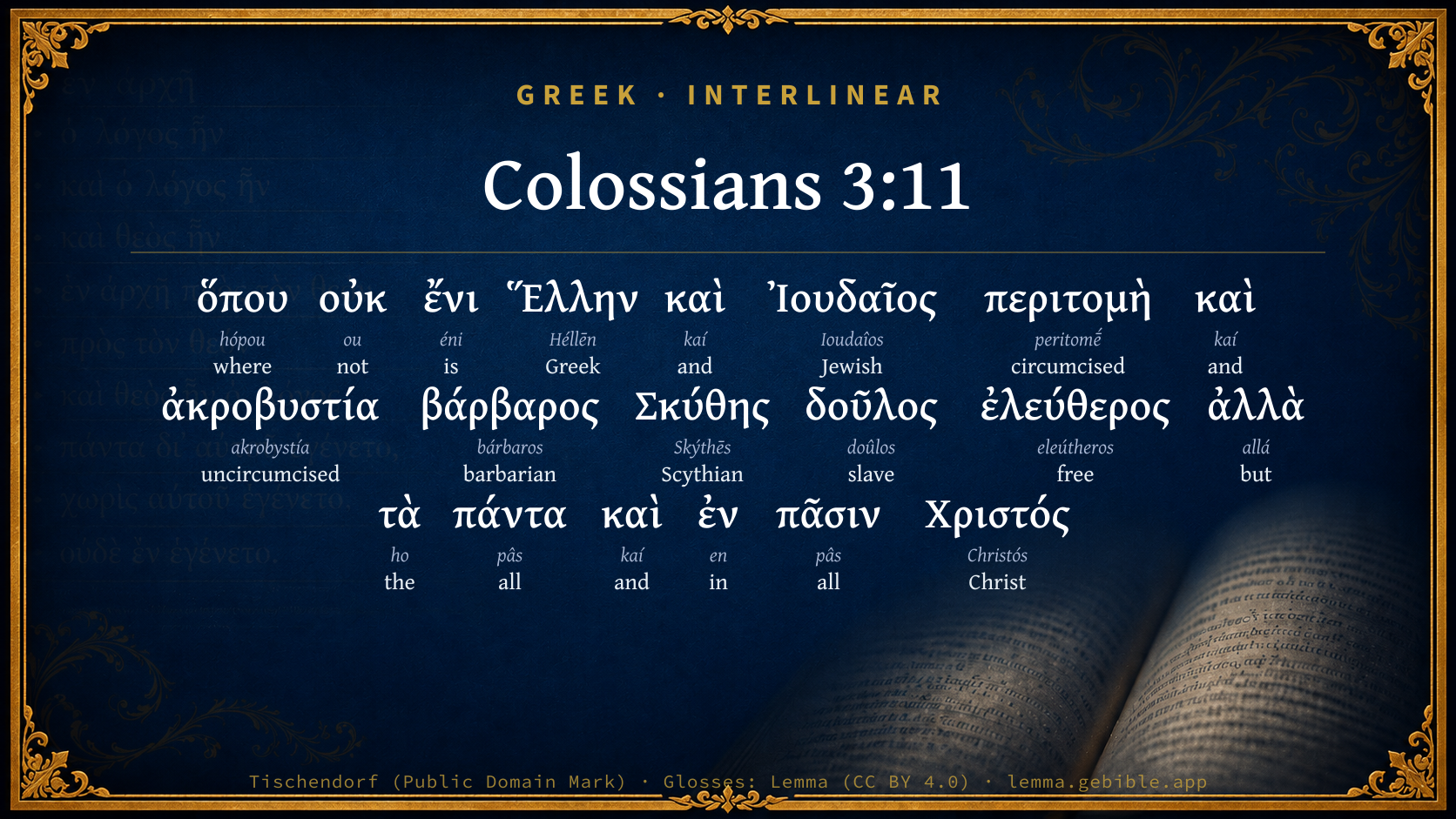
Greek (Tischendorf 8th ed.) Colossians 3:11 appears in the Greek New Testament. The text above is from the Tischendorf 8th edition. Each word links to its Strong’s number and a concise gloss. Click any word for its full Thayer’s Greek Lexicon entry.
Download image
Cite this verse

Colossians 3:11 (World English Bible). Public Domain. Lemma interlinear Bible study tool, https://lemma.gebible.app/v/colossians/3/11.

Show BibTeX & RIS
BibTeX
RIS
English Translation
where there can't be Greek and Jew, circumcision and uncircumcision, barbarian, Scythian, bondservant, freeman; but Christ is all, and in all.
World English Bible · Public Domain
Highlights
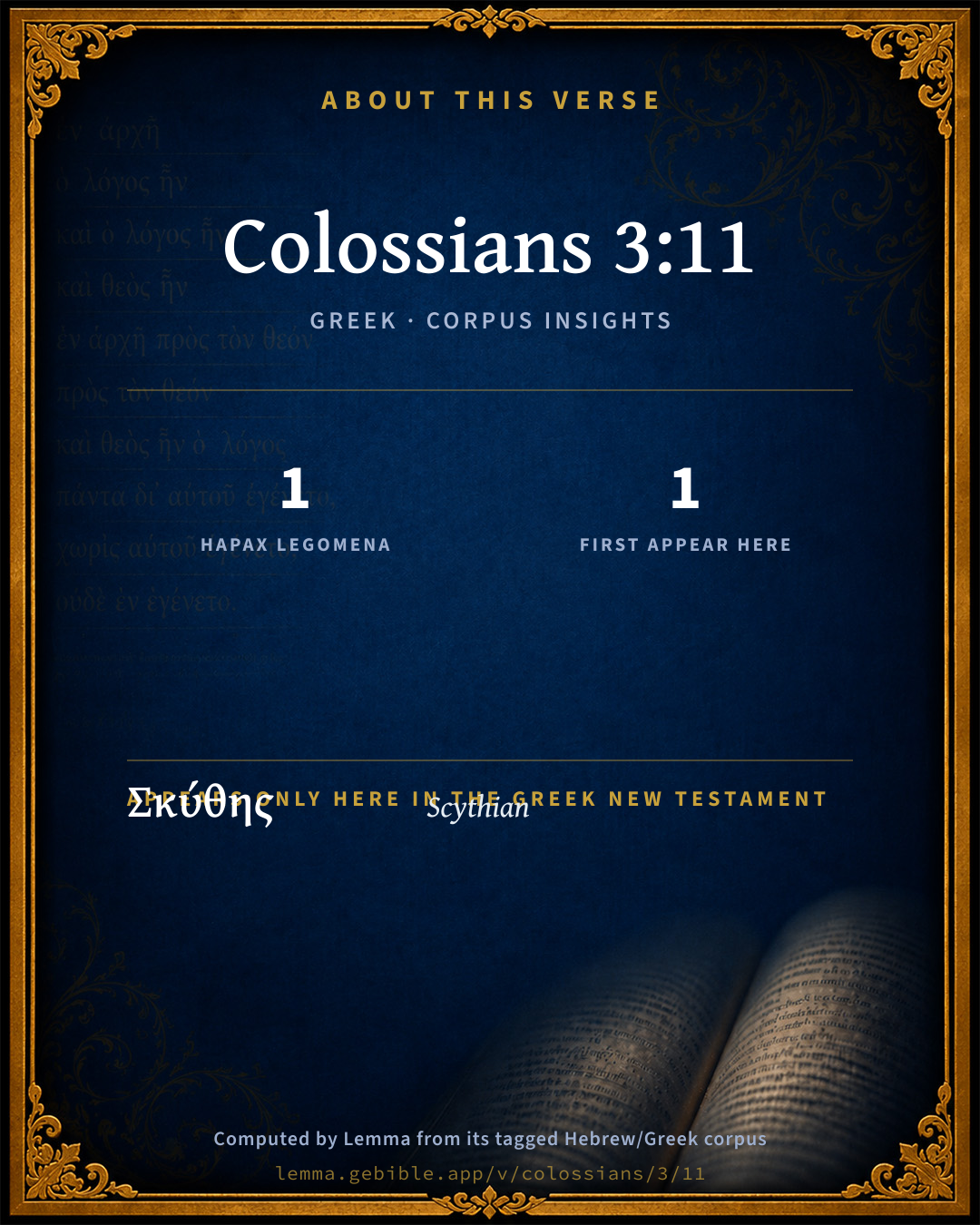
  • 1 hapax legomenon — only here in the Greek New Testament
  • 1 first appearance in the Greek New Testament
Full analysis ↓
Download a study sheet

One document with this verse’s original text, its word-by-word gloss line, the meaning frame, cross-references with their text, attributed commentary, and full source and license credits — printable, and it pastes into notes with its structure intact.

This verse Autodidact and up

Study sheet (.html) Plain text (.txt)

A passage Seminary Student

Up to 50 verses in one chapter. A passage sheet keeps up to 6 commentary sources and 12 cross-references per verse, in the order this page ranks them, and says so on the sheet whenever that leaves anything out. Ask for a single verse and you get the Autodidact verse sheet above.

Everything on this page stays free to read, with no account — the sheet is a download of what is already on screen, not access to it.

Want to remove ads? Support Godless Engineer
Compare translations 3

The same verse in 3 English versions, stacked beneath the original-language interlinear above. Click any original word for its lexicon entry.

Each is an independent rendering of the whole verse — the interlinear is not word-aligned to these translations.

Highlighted words mark where these versions differ — a whole-verse word diff, not a word-by-word alignment.

  • World English Bible Public Domain
    where there can't be Greek and Jew, circumcision and uncircumcision, barbarian, Scythian, bondservant, freeman; but Christ is all, and in all.
  • King James Version Public Domain
    Where there is neither Greek nor Jew, circumcision nor uncircumcision, Barbarian, Scythian, bond nor free: but Christ is all, and in all.
  • unfoldingWord Literal Text CC BY-SA 4.0
    where there is no Greek and Jew, circumcision and uncircumcision, barbarian, Scythian, slave, freeman, but Christ all, and in all.

unfoldingWord Literal Text — © unfoldingWord, licensed CC BY-SA 4.0. Word-aligned USFM3 via Door43 (git.door43.org/unfoldingWord/en_ult).

Versions to compare (up to 4)

3 of 4 selected

Show all 19 translations

Every available English version of this verse, each an independent rendering of the whole verse.

  • World English Bible Public Domain
    where there can't be Greek and Jew, circumcision and uncircumcision, barbarian, Scythian, bondservant, freeman; but Christ is all, and in all.
  • Berean Standard Bible Public Domain
    Here there is no Greek or Jew, circumcised or uncircumcised, barbarian, Scythian, slave, or free, but Christ is all and is in all.
  • Majority Standard Bible Public Domain
    Here there is no Greek or Jew, circumcised or uncircumcised, barbarian, Scythian, slave, or free, but Christ is all and is in all.
  • King James Version Public Domain
    Where there is neither Greek nor Jew, circumcision nor uncircumcision, Barbarian, Scythian, bond nor free: but Christ is all, and in all.
  • American Standard Version (1901) Public Domain
    where there cannot be Greek and Jew, circumcision and uncircumcision, barbarian, Scythian, bondman, freeman; but Christ is all, and in all.
  • Revised Version (1885) Public Domain
    where there cannot be Greek and Jew, circumcision and uncircumcision, barbarian, Scythian, bondman, freeman: but Christ is all, and in all.
  • Geneva Bible (1599) Public Domain
    Where is neither Grecian nor Iewe, circumcision nor vncircumcision, Barbarian, Scythian, bond, free: But Christ is all, and in all things.
  • Douay-Rheims (1899) Public Domain
    Where there is neither Gentile nor Jew, circumcision nor uncircumcision, Barbarian nor Scythian, bond nor free. But Christ is all, and in all.
  • Young's Literal Translation Public Domain
    where there is not Greek and Jew, circumcision and uncircumcision, foreigner, Scythian, servant, freeman -- but the all and in all -- Christ.
  • Literal Standard Version CC BY-SA 4.0
    where there is not Greek and Jew, circumcision and uncircumcision, foreigner, Scythian, servant, freeman, but Christ [is] all and in all.
  • Unlocked Literal Bible CC BY-SA 4.0
    This is where there is no Greek and Jew, circumcision and uncircumcision, barbarian, Scythian, slave, freeman, but Christ is all, and is in all.
  • unfoldingWord Literal Text CC BY-SA 4.0
    where there is no Greek and Jew, circumcision and uncircumcision, barbarian, Scythian, slave, freeman, but Christ all, and in all.
  • Darby Bible Public Domain
    wherein there is not Greek and Jew, circumcision and uncircumcision, barbarian, Scythian, bondman, freeman; but Christ [is] everything, and in all.
  • World Messianic Bible Public Domain
    where there can’t be Greek and Jew, circumcision and uncircumcision, barbarian, Scythian, bondservant, or free person; but Messiah is all, and in all.
  • Webster's Bible Public Domain
    Where there is neither Greek nor Jew, circumcision nor uncircumcision, Barbarian, Scythian, bond nor free: but Christ is all, and in all.
  • Free Bible Version CC BY-SA 4.0
    In this new situation there's no Greek or Jew, circumcised or uncircumcised, foreigner, barbarian, slave or free, for Christ is everything, and he lives in all of us.
  • Bible in Basic English Public Domain
    Where there is no Greek or Jew, no one with circumcision or without circumcision, no division between nations, no servant or free man: but Christ is all and in all.
  • Text-Critical English NT CC BY 4.0
    Here there is no distinction between Greek and Jew, circumcised and uncircumcised, barbarian, Scythian, slave and free, but Christ is all and in all.
  • Tyndale New Testament (1534) Public Domain
    where is nether gentile ner Iewe circumcision nor vncircumcision Barbarous or Sithian bonde or fre: but Christe is all in all thynges.

Literal Standard Version (2020), Covenant Press — licensed CC BY-SA 4.0. Text via the HelloAO Bible API (eBible.org). Unlocked Literal Bible (unfoldingWord) — licensed CC BY-SA 4.0. Text via the HelloAO Bible API (eBible.org). unfoldingWord Literal Text — © unfoldingWord, licensed CC BY-SA 4.0. Word-aligned USFM3 via Door43 (git.door43.org/unfoldingWord/en_ult). Free Bible Version, Dr. Jonathan Gallagher — licensed CC BY-SA 4.0. Text via the HelloAO Bible API (eBible.org).

Word by word

More ways to search: Search by grammar → Find every occurrence → Compare this word →

Practice this passage: Drill this verse → Learn its vocabulary →

Σκύθης
Skýthēs
G4658
“Scythian”
Noun, Nominative, Singular, Masculine
Part of Speech
Noun
Case
Nominative
Number
Singular
Gender
Masculine
Full Thayer's Definition

Origin: probably of foreign origin

TDNT: 14:27,1

Scythian = "rude or rough" 1. a Scythian, an inhabitant of Scythia or modern day Russia a. by the more civilised nations of antiquity the Scythians were regarded as the wildest of barbarians
  1. ὅπου hópou G3699 “where” Adverb
  2. οὐκ ou G3756 “not” Particle, Negative
  3. ἔνι éni G1762 “is” Verb, Present, Active, Indicative, 3rd person, Singular
  4. Ἕλλην Héllēn G1672 “Greek” Noun, Nominative, Singular, Masculine
  5. καὶ kaí G2532 “and” Conjunction
  6. Ἰουδαῖος Ioudaîos G2453 “Jewish” Adjective, Nominative, Singular, Masculine
  7. περιτομὴ peritomḗ G4061 “circumcised” Noun, Nominative, Singular, Feminine
  8. καὶ kaí G2532 “and” Conjunction
  9. ἀκροβυστία akrobystía G203 “uncircumcised” Noun, Nominative, Singular, Feminine
  10. βάρβαρος bárbaros G915 “barbarian” Adjective, Nominative, Singular, Masculine
  11. δοῦλος doûlos G1401 “slave” Noun, Nominative, Singular, Masculine
  12. ἐλεύθερος eleútheros G1658 “free” Adjective, Nominative, Singular, Masculine
  13. ἀλλὰ allá G235 “but” Conjunction
  14. τὰ ho G3588 “the” Article, Nominative, Plural, Neuter
  15. πάντα pâs G3956 “all” Adjective, Nominative, Plural, Neuter
  16. καὶ kaí G2532 “and” Conjunction
  17. ἐν en G1722 “in” Preposition
  18. πᾶσιν pâs G3956 “all” Adjective, Dative, Plural, Neuter
  19. Χριστός Christós G5547 “Christ” Noun, Nominative, Singular, Masculine

About this verse

These counts appear in no published source. They are computed here, from the morphology-tagged text and Lemma’s own curated glosses. What Lemma adds →

20
words
17
distinct lemmas
Pauline Epistles
section

Notable vocabulary

1 hapax legomenon — a word that appears only here in the entire Greek New Testament:

  • Σκύθης Scythian G4658

First appearance in Scripture

This word makes its first canonical appearance in the Greek New Testament here:

  • Σκύθης Scythian G4658

Shared distinctive vocabulary

ἔνι is G1762 occurs in 4 verses of the Greek New Testament. Also found in:
Repetition

Words recur within this verse:

Cross-references

50

Topical passages linked to Colossians 3:11 in the Treasury of Scripture Knowledge — connected by theme and wording, ordered by reader-vote popularity; previews shown in the World English Bible.

  • Galatians 3:28–29 There is neither Jew nor Greek, there is neither slave nor free man, there is neither male nor female; for you are all one in Christ Jesus.
  • 1 Corinthians 12:13 For in one Spirit we were all baptized into one body, whether Jews or Greeks, whether bond or free; and were all given to drink into one Spirit.
  • Romans 10:12 For there is no distinction between Jew and Greek; for the same Lord is Lord of all, and is rich to all who call on him.
  • Ephesians 3:6 that the Gentiles are fellow heirs, and fellow members of the body, and fellow partakers of his promise in Christ Jesus through the Gospel,
  • Ephesians 1:23 which is his body, the fullness of him who fills all in all.
  • Romans 9:24–26 us, whom he also called, not from the Jews only, but also from the Gentiles?
  • Romans 3:29 Or is God the God of Jews only? Isn't he the God of Gentiles also? Yes, of Gentiles also,
  • Galatians 5:6 For in Christ Jesus neither circumcision amounts to anything, nor uncircumcision, but faith working through love.
  • Matthew 12:18–21 "Behold, my servant whom I have chosen; My beloved in whom my soul is well pleased: I will put my Spirit on him. He will proclaim justice to the Gentiles.
  • John 17:23 I in them, and you in me, that they may be perfected into one; that the world may know that you sent me, and loved them, even as you loved me.
  • Isaiah 52:10 Yahweh has made bare his holy arm in the eyes of all the nations; and all the ends of the earth have seen the salvation of our God.
  • Acts 15:17 That the rest of men may seek after the Lord; All the Gentiles who are called by my name, Says the Lord, who does all these things.
  • 1 Corinthians 7:19 Circumcision is nothing, and uncircumcision is nothing, but the keeping of the commandments of God.
  • Galatians 2:20 I have been crucified with Christ, and it is no longer I that live, but Christ living in me. That life which I now live in the flesh, I live by faith in the Son of God, who loved me, and gave himself up for me.
  • Isaiah 49:6 yes, he says, It is too light a thing that you should be my servant to raise up the tribes of Jacob, and to restore the preserved of Israel: I will also give you for a light to the Gentiles, that you may be my salvation to the end of the earth.
  • Amos 9:12 that they may possess the remnant of Edom, and all the nations who are called by my name," says Yahweh who does this.
  • Micah 4:2 Many nations will go and say, "Come, and let us go up to the mountain of Yahweh, And to the house of the God of Jacob; And he will teach us of his ways, And we will walk in his paths." For out of Zion will go forth the law, And the word of Yahweh from Jerusalem;
  • Zechariah 2:11 Many nations shall join themselves to Yahweh in that day, and shall be my people; and I will dwell in the midst of you, and you shall know that Yahweh of Hosts has sent me to you.
  • Zechariah 8:20–23 Thus says Yahweh of Hosts: "Many peoples, and the inhabitants of many cities will yet come;
  • Malachi 1:11 For from the rising of the sun even to the going down of the same, my name is great among the nations, and in every place incense will be offered to my name, and a pure offering: for my name is great among the nations," says Yahweh of Hosts.
  • Acts 13:46–48 Paul and Barnabas spoke out boldly, and said, "It was necessary that God's word should be spoken to you first. Since indeed you thrust it from you, and judge yourselves unworthy of eternal life, behold, we turn to the Gentiles.
  • Romans 15:9–13 and that the Gentiles might glorify God for his mercy. As it is written, "Therefore will I give praise to you among the Gentiles, And sing to your name."
  • Isaiah 19:23–25 In that day shall there be a highway out of Egypt to Assyria, and the Assyrian shall come into Egypt, and the Egyptian into Assyria; and the Egyptians shall worship with the Assyrians.
  • Isaiah 66:18–22 For I [know] their works and their thoughts: [the time] comes, that I will gather all nations and languages; and they shall come, and shall see my glory.
  • Romans 9:30–31 What shall we say then? That the Gentiles, who didn't follow after righteousness, attained to righteousness, even the righteousness which is of faith;
  • Acts 26:17–18 delivering you from the people, and from the Gentiles, to whom I send you,
  • Romans 1:14 I am debtor both to Greeks and to foreigners, both to the wise and to the foolish.
  • 1 Corinthians 3:21–23 Therefore let no one boast in men. For all things are yours,
  • Colossians 2:10 and in him you are made full, who is the head of all principality and power;
  • John 15:5 I am the vine. You are the branches. He who remains in me, and I in him, the same bears much fruit, for apart from me you can do nothing.
  • Psalms 117:2 For his loving kindness is great toward us. Yahweh's faithfulness endures forever. Praise Yah!
  • Hosea 2:23 I will sow her to me in the earth; And I will have mercy on her who had not obtained mercy; And I will tell those who were not my people, 'You are my people;' And they will say, 'My God!'"
  • John 6:56–57 He who eats my flesh and drinks my blood lives in me, and I in him.
  • John 14:23 Jesus answered him, "If a man loves me, he will keep my word. My Father will love him, and we will come to him, and make our home with him.
  • Acts 28:2 The natives showed us uncommon kindness; for they kindled a fire, and received us all, because of the present rain, and because of the cold.
  • Acts 28:4 When the natives saw the creature hanging from his hand, they said one to another, "No doubt this man is a murderer, whom, though he has escaped from the sea, yet Justice has not allowed to live."
  • Romans 4:10–11 How then was it counted? When he was in circumcision, or in uncircumcision? Not in circumcision, but in uncircumcision.
  • Romans 8:10–11 If Christ is in you, the body is dead because of sin, but the spirit is alive because of righteousness.
  • 1 John 5:11–12 The testimony is this, that God gave to us eternal life, and this life is in his Son.
  • Jeremiah 16:19 Yahweh, my strength, and my stronghold, and my refuge in the day of affliction, to you shall the nations come from the ends of the earth, and shall say, Our fathers have inherited nothing but lies, [even] vanity and things in which there is no profit.
  • Acts 10:34–35 Peter opened his mouth and said, "Truly I perceive that God doesn't show favoritism;
  • 1 Corinthians 1:29–30 that no flesh should boast before God.
  • 1 Corinthians 7:21–22 Were you called being a bondservant? Don't let that bother you, but if you get an opportunity to become free, use it.
  • 1 Corinthians 14:11 If then I don't know the meaning of the sound, I would be to him who speaks a foreigner, and he who speaks would be a foreigner to me.
  • Galatians 6:14–15 But far be it from me to boast, except in the cross of our Lord Jesus Christ, through which the world has been crucified to me, and I to the world.
  • Ephesians 3:17 that Christ may dwell in your hearts through faith; to the end that you, being rooted and grounded in love,
  • Ephesians 6:8 knowing that whatever good thing each one does, he will receive the same again from the Lord, whether he is bound or free.
  • Philippians 3:7–9 However, what things were gain to me, these have I counted loss for Christ.
  • 1 John 5:20 We know that the Son of God has come, and has given us an understanding, that we know him who is true, and we are in him who is true, in his Son Jesus Christ. This is the true God, and eternal life.
  • 2 John 1:9 Whoever transgresses and doesn't remain in the teaching of Christ, doesn't have God. He who remains in the teaching, the same has both the Father and the Son.

Cross-references courtesy of OpenBible.info (CC BY 4.0).

Commentary

Notes on Colossians 3:11 from classic Christian and Jewish commentators (each source and its license shown beneath its notes). The classic Christian expositions comment on the surrounding passage and are grouped to its opening verse, so a note may address several verses; the Jewish commentaries on the Tanakh (Rashi and others) are per-verse, so they appear only where the commentator wrote on this verse.

Lemma curates 59 commentaries, every one of them public domain or Creative Commons licensed, each selected and text-cleaned for this edition rather than reprinted as found. About our sources →

The Biblical Illustrator

Joseph S. Exell

Col_3:11

Where there is neither Greek nor Jew.

Comparing the enumeration here with that in Gal_3:28, we mark this difference. In Galatians the abolition of all distinctions is stated in the broadest way by the selection of three typical instances: Religious prerogative, Jew and Greek; social ,caste, bond and free; natural sex, male and female. Here, on the other hand, the examples are chosen with special reference to the circumstances of the Colossian Church.

1. The Judaism of the Colossian heretics is met by Greek and Jew, and as it manifested itself especially in enforcing circumcision, this is further emphasized by circumcision nor uncircumcision.

2. Their Gnosticism is met by Barbarian, Sythian. They laid special stress on intelligence, penetration, gnosis. The apostle offers the full privileges of the gospel to barbarians even of the lowest type. In Rom_1:14 the division Greek and Barbarian is almost synonymous with wise and unwise.

3. Special circumstances connected with an eminent member of the Colossian Church had directed his attention at this moment to the relation of master and slaves. Hence he cannot leave the subject without adding bond, free. (Bishop Lightfoot.)

The high level

I. The gospel produces the new man.

1. Before man is made anew all influences fail to produce the change. The glories of heaven never move him to praise, the riches of the earth never touch his gratitude. Like a withered tree, which receives no benefit from sunshine or shower, gracious influences made no impression.

2. But thrown into the crucible and mould of the Cross, he comes out a new man. New thoughts crowd the theatre of his mind, new emotions flower in the garden of his soul, new prospects enliven his future, and impelled by new convictions he builds up a new character. When ignorant become learned and subjects kings, there is less change than when lions become lambs, and Gods enemies His friends.

3. The new man is possible to all. You cannot make poets, painters, musicians, soldiers, statesmen of all men, but the gospel can renovate all.

II. The gospel unites mankind under one head.

1. There were distinctions.

(1) The national contrast between Jew and Greek was strong. The boast of race, achievements, culture, etc., created mutual contempt. Those who gloried in Alexander and Socrates were scornfully reminded of David and Solomon.

(2) The religious distinction was still sharper.

(3) That between high and low was observed with rigour, there being no middle class.

2. All these distinctions must be sunk and the race come up by another way.

(1) All men must humble themselves in the sight of God. The gospel does not propose to readjust these various claims, but to press regeneration on all. Paul once prided himself on his distinctions, but they vanished in view of the great question, What must I do to be saved?

(2) The gospel leads to an exaltation which leaves the most exalted human stations behind. Stars shine brightly till the sun appears. The barbarian at the foot of the Cross is higher than Caesar on his throne. He who embraces Christ is rich, while the millionaire who trusts in riches is poor.

III. The gospel assimilates human life to that of christ.

1. Christ absorbs every other condition which influences the mind. The river which flows over mountain and dale preserves its name and identity all the way to its mouth--then it is lost. So with him whose life-streams flow towards Christ, they will be absorbed in the ocean of His love. We surrender all to the claims of the Cross.

2. Christ is seen and felt in all the relations of life. Nature, duty, etc., which before were Christless, are now full of Christ.

3. As Christ is all in all and we in Him, therefore all things are ours. (T. Davies, Ph. D.)

Christ is all.--

Christ is all

There are two worlds, the old and the new. These are peopled by two sorts of manhood, the old man, and the new man, concerning whom see verses 9, 10.

I. What there is not is the new. When we come to be renewed after the image of Him that created us, we find an Obliteration of--

1. National distinctions: Where there is neither Greek nor Jew. Jesus is The Man. In the broadest sense He is neither Jew nor Gentile. Jesus furnishes us with a new patriotism, loyalty, and clanship, which we may safely indulge to the utmost.

2. Ceremonial distinctions: There is neither circumcision nor uncircumcision. The separating rite is abolished, and the peculiar privilege of a nation born after the flesh is gone with it.

3. Social distinctions: There is neither bond nor free. We are enabled through Divine grade to see that these distinctions are--

(1) Transient.

(2) Superficial.

(3) Of small value.

(4) Nonexistent in the spiritual realm.

What a blessed blending of all men in one body is brought about by our Lord Jesus! Let us all work in the direction of unity.

II. What there is in the new. Christ is all and in all.

1. All our culture. In Him we emulate and excel the Greek.

2. All our revelation. We glory in Him even as the Jew gloried in receiving the oracles of God.

3. All our ritual. We have no circumcision. All Scriptural ordinances are of Him.

4. All our simplicity.

5. All our natural traditions. He is more to us than the freshest ideas which cross the mind of the Barbarian.

6. All our unconquerableness and liberty. The Scythian had not such boundless independence as we find in Him.

7. All as our Master, if we be bond. Happy servitude of which He is the head!

8. Our Magna Charta: yea, our liberty itself if we be free.

Conclusion: Christ all and in all furnishes a test question for us.

1. Is Christ so great with us that He is our all?

2. Is Christ so broadly and fully with us that He is all in our all?

3. Is He, then, all in our trust, our hope, our assurance, our joy, our aim, our strength, our wisdom--in a word, all in all?

4. If so, are we living in all for Him?

5. Are we doing all for Him, because He is all to us? (C. H. Spurgeon.)

But Christ is all in all

Here in the text Christ is said to be all; but in what sense is Christ all?

1. Christ is all by way of eminency; all good things are eminently to be found in Him, as the sun doth virtually contain in it the light of the lesser stars.

2. Christ is all, by way of derivation; all good things are transmitted and conveyed to us through Christ; as your rich commodities, jewels, and spices come by sea, so all heavenly blessings sail to us through the red sea of Christs blood; through Him and to Him are all things. Christ is that spiritual pipe, through which the golden oil of mercy empties itself into the soul. Christ must needs be all, for in Him dwelleth all the fulness of the Godhead. He hath a partnership with God the Father; all things that the Father hath are Mine; so that there is enough in Him to scatter all our fears, to remove all our burdens, to supply all our wants; there can be no defect in that which is infinite. It shows us the glorious fulness of Jesus Christ; He is all in all. Christ is a panoply, a magazine and storehouse of all spiritual riches: you may go with the bee from flower to flower, and suck here and there a little sweetness, but you will never have enough till you come to Christ, for Be is all in all.

Now, in particular, Christ is in all six respects:

1. Christ is all in regard of righteousness--He is made to us righteousness.

2. Christ is all in regard of sanctification--He is made to us sanctification. This doth tune and prepare the soul for heaven; it turns iron into gold; it makes the heart which was Satans picture, Christs epistle. There must be first our days of purification before our days of glorification. What a blessed work is this! A soul beautified and adorned with grace, is like the firmament bespangled with glittering stars. But whence is this? Christ is all; He is made to us sanctification; He it is that sends His Spirit into our hearts to be a refiners fire, to burn up our dross, and make our graces sparkle like gold in the furnace; Christ ariseth upon the soul with healing in His wings.

3. Christ is all in regard of Divine acceptance. As Joseph did present his brethren before Pharaoh, and brought them into favour with the king, so the Lord Jesus carries the name of the saints upon His breast, and presents them before His Father, so bringing them into repute and honour. Through the red glass everything appears of a red colour; through the blood of Christ we look of a sanguine complexion, ruddy and beautiful in Gods eyes.

4. Christ is all in regard of Divine assistance; a Christians strength lies in Christ. Whence is it a Christian is able to do duty, to resist temptation, but through Christs strengthening?

5. Christ is all in regard of pacification; when conscience is in an agony, and burns as hell in the sense of Gods wrath; now Christ is all, He pours the palm of His blood into these wounds, He maketh the storm a calm. Christ doth not only make peace in the court of heaven, but in the court of conscience; He not only makes peace above us, but within us.

6. Christ is all in regard of remuneration; He it is that crowns us after all our labours and sufferings. If Christ be all, it shows what a vast disproportion there is between Christ and the creature; there is as much difference as between ens and nihil; Christ is all in all, and the creature is nothing at all--wilt thou set thine eyes on that which is not? In all our spiritual wants we should repair to Christ as Jacobs sons did to their brother Joseph. He opened all the store-houses, and gave to his brethren corn and provision for the way. Thus the Lord hath made Christ our Joseph; in whom are hid all treasures. If Christ be all, see here the Christians inventory, how rich is he that hath Christ! he hath all that may make him completely happy. Plutarch reports that the wife of Phocion being asked where her jewels were, she answered, My husband, and his triumphs are my jewels! so, if a Christian be asked, where are his riches, he will say, Christ is my riches. How could a Christian sit down satisfied with Christ? Christ is all. What though he wants other things, is not Christ enough? If a man hath sunshine, he doth not complain he wants the light of a candle. Thou hast Christ with all His perquisites and royalties! Suppose a father should deny his son furniture for his house, but should settle all his land upon him, had he any cause to complain? If God denies thee a little furniture in the world, but in the meantime settles His land upon thee, He gives thee the field wherein the pearl of price is hid, hast thou any cause to repine? A Christian that wants necessaries, yet having Christ, he hath the one thing needful; ye are complete in Him. What! complete in Christ, and not content with Christ? If Christ be all, see the deplorable condition of a Christless person; he is poor, he is worth nothing; thou are wretched, miserable, and poor, etc.

The sadness of a man that wants Christ will appear in these seven particulars.

1. He hath no justification.

2. He that wants Christ, wants the beauty of holiness; Jesus Christ is a living spring of grace; full of grace and truth.

3. He that wants Christ, wants His freedom; if the Son make you free, you shall be free indeed.

4. He that wants Christ, hath no ability for service.

5. He that wants Christ, hath no consolation; Christ is called the consolation of Israel. A Christless soul is a comfortless soul.

6. He that wants Christ, hath no salvation.

1. If Christ be all, then set a high valuation upon Jesus Christ; to you which believe, He is precious.

2. If Jesus Christ be all, then make sure of Christ; never leave trading in ordinances, till you have gotten this pearl of price. In Christ there is the accumulation of all good things.

And that I may persuade all to get Christ, let me show what an enriching blessing Christ is.

1. Christ is a supreme good; put what you will in the balance with Christ, He doth infinitely outweigh. Is life sweet? Christ is better: He is the life of the soul; His loving: kindness is better than life.

2. Christ is a sufficient good; He who hath Christ, needs no more; he who hath the ocean, needs not the cistern.

3. Christ is a sanctifying good, He makes every condition happy to us, He sweetens all our comforts, and sanctifies all our crosses.

4. Christ is a select, choice good. God shows more love in giving us Christ, than in giving us crowns and kingdoms.

5. Christ is such a good, as without which nothing is good, without Christ health is not good, it is fuel for lust: riches are not good, they are golden snares; ordinances are not good, though they are good in themselves, yet not good to us.

6. Christ is an enduring good; other things are like the lamp, which while it shines it spends, the heavens shall wax old like a garment.

7. Christ is a diffusive, communicative good; He is full, not only as a vessel, but as a spring, He is willing to give Himself to us.

But how shall I get a part in Christ?

1. See your need of Christ, know that you are undone without Him.

2. Be importunate after Christ. Lord, give me Christ, or I die!

3. Be content to have Christ, as Christ is offered,

A Prince and a Saviour.

1. Make Christ all in your understanding, be ambitious to know nothing but Christ. What is it to have knowledge in physic--to be able with Esculapius and Galen to discourse of the causes and symptoms of a disease, and what is proper to apply, and in the meantime to be ignorant of the healing under Christs wings? What is it to have knowledge in astronomy--to discourse of the stars and planets, and to be ignorant vi Christ, that bright morning-star which leads to heaven? We cannot know God but through Christ.

2. Make Christ all in your affections. Love nothing but Christ; love is the choicest affection, it is the richest jewel the creature hath to bestow; O if Christ be all, love Him better than all!

3. Make Christ all in your abilities, do all in His strength, be strong in the Lord, and in the power of His might. When you are to resist a tentation, to mortify a corruption, do not go out in your own strength, but in the strength of Christ: be strong in the Lord.

4. Make Christ all in your aims; do all to His glory.

5. Make Christ all in your affiance; trust to none but Christ for salvation; the Papists make Christ something, but not all.

6. Make Christ all in your joy. God forbid that I should glory, save in the cross of our Lord Jesus Christ. When a Christian sees a deficiency in himself, he may see an all-sufficiency in his Saviour: happy is that people whose God is the Lord! That servant needs not want who hath his masters full purse at command: he needs not want who hath Christ, for Christ is all and in all. (T. Watson.)

Christ is all

The doctrine of the text--

I. Accounts for the essential similarity of Christian character. Innumerable are the causes of diversity--constitutional peculiarities, external circumstances, accidental associations. But amidst all these, whether men are slaves or freemen, rude or civilized, etc., the Christian principle equalizes all, us forming a common centre, a standard under which all are enlisted, the source of their felicity, the rejoicing of their hearts. Christ is all in all.

1. To those who believe in Him.

2. In all the felicities of an eternal life.

II. Illustrates the true unity of the church. To produce unity uniformity has been attempted, but this is different from oneness of spirit. No visible accordance by subscribing to formularies or uniting in observances can realize unity. There will be a period when this will be realized; but amidst all that separates, amidst all that enemies and friends have done to injure the cause, there is a real and effective unity between Christians. Bring believers of every age, class, name together, and one chord will vibrate in every heart, one topic be the theme of every song, one principle the life of all. They are all in Christ and therefore one: one in relationship, sympathy, joy, sorrow, hope.

III. Proves the universality of the Christian dispensation. This is the religion of man; adapted to him wherever you find him, whether scorched by Indian suns or blanched by northern snows. All men are lost; Christianity comes to save all men. The religion of Christ, unlike any other, has nothing local or restrictive. There are no circumstantials in it to narrow its range. This universality--

1. Is founded on the condition of man in all circumstances.

2. Is proved by its actual results wherever received.

3. Is provided for by the security of the everlasting covenant.

4. Is guaranteed to the Church by the presence of Christ.

IV. Constitutes the great subject of the Christian ministry, and assigns the true cause of its efficiency. I if I be lifted up, etc.

V. Exhibits an adequate source of consolation and support in the prospect of death and eternity.

1. It secures a victory over the king of terrors.

2. It ensures an abundant entrance into heaven. (J. Fletcher, D. D.)

Christ is all

These three words are the essence of Christianity. If our hearts really go along with them it is well. If not we have much to learn. Christ is all.

I. In all the counsels of God concerning man.

1. There was a time when this earth had no being, where was Christ then? (Joh_1:1; Php_2:6; Joh_17:5; Joh_17:24; Pro_7:23).

2. There came a time when this earth was created in its present order. Where was Christ then? (Joh_1:3; Col_1:16; Heb_1:10; Pro_8:27-30).

3. There came a day when sin entered the world. Where was Christ then? (Gen_3:15).

4. There came a time when the world seemed buried in ignorance of God. For 4,000 years the nations of the earth appeared to have clean forgotten the God that made them (1Co_1:21). What did Christ do then? Left His eternal glory and came down to provide a salvation.

5. There is a time coming when sin shall be cast out from this world (Rom_8:22; Act_3:21; 2Pe_3:13; Isa_11:9). Where shall Christ be then? And what shall He do? (Mat_24:30; Rev_11:15; Psa_2:8; Php_2:10-11; Dan_7:14).

6. There is a day Coming when all men shall be judged. Where will Christ be then? (Joh_5:22; Mat_25:32; 2Co_5:10). Now, if any think little of Christ, he is very unlike God. He is of one mind and God of another. In all the eternal counsels of God the Father, in creation, redemption, restitution, and judgment Christ is all (Joh_5:23).

II. Is the inspired books which make up the bible.

1. It was Christ crucified who was set forth in every Old Testament sacrifice (1Pe_3:18).

2. It was Christ to whom Abel looked when he offered a better sacrifice than Cain (Heb_11:4).

3. It was Christ of whom Enoch prophesied in the days of abounding wickedness before the flood (Jud_1:15).

4. It was Christ to whom Abraham looked when he dwelt in tents in the land of promise (Joh_8:56).

5. It was Christ of whom Jacob spoke to his sons, as he lay dying (Gen_49:10).

6. It was Christ who was the subject of the ceremonial law. The sacrifices, altar, priesthood, etc., were emblems of Christ and His work (Gal_3:24).

7. It was Christ to whom God directed the attention of Israel by all the miracles of the wilderness (1Co_10:4; Joh_3:14).

8. It was Christ of whom the Judges were types.

9. It was Christ of whom David was a type.

10. It was Christ of whom all the prophets from Isaiah to Malachi spoke (1Pe_1:11).

11. It is Christ of whom the whole New Testament is full. The Gospels are Christ living among men; the Epistles are Christ explained and exalted; the Acts are Christ proclaimed. What is the Bible to you? A book of good moral precepts, or one in which Christ is all and in all? If not the latter you have used it to little purpose. You are like a man who studies the solar system and leaves out the sun.

III. In the religion of all true christians. Christ is all--

1. In a sinners justification before God (Eph_3:12; Rom_3:26). Wherewith shall man come before God? Shall we say we have done our duty, and bring forward prayers, morality, church-going? Which of these will stand Gods searching inspection? None. We must come through Jesus.

(1) His righteousness is the only robe which can cover us.

(2) His name our only shibboleth at the gate of heaven.

(3) His blood the only mark that can save us from destruction.

2. In a Christians sanctification.

(1) No man is holy till he is united to Christ (Joh_15:5).

(2) None grows in holiness except he abide in Christ (Col_2:6-7).

3. In a Christians comfort in time present. A saved soul has many sorrows and trials, which were unbearable but for Christ (Php_2:1). Jesus is a brother born for adversity (Heb_4:15). We talk of the preciousness of sympathy, but there is none like that of Christ (Psa_94:19; Psa_124:5). In Him alone there is no failure. Rich men are disappointed in their wealth, learned men in their books, husbands in their wives, etc., statesmen in their places; but none was ever disappointed in Christ.

4. In a Christians hopes for time to come. He has a good hope, the worldly man has none. It is a blessed hope (Tit_2:13; Psa_62:5).

IV. In heaven.

1. Like the altar in Solomons temple Christ will be the grand object in heaven (Rev_5:6; Rev_21:23).

2. His praise will be our eternal song (Rev_5:12-13).

3. His service will be our one occupation (Rev_7:15).

4. His presence will be our one everlasting enjoyment (Rev_22:4; Psa_17:15). All this being the ease, then Christ ought to be all in all.

V. In the visible Church Splendid buildings, gorgeous ceremonies, troops of ordained men are nothing in the sight of God if Christ be not magnified.

VI. In the Christian ministry. Its one work is to lift up Christ. Conclusion: Learn--

1. The utter uselessness of a Christless religion.

2. The enormous folly of joining anything with Christ in the matter of salvation.

3. If you want to be saved to apply direct to Christ.

4. If you be Christians deal with Him as if you really believed this; trust Him far more than you have ever done. (Bishop Ryle.)

Christ is all

I. By whom this truth is recognized.

1. There are many to whom Christ is nothing; He scarcely enters into their thoughts.

2. There are others to whom Christ is something but not much. They are anxious to save themselves, and use the merits of Christ as a sort of make weight to their own slight deficiencies.

3. Others think Him to be much but not all, and so want to feel more, repent more, before they accept Him.

4. Some regard Christ as all in some things, in justification, e.g., but not sanctification, whereas it is said that He is made unto us wisdom, etc. There is no point between the gates of hell and the gates of heaven where a believer has to say, Christ fails me here and I must rely on my own endeavours.

5. This is a truth which every believer recognizes, and on which the Church, in spite of its divisions, is one. The man who cannot say this is no Christian, the man who can is.

II. What this truth includes.

1. Christ is all by way of

(1) National distinction. As a man I may rejoice that I am an Englishman, but not with the same joy as that I am a Christian. A Christian foreigner is more allied to me than a godless Briton.

(2) Subject for glorying. The Greek said, We are a nation of heroes, remember Sparta; but when he joined the Church he boasted of a nobler victory through the Cross. So the Jew laid aside his national traditions; the Scythian spoke the language of Canaan as correctly as his Greek brother; the slave was no longer a slave when he breathed the air of a Christian Church.

(3) Sinful national customs. Each asked no more, What did my ancestors do? but what does Christ bid me do?

2. Christ is all to us--

(1) Godwards. We need a Mediator; Christ is that. Who shall lay anything to the charge of Gods elect?

(2) Before our enemies. Satan, and the world with all its vicissitudes.

(3) Within ourselves. If we look into our inner nature we see all manner of deficiencies; but when we see Christ there we know that He will destroy the works of the devil and perfect that which He has begun in us.

3. Christ is all.

(1) For us. The Lord hath laid on Him the iniquity of us all. He made Him to be sin for us, etc.

(2) To us. We have no other hope but in His righteousness.

(3) In us. Whatever there is in us that is not of Christ will have to come out. Christ on the cross saved us by becoming Christ in the heart.

4. Shift the kaleido scope; Christ is all.

(1) The channel of all. All the love and mercy of God flow through Him. Other conduits are dry, but this is always full.

(2) The pledge of all. He that spared not His own son, etc.

(3) The sum of all. When we travel we need only to take money which answereth all things. So Christ has the sub stance of all good.

5. Christ is all

(1) we desire;

(2) can conceive.

III. What this truth involves.

1. The excellence of Christ. Of whom else could this be said? There are many good things in this world, but nothing that is good for everything. Some plants may be good medicine but not good cordial; but the plant of renown is good every way. Good clothing is not able to stay your hunger, but Christ is the bread of heaven and the best robe.

2. The safety and blessedness of the believer. Christ is all that he will as well as does want; but we are devoid of all when destitute of Christ.

2. A rebuke for the doubts of many seekers. I have not this or that, but Christ has it if it be good for anything.

4. A rebuke for the coldness of saints, If Christ be all, how is it we prize and love Him so little?

5. A means of measuring young converts. We ought not to expect them to be philosophers or divines. Is Christ all in all to them? If so, welcome them.

6. A measure for ministers. Is Christ all in their preaching?

7. A help to estimate our devotions.

IV. What this truth requires--the exhibition of a Christlike life. (C. H. Spurgeon.)

Christ all in all

Christianity is simply Christ. Without His person there is nothing left that is distinctively Christian. Other religions may be separated from their founders; and we rosy take any feature away without destroying its force. But separate any truth of Christianity from Christ and it has lost its peculiar character. Christ is the all in all--

I. Of Christian Morality. Even sceptics admit the extraordinary reformatory effect of Christianity. This is not due to any new truth of morals Christ gave to the world. His system is original in the new form and power given to truth. It would be absurd to deny the claim of an inventor to originality, simply because the materials of his machine were known before. But the peculiar power which has made Christian morality so effective is the living person of Jesus. Embodied in Him the truth is seen and felt and loved as never before, We first love Him and then we love the purity, charity, etc., which make Him the altogether lovely, and enthusiasm for these follows. When the sun has set, the mountains, plains, and rivers may be still visible, but their glory has gone. When the person of Jesus is removed from His moral system, its precepts and maxims are there still, but their charm has gone.

II. Of Christian philantrophy. There is no such self-sacrifice and devotion as in Christianity. Witness the history of missionary and charitable effort. Its secret inspiration is The love of Christ constraineth us, There are other motives, and Christians feel them as much as non-Christians--the beauty of self-sacrifice, the fine sentiment of humanity, the grandeur of heroic effort. But the grand inspiration is as Paul puts it. A child will work wonders under the approving eye of father or mother. A soldier will fight marvellously under the eye of his captain. A Highland chief fell; and his clan thinking him slain began to waver, but raising himself on his elbow he called, My children, I am not dead, I am looking at you. That turned defeat into victory. At the battle of Ivry Henry IV. said, My children, when you lose sight of your colours rally to my white plume. You will always find it in the way to glory. So when every other motive fails; when the flags of humanity, sentiment, duty have gone down, the Christian rallies round the Captain of his salvation.

III. Of Christian Consolation. It is not in any new philosophy of suffering, or philosophical way of looking at it, that the Christian finds that peace which the world knows not nor can give. Take to an afflicted Christian even Pauls These light afflictions, etc., and you elicit no peculiar response. But speak to him of the personal love and sympathy of Jesus; say, In all thy affliction He is afflicted; point out to him in the dark valley he is treading the bloody foot-prints of his Redeemer; show him in the furnace one like unto the Son of Man, and mark the different effect.

IV. Of the Christian plan of salvation. Conclusion: Learn--

1. The folly of that cant about retaining all that is essential in Christianity without the person of Christ.

2. That to be a Christian is to be in personal communion with Christ. (S. P. Sprecher, D. D.)

Christ all in all

I. For the righteousness of the Church. He is the Lord our Righteousness. He hath made Him to be sin for us, etc.

II. In a sinners acceptance before God. No man cometh to the Father but by Me.

III. For the sanctification of believers. Made unto us … sanctification.

IV. For the assistance of a saints weakness. Present help in time of trouble. My graze is sufficient for thee.

V. For the tranquility of the Christians soul. We have peace with God through our Lord Jesus Christ. The peace of God which passeth all understanding, etc.

VI. In the gracious rewards offered to His disciples. Father, I will that … they be with Me. Inferences:

1. How great the difference between Christ as our portion, and all those sources of comfort which earth can afford. The one is the fountain of living waters, the other broken cisterns. All are yours if ye are Christs.

2. The believer should glory in none but Him.

3. How deplorable the condition of those who have no interest in Him.

4. Let us make Him all in all to ourselves.

(1) In our understandings;

(2) affections;

(3) ability;

(4) every aim and action. (R. P. Buddicomb, M. A.)

The Lord Jesus Christ all in all

I. There are some persons who have no essentials in their creed, and others no circumstantials.

(1) Some seem perfectly regardless of doctrinal principles; it is nothing to them whether they address the Supreme Being as Jehovah, Jove and Lord, whether Christ is Divine or merely human, and whether His sacrifice is an atonement or an example.

(2) Others regard everything as equally important, and lay as much stress upon discipline as on doctrine, on the mode of administering an ordinance as upon the ordinance itself, and plead as much for mint, anise, etc., as for the weightier matters of the law.

(3) While one of these parties has no room for faith, the other has no room for charity. Both extremes are to be avoided.

2. Surely there are differences between things, between speculative opinion and a practical truth, the ornament of a bridge and the key-stone of an arch, a man maimed and a man dead. The Scriptures, therefore, diminish the value of inferior things in religion, and magnify the importance of the superior ones. Hence, it everywhere shows that Christ is all in all. This is so--

I. In the operations of Divine grace.

1. Redemption. Ye are bought with a price, and this price is the precious blood of Christ.

2. Justification. By Him all that believe are justified from all things. Men talk of making their peace with God. That is made by the blood of Christs cross; all that is required is to accept it.

3. Renovation. We are new creatures in Christ Jesus.

4. Perseverance. The righteous hold on their way not by their own resolutions and efforts, but because He is able to save to the uttermost. We are more than conquerors through Him.

5. Glorification. When Christ, who is our life, shall appear, etc.

II. In the testimony of Scripture. The Bible is a revelation of Christ, and is therefore called the Word of Christ. Christ is all in all.

1. in the historical part. In Adam you see him as the head and representative of his people; in Noah, as the restorer of the new world; in Isaac, as a burnt offering; in Joseph, as humbled and exalted, and the saviour of his fathers house; in Aaron, as a high priest; in Moses, as a lawgiver; in Joshua, as the leader and commander of the people; in Solomon, as the Prince of Peace; in Jonah, rising again the third day.

2. In the Levitical part, which was a shadow of which He is the body. Everything in this dispensation reminds us of Christ: the smitten rock, of His refreshment; the manna, of the Bread of Life; the mercy seat, of His propitiation; the passover, of His blood sprinkled on the conscience securing us from the avenger; the sacrifices, of His atonement.

3. In the prophetical part. To Him gave all the prophets witness. The testimony of Jesus is the spirit of prophecy.

4. The promissory part. The promises are only exceeding great and precious, as they are Yea and Amen in Him.

5. The evangelical part.

6. The epistolary part.

III. Is the work of the ministry.

1. In its institution. When He ascended on high He gave gifts to men, and gave some apostles, etc., for the work of the ministry.

2. In its commission. Go ye into all the world.

3. In its qualification. He only can make men able ministers of the New Testament.

4. In its successes. He confirms the word by signs following.

5. In its theme. God forbid that I should glory, etc. All other themes radiate from or converge in Him--God, providence, heaven.

IV. In the estimation of His people.

1. This applies to Abraham, who rejoiced to see his day; to Moses, who esteemed His reproach greater riches than the treasures of Egypt; to Job, who knew that his Redeemer lived; to David, to whom He was fairer than the children of men; to the Church, in whose sight He is altogether lovely; to Simeon, who saw in Him Gods salvation; to Paul, who esteemed all things loss for the excellency of His knowledge; to the first Christians, who exclaimed, Whom not having seen we love; to the noble army of martyrs, who said, We cannot dispute for Him, but we can burn for Him.

2. This applies to His own people now, for He is all in all in their thoughts, desires, experience, actions. (W. Jay.)

Christ is a Christians all

1. By a Christian is meant:

(1) Negatively: not those who have nothing more to declare them such than their baptism and professions (Rev_3:1). We account them monsters who have faces of men and limbs of beasts, and they are religious monsters who have the faces of Christians and the lives of pagans.

(2) Positively: those who are Israelites indeed.

2. To such Christ is all (1Co_1:30). We are foolish, but Christ is our wisdom; we are guilty, but He is our righteousness; we are polluted, but He is our sanctification; we are lost and undone, but He is our redemption; we are empty, He is a full fountain; we are necessitous and indigent, in Him dwells all fulness of everything (Col_1:19; Col_2:3; Col_2:9-10). The rich merchant was none the poorer for parting with all for the pearl of great price (Mat_13:45-46).

3. When ever so much is said, there cannot be a greater word than all. The Greeks deemed it an excellency to speak much in few words; an ocean of matter: in a drop of words. The apostle gives us here gold in the wedge, which we are to beat out. The two names given by the ancient philosophers to God were The Being, and The All. These the apostle gives to Christ. Physicians speak of an universal medicine, but Jesus is a true panacea. There are thousands of cases in which no other can help, but not one in which Christ cannot help fully.

I. Wherein Christ is all.

1. To all Christians, to free them from whatever might hinder their salvation.

(1) Sin. This he does

(a) by expiating its guilt, and so removing the wrath of God (Eph_5:6; Rom_8:1). This neither legal sacrifices nor good works could do; but Christ not only frees us from condemnation but confers the adoption of children (Rom_8:14-16).

(b) By cleansing its pollution (Zec_13:1), and restoring us to purity (Isa_1:18).

(c) By conquering its tyranny, and reigning Himself where it once held sway.

(d) By redeeming us from its bondage, and giving us the glorious liberty of the children of God.

(2) The oppositions of Satan, his wiles and subtleties. These are of great importance, as our first parents knew; and we, though redeemed, are not exempt from them (2Co_11:3). But Christ hath spoiled him (Col_2:15), and led captivity captive (Eph_4:8). Christ is all, and in that we may rely for resisting power.

(3) The disturbances, allurements, discouragements, smiles and frowns of a profane world. Be of good cheer, Christ hath overcome it: live by faith in Him who is your all, and you will overcome.

2. To fill the souls of believers with all that good which may capacitate them for happiness. The experience of grace is essential for the enjoyment of glory. Heaven must be brought down into our souls, before we can ascend thither (Col_1:12; Eph_5:5). We are by nature unmeet, and could we enter heaven in a state of nature, it would not be heaven for us (Rom_8:6-7), because all delight arises from the suitableness of object to subject. Now Christ is all in this respect (Joh_1:16; Joh_10:10; Eph_5:8; Eph_2:5-10).

3. To fill all ordinances with power. These are means of salvation, and through His concurrence effectual means. Yet they are but empty pipes unless Christ is pleased to fill them, who filleth all in all (Eph_1:23). It is He who baptizes with the Holy Ghost; and in the preaching of the Word speaks to the heart (Luk_24:32). While the disciples fished alone they caught nothing; but when Christ came they caught multitudes (Joh_21:3-6).

4. To fill every condition with comfort. The best condition is not good without Him, nor the worst bad with Him (Psa_84:10; Psa_73:25; Psa_63:3). The sense of Christs love enabled Paul to overcome all adversaries (Rom_8:38-39).

5. To furnish us with strength to persevere. The way to heaven is no smooth and easy way (Mat_7:14; Act_14:22): and inasmuch as the crown is reserved for the head of perseverance (Rev_2:10), we require a strength greater than our own (Rom_7:24). In ourselves we can do nothing (Joh_15:5; 2Co_3:5), but in Him who is our all; we can do all things (Php_4:13). Thus the Christian is complete in Christ (Col_2:10).

II. How is Christ our all?

1. Negatively: not so as to excuse us from all endeavours. Christs sufficiency does not excuse, but engage our industry (Php_2:12-13). It is God who does all; therefore, do all you can.

2. Positively:

(1) By way of impetration, inasmuch as our salvation was His purchase. Whence is it that they who have brought themselves under the deserts of hell, may have the hopes, means, and first fruits of heaven? All are the price of Christs blood (Eph_5:25-27; Act_20:28; Joh_15:13). It was by His own blood that He entered heaven, and opened the door for all who are incorporated into Him (Heb_9:12; Heb_10:19-20).

(2) By way of application, inasmuch as He brings home the blessings He has purchased into the soul of His people. He has not only purchased salvation for them, but them for it: not only the possibility of heaven, but the proprietorship, and this is necessary to every comfort. What are the treasures of the Indies to him who only hears of them? Mere stories. What are the glories of heaven to him deprived of the enjoyment of them? Mere torments. But we enjoy all in Christ. What the root is to the tree, the vine to the branches, the head to the body, all this is Christ to believers (Col_2:7; Joh_15:1; Joh_15:5; Eph_1:22-23), viz., not only a treasury of all good, but a fountain continually streaming down blessings into our souls.

III. what advantage is it to have our all in Christ.

1. Because our salvation can be in no hands so safe as Christs. Had it been in ours, alas for us; but in His who is able to save to the utmost it is secure. Hence, as we can have no other Saviour beside Him, we cannot have any other like Him (Act_4:12).

2. Because our salvation could have been in no way so comfortable. As God has the glory of every attribute, so Christians have the comfort of every attribute in this way of salvation.

Application:

1. If Christ be all, then there is no ground for despondency, either from your own deficiencies or those of creature helps. You need nothing since Christ is your all.

(1) You have the sum of all. Though you have not estates, friends, worldly comforts, you have Christ, who more than makes up for the want of them. The cistern may well be dispensed with by him who lives at the fountain; and the light of a candle by him …, who enjoys the sun (2Co_6:10).

(2) You have the pledge of all (Rom_8:32).

2. What cause have we to be thankful for Christ (Gen_32:10; Eph_1:3).

3. How great is their folly and misery who keep at a distance from Christ. (Joh_5:40; Eph_2:12).

4. That Christ may be all in all to you.

(1) Labour to get your judgments settled in the belief that all things in the world are nothing without Christ.

(2) Cast out all inmates which, because they are unmeet companions for Christ, may hinder His taking possession of your souls. The ark and Dagon could not stand together in the same room (Amo_3:3).

(3) Accept Christ on His own terms.

(4) Measure all things by their reference to Christ.

(5) Be serious in resolving this great question--Whether Christ who is all to sincere Christians is all to you.

(a) Are you conformable unto Christ (Rom_8:9; Php_2:5; 1Co_6:17; 2Co_5:17).

(b) Are you all to Him in your affections (Psa_63:3; Psa_73:5; Heb_11:26; Mat_10:37); in your acknowledgements (1Co_15:10; Eph_5:20); in your contentment and satisfaction (Heb_3:17-18); in your dependencies and expectations; in your designs and aims (Php_1:20). (W. Whitaker, A. M.)

Christ everything to the Christian

The happiness we derive from creatures is like a beggars garment; it is made up of pieces and patches, and is worth very little after all. But the blessedness we derive from the Saviour is simple and complete. In Him all fulness dwells. He is coeval with every period. He is answerable to every condition. He is a Physician to heal, a Counsellor to advise, a King to govern, a Friend to sympathise, a Father to provide. He is a Foundation to sustain, a Root to enliven, a Fountain to refresh. He is the Shadow from the heat, the Bread of Life, the Morning Star, the Sun of Righteousness--all and in all. No creature can be a substitute for Him, but He can supply the place of every creature. (W. Jay.)

Christ all in all in death

Foster Rutherford when dying said, He has indeed been a precious Christ to me; and now I feel Him to be my rock, my strength, my rest, my hope, my joy, my all in all. Robert Newton said, Christ Jesus the Saviour of sinners and life of the dead. I am going, going, going, to glory! Farewell, sin! farewell, death! Praise the Lord!

The Biblical Illustrator, edited by Joseph S. Exell (c. 1880s–1900s) — public domain. Text from a community e-Sword module.

Tyndale Open Study Notes

Tyndale Open Resources

3:11 barbaric, uncivilized: Literally Barbarian, Scythian. The Greeks mocked people from other cultures for their inability to speak Greek well, claiming they could only say “bar bar” (hence the word barbarian). The Scythians were tribes that had settled on the north coast of the Black Sea and were widely viewed as fierce and crude (see Josephus, Against Apion 2.38). All such distinctions do not matter in our relationship with God through Christ.

Tyndale Open Study Notes — © Tyndale Open Resources, licensed CC BY-SA 4.0. Text via the HelloAO Bible API.

Bengel's Gnomon

Johann Albrecht Bengel

Col 3:11. Ὅπου) where, i.e. in whom, or in which thing.—οὐκ ἔνι, there is not present) In the estimation of God and of believers there is present neither Jew, etc.—Ἕλλην καὶ Ἰουδαῖος, Greek and Jew) The concrete for the abstract, as afterwards also Christ is used: for circumcision and uncircumcision, which occur presently, are abstract nouns.—ἀκροβυστία, uncircumcision) Even the Greek might have been circumcised. Therefore the mention of uncircumcision renders the expression more distinct.—Βάρβαρος, Σκύθης, Barbarian, Scythian) These two words, put by Asyndeton without a conjunction, make equally a pair (συζυγίαν) as bond, free. The Greeks were on the west, the Jews on the east; the Barbarians on the south (for Scaliger shows that the term Barbarians is an Arabic word properly applied to the Numidians), the Scythians on the north, more barbarous than the barbarians (properly so-called). And with this impression Anacharsis, as Galen relates, was reproached by, I know not whom, ὅτι βάρβαρος εἴη καὶ Σκὐθης, that he was a barbarian, and [what is tantamount to] barbarous, a Scythian. Every nation, as it prefers some one other nation to itself, so again, under whatever pretext, prefers itself to all the rest. Therefore the Barbarian, as occupying the middle place between the Greeks and Scythians, gave the palm to the Greek, but at the same time considered himself superior to the Scythian. Faith takes away this distinction. Perhaps at Colosse there were one or two Scythian Christians.—τὰ πάντα καὶ ἐν πᾶσι Χριστὸς, Christ is all and in all) The apposition is Χριστὸς (ὤν) τὰ πάντα καὶ ἐν πᾶσι. A Scythian is not a Scythian, but Christ’s. A barbarian is not a barbarian, but Christ’s. Christ is all, and that too in all, who believe. The new creature is in Christ, Col 3:10; Gal 6:15.

Bengel's Gnomon of the New Testament — English translation (T&T Clark, Edinburgh, 1860) — public domain. Text from a community e-Sword module.

Meyer's Critical & Exegetical Commentary

Heinrich August Wilhelm Meyer

Col_3:11. Where all the separating diversities have ceased, by which those phenomena of malevolence and passion mentioned in Col_3:8 were occasioned and nourished. Comp. Gal_3:28, of which passage Baur indeed sees here only an extended and climactic imitation.

ὅπου] where there is not, etc.; namely there, where the old man has been put off, and the νέος κ.τ.λ. put on, Col_3:10. It represents the existing relation according to local conception, like the Latin ubi, i.e. qua in re, or in quo rerum statu, like the local ἵνα; comp. Kühner, ad Xen. Mem. iii. 5. 1; Ellendt, Lex. Soph. II. p. 331 f. The relation is one objectively real, historically occurring (comp. Gal_3:28; Rom_10:12; 1Co_12:13), present in renewed humanity. Consequently ὅπου is not to be referred to the ἐπίγνωσις, and to be interpreted within which, i.e. in the Christian consciousness (Schenkel); but just as little is the relative clause to be joined immediately with εἰς ἐπίγνωσιν κατʼ εἰκόνα κ.τ.λ. so that it affirms that there, where this image is found, all contrasts, etc., have vanished; so Hofmann in connection with his erroneous explanation of εἰς ἐπίγνωσιν κατʼ εἰκόνα κ.τ.λ., see on Col_3:10.

Respecting ἔνι, equivalent to ἔνεστι, see on Gal_3:28.

Ἕλλην κ. Ἰουδ.] national diversity, without taking Ἕλλην, however, with Chrysostom, Theophylact, and others, in the sense of proselyte.

περιτ. κ. ἀκροβ.] theocratic diversity.[152]

βάρβαρος κ.τ.λ.] In the increasing vividness of conception the arrangement by pairs is dropped, and the nouns are placed beside each other asyndetically. Paul does not couple with βάρβαρος, as he does again in the case of ΔΟῦΛΟς, its opposite, which was already adduced (Ἕλλην, comp. on Rom_1:14), but proceeds by way of a climax: Σκύθης. Bengel (comp. Grotius) well says: Scythae … barbaris barbariores; they were included, however, among the barbarians (in opposition to Bengel, who thinks that the latter term indicates the Numidians). For instances in which the Scythians are termed βαρβαρώτατοι (comp. also 2Ma_4:47; 3Ma_7:5), see Wetstein. We may infer, moreover, from the passage, that among the Christians there were even some Scythians, possibly immigrants into Greek and Roman countries.

ἀλλὰ τὰ πάντα … Χριστός] the dividing circumstances named, which, previous to the putting on of the ΝΈΟς ἌΝΘΡΩΠΟς, were so influential and regulative of social interests and conduct, have nowa fact, which was beyond doubt not recognised by the Jewish prejudice of the false teacherssince the Christian renovation (comp. 2Co_5:17) ceased to exist in the fellowship established by the latter (ideal expression of the thought: their morally separating influence is abolished); whereas Christ is the sum total of all desires and strivings, and that in all individuals, without distinction of nations, etc.; He solus proram et puppim, ut aiunt, principium et finem tenet (Calvin). All are one in Christ, Gal_3:28; Gal_5:15; Rom_10:12; 1Co_12:13; Eph_2:14. Comp. on this use of the τὰ πάντα in the sense of persons, who pass for everything, 1Co_15:28; Herod. iii. 157, vii. 156; Thuc. viii. 95. 1; Dem. 660. 7; Hermann, ad Viger. p. 727.

Χριστός] the subject put at the end with great emphasis. He, in all His believers (ἐν πᾶσι) the all-determining principle of the new life and activity, is also the constituent of the new sublime unity, in which those old distinctions and contrasts have become meaningless and as it were no longer exist. The Hellene is no longer other than the Jew, etc., but in all it is only Christ, who gives the same specific character to their being and life.

[152] For even a Ἕλλην might be circumcised and thereby received into the theocracy.The tact that Ἕλλην stands before. Ἰουδ (it is otherwise in Gal_3:28; 1Co_12:13; Rom_10:12, et al.) ought not to be urged, with Holtzmann, following Baur and Hökstra, against the originality of the passage. Paul does not arrange the designations mechanically, as is evident from the second clause. Holtzmann, however, justly denies, in opposition to Mayerhoff and Hökstra, that the arrangement is so inserted in antagonism to the Jewish people.

Meyer — Critical and Exegetical Commentary on the New Testament — English translation by Peter Christie, edited by Frederick Crombie (T&T Clark, 1880) — public domain. Text from a community e-Sword module.

Expositor's Greek Testament

ed. W. Robertson Nicoll

Col 3:11 . Cf. Gal 3:28 . He has been speaking of sins inconsistent with brotherly love, anger and falsehood. Such sins are incompatible with Christianity, which has abolished even those deep distinctions that divided mankind into hostile camps. In the splendid sweep of the great principle, which has cancelled the most radical differences of nationality, ceremonial status, culture and social position, all minor causes of strife are necessarily included. The solvent of national, racial and even religious hate cannot be powerless before the petty strifes of a Christian church. ὅπου οὐκ ἔνι : “where there cannot be”, ὅπ . seems to refer to “the new man,” not to “knowledge” or “the image”. In the new man created by God all these distinctions vanish. ἔνι seems not to be for ἐνεστι , as used to be said, but, as Buttmann maintained, a form of ἐν . Winer-Schmiedel says “ ἔνι is the older form of ἐν , and has the significance of ἔνεστιν ”. Ἕλλην κ . τ . λ . The first two pairs contain opposites, in race and then in religion. For the third pair Paul cannot employ an antithesis, since Ἕλλ ., the contrast to βάρ ., has already been used in the sense of Gentile. He therefore adds to barbarian the Scythian as the extreme example Scythae barbaris barbariores (Beng.) but reverts to the method of opposition in the last pair. The order Έλλ . κ . Ἰουδ . is unusual, and perhaps due to the fact that he is writing to Gentiles, but in Gal 3:28 he is writing to Gentiles too. The usual order is resumed in περ . κ . ἀκρ . In δοῦλ . ἐλεύθ . he may have a reference to Philemon and Onesimus, but the terms occur also in the Galatian list. πάντα καὶ ἐν πᾶσιν Χριστός . This expresses the thought that Christ is all, and that He is in all the relations of life; πᾶσιν is neuter, and Χ . is placed at the end for emphasis. Since He is all, and all things are one in Him, He is the principle of unity, through whom all the distinctions that mar the oneness of mankind are done away.

The Expositor's Greek Testament, edited by W. Robertson Nicoll (1897–1910) — public domain. Text from a community e-Sword module.

Geneva Bible (1599)

Geneva Bible translators

He telleth them again, that the Gospel doth not respect those external things, but true justification and sanctification in Christ only, which have many fruits, as he reckoneth them up here: But commendeth two things especially, to wit, godly concord, and continual study of God’s word.

Geneva Bible (1599) marginal notes — public domain. Text via Bolls.life.

Jamieson, Fausset & Brown

Robert Jamieson, A. R. Fausset & David Brown

Where--Translate, "Wherein," namely, in the sphere of the renewed man.

neither . . . nor . . . nor . . . nor--Translate as Greek, "There is no such thing as Greek and Jew (the difference of privilege between those born of the natural seed of Abraham and those not, is abolished), circumcision and uncircumcision (the difference of legal standing between the circumcised and uncircumcised is done away, Gal 6:15) --bondman, freeman." The present Church is one called out of the flesh, and the present world-course (Eph 2:2), wherein such distinctions exist, to life in the Spirit, and to the future first resurrection: and this because Satan has such power now over the flesh and the world. At Christ's coming when Satan shall no longer rule the flesh and the world, the nations in the flesh, and the word in millennial felicity, shall be the willing subjects of Christ and His glorified saints (Dan 7:14, Dan 7:22, Dan 7:27; Luk 19:17, Luk 19:19; Rev 20:1-6; Rev 3:21). Israel in Canaan was a type of that future state when the Jews, so miraculously preserved distinct now in their dispersion, shall be the central Church of the Christianized world. As expressly as Scripture abolishes the distinction of Jew and Greek now as to religious privileges, so does it expressly foretell that in the coming new order of things, Israel shall be first of the Christian nations, not for her own selfish aggrandizement, but for their good, as the medium of blessing to them. Finally, after the millennium, the life that is in Christ becomes the power which transfigures nature, in the time of the new heaven and the new earth; as, before, it first transfigured the spiritual, then the political and social world.

Scythian--heretofore regarded as more barbarian than the barbarians. Though the relation of bond and free actually existed, yet in relation to Christ, all alike were free in one aspect, and servants of Christ in another (Co1 7:22; Gal 3:28).

Christ is all--Christ absorbs in Himself all distinctions, being to all alike, everything that they need for justification, sanctification, and glorification (Co1 1:30; Co1 3:21-23; Gal 2:20).

in all--who believe and are renewed, without distinction of person; the sole distinction now is, how much each draws from Christ. The unity of the divine life shared in by all believers, counterbalances all differences, even as great as that between the polished "Greek" and the rude "Scythian." Christianity imparts to the most uncivilized the only spring of sound, social and moral culture.

Jamieson, Fausset & Brown — Commentary Critical and Explanatory on the Whole Bible (1871) — public domain (CC PDM 1.0). Text via the HelloAO Bible API.

Adam Clarke's Commentary

Verse 11. Where there is neither Greek nor Jew] In which new creation no inquiry is made what nation the persons belonged to, or from what ancestry they had sprung, whether in Judea or Greece.

Circumcision nor uncircumcision] Nor is their peculiar form of religion of any consideration, whether circumcised like the Jews, or uncircumcised like the heathens.

Barbarian, Scythtian] Nor whether of the more or less tractable of the nations of the world; for although knowledge, and the most refined and sublime knowledge, is the object to be attained, yet, under the teaching and influence of the blessed Spirit, the most dull and least informed are perfectly capable of comprehending this Divine science, and becoming wise unto salvation.

Bond nor free] Nor does the particular state or circumstances in which a man may be found, either help him to or exclude him from the benefit of this religion; the slave having as good a title to salvation by grace as the freeman.

But Christ is all, and in all.] All mankind are his creatures, all conditions are disposed and regulated by his providence, and all human beings are equally purchased by his blood. He alone is the source whence all have proceeded, and to him alone all must return. He is the Maker, Preserver, Saviour, and Judge of all men.

Adam Clarke's Commentary on the Bible (1810–1826) — public domain. Text from a community e-Sword/MySword module.

John Calvin's Commentaries

11. Where there is neither Jew. He has added this intentionally, that he may again draw away the Colossians from ceremonies. For the meaning of the statement is this, that Christian perfection does not stand in need of those outward observances, nay, that they are things that are altogether at variance with it. For under the distinction of circumcision and uncircumcision, of Jew and Greek, he includes, by synecdoche, all outward things. The terms that follow, barbarian, Scythian, bond, free, are added by way of amplification.

Christ is all, and in all, that is, Christ alone holds, as they say, the prow and the stern — the beginning and the end. Farther, by Christ, he means the spiritual righteousness of Christ, which puts an end to ceremonies, as we have formerly seen. They are, therefore, superfluous in a state of true perfection, nay more, they ought to have no place, inasmuch as injustice would otherwise be done to Christ, as though it were necessary to call in those helps for making up his deficiencies.

John Calvin's Commentaries (1540-1563) — public domain. Text from the Calvin Translation Society English edition (1840s-50s) via the Christian Classics Ethereal Library (ccel.org). Calvin's coverage is partial (roughly two-thirds of the Bible); uncommented books and verses are honest gaps, never fabricated. The 19th-century editor's footnotes and remarks are omitted so the notes are faithfully Calvin's own voice.

Ellicott's Commentary for English Readers

(11) Where there is neither . . .—This passage naturally suggests comparison with Gal_3:28. “There is neither Jew nor Greek; there is neither bond nor free; there is neither male nor female: for ye are all one in Jesus Christ.” In comparing the passages (passing by the insertion here of “circumcision nor uncircumcision,” which is simply explanatory of “Jew nor Greek”) we notice in this—(1) The insertion of “barbarian, Scythian.” This insertion is clearly intended to rebuke that pride of intellect, contemptuous of the unlearned, which lay at the root of Gnosticism. The “barbarian” was simply the foreigner (comp. 1Co_14:11); the “Scythian” was the savage, towards whom the contempt implied for the “barbarian” assumed explicitness, and reached its climax. (2) The omission of “male nor female.” In the Oriental society, as in Galatia, the dignity of women needed to be asserted against supposed inferiority. In Greek or Græcised society, as at Corinth, Ephesus, and Colossæ, the new “freedom” of the gospel was apt to be abused to license; hence it was rather the “subjection” of women which needed to be suggested. (Comp. 1Co_11:3-16; 1Co_14:34-35; Eph_5:22-24; and 1Ti_2:11-15.) (3) Whereas in the Galatian Epistle the stress is laid on the unity of all with one another in Christ, here (as usual) the great truth is that “Christ is all things and in all.” In 1Co_15:28 we have this phrase applied to God, in contradistinction to the office of the Son in His mediatorial kingdom. Here it is in reference to that kingdom that it is used. In it Christ (see Eph_1:23) “fills all in all;” and by His universal mediation all “life is hid with Him in God.” He is all that can be needed, and that both “in all things” and “in all persons.” But under both aspects the catholicity of the gospel is equally brought out; here by the direct union of all alike with Christ, there by the resulting unity of all with one another.

A Bible Commentary for English Readers, edited by Charles John Ellicott (1878–1897) — public domain. Text from a community e-Sword module.

The Cambridge Bible for Schools and Colleges

gen. ed. J. J. S. Perowne

11. where] “in” “the new Man.” This phrase is a further suggestion of the inner reference to Christ as the New Man which we find in this passage and the Ephesian parallel. Certainly the language of locality accords better with such a reference than with a reference merely to the regenerate state of the Christian.

there is neither] The Greek is emphatic; there exists neither. “Not merely the fact but the possibility” is negatived (Lightfoot). In Christ, such differences cannot breathe.

Greek nor Jew] Cp. Rom_10:12; 1Co_12:13; Gal_3:28 (a close verbal parallel). The word Hellên in such antithetical places “denotes all nations not Jews that made the language, customs and learning of the Greeks their own” (Grimm’s N.T. Lexicon, ed. Thayer). In this sense it is used e.g. Joh_7:35, where A.V. renders “Gentiles.” See too Act_11:20 (true reading), Act_14:1, &c.

circumcision nor uncircumcision] Cp. Rom_2:25-27; Rom_3:30; 1Co_7:19; Gal_5:6; Gal_6:15; and see Eph_2:11.

barbarian, Scythian] The word barbaros, in Greek, first denoted a speaker of an unintelligible language, and so a non-Greek, whatever his state of society or culture. It thus included the Romans, and in pre-Augustan Latin writers is even used as a synonym for Latin. But “from the Augustan age the name belonged to all tribes which had no Greek or Roman accomplishments” (Liddell and Scott, Greek Lexicon).

“Scythian:”—an intensification of the previous word. The Scythians, a wandering race, akin probably to the modern Turks, were regarded by both Greeks and Jews as the wildest of wild tribes, (though the opposite view, strangely, had been taken by early Greek thought, idealizing the unknown. Thus Æschylus (cent. 5 b.c.) calls the Scythians “well-ordered”).—Lightfoot points out that to the Jews the Scythians were specially a name of terror and savagery, for in the reign of Josiah they had poured into Palestine (Herodotus i. 105–6); an invasion not recorded in Scripture, but perhaps indicated in Jer_1:13-16; Ezekiel 38-39.

bond nor free] Cp. 1Co_12:13; Gal_3:28; Eph_6:8 (with notes in this series on Col_3:5); and see 1Co_7:22.—Onesimus and Philemon would be at hand as living illustrations of this brief but wonderful statement.

but Christ is all and in all] More exactly, to paraphrase, but all things, and in all (persons), are—Christ. Such was the union of every believer with Him, that each was to each an embodiment as it were of His presence and life. In this respect all differences, national, ritual, educational, social, were assimilated in the eyes of faith and love. Facts of race, history, status, were not indeed contradicted, but they were overruled, and transfigured into mere varying phases of a central union in the Lord, Who shone equally through all His members.

This short sentence is at once a radical contradiction to some of the deepest prejudices of classical paganism and of (distorted) Judaism, and a wonderful positive revelation.

The Cambridge Bible for Schools and Colleges (gen. ed. J. J. S. Perowne; Cambridge University Press, 1878–1918) — public domain. Text from a community e-Sword module.

John Gill's Exposition

Where there is neither Greek nor Jew,.... That is, either in Christ, after whose image the new man is created; see Gal 5:6 or in the new man, and with respect to

regeneration; or in the whole business of salvation: it matters not of what nation a man is; this has no influence on his new birth, either to forward or hinder it; for he is never the more a new creature, a regenerate man, and interested in salvation, because he is a Jew, which he may be outwardly, and not inwardly; and he may be born again, though he is a Greek or Gentile, as the Syriac version reads; for God of his own will, and abundant mercy, and not out of respect to nations and persons, begets souls again to a lively hope of the heavenly inheritance:

circumcision or uncircumcision; a man's being circumcised in the flesh signifies nothing; this he may be, and not a new creature; for that is not true circumcision, but that which is of the heart, and in the spirit: and, on the other hand, it is no objection to a man's being born again, that he is uncircumcised in the flesh; this may be his case, and yet may be circumcised with the circumcision made without hands; neither one nor the other is of any account with God, nor makes the man either better or worse.

Barbarian, Scythian; all such were Barbarians to the Romans, that did not speak their language; and as were such also to the Greeks, who were not of their nation, and therefore Greeks and Barbarians are opposed to each other, see Rom 1:14 and so they are here in the Syriac version, which reads "Greek" and "Barbarian". The Arabic version, instead of "Barbarian", reads "Persian", because it may be, a Persian is so accounted by the Arabians; and because the Scythians were, of all people, the most barbarous and unpolished (z), and were had in great disdain by others, therefore the apostle mentions them, as being within the reach of the powerful and efficacious grace of God; nor were the fierceness of their dispositions, and the impoliteness of their manners, any bar unto it. Remarkable is the saying of Anacharsis the Scythian, who being reproached by a Grecian, because he was a Scythian, replied (a),

"my country is a reproach to me, but thou art a reproach to thy country.''

It matters not of what nation a man is, so be it he is but a good man; especially in Christianity, all distinctions of this kind cease. It is added,

bond or free; the grace of God in regeneration is not bestowed upon a man because he is a free man, or withheld from another because he is a bond servant. Onesimus, a fugitive servant, was converted by the Apostle Paul in prison; and whoever is called by grace, if he is a free man in a civil sense, he is Christ's servant in a religious one; and if he is a servant of men, he is, in a spiritual sense, the Lord's free man. It is not nation, nor outward privileges, nor the civil state and condition of men, which are regarded by God, or are any motive to him, or have any influence upon the salvation of men:

but Christ is all, and in all; he is "all" efficiently; he is the first cause of all things, the beginning of the creation of God, the author of the old, and of the new creation, of the regeneration of his people, and of their whole salvation: he is all comprehensively; has all the fulness of the Godhead, all the perfections of deity in him; he is possessed of all spiritual blessings for his people; and has all the promises of the covenant of grace in his hands for them; yea, all fulness of grace dwells in him, in order to be communicated to them: and he is all communicatively; he is their light and life, their wisdom, righteousness, sanctification, and redemption, their food and clothing, their strength and riches, their joy, peace, and comfort, who gives them grace here, and glory hereafter, So, with the Jews, the Shekinah is called "all" (b): and this likewise, with the Cabalists (c), is one of the names of the living God, and well agrees with Christ, who has all things in him; and is the reason they give for this divine appellation: and Christ is "in all"; in all places, being infinite, immense, and incomprehensible, as God, and so is everywhere by his power, upholding all things by it; and in all his churches, by his gracious presence, and in the hearts of all his regenerate ones, of whatsoever nation, state, and condition they be: he is revealed in them, formed within them, and dwells in their hearts by faith; and is all in all to them, exceeding precious, altogether lovely, the chiefest among ten thousands, and whom they esteem above all creatures and things. The Arabic version reads, "Christ is above all, and in all".

(z) Vid. Justin. l. 2. c. 1, 2, 3. Plin. l. 4. c. 12. & 6. 17. Herodot. l. 4. c. 46. (a) Laertius in Vita Anacharsis. (b) Tzeror Hammot, fol. 28. 2. (c) Shaare Ora, fol. 6. 1. & 22. 2. & 25. 3.

John Gill's Exposition of the Whole Bible (1746–1763) — public domain (CC PDM 1.0). Text via the HelloAO Bible API.

Trapp's Complete Commentary

John Trapp

11 Where there is neither Greek nor Jew, circumcision nor uncircumcision, Barbarian, Scythian, bond nor free: but Christ is all, and in all.

Ver. 11. Christ is all, and in all] Not only in the hearts of men, but in all things else, εν πασι, in the neuter gender. This second Adam hath filled all things again; neither is there anything else required to justification and salvation.

John Trapp, A Commentary or Exposition upon All the Books of the Old and New Testament (1647–1656) — public domain. Text from a community e-Sword module.

Albert Barnes' Notes on the Bible

Where there is neither Greek nor Jew - See this fully explained in the notes at Gal 3:28. The meaning here is, that all are on a level; that there is no distinction of nation in the church; that all are to be regarded and treated as brethren, and that therefore no one should be false to another, or lie to another.

Circumcision nor uncircumcision - No one is admitted into that blessed society because he is circumcised; no one is excluded because he is uncircumcised. That distinction is unknown, and all are on a level.

Barbarian - No one is excluded because he is a barbarian, or because he lives among those who are uncivilized, and is unpolished in his manners; see the word “barbarian” explained in the notes at Rom 1:14.

Scythian - This word does not occur elsewhere in the New Testament. The name Scythian is applied in ancient geography to the people who lived on the north and northeast of the Black and Caspian seas, a region stretchings indefinitely into the unknown countries of Asia. They occupied the lands now peopled by the Monguls and Tartars. The name was almost synonymous with barbarian, for they were regarded as a wild and savage race. The meaning here is, that even such a ferocious and uncivilized people were not excluded from the gospel, but they were as welcome as any other, and were entitled to the same privileges as others. No one was excluded because he belonged to the most rude and uncivilized portion of mankind.

Bond nor free - See the notes at Gal 3:28.

But Christ is all, and in all - The great thing that constitutes the uniqueness of the church is, that Christ is its Saviour, and that all are his friends and followers. Its members lay aside all other distinctions, and are known only as his friends. They are not known as Jews and Gentiles; as of this nation or that; as slaves or freemen, but they are known as Christians; distinguished from all the rest of mankind as the united friends of the Redeemer; compare the notes at Gal 3:28.

Albert Barnes' Notes on the Bible (1834–1885) — public domain. Text from a community e-Sword/MySword module.

Haydock's Catholic Bible Commentary

Where, or in which state, when we put on the new man by sanctity and grace, God makes no distinction betwixt Jew and Gentile, &c. (Witham) --- In the Church of Christ God makes no exception of persons; all are called to the marriage feast, whether Jews (formerly the most favoured people of God) or Greeks, (where were reckoned the most polite, or learned) or Barbarians, or Scythians: (who were esteemed the most cruel and ferocious of men) still these are called; Christ died for all. (Calmet) --- In St. Paul’s epistles, by the Greeks are usually designated the Gentiles. (Bible de Vence)

George Leo Haydock (1774–1849), Haydock's Catholic Family Bible and Commentary, 1859 edition — public domain. Excludes Psalms (Douay-Rheims chapter numbering differs from Protestant) and Deuterocanonical books (Catholic canon only).

Matthew Poole's English Annotations

He prevents the reasoning of those, who did not neglect regeneration, and place religion in more externals, showing that in the new man, or true sanctification, and real Christianity, there was sufficient to save us, in communion with Christ, without those external observances false teachers did stickle for as necessary.

If there there is neither Greek nor Jew; God, in effectually calling persons into a state of regeneration, had no regard to those known distinctions then in the world, of those who were born of the Gentiles or the seed of Abraham, Mat 3:9; Joh 8:39 Rom 2:11; 10:12; Rom 11:7,11,12; See Poole on "Gal 3:28".

Circumcision nor uncircumcision; he works upon those who are not circumcised, as well as on those who are circumcised, now Christ is come, Gal 5:6; 6:15, since which the posterity of Japheth, constituting the greater part of the Gentile church, do dwell in the tents of Shem, according to Noah’s prophecy, Gen 9:27, compared with Balaam’s, Num 24:24. Shem and Ham are not excluded, yet (a learned man observes) the faith of Christ from the ages of the apostles hath flourished most hitherto in Europe, and the parts of Asia where Japheth’s lot lay; and as of old some of the latter might, so we know of the former many of late have passed into America. Upon the apostle’s adding

Barbarian, Scythian, without conjunction either compulative or disjunctive, some have inquired whether these two should be balanced in the like opposition with the former? And it may be said, there is no more necessity for such exactness here, than elsewhere in the like form of speech, Rom 8:39; 1Co 3:22; and the most think here is an increase of the oration, understanding by

Scythian (which is now more strictly the Tartarian) the most barbarous of the Barbarians. Yet, because the Grecians sometime accounted the world, besides themselves, (who were polished with human learning and philosophy), Barbarians, if any think there ought to be an opposition between the Barbarian and Scythian, then by Barbarian (i.e. in the philosophers’ reckoning) may be understood the Jews; by Scythian, the Gentiles. So Jew, circumcision, Barbarian, as in a parallel, are opposed to Gentile, uncircumcision, Scythian. For Scythians being numerous, thereby some used to express the nations, ( as Symmachus translates Gen 14:9, Tidal king of the Scythians), and so reckon the whole world might be divided into the Jews and Scythians, no otherwise than into circumcised and uncircumcised.

Bond nor free; as to acceptance with God in Christ, the distinctions of people were abolished with their observances and polities, because, some where they were more free, having milder laws; some where they were more servile, having more severe laws, which was an indifferent thing now as to their being in Christ, concerned to submit to certain honest laws, ordinances of magistrates, 1Pe 2:13, though not Judaic or judicial ones. In every condition, high or low, whether of service or freedom, Act 10:34,35; 1Co 7:20-22, whosoever hath put on the new man in Christ is accepted. Neither the eloquence of the philosopher nor the rudeness of him who is uncultivated, neither the liberty of the freeman nor the bondage of the slave, doth further or obstruct the work of the new creation.

But Christ is all, and in all; but they that are truly interested in Christ, have really put him on, they are certainly privileged with that which answers all, they are indeed the blessed with faithful Abraham, whether they be of his seed according to the flesh, yea or no, Psa 32:2; Gal 3:7-9; having put on Christ, Rom 13:14, they are all complete in him, Col 2:10. He is all things to and in all those who are renewed, both meritoriously and efficaciously, 1Co 1:30; 15:10; Gal 2:20; being by fiath one with him who hath all, they have all, Eph 3:17, either for their present support or their eternal happiness, Act 4:12.

Matthew Poole's English Annotations on the Holy Bible (1683–1685) — public domain. Text from a community e-Sword/MySword module.

Whedon's Commentary on the Bible

Daniel D. Whedon

11. Where—In this new order of humanity, of which Christ is the head and representative, no class distinction of worth, or privilege, or disability is recognized, whether based on national differences, as Greek and Jew; on previous religious forms, as circumcised and uncircumcised; on lowness in culture, as Barbarian and Scythian; or on social position, as bond and free. These differences remain as between man and man, but none of them affects their relation to Christ. He is all. Every thing centres in him, and he becomes every thing to them who love him. He is also in all believers, dwelling in them, and so bringing all into union with himself, and brotherhood with each other.

Daniel D. Whedon (gen. ed.), Commentary on the Old and New Testaments (1874–1909) — public domain. Text from a community e-Sword module.

The Pulpit Commentary

Where there is (or, can be) no Greek and Jew, circumcision and uncircumcision, barbarian, Scythian, bondman, freeman (Gal_3:28 Gal_6:15; Eph_2:14-18 Eph_4:25; 1Co_12:13; Rom_15:5-12 Phm_1:15, 16; Joh_17:20-23; Luk_22:24-27; Joh_13:12-17) That eni means "can be," "negativing, not merely the fact, but the possibility," is doubtful in view of. 1Co_6:5 (Revised Text). "In Christ" these distinctions are non-existent. There is no place for them. These and the following words indicate the sphere, as "unto knowledge" the end, and "after the image" the ideal or norm, of the progressive renewal to be effected in the Colossian believer. It can be carried on only where and so far as these distinctions are set aside. The "new man" knows nothing of them. The enmity between Greek and Jew being removed, the malice and falsehood that grew out of it will disappear. (vers. 8, 9: comp. Eph_4:25) In Gal_3:28 "Jew" stands first, and the distinction of sex is added. The distinctions here enumerated appear as looked at from the Greek side. Only here in the New Testament does "Greek" precede "Jew". (comp. Rom_1:16; 1Co_12:13, etc.) "Barbarian" (Rom_1:14) and "Scythian" (only here in the New Testament) are together opposed to "Greek," and imply want of culture rather than alien nationality, the Scythian being the rudest of barbarians (see Lightfoot"s full note). Such terms of contempt would, in Asia Minor, be commonly applied by Greeks to the native population. The party who affected philosophic culture (Col_2:8, Col_2:23) may, perhaps, have applied them to simple, uneducated Christians. (see note on Col_1:28) (On "circumcision," see Col_2:11; and for the connection with ver. 9. (comp. Gal_6:15) For "bond" and "free," a division then pervading society universally, comp. Galatian list. Onesimus and Philemon are doubtless in the apostle"s mind. On this relationship he enlarges in the next section. (Col_3:22-25; Col_4:1) The four pairs of opposed terms represent distinctions

(1) of race,

(2) of religious privilege,

(3) of culture,

(4) of social rank.

But Christ is all things, and in all (Col_1:15-20 Col_2:9, 10 3:4; Eph_1:3, Eph_1:10, Eph_1:22, 23 2:13-22 3:8, 19; Php_1:21 3:7-14 4:19; Gal_2:20 Gal_5:2, Gal_5:4; Rom_5:10 Rom_8:32, Rom_8:39) "Christ" stands at the end of the sentence, with accumulated emphasis. The Church regards and values each man in his relation to Christ, and bids every other consideration bow to this. He is "all things our common centre, our standard of reference, and fount of honour, the stun of all we acknowledge and desire; and he is "in all the common life and soul of his people, the substance of all we experience and possess as Christians. The second "all" is masculine (so most commentators, from Chrysostom downwards), referring more specially to the classes just enumerated. Similarly, in Eph_4:6: comp. Col_1:27; Ephesians Gal_1:15 Gal_2:20 Gal_4:19. (While he is "in all," it is equally true that all are "in him:" (comp. Joh_15:4 Joh_17:23, Joh_17:26) Just as in the spiritual sphere, and in the relations between God and man, Christ is shown to be all, so that "principalities and powers" are comparatively insignificant; (Col_1:16 Col_2:9, Col_2:10, Col_2:15) so in the moral sphere, and in the relations between man and man. All human distinctions, like all angelic offices, must pay homage to his supremacy, and submit to the reconciling unity of his kingdom. (Eph_1:10)

All distinctions obliterated in Christ.

there cannot be Greek and Jew, circumcision and uncircumcision, barbarian, Scythian, bondman, freeman: but Christ is all, and in all." The old distinctions which separated man from man can have no existence in the new spiritual life.

I NATIONAL DISTINCTIONS ARE ABOLISHED IN CHRIST. "Greek and Jew." The peculiar privilege of Abraham"s natural seed is gone. Mercy is shown on exactly similar terms to Jew and to Gentile. Thus is manifest that catholicity of the gospel which the Gnostics repudiated.

II RITUALISTIC DISTINCTIONS ARE ABOLISHED. "Circumcision and uncircumcision." The errorists in Galatia would have imposed circumcision on the Gentile Christians, but neither circumcision nor the want of it availed anything in Christ"s kingdom, but "a new creation". (Gal_6:15) Thus, while it was an advantage to be born a Jew rather than a Gentile, it was none to become as a Jew by conforming to its ritual. (1Co_7:19)

III NO DISTINCTION IS RECOGNIZED AS TO CIVILIZATION OR REFINEMENT. "Barbarian, Scythian." The barbarian was the foreigner, the Scythian the savage. The gospel turns the barbarian into a brother, and lifts even the Scythians the lowest type of barbarians into the dignity of Christian fellowship.

IV SOCIAL DISTINCTIONS ARE ABOLISHED. "Bondman, freeman." The gospel has placed them on one level of religious privilege.

V CHRIST HAS OBLITERATED ALL THESE DISTINCTIONS. "But Christ is all, and in all." He has absorbed them all into himself, filling the whole sphere of human life in its widest varieties of development. He dwells in all, their true Centre; for the life of all believers is "hid with Christ in God." This fact places the saints under immense obligations. They must consecrate all to Christ and resign all to his wise and loving will. T. C.

Ver. 11 (last clause).

Christ all, and in all.

I THE FACT.

1. Christ is everything to the Christian. All other interests sink into insignificance before him, as the stars fade at the rising of the sun.

(1) Christ is the whole price of redemption. We need no additional grace to that of his gospel. We have not to supplement that gospel by the Law, or to eke out the store of grace with our good works, or to add the intercession of saints to that of Christ, or to offer any fresh sacrifices to complete the atonement. Christ cried on the cross, "It is finished." He, and he alone, is sufficient to bring full salvation.

(2) Christ is the one Lord of our lives. He will accept no divided devotion. He, and he alone, has a claim to rule over our hearts. There is but one King of the kingdom of heaven that is set up in our midst. Any priestly pretension, any dogmatic teaching, or any political coercion that interferes with the authority of Christ, is treason against Heaven.

(3) In Christ are all our requirements. To be in him now is the deepest peace; to be with him hereafter is the joy of heaven. All sympathy for all kinds of men, in all possible conditions of sorrow or of joy, may be found in him. All truth of the highest Divine things may be seen in him, the "Word of God.

2. Christ fills everything for the Christian. He is in all.

(1) Christ is in the whole heart. All the true Christian"s thought and affection are filled with Christ. It is true that Christ does not exclude natural human affections. It was the fantastic mistake of the Church that a St. Catherine, in order to be the bride of Christ, must be excluded from human love. On the contrary, Christ enters our human affections and pervades them. In regard to social intercourse we may say

Let not my heart within me burn Except in all I thee discern.

(2) Christ is in the whole of life. lie does not belong to a small consecrated section of it, a temple of holiness, shut off from the busy haunts of commerce and pleasure. He comes into our business, our pleasure, our mundane affairs generally, he is as much in the office and the workshop as in the Church. He claims the six days as much as the Sunday.

(3) Christ is in each and all of his people, he is not only in apostolic leaders and pattern saints; he is in little children, the ignorant, the insignificant, the imperfect, the latest converts of a mission to degraded heathen.

II THE CONSEQUENCES OF THIS FACT.

1. It is a motive for holiness. If we are new men in Christ, all life belongs to him. There is no room for the indulgence of sin. Any unclean spot is a desecration of his temple.

2. This fact breaks down the separating barrier between man and man. Political distinctions ("Greek and Jew"), religious distinction"s apart from Christ ("circumcision and uncircumcision"), distinctions of civilization ("barbarian, Scythian"), social distinctions ("bondman, freeman"), all melt before the unifying influence of the common presence of Christ.

3. This fact is a motive for Christian charity. (Vers. 12, 13.) It should lead to wider sympathy and warmer compassion; to greater gentleness, forbearance, and meekness; to a more forgiving spirit among Christians. Remember that as you treat your fellow Christian so you are treating Christ. (Mat_25:45) If it is difficult to love him for his own sake, love him for the sake of Christ. If there is little of beauty in his soul and much to repel and annoy us, still consider that, though the temple is not attractive, there dwells within it One who is altogether lovely. Love the Christ who may be found even in the uncouth Christian. W.F.A.

The Pulpit Commentary (1880–1919), ed. H.D.M. Spence-Jones & Joseph S. Exell — public domain. Text from a community e-Sword module.

John Wesley's Explanatory Notes

Where - In which case, it matters not what a man is externally, whether Jew or gentile, circumcised, or uncircumcised, barbarian, void of all the advantages of education, yea, Scythian, of all barbarians most barbarous. But Christ is in all that are thus renewed, and is all things in them and to them.

John Wesley, Explanatory Notes Upon the Whole Bible (1754–1765) — public domain. Text via the GEBible commentary corpus.

Burkitt's Expository Notes on the New Testament

William Burkitt

Where, that is, in which state of renovation, or under the present gospel-dispensation, there is found with God no respect to any man’s person or nation, as before there was under the legal dispensation; now Jew and Gentile, male and female, bond and free, circumcised and uncircumcised, everyone that feareth God, and worketh righteousness, is accepted of God, through Christ, who is all, in all things, to all believers:

But how is Christ all in all unto his people?

Thus, his teaching is all in all in the work of illumination, his Spirit is all in all in the work of conversion, his death is all in all in the work of satisfaction, his righteousness is all in all in the matter of our justification, his grace is all in all in our satisfaction, his intercession is all in all in our acceptation, his peace is all in all in our consolation, his power is all in all in our resurrection, his presence is all in all in our glorification.

O blessed Jesus! art thou thus all to me? I will labour to be all to thee; I will give thee all that I am, my soul with all its faculties, my understanding, my heart, and my affections, particularly my love and my hatred, my joy and my sorrow, my hope and my fear, my body with all its members: For thou hast created, redeemed, and wilt glorify the body as well as the soul; and therefore I will glorify thee with my body and with my spirit, which is thine: I will also give thee all that I have, by consecrating it all to the service of Christ, and resigning up all to the will of Christ, and will intitle thee to all that I do, by making thy word my rule, and thy glory my end, in all my actions and undertakings.

William Burkitt's Expository Notes on the New Testament (1700–1703) — public domain. Text from a community e-Sword module.

Godbey's Commentary on the New Testament

William B. Godbey

ARGUMENT 15

BROTHERHOOD OF THE SAINTS

11. What a contrast the religion of Jesus, reaching its Briarean arms around the world, gathering the Caucasian, the Mongolian, the Ethiopian, the Jew, the Mohammedan, the Buddhist, the Brahmin, the Romanist, and all the infinitely diversified Protestant sects into one universal brotherhood, filling the globe with Christian philanthropy, flooding the nations with holy benefactions, and making the plains resound and the mountains reverberate the praises of God! How decisive the contrast with the poor selfish sectarian religions filling the world with jargon, logomachy, and confusion! God’s ways are always right and successful. You see this wonderful eleventh verse concludes the paragraph on sin’s extermination. All of the sects let old Adam live. If they did not, then sectarian ecclesiasticisms would collapse forever, and perfect love inundate them in a sea of glory. The metropolitan pulpits must defend the man of sin, and make room for him, or carnal power is at an end.

12. We are nominated in conversion, and elected in sanctification. Sin goes out to make room for grace. Hence, following this wonderful paragraph on sin’s extermination (Col 3:5-11) we have election and perfect love, and the beautiful graces of goodness, humility, meekness, and long suffering, constituting the substratum of perfect love’s gorgeous temple.

13. Delighting to forgive all wrongs. So you wish somebody would treat you like a dog, so you will have a chance at the amiable blessing of forgiveness. Two neighbors living on adjoining lots fell out, quarreled, and fought, utterly stopping all comers and goers till the grass grew green over the path. One of them happens at a glorious revival, gets a knockdown conviction, rolls and cries at the mourner’s bench till two o’clock, and passes gloriously into life. “I can not go to bed for thinking of my neighbor; but must go to see him.” Arriving at four in the morning, he knocks at the door. “Who is that?” “It is Bill Johnson.” “Go away, you scoundrel, or I will kill you!” “But I want to tell you how I love you, and how mean I have treated you. O, do please forgive me for treating you so mean.” “Why, Bill, what is the matter with you?” “Glory to God! I got religion tonight, and won’t you please forgive me?” The door is thrown wide open. “O Bill, I have been a heap meaner to you than you have to me. If they get religion after that sort, I must go to that meeting, too; for I am the meanest man in the world.” So he goes, gets gloriously converted, and they live like David and Jonathan.

14. “In all of these things, Divine love, which is the bond of perfection.” The crucifixion of old Adam is negative sanctification. Then perfect love fills the vacuum, and inundates the soul, making your life a constant sunshine, and keeping old Adam out forever; for he can only live in the jungles of depravity, all of which have been transformed into fruitfulness and added to Immanuel’s lands.

15. In justification you have peace with God, but in sanctification the peace of God. Here it says “the peace of Christ.” Christ never had the peace of pardon, as he never had any sins to be pardoned. But he always had the peace of purity. as he always had a pure heart. Hence, you must get sanctified wholly, if you would have the peace of Christ; i.e., the peace of God. You see this follows that paragraph on sin’s extermination. If you will quit believing human creeds, written and oral, and believe the Bible, giving all your sins and all your doubts to the devil, where they belong, you learn the truth of sin’s destruction. So long as you believe unsanctified preachers, who seek to bring the standard down to their level, you will never enjoy the unutterably sweet experience of entire sanctification, as your attainment will never rise above your faith; but, glory to God it will come up to it.

16. “Let the Word of Christ dwell abundantly in your hearts, in all wisdom teaching and admonishing one another.” O what a blessing to us and to others to have the Word of Christ dwelling richly in us! It is our duty to be well posted in the Word of God, and freely give others the full benefit of our knowledge, not only teaching one another, but admonishing either the other, freely correcting the faults we see in one another in perfect love, enlightened by the Holy Ghost in the fear of God. O what a blessing God will thus make us to one another! Psalms, hymns, spiritual songs; what a contrast this with the old pipe-organ, the senseless preludes, interludes, and postludes, with the jargon of Satan’s choir squealing out an operatic song! God, help us to get back to the New Testament!

17. We are to do “everything in the name of the of Jesus.” Can you follow the senseless, extravagant fashions, wear jewelry, put on needless ornamentation in His name? Can you attend the theater and horserace in His name, taking him with you? Can you prevail on him to go with you to sociables, card parties, and festivals?

William B. Godbey, Commentary on the New Testament (1896–1900) — public domain. Text from a community e-Sword module.

The People's New Testament

B. W. Johnson

11. Where there cannot be Greek, etc. In Christ there can be no distinction of race, or of caste. The Greek, when he is converted, becomes a new being; not a Greek, but a Christian. So of Jew, Roman, Scythian. They are all naturalized into a new kingdom, that of Christ, and belong to a new, holy nation (1 Peter 2:9). All the old barriers to fraternity are removed. Barbarian. The Greeks long called all who were not Greeks barbarians, but in the apostolic age applied it more particularly to those who had not accepted the Greek civilization. Bond nor free. The master and the slave were on a level in the church. “Humanity is a word which you look for in vain in Plato and Aristotle; the idea of mankind as one family, as the children of one God, is an idea of Christian growth.”—Max Muller. But Christ is all. He is the life of all the new creation, and in all.

B. W. Johnson's The People's New Testament with Notes (1889–1891) — public domain. Electronic text from the Christian Classics Ethereal Library (CCEL) ThML edition.

Cambridge Greek Testament for Schools and Colleges

11. ὅπου. (1) Probably this refers to the εἰκών, the image in which the new man will eventually be. In that future perfected likeness to God there will be no Greek, etc., but Christ will be all and in all. (2) Perhaps the direct reference is to the νέος ἄνθρωπος (cf. Mat 26:57, where the verbal antecedent is Καιάφαν), the state of the new man as such being already opposed to all worldly distinctions.

οὐκ ἔνι, “there does not exist.” ἔνι (1Co 6:5; Gal 3:28 ter; Jas 1:17†) “is not a contraction of ἔνεστι, but the preposition ἐν, ἐνί strengthened by a more vigorous accent, like ἔπι, πάρα, and used only with an ellipsis of the substantive verb” (Lightfoot on Gal 3:28). It is stronger than ἐστι, but, in view of 1Co 6:5, the translation “there cannot be” (R.V.) would appear to be too forcible.

Ἕλλην καὶ Ἰουδαῖος. For similar contrasts see Rom 1:16; 1Co 12:13; Gal 3:28. (1) In the other passages Ἰουδαῖος comes first because the stress is on difference of religion, and the Epistles of the Second Group had a primary reference to the overweening claims of Judaism. Here the emphasis on religious distinctions is brought out by περιτομὴ καὶ ἀκροβυστία. Hence we must see in Ἕλλ. κ. Ἰουδ. chiefly the thought of nationality, and as addressing Colossians St Paul naturally puts Ἕλλην first. (2) Thus the pairs of words deal with (a) nationality, (b) pre-Christian religion, (c) culture, (d) social relationship. Distinctions in all these things have no existence in the ideal image to which the Christian will be brought.

περιτομὴ καὶ ἀκροβυστία. In religious matters St Paul naturally puts first what was to him as a Jew the higher type. Yet “if it is no advantage to be born a Jew, it is none to become as a Jew; compare 1Co 7:19; Gal 5:6; Gal 6:15” (Lightfoot).

βάρβαρος, Σκύθης. Probably καὶ was here omitted because these two do not, properly, form a contrast. Rather Σκύθης is the furthest type of βάρβαρος. Then the καί having been once omitted it would not be natural to reintroduce it into the following pair. βάρβαρος, from being the onomatopoeic designation of a man ignorant of the proper language and speaking only a foreign tongue (Berber is said to be the same word, but formed independently of Greek, by Egyptians to express non-Egyptian peoples), readily acquired the notion of uncivilised; of. ἀμαθὴς καἰ βάρβαρος, Ar. Nub. 492. See by all means Lightfoot’s note with a noble quotation from Max Müller.

Σκύθης. While Sym. in Gen 14:1; Gen 14:9 translates Elam by σκυθῶν (possibly Aq. also in Col 3:9), and further also in Gen 14:9 Goyim also possibly by σκυθῶν (a not unreasonable translation), the LXX. has the word (besides Σκυθῶν πόλις Beth-Shean) only in 2Ma 4:47, 3Ma 7:5, in each case a synonym for savages. Compare Jos. c. Ap. II. 37. It is interesting to notice in Wet stein, that Polybius, IX. 28, classes Scythians and Galatians together, and, that we Britons may take our proper position, Cicero, Scythia and Britain, De Nat. Deor. II. 34. For details and theories concerning the Scythians see Schmidt’s article in Encycl. Bibl.

δοῦλος, ἐλεύθερος. A distinction always present in every congregation of early Christians, yet abolished for them in Christ. St Paul would have special pleasure in mentioning this in view of the accompanying letter to Philemon. On the whole question of slavery in the early Church see the Introduction to that Epistle. Compare also, infra, the summary of Col 3:22 to Col 4:1.

ἀλλὰ πάντα καὶ ἐν πᾶσιν Χριστός. Observe the overwhelming emphasis in the position of Χριστός. ἐν πᾶσιν is probably neuter, for there is nothing to suggest a change of gender, as there is in 1Co 12:6-7, ἐνεργῶν τὰ πάντα ἐν πᾶσιν. ἑκάστῳ δὲ κ.τ.λ.

Observe that “all” hardly expresses the distributive sense of πάντα and ἐν πᾶσιν. Our idiom would be “Christ is everything and in everything.” St Paul says this partly from his enthusiasm of hope in future perfection; partly to meet once more the claims of the false teachers for superiority in their teaching (especially βάρβαρος Σκύθης); but chiefly to show the inconsistency of any unbecoming actions towards others. In the true standard of life all such differences vanish; every distinction and every relation is satisfied by Christ and by our common relation to Him.

Col 3:12-17. The individual life considered positively.

(Col 3:12) I say put on (for with such an ideal this duty is evident, and the fact that you have been chosen of God, both consecrated and beloved, requires it) tender feelings and behaviour towards others, humility, meekness, patience, (Col 3:13) bearing the faults and failings of one another and forgiving each other as too the Lord forgave you—so, I say, must you. (Col 3:14) In addition to these put on love, which binds together all the graces in perfection, (Col 3:15) and let Christ’s peace, which you possess, always act as umpire in your hearts, for it was to inner peace that you were also chosen, and you are in fact one body. And, both as result and cause of peace, be ever more and more thankful, (Col 3:16) Let Christ’s word dwell within you in abundance and in practical knowledge; as you teach and warn each other by holy song, as you express your thanks, singing in your hearts to God Himself. (Col 3:17) Do I say “In your hearts”? Not there alone. Let everything that you do, in word or in deed, let all things, I say, be done in the name of the Lord Jesus, giving thanks to your God and Father by means of Him alone.

Cambridge Greek Testament for Schools and Colleges (Cambridge University Press, 1896; 21 vols, various authors incl. Carr, Maclear, Plummer, Farrar, Lumby, Moule, M. R. James, Simcox) — public domain. Text from a community e-Sword module.

International Critical Commentary

11. ὅπου οὐκ ἔνι. Compare Gal 3:28. This ἔνι is not, as formerly used to be stated, a contraction of ἔνεστι, although it is often used in that sense; it is simply the longer form of the preposition ἐν, with ἐστι understood, as in πάρα, ἄνα. The fact that ἐν is used with it in 1Co 6:5 is not inconsistent with this, since the word came to be looked upon as equivalent to ἔνεστι. That passage, however, shows that we are not to press here the idea of “impossibility,” οὐκ ἔνι ἐν ὑμῖν οὐδεὶς σοφός. The word here simply states the objective fact.

The distinctions enumerated as abolished are first those of birth, involving national privileges; secondly, of legal or ceremonial standing (which might be gained by adoption); thirdly, those of culture; and fourthly, of social caste.

Ἕλλην καὶ Ἰουδαῖος. In contrast with Ἰουδαῖος, Ἕλλην means simply “Gentile”; and, indeed, even to the present day the Jews sometimes speak of other nations as Greeks.

περιτομὴ καὶ ἀκροβυστία. Abstract for concrete. This clause and the former have special reference to the Judaising tendency of the heretical teachers.

βάρβαρος, properly one who did not speak Greek (probably with the idea of talking “gibberish.” Strabo explains it as onomatopoetic.) Hence the Greeks applied the term to all other nations. Even the older Roman poets (as Plautus) used the term of themselves; but later writers excluded the Romans from the class “barbari,” and even included them under the term Ἕλληνες (Dion. Hal. Ant. Rom. v. 8).

Lightfoot quotes a striking passage from Professor Max Müller: “Not till that word barbarian was struck out of the dictionary of mankind, and replaced by brother, not till the right of all nations of the world to be classed as members of one genus or kind was recognised, can we look even for the first beginnings of our science (of language). … This change was effected by Christianity” (Lectures on the Science of Language, Ist Ser. p. 81. The whole passage is too long to cite).

Σκύθης. The natural antithesis to βάρβαρος would be ῞ελλην (cf. Rom 1:14); but as that has already been used the apostle substitutes for an antithesis a climax, for the Scythians were regarded as “barbaris barbariores,” Bengel. The earlier Greek writers, indeed, on the principle “omne ignotum pro magnifico,” described them as εὔνομοι (Aesch. Frag. 189); but Josephus says they are βραχὺ τῶν θηρίων διαφέροντες (contra Ap. ii. 37). Cicero uses a climax similar to that before us, “quod nullus in barbaria, Quis hoc facit ulla in Scythia tyrannus?” (In Pisonem, viii.). The word Σκύθης was used of any rough person, like our “Goth.” This clause has reference, perhaps, to the stress laid by the Gnostic teachers on their γνῶσις.

δοῦλος, ἐλεύθερος. There was a special reason for St. Paul’s thoughts being directed to the relation of master and slave, in the incident of Onesimus’ conversion and return to his master.

πάντα and τὰ πάντα are very frequently used by classical writers as predicates of persons. Wetstein on 1Co 15:28 quotes many examples. One or two may suffice here. Dem. De Cor. p. 240, πάντʼ ἐκεῖνος ἦν αὐτοῖς: cont. Ariston, p. 66o, πάντα ἦν Ἀλέξανδρος; Lucian, De Morte Peregr. 11, προφήτης καὶ ξυναγωγεύς, καὶ τὰ πάντα μόνος αὐτὸς ὤν.

International Critical Commentary — older volumes (1896–1929), various authors — public domain. Text from a community e-Sword module.

Lightfoot's Colossians and Philemon

J. B. Lightfoot

11. ὅπου] i.e. ‘in this regenerate life, in this spiritual region into which the believer is transferred in Christ.’

οὐκ ἕνι] ‘Not only does the distinction not exist, but it cannot exist.’ It is a mundane distinction, and therefore it has disappeared. For the sense of ἕνι, negativing not merely the fact but the possibility, see the note on Gal. iii. 28.

Ἕλλην κ.τ.λ.] Comparing the enumeration here with the parallel passage Gal. iii. 28, we mark this difference. In Galatians the abolition of all distinctions is stated in the broadest way by the selection of three typical instances; religious prerogative (Ἰουδαῖος, Ἕλλην), social caste (δοῦλος, ἐλεύθερος), natural sex (ἄρσεν, θῆλυ). Here on the other hand the examples are chosen with special reference to the immediate circumstances of the Colossian Church. (1) The Judaism of the Colossian heretics is met by Ἕλλην καὶ Ἰουδαῖος, and as it manifested itself especially in enforcing circumcision, this is further emphasized by περιτομὴ καὶ ἀκροβυστία (see above, p. 73). (2) Their Gnosticism again is met by βάρβαρος, Σκύθης. They laid special stress on intelligence, penetration, gnosis. The Apostle offers the full privileges of the Gospel to barbarians and even barbarians of the lowest type (see p. 99 sq.). In Rom. i. 14, the division Ἕλλησίν τε καὶ βαρβαροῖς is almost synonymous with σοφοῖς τε καὶ ἀνόητοις. (3) Special circumstances, connected with an eminent member of the Church of Colossæ, had directed his attention at this moment to the relation of masters and slaves. Hence he cannot leave the subject without adding δοῦλος, ἐλεύθερος, though this has no special bearing on the Colossian heresy. See above p. 33, and the note on iii. 22, together with the introduction to the Epistle to Philemon.

περιτομὴ κ.τ.λ.] Enforcing and extending the lesson of the previous clause. This abolition of distinctions applies to religious privilege, not only as inherited by birth (Ἕλλην καὶ Ἰουδαῖος), but also as assumed by adoption (περιτομὴ καὶ ἀκροβυστία). If it is no advantage to be born a Jew, it is none to become as a Jew; comp. 1 Cor. vii. 19, Gal. v. 6, vi. 15.

βάρβαρος] To the Jew the whole world was divided into Ἰουδαῖοι and Ἕλληνες, the privileged and unprivileged portions of mankind, religious prerogative being taken as the line of demarcation (see notes Gal. ii. 3). To the Greek and Roman it was similarly divided into Ἕλληνες and βάρβαροι, again the privileged and unprivileged portion of the human race, civilization and culture being now the criterion of distinction. Thus from the one point of view the Ἕλλην is contrasted disadvantageously with the Ἰουδαῖος, while from the other he is contrasted advantageously with the βάρβαρος. Both distinctions are equally antagonistic to the Spirit of the Gospel. The Apostle declares both alike null and void in Christ. The twofold character of the Colossian heresy enables him to strike at these two opposite forms of error with one blow.

The word βάρβαρος properly denoted one who spoke an inarticulate, stammering, unintelligible language; see Max Müller Lectures on the Science of Language 1st ser. p. 81 sq., 114 sq., Farrar Families of Speech p. 21: comp. 1 Cor. xiv. 11. Hence it was adopted by Greek exclusiveness and pride to stigmatize the rest of mankind, a feeling embodied in the proverb πᾶς μὴ Ἕλλην βάρβαρος (Servius on Verg. Æn. ii. 504); comp. Plato Polit. 262 E τὸ μὲν Ἑλληνικὸν ὡς hὲν ἀπὸ πάντων ἀφαιροῦντες χωρίς, σύμπασι δὲ τοῖς ἄλλοις γένεσιν ... βάρβαρον μιᾷ κλήσει προσέιποντες αὐτὸ κ.τ.λ., Dionys. Hal. Rhet. xi. 5 διπλοῦν δὲ τὸ ἔθνος, Ἕλλην ἢ βάρβαρος κ.τ.λ. So Philo Vit. Moys. ii. 5 (II. p. 138) speaks of τὸ ἥμισυ τμῆμα τοῦ ἀνθρώπων γένους, τὸ βαρβαρικόν, as opposed to τὸ Ἑλληνικόν. It is not necessary to suppose that they adopted it from the Egyptians, who seem to have called non-Egyptian peoples berber (see Sir G. Wilkinson in Rawlinson’s Herod. ii. 158); for the onomatopœia will explain its origin independently, Strabo xiv. 2. 28 (p. 662) οἶμαι δὲ τὸ βάρβαρον κατ’ ἀρχὰς ἐκπεφωνῆσθαι οὕτως κατ’ ὀνοματοποιίαν ἐπὶ τῶν δυσεκφόρως καὶ σκληρῶς καὶ τραχέως λαλούντων, ὡς τὸ βατταρίζειν κ.τ.λ. The Latins, adopting the Greek culture, adopted the Greek distinction also, e.g. Cic. de Fin. ii. 15 ‘Non solum Græcia et Italia, sed etiam omnis barbaria’: and accordingly Dionysius, Ant. Rom. i. 69, classes the Romans with the Greeks as distinguished from the ‘barbarians’—this twofold division of the human race being taken for granted as absolute and final. So too in v. 8, having mentioned the Romans, he goes on to speak of οἱ ἄλλοι Ἕλληνες. The older Roman poets however, writing from a Greek point of view, (more than half in irony) speak of themselves as barbari and of their country as barbaria; e.g. Plaut. Mil. Glor. ii. 2. 58 ‘poeta barbaro’ (of Nævius), Asin. Prol. II. ‘Maccus vortit barbare’, Pœn. iii. 2. 21 ‘in barbaria boves’.

In this classification the Jews necessarily ranked as ‘barbarians’. At times Philo seems tacitly to accept this designation (Vit. Moys. l.c.); but elsewhere he resents it, Leg. ad Cai. 31 (II. p. 578) ὑπὸ φρονήματος, ὡς μὲν ἕνιοι τῶν διαβαλλόντων ἔιποιεν ἂν, βαρβαρικοῦ, ὡς δ’ ἔχει τὸ ἀληθές, ἐλευθερίου καὶ εὐγενοῦς. On the other hand the Christian Apologists with a true instinct glory in the ‘barbarous’ origin of their religion: Justin Apol. i. 5 (p. 56 A) ἀλλὰ καὶ ἐν βαρβάροις ὑπ’ αὐτοῦ τοῦ Λόγου μορφωθέντος καὶ ἀνθρώπου γενομένου, ib. § 46 (p. 83 D) ἐν βαρβάροις δὲ Ἀβράαμ κ.τ.λ., Tatian. ad Græc. 29 γραφαῖς τισὶν ἐντυχεῖν βαρβαρικαῖς, ib. 31 τὸν δὲ (Μωυσῆν) πάσης βαρβάρου σοφίας ἀρχηγόν, ib. 35 τῆς καθ’ ἡμᾶς βαρβάρου φιλοσοφίας. By glorying in the name they gave a practical comment on the Apostle’s declaration, that the distinction of Greek and barbarian was abolished in Christ. In a similar spirit Clem. Alex. Strom. i. 16 (p. 361) endeavours to prove that οὐ μόνον φιλοσοφίας ἀλλὰ καὶ πάσης σχεδὸν τέχνης εὑρετὰι βάρβαροι.

‘Not till that word barbarian’, writes Prof. Max Müller (l.c. p. 118), ‘was struck out of the dictionary of mankind and replaced by brother, not till the right of all nations of the world to be classed as members of one genus or kind was recognised, can we look even for the first beginnings of our science. This change was effected by Christianity.... Humanity is a word which you look for in vain in Plato or Aristotle; the idea of mankind as one family, as the children of one God, is an idea of Christian growth: and the science of mankind, and of the languages of mankind, is a science which, without Christianity, would never have sprung into life. When people had been taught to look upon all men as brethren, then and then only, did the variety of human speech present itself as a problem that called for a solution in the eyes of thoughtful observers: and I therefore date the real beginning of the science of language from the first day of Pentecost.... The common origin of mankind, the differences of race and language, the susceptibility of all nations of the highest mental culture, these become, in the new world in which we live, problems of scientific, because of more than scientific interest’. St Paul was the great exponent of the fundamental principle in the Christian Church which was symbolized on the day of Pentecost, when he declared, as here, that in Christ there is neither Ἕλλην nor βάρβαρος, or as in Rom. i. 14 that he himself was a debtor equally Ἕλλησίν τε καὶ βαρβάροις.

The only other passage in the New Testament (besides those quoted) in which βάρβαρος occurs is Acts xxviii. 2, 4, where it is used of the people of Melita. If this Melita be Malta, they would be of Phœnician descent.

Σκύθης] the lowest type of barbarian. There is the same collocation of words in Dionys. Halic. Rhet. xi. 5, 6 πατήρ, βάρβαρος, Σκύθης, νέος, Æsch. c. Ctes. 172 Σκύθης, βάρβαρος, ἑλληνίζων τῇ φωνῇ (of Demosthenes). The savageness of the Scythians was proverbial. The earlier Greek writers indeed, to whom omne ignotum was pro magnifico, had frequently spoken of them otherwise (see Strabo vii. 3. 7 sq., p. 300 sq.). Æschylus for instance called them ἔυνομοι Σκύθαι, Fragm. 189 (comp. Eum. 703). Like the other Hyperboreans, they were a simple, righteous people, living beyond the vices and the miseries of civilisation. But the common estimate was far different, and probably far more true: e.g. 3 Macc. vii. 5 νόμου Σκυθῶν ἀγριωτέραν ... ὠμότητα (comp. 2 Macc. iv. 47), Joseph. c. Ap. ii. 37 Σκύθαι ... βραχὺ τῶν θηρίων διαφέροντες, Philo Leg. ad Cai. 2 (II p. 547) Σαρματῶν γένη καὶ Σκυθῶν, ἅπερ οὐχ ἧττον ἐξηγρίωται τῶν Γερμανικῶν, Tertull. adv. Marc. i. 1 ‘Scytha tetrior’. In Vit. Moys. ii. 4 (I. p. 137) Philo seems to place the Egyptians and the Scythians at the two extremes in the scale of barbarian nations. The passages given in Wetstein from classical writers are hardly less strong in the same direction. Anacharsis the Scythian is said to have retorted ἑμοὶ δὲ πάντες Ἕλληνες σκυθίζουσιν, Clem. Strom. i. 16 (p. 364).

The Jews had a special reason for their unfavourable estimate of the Scythians. In the reign of Josiah hordes of these northern barbarians had deluged Palestine and a great part of Western Asia (Herod. i. 103–106). The incident indeed is passed over in silence in the historical books; but the terror inspired by these invaders has found expression in the prophets (Ezek. xxxviii, xxxix, Jer. i. 13 sq., vi. 1 sq.), and they left behind them a memorial in the Greek name of Beth-shean, Σκυθῶν πόλις (Judith iii. 10, 2 Macc. xii. 29: comp. Judges i. 27 LXX) or Σκυθόπολις, which seems to have been derived from a settlement on this occasion (Plin. N.H. v. 16; see Ewald. Gesch. III. p. 689 sq., Grove s.v. Scythopolis in Smith’s Bibl. Dict.).

Hence Justin, Dial. § 28 (p. 246 A), describing the largeness of the new dispensation, says κἂν Σκύθης ᾖ τις ἢ Πέρσης, ἔχει δὲ τὴν τοῦ Θεοῦ γνῶσιν καὶ τοῦ Χριστοῦ αὐτοῦ καὶ φυλάσσει τὰ αἴωνια δίκαια ... φίλος ἐστὶ τῷ Θεῷ, where he singles out two different but equally low types of barbarians, the Scythians being notorious for their ferocity, the Persians for their licentiousness (Clem. Alex. Pæd. i. 7, p. 131, Strom. iii. 2, p. 515, and the Apologists generally). So too the Pseudo-Lucian, Philopatris 17, satirising Christianity, ΚΡ. τόδε εἶπε, εἰ καὶ τὰ τῶν Σκυθῶν ἐν τῷ οὐρανῷ ἐγχαράτουσι. ΤΡ. πάντα, εἰ τύχοι γε χρηστὸς καὶ ἐν ἔθνεσι. From a misconception of this passage in the Colossians, heresiologers distinguished four main forms of heresy in the pre-Christian world, βαρβαρισμός, σκυθισμός, ἑλληνισμός, ἰουδαϊσμός; so Epiphan. Epist. ad. Acac. 2 σαφῶς γὰρ περὶ τούτων τῶν τεσσάρων αἱρέσεων ὁ ἀπόστολος ἐπιτεμὼν ἔφη, Ἐν γὰρ Χριστῷ Ἰησοῦ οὐ βάρβαρος, οὐ Σκύθης, οὐχ Ἕλλην, οὐκ Ἰουδαῖος, ἀλλὰ καινὴ κτίσις: comp. Hær. i. 4, 7 sq., I. p. 5, 8 sq., Anaceph. II. pp. 127, 129 sq.

τὰ πάντὰ κ.τ.λ.] ‘Christ is all things and in all things.’ Christ has dispossessed and obliterated all distinctions of religious prerogative and intellectual preeminence and social caste; Christ has substituted Himself for all these; Christ occupies the whole sphere of human life and permeates all its developments; comp. Ephes. i. 23 τοῦ τὰ πάντα ἐν πᾶσιν πληρουμένου. For τὰ πάντα, which is stronger than οἱ πάντες, see Gal. iii. 22 συνέκλεισεν ἡ γραφὴ τὰ πάντα ὑπὸ ἁμαρτίαν with the note. In this passage ἐν πᾶσιν is probably neuter, as in 2 Cor. xi. 6, Phil. iv. 12, 1 Tim. iii. II, 2 Tim. ii. 7, iv. 5, Ephes. iv. 6, vi. 16.

In the parallel passage Gal. iii. 28 the corresponding clause is πάντες ὑμεῖς ἑῖς ἐστὲ ἐν Χριστῷ Ἰησοῦ. The inversion here accords with a chief motive of the epistle, which is to assert the absolute and universal supremacy of Christ; comp. i. 17 sq., ii. 10 sq., 19. The two parts of the antithesis are combined in our Lord’s saying, Joh. xiv. 20 ὑμεῖς ἐν ἐμοί, κἀγὼ ἐν ὑμῖν.

J. B. Lightfoot, St Paul's Epistles to the Colossians and Philemon: a revised text with introductions, notes and dissertations (London: Macmillan, 1875) — public domain. Electronic text from Project Gutenberg (ebook #50857). Covers Colossians and Philemon only (the verse-by-verse notes; introductions and dissertations are omitted); Lightfoot's companion Galatians and Philippians volumes are not included, as the available public-domain scans carry garbled Greek that cannot be faithfully reproduced.

Lesson kit

Teaching starters — assembled from the data on this page, not authored interpretation. Every prompt links to the verse data it draws on. Edit before teaching.

Colossians, in the Pauline Epistles, opens this verse with 20 words (17 distinct Greek lemmas). Its most distinctive word is Skýthēs (“Scythian”). A historical commentator’s framing appears above. Read the whole chapter for the surrounding context.

Discussion questions

  1. The word Skýthēs carries the sense “Scythian.” How does it shape the verse?
  2. 1 word here appears nowhere else in the Greek New Testament. Why might the author reach for such rare wording?
  3. This is the first place “Scythian” appears in Scripture (first appears here). What does its debut here establish?
  4. How does 1 Corinthians 6:5, which shares the word «is», read alongside this verse?
  5. What does the repetition of “all” (2× in this one verse) do in this verse?
  6. These translations render this verse differently. What is at stake in choosing one wording over another?
  7. Compare how The Biblical Illustrator and Tyndale Open Study Notes read this verse. Where do they agree or differ?

Things to notice

  • 1 word in this verse appears nowhere else in the Greek New Testament.
  • 1 word makes its first canonical appearance in Scripture here.
  • These translations choose different wording for 7 words in this verse.
  • “all” occurs 2× in this single verse.
  • 17 distinct Greek lemmas span 20 words in this verse.

Reading settings

Reading text

Shown beneath each verse's original-language words.

Old Testament
Old Testament edition

Read the OT as the Masoretic Hebrew (MT) or the Greek Septuagint (LXX).

English shown for the Greek Septuagint (in the Hebrew ↔ Greek comparison).

Comparing translations? Open the Compare panel on any verse page to stack up to four side by side.