2 Timothy 2:11

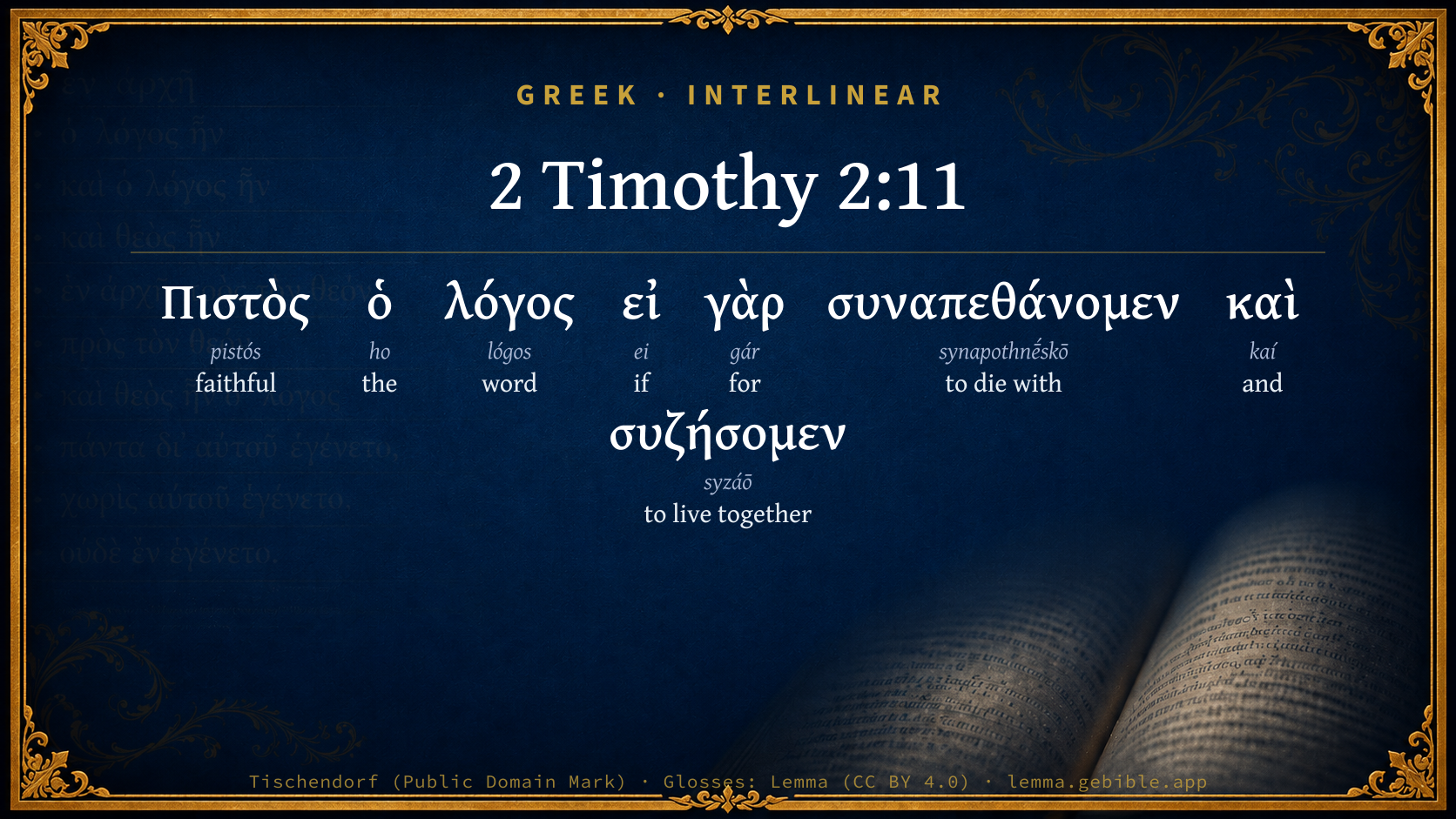
Greek (Tischendorf 8th ed.) 2 Timothy 2:11 appears in the Greek New Testament. The text above is from the Tischendorf 8th edition. Each word links to its Strong’s number and a concise gloss. Click any word for its full Thayer’s Greek Lexicon entry.
Download image
Cite this verse

2 Timothy 2:11 (World English Bible). Public Domain. Lemma interlinear Bible study tool, https://lemma.gebible.app/v/2-timothy/2/11.

Show BibTeX & RIS
BibTeX
RIS
English Translation
This saying is faithful: For if we died with him, We will also live with him.
World English Bible · Public Domain
Download a study sheet

One document with this verse’s original text, its word-by-word gloss line, the meaning frame, cross-references with their text, attributed commentary, and full source and license credits — printable, and it pastes into notes with its structure intact.

This verse Autodidact and up

Study sheet (.html) Plain text (.txt)

A passage Seminary Student

Up to 50 verses in one chapter. A passage sheet keeps up to 6 commentary sources and 12 cross-references per verse, in the order this page ranks them, and says so on the sheet whenever that leaves anything out. Ask for a single verse and you get the Autodidact verse sheet above.

Everything on this page stays free to read, with no account — the sheet is a download of what is already on screen, not access to it.

Want to remove ads? Support Godless Engineer
Compare translations 3

The same verse in 3 English versions, stacked beneath the original-language interlinear above. Click any original word for its lexicon entry.

Each is an independent rendering of the whole verse — the interlinear is not word-aligned to these translations.

Highlighted words mark where these versions differ — a whole-verse word diff, not a word-by-word alignment.

  • World English Bible Public Domain
    This saying is faithful: For if we died with him, We will also live with him.
  • King James Version Public Domain
    It is a faithful saying: For if we be dead with him, we shall also live with him:
  • unfoldingWord Literal Text CC BY-SA 4.0
    The word trustworthy: “For if we died with, we will also live with.

unfoldingWord Literal Text — © unfoldingWord, licensed CC BY-SA 4.0. Word-aligned USFM3 via Door43 (git.door43.org/unfoldingWord/en_ult).

Versions to compare (up to 4)

3 of 4 selected

Show all 19 translations

Every available English version of this verse, each an independent rendering of the whole verse.

  • World English Bible Public Domain
    This saying is faithful: For if we died with him, We will also live with him.
  • Berean Standard Bible Public Domain
    This is a trustworthy saying: If we died with Him, we will also live with Him;
  • Majority Standard Bible Public Domain
    This is a trustworthy saying: If we died with Him, we will also live with Him;
  • King James Version Public Domain
    It is a faithful saying: For if we be dead with him, we shall also live with him:
  • American Standard Version (1901) Public Domain
    Faithful is the saying: For if we died with him, we shall also live with him:
  • Revised Version (1885) Public Domain
    Faithful is the saying: For if we died with him, we shall also live with him:
  • Geneva Bible (1599) Public Domain
    It is a true saying, For if we be dead together with him, we also shall liue together with him.
  • Douay-Rheims (1899) Public Domain
    A faithful saying: for if we be dead with him, we shall live also with him.
  • Young's Literal Translation Public Domain
    Stedfast `is' the word: For if we died together -- we also shall live together;
  • Literal Standard Version CC BY-SA 4.0
    The word [is] steadfast: For if we died together—we will also live together;
  • Unlocked Literal Bible CC BY-SA 4.0
    This is a trustworthy saying: “If we have died with him, we will also live with him.
  • unfoldingWord Literal Text CC BY-SA 4.0
    The word trustworthy: “For if we died with, we will also live with.
  • Darby Bible Public Domain
    The word [is] faithful; for if we have died together with [him], we shall also live together;
  • World Messianic Bible Public Domain
    This saying is trustworthy: “For if we died with him, we will also live with him.
  • Webster's Bible Public Domain
    It is a faithful saying: For if we are dead with him, we shall also live with him:
  • Free Bible Version CC BY-SA 4.0
    This is a trustworthy saying: “If we died with him, we will also live with him;
  • Bible in Basic English Public Domain
    This is a true saying: If we undergo death with him, then will we be living with him:
  • Text-Critical English NT CC BY 4.0
    This saying is trustworthy: If we died with him, we will also live with him;
  • Tyndale New Testament (1534) Public Domain
    It is a true sayinge if we be deed with him we also shall live with him.

Literal Standard Version (2020), Covenant Press — licensed CC BY-SA 4.0. Text via the HelloAO Bible API (eBible.org). Unlocked Literal Bible (unfoldingWord) — licensed CC BY-SA 4.0. Text via the HelloAO Bible API (eBible.org). unfoldingWord Literal Text — © unfoldingWord, licensed CC BY-SA 4.0. Word-aligned USFM3 via Door43 (git.door43.org/unfoldingWord/en_ult). Free Bible Version, Dr. Jonathan Gallagher — licensed CC BY-SA 4.0. Text via the HelloAO Bible API (eBible.org).

Word by word

More ways to search: Search by grammar → Find every occurrence → Compare this word →

Practice this passage: Drill this verse → Learn its vocabulary →

About this verse

These counts appear in no published source. They are computed here, from the morphology-tagged text and Lemma’s own curated glosses. What Lemma adds →

8
words
8
distinct lemmas
Pauline Epistles
section

Notable vocabulary

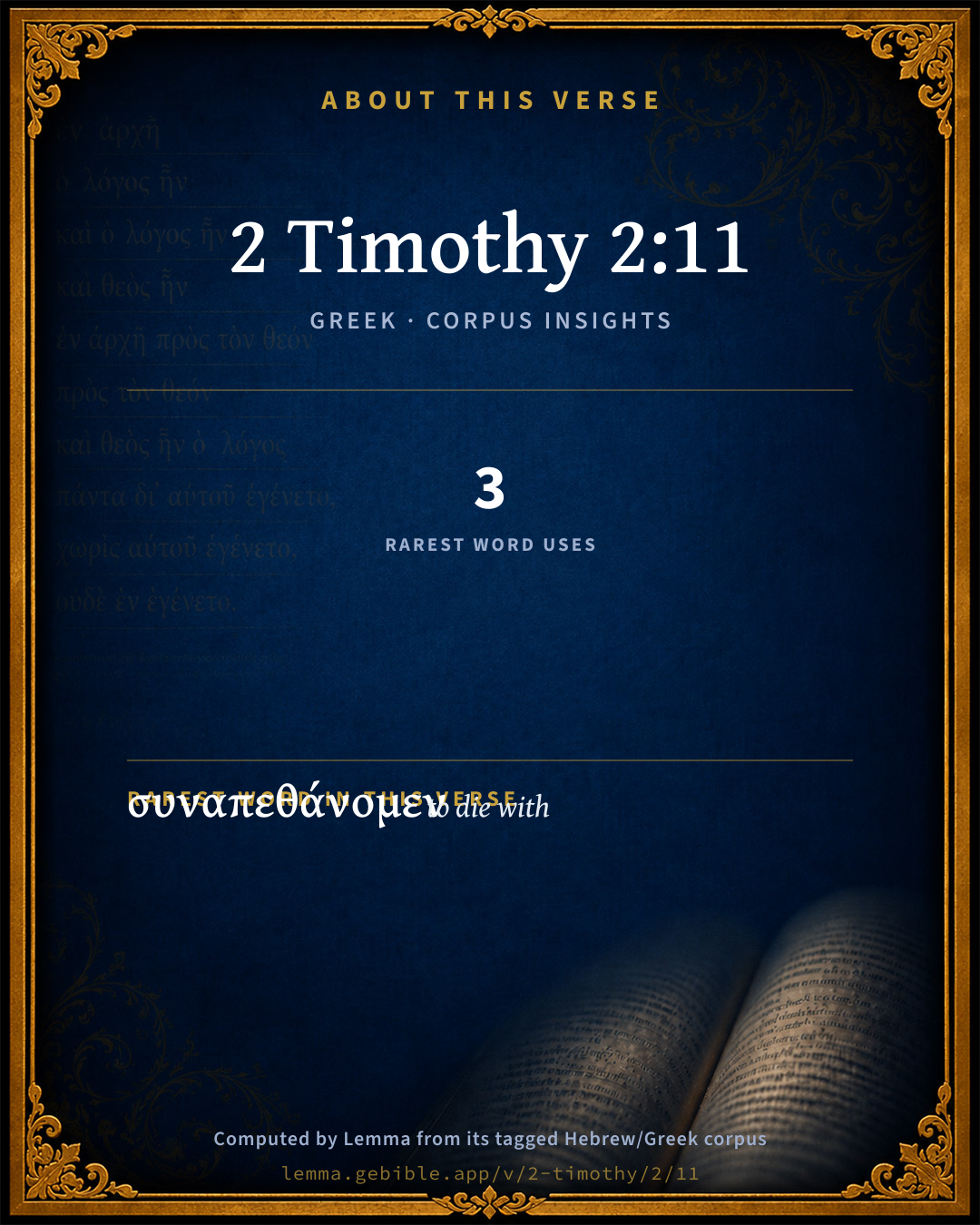
The rarest word here is συναπεθάνομεν to die with G4880 — appearing just 3 times in the whole Greek New Testament.

Shared distinctive vocabulary

συναπεθάνομεν to die with G4880 occurs in 3 verses of the Greek New Testament. Also found in:

Cross-references

12

Topical passages linked to 2 Timothy 2:11 in the Treasury of Scripture Knowledge — connected by theme and wording, ordered by reader-vote popularity; previews shown in the World English Bible.

  • Romans 6:8 But if we died with Christ, we believe that we will also live with him;
  • Colossians 3:3–4 For you died, and your life is hidden with Christ in God.
  • Romans 6:5 For if we have become united with him in the likeness of his death, we will also be part of his resurrection;
  • 1 Timothy 1:15 The saying is faithful and worthy of all acceptance, that Christ Jesus came into the world to save sinners; of whom I am chief.
  • John 14:19 Yet a little while, and the world will see me no more; but you will see me. Because I live, you will live also.
  • 2 Corinthians 4:10 always carrying in the body the putting to death of the Lord Jesus, that the life of Jesus may also be revealed in our body.
  • 2 Corinthians 13:4 For he was crucified through weakness, yet he lives through the power of God. For we also are weak in him, but we will live with him through the power of God toward you.
  • Galatians 2:19–20 For I, through the law, died to the law, that I might live to God.
  • 1 Thessalonians 5:10 who died for us, that, whether we wake or sleep, we should live together with him.
  • 1 Thessalonians 4:17 then we who are alive, who are left, will be caught up together with them in the clouds, to meet the Lord in the air. So we will be with the Lord forever.
  • Titus 3:8 This saying is faithful, and concerning these things I desire that you affirm confidently, so that those who have believed God may be careful to maintain good works. These things are good and profitable to men;
  • 1 Timothy 3:1 This is a faithful saying: if a man seeks the office of an overseer, he desires a good work.

Cross-references courtesy of OpenBible.info (CC BY 4.0).

Commentary

Notes on 2 Timothy 2:11 from classic Christian and Jewish commentators (each source and its license shown beneath its notes). The classic Christian expositions comment on the surrounding passage and are grouped to its opening verse, so a note may address several verses; the Jewish commentaries on the Tanakh (Rashi and others) are per-verse, so they appear only where the commentator wrote on this verse.

Lemma curates 59 commentaries, every one of them public domain or Creative Commons licensed, each selected and text-cleaned for this edition rather than reprinted as found. About our sources →

Jamieson, Fausset & Brown

Robert Jamieson, A. R. Fausset & David Brown

Greek, "Faithful is the saying."

For--"For" the fact is so that, "if we be dead with Him (the Greek aorist tense implies a state once for all entered into in past times at the moment of regeneration, Rom 6:3-4, Rom 6:8; Col 2:12), we shall also live with Him." The symmetrical form of "the saying," Ti2 2:11-13, and the rhythmical balance of the parallel clauses, makes it likely, they formed part of a Church hymn (see on Ti1 3:16), or accepted formula, perhaps first uttered by some of the Christian "prophets" in the public assembly (Co1 14:26). The phrase "faithful is the saying," which seems to have been the usual formula (compare Ti1 1:15; Ti1 3:1; Ti1 4:9; Tit 3:8) in such cases, favors this.

Jamieson, Fausset & Brown — Commentary Critical and Explanatory on the Whole Bible (1871) — public domain (CC PDM 1.0). Text via the HelloAO Bible API.

Ellicott's Commentary for English Readers

(11) For if we be dead with him, we shall also live with him.—The last sentence ended with the words “eternal glory”—the goal, the end of the salvation which is in Christ. This it is which the Apostle will help others to win, regardless of any suffering it may cost him; then, with his mind full of the thoughts of the “eternal glory,” once more he addressed himself to Timothy. “Faithful is the saying, namely, if we be dead with him,” &c. It was as though he said, “Do you not remember that well-known watchword of our own faith, so often repeated among us in our solemn assemblies when the brotherhood meet together?” Many have supposed, from the rhythmical character of the clauses of 2Ti_2:11-13, that this “saying” was taken from some most ancient Christian hymns, composed and used in the very earliest days of the faith; but whether or no this be the case, there is high probability that the words formed part of a liturgy in common use in the days of Timothy. If not as a hymn—which seems, on the whole, the most likely supposition—we can well conceive them as part of the tapestry of a primitive Christian liturgy, woven in like the introductory sentences in our morning and evening prayer, or like the “comfortable words” of the Communion Service. The expression “If we be dead with Him”—more accurately, If we died with Him—is well explained by 1Co_15:31 : “I die daily.” The Apostle died when he embraced the lot of daily death. The meaning is still further illustrated in 2Co_4:10, where we read how St. Paul and his companions were “always bearing about in the body the dying of the Lord Jesus.” “He and his faithful companions (was Timothy, to whom he was then writing, to be ranked in this blessed company? ) had given themselves up to a life that involved exposure to sufferings, bitter enmity, cruel persecutions, even death; but if we be thus dead with Him, what matters it? How can we fear even that last agony man can inflict on us—physical death?—for death with Him involves, surely, life with Him too: that life endless, fadeless, full of glory, we know He is now enjoying, in the possession of which I, Paul, and some of us have even seen Him, face to face, eye to eye. In that life of His we shall share; we shall be partakers in this life of His there, but only if we have shared in the life of suffering which was His life here.”

A Bible Commentary for English Readers, edited by Charles John Ellicott (1878–1897) — public domain. Text from a community e-Sword module.

The Biblical Illustrator

Joseph S. Exell

2Ti_2:11-12

If we be dead with Him, we shall also live with Him.

Union with Christ in death and life

I. The first branch of this faithful saying is, If we be dead with Him, we shall also live with Him. There seem to be two ways chiefly in which the soul is dead with Christ. If we look at the operation of the law as a manifestation of the justice of God, the law was the cause of the death of Christ--that is to say, the law being broken by the Church in whose place Christ stood, He, as a Substitute and a Surety, stood under its curse, and that curse was death. If, then, we are to die with Christ, we must die under the law just as Jesus died under the law, or else there is no union with Christ in His death. But further, Christ died under the weight of sin and transgression. Every living soul then that shall die with Christ spiritually and experimentally, must die too under the weight of sin--that is, he must know what it is so to experience the power and presence of sin in his carnal mind, so to feel the burden of his iniquities upon his guilty head, and to be so overcome and overpowered by inward transgression, as to be utterly helpless, and thoroughly unable to deliver himself from the dominion and rule of it in his heart. But there is another way in which the soul dies with Christ. Christ not only died under the law and died under sin, but He died unto the law, and He died unto sin. But in living with Christ, there will be, if I may use the expression, a dying life, or a living death, running parallel with all the experience of a child of God, who is brought to some acquaintance with the Lord Jesus. For instance, the apostle says, I am crucified with Christ, nevertheless I live; yet not I, but Christ liveth in me.

II. But we go on to consider another branch of this vital union with Christ. If we suffer, we shall also reign with Him. There can be no suffering with Christ, until there is a vital union with Christ; and no realisation of it, until the Holy Ghost manifests this vital union by making Christ known, and raising up faith in our hearts, whereby He is embraced and laid hold of. And there is no reigning with Christ, except there first be a suffering with Christ. I believe that reigning not only signifies a reigning with Him in glory hereafter, but also a measure of reigning with Him now, by His enthroning Himself in our hearts.

III. If we deny Him, He also will deny us, that is the next branch. The words have a twofold meaning; they apply to professors, and they apply to possessors. There were those in the Church who would deny Him, for there were those who never knew Him experimentally, and when the trial came, they would act as Judas acted. And then there were those who were real followers of Him, but when put to the test might act as Peter acted. (J. C. Philpot.)

Christ and the Christian

In matters of great worth and difficulty prefaces are used: so here. Whence observe we, that--

I. Afflictions are not easy to be endured,

II. Gods word is faithful.

III. Christ and a Christian are fellow-sufferers.

IV. Christ and a christian shall live together. (J. Barlow, D. D.)

Dead with Christ

In the fourth century a young earnest disciple sought an interview with the great and good Macarius, and asked him what was meant by being dead to sin. He said, You remember our brother who died and was buried a short time since. Go to his grave, and tell him all the unkind things you ever heard of him. Go, my son, and hear what he will answer. The young man doubted whether he understood; but Macarius only said, Do as I tell you, my son; and come and tell me what he says. He went, and came back, saying, I can get He reply; he is dead. Go again, and try him with flattering words--tell him what a great saint he was, what noble work he did, and how we miss him; and come again and tell me what he says. He did so, but on his return said, He answers nothing, father; he is dead and buried. You know now, my son, said the old father, what it is to be dead to sin, dead and buried with Christ. Praise and blame are nothing to him who is really dead and buried with Christ. (Christian Herald.)

Dead with Christ

Believe, my dear Pris, what I am just beginning to learn, and you knew long ago, that the death of Christ is far, very far, more than a mere peace-making, though that view of it is the root of every other. But it is actually and literally the death of you and me and the whole human race; the absolute death and extinction of all our selfishness and individuality. So St. Paul describes it in Rom_6:1-23. and in every one of his Epistles. Let us believe, then, what is the truth and no lie--that we are dead, actually, absolutely dead; and let as believe further that we are risen and that we have each a life, our only life, a life not of you nor me, but a universal life--in Him. He will live in us and quicken us with all life and all love; will make us understand the possibility, and, as I am well convinced, experience the reality, of loving God and loving our brethren. (F. D. Maurice to his sister.)

Suffering and reigning with Jesus

I. Suffering with Jesus, and its reward. To suffer is the common lot of all men. It is not possible for us to escape from it. We come into this world through the gate of suffering, and over deaths door hangs the same escutcheon. If, then, a man hath sorrow, it doth not necessarily follow that he shall be rewarded for it, since it is the common lot brought upon all by sin. You may smart under the lashes of sorrow in this life, but this shall not deliver you from the wrath to come. The text implies most clearly that we must suffer with Christ in order to reign with Him.

1. We must not imagine that we are suffering for Christ, and with Christ, if we are not in Christ.

2. Supposing a man to be in Christ, yet it does not even then follow that all his sufferings are sufferings with Christ, for it is essential that he be called by God to suffer. If a good man were, out of mistaken views of mortification and self-denial, to mutilate his body, or to flog his flesh, aa many a sincere enthusiast has done, I might admire the mans fortitude, but I should not allow for an instant that he was suffering with Christ.

3. Again, in troubles which come upon us as the result of sin, we must not think we are suffering with Christ. When Miriam spoke evil of Moses, and the leprosy polluted her, she was not suffering for God. When Uzziah thrust himself into the temple, and became a leper all his days, he could not say that he was afflicted for righteousness sake. If you speculate and lose your property, do not say that you are losing all for Christs sake; when you unite with bubble companies and are duped, do not whine about suffering for Christ--call it the fruit of your own folly. If you will put your hand into the fire and it gets burned, why, it is the nature of fire to burn you or anybody else; but be not so silly as to boast as though you were a martyr.

4. Be it observed, moreover, that suffering such as God accepts and rewards for Christs sake, must have Gods glory as its end.

5. I must mind, too, that love to Christ, and love to His elect, is ever the main-spring of all my patience; remembering the apostles words, Though I give my body to be burned, and have not charity, it profiteth me nothing.

6. I must not forget also that I must manifest the spirit of Christ, or else I do not suffer with Him. I have heard of a certain minister who, having had a great disagreement with many members in his church, preached from this text, And Aaron held his peace. The sermon was intended to pourtray himself as an astonishing instance of meekness; but as his previous words and actions had been quite sufficiently violent, a witty hearer observed, that the only likeness he could see between Aaron and the preacher was this, Aaron held his peace, and the preacher did not. I shall now very briefly show what are the forms of real suffering for Jesus in these days.

(1) Some suffer in their estates. I believe that to many Christians it is rather a gain than a loss, so far as pecuniary matters go, to be believers in Christ; but I meet with many cases--cases which I know to be genuine, where persons have had to suffer severely for conscience sake.

(2) More usually, however, the suffering takes the form of personal contempt.

(3) Believers have also to suffer slander and falsehood.

(4) Then again, if in your service for Christ you are enabled so to sacri fice yourself, that you bring upon yourself inconvenience and pain, labour and loss, then I think you are suffering with Christ.

(5) Let us not forget that contention with inbred lusts, denials of proud self, resistance of sin, and agony against Satan, are all forms of suffering with Christ.

(6) There is one more class of suffering which I shall mention, and that is, when friends forsake, or become foes. If you are thus called to suffer for Christ, will you quarrel with me if I say, in adding all up, what a very little it is compared with reigning with Jesus! For our light affliction, which is but for a moment, worketh for us a far more exceeding and eternal weight of glory. When I contrast our sufferings of to-day with those of the reign of Mary, or the persecutions of the Albigenses on the mountains, or the sufferings of Christians in Pagan Rome, why, ours are scarcely a pins prick: and yet what is the reward? We shall reign with Christ. There is no comparison between the service and the reward. Therefore it is all of grace. We are not merely to sit with Christ, but we are to reign with Christ.

II. Denying Christ, and its penalty. If we deny Him, He also will deny us, In what way can we deny Christ? Some deny Him openly as scoffers do, whose tongue walketh through the earth and defieth heaven. Others do this wilfully and wickedly in a doctrinal way, as the Arians and Socinians do, who deny His deity: those who deny His atonement, who rail against the inspiration of His Word, these come under the condemnation of those who deny Christ. There is a way of denying Christ without even speaking a word, and this is the more common. In the day of blasphemy and rebuke, many hide their heads. Are there not here some who have been baptized, and who come to the Lords table, but what is their character? Follow them home. I would to God they never had made a profession, because in their own houses they deny what in the house of God they have avowed. In musing over the very dreadful sentence which closes my text, He also will deny us, I was led to think of various ways in which Jesus will deny us. He does this sometimes on earth. You have read, I Suppose, the death of Francis Spira. If you have ever read it, you never can forget it to your dying day. Francis Spira knew the truth; he was a reformer of no mean standing; but when brought to death, out of fear, he recanted. In a short time he fell into despair, and suffered hell upon earth. His shrieks and exclamations were so horrible that their record is almost too terrible for print. His doom was a warning to the age in which he lived. Another instance is narrated by my predecessor, Benjamin Keach, of one who, during Puritanic times, was very earnest for Puritanism; but afterwards, when times of persecution arose, forsook his profession. The scenes at his deathbed were thrilling and terrible. He declared that though he sought God, heaven was shut against him; gates of brass seemed to be in his way, he was given up to overwhelming despair. At intervals he cursed, at other intervals he prayed, and so perished without hope. If we deny Christ, we may be delivered to such a fate. (C. H. Spurgeon.)

Deniers of Christ

I. Difficult duties are greatly to be pressed.

II. To conceive the estate of a Christian is to have an eye to his latter end.

III. Gods method and the devils differ. He begins with death, ends with life: but Satan the contrary.

IV. Christ is not to be denied.

V. The deniers of Christ shall de denied. Helps against this sin--

1. Deny thyself.

2. Never dispute with flesh and blood.

3. Look not on death as death: but on Gods power, which is manifest in our weakness.

4. Consider the examples of so many martyrs. (J. Barlow, D. D.)

The encouragement to suffer for Christ, and the danger of denying Him

It is a faithful saying. This is a preface used by this apostle to introduce some remarkable sentence of more than ordinary weight and concernment. I shall begin with the first part of this remarkable saying: If we be dead with Him, we shall also live with Him; if we suffer, we shall also reign with Him.

1. What virtue there is in a firm belief and persuasion of a blessed immortality in another world, to support and bear up mens spirits under the greatest sufferings for righteousness sake; and even to animate them, if God shall call them to it, to lay down their lives for their religion.

2. How it may be made out to be reasonable to embrace and voluntarily to submit to present and grievous sufferings, in hopes of future happiness and reward; concerning which we have not, nor perhaps are capable of having, the same degree of certainty and assurance which we have of the evils and sufferings of this present life. Now, granting that we have not the same degree of certainty concerning our future happiness that we have of our present sufferings, which we feel, or see just ready to come upon us; yet prudence making it necessary for men to run this hazard does justify the reasonableness of it. This I take to be a known and ruled case in the common affairs of life and in matters of temporal concernment; and men act upon this principle every day. The matter is now brought to this plain issue, that if it be reasonable to believe there is a God, and that His providence considers the actions of men; it is also reasonable to endure present sufferings, in hope of a future reward: and there is certainly enough in this case to govern and determine a prudent man that is in any good measure persuaded of another life after this, and hath any tolerable consideration of, and regard to, his eternal interest. In the virtue of this belief and persuasion, the primitive Christians were fortified against all that the malice and cruelty of the world could do against them; and they thought they made a very wise bargain, if through many tribulations they might at last enter into the kingdom of God; because they believed that the joys of heaven would abundantly recompense all their sorrows and sufferings upon earth. And so confident were they of this, that they looked upon it as a special favour and regard of God to them, to call them to suffer for His name. So St. Paul speaks of it (Php_1:29). If we could compare things justly, and attentively regard and consider the invisible glories of another world, as well as the things which are seen, we should easily perceive that he who suffers for God and religion does not renounce happiness; but puts it out to interest upon terms of the greatest advantage. I shall now briefly speak to the second part of this remarkable saying in the text. If we deny Him, He also will deny us; to which is subjoined in the words following, if we believe not; εἰ ἀπιστοῦμεν, if we deal unfaithfully with Him; yet He abideth faithful, He cannot deny Himself; that is, He will be constant to His word, and make good that solemn threatening which He hath denounced against those who, for fear of suffering, shall deny Him and His truth before men (Mat_10:33). If fear will move us, then, in all reason, that which is most terrible ought to prevail most with us, and the greatest danger should be most dreaded by us, according to our Saviours most friendly and reasonable advice (Luk_12:4-5.) (J. Tillotson, D. D.)

If we suffer, we shall also reign with Him.

Suffering with Christ

In the olden time when the gospel was preached in Persia, one Hamedatha, a courtier of the king, having embraced the faith, was stripped of all his offices, driven from the palace, and compelled to feed camels. This he did with great content. The king passing by one day, saw his former favourite at his ignoble work, cleaning out the camels stables. Taking pity upon him he took him into his palace, clothed him with sumptuous apparel, restored him to all his former honours, and made him sit at the royal table. In the midst of the dainty feast, he asked Hamedatha to renounce his faith. The courtier, rising from the table, tore off his garments with haste, left all the dainties behind him, and said, Didst thou think that for such silly things as these I would deny my Lord and Master? and away he went to the stable to his ignoble work. How honourable is all this! (C. H. Spurgeon.)

Christs martyrs

Christs true martyrs do not die, but live. (E. Thring.)

Ennobled in death

Henry V. on the evening of Agincourt found the chivalric David Gamin still grasping the banner which through the fight his strength had borne and his right arm defended. Often had the monarch noticed that pennon waving in the foremost van of the men of England who that day pierced, broke, and routed the proud ranks of France. The king knighted him as he lay. The hero died, but dying was ennobled!(S. Coley.)

Cyril, the boy martyr

Let me tell you of a young soldier of His, who bore much for his Lord. We must go back to the early days of Christianity, and picture a martyr being led to death in the city of Antioch. At the place of execution is the judge surrounded by a guard of soldiers. The man about to die for his love to his heavenly King says to the judge--Ask any little child here whether we ought to adore the many false gods whom you serve or the one living and true God, the only Saviour of men, and that child will tell you. Close by there stood a Christian mother and her boy of ten years old named Cyril. She had brought her son there to see how a true servant of God could die for his Lord. As the martyr spoke, the judge spied the lad, and asked him a question. To the surprise of all, Cyril answered--There is but one God, and Jesus Christ is one With Him. At these words the judge was very angry. Wretched Christian, he said, turning to the martyr, it is thou who hast taught the boy these words. Then more gently, he said to the child--Tell me, who taught thee this faith? Little Cyril looked lovingly up to his mother, and answered, The grace of God taught my mother, and she taught me. Well, we will see what this grace of God can do for thee, cried the judge. He signed to the guards, who, according to the custom of the Romans, stood with their sheaves of rods. They came near and seized the child. Passionately the mother pleaded that she might give her life for that of her son. But none heeded her entreaties. And all that she could do was to cheer her child, reminding him of the Lord who loved him and died for him. Then cruel strokes fell upon the bare little shoulders of Cyril. In a tone of mocking, the judge said--What good is the grace of God to him now?… It can enable him to bear the same punishment which his Saviour bore for him, answered the mother decidedly. One look from the judge to |he soldiers, and again the cruel blows fell on the tender flesh of the boy. What can the grace of God do for him now? again asked the pitiless judge. Few of the spectators could hear unmoved the mother, who, with heart bleeding at the sight of her boys sufferings, answered--The grace of God teaches him to forgive his persecutors. The childs eyes followed the upward glance of his mother, as she raised her pleading for him in earnest prayer. And when his persecutors asked whether he would not now worship the gods they did, that young soldier answered--No, there is no other God but the Lord, and Jesus is the Redeemer of the world. He loved me, and I love Him, because He is my Saviour. Stroke after stroke fell upon the boy, and at last he fell fainting. Then he was handed to his mother, and the question was once more repeated: What can the grace of God do for him now? Pressing her dying child to her heart, she answered--Now above all, the grace of God will bring him gain and glory, for He will take him from the rage of his persecutors to the peace of His own home in heaven. Once more the dying boy looked up and said, There is only one God, and one Saviour, Jesus Christ--who--loved--me. And then the Lord Jesus received him in His arms for evermore. The boy martyr went in to be with his King, that Saviour who hath abolished death, and hath brought life and immortality to light through the gospel.

Suffering for Christ rewarded

Agrippa, grandson of Herod the Great, once expressed a desire that his friend Caligula might soon come to the throne. Old Tiberius, the reigning monarch, felt such a wish, however flattering to Caligula, to be so little kindly to himself, that he threw the author of it into a loathsome dungeon. But the very day Caligula reached Imperial power, Agrippa was released. The new emperor gave him purple for his rags, tetrarchies for his narrow cell, and carefully weighing the gyves that fettered him, for every link of iron bestowed on him one of gold. Think you that day Agrippa wished his handcuffs and his leg-locks had been lighter? Will Jesus forget the wellwishers of His kingdom, who, for His sake, have borne the burden and worn the chain? His scales will be forthcoming, and assuredly those faithful in great tribulation shall be beautified with greater glory. (S. Coley.)

Happy ending of a suffering life

We have sometimes watched a ship entering the harbour with masts sprung, sails torn, seams yawning, bulwarks stove in--bearing all the marks of having battled with the storms, and of having encountered many a peril. On the deck is a crew of worn and weather-beaten men, rejoicing that they have reached the port in safety. Such was the plight in which many believers of old reached the haven of rest. They met with dangers and encountered difficulties. But if their course was toilsome, their end was happy. It was their joy to labour and suffer for their Lords sake, and they are now sharing His kingdom and His glory. (Bp. Oxenden.)

If we deny Him, He also will deny us.--

Denying Christ

There are many ways of denying Christ, both by word and action. We may take the part of His enemies, or ignore His supreme claim to our allegiance; we may transform Him into a myth, a fairy tale, a subjective principle, or find a substitute in our own life for His grace; and we may assume that He is not the ground of our reconciliation, nor the giver of salvation, nor the sole Head of His Church. If so, we may reasonably fear, lest He should refuse to acknowledge us when upon His approval our eternal destiny will turn. (H. R. Reynolds, D. D.)

The Biblical Illustrator, edited by Joseph S. Exell (c. 1880s–1900s) — public domain. Text from a community e-Sword module.

Joseph Benson's Commentary

2Ti 2:11-14. It is a faithful saying — A saying as important as it is true. If we be dead — Greek, συναπεθανομεν, die, or have died, with him — To the world and sin, and be ready to die for him; we shall live with him — In that everlasting happiness which he hath prepared for all his people. If we suffer with him — Persecution, or whatever he may be pleased to appoint or permit to happen to us, with faith and patience becoming a Christian; we shall also reign with him — In heavenly glory: see on Rom 8:17; 1Pe 4:13. If — Intimidated with these transitory evils, we desert his cause, and deny him — Before men, that we may escape suffering for him; he also will deny us — In the great day, before his Father and the holy angels, Mat 10:33; Luk 12:9. If we believe not — That he will deny us, presuming upon his mercy; yet he abideth faithful — And will fulfil his threatenings on such as expose themselves to them; he cannot deny himself — Cannot falsify his word, or fail to make it good. Or the verse may be interpreted in a more general sense thus: If we believe not the truths and promises of his gospel, or if we are unfaithful, (as some render απιστουμεν, considering it as opposed to πιστος, faithful,) yet he abideth faithful, and will steadily adhere to those rules of judgment, and distribution of rewards and punishments, which he hath so solemnly laid down in his word: for it is certain he cannot deny himself, or frustrate his own public declarations. Therefore be diligent, as if the apostle had said, in the discharge of thy duty, and shrink not from it for fear of suffering. Of these things put them in remembrance — Remind those who are under thy charge of these powerful motives to persevere in patiently suffering ill, and diligently doing well; charging them before the Lord — As in his presence, and as they will answer it to him; not to strive — Greek, μη λογομαχειν, not to contend, or quarrel, about words — An evil to which they are prone; to no profit — Such a contention is altogether unprofitable, and even tends to the subverting of the hearers — The diverting their attention from true, vital religion, and the important truths on which it is built, and filling their minds with pride and passion, and numberless other disorders and vices. There is an awful solemnity, as Doddridge justly observes, in this charge, which plainly shows the great folly and mischief of striving about little controversies. Indeed, consequences such as those here referred to, are wont to flow from most religious disputes as they are commonly managed; so that they tend to nothing out to the subverting of the faith and morals of those who engage keenly in them. They ought therefore to be carefully avoided by all who desire to promote true piety and virtue, agreeably to the apostle’s direction.

Joseph Benson's Commentary on the Old and New Testaments (1811–1818) — public domain. Text from a community e-Sword module.

Tyndale Open Study Notes

Tyndale Open Resources

2:11 a trustworthy saying: See study notes on 1 Tim 1:15; 2:5-6.

Tyndale Open Study Notes — © Tyndale Open Resources, licensed CC BY-SA 4.0. Text via the HelloAO Bible API.

Bengel's Gnomon

Johann Albrecht Bengel

2Ti 2:11. Συναπεθάνομεν) The σὺν occurs thrice in the compound verbs here: viz. with Christ: συναπεθάνομεν, in the sense of the preterite, having respect to them that hope for life.

Bengel's Gnomon of the New Testament — English translation (T&T Clark, Edinburgh, 1860) — public domain. Text from a community e-Sword module.

Meyer's Critical & Exegetical Commentary

Heinrich August Wilhelm Meyer

2Ti_2:11-13. In order to arouse the courage of faith, Paul has been directing attention to the resurrection of Christ and to His own example; he now proceeds, in a series of short antithetical clauses, to set forth the relation between our conduct here and our condition hereafter. This he introduces with the words πιστὸς ὁ λόγος. The γάρ following seems, indeed, to make the words a confirmation of the thought previously expressed, as in 1Ti_4:9 (Chrysostom, Oecumenius, Theophylact, Flatt, de Wette, Wiesinger, Plitt); but Paul only uses this formula to confirm a general thought. There is, however, no general thought in the preceding words, where Paul is speaking only of his own personal circumstances. Hence the formula must, as in 1Ti_1:15; 1Ti_3:1, be referred here to what follows, and γάρ explained by namely (so, too, van Oosterzee).

We cannot say for certain whether the sentences following are really strophes from a Christian hymn (Münter, Ueber die älteste christliche Poesie, p. 29, and Paulus, Memorabilia, i. 109) or not; still it is not improbable that they are, all the more that the same may be said of 1Ti_3:16. The first sentence runs: εἰ συναπεθάνομεν, καὶ συζήσομεν] συν refers to Christ, expressing fellowship, and not merely similarity. De Wette points us to Rom_6:8 for an explanation of the thought; but the context shows that he is not speaking here of spiritual dying, the dying of the old man, which is the negative element of regeneration (against van Oosterzee), but of the actual (not merely ideal) dying with Christ. In other words, he is speaking of sharing in the same sufferings which Christ endured (so also Hofmann), and whose highest point is to undergo death. The meaning therefore is: if we in the faith of Christ are slain for His sake; comp. Php_3:10; also Rom_8:17; Mat_5:11; Joh_15:20, and other passages. The aorist συναπεθάνομεν is either to be taken: if we have entered into the fellowship of His death, or it denotes the actual termination: if we are dead with Him, we shall also live with Him.

συζήσομεν, corresponding to συναπεθάνομεν, is not used of the present life in faith, but of the future participation in Christs glorified life (so, too, Hofmann); comp. 1Th_5:10.2Ti_2:12. The second sentence runs: εἰ ὑπομένομεν, καὶ συμβασιλεύσομεν] This sentence corresponds with the previous one in both members; comp. Rom_8:17, where συμπάσχειν and συνδοξασθῶμεν are opposed to one another. On συμβασ., comp. Rom_5:17 (ἐν ξωῇ βασιλεύσουσι); it denotes participation in the reign of the glorified Messiah.[29] Like death and life, so are enduring and reigning placed in contrast.

The third sentence is a contrast with the two preceding: ΕἸ ἈΡΝΗΣΌΜΕΘΑ, sc. Χριστόν] comp. Mat_10:33; 2Pe_2:1; Jud_1:4; used here specially of the verbal denial of Christ, made through fear of suffering. ΚἈΚΕῖΝΟς ἈΡΝΉΣΕΤΑΙ ἩΜᾶς: he will not recognise us as His own, the result of which will be that we remain in a state without grace and without blessing. The meaning of this sentence is confirmed by 2Ti_2:13.

ΕἸ ἈΠΙΣΤΟῦΜΕΝ, ἘΚΕῖΝΟς ΠΙΣΤῸς ΜΈΝΕΙ] ἈΠΙΣΤΕῖΝ does not mean here: not believe, be unbelieving[30] (Mar_16:11; Mar_16:16; Act_28:24), butin correspondence with ἀρνεῖσθαιbe unfaithful, which certainly implies lack of that genuine faith from which the faithful confession cannot be separated. In Rom_3:3 also, unbelief and unfaithfulness go together, since the people of Israel, to whom the λόγια Θεοῦ were given, showed themselves unfaithful to God by rejecting the promised Messiah, and this after God had chosen them for His people.

ἐκεῖνος πιστὸς μένει] πιστός can only mean faithful. The faithfulness of the Lord is shown in the realization of His decreeboth in acknowledging and in rejecting; the context preceding shows that the latter reference predominates.

The next words confirm this truth: ἀρνήσασθαι γὰρ ἑαυτὸν οὐ δύναται, which declare the ἀπιστία of the Lord to be an impossibility, since it involves a contradiction of Himself, of His nature.

[29] The συζῆν begins for the believer immediately after his death (Php_1:23; comp. also Luk_23:43); the συμβασιλεύειν not till after Christs παρουσία; comp. Hofmann.

[30] Such is the explanation of Chrysostom, who gives Christs resurrection as the subject of unbelief: εἰ ἀπιστοῦμεν, ὅτι ἀνέστη, οὐδὲν ἀπὸ τούτου βλάπτεται ἐκεῖνος, and assigns to ἀρνήσασθαι γὰρ ἑαυτ. οὐ δύν. the strange signification of οὐκ ἔχει φύσιν μὴ εἶναι.

Meyer — Critical and Exegetical Commentary on the New Testament — English translation by Peter Christie, edited by Frederick Crombie (T&T Clark, 1880) — public domain. Text from a community e-Sword module.

Expositor's Greek Testament

ed. W. Robertson Nicoll

2Ti 2:11 . πιστὸς ὁ λόγος : The teaching or saying referred to is “the word of the cross” as set forth by simile and living example in the preceding verses, 4 11. So R.V.m. This is an exactly parallel case to 1Ti 4:9 . Here, as there, γὰρ introduces a reinforcement of the teaching.

εἰ γὰρ συναπεθάνομεν , κ . τ . λ .: The presence of γάρ does not militate against the supposition that we have here a fragment of a Christian hymn. A quotation adduced in the course of an argument must be introduced by some inferential particle; See on 1Ti 4:10 . On the other hand, it is questionable if εἰ ἀρνησόμεθα , κ . τ . λ . is suitable in tone to a hymn; and St. Paul’s prose constantly rises to rhythmical cadences, e.g. , Rom 8:33 sqq. , 1Co 13 . We have here contrasted two crises, and two states in the spiritual life: συναπεθάνομεν and ἀρνησόμεθα point to definite acts at definite times; while ὑπομένομεν and ἀπιστοῦμεν indicate states of being, more or less prolonged.

εἰ συναπεθάνομεν καὶ συνζήσομεν : The two verbs are coupled also in 2Co 7:3 ; but the actual parallel in thought is found in Rom 6:4-5 ; Rom 6:8 . We died (aor., R.V.) with Christ at our baptism (Rom 6:8 ; Col 3:3 ), which, as normally administered by immersion, symbolises our burial with Christ and our rising again with Him to newness of life (Rom 6:4 ; Col 2:12 ). The future, συνζήσομεν , must not be projected altogether into the resurrection life; it includes and is completed by that; and no doubt the prominent notion here is of the life to come; but here, and in Rom 6:8 , it is implied that there is a beginning of eternal life even while we are in the flesh, viz . in that newness of life to which we are called, and for which we are enabled, in our baptism.

The Expositor's Greek Testament, edited by W. Robertson Nicoll (1897–1910) — public domain. Text from a community e-Sword module.

Geneva Bible (1599)

Geneva Bible translators

If we be afflicted with Christ, and for Christ’s sake.

The fourth admonition: we ought not to contend upon words and questions, which are not only unprofitable, but also for the most part hurtful: but rather upon this, how we may frame ourselves to all manner of patience, and to die also with Christ (that is to say, for Christ’s Name) because that is the plain way to the most glorious life: as contrariwise the falling away of men can diminish no part of the truth of God, although by such means, they procure most certain destruction to themselves.

Geneva Bible (1599) marginal notes — public domain. Text via Bolls.life.

Adam Clarke's Commentary

Verse 11. If we be dead with him] That is: As surely as Christ rose again from the dead, so surely shall we rise again; and if we die for him, we shall surely live again with him. This, says the apostle, is πιστος ο λογος, a true doctrine. This is properly the import of the word; and we need not seek, as Bp. Tillotson and many others have done, for some saying of Christ which the apostle is supposed to be here quoting, and which he learned from tradition.

Adam Clarke's Commentary on the Bible (1810–1826) — public domain. Text from a community e-Sword/MySword module.

John Calvin's Commentaries

11 A faithful saying He makes a preface to the sentiment which he is about to utter; because nothing is more opposite to the feeling of the flesh, than that we must die in order to live, and that death is the entrance into life; for we may gather from other passages, that Paul was wont to make use of a preface of this sort, in matters of great importance, or hard to be believed.

If we die with him, we shall also live with him The general meaning is, that we shall not be partakers of the life and glory of Christ, unless we have previously died and been humbled with him; as he says, that all the elect were

“predestinated that they might be conformed to his image.” (Romans 8:29.)

This is said both for exhorting and comforting believers. Who is not excited by this exhortation, that we ought not to be distressed on account of our afflictions, which shall have so happy a result? The same consideration abates and sweetens all that is bitter in the cross; because neither pains, nor tortures, nor reproaches, nor death ought to be received by us with horror, since in these we share with Christ; more especially seeing that all these things are the forerunners of a triumph.

By his example, therefore, Paul encourages all believers to receive joyfully, for the name of Christ, those afflictions in which they already have a taste of future glory. If this shocks our belief, and if the cross itself so overpowers and dazzles our eyes, that we do not perceive Christ in them, let us remember to present this shield, “It is a faithful saying.” And, indeed, where Christ is present, we must acknowledge that life and happiness are there. We ought, therefore, to believe firmly, and to impress deeply on our hearts, this fellowship, that we do not die apart, but along with Christ, in order that we may afterwards have life in common with him; that we suffer with him, in order that we may be partakers of his glory. By death he means all that outward mortification of which he speaks in 2 Corinthians 4:10.

John Calvin's Commentaries (1540-1563) — public domain. Text from the Calvin Translation Society English edition (1840s-50s) via the Christian Classics Ethereal Library (ccel.org). Calvin's coverage is partial (roughly two-thirds of the Bible); uncommented books and verses are honest gaps, never fabricated. The 19th-century editor's footnotes and remarks are omitted so the notes are faithfully Calvin's own voice.

The Cambridge Bible for Schools and Colleges

gen. ed. J. J. S. Perowne

11. It is a faithful saying] Literally, Faithful is the saying, as in 1Ti_1:15; 1Ti_3:1; 1Ti_4:9; Tit_3:8. See note on the first passage and Appendix, E. To close the argument, this rhythmical, perhaps liturgical, strain is quoted. It is introduced by ‘for,’ as is the quotation in Act_17:28. The R.V. by printing ‘For’ in the text and ‘for’ in the margin thus incline to regarding the conjunction as part of the quotation. If it be not part, it will still have quite a fitting sense, as often in classical Greek ‘indeed’ or ‘in fact’ gives a better translation than ‘for’; cf. Donaldson’s Greek Grammar, p. 605.

For if we be dead with him] Read, For if we died with him. It is most natural to refer this to the dying with Christ in Baptism, Col_2:20; Col_3:3, where the aorists are equally to be observed. This would be the thought in the original framing of such a Christian hymn as this may have been. But St Paul’s baptism was no old ceremony and out of date; he was ‘always bearing about in the body the dying of Jesus’ 2Co_4:10; just as the English Prayer Book Service bids Christians after their baptism ‘die from sin, continually mortifying all evil and corrupt affections.’ Hence he can well use the phrase so as to cover his ‘hardship even unto bonds,’ and his ‘daily dying’ to ‘fill up the sufferings of Christ.’

we shall … live with him] in the ‘eternal glory.’

The Cambridge Bible for Schools and Colleges (gen. ed. J. J. S. Perowne; Cambridge University Press, 1878–1918) — public domain. Text from a community e-Sword module.

John Gill's Exposition

It is a faithful saying,.... This may refer either to what goes before, that all things, all reproaches and sufferings, through the ministration of the Gospel, are endured for the elects' sake; and that shall certainly obtain salvation in Christ, and eternal glory, to which they are predestinated: or to what follows, which being of moment and importance, and difficult to be believed, as that death led to life, and sufferings were the way to the kingdom; the apostle prefaces it in this manner, affirming the truth of it, that it was sure and certain, and to be believed, and depended on as such.

For if we be dead with him; with Christ, as all his people are, by virtue of union to him; they are dead with him, he and they being one, in a legal sense; when he died, they died with him; being crucified with him, as their head and representative, their old man, their sins, were also crucified with him, being imputed to him, and laid upon him; and through the efficacy of his death, they became dead to sin, both to its damning and governing power, and so are planted together in the likeness of his death; so that as he died unto sin once, and lives again to die no more, they die unto sin, and are alive to God, and shall live for ever. Moreover, this, agreeably to what follows, may be understood of the saints dying for Christ's sake, and the Gospel, whereby they are conformed unto him, and feel the fellowship of his sufferings, and so may be said to be dead with him: and such may assure themselves of the truth of what follows,

we shall also live with him; as many as were crucified with Christ, and buried with him, rose with him from the dead, and were justified in him, as their head and representative; the free gift came on them to justification of life; and they that are dead to sin, through the efficacy of his death, live a life of sanctification, which they have from him, and is maintained and supported by him, and is to his glory; and they live a life of communion with him, in whose favour is life; and though they die, and for his sake, they shall rise again; and because he lives, they shall live also, even a life of glory, happiness, and endless pleasure. And this is part of the faithful saying, and to be believed, and is believed by the saints: see Rom 6:8. Moreover, since the word "him" is not in the original text, and the elect are spoken of in the preceding verse, what if the sense should be this, this is true doctrine, and a certain matter of fact, if we and the elect of God die together in the same cause, and for the sake of Christ, and the Gospel, we shall live together in everlasting bliss and glory?

John Gill's Exposition of the Whole Bible (1746–1763) — public domain (CC PDM 1.0). Text via the HelloAO Bible API.

Trapp's Complete Commentary

John Trapp

11 It is a faithful saying: For if we be dead with him, we shall also live with him:

Ver. 11. It is a faithful saying] A sound and a sure assertion, Rom 8:17. Afflictions are the praeludia triumphi, prelide of a triumph.

If we be dead] As Christ, 2Ti 2:8. Or, for Christ, if we be in deaths often, and at length lose our lives for his name’s sake.

John Trapp, A Commentary or Exposition upon All the Books of the Old and New Testament (1647–1656) — public domain. Text from a community e-Sword module.

Albert Barnes' Notes on the Bible

It is a faithful saying - Or, rather, that which he was about to say was worthy of entire credence and profound attention; see the notes at 1Ti 1:15. The object is to encourage Timothy to bear trials by the hope of salvation.

For if we be dead with him - see the notes at Rom 6:8.

We shall also live with him - This was a sort of maxim, or a settled point, which is often referred to in the Bible; see the Rom 6:3-5 notes; Joh 11:25 note; 1Th 4:14 note.

Albert Barnes' Notes on the Bible (1834–1885) — public domain. Text from a community e-Sword/MySword module.

Haydock's Catholic Bible Commentary

If we be dead with him, to sin, or as others expound it, by martyrdom, we shall live also, and reign with him in heaven. But if we deny him, by renouncing our faith, or by a wicked life, he also will deny us, and disown us hereafter. See Matthew x. 33. He continues always faithful and true to his promises. He is truth, and cannot deny himself. (Witham)

George Leo Haydock (1774–1849), Haydock's Catholic Family Bible and Commentary, 1859 edition — public domain. Excludes Psalms (Douay-Rheims chapter numbering differs from Protestant) and Deuterocanonical books (Catholic canon only).

Matthew Poole's English Annotations

It is a faithful saying: see the notes on 1Ti 1:15, and 1Ti 4:9, where we had the same phrase.

For if we be dead with him: we are said to be dead with Christ two ways:

1. By our dying to sin, as he died for sin, Rom 6:5.

2. By our suffering in testimony of the truth, 2Co 4:10, which is that being dead with him which is here mentioned.

We shall also live with him: there is also a twofold living with him, by a rising again to a newness of life, Rom 6:5, and hereafter in glory, which latter is here intended.

Matthew Poole's English Annotations on the Holy Bible (1683–1685) — public domain. Text from a community e-Sword/MySword module.

Whedon's Commentary on the Bible

Daniel D. Whedon

11-13. The dead, suffer, believe, of these verses present us in the humble side of the antithesis of 2Ti_2:8. The live, reign, abideth, furnish the exalted side.

11. Saying—Rather, faithful is the saying; for (omitted in the English) it is a changeless truth that if we, etc.

Be dead—Christ’s human antecedent before his resurrection. But the Greek aorist requires the rendering, If we died with him. Hence many commentators refer it (Rom_6:8) to spiritual death, “the negative side of our regeneration,” as Huther expresses it. Alford fixes the time at baptism. Huther, perhaps more correctly, refers it to the real or virtual martyrdom the Christian undergoes in identity with Christ’s death, quoting Php_3:10.

Live—The glorified life of Rev_20:4.

Daniel D. Whedon (gen. ed.), Commentary on the Old and New Testaments (1874–1909) — public domain. Text from a community e-Sword module.

The Pulpit Commentary

Faithful is the saying for it is a faithful saying, A.V; died for be dead, A.V Died; i.e. in baptism, (Rom_6:8) as denoted by the aorist. But the death with Christ in baptism is conceived of as carrying with it, as a consequence, the daily death of which St. Paul speaks so often (Gal_2:20; 1Co_15:31; 2Co_4:10) as well as the death to sin.

Vers. 11-13.

A faithful saying for consolation and for warning.

The apostle introduces the familiar formula, "This is a faithful saying," with its rhythmical significance and arrangement, to emphasize the importance of what is to follow.

I FAMILIAR TRUTHS WITH A CONSOLATORY ASPECT. "If we died with him, we shall also live with him; if we endure, we shall also reign with him." There is here an expressive climax, setting forth two different aspects of the union between Christ and his people.

1. Identification with Christ in his death. All believers died with him, as their Head and Representative, and thus died to sin, through the efficacy of his death, so as to be planted together in the likeness of his death; and thus, being made conformable to his death, they have fellowship with him in his sufferings.

2. But identification with Christ in his life follows as a consequence of this identification in death, because we rose with him from the dead, to be planted in the likeness of his resurrection, that we should walk in newness of life; and thus, being made alive unto God, we live a life of holiness and sanctification with him. (Rom_6:5-8)

3. Identification with Christ in endurance involves identification in his reigning glory. Believers who suffer shame and loss and outrage for Christ"s sake shall reign with him in glory hereafter, as they reign in the kingdom of grace with him now; for they are "a kingdom of priests," destined foreverlasting glory. (Rev_1:6)

II FAMILIAR TRUTHS WITH A THREATENING ASPECT. "If we deny him, he also will deny us; if we believe not, yet he abideth faithful; for he cannot deny himself.

1. The denial of Christ is fatal. It is to reject the only Saviour. Some deny his Messiahship; some deny his Divinity; some deny him by their works, being ashamed of him and refusing to confess him; some deny him by open apostasy. In all these cases the denial involves our Lord"s denial of them. (Mat_7:23 Mat_10:23)

2. Our unbelief does not affect the essential faithfulness of Christ. "If we believe not, yet he abideth faithful.

1. This does not mean that he will save us whether we believe in him ornot; for he has just said that if we deny him he will also deny us, and faith is always an essential condition of salvation.

2. It means that he will abide faithful to his word of threatening, as well as to his nature and perfections; for he cannot falsify his declarations that "he that believeth not shall be condemned". (Mar_16:16) He will say to apostates in the last day, "I never knew you." It would be to deny himself to act otherwise. He cannot consistently with his character regard faith and unbelief as the same thing. Thus the apostle stimulates Timothy to fidelity by an exhibition at once of the bright and the dark sides of Divine truth. T.C.

The Pulpit Commentary (1880–1919), ed. H.D.M. Spence-Jones & Joseph S. Exell — public domain. Text from a community e-Sword module.

John Wesley's Explanatory Notes

Dead with him - Dead to sin, and ready to die for him.

John Wesley, Explanatory Notes Upon the Whole Bible (1754–1765) — public domain. Text via the GEBible commentary corpus.

Fairbairn on Ezekiel, Jonah & the Pastoral Epistles

Patrick Fairbairn

Vers. 11-13. Faithful is the saying, For if we died with Him, we shall also live with Him. Does the saying point to what precedes, or to what follows? Commentators are divided on the question; and as nothing very decisive can be urged for the determination either way, they are still likely to be so. Certainly, as Ellicott contends, and Huther also admits (though he adopts the forward reference), the for (γὰρ) which follows the proverbial saying seems to point backwards, and to introduce a confirmatory statement of what had been uttered immediately before; and this is the view taken by all the ancient Greek commentators. But there is no need for pressing the matter closely either way, as it is substantially the same line of thought that is indicated in both the preceding and the following context—only in the former more individually, in the latter more generally. Whether viewed with respect to Paul himself and his fellow-labourers in the gospel, or with respect to those who in any place or time would lead the Christian life, one must be prepared to look for the same kind of mixed experience—temporal evil followed by a glorious compensation; hardship and suffering as the condition of ultimate victory; death even as the pathway to life, never-ending and full of glory. The truth of the gospel in this respect is a faithful saying: it holds good every way; the apostle himself was in the course of realizing it in his own experience, with the full consent and approval of his own mind. So he had said just before; and now he makes a quite general and comprehensive application of it: For if we died with Him (namely, when by a living faith we embraced Christ as our Saviour, entering into the fellowship of His sufferings and death), we shall also live with Him, sharing at last in His resurrection power and blessedness of life, as spiritually we do in a measure now. If we endure (ὑπομένομεν, patiently undergo trial and hardship,—namely, with Him, or in His cause and service), we shall also reign with Him: as our Lord Himself repeatedly testified (Mat 16:24-27, Mat 19:28-29; Luk 22:28-30), and as is stated also in other passages (Rom 5:17, Rom 6:8, Rom 8:10-11, Rom 8:17; Col 3:3-4; Rev 3:21). If we shall deny (Him),—put contingently, as a thing that might possibly happen in the future,—He also will deny us; a virtual repetition of our Lord’s solemn words: “Whosoever shall deny me before men, him will I also deny before my Father who is in heaven” (Mat 10:33). Finally, if we are unbelieving,—ἀπιστοῦμεν, not merely prove unfaithful in times of trial, shrink from confessing what we inwardly feel to be the truth concerning Him, but, rejecting or quitting our hold of the truth, pass over entirely into the region of unbelief,—if we should thus estrange ourselves from the common ground of faith, still He abides faithful—remaining perpetually true to His declarations and promises, whether we accredit them or not. And the reason follows: For (The received text omits γὰρ, but it is found in the best copies, א, A, C, D, F, L, and is admitted by all the best critics.) He cannot deny Himself. This implies that the word given as the ground of our faith in Scripture is the expression of His own essential nature; it reveals what, as possessed of that nature, He is in His relation to us, what He purposes toward us, or has done in the execution of His purposes. To disown this, therefore, were to deny Himself; and that it is impossible He should ever do, seeing He is the unchangeable Jehovah (Mal 3:6); and so, His word, like Himself, “liveth and abideth for ever.” (As regards the question whether the passage vers. 11-13, from its somewhat measured and rhythmical structure, was not part of some Christian hymn, I would be inclined to give the same judgment as in regard to 1Ti 3:16—which see.)

Patrick Fairbairn — An Exposition of Ezekiel (1851), Jonah (1849), and The Pastoral Epistles (1874) — public domain. Text from a community e-Sword module.

The People's New Testament

B. W. Johnson

11–13. It is a faithful saying. A true saying. Some think that the 11th and 12th verses were part of an early hymn. If we be dead with him. Rather, as in the Revision, “Died with him.” Compare Rom. 6:4, 5, 8, and Col. 2:12. The reference is to death to the old life, and burial into the death of Christ at baptism.

B. W. Johnson's The People's New Testament with Notes (1889–1891) — public domain. Electronic text from the Christian Classics Ethereal Library (CCEL) ThML edition.

unfoldingWord translationNotes

Door43 World Missions Community

This is a trustworthy saying

"These are words you can trust"

If we have died with him ... he cannot deny himself

This is most likely a song or poem that Paul is quoting. If your language has a way of indicating that this is poetry you could use it here. If not, you could translate this as regular prose rather than poetry. (See: Poetry)

died with him

Paul uses this expression to mean that people share in Christ's death when they trust in him, deny their own wants, and obey him.

if we are unfaithful

"even if we fail God" or "even if we do not do what we believe God wants us to do"

he cannot deny himself

"he must always act according to his character" or "he cannot act in ways that are the opposite of his real character"

translationWords

trust

die

life

endure

reign

faithful

faithful

unfoldingWord translationNotes — © Distant Shores Media and the Door43 World Missions Community, licensed CC BY-SA 4.0. Source: git.door43.org/Door43/en_tn.

Cambridge Greek Testament for Schools and Colleges

11–13. FRAGMENT OF A HYMN ON THE GLORIES OF MARTYRDOM

11. πιστὸς ὁ λόγος. See notes on 1Ti 1:15; 1Ti 4:9. Commentators are not agreed as to the reference of this formula here; some, following Chrysostom, hold that it refers to what precedes, viz. the motive to patient endurance set forth in 2Ti 2:10. And it is urged that γάρ, which seems to introduce a reason for what has been said, necessitates this explanation and excludes the reference of πιστὸς ὁ λόγος to 2Ti 2:12-13. But, on the other hand, there is nothing in the preceding verses of the nature of a formula or aphorism or quotation, and it is to such stereotyped phrases that πιστὸς ὁ λόγος has reference in the other instances of its occurrence. And there can be little doubt that 2Ti 2:12-13 are a quotation from a Christian hymn or confession, probably from a hymn on the glories of martyrdom. The antithetical character of the clauses is obvious:—

εἰ συναπεθάνομεν καὶ συνζήσομεν·

εἰ ὑπομένομεν καὶ συνβασιλεύσομεν·

εἰ ἀρνησόμεθα κἀκεῖνος ἀρνήσεται ἡμᾶς·

εἰ ἀπιστοῦμεν ἐκεῖνος πιστὸς μένει·

ἀρνήσασθαι γὰρ ἑαυτὸν οὐ δύναται.

The last line is, possibly, not part of the quotation, but an explanatory comment added by the writer; but, in any case, this fragment of a hymn is exactly the kind of ‘saying’ to which the formula πιστὸς ὁ λόγος would apply. The presence of γάρ in the first clause may be variously accounted for. It may actually be a part of the quotation (as is suggested in the text of the Revised Version); or, again, its force may be merely explanatory, ‘for, as you remember,’ &c.

εἰ συναπεθάνομεν. The words are very close to those of Rom 6:8, εἰ δὲ ἀπεθάνομεν σὺν Χριστῷ, πιστεύομεν ὄτι καὶ συνζήσομεν αὐτῷ; but while in that passage the thought is of baptism as typifying a death to sin, in this fragment of a hymn the reference seems to be to death by martyrdom. The ethical reference of the words here to baptism would, no doubt, give a good sense, but it is not harmonious with the context; the hymn is quoted as an incentive to courage and endurance. The aorist tense, συναπεθάνομεν, should be noted; it points to a single definite act of self-devotion, and in this is contrasted with ὑπομένομεν in the next line, where the present tense marks a continual endurance.

καὶ συνζήσομεν, we shall also live with Him; not to be interpreted in any figurative or allegorical sense, but literally, of the life of the blessed in heaven.

Cambridge Greek Testament for Schools and Colleges (Cambridge University Press, 1896; 21 vols, various authors incl. Carr, Maclear, Plummer, Farrar, Lumby, Moule, M. R. James, Simcox) — public domain. Text from a community e-Sword module.

International Critical Commentary

11. πιστὸς ὁ λόγος] almost certainly a quotation (cf. Tit 3:8 note). It may refer to the preceding verses; if so, most probably to v. 8, γάρ 11 confirming the writer’s appeal to the saying about the Risen and Royal Christ by the quotation of a well-known hymn; or possibly to the following11-13; γάρ being explanatory, “namely,” or a part of the quotation. In any case, εἰ γὰρ . . . πιστὸς μένει is a rhythmical saying, a careful balancing of encouragement and warning. The language is full of reminiscences of earlier passages in the N.T., Rom 6:8, Rom 8:17, Rom 3:3, Mat 10:33, and may be a hymn composed in face of persecution, encouraging to boldness and warning against defection. Polycarp, c. 5, has a reminiscence of this place, or perhaps an independent reminiscence of the same hymn: ὑπέσχετο ἐγεῖραι ἡμᾶς ἐκ νεκρῶν καὶ ὅτι, ἐὰν πολιτευσώμεθα ἀξίως αὐτοῦ, καὶ συμβασιλεύσομεν αὐτῷ, εἴγε πιστεύομεν.

εἰ συναπεθάνομεν] the aorist perhaps anticipates the “one act of self-devotion in martyrdom” (Bernard); but the analogy of Rom 6:8 suggests that the primary reference is to baptism: “if our death with Christ was real and complete, so real that we shall be ready to share his literal death”; so Chrys. θάνατον, τόν τε διὰ τοῦ λουτροῦ καὶ τὸν διὰ τῶν παθημάτων.

συζήσομεν confirms ἐγηγερμένον8; as συμβασιλεύσομεν does ἐκ σπέρματος Δαβίδ 8 and ὑπομένομεν does ὑπομένω 10. The writer’s mind passes from the past (συναπεθάνομεν) through the present (ὑπομ.) to the final test (ἀρνησόμεθα); cf. Tertullian, De Fuga. 14, “Non potest qui pati timet ejus esse qui passus est.”

International Critical Commentary — older volumes (1896–1929), various authors — public domain. Text from a community e-Sword module.

Vincent's Word Studies in the New Testament

Marvin R. Vincent

It is a faithful saying. Better, faithful is the saying. See on 1Ti 1:15. It refers to what precedes - the eternal glory of those who are raised with Christ verse 8) which stimulates to endurance of sufferings for the gospel.

For [γαρ] . Faithful is the saying that the elect shall obtain salvation with eternal glory, for if we be dead, etc. 136 The following words to the end of verse 12 may be a fragment of a hymn or confession, founded on Rom 6:8; Rom 8:17.

If we be dead with him [ει συναπεθανομεν] . A. V. misses the force of the aorist. Better, if we died, etc. Comp. Rom 6:8; Col 2:20. For the verb, comp. Mr 14:31; 2Co 7:3.

Marvin R. Vincent, Word Studies in the New Testament (1887–1900) — public domain. Text from a community e-Sword/MySword module.

Lesson kit

Teaching starters — assembled from the data on this page, not authored interpretation. Every prompt links to the verse data it draws on. Edit before teaching.

2 Timothy, in the Pauline Epistles, opens this verse with 8 words (8 distinct Greek lemmas). Its most distinctive word is synapothnḗskō (“to die with”). A historical commentator’s framing appears above. Read the whole chapter for the surrounding context.

Discussion questions

  1. The word synapothnḗskō carries the sense “to die with.” How does it shape the verse?
  2. Mark 14:31 shares the word «to die with» with this verse. How do the two illuminate each other?
  3. These translations render this verse differently. What is at stake in choosing one wording over another?
  4. Reading how Jamieson, Fausset & Brown and Ellicott's Commentary for English Readers read this verse, where do the two commentators agree and where do they part?

Things to notice

Reading settings

Reading text

Shown beneath each verse's original-language words.

Old Testament
Old Testament edition

Read the OT as the Masoretic Hebrew (MT) or the Greek Septuagint (LXX).

English shown for the Greek Septuagint (in the Hebrew ↔ Greek comparison).

Comparing translations? Open the Compare panel on any verse page to stack up to four side by side.