
Psalms 89:33

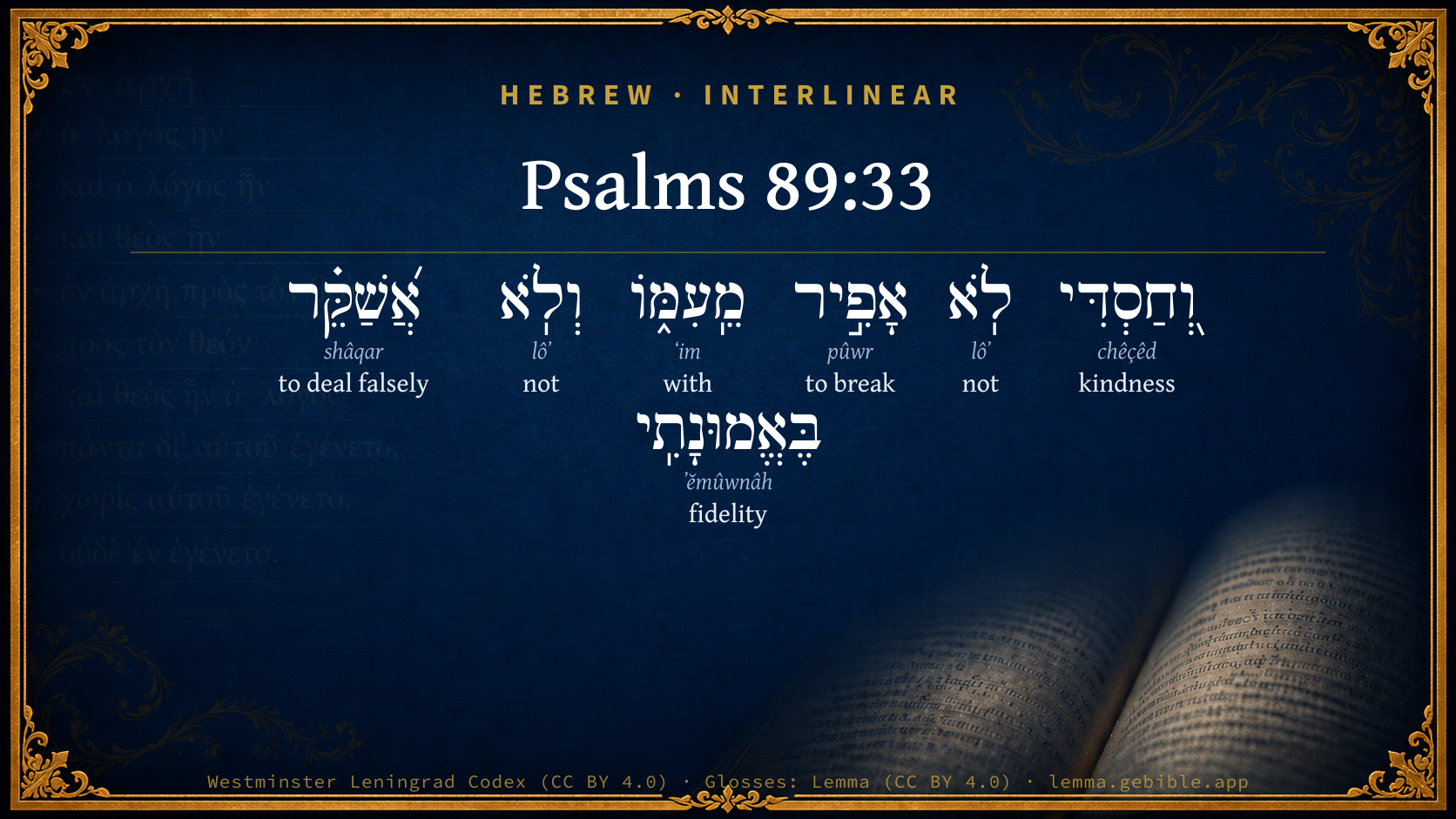
Hebrew (Westminster Leningrad Codex) Psalms 89:33 appears in the Hebrew Old Testament. The text above is from the Westminster Leningrad Codex. Each word links to its Strong’s number, a concise gloss, and parsing drawn from the Open Scriptures Hebrew Bible morphology. Click any word for its full Brown-Driver-Briggs (BDB) entry.
Download image
Cite this verse

Psalms 89:33 (World English Bible). Public Domain. Lemma interlinear Bible study tool, https://lemma.gebible.app/v/psalms/89/33.

Show BibTeX & RIS
BibTeX
RIS
English Translation
But I will not completely take my loving kindness from him, Nor allow my faithfulness to fail.
World English Bible · Public Domain
Download a study sheet

One document with this verse’s original text, its word-by-word gloss line, the meaning frame, cross-references with their text, attributed commentary, and full source and license credits — printable, and it pastes into notes with its structure intact.

This verse Autodidact and up

Study sheet (.html) Plain text (.txt)

A passage Seminary Student

Up to 50 verses in one chapter. A passage sheet keeps up to 6 commentary sources and 12 cross-references per verse, in the order this page ranks them, and says so on the sheet whenever that leaves anything out. Ask for a single verse and you get the Autodidact verse sheet above.

Everything on this page stays free to read, with no account — the sheet is a download of what is already on screen, not access to it.

Want to remove ads? Support Godless Engineer
Compare translations 3

The same verse in 3 English versions, stacked beneath the original-language interlinear above. Click any original word for its lexicon entry.

Each is an independent rendering of the whole verse — the interlinear is not word-aligned to these translations.

Highlighted words mark where these versions differ — a whole-verse word diff, not a word-by-word alignment.

  • World English Bible Public Domain
    But I will not completely take my loving kindness from him, Nor allow my faithfulness to fail.
  • King James Version Public Domain
    Nevertheless my lovingkindness will I not utterly take from him, nor suffer my faithfulness to fail.
  • unfoldingWord Literal Text CC BY-SA 4.0
    But my covenant faithfulness I will not break off from him, and I will not deal falsely in my faithfulness.

unfoldingWord Literal Text — © unfoldingWord, licensed CC BY-SA 4.0. Word-aligned USFM3 via Door43 (git.door43.org/unfoldingWord/en_ult).

Versions to compare (up to 4)

3 of 4 selected

Show all 18 translations

Every available English version of this verse, each an independent rendering of the whole verse.

  • World English Bible Public Domain
    But I will not completely take my loving kindness from him, Nor allow my faithfulness to fail.
  • Berean Standard Bible Public Domain
    But I will not withdraw My loving devotion from him, nor ever betray My faithfulness.
  • Majority Standard Bible Public Domain
    But I will not withdraw My loving devotion from him, nor ever betray My faithfulness.
  • King James Version Public Domain
    Nevertheless my lovingkindness will I not utterly take from him, nor suffer my faithfulness to fail.
  • American Standard Version (1901) Public Domain
    But my lovingkindness will I not utterly take from him, Nor suffer my faithfulness to fail.
  • Revised Version (1885) Public Domain
    But my mercy will I not utterly take from him, nor suffer my faithfulness to fail.
  • Geneva Bible (1599) Public Domain
    Yet my louing kindnesse will I not take from him, neither will I falsifie my trueth.
  • Douay-Rheims (1899) Public Domain
    I will visit their iniquities with a rod: and their sins with stripes.
  • Young's Literal Translation Public Domain
    And My kindness I break not from him, Nor do I deal falsely in My faithfulness.
  • Literal Standard Version CC BY-SA 4.0
    And I do not break My kindness from him, || Nor do I deal falsely in My faithfulness.
  • Unlocked Literal Bible CC BY-SA 4.0
    But I will not remove my steadfast love from him or be unfaithful to my promise.
  • unfoldingWord Literal Text CC BY-SA 4.0
    But my covenant faithfulness I will not break off from him, and I will not deal falsely in my faithfulness.
  • Darby Bible Public Domain
    Nevertheless my loving-kindness will I not utterly take from him, nor belie my faithfulness;
  • World Messianic Bible Public Domain
    But I will not completely take my loving kindness from him, nor allow my faithfulness to fail.
  • Webster's Bible Public Domain
    \\89:32\\Then will I visit their transgression with the rod, and their iniquity with stripes.
  • Free Bible Version CC BY-SA 4.0
    However, I will not take away my love from him; I will not break my promise to him.
  • Bible in Basic English Public Domain
    But I will not take away my mercy from him, and will not be false to my faith.
  • JPS Tanakh (1917) Public Domain
    (89-34) But My mercy will I not break off from him, nor will I be false to My faithfulness.

Literal Standard Version (2020), Covenant Press — licensed CC BY-SA 4.0. Text via the HelloAO Bible API (eBible.org). Unlocked Literal Bible (unfoldingWord) — licensed CC BY-SA 4.0. Text via the HelloAO Bible API (eBible.org). unfoldingWord Literal Text — © unfoldingWord, licensed CC BY-SA 4.0. Word-aligned USFM3 via Door43 (git.door43.org/unfoldingWord/en_ult). Free Bible Version, Dr. Jonathan Gallagher — licensed CC BY-SA 4.0. Text via the HelloAO Bible API (eBible.org).

Word by word

More ways to search: Search by grammar → Find every occurrence → Compare this word →

Practice this passage: Drill this verse → Learn its vocabulary →

About this verse

These counts appear in no published source. They are computed here, from the morphology-tagged text and Lemma’s own curated glosses. What Lemma adds →

7
words
6
distinct lemmas
Wisdom
section

Notable vocabulary

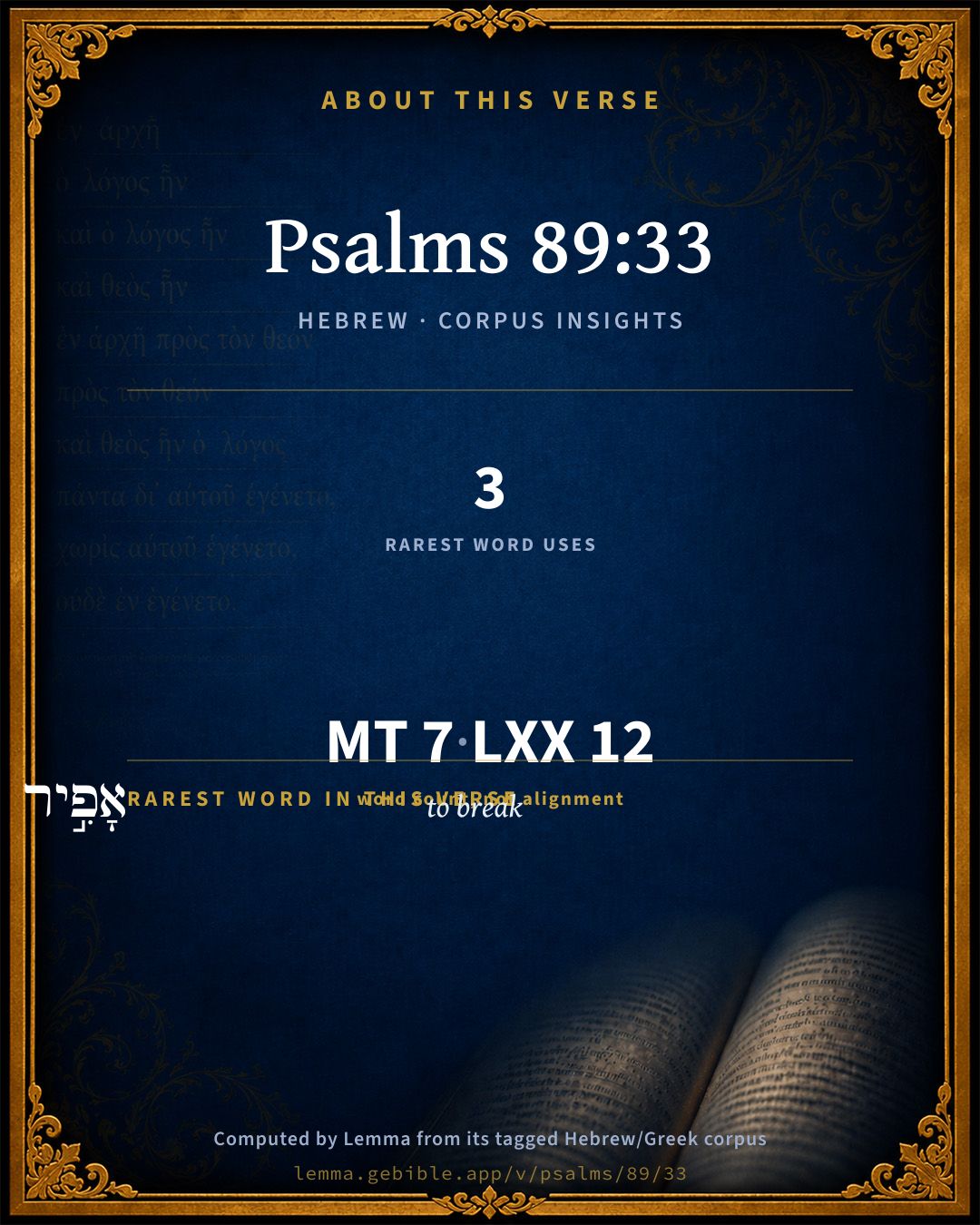
The rarest word here is אָפִ֣יר to break H6331 — appearing just 3 times in the whole Hebrew Bible.

Shared distinctive vocabulary

אָפִ֣יר to break H6331 occurs in 3 verses of the Hebrew Bible. Also found in:

Grammatical profile

  • 2 verbs
  • 2 nouns
  • 1 preposition
  • 2 particles

Verb forms

  • אָפִ֣יר Hiphil · Imperfect
  • אֲ֝שַׁקֵּ֗ר Piel · Imperfect

Repetition

A word recurs within this verse — often emphatic in Hebrew:

Hebrew & Septuagint length

In English translation the verse runs 17 words from the Hebrew and 14 from the Septuagint (LXX English) — closely comparable.

A rough comparison of the two English renderings, which tokenize alike — not a word-level alignment.

Word counts can differ between the Hebrew and the Greek without any difference in meaning — e.g. the Hebrew direct-object marker אֵת has no separate Greek word, and Greek often adds the article ὁ.

In the original languages it is 7 Hebrew tokens and 12 Greek tokens — but the two are counted differently (Hebrew bundles its prefixes and suffixes into one token; the Greek is in lemma form), so that isn’t a like-for-like length.

Cross-references

12

Topical passages linked to Psalms 89:33 in the Treasury of Scripture Knowledge — connected by theme and wording, ordered by reader-vote popularity; previews shown in the World English Bible.

  • Isaiah 54:8–10 In overflowing wrath I hid my face from you for a moment; but with everlasting loving kindness will I have mercy on you, says Yahweh your Redeemer.
  • 2 Samuel 7:15 but my loving kindness shall not depart from him, as I took it from Saul, whom I put away before you.
  • Lamentations 3:31–32 For the Lord will not cast off forever.
  • Jeremiah 33:20–26 Thus says Yahweh: If you can break my covenant of the day, and my covenant of the night, so that there shall not be day and night in their season;
  • Hebrews 6:18 that by two immutable things, in which it is impossible for God to lie, we may have a strong encouragement, who have fled for refuge to take hold of the hope set before us.
  • 1 Samuel 15:29 Also the Strength of Israel will not lie nor repent; for he is not a man, that he should repent.
  • 1 Kings 11:36 To his son will I give one tribe, that David my servant may have a lamp always before me in Jerusalem, the city which I have chosen me to put my name there.
  • 2 Samuel 7:13 He shall build a house for my name, and I will establish the throne of his kingdom forever.
  • 1 Kings 11:13 However I will not tear away all the kingdom; but I will give one tribe to your son, for David my servant's sake, and for Jerusalem's sake which I have chosen.
  • 1 Kings 11:32 (but he shall have one tribe, for my servant David's sake and for Jerusalem's sake, the city which I have chosen out of all the tribes of Israel);
  • 1 Corinthians 15:25 For he must reign until he has put all his enemies under his feet.
  • Psalms 89:39 You have renounced the covenant of your servant. You have defiled his crown in the dust.

Cross-references courtesy of OpenBible.info (CC BY 4.0).

Hebrew and Greek witnesses Masoretic Hebrew ↔ Greek Septuagint

The same verse in the two great witnesses to the Old Testament, shown verse-for-verse.

You’re reading Greek Psalm 88 (Hebrew Psalm 89). The Septuagint counts the superscription, so verse numbers can differ from the Hebrew — chapter-level alignment, not verse-by-verse. Numbering follows Rahlfs.

These are two independent witnesses, not word-aligned to each other, and the Septuagint is shown in lemma (dictionary) form.

Hebrew Psalms 89:33 Masoretic · Westminster Leningrad Codex

וְ֭חַסְדִּי לֹֽא אָפִ֣יר מֵֽעִמּ֑וֹ וְלֹֽא אֲ֝שַׁקֵּ֗ר בֶּאֱמוּנָתִֽי

But I will not completely take my loving kindness from him, Nor allow my faithfulness to fail.

World English Bible · Public Domain

Greek LXX Greek Psalm 88:33 Septuagint · lemma form

ἐπισκέπτομαι ἐν ῥάβδος ὁ ἀνομία αὐτός καί ἐν μάστιξ ὁ ἁμαρτία αὐτός

But my mercy I will not utterly remove from him, nor wrong my truth.

LXX2012 (modern English Septuagint) · Public Domain

Hebrew: Westminster Leningrad Codex (CC BY 4.0). Greek: Septuagint (public domain); English from LXX2012 (modern English Septuagint) (Public Domain). How the Septuagint differs from the Hebrew →

Commentary

Notes on Psalms 89:33 from classic Christian and Jewish commentators (each source and its license shown beneath its notes). The classic Christian expositions comment on the surrounding passage and are grouped to its opening verse, so a note may address several verses; the Jewish commentaries on the Tanakh (Rashi and others) are per-verse, so they appear only where the commentator wrote on this verse.

Lemma curates 59 commentaries, every one of them public domain or Creative Commons licensed, each selected and text-cleaned for this edition rather than reprinted as found. About our sources →

Trapp's Complete Commentary

John Trapp

Psa 89:33 Nevertheless my lovingkindness will I not utterly take from him, nor suffer my faithfulness to fail.

Ver. 33. Nevertheless my lovingkindness, &c.] For that were to break covenant: I will correct him in mercy, and in measure. Sinite virgam corrigentem, ne sentiatis malleum conterentem, saith Bernard.

Nor suffer my faithfulness to fail] Non mentiar in veritate mea, God is very careful to keep touch with his.

John Trapp, A Commentary or Exposition upon All the Books of the Old and New Testament (1647–1656) — public domain. Text from a community e-Sword module.

J. A. Alexander on Psalms

Joseph Addison Alexander

34. (Psa 89:33) And my mercy I will not withdraw from him, and will not prove false (or deal falsely) in my faith. Our idiom requires a but to render clear the relation of this sentence to the foregoing context. The verb in the first clause means to break or violate, but construed, as it here is, with the preposition from, suggests the idea of breaking an engagement by with-drawing what was stipulated to be given and secured. Faith in the last clause means fidelity or truth, as in the phrases, good faith, keep faith, etc. See above, on Psa 44:17. The promise in this verse is not to them but him, not to the sinning individuals mentioned just before, but to the family or race as such, to David as still living in his natural descendants. Compare 1Ki 11:36, 2Ki 8:19, 2Ch 6:42, Isa 37:35.

Joseph Addison Alexander, The Psalms Translated and Explained (1850) — public domain. Text from a community e-Sword module.

Geneva Bible (1599)

Geneva Bible translators

Though the faithful answer not in all points to their profession, yet God will not break his Covenant with them.

Geneva Bible (1599) marginal notes — public domain. Text via Bolls.life.

The Cambridge Bible for Schools and Colleges

gen. ed. J. J. S. Perowne

33. But my lovingkindness will I not break off from him,

Neither be false to my faithfulness.

The word rendered break off is an unusual one to apply to lovingkindness, and its form is anomalous. The change of one letter however gives the word used in 1Ch_17:13, I will not take away, and this emendation should probably be adopted. Be false to is the word found in 1Sa_15:29, “The Strength of Israel will not lie.”

The Cambridge Bible for Schools and Colleges (gen. ed. J. J. S. Perowne; Cambridge University Press, 1878–1918) — public domain. Text from a community e-Sword module.

John Gill's Exposition

My covenant will I not break,.... Not the covenant at Sinai, as Aben Ezra, but the covenant of grace made with Christ, and which stands fast with him, Psa 89:3, which is firm, sure, and stable, and as immovable as mountains and hills, and more so, Sa2 23:5 or "profane" (m) it, though his people profane his statutes, Psa 89:31, he will not profane his covenant; though they violate his laws, he is a God keeping covenant with them, and will not break his word with them:

nor alter the thing that is gone out of my lips; any promise of his, respecting either the temporal, spiritual, or eternal welfare of his people: or "not change" (n); as he changes not in his nature and perfections, nor in his love and affections, nor in his counsels and purposes; so neither in his covenant and promises, they are always the same, and have a certain and unchangeable accomplishment; there is a performance of whatsoever is spoken by the Lord, Luk 1:45.

(m) "non prophanabo", V. L. Pagninus, Montanus, Tigurine version, &c. (n) "non mutabo", Pagninus, Montanus, Tigurine version, Junius & Tremellius, &c.

John Gill's Exposition of the Whole Bible (1746–1763) — public domain (CC PDM 1.0). Text via the HelloAO Bible API.

Albert Barnes' Notes on the Bible

Nevertheless my loving-kindness - My mercy; my favor. I will not utterly cast him off. He shall not be in the condition of those who are my enemies, or who are entirely forsaken.

Will I not utterly take from him - Margin, “I will not make void from.” The Hebrew word - פרר pârar - means to break, to break in pieces; then, to violate, as a covenant; then, to make vain, to bring to nought, to frustrate; then, to annul, to abolish. The idea here is that of making entirely vain; wholly removing from; or taking completely away. The meaning is, that he would not wholly take away his favor; he would not entirely abandon him; he would not suffer him to become wholly apostate; he would not leave him to ruin. The covenant once made would be accomplished; the promise given would be carried out.

Nor suffer my faithfulness - My faithfulness as pledged in the covenant or promise. “To fail.” Margin,” lie.” I will not prove false, or deal falsely in the pledge which I have made. It shall not appear at last that I have made a promise which has not been kept. This passage contains a very important principle in regard to the dealings of God with his people. The principle is, that if people are converted, if they in fact become his people - he will never suffer them wholly to fall away and perish. They may be suffered to backslide; they may fall into sin, but they will not be allowed to go so far as to apostatize wholly. They will be brought back again. Whatever method may be necessary for this, will be adopted. Commands; warnings; entreaties; remonstrances; - their own experience; the admonitions of others; the influences of the Holy Spirit: judgments and calamities; sickness; loss of property; bereavement; disappointment; disgrace; any of these, or all of these, may be resorted to, in order to bring them back; but they will be brought back. God, in mercy and in love, will so visit them with sorrow and trouble that they shall be recovered, and that their “spirit shall be saved in the day of the Lord Jesus.”

Albert Barnes' Notes on the Bible (1834–1885) — public domain. Text from a community e-Sword/MySword module.

Matthew Poole's English Annotations

My loving-kindness; my mercy promised to David.

Matthew Poole's English Annotations on the Holy Bible (1683–1685) — public domain. Text from a community e-Sword/MySword module.

The Treasury of David

Charles H. Spurgeon

Ver. 33. Nevertheless. And a glorious nevertheless too! Nevertheless my lovingkindness will I not utterly take from him. O glorious fear killing sentence! This crowns the covenant with exceeding glory. Mercy may seem to depart from the Lord's chosen, but it shall never altogether do so. Jesus still enjoys the divine favour, and we are in him, and therefore under the most trying circumstances the Lord's lovingkindness to each one of his chosen will endure the strain. If the covenant could be made void by our sins it would have been void long ere this; and if renewed its tenure would not be worth an hour's purchase if it had remained dependent upon us. God may leave his people, and they may thereby suffer much and fall very low, but utterly and altogether he never can remove his love from them; for that would be to cast a reflection upon his own truth, and this he will never allow, for he adds,

nor suffer my faithfulness to fail. Man fails in all points, but God in none. To be faithful is one of the eternal characteristics of God, in which he always places a great part of his glory: his truth is one of his peculiar treasures and crown jewels, and he will never endure that it should be tarnished in any degree. This passage sweetly assures us that the heirs of glory shall not be utterly cast off. Let those deny the safety of the saints who choose to do so, we have not so learned Christ. We believe in the gospel rod, but not in the penal sword for the adopted sons.

Ver. 33. Nevertheless my lovingkindness, etc. Except the covenant of grace had this article in it for remission of sin and for fatherly correction, to drive unto repentance, that the penitent person coming to God by faith might have sin forgiven him and lovingkindness shown to him; this covenant should fail us no less than the covenant of works. David Dickson.

Ver. 33. I will not utterly take from him. Why "from him?" Because all God's lovingkindness to his people is centred in Christ. Does God love you? it is because he loves Christ; you are one with Christ. Your transgressions are your own; they are separate from Christ; but God's love is not your own; it is Christ's: you receive it because you are one with him. How beautifully that is distinguished here"If they transgress, I will punish them; but my lovingkindness will I not take from him" in whom alone they find it; and in union with whom alone they enjoy it. Capel Molyneux.

Ver. 33. From him. The words, "Nevertheless my lovingkindness will not utterly take from him", are worthy of consideration; for the question being about those who are chastised, it would appear that he should have written, from them, and not from him. But the prophet has thus worded it, because, being the children and members of his Christ, the favours which God bestows upon us belong to him in some manner; and it seems that the Psalmist wishes to show us hereby, that it is in Jesus Christ, and for love of him alone, that God bestows favours on us. And that which follows, in Ps 89:34 verse, agrees herewith, My covenant will I not break for it is properly to Jesus Christ, on account of his admirable obedience, that God the Father has promised to be merciful to our iniquities, and never to leave one of those to perish who are in covenant with him. Jean Daille.

Ver. 33. Nor suffer my faithfulness to fail. Man's faith may fail him sometimes, but God's faithfulness never fails him: God will not suffer his faithfulness to fail. God's operations may have an aspect that way; the devil's temptations, and our unbelieving hearts, may not only make us think so, but persuade us it is so, whereas it cannot be so, for the Lord will not suffer it, he will not make a lie in his truth or faithfulness; so the Hebrew is: he is a God that cannot lie, he is Truth, speaks truth, and not one of his promises can or shall fail; which may afford strong consolation unto all that are under any promise of God. William Greenhill.

Psalms 89:34*

Charles H. Spurgeon's The Treasury of David (1869–1885) — public domain. Psalms only. Text from a community e-Sword/MySword module.

The Pulpit Commentary

Nevertheless my loving kindness will I not utterly take from him, nor suffer my faithfulness to fail. Compare the original promise; (2Sa_7:15) and see also 1Ki_11:12, 1Ki_11:13, 34-39 15:4, 5, etc. The seed of David was not allowed to fail, but was continued on, until, in the fulness of time, there was born into the world, of David"s seed and in David"s city, One in whom all the promises made to David could be, and were, accomplished in their utmost fulness.

The Pulpit Commentary (1880–1919), ed. H.D.M. Spence-Jones & Joseph S. Exell — public domain. Text from a community e-Sword module.

unfoldingWord translationNotes

Door43 World Missions Community

I will not remove my steadfast love from him or be unfaithful to my promise

This can be stated in positive form. AT: "I will always love David, and I will do what I promised to him" (See: Litotes)

the words of my lips

Here "lips" represent the whole mouth and the person speaking. AT: "what I said" (See: Synecdoche)

translationWords

covenant faithfulness

faithful

promise

covenant

unfoldingWord translationNotes — © Distant Shores Media and the Door43 World Missions Community, licensed CC BY-SA 4.0. Source: git.door43.org/Door43/en_tn.

Rashi

Rabbi Shlomo Yitzchaki (Rashi)

I shall punish their transgression with a rod So did Nathan the prophet say to him concerning Solomon (II Sam. 7:14): “so that when he goes astray, I will chasten him with the rod of men.” This refers to Rezon the son of Eliada, who rose up as an adversary to him: “and with the stripes of the sons of Adam.” This refers to Ashmadai, according to the Sages of blessed memory.

Rashi on the Tanakh — English translations: “The Judaica Press complete Tanach with Rashi, translated by A. J. Rosenberg” (CC BY 4.0); “Pentateuch with Rashi's commentary by M. Rosenbaum and A.M. Silbermann, 1929-1934” (public domain); “The Metsudah Tanach series, Lakewood, N.J” (CC BY 4.0); and “The Book of Joshua, Metsudah Publications, 1997” (CC BY 4.0). Text via Sefaria.

Lesson kit

Teaching starters — assembled from the data on this page, not authored interpretation. Every prompt links to the verse data it draws on. Edit before teaching.

Psalms, in the Wisdom, opens this verse with 7 words (6 distinct Hebrew lemmas). Its most distinctive word is pûwr (“to break”). A historical commentator’s framing appears above. Read the whole chapter for the surrounding context.

Discussion questions

  1. How does “to break” (pûwr) shape what this verse is saying?
  2. How does Psalms 33:10, which shares the word «to break», read alongside this verse?
  3. What does the repetition of “not” (2× in this one verse) do in this verse?
  4. These translations render this verse differently. What is at stake in choosing one wording over another?
  5. «אָפִ֣יר» is a Hiphil Imperfect verb. How does that grammatical form shape the action described?
  6. Compare how Trapp's Complete Commentary and J. A. Alexander on Psalms read this verse. Where do they agree or differ?

Things to notice

Reading settings

Reading text

Shown beneath each verse's original-language words.

Old Testament
Old Testament edition

Read the OT as the Masoretic Hebrew (MT) or the Greek Septuagint (LXX).

English shown for the Greek Septuagint (in the Hebrew ↔ Greek comparison).

Comparing translations? Open the Compare panel on any verse page to stack up to four side by side.