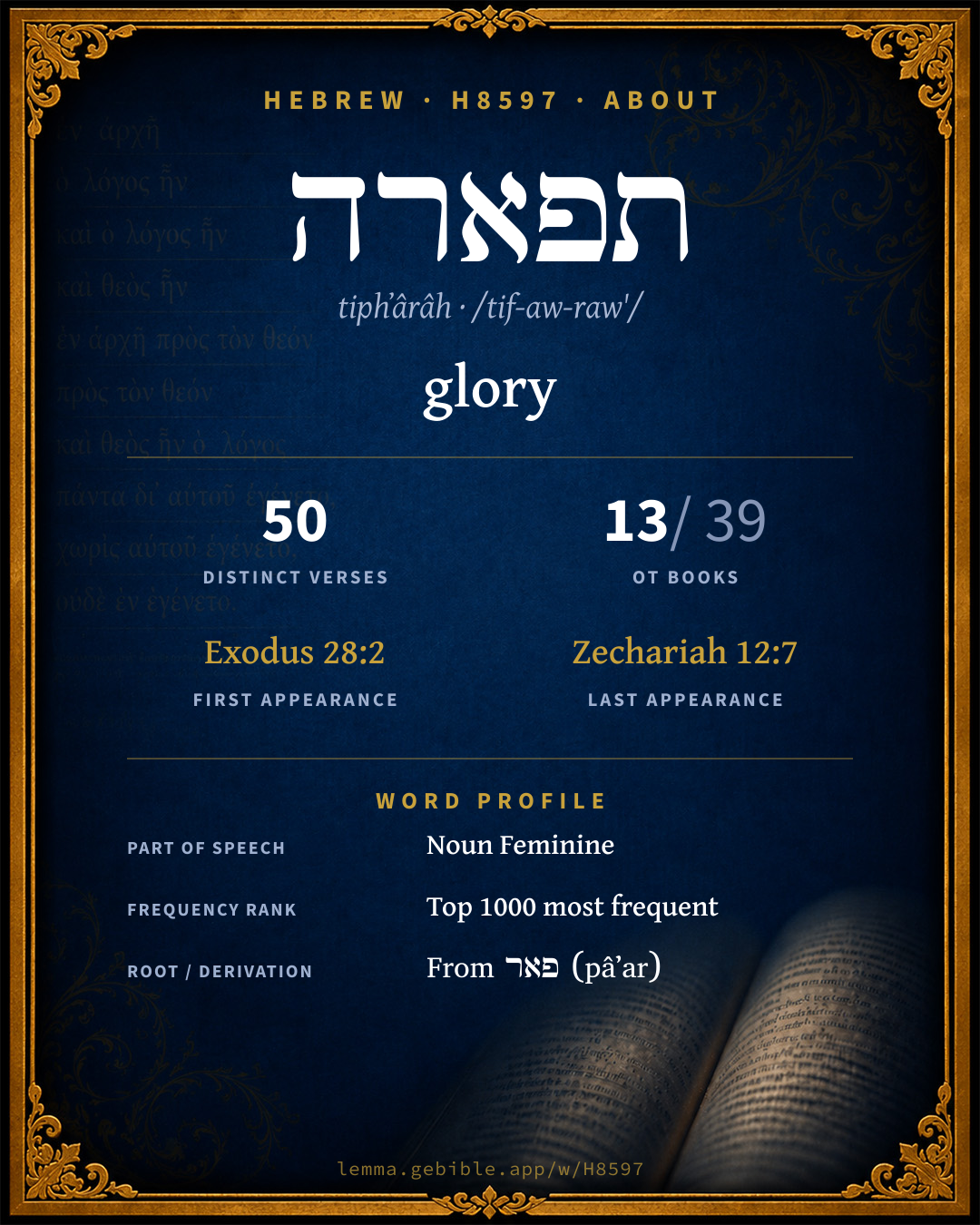
תִּפְאָרָה
glory
also: beauty, splendour fuller range ↓
Full lexicon entry — Brown-Driver-Briggs (BDB)
From Brown-Driver-Briggs (BDB)
Where this word appears
See every Construct-state word in the Hebrew Bible →
Grammar key — what these labels mean
Part of speech
- Noun
- A naming word — a person, place, thing, or idea.
Noun type
- Common
- A common noun — a general class of person, place, or thing (“king,” “city,” “water”), not a specific name.
State
- Absolute
- The independent form of a noun, not bound to a following word.
- Construct
- A noun bound to a following noun in a possessive / “of” relationship (the construct chain).
Gender
- Feminine
- Grammatically feminine.
Number
- Singular
- One.
14 verses where H8597 appears in the Construct state in the Book of Isaiah. Filtered view — show all forms. Click any verse to open its interlinear word-by-word view. Verse text shown in the World English Bible for context — . Each verse’s Hebrew form is shown with its reference; the English is not keyword-highlighted, since the data carries no word-level English alignment. Use “Compare translations” on any verse to read it across multiple English versions. This concordance covers the Hebrew Bible; Septuagint (Greek Old Testament) occurrences are not indexed here.
Isaiah
- Isaiah 3:18 תִּפְאֶ֧רֶת n c fs cs In that day the Lord will take away the beauty of their anklets, the headbands, the crescent necklaces,
- Isaiah 10:12 תִּפְאֶ֖רֶת n c fs cs Therefore it shall happen that, when the Lord has performed his whole work on Mount Zion and on Jerusalem, I will punish the fruit of the stout heart of the king of Assyria, and the glory of his high looks.
- Isaiah 13:19 תִּפְאֶ֖רֶת n c fs cs Babylon, the glory of kingdoms, the beauty of the Chaldeans' pride, shall be as when God overthrew Sodom and Gomorrah.
- Isaiah 20:5 תִּפְאַרְתָּֽ/ם n c fs cs + sfx pers 3mp They shall be dismayed and confounded, because of Ethiopia their expectation, and of Egypt their glory.
- Isaiah 28:1 תִפְאַרְתּ֑/וֹ n c fs cs + sfx pers 3ms Woe to the crown of pride of the drunkards of Ephraim, and to the fading flower of his glorious beauty, which is on the head of the fat valley of those who are overcome with wine!
- Isaiah 28:4 תִפְאַרְתּ֔/וֹ n c fs cs + sfx pers 3ms and the fading flower of his glorious beauty, which is on the head of the fat valley, shall be as the first-ripe fig before the summer; which when he who looks on it sees, while it is yet in his hand he eats it up.
- Isaiah 44:13 כְּ/תִפְאֶ֥רֶת prep + n c fs cs The carpenter stretches out a line; he marks it out with a pencil; he shapes it with planes, and he marks it out with the compasses, and shapes it after the figure of a man, according to the beauty of a man, to dwell in a house.
- Isaiah 46:13 תִּפְאַרְתִּֽ/י n c fs cs + sfx pers 1cs I bring near my righteousness, it shall not be far off, and my salvation shall not wait; and I will place salvation in Zion for Israel my glory.
- Isaiah 52:1 תִפְאַרְתֵּ֗/ךְ n c fs cs + sfx pers 2fs Awake, awake, put on your strength, Zion; put on your beautiful garments, Jerusalem, the holy city: for henceforth there shall no more come into you the uncircumcised and the unclean.
- Isaiah 60:7 תִּפְאַרְתִּ֖/י n c fs cs + sfx pers 1cs All the flocks of Kedar shall be gathered together to you, the rams of Nebaioth shall minister to you; they shall come up with acceptance on my altar; and I will glorify the house of my glory.
- Isaiah 60:19 לְ/תִפְאַרְתֵּֽ/ךְ prep + n c fs cs + sfx pers 2fs The sun shall be no more your light by day; neither for brightness shall the moon give light to you: but Yahweh will be to you an everlasting light, and your God your glory.
- Isaiah 63:12 תִּפְאַרְתּ֑/וֹ n c fs cs + sfx pers 3ms who caused his glorious arm to go at the right hand of Moses? who divided the waters before them, to make himself an everlasting name?
- Isaiah 63:15 וְ/תִפְאַרְתֶּ֑/ךָ conj + n c fs cs + sfx pers 2ms Look down from heaven, and see from the habitation of your holiness and of your glory: where are your zeal and your mighty acts? the yearning of your heart and your compassion is restrained toward me.
- Isaiah 64:11 וְ/תִפְאַרְתֵּ֗/נוּ conj + n c fs cs + sfx pers 1cp Our holy and our beautiful house, where our fathers praised you, is burned with fire; and all our pleasant places are laid waste.
About this entry
At a glance — auto-summarized from this page’s data, not written by a person. Every figure links to its source below. This summary describes the numbers; it doesn’t interpret them.
תפארה (tiphʼârâh) is a Hebrew noun most often rendered “glory.” Older and newer Bibles part ways — “glory” in the King James Version, “splendor” (unfoldingWord Literal Text) in modern versions. See the renderings breakdown. It turns up in 50 verses across 13 books, a moderately common footprint. It concentrates in Isaiah, which alone accounts for 36% of its uses. Beyond its headline sense, its full sense range takes in “beauty” and “splendour”. The sections below give every sense, occurrence, and version rendering.
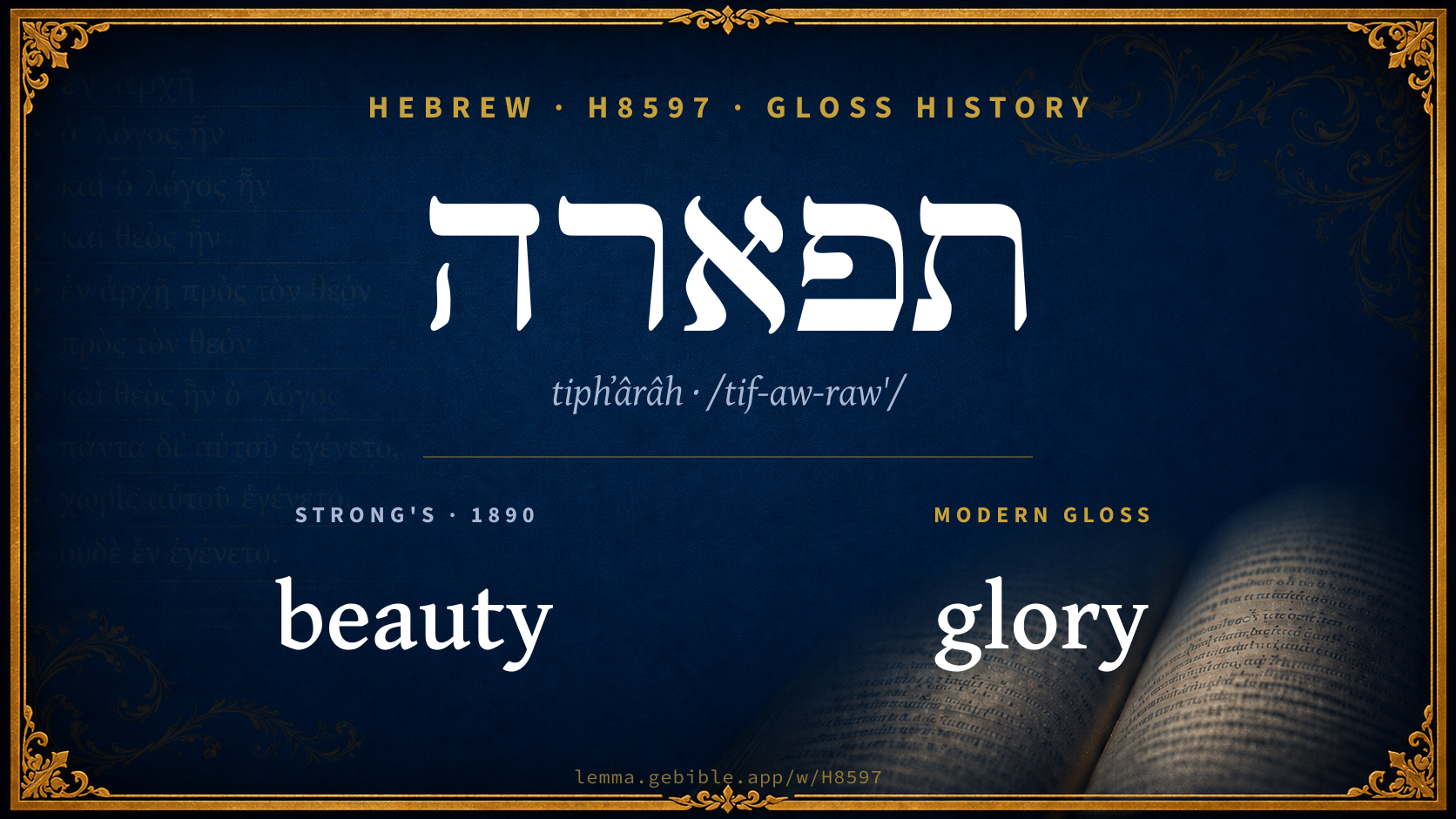
Gloss history
Strong's 1890 vs modern scholarship
About this word
Strong's H8597 catalogs a Hebrew word from the Hebrew Old Testament.
These counts are not copied from any lexicon or concordance. They are computed here, from the morphology-tagged Hebrew Old Testament. What Lemma adds →
- 50
- distinct verses
- The word appears in 50 distinct verses.
- 13 / 39
- OT books
- The word appears in 13 of 39 Old Testament books.
- #723
- by frequency
- Top 1000 most frequent Hebrew words (rank 723 of 8,640 Hebrew words by occurrence).
View all 50 occurrences in the concordance →
By section of the Old Testament
By traditional corpus
Conventional, traditional groupings — biblical authorship is debated, so this is a traditional corpus grouping, not an authorship claim. Each share is this word’s portion of its verses in that division of the Hebrew canon. Each figure is a share of the word’s 50 distinct verses.
- Prophets (Nevi'im) 31 verses · 62%
- Writings (Ketuvim) 16 verses · 32%
- Torah (Pentateuch) 3 verses · 6%
How translations render this word
Counts come from each version’s own published word-to-Strong’s tagging or interlinear alignment — an approximate guide to how each version renders this word, not a word-level alignment the data otherwise carries. Because each total is that version’s own tagged count, the per-version totals vary from one another and need not match the appearance or distinct-verse counts above. These counts may also differ from a printed concordance because Lemma counts each distinctly tagged rendering and does not collapse phrase taggings into a single head-word total. This is a fixed set of word-tagged versions (KJV, ASV, BSB, ULT) and does not change with the reading translation you choose elsewhere. Each version’s license is shown beside its name below (and on Sources).
- King James Version: Glory 20×, Beauty 9×, Beautiful 5×
- American Standard Version: Glory 19×, Beauty 10×, Beautiful 4×
- Berean Standard Bible: Glory 13×, Splendor 9×, Glorious 8×
- unfoldingWord Literal Text: Splendor 15×, Beauty 10×, Splendor of 7×
King James Version Public Domain
Renders H8597 across 51 tagged occurrences — most commonly:
Plus 9 renderings that appear only once — usually multi-word phrases or single function words the recovered tagging swept in, not distinct renderings.
American Standard Version Public Domain
Renders H8597 across 51 tagged occurrences — most commonly:
Plus 13 renderings that appear only once — usually multi-word phrases or single function words the recovered tagging swept in, not distinct renderings.
Berean Standard Bible Public Domain
Renders H8597 across 49 tagged occurrences — most commonly:
Plus 8 renderings that appear only once — usually multi-word phrases or single function words the recovered tagging swept in, not distinct renderings. Not rendered by a distinct English word in 2 further occurrences.
unfoldingWord Literal Text CC BY-SA 4.0
Renders H8597 across 53 tagged occurrences — most commonly:
Plus 10 renderings that appear only once — usually multi-word phrases or single function words the recovered tagging swept in, not distinct renderings.
7 senses and sub-senses in the full BDB
What do BDB’s symbols mean?
BDB uses these scholarly abbreviations:
| Symbol | Meaning |
|---|---|
| 𝔊 | the Septuagint (the ancient Greek translation, LXX) |
| 𝔙 | the Vulgate (the Latin translation) |
| 𝔖 | the Syriac version (the Peshitta) |
| 𝔗 | the Targum (the Aramaic translation) |
| ψ | the Psalms |
| √ | root (the underlying root or stem) |
| ‖ | parallel passage (a synonymous or contrasted parallel) |
| † | the dagger: every passage where the word occurs is cited |
The 7 senses and sub-senses the full Brown-Driver-Briggs lexicon distinguishes for this word, in lexicon order (not ranked by frequency), with BDB’s own verbatim wording and sub-sense lettering. Shown in Hebrew script with BDB’s own scholarly abbreviations. The condensed entry is in the Lexicon Entry tab. See also the Forms in the corpus table below.
- 1. beauty, finery Is 3:18; of garments 52:1; jewels Ez 16:17, 39; 23:26, cf. 2 Ch 3:6; flock Je 13:20; a man Is 44:13; city of Samaria 28:1, 4; diadem v 5. e.g. Isaiah 3:18
- 2. glory:
- a. of rank: apparel of h. p. Ex 28:2, 40 (P); עֲטֶרֶת ת׳ crown of glory Pr 4:9; 16:31 Is 62:3 Je 13:18 Ez 16:12; 23:42; greatness of monarch Est 1:4; house of David and inhabitants of Jerus. Zc 12:7(×2). e.g. Exodus 28:2
- b. of renown לְשֵׁם ולת׳ Dt 26:19 1 Ch 22:5 Je 13:11; 33:9. e.g. Deuteronomy 26:19
- c. attribute of י׳ ψ 71:8 1 Ch 29:11; שֵׁם ת׳ Is 63:14 1 Ch 29:13; ת׳ עֹז ψ 89:18; זְרוֹעַ ת׳ Is 63:12; hence ת׳ in י׳’s sanctuary ψ 96:6, בֵּית תִּפְאַרְתִּי Is 60:7 cf. 63:15 (of heavenly temple), 64:10; ת׳ as י׳’s gift to Isr. 46:13 cf. 60:19 (also ψ 89:18 supr.); of future fruit of land 4:2; design. of ark of י׳ ψ 78:61. e.g. Psalms 71:8
- 3.
- a. honour of nation Isr. La 2:1. e.g. Lamentations 2:1
- b. glorying, boasting, of individ., Is 20:5 Pr 17:6; 19:11; 20:29; 28:12; warrior Ju 4:9; monarchs Is 10:12; nations Is 13:19 Ez 24:25, מַקֵּל ת׳ rod (sceptre) of glorying Je 48:17 (others 1). e.g. Isaiah 20:5
Senses from the full Brown-Driver-Briggs lexicon (Brown, Driver, Briggs; Oxford 1906 — public domain), digitized via Sefaria, supplemented by the OpenScriptures HebrewLexicon (CC BY 4.0). Full attribution on Sources.
Word origin
n.f. beauty, glory;—תּ׳ Is 28:5 Je 48:17; elsewhere abs. and cstr. תִּפְאֶרֶת Is 3:18 + 20 times; תִּפְאָ֑רֶת Pr 28:12 + 6 times; sf. תִּפְאַרְתִּי Is 46:13 + 20 times sf.;—
— Brown-Driver-Briggs (Oxford 1906, public domain), digitized via Sefaria, supplemented by the OpenScriptures HebrewLexicon (CC BY 4.0). See Sources.
Derived from פאר (pâʼar) (H6286) — to glorify.
Forms in the corpus
The 37 distinct written forms H8597 takes in the Hebrew Bible, most frequent first — each parse links to that state’s occurrences in the concordance. Hebrew forms include their vowel points and cantillation, so a single lemma takes many written forms.
Same root — word family
Other BDB entries built from the same root as H8597, grouped by Strong’s listed origin. These share a root / origin per the lexicon — not necessarily a shared meaning. Each links to that word’s own entry.
Derives from
Shares the same root
Proper names from this root
People and places named from this root — a name, not an additional meaning of the word.
Compare all same-root words → Showing 4 of 6 — not the complete family. 1 of the same-root words is a proper name (a person or place). They share a root, not necessarily a meaning.
Septuagint verse parallels
This word appears in 47 verses that also exist in the Greek Old Testament (Septuagint), out of the 50 Hebrew verses it occurs in. You can read those verses in Greek by switching the Old Testament edition to the Septuagint.
Read these verses in the Septuagint
- Exodus 28:2
- Deuteronomy 26:19
- Judges 4:9
- 1 Chronicles 22:5
- 2 Chronicles 3:6
- Esther 1:4
- Psalms 71:8
- Proverbs 4:9
- Isaiah 3:18
- Jeremiah 13:11
- Lamentations 2:1
- Ezekiel 16:12
This is a verse-level parallel only — the same verses exist in both the Hebrew and Greek Old Testaments. No word-level Hebrew↔Greek correspondence is claimed: the data carries no such alignment, so no Greek word is shown as this Hebrew word’s translation. Coverage is not total — the Septuagint omits the deuterocanon and renumbers the Psalms, so some Hebrew verses have no direct Greek parallel.