Isaiah 13:19

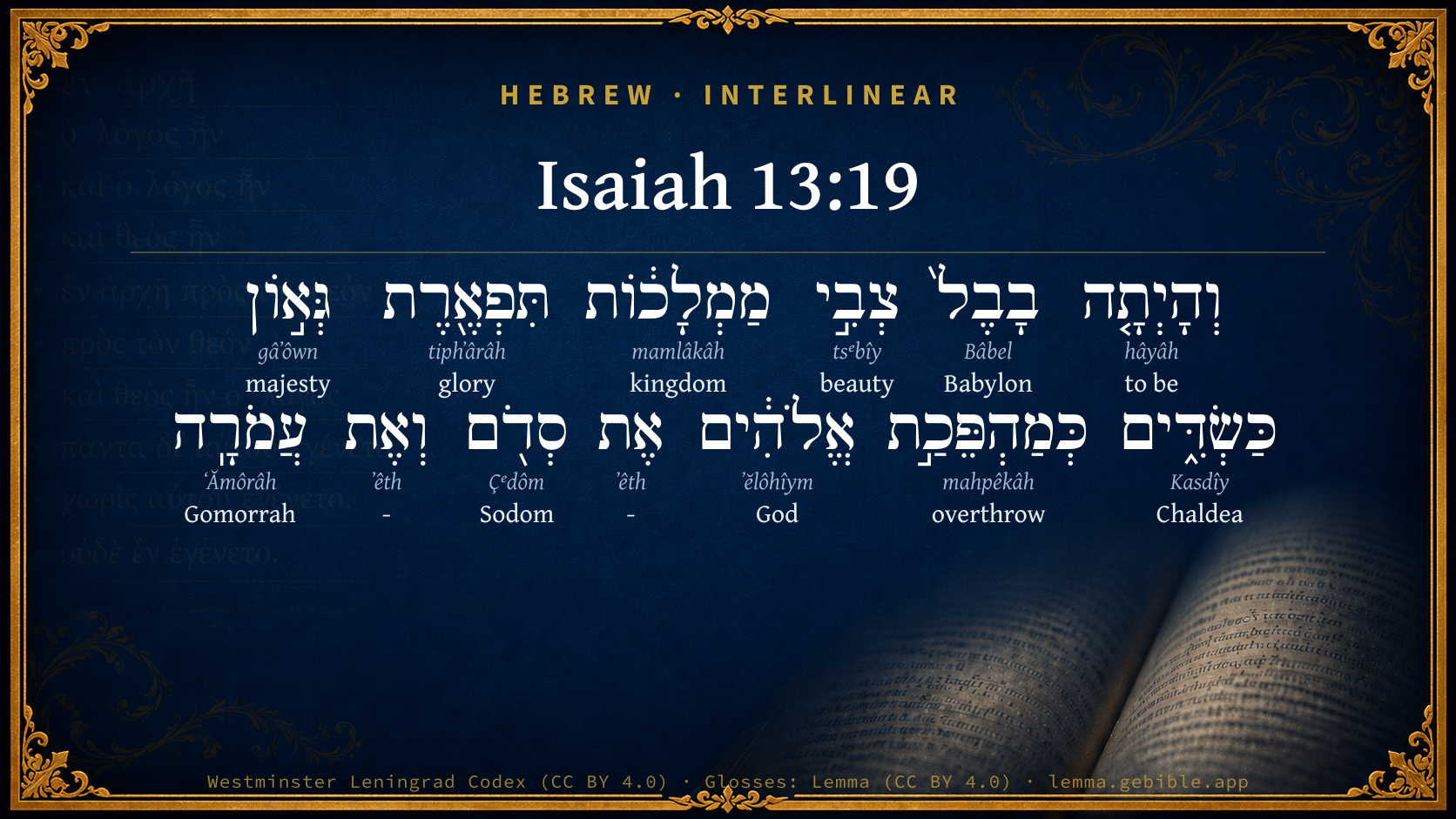
Hebrew (Westminster Leningrad Codex) Isaiah 13:19 appears in the Hebrew Old Testament. The text above is from the Westminster Leningrad Codex. Each word links to its Strong’s number, a concise gloss, and parsing drawn from the Open Scriptures Hebrew Bible morphology. Click any word for its full Brown-Driver-Briggs (BDB) entry.
Download image
Cite this verse

Isaiah 13:19 (World English Bible). Public Domain. Lemma interlinear Bible study tool, https://lemma.gebible.app/v/isaiah/13/19.

Show BibTeX & RIS
BibTeX
RIS
English Translation
Babylon, the glory of kingdoms, the beauty of the Chaldeans' pride, shall be as when God overthrew Sodom and Gomorrah.
World English Bible · Public Domain
Download a study sheet

One document with this verse’s original text, its word-by-word gloss line, the meaning frame, cross-references with their text, attributed commentary, and full source and license credits — printable, and it pastes into notes with its structure intact.

This verse Autodidact and up

Study sheet (.html) Plain text (.txt)

A passage Seminary Student

Up to 50 verses in one chapter. A passage sheet keeps up to 6 commentary sources and 12 cross-references per verse, in the order this page ranks them, and says so on the sheet whenever that leaves anything out. Ask for a single verse and you get the Autodidact verse sheet above.

Everything on this page stays free to read, with no account — the sheet is a download of what is already on screen, not access to it.

Want to remove ads? Support Godless Engineer
Compare translations 3

The same verse in 3 English versions, stacked beneath the original-language interlinear above. Click any original word for its lexicon entry.

Each is an independent rendering of the whole verse — the interlinear is not word-aligned to these translations.

Highlighted words mark where these versions differ — a whole-verse word diff, not a word-by-word alignment.

  • World English Bible Public Domain
    Babylon, the glory of kingdoms, the beauty of the Chaldeans' pride, shall be as when God overthrew Sodom and Gomorrah.
  • King James Version Public Domain
    And Babylon, the glory of kingdoms, the beauty of the Chaldees' excellency, shall be as when God overthrew Sodom and Gomorrah.
  • unfoldingWord Literal Text CC BY-SA 4.0
    And Babylon, the glory of the kingdoms, the splendor of the pride of the Chaldeans, will be like the destruction of God Sodom and Gomorrah.

unfoldingWord Literal Text — © unfoldingWord, licensed CC BY-SA 4.0. Word-aligned USFM3 via Door43 (git.door43.org/unfoldingWord/en_ult).

Versions to compare (up to 4)

3 of 4 selected

Show all 18 translations

Every available English version of this verse, each an independent rendering of the whole verse.

  • World English Bible Public Domain
    Babylon, the glory of kingdoms, the beauty of the Chaldeans' pride, shall be as when God overthrew Sodom and Gomorrah.
  • Berean Standard Bible Public Domain
    And Babylon, the jewel of the kingdoms, the glory of the pride of the Chaldeans, will be overthrown by God like Sodom and Gomorrah.
  • Majority Standard Bible Public Domain
    And Babylon, the jewel of the kingdoms, the glory of the pride of the Chaldeans, will be overthrown by God like Sodom and Gomorrah.
  • King James Version Public Domain
    And Babylon, the glory of kingdoms, the beauty of the Chaldees' excellency, shall be as when God overthrew Sodom and Gomorrah.
  • American Standard Version (1901) Public Domain
    And Babylon, the glory of kingdoms, the beauty of the Chaldeans' pride, shall be as when God overthrew Sodom and Gomorrah.
  • Revised Version (1885) Public Domain
    And Babylon, the glory of kingdoms, the beauty of the Chaldeans’ pride, shall be as when God overthrew Sodom and Gomorrah.
  • Geneva Bible (1599) Public Domain
    And Babel the glorie of kingdomes, the beautie and pride of the Chaldeans, shall be as the destruction of God in Sodom and Gomorah.
  • Douay-Rheims (1899) Public Domain
    And that Babylon, glorious among kingdoms, the famous pride of the Chaldeans, shall be even as the Lord destroyed Sodom and Gomorrha.
  • Young's Literal Translation Public Domain
    And Babylon, the beauty of kingdoms, The glory, the excellency of the Chaldeans, Hath been as overthrown by God, With Sodom and with Gomorrah.
  • Literal Standard Version CC BY-SA 4.0
    And Babylon, the beauty of kingdoms, || The glory, the excellence of the Chaldeans, || Has been as overthrown by God, || With Sodom and with Gomorrah.
  • Unlocked Literal Bible CC BY-SA 4.0
    Then Babylon, the most admired of kingdoms, the splendor of Chaldean pride, will be overthrown by God like Sodom and Gomorrah.
  • unfoldingWord Literal Text CC BY-SA 4.0
    And Babylon, the glory of the kingdoms, the splendor of the pride of the Chaldeans, will be like the destruction of God Sodom and Gomorrah.
  • Darby Bible Public Domain
    And Babylon, the glory of kingdoms, the beauty of the Chaldeans' pride, shall be as when God overthrew Sodom and Gomorrah.
  • World Messianic Bible Public Domain
    Babylon, the glory of kingdoms, the beauty of the Kasdim’ pride, will be like when God overthrew Sodom and Gomorrah.
  • Webster's Bible Public Domain
    And Babylon, the glory of kingdoms, the beauty of the Chaldees' excellence, shall be as when God overthrew Sodom and Gomorrah.
  • Free Bible Version CC BY-SA 4.0
    Babylon, the most marvelous city of any kingdom, the greatest pride of the Babylonian people, will be demolished by God like Sodom and Gomorrah.
  • Bible in Basic English Public Domain
    And Babylon, the glory of kingdoms, the beautiful town which is the pride of the Chaldaeans, will be like God's destruction of Sodom and Gomorrah.
  • JPS Tanakh (1917) Public Domain
    And Babylon, the glory of kingdoms, the beauty of the Chaldeans' pride, shall be as when God overthrew Sodom and Gomorrah.

Literal Standard Version (2020), Covenant Press — licensed CC BY-SA 4.0. Text via the HelloAO Bible API (eBible.org). Unlocked Literal Bible (unfoldingWord) — licensed CC BY-SA 4.0. Text via the HelloAO Bible API (eBible.org). unfoldingWord Literal Text — © unfoldingWord, licensed CC BY-SA 4.0. Word-aligned USFM3 via Door43 (git.door43.org/unfoldingWord/en_ult). Free Bible Version, Dr. Jonathan Gallagher — licensed CC BY-SA 4.0. Text via the HelloAO Bible API (eBible.org).

Word by word

More ways to search: Search by grammar → Find every occurrence → Compare this word →

Practice this passage: Drill this verse → Learn its vocabulary →

כְּמַהְפֵּכַ֣ת
mahpêkâh
H4114
“like/as · overthrow of”
Preposition + Noun, Common, Feminine, Singular, Construct
Part of Speech
Preposition + Noun
Type
Common
Gender
Feminine
Number
Singular
State
Construct
Full BDB Definition

Origin: from H2015

TWOT: 512d

overthrow, destruction - always of Sodom and Gomorrah
  1. וְהָיְתָ֤ה hâyâh H1961 “and · to be” Conjunction + Verb, Qal, Sequential Perfect, 3rd Person, Feminine, Singular
  2. בָבֶל֙ Bâbel H894 “Babylon” Noun, Proper
  3. צְבִ֣י tsᵉbîy H6643 “beauty of” Noun, Common, Masculine, Singular, Construct
  4. מַמְלָכ֔וֹת mamlâkâh H4467 “kingdoms” Noun, Common, Feminine, Plural, Absolute
  5. תִּפְאֶ֖רֶת tiphʼârâh H8597 “glory of” Noun, Common, Feminine, Singular, Construct
  6. גְּא֣וֹן gâʼôwn H1347 “majesty of” Noun, Common, Masculine, Singular, Construct
  7. כַּשְׂדִּ֑ים Kasdîy H3778 “Chaldea” Noun, Proper
  8. אֱלֹהִ֔ים ʼĕlôhîym H430 “God(s)” Noun, Common, Masculine, Plural, Absolute
  9. אֶת ʼêth H853 “-” Particle, Direct Object
  10. סְדֹ֖ם Çᵉdôm H5467 “Sodom” Noun, Proper
  11. וְאֶת ʼêth H853 “and · -” Conjunction + Particle, Direct Object
  12. עֲמֹרָֽה ʻĂmôrâh H6017 “Gomorrah” Noun, Proper

About this verse

These counts appear in no published source. They are computed here, from the morphology-tagged text and Lemma’s own curated glosses. What Lemma adds →

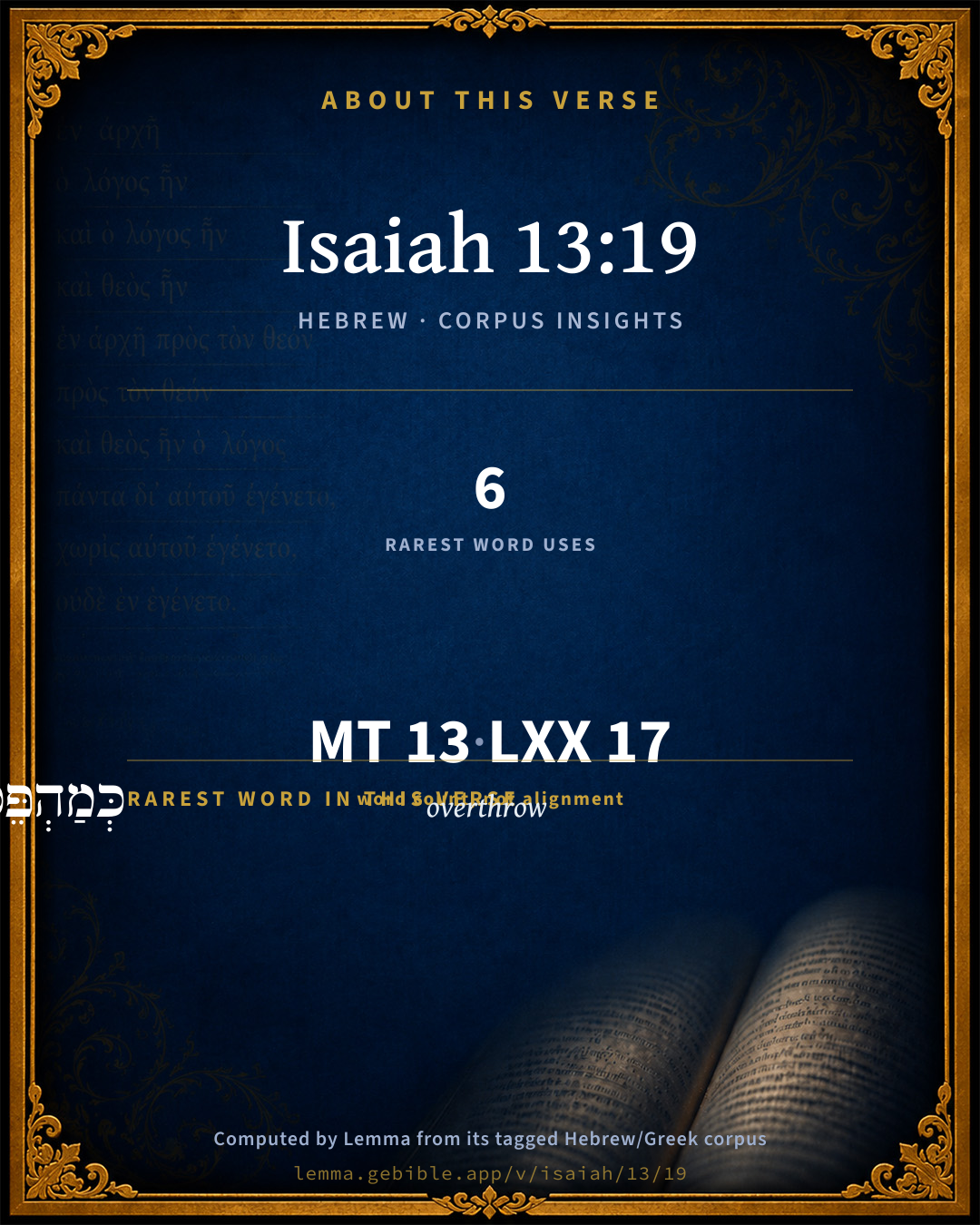
13
words
12
distinct lemmas
Prophets
section

Notable vocabulary

The rarest word here is כְּמַהְפֵּכַ֣ת overthrow H4114 — appearing just 6 times in the whole Hebrew Bible.

Shared distinctive vocabulary

כְּמַהְפֵּכַ֣ת overthrow H4114 occurs in 6 verses of the Hebrew Bible. Also found in:

Grammatical profile

  • 1 verb
  • 10 nouns
  • 2 particles

Verb forms

  • וְהָיְתָ֤ה Qal · Sequential Perfect

Hebrew & Septuagint length

In English translation the verse runs 20 words from the Hebrew and 21 from the Septuagint (LXX English) — closely comparable.

A rough comparison of the two English renderings, which tokenize alike — not a word-level alignment.

Word counts can differ between the Hebrew and the Greek without any difference in meaning — e.g. the Hebrew direct-object marker אֵת has no separate Greek word, and Greek often adds the article ὁ.

In the original languages it is 13 Hebrew tokens and 17 Greek tokens — but the two are counted differently (Hebrew bundles its prefixes and suffixes into one token; the Greek is in lemma form), so that isn’t a like-for-like length.

Cross-references

11

Topical passages linked to Isaiah 13:19 in the Treasury of Scripture Knowledge — connected by theme and wording, ordered by reader-vote popularity; previews shown in the World English Bible.

  • Daniel 4:30 The king spoke and said, Is not this great Babylon, which I have built for the royal dwelling-place, by the might of my power and for the glory of my majesty?
  • Genesis 19:24 Then Yahweh rained on Sodom and on Gomorrah sulfur and fire from Yahweh out of the sky.
  • Deuteronomy 29:23 [and that] the whole land of it is sulfur, and salt, [and] a burning, [that] it is not sown, nor bears, nor any grass grows therein, like the overthrow of Sodom and Gomorrah, Admah and Zeboiim, which Yahweh overthrew in his anger, and in his wrath:
  • Jeremiah 49:18 As in the overthrow of Sodom and Gomorrah and the neighbor cities of it, says Yahweh, no man shall dwell there, neither shall any son of man sojourn therein.
  • Jeremiah 50:40 As when God overthrew Sodom and Gomorrah and the neighbor cities of it, says Yahweh, so shall no man dwell there, neither shall any son of man sojourn therein.
  • Jeremiah 51:41 How is Sheshach taken! and the praise of the whole earth seized! how is Babylon become a desolation among the nations!
  • Amos 4:11 "I have overthrown some of you, As when God overthrew Sodom and Gomorrah, And you were like a burning stick plucked out of the fire; Yet you haven't returned to me," says Yahweh.
  • Zephaniah 2:9 Therefore as I live, says Yahweh of Hosts, the God of Israel, surely Moab will be as Sodom, and the children of Ammon as Gomorrah, a possession of nettles, and salt pits, and a perpetual desolation. The remnant of my people will plunder them, and the survivors of my nation will inherit them.
  • Isaiah 14:4–6 that you shall take up this parable against the king of Babylon, and say, How has the oppressor ceased! the golden city ceased!
  • Isaiah 14:12–15 How you are fallen from heaven, day-star, son of the morning! How you are cut down to the ground, who laid the nations low!
  • Daniel 2:37–38 You, O king, are king of kings, to whom the God of heaven has given the kingdom, the power, and the strength, and the glory;

Cross-references courtesy of OpenBible.info (CC BY 4.0).

Hebrew and Greek witnesses Masoretic Hebrew ↔ Greek Septuagint

The same verse in the two great witnesses to the Old Testament, shown verse-for-verse.

These are two independent witnesses, not word-aligned to each other, and the Septuagint is shown in lemma (dictionary) form.

Hebrew Isaiah 13:19 Masoretic · Westminster Leningrad Codex

וְהָיְתָ֤ה בָבֶל֙ צְבִ֣י מַמְלָכ֔וֹת תִּפְאֶ֖רֶת גְּא֣וֹן כַּשְׂדִּ֑ים כְּמַהְפֵּכַ֣ת אֱלֹהִ֔ים אֶת סְדֹ֖ם וְאֶת עֲמֹרָֽה

Babylon, the glory of kingdoms, the beauty of the Chaldeans' pride, shall be as when God overthrew Sodom and Gomorrah.

World English Bible · Public Domain

Greek LXX Isaiah 13:19 Septuagint · lemma form

καί εἰμί βαβυλών ὅς καλέω ἔνδοξος ὑπό βασιλεύς χαλδαῖος ὅς τρόπος καταστρέφω ὁ θεός σοδομα καί γομορρα

And Babylon, which is called glorious by the king of the Chaldeans, shall be as when God overthrew Sodoma, and Gomorrha.

LXX2012 (modern English Septuagint) · Public Domain

On this verse, The Biblical Illustrator discusses the Septuagint’s reading. Read the note in Commentary ↓

Hebrew: Westminster Leningrad Codex (CC BY 4.0). Greek: Septuagint (public domain); English from LXX2012 (modern English Septuagint) (Public Domain). How the Septuagint differs from the Hebrew →

Targum (Aramaic paraphrase)

1

The Targum is the ancient Jewish Aramaic paraphrase of the Hebrew Scriptures — an interpretive translation, not the Hebrew text itself. Onkelos (literal) and Pseudo-Jonathan (expansive) render the Torah, and Jonathan the Prophets. Coverage is partial: where no permissively-licensed English translation exists for a verse, only the Aramaic is shown. This is verse-level text, not a word-by-word alignment to the Hebrew.

  1. Targum Jonathan Prophets (Joshua–Malachi)
    וּתְהֵי בָּבֶל דַהֲוַת מִלְקַדְמִין חֶדְוַת מַלְכְּוַן תּוּשְׁבָּחַת רְבוּת כַּסְדָאֵי כַּהֲפֵיכָתָא דַהֲפַךְ יְיָ יַת סְדוֹם וְיַת עֲמוֹרָה:

    And Babylon shall become, she that was aforetimes the joy of kings, the beauty of the Chaldeens' excellency, as the overthrow wherewith the Lord overthrew Sodom and Gomorrah.

    Targum Jonathan — Aramaic: “Mikraot Gedolot” (public domain). English: “Sefaria Community Translation” (CC0 1.0 (public-domain dedication)); “London "Chaldee Paraphrase," 1871” (public domain). Text via Sefaria.

Commentary

Notes on Isaiah 13:19 from classic Christian and Jewish commentators (each source and its license shown beneath its notes). The classic Christian expositions comment on the surrounding passage and are grouped to its opening verse, so a note may address several verses; the Jewish commentaries on the Tanakh (Rashi and others) are per-verse, so they appear only where the commentator wrote on this verse.

Lemma curates 59 commentaries, every one of them public domain or Creative Commons licensed, each selected and text-cleaned for this edition rather than reprinted as found. About our sources →

Trapp's Complete Commentary

John Trapp

Isa 13:19 And Babylon, the glory of kingdoms, the beauty of the Chaldees’ excellency, shall be as when God overthrew Sodom and Gomorrah.

Ver. 19. And Babylon, the glory of kingdoms.] Those four great monarchies of the world had their times and their turns, their rise and their ruin. The Roman empire can scarce stand on its feet of clay; and by the death of the recent emperor, no King of Romans being nominated, is like to suffer great concussions.

Shall be as when God overthrew Sodom.] The destruction whereof was the greatest and most stupendous that ever we read of.

John Trapp, A Commentary or Exposition upon All the Books of the Old and New Testament (1647–1656) — public domain. Text from a community e-Sword module.

The Biblical Illustrator

Joseph S. Exell

Isa_13:19-22

Babylon . . . shall be as when God overthrew Sodom and Gomorrah

The re-entries of nature

All this we may say is historical and local.

On the other hand, all this is moral and suggestive. This process may take place in the Babylon of the mind. The greatest mind is only safe whilst it worships. The most magnificent intellectual temple is only secure from the judgment and whirlwind of heaven in proportion as its altar is defended from the approach of every unworthy suppliant. If we hand over Gods altar, whether mental or ecclesiastical, to wrong custodians, or devote either to forbidden purposes, then make way for Gods judgments: wild beasts of the desert shall lie there; and the houses that were full of beauty and colour and charm shall be full of doleful creatures; and the wild beasts of the islands shall cry in their desolate houses, and dragons in their pleasant palaces. This may happen to any one of us. Beware of arrogancy, pride, worldliness, self-sufficiency; beware of the betrayal of trusts: nature will re-enter if we be unfaithful. We speak of our wisdom in putting cautionary covenants into all our legal documents, and especially a man assures himself that he is doubly safe when he has secured the right of re-entry under certain breaches of agreement; he says to himself with complacency, That is justifiable; I have arranged that in the event of certain things failing I shall re-enter. Nature always puts that clause into her covenants. She re-enters in a moment. If the gardener is too late by one day with his spade or seed or other attention, nature begins to re-enter; and if he tarry for a week he will find that nature has made great advances into the property. It is so with education, with the keeping up of intelligence, with the maintenance of healthy discipline; relax a month, and nature re-enters, and nature plays the spoiler. Nature is not a thrifty, careful husbandman. Nature has a function of desolation; she will grow weeds in your richest flower beds if you neglect them for a day. God re-enters by the spirit of judgment and by the visitations of anger. Herein His providence is but in harmony with the kingdom which He has instituted within the sphere which we call husbandry, and even within the sphere which we denominate by education or discipline. It is one government. Neglect your music for a month, and you will find at the end that nature has re-entered, and you are not wanted; you have not brought with you the wedding garment of preparation up to date. There must be no intermission; the last line must be filled in. Nature will not have things done in the bulk, in the gross: nature will not allow us simply to write the name; she will weave her web work all round the garment if we have neglected the borders, and paid attention to only the middle parts. (J. Parker, D. D.)

Babylon: an Arab superstition

It is said that at this very day the Bedouin or wandering Arab has a superstitious fear of passing a single night on the site of Babylon, and that the natives of the country believe it to be inhabited by demons in the form of goats. (Sir E. Strachey, Bart.)

Satyrs

There seems to have been an ancient belief among the Jews themselves that demons took the form of goats--appeared as satyrs in fact. (Sir E. Strachey, Bart.)

Satyrs

The word which most versions and commentators agree with the LXX in rendering demons or satyrs is used in Lev_17:7 2Ch_11:15 for demons which the Jews worshipped. (Sir E. Strachey, Bart.)

.

The Biblical Illustrator, edited by Joseph S. Exell (c. 1880s–1900s) — public domain. Text from a community e-Sword module.

Joseph Benson's Commentary

Isa 13:19. Babylon, the glory of kingdoms — Which once was the most noble and excellent of all the kingdoms then in being, and was more glorious than the succeeding empire, and therefore is represented by the head of gold, Dan 2:37. The beauty of the Chaldees’ excellency — The famous and beautiful seat of the Chaldean monarchy; shall be as when God overthrew Sodom, &c. — Shall be totally and irrecoverably destroyed, as is more fully expressed in the following verses. Babylon, “according to the lowest account given of it by ancient historians, was a regular square, forty-five miles in compass, enclosed by a wall two hundred feet high and fifty broad; in which there were one hundred gates of brass. Its principal ornaments were the temple of Belus, in the middle of which was a tower of eight stories,” (or towers placed one above another, diminishing always as they went up,) “upon a base of a quarter of a mile square; a most magnificent palace; and the famous hanging gardens, which were an artificial mountain, raised upon arches, and planted with trees of the largest, as well as the most beautiful sorts.” What is very remarkable, “this great city was rising to its height of glory at this very time, while Isaiah was repeatedly denouncing its utter destruction. From the first of Hezekiah to the first of Nebuchadnezzar, under whom it was brought to the highest degree of strength and splendour, are about one hundred and twenty years.” See Bishop Lowth.

Joseph Benson's Commentary on the Old and New Testaments (1811–1818) — public domain. Text from a community e-Sword module.

The Preacher's Complete Homiletical Commentary

Joseph S. Exell (gen. ed.)

SODOM AND GOMORRAH

Isa_13:19. And Babylon, the glory of the kingdoms, &c.

The anticipated destruction of Babylon is here compared to that of Sodom and Gomorrah, because of its completeness, and because of the hopelessness of any return of that city to its former glory (Isa_13:20-22). The fate of Sodom and Gomorrah should be pondered, not merely because it is here used as a symbol of the fate of Babylon, but also because of the solemn lessons it affords in relation to sin. That memorable overthrow occurred—I. As a Divine vengeance upon long-continued and unmitigated wickedness (Gen_18:20-21). II. Notwithstanding the influence of a good man in their midst (2Pe_2:7-8). A man like Lot, even though he perhaps suffered injury to his own character, could not live among people like the Sodomites without being a witness for better things and a testimony against their crimes. III. Notwithstanding the fervent intercessions on their behalf of an eminently godly man (Gen_18:23, &c.). IV. The overthrow came at last without any suspicion on the part of their guilty inhabitants that their doom was so near (Pro_29:1).

But why dwell upon a fate so awful, and that occurred so long ago? Because it is a solemn warning to men to-day. Listen to our Saviour’s teaching on this point (Mat_11:20-24). From this we learn that the fate of those who reject Christ will be more severe even than that which befell those guilty cities—

1. Because of clearer light against which they sinned. It cannot be in any way a trivial thing to possess the Gospel (2Co_2:16).

2. Because of the more abundant opportunities of salvation which were afforded them.

3. Because of the more abundant and excellent examples set before them.

4. Because of the multiplied examples of warning to which they should have given heed.—William Manning.

The Preacher's Complete Homiletical Commentary (gen. ed. Joseph S. Exell; Funk & Wagnalls, c. 1892) — public domain (pre-1929). A full-Bible homiletical/sermon-outline anthology covering 65 of 66 books (2 John is absent from the source module). Text from a community e-Sword module.

Tyndale Open Study Notes

Tyndale Open Resources

13:19-22 This picture of Babylon as a perpetually haunted ruin contrasts with its magnificence at its peak (see Dan 4:29-30).

Tyndale Open Study Notes — © Tyndale Open Resources, licensed CC BY-SA 4.0. Text via the HelloAO Bible API.

Matthew Henry's Commentary

The great havoc and destruction which it was foretold should be made by the Medes and Persians in Babylon here end in the final destruction of it. 1. It is allowed that Babylon was a noble city. It was the glory of kingdoms and the beauty of the Chaldees' excellency; it was that head of gold (Dan 2:37, Dan 2:38); it was called the lady of kingdoms (Isa 47:5), the praise of the whole earth (Jer 51:41), like a pleasant roe (so the word signifies); but it shall be as a chased roe, Isa 13:14. The Chaldeans gloried in the beauty and wealth of this their metropolis. 2. It is foretold that it should be wholly destroyed, like Sodom and Gomorrah; not so miraculously, nor so suddenly, but as effectually, though gradually; and the destruction should come upon them as that upon Sodom, when they were secure, eating and drinking, Luk 17:28, Luk 17:29. Babylon was taken when Belshazzar was in his revels; and, though Cyrus and Darius did not demolish it, yet by degrees it wasted away and in process of time it went all to ruin. It is foretold here (Isa 13:20) that it shall never be inhabited; in Adrian's time nothing remained but the wall. And whereas it is prophesied concerning Nineveh, that great city, that when it should be deserted and left desolate yet flocks should lie down in the midst of it, it is here said concerning Babylon that the Arabians, who were shepherds, should not make their folds there; the country about should be so barren that there would be no grazing there; no, not for sheep. Nay, it shall be the receptacle of wild beasts, that affect solitude; the houses of Babylon, where the sons and daughters of pleasure used to rendezvous, shall be full of doleful creatures, owls and satyrs, that are themselves frightened thither, as to a place proper for them, and by whom all others are frightened thence. Historians say that this was fulfilled in the letter. Benjamin Bar-Jona, in his Itinerary, speaking of Babel, has these words: "This is that Babel which was of old thirty miles in breadth; it is now laid waste. There are yet to be seen the ruins of a palace of Nebuchadnezzar, but the sons of men dare not enter in, for fear of serpents and scorpions, which possess the place." Let none be proud of their pompous palaces, for they know not but they may become worse than cottages; nor let any think that their houses shall endure for ever (Psa 49:11), when perhaps nothing may remain but the ruins and reproaches of them. 3. It is intimated that this destruction should come shortly (Isa 13:22): Her time is near to come. This prophecy of the destruction of Babylon was intended for the support and comfort of the people of God when they were captives there and grievously oppressed; and the accomplishment of the prophecy was nearly 200 years after the time when it was delivered; yet it followed soon after the time for which it was calculated. When the people of Israel were groaning under the heavy yoke of Babylonish tyranny, sitting down in tears by the rivers of Babylon and upbraided with the songs of Zion, when their insolent oppressors were most haughty and arrogant (Isa 13:11), then let them know, for their comfort, that Babylon's time, her day to fall, is near to come, and the days of her prosperity shall not be prolonged, as they have been. When God begins with her he will make an end. Thus it is said of the destruction of the New Testament Babylon, whereof the former was a type, In one hour has her judgment come.

Matthew Henry's Commentary on the Whole Bible (1708–1710) — public domain (CC PDM 1.0). Text via the HelloAO Bible API.

Jamieson, Fausset & Brown

Robert Jamieson, A. R. Fausset & David Brown

glory of kingdoms-- (Isa 14:4; Isa 47:5; Jer 51:41).

beauty of . . . excellency--Hebrew, "the glory of the pride" of the Chaldees; it was their glory and boast.

as . . . Gomorrah--as utterly (Jer 49:18; Jer 50:40; Amo 4:11). Taken by Cyrus, by clearing out the canal made for emptying the superfluous waters of the Euphrates, and directing the river into this new channel, so that he was able to enter the city by the old bed in the night.

Jamieson, Fausset & Brown — Commentary Critical and Explanatory on the Whole Bible (1871) — public domain (CC PDM 1.0). Text via the HelloAO Bible API.

Adam Clarke's Commentary

Verse 19. And Babylon] The great city of Babylon was at this time rising to its height of glory, while the Prophet Isaiah was repeatedly denouncing its utter destruction. From the first of Hezekiah to the first of Nebuchadnezzar, under whom it was brought to the highest degree of strength and splendour, are about one hundred and twenty years. I will here very briefly mention some particulars of the greatness of the place, and note the several steps by which this remarkable prophecy was at length accomplished in the total ruin of it.

It was, according to the lowest account given of it by ancient historians, a regular square, forty-five miles in compass, inclosed by a wall two hundred feet high and fifty broad; in which there were a hundred gates of brass. Its principal ornaments were the temple of Belus, in the middle of which was a tower of eight stories of building, upon a base of a quarter of a mile square, a most magnificent palace, and the famous hanging gardens, which were an artificial mountain, raised upon arches, and planted with trees of the largest as well as the most beautiful sorts.

Cyrus took the city by diverting the waters of the Euphrates which ran through the midst of it, and entering the place at night by the dry channel. The river being never restored afterward to its proper course, overflowed the whole country, and made it little better than a great morass; this and the great slaughter of the inhabitants, with other bad consequences of the taking of the city, was the first step to the ruin of the place. The Persian monarchs ever regarded it with a jealous eye; they kept it under, and took care to prevent its recovering its former greatness. Darius Hystaspes not long afterward most severely punished it for a revolt, greatly depopulated the place, lowered the walls, and demolished the gates. Xerxes destroyed the temples, and with the rest the great temple of Belus, Herod. iii. 159, Arrian Exp. Alexandri, lib. vii. The building of Seleucia on the Tigris exhausted Babylon by its neighbourhood, as well as by the immediate loss of inhabitants taken away by Seleucus to people his new city, Strabo, lib. xvi. A king of the Parthians soon after carried away into slavery a great number of the inhabitants, and burned and destroyed the most beautiful parts of the city, Valesii Excerpt. Diodori, p. 377. Strabo (ibid.) says that in his time great part of it was a mere desert; that the Persians had partly destroyed it; and that time and the neglect of the Macedonians, while they were masters of it, had nearly completed its destruction. Jerome (in loc.) says that in his time it was quite in ruins, and that the walls served only for the inclosure for a park or forest for the king's hunting. Modern travellers, who have endeavoured to find the remains of it, have given but a very unsatisfactory account of their success. What Benjamin of Tudela and Pietro della Valle supposed to have been some of its ruins, Tavernier thinks are the remains of some late Arabian building. Upon the whole, Babylon is so utterly annihilated, that even the place where this wonder of the world stood cannot now be determined with any certainty! See also Clarke's note on "Isa 43:14".

We are astonished at the accounts which ancient historians of the best credit give of the immense extent, height, and thickness of the walls of Nineveh and Babylon; nor are we less astonished when we are assured, by the concurrent testimony of modern travellers, that no remains, not the least traces, of these prodigious works are now to be found. Scattered fragments of its tiles and bricks are yet to be found. Proud Babylon reduced now to a few brick-bats! Our wonder will, I think, be moderated in both respects, if we consider the fabric of these celebrated walls, and the nature of the materials of which they consisted. Buildings in the east have always been, and are to this day, made of earth or clay, mixed or beat up with straw to make the parts cohere, and dried only in the sun. This is their method of making bricks; see on Isa 9:9. The walls of the city were built of the earth digged out on the spot, and dried upon the place, by which means both the ditch and the wall were at once formed, the former furnishing materials for the latter. That the walls of Babylon were of this kind is well known; and Berosus expressly says, (apud Joseph. Antiq. x. 11,) that Nebuchadnezzar added three new walls both to the old and new city, partly of brick and bitumen, and partly of brick alone. A wall of this sort must have a great thickness in proportion to its height, otherwise it cannot stand. The thickness of the walls of Babylon is said to have been one-fourth of their height, which seems to have been no more than was absolutely necessary. Maundrell, speaking of the garden walls of Damascus, says, "They are of a very singular structure. They are built of great pieces of earth, made in the fashion of brick, and hardened in the sun. In their dimensions they are two yards long each, and somewhat more than one broad, and half a yard thick." And afterward, speaking of the walls of the houses, he says, "From this dirty way of building they have this amongst other inconveniences, that upon any violent rain the whole city becomes, by the washing of the houses, as it were a quagmire," p. 124. And see note on Isa 30:13. When a wall of this sort comes to be out of repair, and is neglected, it is easy to conceive the necessary consequences, namely, that in no long course of ages it must be totally destroyed by the heavy rains, and at length washed away, and reduced to its original earth. - L.

Adam Clarke's Commentary on the Bible (1810–1826) — public domain. Text from a community e-Sword/MySword module.

Ellicott's Commentary for English Readers

(19) And Babylon, the glory of kingdoms.—The words paint the impression which the great city, even in Isaiah’s time, made upon all who saw it. So Nebuchadnezzar, though his work was mainly that of a restorer, exulted in his pride in the greatness of the city of which he claimed to be the builder (Dan_4:30). So Herodotus (i. 178) describes it as the most famous and the strongest of all the cities of Assyria, adorned beyond any other city on which his eyes had ever looked. (Compare the descriptive notices in Jer_51:41, and the constantly recurring epithet of “gold-abounding Babylon” in the Persians of Ӕschylus.)

As when God overthrew Sodom and Gomorrah.—The phrase had clearly become proverbial, as in Isa_1:9; Jer_50:40; Deu_29:23, carrying the picture of desolation to its highest point. The present state of the site of Babylon corresponds literally to the prediction. It is “a naked and hideous waste” (Layard, Nineveh and Babylon, p. 484). The work was, however, accomplished by slow degrees, and was not, like the destruction of Nineveh, the result of a single overthrow. Darius dismantled its walls, Xerxes pulled down the Temple of Belus. Alexander contemplated its restoration, but his designs were frustrated by his early death. Susa and Ecbatana, Seleucia and Antioch, Ctesiphon and Bagdad, became successively the centres of commerce and of government. By the time of Strabo (B.C. 20) the work was accomplished, and “the vast city” had become a “vast desolation” (Strabo, xvi. 15). At no time within the range of Old Testament literature did such a consummation come within the range of the forecast which judges of the future by an induction from the past.

A Bible Commentary for English Readers, edited by Charles John Ellicott (1878–1897) — public domain. Text from a community e-Sword module.

The Cambridge Bible for Schools and Colleges

gen. ed. J. J. S. Perowne

19. the Chaldees’ excellency] The territory of the Chaldæans lay near the head of the Persian Gulf. Their dominion over Babylon began with Nabopolassar, the father of Nebuchadnezzar.

as when God overthrew, &c.] See on Isa_1:7 and cf. Amo_4:11, where the same phrase occurs (also Jer_50:40).

The Cambridge Bible for Schools and Colleges (gen. ed. J. J. S. Perowne; Cambridge University Press, 1878–1918) — public domain. Text from a community e-Sword module.

John Gill's Exposition

And Babylon, the glory of kingdoms,.... The first and most ancient kingdom, Gen 10:10 and now, at the time of its fall, the largest and most extensive; wherefore of the image Nebuchadnezzar saw in his dream, which was a representation of several kingdoms, this was the head, the head of gold, Dan 2:31 so Babylon is called the "lady of kingdoms", Isa 47:5 the word here used for "glory" is the same with that which is rendered a "roe", Isa 13:14. Babylon was once as a pleasant roe, but now a chased one:

the beauty of the Chaldees excellency; the glory of that nation; what they gloried in, being so famous for pompous buildings, number of inhabitants, riches and wealth, see Dan 4:30. Pliny (n) calls it the head of the Chaldean nations, and says it obtained great fame in the whole world:

shall be as when God overthrew Sodom and Gomorrah; which, though not at once, and by fire from heaven, as that was, yet was of God, and, when completed, was, like that, irrecoverable; which was begun by Cyrus and Darius, and in after times finished; and besides there was a circumstance which made it similar to that; for as the men of Sodom were eating and drinking, when their destruction came upon them, so Belshazzar, and his nobles, were feasting and revelling when the city was taken. The Jews (o) say, that, after Belshazzar was slain, Darius reigned one year, and in his second year the city was overthrown, as God overthrew Sodom and Gomorrah by fire from heaven; but without any foundation; for certain it is that Babylon was in being many years after this, and continued to the time of Alexander the great.

(n) Nat. Hist. l. 6. c. 26. (o) Jarchi & Kimchi ex Seder Olam Rabba, c. 28.

John Gill's Exposition of the Whole Bible (1746–1763) — public domain (CC PDM 1.0). Text via the HelloAO Bible API.

Albert Barnes' Notes on the Bible

And Babylon, the glory of kingdoms - That is, the capital or chief ornament of many nations. Appellations of this kind, applied to Babylon, abound in the Scriptures. In Dan 4:30, it is called ‘great Babylon;’ in Isa 14:4, it is called ‘the golden city;’ in Isa 47:5, ‘the lady of kingdoms;’ in Jer 51:13, it is, spoken of as ‘abundant in treasures;’ and, in Jer 51:41, as ‘the praise of the whole earth.’ All these expressions are designed to indicate its immense wealth and magnificence. It was the capital of a mighty empire, and was the chief city of the pagan world.

The beauty of the Chaldees’ excellency - Hebrew, ‘The glory of the pride of the Chaldees;’ or the ornament of the proud Chaldees. It was their boast and glory; it was that on which they chiefly prided themselves. How well it deserved these appellations we have already seen.

Shall be as when God overthrew Sodom and Gomorrah - Gen 19:24. That is, shall be completely and entirely overthrown; shall cease to be inhabited, and shall be perfectly desolate. It does not mean that it shall be overthrown in the same manner as Sodom was, but that it should be as completely and entirely ruined. The successive steps in the overthrow of Babylon, by which this prophecy was so signally fulfilled, were the following:

(1) The taking of the city by Cyrus. This was accomplished by his clearing out the “Pallacopas,” a canal that was made for the purpose of emptying the superfluous waters of the Euphrates into the lakes and marshes formed by it in the south - west borders of the province toward Arabia. Into this canal he directed the waters of the Euphrates, and was thus enabled to enter the city in the channel of the river under the walls (see the notes at Isa 45:1-2). He took the city by surprise, and when the inhabitants, confident of security, had given themselves up to the riot of a grand public festival; and the king and the nobles were revelling at a public entertainment. From this cause, also, it happened that the waters, which were thus diverted from their usual channel, converted the whole country into a vast, unhealthy morass, that contributed greatly to the decline of Babylon.

(2) The “second” capture of Babylon by Darius Hystaspes. Cyrus was not the destroyer of the city, but he rather sought to preserve its magnificence, and to perpetuate its pre-eminence among the nations. He left it to his successor in all its strength and magnificence. But, after his death, it rebelled against Darius, and bade defiance to the power of the whole Persian empire. Fully resolved not to yield, they adopted the resolution of putting every woman in the city to death, with the exception of their mothers and one female, the best beloved in every family, to bake their bread. All the rest, says Herodotus (iii. 150), were assembled together and strangled. The city was taken at that time by Darius, by the aid of Zopyrus, son of Megabyzus, who, in order to do it, mutilated himself beyond the power of recovery. He cut off his nose and ears, and having scourged himself severely, presented himself before Darius. He proposed to Darius to enter the city, apparently as a deserter who had been cruelly treated by Darius, and to deliver the city into his hands.

He was one of the chief nobles of Persia; was admitted in this manner within the walls; represented himself as having been punished because he advised Darius to raise the siege; was admitted to the confidence of the Babylonians; and was finally entrusted with an important military command. After several successful conflicts with the Persians, and when it was supposed his fidelity had been fully tried, he was raised to the chief command of the army; and was appointed to the responsible office of τειχοφύλαξ teichophulax, or guardian of the walls. Having obtained this object, he opened the gates of Babylon to the Persian army, as he had designed, and the city was taken without difficulty (Herod. iii. 153-160). As soon as Darius had taken the city, he ‘leveled the walls, and took away the gates, neither of which things had Cyrus done before. Three thousand of the most distinguished of the nobility he ordered to be crucified; the rest he suffered to remain.’ - (Herod. iii. 159.)

(3) After its conquest by Darius, it was always regarded by the Persian monarchs with a jealous eye. Xerxes destroyed the temples of the city, and, among the rest, the celebrated temple or tower of Belus (Strabo, xvi. 1, 5.) ‘Darius,’ says Herodotus, ‘had designs upon the golden statue in the temple of Belus, but did not dare to take it; but Xerxes, his son, took it, and slew the priest who resisted its removal.’

(4) The city was captured a third time, by Alexander the Great. Mazaeus, the Persian general, surrendered the city into his hands, and he entered it with his army - “velut in aciem irent” - ‘as if they were marching to battle.’ - (Q. Curtius, v. 3.) It was afterward taken by Antigonus, by Demetrius, by Antiochus the Great, and by the Parthians; and each successive conquest contributed to its reduction.

(5) Cyrus transferred the capital from Babylon to Susa or Shusan Neh 1:1; Ezr 2:8; Ezr 4:16; Ezr 9:11, Ezr 9:15, which became the capital of the kingdom of Persia, and, of course, contributed much to diminish the importance of Babylon itself.

(6) Seleucus Nicator founded Seleucia in the neighborhood of Babylon, on the Tigris, chiefly with a design to draw off the inhabitants of Babylon to a rival city, and to prevent its importance. A great part of its population migrated to the new city of Seleucia (Plin. “Nat. Hist.” vi. 30). Babylon thus gradually declined until it lost all its importance, and the very place where it stood was, for a long time, unknown. About the beginning of the first century, a small part of it only was inhabited, and the greater portion was cultivated (Diod. Sic. ii. 27). In the second century, nothing but the walls remained (Pausanius, “Arcad.” c. 33). It became gradually a great desert; and, in the fourth century, its walls, repaired for that purpose, formed an enclosure for wild beasts, and Babylon was converted into a hunting place for the pastime of the Persian monarchs. After this, there is an interval of many ages in the history of its mutilated remains, and of its mouldering decay (Keith, “On the Prophecies,” p. 216; Jerome, “Commentary on Isa.” ch. xiv.) Benjamin of Tudela vaguely alludes to the palace of Nebuchadnezzar, which, he says, could not be entered, on account of its being the abode of dragons and wild beasts. Sir John Maundeville, who traveled over Asia, 1322 a.d., says, that ‘Babylone is in the grete desertes of Arabye, upon the waye as men gert towarde the kyngdome of Caldce. But it is full longe sithe ony man durste neyhe to the toure, for it is alle deserte and full of dragons and grete serpentes, and fulle dyverse veneymouse bestes all abouten.’

Albert Barnes' Notes on the Bible (1834–1885) — public domain. Text from a community e-Sword/MySword module.

Haydock's Catholic Bible Commentary

Gomorrha. Towards the end of the Macedonian empire. (Calmet) --- The Persians kept wild beasts in it. (St. Jerome) --- The palace of Nabuchodonosor subsisted in the days of Benjamin, (Calmet) but could not be approached on account of serpents. (Tudel. p. 70.)

George Leo Haydock (1774–1849), Haydock's Catholic Family Bible and Commentary, 1859 edition — public domain. Excludes Psalms (Douay-Rheims chapter numbering differs from Protestant) and Deuterocanonical books (Catholic canon only).

Matthew Poole's English Annotations

The glory of kingdoms; which once was the most noble and excellent of all the kingdoms then in being, and Was more glorious than the succeeding empires, whence it was represented by the head of gold, Dan 2:32.

The beauty of the Chaldees’ excellency; the famous and beautiful seat of the Chaldean monarchy.

Shall be as when God overthrew Sodom and Gomorrah; shall be totally and irrecoverably destroyed, as is more fully expressed in the following verses; which yet was not done immediately upon the taking of the city by Darius and Cyrus, but was fulfilled by degrees, as is confessed by historians, and appears this day.

Matthew Poole's English Annotations on the Holy Bible (1683–1685) — public domain. Text from a community e-Sword/MySword module.

Whedon's Commentary on the Bible

Daniel D. Whedon

19. Babylon… shall be as… Gomorrah — With such inhuman work of the foe, Babylon becomes like Elohim’s overthrowing judgment upon Sodom and Gomorrah.

Glory of kingdoms — Because it became the centre of many conquered realms.

Beauty of the Chaldees’ excellency — Babylon was the seat of the ancient Chaldean culture, in which respect writers of antiquity all concur in stating she was always superior to Nineveh. All Assyrian learning and science came to them from Chaldea; but in plastic arts the Chaldeans were behind their northern neighbours. In Assyria was the birthplace of the great school of ancient art which exercised so decisive an influence on the opening period of the Grecian school. (Lenormant.)

Daniel D. Whedon (gen. ed.), Commentary on the Old and New Testaments (1874–1909) — public domain. Text from a community e-Sword module.

The Pulpit Commentary

Babylon, the glory of kingdoms. The glory" of Babylon consisted:

1. In her antiquity. She had been the head of a great empire long before Assyria rose to power.

2. In her origination of literature, architecture, and the other arts, which all passed from her to Assyria, and thence to the other nations of Asia.

3. In her magnificence and the magnificence of her kings, which provoked the admiration of the Assyrians themselves ("Records of the Past," vol. 9. p. 15). As time went on, she grew in wealth and splendor. Perhaps it was granted to Isaiah to see her in ecstatic vision, not merely such as she was in the time of Sargon under Merodach-Baladan, but such as she became under Nebuchadnezzar, the greatest of her kings, who raised her to the highest pitch or glory and eminence. The beauty of the Chaldees" excellency. The Kaldi appear to have been originally one of the many tribes by which Babylonia was peopled at an early date, From the expression, "Ur of the Chaldees," which occurs more than once in Genesis, (Gen_11:28, Gen_11:31) we may gather that they were inhabitants of the more southern part of the country, near the coast. The same conclusion may be drawn from the Assyrian inscriptions, especially those of Shalmaneser II the Black Obelisk king. The term never became a general name for the Babylonian people among themselves or among the Assyrians; but, somehow-or other, it was accepted in that sense by the Jews, and is so used, not only by Isaiah, but also by the writers of Kings and Chronicles, by Jeremiah, Ezekiel, Daniel, and Habakkuk. As when God overthrew Sodom. Equally sudden and complete as that destruction.

Vers. 19-22. The overthrow of evil.

The minuteness of detail with which this prophecy has been fulfilled goes far to prove that holy men of old did speak "as they were moved by the Holy Ghost." The prediction is profoundly interesting in this light; it is also instructive as foretelling the entire extinction of a world-power which, at the hour of utterance, appeared to rest on immovable foundations. There are great powers national, ecclesiastical, dynastic, institutional, social which are as Babylon in Isaiah"s time, and which need to be extinguished for the happiness and well-being of the race. Respecting the overthrow of evil, we see

I ITS APPARENT IMPOSSIBILITY OR DISHEARTENING DISTANCE. How utterly impossible, or at least how hopelessly remote, must the day of Babylon"s overthrow have seemed to the Jews in the time of the prophet! To those of a scoffing spirit, or to the constitutionally incredulous or despondent, the words of Isaiah doubtless seemed visionary, if not altogether wild and vain, So vain may seem to us now the-hopes which are held out of the fall and ultimate extinction of existing evils the despotic empire; the usurping and corrupt Church; the huge, wasteful, war-inciting military and naval organizations; strongly entrenched social habits which dishonor and enfeeble the community; venerable systems of erroneous belief which have lasted for centuries and deluded millions of minds, etc. It seems to us desirable, beyond all reckoning, that these things should receive their death-blow, and should be numbered among the things of the past. But how can we venture to expect their defeat and their disappearance? All strong things are in their favor; the majority of mankind favor them; pecuniary interests, deep-rooted habits, social customs, inveterate prejudices, powerful societies, are sustaining them. How hopeless it seems that powers so fortified can be successfully assailed and absolutely demolished!

II ITS ARRIVAL IN DUE COURSE. Babylon did fall; it was taken and re-taken and taken again, and finally deserted, until it became what is here foretold. Every evil thing shall share its fate. Everything which exalts itself against God, everything which is hostile to the truth, everything which is actually harmful to mankind, shall one day be defeated and destroyed. As the little living seeds dropped into the crack of the huge temple become the upspringing plants which push their way through the strong masonry and at length overturn the tall columns and the massive walls and lay the whole structure on the ground; so the seed of Divine truth, inserted in the temple of error, of vice, of tyranny, of idolatry, of iniquity, shall spring and grow, and thrust and overturn, until the frowning walls have fallen and the structure of sin is a harmless ruin. The great Babylon of sin itself shall one day lie waste and have no inhabitant.

III ITS MORAL.

1. It is a wretched thing to be on the side of wrong. First and most of all, because it is the wrong side we are espousing, and it ought to be an insufferable thing to us that we are thinking, speaking, working on behalf of that which is evil in the sight of God and hurtful to the truer interests of man. But also because we are certain to be defeated in the end.

2. It is a blessed thing to be engaged on the side of righteousness. First and most, because it is the cause of God, of man, of truth, on which we are leagued; and also because we are sure to win at last. The wise and the good may meet with many a check, but they will gain the victory; the unholy and the evil-minded may snatch many an advantage, but the end shall be a miserable disaster, an utter overthrow, a dragon-haunted desert. Let us see to it that we are fighting on God"s side, and, once sure that we are, let us strike our blow for truth and wisdom, confident that, however strong and high stand the towers of sin, its citadel will be taken, its day will descend into darkness, its million-peopled streets become a doleful desert. C.

The fall of pride.

The type of pride, in Scripture, is Babylon; to the grandeur of it the Chaldees pointed in self-admiring triumph. "The words of this text paint the impression which the great city, even in Isaiah"s time, made upon all who saw it. So Nebuchadnezzar, though his work was mainly that of a restorer, exulted in his pride in the greatness of the city of which he claimed to be the builder. (Dan_4:30) So Herodotus describes it as the most famous and strongest of all the cities of Assyria, adorned beyond any other city on which his eyes had ever looked." God"s dealings with nations are illustrations, in the large, of his dealings with families and individuals. The evil recognized as characteristic of a nation may be equally characteristic of a family and of an individual, on whom, therefore, the appropriate Divine judgments will be sure to fall. Nations stand forth prominently in the world"s eye, and keep their lessons in history for the instruction of all the ages. This may be illustrated from the Babylonian kingdom of the ancient days, and from Napoleonic France of modern times. The following points will readily suggest illustration from history, and from the circle of our actual experience.

I PRIDE OF CONQUEST HAS NEVER PROVED LASTING. See the stories of Sennacherib, Nebuchadnezzar, Alexander, Tamerlane, Charlemagne, Buonaparte, and others. It is equally true of cases of private acquisition. The man who grasps his neighbor"s property, and joins field to field, has to learn that God hateth the proud. The riches gathered fly away, or the son that follows him squanders it all.

II PRIDE OF SOCIAL GRANDEUR HAS NEVER PROVED LASTING. Beckford thought to outrival all country mansions with his Fonthill Abbey, and it fell, and great was the fall thereof. Grant thought to build a palace in the west of London, grander than all around him, and it has passed under the hammer of the auctioneer.

III PRIDE OF COMMERCIAL PROSPERITY HAS NEVER PROVED LASTING. Venice and Genoa and the Holland ports illustrate this. God"s providence brings round the judgment when the pride has become overwhelming. God holds a limit beyond which he never permits a nation, a family, or an individual to go. As soon as pride begins to take the honor due to God, stability is over, our foundations begin to shift, and the night of the first wild storm all that we have raised so anxiously lies about us in ruins. There is a day of God always near at hand for the proud. R.T.

The Pulpit Commentary (1880–1919), ed. H.D.M. Spence-Jones & Joseph S. Exell — public domain. Text from a community e-Sword module.

John Wesley's Explanatory Notes

Glory - Which once was the most noble of all the kingdoms. Beauty - The beautiful seat of the Chaldean monarchy shall be totally and irrecoverably destroyed.

John Wesley, Explanatory Notes Upon the Whole Bible (1754–1765) — public domain. Text via the GEBible commentary corpus.

Keil & Delitzsch

C. F. Keil & F. Delitzsch

"And Babel, the ornament of kingdoms, the proud boast of the Chaldeans, becomes like Elohim's overthrowing judgment upon Sodom and Gomorrah." The ornament of kingdoms (mamlâcoth), because it was the centre of many conquered kingdoms, which now avenged themselves upon it (Isa 13:4); the pride (cf., Isa 28:1), because it was the primitive dwelling-place of the Chaldeans of the lowlands, that ancient cultivated people, who were related to the Chaldean tribes of the Carduchisan mountains in the north-east of Mesopotamia, though not of the same origin, and of totally different manners (see at Isa 23:13). Their present catastrophe resembled that of Sodom and Gomorrah: the two eths are accusative; mahpēcâh (καταστροφή) is used like de‛âh in Isa 11:9 with a verbal force (τὸ καταστρέψαι, well rendered by the lxx ὄν τρόπον κατέστρεψεν ὁ Θεός. On the arrangement of the words, see Ges. 133, 3).

Keil & Delitzsch — Biblical Commentary on the Old Testament (1861–1891) — public domain (CC PDM 1.0). Text via the HelloAO Bible API. (Old Testament only.)

J. A. Alexander on Isaiah

Joseph Addison Alexander

From the very height of greatness and renown, Babylon shall be reduced not only to subjection but to annihilation. “And Babylon, the beauty (or glory) of kingdoms, the ornament, the pride, of the Chaldees, shall be like God’s overthrowing Sodom and Gomorrah,” (i.e., shall be totally destroyed in execution of a special divine judgment). The beauty of kingdoms is by most writers understood comparatively as denoting the most beautiful of kingdoms, either in the proper sense or in that of royal cities (see 1Sa 27:5). But some understand the words more strictly as denoting the ornament of an empire which in eluded various tributary kingdoms. This agrees well with the next clause, which describes the city as the ornament and pride of the Chaldees. The origin of this name, and of the people whom it designates, is doubtful and disputed. But whether the Chaldees were of Semitic origin or not, and whether they were the indigenous inhabitants of Babylonia or a foreign race imported from Armenia and the neighboring countries, it is plain that the word here denotes the nation of which Babylon was the capital. The exact sense of the last clause is that already given, like God’s overthrowing Sodom and Gomorrah. This is a common formula in Scripture for complete destruction, viewed as a special punishment of sin. (See above Isa 1:7; Isa 1:9). It is certain that the destruction of Babylon was gradual, successively promoted by the conquests of Cyrus, Darius Hystaspes, Alexander the Great, Antigonus, Demetrius, the Parthians, and the founding of the cities of Seleucia and Ctesiphon. From this apparent disagreement of the prophecy with history, some seem disposed to infer that it relates not to the literal but spiritual Babylon. The true conclusion is that the prophecy does not relate to any one invasion or attack exclusively, but to the whole process of subjection and decay, so completely carried out through a course of ages, that the very site of ancient Babylon is now disputed. This hypothesis accounts for many traits in the description which appear inconsistent only in consequence of being all applied to one point of time and one catastrophe exclusively.

Joseph Addison Alexander, The Prophecies of Isaiah (1846–1847; New York: Scribner, 1870–1878) — public domain. Text from a community e-Sword module.

Scofield Reference Notes

C. I. Scofield

And Babylon

Isa 13:12-16 look forward to the apocalyptic judgments (Revelation 6-13.). Isa 13:17-22 have a near and far view. They predict the destruction of the literal Babylon then existing; with the further statement that, once destroyed, Babylon should never be rebuilt (cf) Jer 51:61-64. All of this has been literally fulfilled. But the place of this prediction in a great prophetic strain looks forward to the destruction of both politico-Babylon and ecclesio- Babylon in the time of the Beast shows that the destruction of the actual Babylon typifies the greater destruction yet to come upon the mystical Babylons. Cf. (See Scofield "Isa 13:1").

Babylon See note 2; (See Scofield "Isa 13:1").

The Scofield Reference Bible (1917 edition), notes by C. I. Scofield — public domain. Text from a community e-Sword module.

unfoldingWord translationNotes

Door43 World Missions Community

Connecting Statement:

Yahweh continues speaking.

the most admired of kingdoms

This can be stated in active form. AT: "the kingdom that people most admire" (See: Active or Passive)

Then Babylon ... will be overthrown by God

This can be stated in active form. AT: "Then God will destroy Babylon, the most admired of kingdoms, the splendor of Chaldean pride, as he destroyed Sodom and Gomorrah" (See: Active or Passive)

the splendor of Chaldean pride

The abstract nouns "splendor" and "pride" can be translated with adjectives. The word "splendor" refers to the beautiful appearance of Babylon. AT: "the beautiful city that the Chaldeans are so proud of" (See: Abstract Nouns)

It will not be inhabited or lived in

The two verbs mean basically the same thing. This can be stated in active form. AT: "No one will live in it" (See: Doublet and Active or Passive)

from generation to generation

The phrase "generation to generation" refers to all generations of people who will live in the future. AT: "for ever" or "ever again" (See: Idiom)

The Arab

This refers to Arab people in general, not one person. AT: "Arabs" or "Arab people" (See: Generic Noun Phrases)

translationWords

Babylon

kingdom

splendor

Chaldea

proud

God

Sodom

Gomorrah

generation

Arabia

shepherd

flocks

unfoldingWord translationNotes — © Distant Shores Media and the Door43 World Missions Community, licensed CC BY-SA 4.0. Source: git.door43.org/Door43/en_tn.

Rashi

Rabbi Shlomo Yitzchaki (Rashi)

And Babylon...shall be Two calamities befell her in two years. Darius assassinated Belshazzar and ruled a year, and in the second year it was turned over like Sodom from heaven. And so we learned in Seder Olam (ch. 28). And in that year the news came concerning Darius, and after him, in the year, the news, and Babylon that was the beauty of the kingdoms...that was the leader and the head of the kingdoms and that was the glory of the pride of the Chaldees now, shall be like the overturning of Sodom.

Rashi on the Tanakh — English translations: “The Judaica Press complete Tanach with Rashi, translated by A. J. Rosenberg” (CC BY 4.0); “Pentateuch with Rashi's commentary by M. Rosenbaum and A.M. Silbermann, 1929-1934” (public domain); “The Metsudah Tanach series, Lakewood, N.J” (CC BY 4.0); and “The Book of Joshua, Metsudah Publications, 1997” (CC BY 4.0). Text via Sefaria.

Ibn Ezra

Rabbi Abraham ibn Ezra

And Babylon, the glory of kingdoms. And Babylon that HAS BEEN the glory of kingdoms; comp. הבית הזה יהיה עליון this house which will HAVE BEEN high (1 Kings 9:8).

Ibn Ezra on the Tanakh — English translations: “Sefaria Community Translation” (CC0 1.0 (public-domain dedication)); “Yalkut, Sifsei Chachomim Chumash, Metsudah Publications, 2009” (CC BY 4.0); and “Commentary of Ibn Ezra on Isaiah - trans. by M. Friedlander, 1873” (public domain). Text via Sefaria.

Lesson kit

Teaching starters — assembled from the data on this page, not authored interpretation. Every prompt links to the verse data it draws on. Edit before teaching.

Isaiah, in the Prophets, opens this verse with 13 words (12 distinct Hebrew lemmas). Its most distinctive word is mahpêkâh (“overthrow”). A historical commentator’s framing appears above. Read the whole chapter for the surrounding context.

Discussion questions

  1. What does “overthrow” (mahpêkâh) contribute to the verse as a whole?
  2. How does Deuteronomy 29:23, which shares the word «overthrow», read alongside this verse?
  3. These translations render this verse differently. What is at stake in choosing one wording over another?
  4. «וְהָיְתָ֤ה» is a Qal Sequential Perfect verb. How does that grammatical form shape the action described?
  5. Compare how Trapp's Complete Commentary and The Biblical Illustrator read this verse. Where do they agree or differ?

Things to notice

Reading settings

Reading text

Shown beneath each verse's original-language words.

Old Testament
Old Testament edition

Read the OT as the Masoretic Hebrew (MT) or the Greek Septuagint (LXX).

English shown for the Greek Septuagint (in the Hebrew ↔ Greek comparison).

Comparing translations? Open the Compare panel on any verse page to stack up to four side by side.