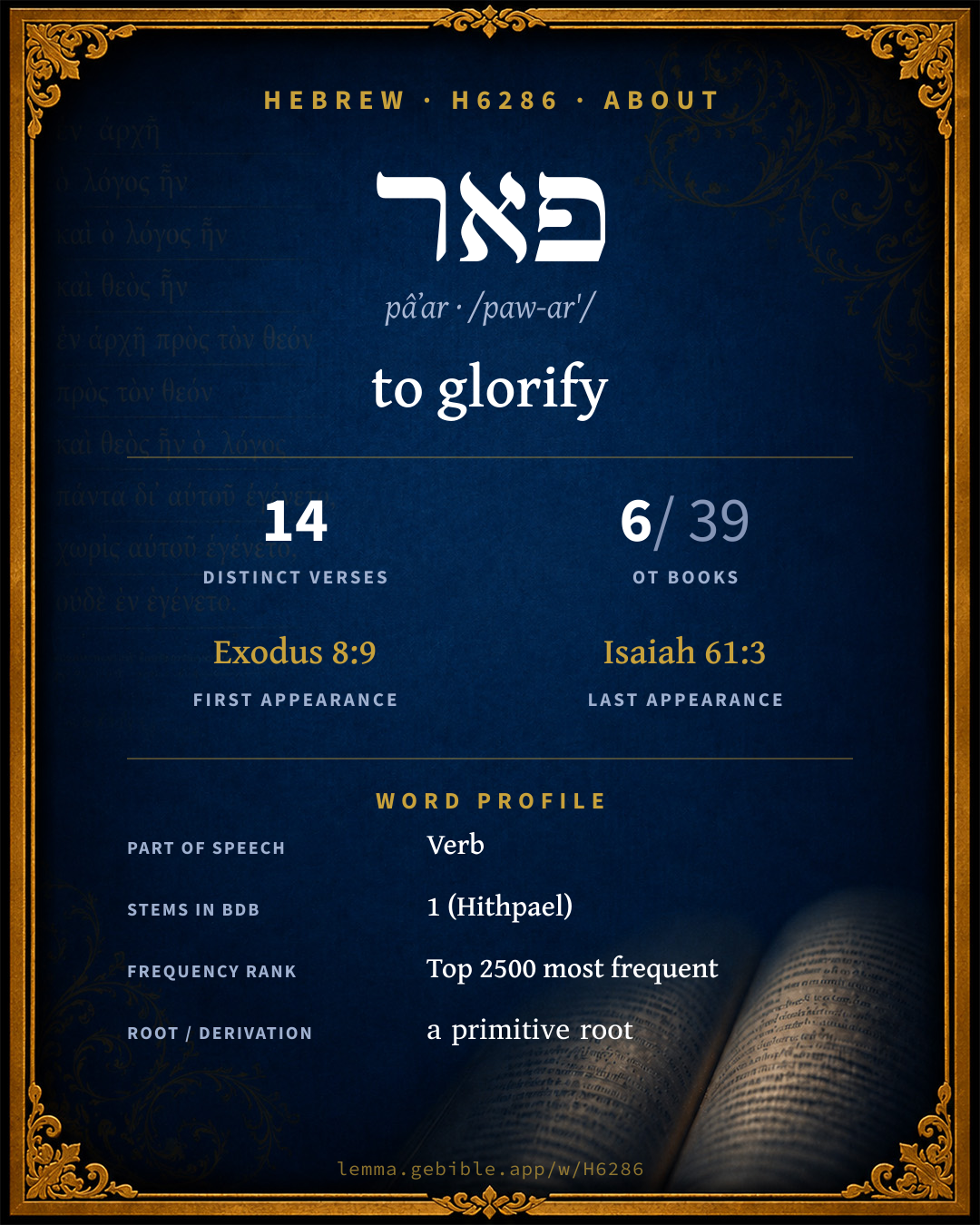
פאר
to glorify
also: beautify, adorn fuller range ↓
Full lexicon entry — Brown-Driver-Briggs (BDB)
From Brown-Driver-Briggs (BDB)
Where this word appears
See every Hithpael verb in the Hebrew Bible →
Grammar key — what these labels mean
Part of speech
- Verb
- An action or state-of-being word.
Stem
- Piel
- An intensive or resultative active stem.
- Hithpael
- The reflexive or reciprocal stem (the subject acts on itself). Here: ‘glorify oneself = boast’
Form
- Infinitive Construct
- A bound verbal noun, frequently with prepositions (“to write / in writing”).
- Perfect
- A completed action or state — Hebrew marks aspect (completeness) more than strict tense (“he wrote”).
- Imperfect
- An incomplete, ongoing, or future action (“he will / would write”).
- Imperative
- A direct command (“write!”).
Person
- 3rd Person
- The one spoken about (“he / she / it / they”).
- 1st Person
- The speaker (“I / we”).
- 2nd Person
- The one addressed (“you”).
Gender
- Masculine
- Grammatically masculine.
- Common
- Either gender — not distinguished for this form.
Number
- Singular
- One.
Grammatical forms 9 distinct
- Verb, Hithpael, Imperfect, 3rd Person, Masculine, Singular 3 times (21%)
- Verb, Piel, Infinitive Construct 2 times (14%)
- Verb, Hithpael, Infinitive Construct 2 times (14%)
- Verb, Piel, Perfect, 3rd Person, Masculine, Singular 2 times (14%)
- Verb, Piel, Imperfect, 1st Person, Common, Singular 1 time (7%)
- Verb, Piel, Imperfect, 2nd Person, Masculine, Singular 1 time (7%)
- Verb, Piel, Imperfect, 3rd Person, Masculine, Singular 1 time (7%)
- Verb, Hithpael, Imperfect, 1st Person, Common, Singular 1 time (7%)
+1 more form (1 occurrence)
Parsed forms decoded from the imported morphology (morphhb / Westminster Leningrad Codex — WLC text public domain, morphhb tagging CC BY 4.0), counted across 14 parsed occurrences — not distinct verses.
Every verse where H6286 appears — 14 distinct verses across 6 books. Click any verse to open its interlinear word-by-word view. Verse text shown in the World English Bible for context — . Each verse’s Hebrew form is shown with its reference; the English is not keyword-highlighted, since the data carries no word-level English alignment. Use “Compare translations” on any verse to read it across multiple English versions. This concordance covers the Hebrew Bible; Septuagint (Greek Old Testament) occurrences are not indexed here.
Exodus 1 verse
Deuteronomy 1 verse
Judges 1 verse
Ezra 1 verse
Psalms 1 verse
Isaiah 9 verses
- Isaiah 10:15 הֲ/יִתְפָּאֵר֙ ptcl inter + Hithpael impf 3ms Shall the axe boast itself against him who hews therewith? Shall the saw magnify itself against him who wields it? as if a rod should wield those who lift it up, [or] as if a staff should lift up [him who is] not wood.
- Isaiah 44:23 יִתְפָּאָֽר Hithpael impf 3ms Sing, you heavens, for Yahweh has done it; shout, you lower parts of the earth; break forth into singing, you mountains, O forest, and every tree therein: for Yahweh has redeemed Jacob, and will glorify himself in Israel.
- Isaiah 49:3 אֶתְפָּאָֽר Hithpael impf 1cs and he said to me, You are my servant; Israel, in whom I will be glorified.
- Isaiah 55:5 פֵאֲרָֽ/ךְ Piel pf 3ms + sfx pers 2fs Behold, you shall call a nation that you don't know; and a nation that didn't know you shall run to you, because of Yahweh your God, and for the Holy One of Israel; for he has glorified you.
- Isaiah 60:7 אֲפָאֵֽר Piel impf 1cs All the flocks of Kedar shall be gathered together to you, the rams of Nebaioth shall minister to you; they shall come up with acceptance on my altar; and I will glorify the house of my glory.
- Isaiah 60:9 פֵאֲרָֽ/ךְ Piel pf 3ms + sfx pers 2fs Surely the isles shall wait for me, and the ships of Tarshish first, to bring your sons from far, their silver and their gold with them, for the name of Yahweh your God, and for the Holy One of Israel, because he has glorified you.
- Isaiah 60:13 לְ/פָאֵר֙ prep + Piel inf.cs The glory of Lebanon shall come to you, the fir tree, the pine, and the box tree together, to beautify the place of my sanctuary; and I will make the place of my feet glorious.
- Isaiah 60:21 לְ/הִתְפָּאֵֽר prep + Hithpael inf.cs Your people also shall be all righteous; they shall inherit the land forever, the branch of my planting, the work of my hands, that I may be glorified.
- Isaiah 61:3 לְ/הִתְפָּאֵֽר prep + Hithpael inf.cs to appoint to those who mourn in Zion, to give to them a garland for ashes, the oil of joy for mourning, the garment of praise for the spirit of heaviness; that they may be called trees of righteousness, the planting of Yahweh, that he may be glorified.
About this entry
At a glance — auto-summarized from this page’s data, not written by a person. Every figure links to its source below. This summary describes the numbers; it doesn’t interpret them.
“to glorify” is the headline sense of the Hebrew verb פאר (pâʼar). It clusters heavily in Isaiah, which alone accounts for 64% of its uses. With 14 verses in 6 books, it is an uncommon word in the Hebrew Bible. Scripture first uses it in Exodus 8:9. Not a single-sense word: its full sense range also takes in “beautify” and “adorn”. The sections below give every sense, occurrence, and version rendering.
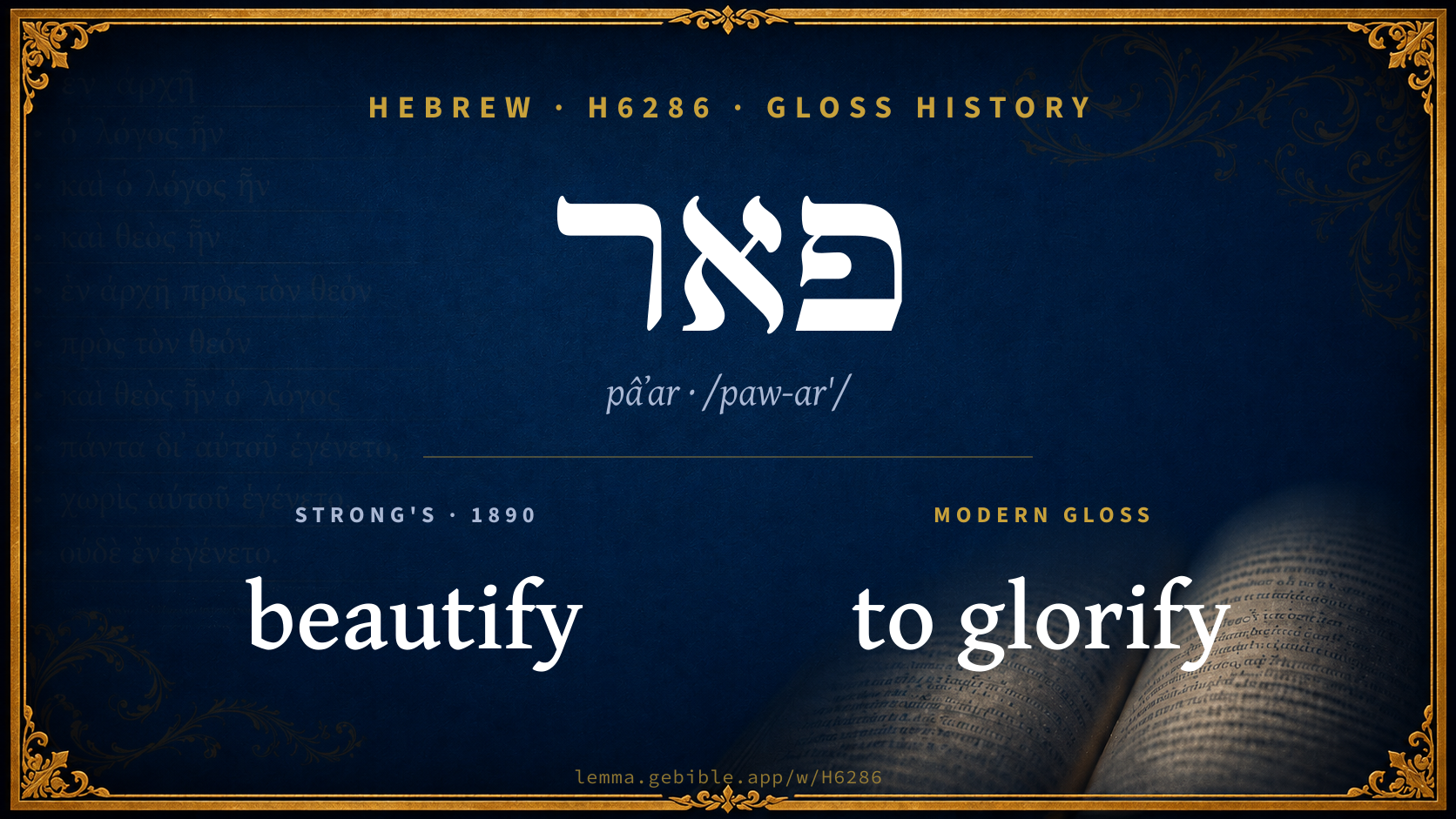
Gloss history
Strong's 1890 vs modern scholarship
About this word
Strong's H6286 catalogs a Hebrew word from the Hebrew Old Testament.
These counts are not copied from any lexicon or concordance. They are computed here, from the morphology-tagged Hebrew Old Testament. What Lemma adds →
- 14
- distinct verses
- The word appears in 14 distinct verses.
- 6 / 39
- OT books
- The word appears in 6 of 39 Old Testament books.
- #1,910
- by frequency
- Top 2500 most frequent Hebrew words (rank 1,910 of 8,640 Hebrew words by occurrence).
View all 14 occurrences in the concordance →
Most concentrated in
- Isaiah 9 verses 64%
- Exodus 1 verse 7%
- Deuteronomy 1 verse 7%
By section of the Old Testament
By traditional corpus
Conventional, traditional groupings — biblical authorship is debated, so this is a traditional corpus grouping, not an authorship claim. Each share is this word’s portion of its verses in that division of the Hebrew canon. Each figure is a share of the word’s 14 distinct verses.
- Prophets (Nevi'im) 10 verses · 71%
- Torah (Pentateuch) 2 verses · 14%
- Writings (Ketuvim) 2 verses · 14%
How translations render this word
Counts come from each version’s own published word-to-Strong’s tagging or interlinear alignment — an approximate guide to how each version renders this word, not a word-level alignment the data otherwise carries. Because each total is that version’s own tagged count, the per-version totals vary from one another and need not match the appearance or distinct-verse counts above. These counts may also differ from a printed concordance because Lemma counts each distinctly tagged rendering and does not collapse phrase taggings into a single head-word total. This is a fixed set of word-tagged versions (KJV, ASV, BSB, ULT) and does not change with the reading translation you choose elsewhere. Each version’s license is shown beside its name below (and on Sources).
BDB lists this Strong’s number as 2 distinct words (homographs). Each count above pools all of them and is not split by sense — see the Senses section below. A low-frequency rendering may belong to a different one of those words, not the primary meaning.
- King James Version†: Beautify 2×, He hath glorified 2×
- American Standard Version†: Beautify 2×, He hath glorified thee 2×
- Berean Standard Bible†: Adorn 1×, Glorify themselves 1×, Go over 1×
- unfoldingWord Literal Text†: Beautify 1×, Does 1×, Exalt itself 1×
King James Version Public Domain
Renders H6286 across 14† tagged occurrences — most commonly:
Plus 10 renderings that appear only once — usually multi-word phrases or single function words the recovered tagging swept in, not distinct renderings.
American Standard Version Public Domain
Renders H6286 across 14† tagged occurrences — most commonly:
Plus 10 renderings that appear only once — usually multi-word phrases or single function words the recovered tagging swept in, not distinct renderings.
Berean Standard Bible Public Domain
Renders H6286 across 14† tagged occurrences — most commonly:
Plus other, less common renderings.
unfoldingWord Literal Text CC BY-SA 4.0
Renders H6286 across 16† tagged occurrences — most commonly:
Plus other, less common renderings.
Senses in the full BDB
What do BDB’s symbols mean?
BDB uses these scholarly abbreviations:
| Symbol | Meaning |
|---|---|
| 𝔊 | the Septuagint (the ancient Greek translation, LXX) |
| 𝔙 | the Vulgate (the Latin translation) |
| 𝔖 | the Syriac version (the Peshitta) |
| 𝔗 | the Targum (the Aramaic translation) |
| ψ | the Psalms |
| √ | root (the underlying root or stem) |
| ‖ | parallel passage (a synonymous or contrasted parallel) |
| † | the dagger: every passage where the word occurs is cited |
The 2 senses and sub-senses the full Brown-Driver-Briggs lexicon distinguishes for this word, in lexicon order (not ranked by frequency), with BDB’s own verbatim wording and sub-sense lettering. Shown in Hebrew script with BDB’s own scholarly abbreviations. The condensed entry is in the Lexicon Entry tab. See also the Forms in the corpus table below.
פאר I beautify, glorify
Hithpael
- 1. glorify oneself = boast
- 2. get glory to oneself, be glorified, by means of
פאר II go over the boughs
Senses from the full Brown-Driver-Briggs lexicon (Brown, Driver, Briggs; Oxford 1906 — public domain), digitized via Sefaria, supplemented by the OpenScriptures HebrewLexicon (CC BY 4.0). Full attribution on Sources.
Word origin
I. [ פָּאַר ] vb. Pi. beautify, glorify
[ פִּאֵר ] vb. denom. Pi. go over the boughs;— Dt 24:20
— Brown-Driver-Briggs (Oxford 1906, public domain), digitized via Sefaria, supplemented by the OpenScriptures HebrewLexicon (CC BY 4.0). See Sources.
Origin: a primitive root
Jastrow Dictionary
A second Hebrew/Aramaic lexicon for comparison, covering Aramaic and post-biblical (Talmudic, Targumic, Midrashic) usage that the biblical-Hebrew BDB does not. Matched by lemma rather than by Strong’s number, so a lemma may carry more than one Jastrow headword (shown separately below), and the entries cover usage well beyond the Bible.
פְּאֵר
- פאר to cut off; to distinguish) ornament, crown, bonnet of distinction. Y. M. Kat. III, 82ᵈ top (ref. to פארך, Ez. XXIV, 17) אית דבעי מימר אילו התפלין some say, this refers to the T’fillin (which ordinarily a mourner must not put on); אית דבעי מימר זה הגיהוץ some say, this refers to glossy linen (festive dress, v. גִּיהוּץ); Ber. 11ᵃ אבל חייב … שהרי נאמר בהם פ׳ a mourner is bound to observe all ceremonial laws …, except that of T’fillin, which are called an ornament; ib. 16ᵇ; a. e.—*Pl. פְּאֵרוֹת head-ornaments, pearls, trinkets (strung on chains or cords). Ab. Zar. 47ᵃ בני מעיה מהו לפ׳ may its small intestines be used for pearl-strings? [Ms. M. לכנורות, v. כִּנּוֹר; ed. Pes. a. oth. פְּאוֹרוֹת; cmp. b. h. פֻּארָה, פֹּארֹת]. e.g. Ezekiel 24:17
פָּאַר
- (b. h.), Pi. פֵּאֵר (denom. of preced.)
- 1. to cut the crown off. Ḥull. 131ᵃ, sq. (ref. to תְפָאֵר, Deut. XXIV, 20) שלא תטול תפארתו ממנו thou must not cut the crown off it (the last berries). e.g. Deuteronomy 24:20
- 2. to crown, glorify. Lev. R. s. 2 כל מה … לגדלן ולפָאֲרָן פָּאֵר … להִתְפָּאֵר בהם as much as thou canst praise Israel, praise, as much as thou canst raise and glorify them, glorify, for I am to be glorified through them; Tanḥ. Ki Thissa 8; Pesik. Shek., p. 17ᵇ לפָאֲרוֹ פָּאֲרוֹ; a. e.—Part. pass. מְפוֹאָר; f. מְפוֹאָרָה, מְפוֹאֶרֶת. Taan. 7ᵃ (to R. Joshua) אי חכמה מפ׳ בכלי מכוער O for that glorious wisdom in an ugly vessel! Ab. Zar. 24ᵇ, v. עֲדִי II.
- 1. to lord it, rule. Sifré Deut. 284 (ref. to תפאר, v. supra) לא תִתְפָּאֵר לעני do not make thyself the master of the poor man (i.e. do not decide who shall and who shall not get the gleanings &c.); Yalk. ib. 937.
- 2. to be adorned, glorified. Lev. R. l. c., a. e., v. supra. Esth. R. to III, 6, v. פּוּרְפּוּרָא; a. e.
A Dictionary of the Targumim, the Talmud Babli and Yerushalmi, and the Midrashic Literature (Marcus Jastrow; London, Luzac, 1903) — Public Domain. Digitized via Sefaria. Digitized via Sefaria. Full attribution on Sources.
Forms in the corpus
The 12 distinct written forms H6286 takes in the Hebrew Bible, most frequent first — each parse links to that stem’s occurrences in the concordance. Hebrew forms include their vowel points and cantillation, so a single lemma takes many written forms.
| Form | Parsing | Example | Uses |
|---|---|---|---|
| לְ/הִתְפָּאֵֽר | Verb, Hithpael, Infinitive Construct | Isaiah 60:21 | 2 |
| פֵאֲרָֽ/ךְ | Verb, Piel, Perfect, 3rd Person, Masculine, Singular | Isaiah 55:5 | 2 |
| אֲפָאֵֽר | Verb, Piel, Imperfect, 1st Person, Common, Singular | Isaiah 60:7 | 1 |
| אֶתְפָּאָֽר | Verb, Hithpael, Imperfect, 1st Person, Common, Singular | Isaiah 49:3 | 1 |
| הֲ/יִתְפָּאֵר֙ | Verb, Hithpael, Imperfect, 3rd Person, Masculine, Singular | Isaiah 10:15 | 1 |
| הִתְפָּאֵ֣ר | Verb, Hithpael, Imperative, 2nd Person, Masculine, Singular | Exodus 8:9 | 1 |
| יְפָאֵ֥ר | Verb, Piel, Imperfect, 3rd Person, Masculine, Singular | Psalms 149:4 | 1 |
| יִתְפָּאֵ֨ר | Verb, Hithpael, Imperfect, 3rd Person, Masculine, Singular | Judges 7:2 | 1 |
| יִתְפָּאָֽר | Verb, Hithpael, Imperfect, 3rd Person, Masculine, Singular | Isaiah 44:23 | 1 |
| לְ/פָאֵ֕ר | Verb, Piel, Infinitive Construct | Ezra 7:27 | 1 |
| לְ/פָאֵר֙ | Verb, Piel, Infinitive Construct | Isaiah 60:13 | 1 |
| תְפָאֵ֖ר | Verb, Piel, Imperfect, 2nd Person, Masculine, Singular | Deuteronomy 24:20 | 1 |
Same root — word family
Other BDB entries built from the same root as H6286, grouped by Strong’s listed origin. These share a root / origin per the lexicon — not necessarily a shared meaning. Each links to that word’s own entry.
Derived from this word
- פאר pᵉʼêr H6287 turban
- פארה pᵉʼôrâh H6288 branch
- פארור pâʼrûwr H6289 heat
- תפארה tiphʼârâh H8597 glory
Proper names from this root
People and places named from this root — a name, not an additional meaning of the word.
Compare all same-root words → Showing 4 of 6 — not the complete family. 1 of the same-root words is a proper name (a person or place). They share a root, not necessarily a meaning.
Septuagint verse parallels
This word appears in 14 verses that also exist in the Greek Old Testament (Septuagint), out of the 14 Hebrew verses it occurs in. You can read those verses in Greek by switching the Old Testament edition to the Septuagint.
Read these verses in the Septuagint
This is a verse-level parallel only — the same verses exist in both the Hebrew and Greek Old Testaments. No word-level Hebrew↔Greek correspondence is claimed: the data carries no such alignment, so no Greek word is shown as this Hebrew word’s translation. Coverage is not total — the Septuagint omits the deuterocanon and renumbers the Psalms, so some Hebrew verses have no direct Greek parallel.