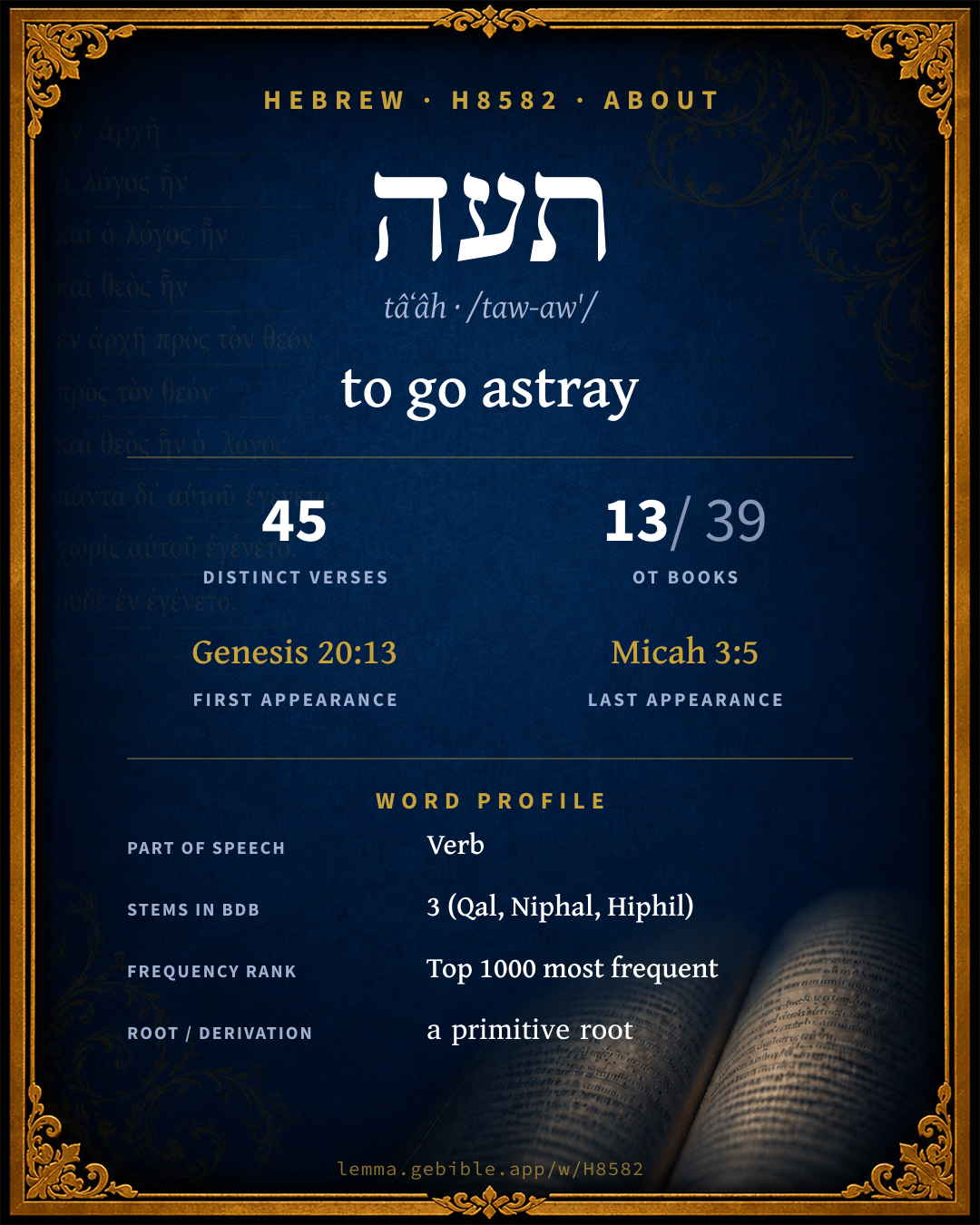
תָּעָה
to go astray
‘to go astray’ is one of 3 main senses fuller range ↓
Full lexicon entry — Brown-Driver-Briggs (BDB)
From Brown-Driver-Briggs (BDB)
Where this word appears
See every Qal verb in the Hebrew Bible →
Grammar key — what these labels mean
Part of speech
- Verb
- An action or state-of-being word.
Stem
- Qal
- The basic, simple active stem — the plain form of the verb (“he wrote”). Here: ‘physically’
- Hiphil
- The causative active stem (“he caused / brought about”). Here: ‘physically’
- Niphal
- Usually the simple passive or reflexive of the Qal (“he was written”). Here: ‘be made to wander about’
Form
- Perfect
- A completed action or state — Hebrew marks aspect (completeness) more than strict tense (“he wrote”).
- Sequential Imperfect
- An imperfect with prefixed waw — the standard past-narrative form (waw-consecutive imperfect).
- Imperfect
- An incomplete, ongoing, or future action (“he will / would write”).
- Infinitive Construct
- A bound verbal noun, frequently with prepositions (“to write / in writing”).
- Participle Active
- A verbal adjective expressing ongoing or characteristic action (“writing / one who writes”).
- Sequential Perfect
- A perfect with prefixed waw continuing a preceding imperfect or command (waw-consecutive perfect).
- Jussive
- A third- or second-person volitional form expressing wish or command (“let him write”).
State
- Absolute
- The independent form of a noun, not bound to a following word.
- Construct
- A noun bound to a following noun in a possessive / “of” relationship (the construct chain).
Person
- 3rd Person
- The one spoken about (“he / she / it / they”).
- 1st Person
- The speaker (“I / we”).
- 2nd Person
- The one addressed (“you”).
Gender
- Common
- Either gender — not distinguished for this form.
- Masculine
- Grammatically masculine.
- Feminine
- Grammatically feminine.
Number
- Plural
- More than one (in Hebrew, generally three or more).
- Singular
- One.
Grammatical forms 23 distinct
- Verb, Qal, Perfect, 3rd Person, Common, Plural 9 times (18%)
- Verb, Hiphil, Sequential Imperfect, 3rd Person, Masculine, Singular 5 times (10%)
- Verb, Qal, Imperfect, 3rd Person, Masculine, Plural 4 times (8%)
- Verb, Qal, Infinitive Construct 3 times (6%)
- Verb, Qal, Participle Active, Masculine, Singular, Absolute 3 times (6%)
- Verb, Hiphil, Sequential Imperfect, 3rd Person, Masculine, Plural 3 times (6%)
- Verb, Hiphil, Perfect, 3rd Person, Common, Plural 3 times (6%)
- Verb, Hiphil, Participle Active, Masculine, Plural, Absolute 3 times (6%)
+15 more forms (18 occurrences)
Parsed forms decoded from the imported morphology (morphhb / Westminster Leningrad Codex — WLC text public domain, morphhb tagging CC BY 4.0), counted across 51 parsed occurrences — not distinct verses.
Every verse where H8582 appears — 45 distinct verses across 13 books. Click any verse to open its interlinear word-by-word view. Verse text shown in the World English Bible for context — . Each verse’s Hebrew form is shown with its reference; the English is not keyword-highlighted, since the data carries no word-level English alignment. Use “Compare translations” on any verse to read it across multiple English versions. This concordance covers the Hebrew Bible; Septuagint (Greek Old Testament) occurrences are not indexed here.
Genesis 3 verses
- Genesis 20:13 הִתְע֣וּ Hiphil pf 3cp It happened, when God caused me to wander from my father's house, that I said to her, 'This is your kindness which you shall show to me. Everywhere that we go, say of me, "He is my brother."'"
- Genesis 21:14 וַ/תֵּ֔תַע conj + Qal wimpf 3fs Abraham rose up early in the morning, and took bread and a bottle of water, and gave it to Hagar, putting it on her shoulder, and gave her the child, and sent her away. She departed, and wandered in the wilderness of Beersheba.
- Genesis 37:15 תֹעֶ֖ה Qal ptcp.act ms A certain man found him, and behold, he was wandering in the field: and the man asked him, saying, "What are you looking for?"
Exodus 1 verse
2 Kings 1 verse
2 Chronicles 1 verse
Job 4 verses
- Job 12:24 וַ֝/יַּתְעֵ֗/ם conj + Hiphil wimpf 3ms + sfx pers 3mp He takes away understanding from the chiefs of the people of the earth, And causes them to wander in a wilderness where there is no way.
- Job 12:25 וַ֝/יַּתְעֵ֗/ם conj + Hiphil wimpf 3ms + sfx pers 3mp They grope in the dark without light. He makes them stagger like a drunken man.
- Job 15:31 נִתְעָ֑ה Niphal pf 3ms Let him not trust in emptiness, deceiving himself; For emptiness shall be his reward.
- Job 38:41 יִ֝תְע֗וּ Qal impf 3mp Who provides for the raven his prey, When his young ones cry to God, And wander for lack of food?
Psalms 6 verses
- Psalms 58:3 תָּע֥וּ Qal pf 3cp The wicked go astray from the womb. They are wayward as soon as they are born, speaking lies.
- Psalms 95:10 תֹּעֵ֣י Qal ptcp.act mp cs Forty long years I was grieved with that generation, And said, "It is a people that errs in their heart. They have not known my ways."
- Psalms 107:4 תָּע֣וּ Qal pf 3cp They wandered in the wilderness in a desert way. They found no city to live in.
- Psalms 107:40 וַ֝/יַּתְעֵ֗/ם conj + Hiphil wimpf 3ms + sfx pers 3mp He pours contempt on princes, And causes them to wander in a trackless waste.
- Psalms 119:110 תָעִֽיתִי Qal pf 1cs The wicked have laid a snare for me, Yet I haven't gone astray from your precepts.
- Psalms 119:176 תָּעִ֗יתִי Qal pf 1cs I have gone astray like a lost sheep. Seek your servant, for I don't forget your commandments.
Proverbs 5 verses
- Proverbs 7:25 תֵּ֝תַע Qal juss 2ms Don't let your heart turn to her ways. Don't go astray in her paths,
- Proverbs 10:17 מַתְעֶֽה Hiphil ptcp.act ms He is in the way of life who heeds correction, But he who forsakes reproof leads others astray.
- Proverbs 12:26 תַּתְעֵֽ/ם Hiphil impf 3fs + sfx pers 3mp A righteous person is cautious in friendship, But the way of the wicked leads them astray.
- Proverbs 14:22 יִ֭תְעוּ Qal impf 3mp Don't they go astray who plot evil? But love and faithfulness belong to those who plan good.
- Proverbs 21:16 תּ֭וֹעֶה Qal ptcp.act ms The man who wanders out of the way of understanding Shall rest in the assembly of the dead.
Isaiah 13 verses
- Isaiah 3:12 מַתְעִ֔ים Hiphil ptcp.act mp As for my people, children are their oppressors, And women rule over them. My people, those who lead you cause you to err, And destroy the way of your paths.
- Isaiah 9:16 מַתְעִ֑ים Hiphil ptcp.act mp For those who lead this people cause them to err; and those who are led of them are destroyed.
- Isaiah 16:8 תָּ֣עוּ Qal pf 3cp For the fields of Heshbon languish, [and] the vine of Sibmah; the lords of the nations have broken down the choice branches of it, which reached even to Jazer, which wandered into the wilderness; its shoots were spread abroad, they passed over the sea.
- Isaiah 19:13 הִתְע֥וּ Hiphil pf 3cp The princes of Zoan are become fools, the princes of Memphis are deceived; they have caused Egypt to go astray, who are the corner-stone of her tribes.
- Isaiah 19:14 וְ/הִתְע֤וּ כְּ/הִתָּע֥וֹת conj + Hiphil wpf 3cp prep + Niphal inf.cs Yahweh has mixed a spirit of perverseness in the midst of her; and they have caused Egypt to go astray in every work of it, as a drunken man staggers in his vomit.
- Isaiah 21:4 תָּעָ֣ה Qal pf 3ms My heart flutters, horror has frightened me; the twilight that I desired has been turned into trembling to me.
- Isaiah 28:7 תָּע֑וּ תָּעוּ֙ Qal pf 3cp Qal pf 3cp Even these reel with wine, and stagger with strong drink; the priest and the prophet reel with strong drink, they are swallowed up of wine, they stagger with strong drink; they err in vision, they stumble in judgment.
- Isaiah 29:24 תֹֽעֵי Qal ptcp.act mp cs They also who err in spirit shall come to understanding, and those who murmur shall receive instruction.
- Isaiah 30:28 מַתְעֶ֔ה Hiphil ptcp.act ms and his breath is as an overflowing stream, that reaches even to the neck, to sift the nations with the sieve of destruction: and a bridle that causes to err [shall be] in the jaws of the peoples.
- Isaiah 35:8 יִתְעֽוּ Qal impf 3mp A highway shall be there, and a way, and it shall be called The way of holiness. The unclean shall not pass over it, but is shall be for for him who walks in the Way. Wicked fools will not go there.
- Isaiah 47:15 תָּע֔וּ Qal pf 3cp Thus shall the things be to you in which you have labored: those who have trafficked with you from your youth shall wander everyone to his quarter; there shall be none to save you.
- Isaiah 53:6 תָּעִ֔ינוּ Qal pf 1cp All we like sheep have gone astray; everyone has turned to his own way; and Yahweh has laid on him the iniquity of us all.
- Isaiah 63:17 תַתְעֵ֤/נוּ Hiphil impf 2ms + sfx pers 1cp O Yahweh, why do you make us to err from your ways, and harden our heart from your fear? Return for your servants' sake, the tribes of your inheritance.
Jeremiah 4 verses
- Jeremiah 23:13 וַ/יַּתְע֥וּ conj + Hiphil wimpf 3mp I have seen folly in the prophets of Samaria; they prophesied by Baal, and caused my people Israel to err.
- Jeremiah 23:32 וַ/יַּתְע֣וּ conj + Hiphil wimpf 3mp Behold, I am against those who prophesy lying dreams, says Yahweh, and do tell them, and cause my people to err by their lies, and by their vain boasting: yet I didn't send them, nor commanded them; neither do they profit this people at all, says Yahweh.
- Jeremiah 42:20 התעתי/ם הִתְעֵיתֶם֮ Hiphil pf 1cs + sfx pers 3mp Hiphil pf 2mp For you have dealt deceitfully against your own souls; for you sent me to Yahweh your God, saying, Pray for us to Yahweh our God; and according to all that Yahweh our God shall say, so declare to us, and we will do it:
- Jeremiah 50:6 הִתְע֔וּ/ם Hiphil pf 3cp + sfx pers 3mp My people have been lost sheep: their shepherds have caused them to go astray; they have turned them away on the mountains; they have gone from mountain to hill; they have forgotten their resting-place.
Ezekiel 4 verses
- Ezekiel 14:11 יִתְע֨וּ Qal impf 3mp that the house of Israel may go no more astray from me, neither defile themselves any more with all their transgressions; but that they may be my people, and I may be their God, says the Lord Yahweh.
- Ezekiel 44:10 בִּ/תְע֤וֹת תָּע֣וּ prep + Qal inf.cs Qal pf 3cp But the Levites who went far from me, when Israel went astray, who went astray from me after their idols, they shall bear their iniquity.
- Ezekiel 44:15 בִּ/תְע֤וֹת prep + Qal inf.cs But the priests the Levites, the sons of Zadok, who kept the charge of my sanctuary when the children of Israel went astray from me, they shall come near to me to minister to me; and they shall stand before me to offer to me the fat and the blood, says the Lord Yahweh:
- Ezekiel 48:11 תָע֗וּ בִּ/תְעוֹת֙ תָּע֖וּ Qal pf 3cp prep + Qal inf.cs Qal pf 3cp [It shall be] for the priests who are sanctified of the sons of Zadok, who have kept my charge, who didn't go astray when the children of Israel went astray, as the Levites went astray.
Hosea 1 verse
Amos 1 verse
Micah 1 verse
About this entry
At a glance — auto-summarized from this page’s data, not written by a person. Every figure links to its source below. This summary describes the numbers; it doesn’t interpret them.
תעה — transliterated tâʻâh — is a Hebrew verb carrying the sense “to go astray.” Where the King James Version says “err,” newer translations reach for “astray” (Berean Standard Bible); the renderings breakdown has the detail. The Hebrew Bible uses it across 45 verses — moderately common. More than a quarter of its appearances fall in Isaiah. Different stems carry different senses — BDB groups them under 3 stems, among them Qal and Niphal. Each statement above links to its evidence; the full detail follows below.
Gloss history
Strong's 1890 vs modern scholarship
About this word
Strong's H8582 catalogs a Hebrew word from the Hebrew Old Testament.
These counts are not copied from any lexicon or concordance. They are computed here, from the morphology-tagged Hebrew Old Testament. What Lemma adds →
- 45
- distinct verses
- The word appears in 45 distinct verses.
- 13 / 39
- OT books
- The word appears in 13 of 39 Old Testament books.
- #723
- by frequency
- Top 1000 most frequent Hebrew words (rank 723 of 8,640 Hebrew words by occurrence).
View all 45 occurrences in the concordance →
By section of the Old Testament
By traditional corpus
Conventional, traditional groupings — biblical authorship is debated, so this is a traditional corpus grouping, not an authorship claim. Each share is this word’s portion of its verses in that division of the Hebrew canon. Each figure is a share of the word’s 45 distinct verses.
- Prophets (Nevi'im) 25 verses · 56%
- Writings (Ketuvim) 16 verses · 36%
- Torah (Pentateuch) 4 verses · 9%
How translations render this word
Counts come from each version’s own published word-to-Strong’s tagging or interlinear alignment — an approximate guide to how each version renders this word, not a word-level alignment the data otherwise carries. Because each total is that version’s own tagged count, the per-version totals vary from one another and need not match the appearance or distinct-verse counts above. These counts may also differ from a printed concordance because Lemma counts each distinctly tagged rendering and does not collapse phrase taggings into a single head-word total. This is a fixed set of word-tagged versions (KJV, ASV, BSB, ULT) and does not change with the reading translation you choose elsewhere. Each version’s license is shown beside its name below (and on Sources).
- King James Version: Err 5×, Went astray 4×, Causeth them to wander 2×
- American Standard Version: Went astray 4×, Causeth them to wander 2×, Err 2×
- Berean Standard Bible: Astray 5×, Go astray 4×, Stray 3×
- unfoldingWord Literal Text: Astray 4×, Go astray 3×, Wander 3×
King James Version Public Domain
Renders H8582 across 51 tagged occurrences — most commonly:
Plus 38 renderings that appear only once — usually multi-word phrases or single function words the recovered tagging swept in, not distinct renderings.
American Standard Version Public Domain
Renders H8582 across 51 tagged occurrences — most commonly:
Plus 41 renderings that appear only once — usually multi-word phrases or single function words the recovered tagging swept in, not distinct renderings.
Berean Standard Bible Public Domain
Renders H8582 across 49 tagged occurrences — most commonly:
Plus 26 renderings that appear only once — usually multi-word phrases or single function words the recovered tagging swept in, not distinct renderings. Not rendered by a distinct English word in 1 further occurrence.
unfoldingWord Literal Text CC BY-SA 4.0
Renders H8582 across 63 tagged occurrences — most commonly:
Plus 39 renderings that appear only once — usually multi-word phrases or single function words the recovered tagging swept in, not distinct renderings.
10 senses and sub-senses in the full BDB
Hebrew verbs can shift meaning by stem (binyan): Qal is the basic action, Niphal is often passive or reflexive, Piel often intensifies or makes it factitive, and Hiphil is typically causative. The senses below are grouped under the stem BDB assigns to each.
What do BDB’s symbols mean?
BDB uses these scholarly abbreviations:
| Symbol | Meaning |
|---|---|
| 𝔊 | the Septuagint (the ancient Greek translation, LXX) |
| 𝔙 | the Vulgate (the Latin translation) |
| 𝔖 | the Syriac version (the Peshitta) |
| 𝔗 | the Targum (the Aramaic translation) |
| ψ | the Psalms |
| √ | root (the underlying root or stem) |
| ‖ | parallel passage (a synonymous or contrasted parallel) |
| † | the dagger: every passage where the word occurs is cited |
The 10 senses and sub-senses the full Brown-Driver-Briggs lexicon distinguishes for this word, in lexicon order (not ranked by frequency), with BDB’s own verbatim wording and sub-sense lettering. Shown in Hebrew script with BDB’s own scholarly abbreviations. The condensed entry is in the Lexicon Entry tab. See also the Forms in the corpus table below.
Qal
- Pf. 3 ms. ת׳ Is 21:4; 1 s. תָּעִ֫יתִי ψ 119:110, 176, etc.; Impf. 3 fs. תֵּתַע Gn 21:14 Pr 7:25; 3 mpl. יִתְעוּ Is 35:8 +; Inf. cstr. תְּעוֹת Ez 44:10 +; Pt. תֹּעֶה Gn 37:15 +, etc.;— e.g. Isaiah 21:4
- 1. physically, wander about, abs. Ex 23:4 (E) Is 35:8; 53:6; Jb 38:41 ψ 119:176;;c.; ב loc. Gn 21:14; 37:15 (JE), Pr 7:25 ψ 107:4;;c.; ל loc. Is 47:15; acc. loc. 16:8. e.g. Exodus 23:4
- 2. of intoxication,;c.; בְּ of wine Is 28:7; מן of wine v 7; fig. of perplexity, subj. לבב 21:4. e.g. Isaiah 28:7
- 3. ethically, abs. Ez 44:10; 48:11(×3) ψ 58:4 prob. Pr 14:22 (cf. חוטא v 21, but Bu Toy go astray to ruin); תֹּעֵי רוח Is 29:24, תֹּעֵי לבב ψ 95:10; c. מן 119:110; Pr 21:16, מֵאַחֲרַי Ez 14:11, מֵעָלַי Ez 44:10, 15. e.g. Ezekiel 44:10
Niphal
- 1. be made to wander about, as a drunkard: Inf. cstr. הִתָּעוֹת Is 19:14. e.g. Isaiah 19:14
- 2. ethically: Pf. 3 ms. נִתְעָה be led astray Jb 15:31 (c. בשׁוא). e.g. Job 15:31
Hiphil
- Pf. 3 ms. הִתְעָה Ho 4:12 (We הִתְעָם); Impf. וַיֶּ֫תַע 2 Ch 33:9; sf. וַיַּתְעֵם Jb 12:24 +; Pt. מַתְעֶה Is 30:28 +;— e.g. Hosea 4:12
- 1. physically: cause to wander about: abs. Is 30:28 (of bridle, in fig.), Pr 10:17; Je 50:6 (acc. of people as sheep); acc. pers. Pr 12:26; c. מן loc. Gn 20:13 (E), ב loc. Jb 12:24 = ψ 107:40. e.g. Isaiah 30:28
- 2. of intoxication, Is 19:13, 14; Jb 12:25. e.g. Isaiah 19:13
- 3. mentally and morally: cause to err, mislead: abs. Is 3:12; 9:15; Ho 4:12; c. acc. pers. Am 2:4; Mi 3:5; 2 K 21:9 = 2 Ch 33:9; Je 23:13, 32; c. ב obj. Je 42:20 (so Gf; Ke al. (so Pr 10:17) intr. err at cost of; 𝔊 Ew Du Co הֲרֵעֹתֶם); c. מן of י׳ Is 63:17. e.g. Isaiah 3:12
Senses from the full Brown-Driver-Briggs lexicon (Brown, Driver, Briggs; Oxford 1906 — public domain), digitized via Sefaria, supplemented by the OpenScriptures HebrewLexicon (CC BY 4.0). Full attribution on Sources.
Word origin
vb. err (‖ form of טָעָה, q.v.; Aramaic (sometimes) תְּעָא, תְּעִי id.; NH = BH (rare));—
— Brown-Driver-Briggs (Oxford 1906, public domain), digitized via Sefaria, supplemented by the OpenScriptures HebrewLexicon (CC BY 4.0). See Sources.
Origin: a primitive root
Jastrow Dictionary
A second Hebrew/Aramaic lexicon for comparison, covering Aramaic and post-biblical (Talmudic, Targumic, Midrashic) usage that the biblical-Hebrew BDB does not. Matched by lemma rather than by Strong’s number, so a lemma may carry more than one Jastrow headword (shown separately below), and the entries cover usage well beyond the Bible.
תָּעָה
- , v. תעי
תעי
- v. טָעָה) [to move to and fro,] to be lost, go astray; to err. B. Kam. 81ᵇ הרואה חבירו תּוֹעֶה וכ׳, v. פָּסַג. Ib. וכן הוא שתעה וכ׳ (not שתועה) and so also he who has himself lost his way may &c.; Tosef. B. Mets. II, 28 ת׳ (a. טעה). Gen. R. s. 65 (play on כמ̇ת̇ע̇ת̇ע, Gen. XXVII, 12) כמ̇ת̇ כת̇וע̇ה וכע̇ובד וכ׳ as one dead, as one going astray, and as one worshipping idols; Yalk. ib. 115 כתועה וכעובד וכ׳. Ned. 51ᵃ (play on ת̇ו̇ע̇ב̇ה̇) תו̇ע̇ה אתה ב̇ה̇ thou (who committest it) losest thy senses through it; a. e. e.g. Genesis 27:12
- to lead astray. Snh. 55ᵃ מה אילנות … המַתְעֶה את חבירו מדרך וכ׳ if in the case of trees (that have been worshipped) … the Law says, destroy, burn, and exterminate: how much more does this apply to a man who leads his neighbor from the way of life to the way of death!; Yalk. Lev. 624 וּמַתְעֵהוּ מדרך וכ׳ (differ. in Sifra K’dosh. Par. 4, ch. X). Lam. R. introd. (R. Joḥ. 1) ונביאי … שהִתְעוּ אותי וכ׳ the false prophets …, who led me astray from the way of life &c.; a. e.
A Dictionary of the Targumim, the Talmud Babli and Yerushalmi, and the Midrashic Literature (Marcus Jastrow; London, Luzac, 1903) — Public Domain. Digitized via Sefaria. Digitized via Sefaria. Full attribution on Sources.
Forms in the corpus
The 47 distinct written forms H8582 takes in the Hebrew Bible, most frequent first — each parse links to that stem’s occurrences in the concordance. Hebrew forms include their vowel points and cantillation, so a single lemma takes many written forms.
Same root — word family
Other BDB entries built from the same root as H8582, grouped by Strong’s listed origin. These share a root / origin per the lexicon — not necessarily a shared meaning. Each links to that word’s own entry.
Derived from this word
Proper names from this root
People and places named from this root — a name, not an additional meaning of the word.
Compare all same-root words → 1 of the same-root words is a proper name (a person or place). They share a root, not necessarily a meaning.
Septuagint verse parallels
This word appears in 41 verses that also exist in the Greek Old Testament (Septuagint), out of the 45 Hebrew verses it occurs in. You can read those verses in Greek by switching the Old Testament edition to the Septuagint.
Read these verses in the Septuagint
- Genesis 20:13
- Exodus 23:4
- 2 Kings 21:9
- 2 Chronicles 33:9
- Job 12:24
- Psalms 58:3
- Proverbs 7:25
- Isaiah 3:12
- Jeremiah 23:13
- Ezekiel 14:11
- Hosea 4:12
- Amos 2:4
This is a verse-level parallel only — the same verses exist in both the Hebrew and Greek Old Testaments. No word-level Hebrew↔Greek correspondence is claimed: the data carries no such alignment, so no Greek word is shown as this Hebrew word’s translation. Coverage is not total — the Septuagint omits the deuterocanon and renumbers the Psalms, so some Hebrew verses have no direct Greek parallel.