
1 Kings 12:22

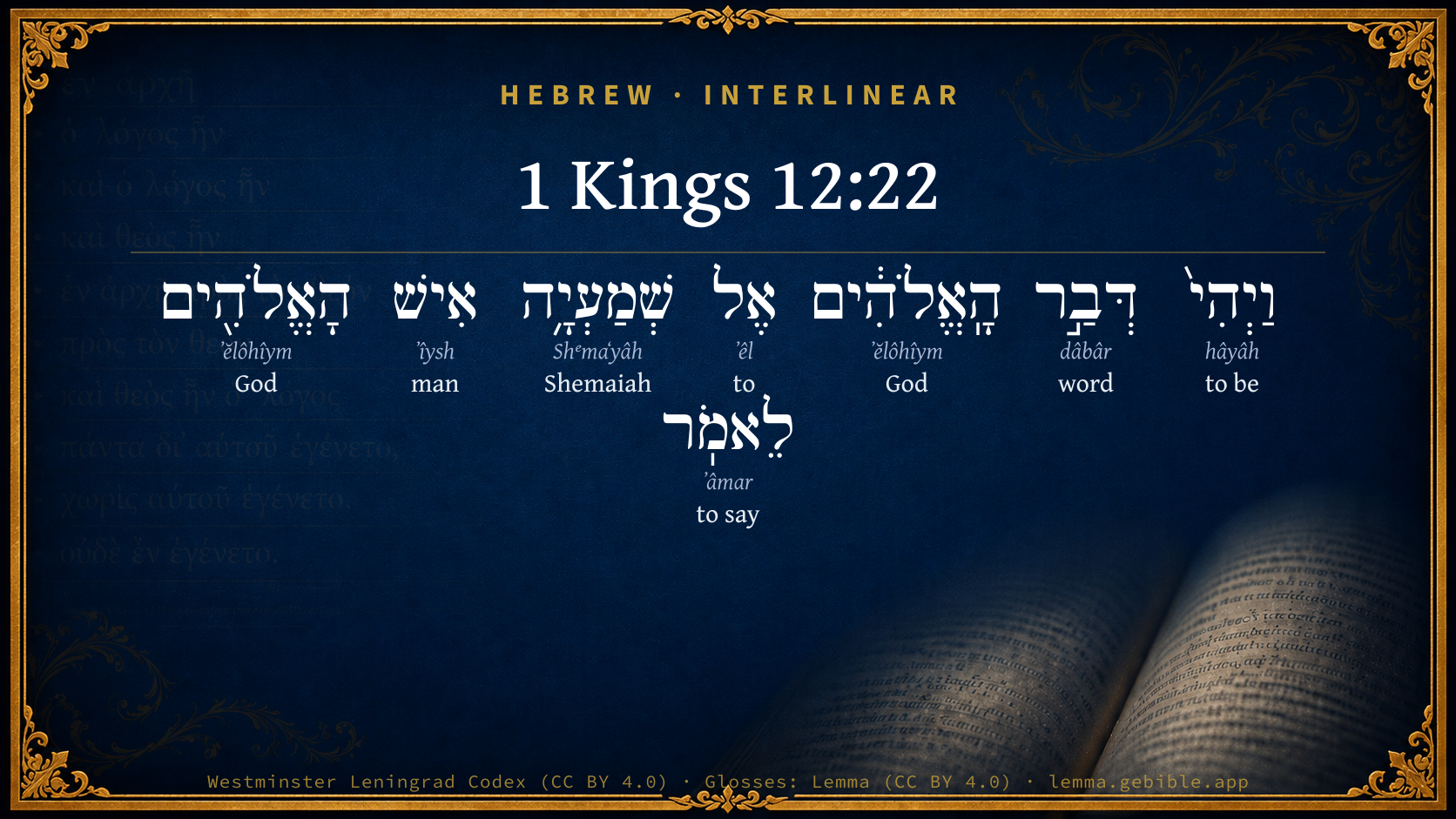
Hebrew (Westminster Leningrad Codex) 1 Kings 12:22 appears in the Hebrew Old Testament. The text above is from the Westminster Leningrad Codex. Each word links to its Strong’s number, a concise gloss, and parsing drawn from the Open Scriptures Hebrew Bible morphology. Click any word for its full Brown-Driver-Briggs (BDB) entry.
Download image
Cite this verse

1 Kings 12:22 (World English Bible). Public Domain. Lemma interlinear Bible study tool, https://lemma.gebible.app/v/1-kings/12/22.

Show BibTeX & RIS
BibTeX
RIS
English Translation
But the word of God came to Shemaiah the man of God, saying,
World English Bible · Public Domain
Highlights
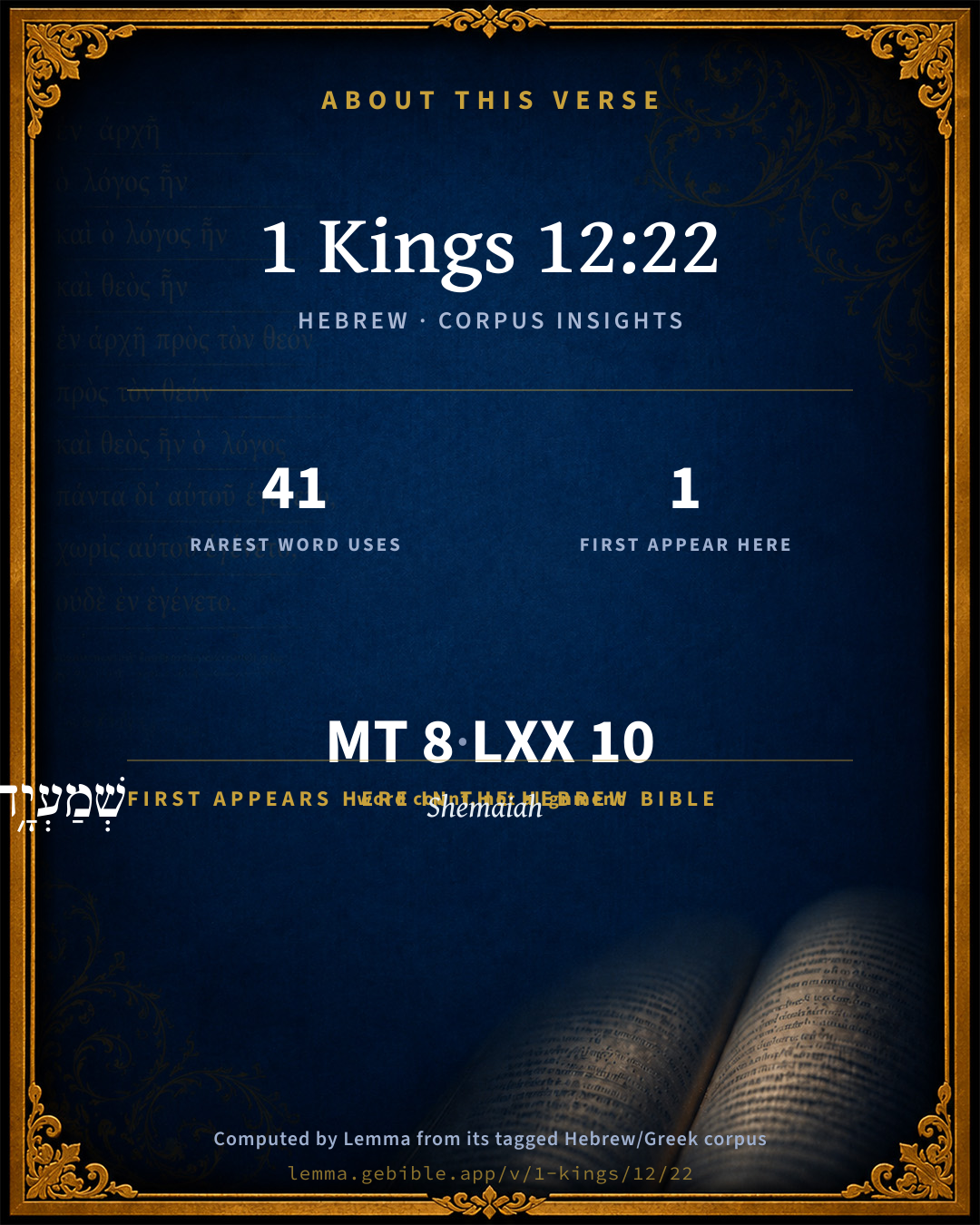
  • 1 first appearance in the Hebrew Bible
Full analysis ↓
Download a study sheet

One document with this verse’s original text, its word-by-word gloss line, the meaning frame, cross-references with their text, attributed commentary, and full source and license credits — printable, and it pastes into notes with its structure intact.

This verse Autodidact and up

Study sheet (.html) Plain text (.txt)

A passage Seminary Student

Up to 50 verses in one chapter. A passage sheet keeps up to 6 commentary sources and 12 cross-references per verse, in the order this page ranks them, and says so on the sheet whenever that leaves anything out. Ask for a single verse and you get the Autodidact verse sheet above.

Everything on this page stays free to read, with no account — the sheet is a download of what is already on screen, not access to it.

Want to remove ads? Support Godless Engineer
Compare translations 3

The same verse in 3 English versions, stacked beneath the original-language interlinear above. Click any original word for its lexicon entry.

Each is an independent rendering of the whole verse — the interlinear is not word-aligned to these translations.

Highlighted words mark where these versions differ — a whole-verse word diff, not a word-by-word alignment.

  • World English Bible Public Domain
    But the word of God came to Shemaiah the man of God, saying,
  • King James Version Public Domain
    But the word of God came unto Shemaiah the man of God, saying,
  • unfoldingWord Literal Text CC BY-SA 4.0
    But the word of God was to Shemaiah the man of God, saying,

unfoldingWord Literal Text — © unfoldingWord, licensed CC BY-SA 4.0. Word-aligned USFM3 via Door43 (git.door43.org/unfoldingWord/en_ult).

Versions to compare (up to 4)

3 of 4 selected

Show all 18 translations

Every available English version of this verse, each an independent rendering of the whole verse.

  • World English Bible Public Domain
    But the word of God came to Shemaiah the man of God, saying,
  • Berean Standard Bible Public Domain
    But the word of God came to Shemaiah the man of God:
  • Majority Standard Bible Public Domain
    But the word of God came to Shemaiah the man of God:
  • King James Version Public Domain
    But the word of God came unto Shemaiah the man of God, saying,
  • American Standard Version (1901) Public Domain
    But the word of God came unto Shemaiah the man of God, saying,
  • Revised Version (1885) Public Domain
    But the word of God came unto Shemaiah the man of God, saying,
  • Geneva Bible (1599) Public Domain
    But the worde of God came vnto Shemaiah the man of God, saying,
  • Douay-Rheims (1899) Public Domain
    But the word of the Lord came to Semeias the man of God, saying:
  • Young's Literal Translation Public Domain
    And the word of God is unto Shemaiah a man of God, saying,
  • Literal Standard Version CC BY-SA 4.0
    And the word of God is to Shemaiah a man of God, saying,
  • Unlocked Literal Bible CC BY-SA 4.0
    But the word of God came to Shemaiah, the man of God; it said,
  • unfoldingWord Literal Text CC BY-SA 4.0
    But the word of God was to Shemaiah the man of God, saying,
  • Darby Bible Public Domain
    But the word of God came to Shemaiah the man of God, saying,
  • World Messianic Bible Public Domain
    But the word of God came to Shemaiah the man of God, saying,
  • Webster's Bible Public Domain
    But the word of God came to Shemaiah the man of God, saying,
  • Free Bible Version CC BY-SA 4.0
    But a message from the Lord came to Shemaiah the man of God that said,
  • Bible in Basic English Public Domain
    But the word of God came to Shemaiah, the man of God, saying,
  • JPS Tanakh (1917) Public Domain
    But the word of God came unto Shemaiah the man of God, saying:

Literal Standard Version (2020), Covenant Press — licensed CC BY-SA 4.0. Text via the HelloAO Bible API (eBible.org). Unlocked Literal Bible (unfoldingWord) — licensed CC BY-SA 4.0. Text via the HelloAO Bible API (eBible.org). unfoldingWord Literal Text — © unfoldingWord, licensed CC BY-SA 4.0. Word-aligned USFM3 via Door43 (git.door43.org/unfoldingWord/en_ult). Free Bible Version, Dr. Jonathan Gallagher — licensed CC BY-SA 4.0. Text via the HelloAO Bible API (eBible.org).

Word by word

More ways to search: Search by grammar → Find every occurrence → Compare this word →

Practice this passage: Drill this verse → Learn its vocabulary →

שְׁמַעְיָ֥ה
Shᵉmaʻyâh
H8098
“Shemaiah”
Noun, Proper
Part of Speech
Noun
Type
Proper
Full BDB Definition

Origin: from H8085 and H3050

TWOT: None

Shemaiah = "heard by Jehovah" - a prophet of the Lord in the reign of king Rehoboam of Judah - the Nehelamite, a false prophet in the time of the prophet Jeremiah - father of Delaiah, one of the princes of Judah in the time of the prophet Jeremiah - an inhabitant of Kirjathjearim and father of Urijah, a prophet of the Lord in the time of the prophet Jeremiah - a Judaite, son of Shechaniah, father of Hattush, and descendant of Zerubbabel - a Simeonite, father of Shimri - a Reubenite, son of Joel and father of Gog - a Merarite Levite, son of Hasshub in the time of Nehemiah - a Levite, son of Galal and father of Obadiah - a Levite and head of the family of the sons of Elizaphan who were commissioned to bring the ark to Jerusalem in the time of David - a Levite and scribe, son of Nethaneel in the time of David - a Levite, 1st son of Obed-Edom in the time of David - a Levite, descendant of Jeduthun the singer in the time of king Hezekiah of Judah - a Levite, one of the messengers of Ezra to Iddo - a Levite in the time of king Jehoshaphat of Judah - a Levite, one of several in charge of distributing the free will offerings brought to God to their Levite brethren in the time of king Hezekiah of Judah - a Levite in the time of king Josiah of Judah - head of a family of exiles who returned with Ezra - a priest, of the sons of Harim who had a foreign wife in the time of Ezra - an Israelite of the sons of Harim who had a foreign wife in the time of Ezra - son of Delaiah, grandson of Mehetabeel, and a false prophet hired by Tobiah and Sanballat to give false guidance to Nehemiah - a priest who sealed the covenant with Nehemiah and participated in the dedication of the wall - a priest who returned from exile with Zerubbabel - a leader of the people at the dedication of the wall of Jerusalem in the time of Nehemiah - grandfather of the priest Zechariah who participated in the dedication of the wall in the time of Nehemiah - another of the priests who along with 25 took part in the dedication of the wall in the time of Nehemiah
  1. וַיְהִי֙ hâyâh H1961 “and · to be” Conjunction + Verb, Qal, Sequential Imperfect, 3rd Person, Masculine, Singular
  2. דְּבַ֣ר dâbâr H1697 “word of” Noun, Common, Masculine, Singular, Construct
  3. הָֽאֱלֹהִ֔ים ʼĕlôhîym H430 “the · God(s)” Particle, Definite Article + Noun, Common, Masculine, Plural, Absolute
  4. אֶל ʼêl H413 “to” Preposition
  5. אִישׁ ʼîysh H376 “man of” Noun, Common, Masculine, Singular, Construct
  6. הָאֱלֹהִ֖ים ʼĕlôhîym H430 “the · God(s)” Particle, Definite Article + Noun, Common, Masculine, Plural, Absolute
  7. לֵאמֹֽר ʼâmar H559 “to say” Preposition + Verb, Qal, Infinitive Construct

About this verse

These counts appear in no published source. They are computed here, from the morphology-tagged text and Lemma’s own curated glosses. What Lemma adds →

8
words
7
distinct lemmas
Historical
section

First appearance in Scripture

This word makes its first canonical appearance in the Hebrew Bible here:

  • שְׁמַעְיָ֥ה Shemaiah H8098

Shared distinctive vocabulary

שְׁמַעְיָ֥ה Shemaiah H8098 occurs in 39 verses of the Hebrew Bible. Also found in:

Grammatical profile

  • 2 verbs
  • 5 nouns
  • 1 preposition

Verb forms

  • וַיְהִי֙ Qal · Sequential Imperfect
  • לֵאמֹֽר Qal · Infinitive Construct

Repetition

A word recurs within this verse — often emphatic in Hebrew:

  • הָֽאֱלֹהִ֔ים God H430 ×2

Hebrew & Septuagint length

In English translation the verse runs 13 words from the Hebrew and 14 from the Septuagint (LXX English) — closely comparable.

A rough comparison of the two English renderings, which tokenize alike — not a word-level alignment.

Word counts can differ between the Hebrew and the Greek without any difference in meaning — e.g. the Hebrew direct-object marker אֵת has no separate Greek word, and Greek often adds the article ὁ.

In the original languages it is 8 Hebrew tokens and 10 Greek tokens — but the two are counted differently (Hebrew bundles its prefixes and suffixes into one token; the Greek is in lemma form), so that isn’t a like-for-like length.

Cross-references

13

Topical passages linked to 1 Kings 12:22 in the Treasury of Scripture Knowledge — connected by theme and wording, ordered by reader-vote popularity; previews shown in the World English Bible.

  • 2 Chronicles 11:2 But the word of Yahweh came to Shemaiah the man of God, saying,
  • Deuteronomy 33:1 This is the blessing, with which Moses the man of God blessed the children of Israel before his death.
  • 1 Kings 13:1 Behold, there came a man of God out of Judah by the word of Yahweh to Beth El: and Jeroboam was standing by the altar to burn incense.
  • 1 Kings 13:4–5 It happened, when the king heard the saying of the man of God, which he cried against the altar in Bethel, that Jeroboam put forth his hand from the altar, saying, Lay hold on him. His hand, which he put forth against him, dried up, so that he could not draw it back again to him.
  • 1 Kings 13:11 Now there lived an old prophet in Bethel; and one of his sons came and told him all the works that the man of God had done that day in Bethel: the words which he had spoken to the king, them also they told to their father.
  • 1 Kings 17:18 She said to Elijah, What have I to do with you, you man of God? You have come to me to bring my sin to memory, and to kill my son!
  • 1 Kings 17:24 The woman said to Elijah, Now I know that you are a man of God, and that the word of Yahweh in your mouth is truth.
  • 2 Kings 4:16 He said, At this season, when the time comes round, you shall embrace a son. She said, No, my lord, you man of God, do not lie to your handmaid.
  • 2 Kings 4:22 She called to her husband, and said, Please send me one of the servants, and one of the donkeys, that I may run to the man of God, and come again.
  • 2 Kings 4:25 So she went, and came to the man of God to Mount Carmel. It happened, when the man of God saw her afar off, that he said to Gehazi his servant, Behold, yonder is the Shunammite:
  • 2 Kings 4:27 When she came to the man of God to the hill, she caught hold of his feet. Gehazi came near to thrust her away; but the man of God said, Let her alone: for her soul is vexed within her; and Yahweh has hid it from me, and has not told me.
  • 2 Chronicles 12:5–7 Now Shemaiah the prophet came to Rehoboam, and to the princes of Judah, who were gathered together to Jerusalem because of Shishak, and said to them, Thus says Yahweh, You have forsaken me, therefore have I also left you in the hand of Shishak.
  • 1 Timothy 6:11 But you, man of God, flee these things, and follow after righteousness, godliness, faith, love, patience, and gentleness.

Cross-references courtesy of OpenBible.info (CC BY 4.0).

Hebrew and Greek witnesses Masoretic Hebrew ↔ Greek Septuagint

The same verse in the two great witnesses to the Old Testament, shown verse-for-verse.

These are two independent witnesses, not word-aligned to each other, and the Septuagint is shown in lemma (dictionary) form.

Hebrew 1 Kings 12:22 Masoretic · Westminster Leningrad Codex

וַיְהִי֙ דְּבַ֣ר הָֽאֱלֹהִ֔ים אֶל שְׁמַעְיָ֥ה אִישׁ הָאֱלֹהִ֖ים לֵאמֹֽר

But the word of God came to Shemaiah the man of God, saying,

World English Bible · Public Domain

Greek LXX 1 Kings 12:22 Septuagint · lemma form

καί γίγνομαι λόγος κύριος πρός σαμαιας ἄνθρωπος ὁ θεός λέγω

And the word of the Lord came to Samaia the man of God, saying,

LXX2012 (modern English Septuagint) · Public Domain

Hebrew: Westminster Leningrad Codex (CC BY 4.0). Greek: Septuagint (public domain); English from LXX2012 (modern English Septuagint) (Public Domain). How the Septuagint differs from the Hebrew →

Targum (Aramaic paraphrase)

1

The Targum is the ancient Jewish Aramaic paraphrase of the Hebrew Scriptures — an interpretive translation, not the Hebrew text itself. Onkelos (literal) and Pseudo-Jonathan (expansive) render the Torah, and Jonathan the Prophets. Coverage is partial: where no permissively-licensed English translation exists for a verse, only the Aramaic is shown. This is verse-level text, not a word-by-word alignment to the Hebrew.

  1. Targum Jonathan Prophets (Joshua–Malachi)
    וַהֲוָה פִתְגַם נְבוּאָה מִן קֳדָם יְיָ עִם שְׁמַעְיָה נְבִיָא דַייָ לְמֵימָר:

    (no public-domain English translation for this verse)

    Targum Jonathan — Aramaic: “Mikraot Gedolot” (public domain). English: “Sefaria Community Translation” (CC0 1.0 (public-domain dedication)); “London "Chaldee Paraphrase," 1871” (public domain). Text via Sefaria.

Commentary

Notes on 1 Kings 12:22 from classic Christian and Jewish commentators (each source and its license shown beneath its notes). The classic Christian expositions comment on the surrounding passage and are grouped to its opening verse, so a note may address several verses; the Jewish commentaries on the Tanakh (Rashi and others) are per-verse, so they appear only where the commentator wrote on this verse.

Lemma curates 59 commentaries, every one of them public domain or Creative Commons licensed, each selected and text-cleaned for this edition rather than reprinted as found. About our sources →

Trapp's Complete Commentary

John Trapp

1Ki 12:22 But the word of God came unto Shemaiah the man of God, saying,

Ver. 22. But the word of God came.] God is said to have come to Balaam, to Laban, and to other profane wretches; but his "word" came only to "his holy prophets, which have been since the world began."

John Trapp, A Commentary or Exposition upon All the Books of the Old and New Testament (1647–1656) — public domain. Text from a community e-Sword module.

Joseph Benson's Commentary

1Ki 12:22-24. The word of God came to Shemaiah the man of God — The prophet so called, partly to distinguish him from others of that name, (see Neh 6:10; Jer 29:31,) and partly to add more weight to his words. It appears this prophet was very well known in the reign of Rehoboam, whose annals he is supposed to have written. Of what authority he was in Judah, we may learn from this passage, in which he is represented as prevailing with the king, and a hundred and fourscore thousand men, to lay down their arms, and return home, instead of proceeding to make war on their brethren as they had intended, merely by declaring that the division which had happened was by the order and appointment of God. — Calmet. This thing is from me — This event is from my counsel and providence, to punish Solomon’s apostacy. They hearkened therefore to the word of the Lord — Either from a conscientious regard to their duty, or because they durst not oppose so potent an adversary.

Joseph Benson's Commentary on the Old and New Testaments (1811–1818) — public domain. Text from a community e-Sword module.

Geneva Bible (1599)

Geneva Bible translators

That is, the Prophet.

Geneva Bible (1599) marginal notes — public domain. Text via Bolls.life.

Ellicott's Commentary for English Readers

(22) Shemaiah the man of God.—From the notices in 2Ch_12:5-8; 2Ch_12:15, it would seem that, while Ahijah belonged to Shiloh in Ephraim, and continued to dwell there, Shemaiah was rather attached to Judah, and hence, that his interference to protect the new kingdom was the more striking and unexpected. In this interposition, to which probably the very preservation of Jeroboam’s half-formed kingdom was due, there is a fresh indication of the great opportunity given to that kingdom to maintain itself, under the blessing of God and in devotion to His service. The phrase “your brethren, the children of Israel,” marks this with much emphasis.

A Bible Commentary for English Readers, edited by Charles John Ellicott (1878–1897) — public domain. Text from a community e-Sword module.

The Cambridge Bible for Schools and Colleges

gen. ed. J. J. S. Perowne

22. the word of God] How Shemaiah and other prophets received their commission is not always explained. Sometimes it is said ‘the Lord sent’ (cf. 2Sa_12:1; 2Sa_12:25). The prompting by a vision in sleep is most frequently recorded, and this we may assume in other cases to have been the way in which God’s message came.

Shemaiah] Beside the present notice of him, Shemaiah is also mentioned at the time when Shishak, king of Egypt, invaded Judæa and besieged Jerusalem (2Ch_12:5; 2Ch_12:7). He then was sent with a message of comfort to the princes of Judah. In 2Ch_12:15 he is said to have written a chronicle of the reign of Rehoboam.

The Cambridge Bible for Schools and Colleges (gen. ed. J. J. S. Perowne; Cambridge University Press, 1878–1918) — public domain. Text from a community e-Sword module.

John Gill's Exposition

Thus saith the Lord,.... A common preface the prophets used when they spoke in the name of the Lord:

ye shall not go up, nor fight against your brethren the children of Israel; and that because they were their brethren; though that is not the only reason, another follows:

return every man to his house, for this thing is from me; it was according to the will of God, as Josephus rightly says (o); it was by his ordination and appointment, though Jeroboam and the people sinned in the way and manner in which they brought it about; and therefore to fight against Israel, in order to regain the kingdom, would be fighting against God, and so to no purpose:

they hearkened therefore to the word of the Lord, and returned to depart according to the word of the Lord; they knew Shemaiah was a prophet of the Lord, and they believed the message he brought came from him, and therefore hearkened and were obedient to it; and with the consent of Rehoboam were disbanded, and returned to their habitations, being satisfied with, and submissive to, the will of God, both king and people.

(o) Ut supra. (Antiqu. l. 8. c. 8. sect. 3.)

John Gill's Exposition of the Whole Bible (1746–1763) — public domain (CC PDM 1.0). Text via the HelloAO Bible API.

Albert Barnes' Notes on the Bible

Shemaiah was the chief prophet in Judah during the reign of Rehoboam, as Ahijah was in Israel. See the marginal references.

Albert Barnes' Notes on the Bible (1834–1885) — public domain. Text from a community e-Sword/MySword module.

Matthew Poole's English Annotations

The man of God, i.e. the prophet, so called, partly to distinguish him from others of that name; see Neh 6:10; Jer 29:31; and partly to add the more weight to his words.

Matthew Poole's English Annotations on the Holy Bible (1683–1685) — public domain. Text from a community e-Sword/MySword module.

Whedon's Commentary on the Bible

Daniel D. Whedon

22. Shemaiah — With this man of God we here meet for the first time, and though our knowledge of him is limited to a few scattered notices, we see in them how vast a moral power the prophets of this age wielded over the king and the nation. They and the converts of their ministry were the salt that preserved the nation through many a long year of idolatrous rebellion. Shemaiah seems to have been, during Rehoboam’s reign, pre-eminently the prophet of Judah. His word on this occasion, though doubtless much against the royal will, awed the king into submission. Again, in the time of Shishak’s invasion, he appeared, and his ministry was instrumental in averting the possible consequences of that invasion — the destruction of Jerusalem. 2Ch_12:5-7. He also composed a history of Rehoboam’s reign. 1Ki_12:15.

Daniel D. Whedon (gen. ed.), Commentary on the Old and New Testaments (1874–1909) — public domain. Text from a community e-Sword module.

The Pulpit Commentary

But the word of God came unto Shemaiah This part of the history is probably derived from the "book" which this prophet wrote. (2Ch_12:15) When Keil describes him as "a prophet who is not mentioned again," he has surely overlooked, 2Ch_12:7, 2Ch_12:8, where we find him prophesying with reference to the army of Shishak the man of God a common expression in the books of Kings. It rarely occurs in the other Scriptures. This designation is not altogether synonymous with "prophet." It is used, for example, of angels, (Jud_1:13:6, 8) of Moses, (Deu_33:1) and of David, (2Ch_8:14) and would embrace any minister or servant of God, while aybin; is restricted to the teaching order. There were false prophets, but no false men of God. It is also worth considering whether the name of prophet may not have been practically restricted to, or bestowed by preference on, those who had received a prophetic training, the "sons of the prophets" who had been taught in the schools. (Cf. 1Sa_10:5-12 1Sa_19:20; Amo_7:14) saying.

The Pulpit Commentary (1880–1919), ed. H.D.M. Spence-Jones & Joseph S. Exell — public domain. Text from a community e-Sword module.

unfoldingWord translationNotes

Door43 World Missions Community

the word of God came ... it said

This is an idiom that is used to introduce something that God told his prophets or his people. AT: "God spoke this message ... and he said" or "God spoke these words ... and he said" (See: Idiom)

Shemaiah

This is the name of a man. (See: How to Translate Names)

the man of God

The expression "man of God" is a respectful way of referring to a prophet of Yahweh. AT: "the man who belongs to God" or "the prophet of God"

all the house of Judah and Benjamin

Here "house" is a metonym that represents a tribe or descendants. AT: "all the people from the tribes of Judah and Benjamin" (See: Metonymy)

your brothers the people of Israel

The words "brothers" and "people of Israel" are a doublet that refer to the men of the ten northern tribes and emphasize the family relationship between them and the tribes of Judah and Benjamin. (See: Doublet)

for this thing has been made to happen by me

This can be stated in active form. AT: "because I have made this thing happen" (See: Active or Passive)

translationWords

word of God

man of God

Yahweh

brother

Israel

obey

unfoldingWord translationNotes — © Distant Shores Media and the Door43 World Missions Community, licensed CC BY-SA 4.0. Source: git.door43.org/Door43/en_tn.

Lesson kit

Teaching starters — assembled from the data on this page, not authored interpretation. Every prompt links to the verse data it draws on. Edit before teaching.

1 Kings, in the Historical, opens this verse with 8 words (7 distinct Hebrew lemmas). Its most distinctive word is Shᵉmaʻyâh (“Shemaiah”). A historical commentator’s framing appears above. Read the whole chapter for the surrounding context.

Discussion questions

  1. The word Shᵉmaʻyâh carries the sense “Shemaiah.” How does it shape the verse?
  2. The word “Shemaiah” first appears here in Scripture. What is being introduced at this debut?
  3. 1 Chronicles 3:22 shares the word «Shemaiah» with this verse. How do the two illuminate each other?
  4. “God” occurs 2× in this one verse. What is the effect of the repetition?
  5. The translations on this page render this verse differently — a whole-verse word diff, not a word-by-word alignment. What might account for the different wordings?
  6. The verb «וַיְהִי֙» is Qal Sequential Imperfect. How does its form color the action?
  7. Reading how Trapp's Complete Commentary and Joseph Benson's Commentary read this verse, where do the two commentators agree and where do they part?

Things to notice

Reading settings

Reading text

Shown beneath each verse's original-language words.

Old Testament
Old Testament edition

Read the OT as the Masoretic Hebrew (MT) or the Greek Septuagint (LXX).

English shown for the Greek Septuagint (in the Hebrew ↔ Greek comparison).

Comparing translations? Open the Compare panel on any verse page to stack up to four side by side.