
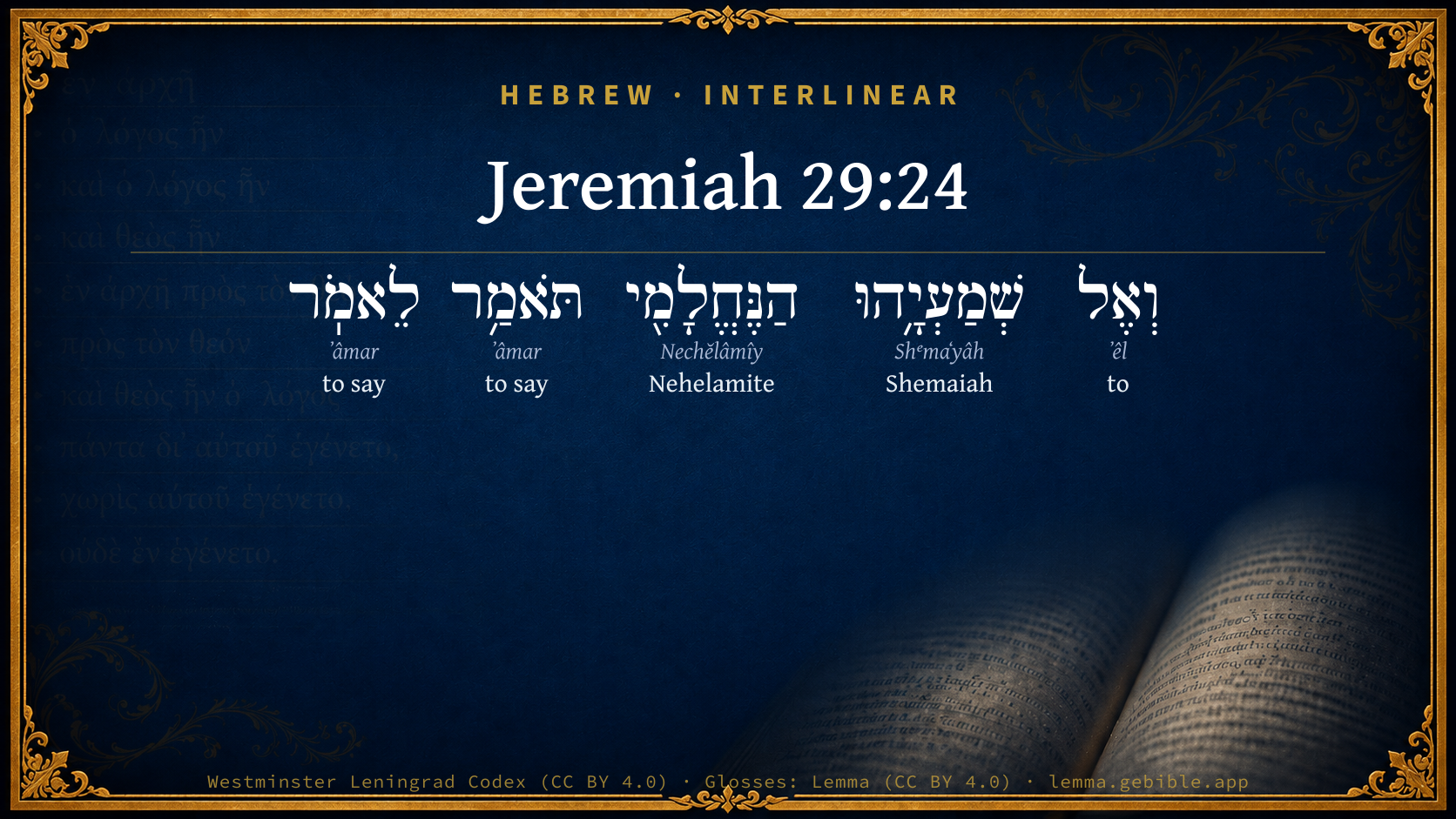
Jeremiah 29:24

Hebrew (Westminster Leningrad Codex) Jeremiah 29:24 appears in the Hebrew Old Testament. The text above is from the Westminster Leningrad Codex. Each word links to its Strong’s number, a concise gloss, and parsing drawn from the Open Scriptures Hebrew Bible morphology. Click any word for its full Brown-Driver-Briggs (BDB) entry.
Download image
Cite this verse

Jeremiah 29:24 (World English Bible). Public Domain. Lemma interlinear Bible study tool, https://lemma.gebible.app/v/jeremiah/29/24.

Show BibTeX & RIS
BibTeX
RIS
English Translation
Concerning Shemaiah the Nehelamite you shall speak, saying,
World English Bible · Public Domain
Highlights
  • 1 first appearance in the Hebrew Bible
Full analysis ↓
Download a study sheet

One document with this verse’s original text, its word-by-word gloss line, the meaning frame, cross-references with their text, attributed commentary, and full source and license credits — printable, and it pastes into notes with its structure intact.

This verse Autodidact and up

Study sheet (.html) Plain text (.txt)

A passage Seminary Student

Up to 50 verses in one chapter. A passage sheet keeps up to 6 commentary sources and 12 cross-references per verse, in the order this page ranks them, and says so on the sheet whenever that leaves anything out. Ask for a single verse and you get the Autodidact verse sheet above.

Everything on this page stays free to read, with no account — the sheet is a download of what is already on screen, not access to it.

Want to remove ads? Support Godless Engineer
Compare translations 3

The same verse in 3 English versions, stacked beneath the original-language interlinear above. Click any original word for its lexicon entry.

Each is an independent rendering of the whole verse — the interlinear is not word-aligned to these translations.

Highlighted words mark where these versions differ — a whole-verse word diff, not a word-by-word alignment.

  • World English Bible Public Domain
    Concerning Shemaiah the Nehelamite you shall speak, saying,
  • King James Version Public Domain
    Thus shalt thou also speak to Shemaiah the Nehelamite, saying,
  • unfoldingWord Literal Text CC BY-SA 4.0
    “About Shemaiah the Nehelamite, say this:

unfoldingWord Literal Text — © unfoldingWord, licensed CC BY-SA 4.0. Word-aligned USFM3 via Door43 (git.door43.org/unfoldingWord/en_ult).

Versions to compare (up to 4)

3 of 4 selected

Show all 18 translations

Every available English version of this verse, each an independent rendering of the whole verse.

  • World English Bible Public Domain
    Concerning Shemaiah the Nehelamite you shall speak, saying,
  • Berean Standard Bible Public Domain
    You are to tell Shemaiah the Nehelamite that
  • Majority Standard Bible Public Domain
    You are to tell Shemaiah the Nehelamite that
  • King James Version Public Domain
    Thus shalt thou also speak to Shemaiah the Nehelamite, saying,
  • American Standard Version (1901) Public Domain
    And concerning Shemaiah the Nehelamite thou shalt speak, saying,
  • Revised Version (1885) Public Domain
    And concerning Shemaiah the Nehelamite thou shalt speak, saying,
  • Geneva Bible (1599) Public Domain
    Thou shalt also speake to Shemaiah the Nehelamite, saying,
  • Douay-Rheims (1899) Public Domain
    And to Semeias the Nehelamite thou shalt say:
  • Young's Literal Translation Public Domain
    `And unto Shemaiah the Nehelamite thou dost speak, saying,
  • Literal Standard Version CC BY-SA 4.0
    And you speak to Shemaiah the Nehelamite, saying,
  • Unlocked Literal Bible CC BY-SA 4.0
    “About Shemaiah the Nehelamite, say this:
  • unfoldingWord Literal Text CC BY-SA 4.0
    “About Shemaiah the Nehelamite, say this:
  • Darby Bible Public Domain
    And thou shalt speak to Shemaiah the Nehelamite, saying,
  • World Messianic Bible Public Domain
    Concerning Shemaiah the Nehelamite you shall speak, saying,
  • Webster's Bible Public Domain
    Thus shalt thou also speak to Shemaiah the Nehelamite, saying,
  • Free Bible Version CC BY-SA 4.0
    Tell Shemaiah the Nehelamite
  • Bible in Basic English Public Domain
    About Shemaiah the Nehelamite.
  • JPS Tanakh (1917) Public Domain
    And concerning Shemaiah the Nehelamite thou shalt speak, saying:

Literal Standard Version (2020), Covenant Press — licensed CC BY-SA 4.0. Text via the HelloAO Bible API (eBible.org). Unlocked Literal Bible (unfoldingWord) — licensed CC BY-SA 4.0. Text via the HelloAO Bible API (eBible.org). unfoldingWord Literal Text — © unfoldingWord, licensed CC BY-SA 4.0. Word-aligned USFM3 via Door43 (git.door43.org/unfoldingWord/en_ult). Free Bible Version, Dr. Jonathan Gallagher — licensed CC BY-SA 4.0. Text via the HelloAO Bible API (eBible.org).

Word by word

More ways to search: Search by grammar → Find every occurrence → Compare this word →

Practice this passage: Drill this verse → Learn its vocabulary →

הַנֶּחֱלָמִ֖י
Nechĕlâmîy
H5161
“the · Nehelamite”
Particle, Definite Article + Noun, Gentilic, Masculine, Singular, Absolute
Part of Speech
Particle + Noun
Type
Gentilic
Gender
Masculine
Number
Singular
State
Absolute
Full BDB Definition

Origin: apparently a patronymic from an unused name (apparently pass. participle of H2492 )

TWOT: None

Nehelamite = "he of the dream" - the designation of a false prophet Shemaiah taken into captivity to Babylon; name is formed from his native place or his progenitor
  1. וְאֶל ʼêl H413 “and · to” Conjunction + Preposition
  2. שְׁמַעְיָ֥הוּ Shᵉmaʻyâh H8098 “Shemaiah” Noun, Proper
  3. תֹּאמַ֥ר ʼâmar H559 “to say” Verb, Qal, Imperfect, 2nd Person, Masculine, Singular
  4. לֵאמֹֽר ʼâmar H559 “to say” Preposition + Verb, Qal, Infinitive Construct

About this verse

These counts appear in no published source. They are computed here, from the morphology-tagged text and Lemma’s own curated glosses. What Lemma adds →

5
words
4
distinct lemmas
Prophets
section

Notable vocabulary

The rarest word here is הַנֶּחֱלָמִ֖י Nehelamite H5161 — appearing just 3 times in the whole Hebrew Bible.

First appearance in Scripture

This word makes its first canonical appearance in the Hebrew Bible here:

  • הַנֶּחֱלָמִ֖י Nehelamite H5161

Shared distinctive vocabulary

הַנֶּחֱלָמִ֖י Nehelamite H5161 occurs in 3 verses of the Hebrew Bible. Also found in:

Grammatical profile

  • 2 verbs
  • 2 nouns
  • 1 preposition

Verb forms

  • תֹּאמַ֥ר Qal · Imperfect
  • לֵאמֹֽר Qal · Infinitive Construct

Repetition

A word recurs within this verse — often emphatic in Hebrew:

  • תֹּאמַ֥ר to say H559 ×2

Cross-references

1

Topical passages linked to Jeremiah 29:24 in the Treasury of Scripture Knowledge — connected by theme and wording, ordered by reader-vote popularity; previews shown in the World English Bible.

  • Jeremiah 29:31–32 Send to all them of the captivity, saying, Thus says Yahweh concerning Shemaiah the Nehelamite: Because Shemaiah has prophesied to you, and I didn't send him, and he has caused you to trust in a lie;

Cross-references courtesy of OpenBible.info (CC BY 4.0).

Hebrew and Greek witnesses Masoretic Hebrew ↔ Greek Septuagint

The same verse in the two great witnesses to the Old Testament, shown verse-for-verse.

These are two independent witnesses, not word-aligned to each other, and the Septuagint is shown in lemma (dictionary) form.

Hebrew Jeremiah 29:24 Masoretic · Westminster Leningrad Codex

וְאֶל שְׁמַעְיָ֥הוּ הַנֶּחֱלָמִ֖י תֹּאמַ֥ר לֵאמֹֽר

Concerning Shemaiah the Nehelamite you shall speak, saying,

World English Bible · Public Domain

Greek LXX Structure differs

In the Septuagint, Jeremiah is about an eighth shorter than the Hebrew and arranges its material differently — the Oracles Against the Nations (Hebrew chapters 46–51) appear in the middle of the Greek book, after 25:13. Because the chapter and verse boundaries do not line up, a verse-for-verse comparison with the Hebrew is not shown.

A verse-for-verse comparison isn’t shown here because the chapters and verses don’t line up. Switch to the LXX edition with the MT / LXX toggle above to read the Greek directly.

On this verse, The Cambridge Bible for Schools and Colleges discusses the Septuagint’s reading. Read the note in Commentary ↓

Hebrew: Westminster Leningrad Codex (CC BY 4.0). Greek: Septuagint (public domain); English from a public-domain English Septuagint. How the Septuagint differs from the Hebrew →

Targum (Aramaic paraphrase)

1

The Targum is the ancient Jewish Aramaic paraphrase of the Hebrew Scriptures — an interpretive translation, not the Hebrew text itself. Onkelos (literal) and Pseudo-Jonathan (expansive) render the Torah, and Jonathan the Prophets. Coverage is partial: where no permissively-licensed English translation exists for a verse, only the Aramaic is shown. This is verse-level text, not a word-by-word alignment to the Hebrew.

  1. Targum Jonathan Prophets (Joshua–Malachi)
    וְלִשְׁמַעְיָה דְמִן חֲלַם תֵּימַר לְמֵימַר:

    (no public-domain English translation for this verse)

    Targum Jonathan — Aramaic: “Mikraot Gedolot” (public domain). English: “Sefaria Community Translation” (CC0 1.0 (public-domain dedication)); “London "Chaldee Paraphrase," 1871” (public domain). Text via Sefaria.

Commentary

Notes on Jeremiah 29:24 from classic Christian and Jewish commentators (each source and its license shown beneath its notes). The classic Christian expositions comment on the surrounding passage and are grouped to its opening verse, so a note may address several verses; the Jewish commentaries on the Tanakh (Rashi and others) are per-verse, so they appear only where the commentator wrote on this verse.

Lemma curates 59 commentaries, every one of them public domain or Creative Commons licensed, each selected and text-cleaned for this edition rather than reprinted as found. About our sources →

Ellicott's Commentary for English Readers

(24) Thus shalt thou also speak to Shemaiah the Nehelamite.—It is clear that this section (Jer_29:24-32) is of the nature of a fragment attached to the Epistle to Babylon on account of its associations with it, but not forming part of it. It gives, in fact (as Jer_29:28 shows), the sequence of events, and so far stands in the same relation to it as the Second Epistle to the Corinthians does to the First. Jeremiah’s letter had naturally roused the indignation of the rival prophets at Babylon, and they organised a movement, of which Shemaiah was the chief instigator, for his destruction. Of Shemaiah himself we know nothing more than is here recorded. The description “Nehelamite” gives us no information, as the name Nehelam does not appear as belonging to any person or place in the Old Testament. It is just possible, as in the marginal reading, that there may be a play upon the Hebrew word (Halam) for “dreamer.”

A Bible Commentary for English Readers, edited by Charles John Ellicott (1878–1897) — public domain. Text from a community e-Sword module.

Trapp's Complete Commentary

John Trapp

Jer 29:24 [Thus] shalt thou also speak to Shemaiah the Nehelamite, saying,

Ver. 24. Thus shalt thou also speak to Shemaiah the Nehelamite.] Or, Dreamer, dream wright, enthusiast; such as were the Messalanian heretics of old, and some of the same stamp, loaves of the same leaven, today.

John Trapp, A Commentary or Exposition upon All the Books of the Old and New Testament (1647–1656) — public domain. Text from a community e-Sword module.

Albert Barnes' Notes on the Bible

A narrative showing the effects of Jeremiah’s letter. Shemaiah the leader of the false prophets wrote to Zephaniah, urging him to restrain the prophet’s zeal with the prison and the stocks.

Jer 29:24

To Shemaiah - Rather, concerning.

The Nehelamite - Not as in the margin; but one belonging to the village of Nehlam (unknown).

Jer 29:26

Officers - Deputy high priests who had the oversight of the temple.

Mad - See 2Ki 9:11 note. Many of the symbolic actions of the prophets, such as that of Jeremiah going about with a yoke on his neck, would be mocked at by the irreverent as passing the line between prophecy and madness.

Prisons - Rather, the stocks Jer 20:2.

The stocks - Rather, collar.

Jer 29:28

This captivity is long - Rather, It is long. God’s anger, their punishment, the exile, the time necessary for their repentance - all is long to men who will never live to see their country again.

Albert Barnes' Notes on the Bible (1834–1885) — public domain. Text from a community e-Sword/MySword module.

Joseph Benson's Commentary

Jer 29:24-28. Thus shalt thou speak to Shemaiah the Nehelamite — Or, the dreamer, as the word הנחלמי, is rendered in the margin: see Jer 29:8. The termination, however, rather shows it to be a word expressing Shemaiah’s family or country, and we find such a place as Helam mentioned, 2Sa 10:16-17. The prophet, it seems, was commanded to send this message to Shemaiah after the messengers who delivered the forementioned writing to the captives at Babylon were returned home, who brought along with them Shemaiah’s letter, mentioned in the following verse. Because thou hast sent letters to Zephaniah, (see Jer 21:1,) saying, The Lord hath made thee priest — Shemaiah directs his letter to Zephaniah in the first place, as being next in order to the high-priest, and therefore called the second priest, Jer 52:24, and tells him that God has appointed him to supply the place of the high- priest, being probably absent at that time, who was either Azariah, or Seraiah his son. But who then, it may be asked, was Jehoiada? “Perhaps,” says Blaney, “he was one that had been superseded in his office of second priest, for being remiss in his duty; and therefore Zephaniah may have been here reminded of him, by way of intimation that, as they had been both appointed for the same purposes, so Zephaniah might expect the same fate as his predecessor, if he copied the example of his negligence. The second priest officiated as substitute of the high-priest, in case of absence or indisposition, and perhaps was always invested with subordinate authority.” That ye should be officers, &c., for every man that is mad, &c. — The prophets and inspired persons were often accused of madness, or of being possessed with an evil spirit, by their enemies. See the margin. For therefore, rather, because, he sent unto us in Babylon — See Jer 29:5.

Joseph Benson's Commentary on the Old and New Testaments (1811–1818) — public domain. Text from a community e-Sword module.

Whedon's Commentary on the Bible

Daniel D. Whedon

CONSEQUENCES OF THE LETTER, Jer_29:24-32.

24. This passage is separated from the preceding by sufficient time for Jeremiah’s letter to be carried to Babylon, and for this retaliatory letter of Shemaiah to reach Jerusalem. It is, of course, quite possible that the same men who took Jeremiah’s letter to the exiles in Babylon brought back this of Shemaiah. The close historical connexion of these two letters of Jeremiah fully vindicates the arrangement which brings them here side by side. Of this Shemaiah we know nothing but what we learn in this passage.

It is probable that his title, the Nehelamite, is derived from the place of his birth or former residence.

Zephaniah — Not the high priest, but probably the governor of the temple, and hence one who had special facilities for punishing Jeremiah. See also Jer_21:1.

Daniel D. Whedon (gen. ed.), Commentary on the Old and New Testaments (1874–1909) — public domain. Text from a community e-Sword module.

Keil & Delitzsch

C. F. Keil & F. Delitzsch

Threatening against the false prophet Shemaiah. - Jeremiah's letter to the exiles (vv. 1-23) had excited great indignation among the false prophets in Babylon, who predicted speedy restoration. One of them, named Shemaiah, wrote accordingly letters to Jerusalem addressed to the people, and especially to the priest Zephaniah, who held the highest place in the management of the temple, insisting that he should immediately take steps to punish Jeremiah and check his labours (Jer 29:24-28). When Zephaniah read this letter to Jeremiah, the latter received from God the commission to tell the pseudo-prophet of the punishment awaiting him, that and his race should perish and not survive Israel's liberation (Jer 29:29-32). - This threatening accordingly dates from a somewhat later time than the letter, vv. 1-23, since it was its arrival and influence upon the exiles that led Shemaiah to write to Jerusalem that letter, to which the threatening of the present verse is the reply. But on account of their historical connection, the letter of Jeremiah and that of Shemaiah were, at the publication of Jeremiah's prophecies, placed the one after the other. - From the introductory clause of Jer 29:24 : "And to Shemaiah the Nehelamite thou shalt speak thus," we might conclude, with Graf, that what Jeremiah had to say was not addressed by letter to Shemaiah himself; and hold it to have sufficed that he should read it, like all the exiles, in the letter which doubtless found its way to Babylon. But this is incompatible with the command of God, Jer 29:31 : Send to all the captives, saying, etc. For it was only by writing that Jeremiah could send to the exiles the sentence from God on Shemaiah that follows in Jer 29:31. The introductory clause is therefore interposed by the author of the book to form a link of connection between the two utterances regarding the pseudo-prophets at Babylon. We cannot make sure whether "the Nehelamite" refers the man to a family or to a place of which we know nothing else. Jer 29:25. Next the introduction to the divine sentence comes (from "Because thou" on) a statement of the occasion that called for it, which extends to Jer 29:28. Then in Jer 29:29-31 we are told that Zephaniah read to Jeremiah the letter he had received from Shemaiah in Babylon, and that Jeremiah was then commissioned by God to intimate to Shemaiah the punishment to be sent on him by God for his false and seducing prophecies. Then, again, attached to the preliminary statement by "therefore," the introductory phrase "Thus saith Jahveh" is repeated, and what the Lord said follows.

Jer 29:25-28

"Because thou hast sent in thy name (without divine commission) letters to all the people in Jerusalem, and to Sephaniah the son of Maaseiah the priest, and to all the priests, saying." ספרים may be a single letter, cf. Kg2 10:1-2; but since these were sent to the people, the priest Zephaniah, and all the people, the word doubtless means here letters in the plural. As to Zephaniah ben Maaseiah, see at Jer 21:1. - In Jer 29:26-28 follows the main substance of the letter: "Jahveh hath set thee to be priest in the stead of the priest Jehoiada, that there should be officers in the house of Jahveh for every man that is mad and prophesieth, that thou shouldest put him in the stocks and in neck-irons. Jer 29:27. And, now, why hast thou not restrained Jeremiah of Anathoth, that prophesieth to you? Jer 29:28. For therefore hath he sent to us to Babylon (a letter) to the effect: It will last long; build houses and dwell (therein), and plant gardens and eat the fruit of them." Zephaniah occupied, acc. to Jer 29:26, the post of a chief officer of the temple, was a chief warden, as Pashur had been before him, Jer 21:1, who had charge of the police regulations of the temple.

In the stead of the priest Jehoiada. These words Grot., Hitz., and Gr. refer to the high priest Jehoiada under King Joash, Kg2 11:18, who set up officers (פּקדּות) over the temple. But this view cannot be reconciled with the words of the text: "Jahveh hath set thee to be priest in Jehoiada's stead, that there should be officers;" since from these ambiguous words, Zephaniah filled the same post as Jehoiada had done, and was his successor in office. The other well-known Jehoiada was high priest, who appointed officers; Zephaniah, on the other hand was only "the second priest," and as such had charge of the temple arrangements and of public order there. Nor is there any hint here or elsewhere that Zephaniah was the immediate successor of Pashur in this office, nor any indication to make it unlikely that Jehoiada held the post after Pashur and that Zedekiah succeeded him. The plural "officers" is general: that at all times there should be officers. "For every man that is mad an prophesieth." משׁגּע, the deranged or mad person, is here closely associated with מתנבּא, him that bears himself as prophet. The former word is used in the evil sense of the apparently deranged behaviour of the man on whom the Spirit of God has laid hold, Kg2 9:11; Hos 9:7. The idea is not: for (or against) every prophet, but: for every madman that plays the prophet. The temple, i.e., the outer court of the temple, was the usual place for prophets to take their stand. Shemaiah accordingly means that it was the duty of the chief warden of the temple to repress attempts to speak in the temple on the part of pretended prophets, by putting such persons in stocks and irons. As to מהפּכת, see on Jer 20:2. צינק is ἁπ λεγ.. It certainly does not mean prison after צנק, in Samaritan = clausit; but apparently neck-irons after Arab. znâq, necklace, ring. Since both words are used together here, and since the meaning is apparently that Jeremiah should be put into both instruments at once, Hitz. conjectures that both together were needed to make the stocks complete, but that each had its own proper name, because it was possible to fix in the neck, leaving hands and feet free, or conversely, as in Jer 20:2. - גּער, rebuke, check by threats, restrain, cf. Rut 2:16; Mal 3:11, etc. "For therefore," sc. just because thou hast not restrained him from prophesying he has sent to Babylon. שׁלח with לאמר following, send to say, means: to send a message or letter as follows. לאמר ארכה היא Hitz. renders: for he thought: it (Babylon) is far away; Jeremiah's meaning being, that in Jerusalem they would know nothing about his letter he was sending to Babylon. But such a hidden purpose is utterly foreign to the character of the prophet. He had publicly predicted in Jerusalem the long seventy years' duration of the exile; and it was not likely to occur to him to wish to make a secret of the letter of like import which he sent to Babylon. Besides, Hitz.'s interpretation is forced. Since there is no לאמר before בּנוּ בתּים, the לאמר before ארכה can only be introductory to the contents of the letter. For ארך used of duration in time, cf. Sa2 3:1; Job 11:9. "Long-lasting it is," sc. your sojourn in Babylon. These words give the burden of his prophecy, that on which he founded his counsel: build houses, etc.

Jer 29:29

Zephaniah read aloud to Jeremiah the letter he had received from Babylon. With what design, we are not told; probably simply to inform him of the proceedings of the pseudo-prophets in Babylon. If we may judge by Jer 21:1 and Jer 37:3, Zephaniah seems to have been friendly to Jeremiah.

Jer 29:30-32

In consequence of this, Jeremiah received from the Lord the commission to predict to Shemaiah his punishment at the hand of God, and to send the prediction to all that are in Babylon in banishment. With Jer 29:31, cf. Jer 28:15. The punishment is this: Shemaiah shall have no posterity among his people, i.e., of his children none shall be left amongst the people, nor shall he see, i.e., experience, have any share in the blessings which the Lord will yet bestow upon His people. The extinction of his race and his own exclusion from the privilege of seeing the day of Israel's redemption are the punishment that is to fall on him for his rebellion against the commandment of the Lord. With 'כּי סרה cf. Jer 28:16.

Keil & Delitzsch — Biblical Commentary on the Old Testament (1861–1891) — public domain (CC PDM 1.0). Text via the HelloAO Bible API. (Old Testament only.)

Lange's Commentary on the Holy Scriptures

2. The Consequences of the Letter

Jer_29:24-32

24, 25Thus shalt thou also speak to Shemaiah the Nehelamite, saying, Thus speaketh the Lord of hosts, the God of Israel, saying, Because thou hast sent letters in thy name unto all the people that are at Jerusalem, and to Zephaniah, the son of Maaseiah 26the priest, and to all the priests, saying, The Lord hath made thee priest in the stead of Jehoiada the priest, that ye should be officers in the house of the Lord, for every man that is mad10 and maketh himself a prophet, that thou shouldest put 27him in prison, and in the stocks.11 Now therefore why hast thou not reproved12 Jeremiah 28 of Anathoth, which maketh himself a prophet to you? For therefore13 he sent [a letter] unto us in Babylon, saying, this captivity is [will continue] long:14 build ye houses, and dwell in them; and plant gardens, and eat the fruit of them. 29And Zephaniah the priest read this letter in the ears of Jeremiah the prophet. 30, 31Then came the word of the Lord unto Jeremiah, saying, Send to all them of the captivity [a message] saying, Thus saith the Lord concerning Shemaiah the Nehelamite; Because that Shemaiah hath prophesied unto you, and I sent him 32not [without my having sent him] and he caused you to trust15 in a lie: Therefore thus saith the Lord: Behold, I will punish Shemaiah the Nehelamite, and his seed: he shall not have a man to dwell among this people; neither shall he behold16 the good that I will do for my people, saith the Lord; because he hath taught rebellion against the Lord.

EXEGETICAL AND CRITICAL

The letter, Jer_29:4-23, caused great exasperation among the false prophets at Babylon. One of them, Shemaiah, complains to the overseer of the temple in Jerusalem that he did not interfere against the conduct of the mad Jeremiah. Jeremiah gets information of this letter and receives the command to announce to Shemaiah that his family shall become extinct, and that he himself will not see the salvation of Israel. The arrangement of the sentences in this passage is very irregular. In the first place all explanation concerning the proximate occasion of this utterance is passed over. Yet this may be accounted for by the fact that this may be learned from the tenor of the passage itself. The beginning will then be made with the command to make an announcement to Shemaiah. This announcement does begin in Jer_29:25, and takes its regular course to the close of Jer_29:28, so that in Jer_29:26-28 the letter is communicated verbatim, which gave the occasion for the announcement to Shemaiah. Here the address to Shemaiah breaks off without a conclusion. Instead of this, after the prophet has suddenly sprung back from the point of the communication by him to the point of the communication to him, the conclusion is given in the form of an address to the exiles, in which Shemaiah is spoken of in the third person (Jer_29:30-32). Here accordingly two announcements seem to have been made (comp. Jer_29:24-25 with Jer_29:30-31), which on account of their identical tenor the prophet allows to combine in the course of his narrative.

Jer_29:24-28. Thus shalt thou … eat the fruit of them. We might indeed translate אֵל here, as in Jer_29:16; Jer_29:21, of [Shemaiah] instead of to, but Jer_29:25 contains a direct address to Shemaiah. Neither he nor his birth-place is mentioned elsewhere.—The letter, communicated in Jer_29:26-28, is addressed specially to the priest Zephaniah. When notwithstanding, in Jer_29:25, letters are spoken of which were addressed to all the prophets and all the priests besides Zephaniah, this may be explained in two ways; either there really were letters with the three addresses mentioned, the principal letter only being communicated to Zephaniah; or this letter was the only one, but designated in Jer_29:25 as intended to be communicated to a wider circle. Both explanations are grammatically possible. For letters (ספרים) may be a general plural. (Comp. פֹטוֹת, yokes, Jer_28:13 and Isa_37:14; Isa_39:1).—Zephaniah, the son of Maaseiah, was כֹּהֵן מִשְׁנֶה, second priest, Jer_52:24. Comp. Jer_21:1 and Jer_37:3.—Officers (פקידים). This also might in itself be a general plural, if the mention of the predecessor did not require us to refer it to both officers.—That is mad. Here the expression involves an insult to Jeremiah. Zephaniah was not to restrain all those who prophesied, but only those who were deranged and presumed to prophesy, and Jeremiah is reckoned among these.—In prison. Comp. Jer_30:2.—This is long. By this the 70 years are meant (Jer_29:10), which, in comparison with the time predicted by the false prophets, would be a very long period.

Jer_29:29-32. And Zephaniah … against Jehovah. The words of Jer_29:29 do not clearly indicate whether Zephaniah read the letter of Jeremiah alone or in the presence of others. We may conclude from the two embassies (Jer_21:1; Jer_37:3) that he was probably not personally hostile towards Jeremiah. We also find no indication that Shemaiah’s letter was at that time of any injury to Jeremiah. It is indeed possible that Zephaniah, though unable to keep the purport of the letter altogether secret, yet acted with the utmost possible consideration toward the prophet. At any rate Jeremiah was not intimidated. Shemaiah receives a reproving answer from the Lord’s prophet: his race shall be extirpated (the phrase “dwelling among his people” signifies a peaceful, secure existence, 2Ki_4:13) and he himself will not have his eyes gladdened by the prosperity of his people.

Footnotes:

[10]Jer_29:26.—משׁנא. Only the Part. Pual and Part. and Inf. Hiphil of this word are found. The radical meaning is to be astray. (Comp. שָׁנָא, שָׁנַנ, שָׁנָה). The Hiphil is used of raving in general, 1 Sam. 21:15,16; מְשֻנָא likewise in Deu_28:34 and 1 Sam. 21:16; elsewhere only of prophets and always in a bad sense; Hos_9:7; 2Ki_9:11.

[11]Jer_29:26.—צינק. The word is ἅπ. λεγ. The root צָנַק also does not occur elsewhere in Hebrew. From the dialects the most suitable comparison is afforded by the Arabic zinäg, collar, ring (Hitzig). According to the older Rabbis in Kimchi צינק=לידים מסנר, כלי as מהפכת=לאוֹאר מסנר Symm.: μόχλος lever, pole, bar. Ges. Thes., p. 1175. Hitzig rightly supposes that both instruments formed the complete instrument of torture, one serving to confine the neck, the other the hands and feet.

[12]Jer_29:27.—נערת. Properly to chide (comp. Gen_37:10) then to interfere, to stop any one (Rth_2:16; Mal_3:11).

[13]Jer_29:28.—כי על־כן. In itself these particles might be taken in the most natural sense; for on this account (viz., on account of defective control); but elsewhere they always designate the reason supposed as the object or result; Jer_38:4; Gen_18:5; Gen_19:8; Gen_33:10; Gen_38:26. Comp. Redslob, lexical. Erürterunyen. Stud. u. Krit., 1841, S 983 sqq.

[14]Jer_29:28.—אָרֹךְ, of extension in time (2Sa_3:1), and in space (Job_11:9). On the neuter significance of the feminine, comp. Naegelsb. Gr., § 60, 6 b.

[15]Jer_29:31.—On ויבִטח comp. Jer_28:15.

[16]Jer_29:32.—ראה withבְ. Comp. Naegelsb. Gr., § 112, 5, a; Ps. 37:34; 54:9; 118:7.

DOCTRINAL AND ETHICAL

1. On Jer_26:3. [“See how God waits to be gracious, waits till we are duly qualified, till we are fit for Him to be gracious to, and in the meantime tries a variety of methods to bring us to be so.” Henry—S. R. A.]

2. On Jer_26:6. “Deus nulli loco præcise alligatus est ita, ut ecclesiam suam et doctrinam cœlestem inde dimovere nequeat propter hominum ingratitudinem. Vehementer igitur errant Romanenses, dum ex auctoritate urbis Romæ suæ ecclesiæ ac religionis auctoritatem evincere satagunt. Multo rectius Hieronymus in hoc memorabili dicto, quod etiam allegatur in Jure Canon. Dist. Jeremiah 19 : Non facile est stare loco Pauli et tenere gradum Petri cum Christo regnantium. Non enim Sanctorum filii sunt, qui tenent loca Sanctorum, sed qui exercent opera eorum.” Förster.

3. On Jer_26:8 sqq. “Scarcely has Jeremiah done speaking than they take him to task, and threaten his life. What does Jeremiah do? Instead of vindicating himself he says: ‘Reform your life, and hearken to the voice of the Lord, and it will be better for you,’ Jer_26:13. You do not wish me to thunder away at you; reform then and I can let it alone. This preaching was seasonable, and produced an admirable effect. The priests and elders contradicted the priests, the parrhesia [free-spokenness, Act_4:13] of the man filled them with astonishment. ‘He is not worthy of death,’ Jer_26:16. A brief illustration of the saying ‘We need not our senses lose, when our enemies accuse.’ Jeremiah has to thank his honesty for this presence of mind, his profound meditation, his constrained calling, the necessity, the ardor, which urged him to preach, for no personal inclination had any share in it. I know in more recent times a man, who has unaffectedly practised Jeremiah’s behavior, a pastor, a teacher, I might say a prophet of many thousand people. Whenever he had to vindicate himself (which happened now and then) he preached, he repeated to the commissioners the very things of which he was accused, confessed and denied not, but pressed them on their hearts, and showed aliud agendo his innocence, his mind, his steadfastness, and all at the same time so plainly that they always returned with full conviction and knew not whether they had gone forth to see a prophet or were sent to examine a culprit? ‘Never man,’ they said, ‘spake like this man.’ That cannot be counterfeited. One must be just as full of the matter, as absorbed in the subject, as pressed at heart, kindled with the same ardor in order to explain himself with the same indifference, repose and plainness, when there is a knife at his throat.” Zinzendorf.

4. On Jer_26:12 sqq. “Si injuriam deposueris penes Deum, ultor est; si damnum, restitutor est; si dolorem, medicus est; si mortem, resuscitator est.” Tertullian. [“Those that persecute God’s ministers hurt not them so much as themselves.” Henry.—S. R. A.]

5. On Jer_26:7-8; Jer_26:11; Jer_26:16. “Auctores persecutionis plerumque esse solent ii, qui in ordine ecclesiastico eminent.” Förster. “Especially are the priests and men-pleasing prophets mad with Jeremiah, for if he is right they have lied.” Diedrich.

6. On Jer_26:18 [“By this it appears that a man may be a true prophet of the Lord and yet may prophesy the destruction of Zion and Jerusalem. When we threaten secure sinners with the taking away of the Spirit of God, and declining churches with the removal of the candle-stick, we say no more than what has been said many a time, and what we have warrant from the word of God to say.” Henry.—S. R. A.]

7. On Jer_26:20 sqq. “Urias, a true prophet, preached like Jeremiah, therefore the king wished to kill him, so he fled to Egypt but could not escape. Jeremiah did not flee and was spared … Our running and anxiety are of no use. The wickedness of the world must for its judgment be displayed on God’s servants, and these must yield to it; but on whom it is to come first God has in His own hand; and we may spare ourselves all our care and flight.” Diedrich. [“Nothing more is known of Urijah than is here related; but this incident suggests that God mercifully strove with His people by the ministry of many prophets whom He sent, rising up early and sending them (Jer_26:5) whose names are written in the Book of Life and are canonized in God’s Martyrology, but do not appear in the pages of any earthly history.” Wordsworth.—S. R. A.]

8. On Jer_26:24. “Monemur hic, Deum servis suis fidelibus subinde largiri quosdam patronos, ut Jeremiæ hic Achikamum et infra cap. 38 Ebedmelechum, Eliæ et prophetis συγχρόνοις Obadiam 1 Reg. 18, Luthero Electores Saxoniæ Fridericum sapientem, Johannem pium, Johannem-Fridericum constantem.” Förster.

9. On Jer_27:2-11. Historical times are preceded by a long series of centuries which present themselves to us as altogether obscure or only in the dubious twilight of tradition. Accredited history also comprises only a relatively small portion of the human race, for the nations which are added as ciphers to the factors of history form the majority. A universal ruler in the biblical sense is not one whose dominion actually extends over the entire globe—for there is none such—but he who represents the leader in the concert of history. This part is here given to Nebuchadnezzar. Among all the universal monarchies that represented by him appears richest in noble capacity. It is therefore compared to the golden head of the image in Daniel 2. Comp. Auberlen, der Prophet Daniel, S. 41 sqq.

10. On Jer_27:5 sqq. [“The things of the world are not the best things, for God often gives the largest share of them to bad men, that are rivals with him and rebels against him. Dominion is not founded in grace. Those that have not any colorable title to eternal happiness may yet have a justifiable title to their temporal good things.” Henry.—S. R. A.] “Great lords sit indeed on high thrones, but not firmly, for they are only God’s vassals. And when they do not please Him and act accordingly, he can easily transfer the fief to another; Dan_2:21; Dan_4:14; Dan_4:22.” Cramer.

11. On Jer_27:12. [“The conduct of Jeremiah, counselling Zedekiah and Jerusalem to submit to Nebuchadnezzar, has been represented as an act of political prudence to be imitated by Statesmen and Ecclesiastics, who are thereby justified in making large concessions of national rights and national independence in times of public emergency (Stanley, Lect. 534).

But was it not rather one of religious duty?

God had revealed to the prophet that He had given the Nation into the hand of Nebuchadnezzar, ‘His servant,’ on account of their sins, and they must submit to Him as the Minister and Vicegerent of God.” Wordsworth. “Many might have prevented destroying providences by humbling themselves under humbling providences. It is better to take up a lighter cross in our way, than pull a heavier on our own head.” Henry.—S. R. A.]

12. On Jer_27:14. “It is one sign of our depraved nature that we are more ready to believe lies than the truth. For when Jeremiah and his colleagues preached, no one believed. But no sooner did the false prophet come and open their mouths, than all their discourses must be spoken directly from heaven, and what they said, must pass current on earth (Psa_73:9). But not what Jeremiah said. Take for example our mother Eve; what God said was of no account, but what the serpent said was something purely excellent.” Cramer.

13. On Jer_27:18. “True prayer is a certain sign of Godliness and a fruit of faith and the Holy Ghost, which cries in our hearts: Abba, dear Father. Therefore he who cannot or will not pray is not a good Christian.” Cramer.

14. On Jer_27:18. “If they be prophets let them supplicate the Lord. This was the great demonstration of Elias, to which Jeremiah adheres. It is infallibly the case that a false teacher has no heart for the Saviour, and goes out of His way. A heretic, who has a heart to pray (and that too in secret) is certainly not far from the truth.” Zinzendorf.

15. On Jer_27:22. [“We are apt to set our clock before God’s dial, and then to quarrel because they do not agree, but the Lord is a God of judgment, and it is fit that we should wait for Him.” Henry.—S. R. A.]

16. On Jer_28:1 sqq. “Wherever the dear lord builds His church, the devil has a chapel near by.” Cramer. This Hananiah (comp. Jer_28:2; Jer_28:11) shows us plainly what it is to lie or deceive in the name of God.

“O Lord, and must Thy glorious name

Thus be a cover to their shame?” Förster.

17. On Jer_28:6. “Amen! the Lord do so. Quite a different attitude of the prophet from the preceding. A false prophet, a miserable comforter disputes with him, brings good news and appeals to an oracle, a voice which he had perhaps heard more lately than Jeremiah. Jeremiah without getting warm about it, says I shall be heartily glad if it be so: but take care that you have understood it correctly. His opponent is encouraged and goes further, he breaks off the prophetic yoke from Jeremiah’s neck. Jeremiah, with the same indifference, which he has shown from the beginning, goes his way … I dare not speak of anything, says Paul, which Christ hath not wrought by me (Rom_15:18).” Zinzendorf.

18. On Jer_28:10-11. “Chananias hic præbet exemplum impudentiæ Jesuwilicæ, cujus magistrum non abs re appellaveris Eumundum Campianum (1580) qui epistola quadum Theologos Angliæ provocare non erubuit, ponens inter alia verba hæc fere thrasonica: Si præstitero cœlos esse, divos esse, Christum esse, fidem esse, causam obtinui: hic non animosus ero? Occidi quidem possum, superari non possum. Pari impudentia Jesuwitas ante Colloquium Ratisbonense scriplitasse legimus: The Prædicantes should come, if they had a heart in their body, they would catch them alive: if they would bring a syllogism, which is in Bocardo, they would throw it at one’s head and say it was in Bocallo.” Förster.

19. On Jer_29:7. “Monemur hic, orandum esse pro magistratibus et non tantum iis, qui nostræ religioni addicti et veræ ecclesiæ membra, sed etiam pro iis, qui extra ecclesiam adeoque gentiles ut Nebuchadnezzar et Nero tyrannus (2Ti_2:2). Nam ex salute reipublicæ etiam salus et incolumitas ecclesiæ constat. Et Lutherus pereleganter: Politia, inquit, servit ecclesiæ, ecclesia servat politiam.” Förster. “Quod pastori hoc et ovibus.” The symbol of the Emperor Charles the Bald.

20. On Jer_29:11. “God always has compassion, and His heart breaks for us (Jer_31:20), for he exercises guardianship over His elect (Wis_4:15). And he knows how, in all that he does, to mitigate His justice with His mercy, so that we may see how richly His mercy is diffused over all His works; that even when He punishes, He straightway has mercy again according to His great goodness, and causes His mercy to be the more richly dispensed, because He knows our frame (Psa_103:14), viz., that we are flesh, a wind which passeth away and returneth not again (Psa_78:40). Cramer.

21. On Jer_29:10-11. “The waiting of the righteous has always something to depend upon, namely, the promise, and it is a duty to God to believe the promises, but an insult and dishonor to the name of the Lord when no faith is put in them. Is it not enough that ye injure men, will ye also insult the Lord my God? (Isa_7:13).” Zinzendorf.

22. On Jer_29:11. “God gives a happy ending; He also tells us beforehand, that we may honor Him by hoping; but He deals with us according to His wisdom and His righteousness, so that He chastens us as long as we need it. We cannot, therefore, do otherwise than place ourselves in His hands.” Diedrich.

23. On Jer_29:12. “Let this be firmly established among the brethren, that there is no sham about the hearing of prayer. I remember that once a great minister said across the table: My pastor wrote me that he had settled it with the dear Lord that my wife should live; I should be comforted. My wife died. Now my pastor congratulates me and says, I could now indeed see that she lived. No wonder. The Bible has a nose or wax; and gentlemen also can explain their own words. … Is it then to be in vain that the Lord Jesus has said; whatever ye ask believing that ye shall receive, shall be given unto you (Mar_11:24; Joh_16:23; Mat_7:7; Jam_4:4)? … Test it as often as it is necessary; ask however in faith, and doubt not. I know most assuredly that you will be heard. But I regard it as a matter for consideration, whether one is to ask.” Zinzendorf.

24. On Jer_29:15-16. “A heavy cross often frees us from a heavier, which would otherwise have come upon us. The best way, therefore, is to be satisfied with God’s ways, who can bring good out of evil (1Pe_4:19; Gen_50:20). ” Starke.

25. On Jer_29:24-32. “Those who seek their own consolation without God must be eternally deprived of the true consolation, which God grants to those who at this time humble themselves under Him. Those who preach false consolation confirm the resistance of men to the divine guidance and thus preach revolt, though intending to act conservatively. But in their blindness they do not see what sort of a time it is.” Diedrich.

HOMILETICAL AND PRACTICAL

1. On Jer_26:1-24. A sermon in rebuke of the corruptions of Zion. 1. Its purport (Jer_26:4-6); 2. How it is received (Jer_26:7-11); 3. How the preacher must defend himself (Jer_26:12-15); 4. What the fate of the preacher will be (a), in the most favorable case (Jer_26:16-19; Jer_26:24) (b), in the most unfavorable case (Jer_26:20-23).

2. On Jer_27:1-22. How the Lord’s servants are to treat Politics.—1. They are to point out to the people that it is the Lord who raises and overthrows the kingdoms of this world (Jer_27:2-8). 2. They are to admonish the people to do what the Lord commands (Jer_27:12-13). 3. They are to warn against those who speak their own thoughts to the people (Jer_27:9-11; Jer_27:14-17). 4. They are to admonish to prayer and intercession (Jer_27:18 sqq).

3. On Jer_28:1-17. Of false and true prophets. 1. False prophets, (a) publish on their own responsibility what the people like to hear (Jer_28:2-4); (b) boldly contradict the true word of God (Jer_28:10-11); (c) come to shame, by the non-fulfilment of their predictions (Jer_28:8-9) and by their personal destruction (Jer_28:15-17). 2. True prophets (a) proclaim faithfully the true word of God, (b) fearlessly oppose the lusts of men and the lies of the false prophets; (c) They are honored (α) by the fulfilment of their prophecies, (β) by martyrdom, i.e., honor with God and posterity.

4. On 28. [This year thou shalt die. Dwight:—A Sermon on the New Year.—S. R. A.]

5. On Jer_29:7. The best Christians the best citizens: 1. They know that the prosperity of the whole is their own prosperity (they do not, therefore, seek selfishly their own personal advantage); 2. They actually labor with all diligence for the furtherance of the common good; 3. They employ for this end the power of Christian prayer. [A. Fuller:—Christian patriotism, or the duty of religious people towards their country. Christianity a religion of peace.—S. R. A.]

6. On Jer_29:11. The thoughts of the Lord concerning us. 1. They are thoughts of peace and not of evil; 2, we must wait for their realization, for the Lord delays this, but he does not forget it.

7. On Jer_29:11. Sermon at the funeral service of the Grand Hereditary Prince of Russia, delivered by Prof. Christiani, in Dorpat, 14 April, 1865: 1. Of the thoughts of peace which the Lord has had in this death; 2. Of the fruits and effects of these thoughts of peace.

8. On Jer_29:11-14. Whereupon is our hope of peace based? 1. Objectively upon this, that the Lord Himself has thoughts of peace concerning us. 2. Subjectively on this, that we (a) call upon and seek the Lord with all our hearts, (b) patiently wait for the time of hearing.

Lange's Commentary on the Holy Scriptures (Critical, Doctrinal, and Homiletical), ed. John Peter Lange, English translation edited by Philip Schaff (1864–1880) — public domain. Text from a community e-Sword module.

Tyndale Open Study Notes

Tyndale Open Resources

29:24-32 A prophet in Babylon named Shemaiah took issue with Jeremiah’s written advice that the exiles should accept a long exile (29:4-23). Shemaiah sent a letter to a leading priest in Jerusalem, urging him to take action against Jeremiah; Jeremiah responded with a letter to the exiles that condemned Shemaiah.

Tyndale Open Study Notes — © Tyndale Open Resources, licensed CC BY-SA 4.0. Text via the HelloAO Bible API.

Geneva Bible (1599)

Geneva Bible translators

Or, dreamer.

Geneva Bible (1599) marginal notes — public domain. Text via Bolls.life.

Matthew Henry's Commentary

We have perused the contents of Jeremiah's letter to the captives in Babylon, who had reason, with a great deal of thanks to God and him, to acknowledge the receipt of it, and lay it up among their treasures. But we cannot wonder if the false prophets they had among them were enraged at it; for it gave them their true character. Now here we are told concerning one of them,

I. How he manifested his malice against Jeremiah. this busy fellow is called Shemaiah the Nehelamite, the dreamer (so the margin reads it), because all his prophecies he pretended to have received from God in a dream. He had got a copy of Jeremiah's letter to the captives, or had heard it read, or information was given to him concerning it, and it nettled him exceedingly; and he will take pen in hand, and answer it, yea, that he will. But how? He does not write to Jeremiah in justification of his own mission, nor offer any rational arguments for the support of his prophecies concerning the speedy return of the captives; but he writes to the priests, those faithful patrons of the false prophets, and instigates them to persecute Jeremiah. He writes in his own name, not so much as pretending to have the people's consent to it; but, as if he must be dictator to all mankind, he sends a circular letter (as it should seem) among the priests at Jerusalem and the rest of the people, probably by the same messengers that brought the letter from Jeremiah. But it is chiefly directed to Zephaniah, who was either the immediate son of Maaseiah, or of the 24th course of the priests, of which Maaseiah was the father and head. He was not the high priest, but sagan or suffragan to the high priest, or in some other considerable post of command in the temple, as Pashur, Jer 20:1. Perhaps he was chairman of that committee of priests that was appointed in a particular manner to take cognizance of those that pretended to be prophets, of which there were very many at this time, and to give judgment concerning them. Now, 1. He puts him and the other priests in mind of the duty of their place (Jer 29:26): The Lord hath made thee priest instead of Jehoiada the priest. Some think that he refers to the famous Jehoiada, that great reformer in the days of Joash; and (says Mr. Gataker) he would insinuate that this Zephaniah is for spirit and zeal such another as he, and raised up, as he was, for the glory of God and the good of the church; and therefore it was expected from him that he should proceed against Jeremiah. Thus (says he) there is no act so injurious or impious, but that wicked wretches and false prophets will not only attempt it, but colour it also with some specious pretence of piety and zeal for God's glory, Isa 66:5; Joh 16:2. Or, rather, it was some other Jehoiada, his immediate predecessor in this office, who perhaps was carried to Babylon among the priests, Jer 29:1. Zephaniah is advanced, sooner than he expected, to this place of trust and power, and Shemaiah would have him think that Providence had preferred him that he might persecute God's prophets, that he had come to this government for such a time as this, and that he was unjust and ungrateful if he did not thus improve his power, or, rather, abuse it. Their hearts are wretchedly hardened who can justify the doing of mischief by their having a power to do it. These priests' business was to examine every man that is mad and makes himself a prophet. God's faithful prophets are here represented as prophets of their own making, usurpers of the office, and lay-intruders, as men that were mad, actuated by some demon, and not divinely inspired, or as distracted men and men in a frenzy. Thus the characters of the false prophets are thrown upon the true ones; and, if this had been indeed their character, they would have deserved to be bound as madmen and punished as pretenders, and therefore he concludes that Jeremiah must be so treated. He does not bid them examine whether Jeremiah could produce any proofs of his mission and could make it to appear that he was not mad. No; that is taken for granted, and, when once he has had a bad name given him, he must be run down of course. 2. He informs them of the letter which Jeremiah had written to the captives (Jer 29:28): He sent unto us in Babylon, with the authority of a prophet, saying, This captivity is long, and therefore resolve to make the best of it. And what harm was there in this, that it should be objected to him as a crime? The false prophets had formerly said that the captivity would never come, Jer 14:13. Jeremiah had said that it would come, and the event had already proved him in the right, which obliged them to give credit to him who now said that it would be long, rather than to those who said that it would be short, but had once before been found liars. 3. He demands judgment against him, taking it for granted that he is mad, and makes himself a prophet. He expects that they will order him to be put in prison and in the stocks (Jer 29:26), that they will thus punish him, and by putting him to disgrace possess the people with prejudices against him, ruin his reputation, and so prevent the giving of any credit to his prophecies at Jerusalem, hoping that, if they could gain that point, the captives in Babylon would not be influenced by him. Nay, he takes upon him to chide Zephaniah for his neglect (Jer 29:27): Why hast thou not rebuked and restrained Jeremiah of Anathoth? See how insolent and imperious these false prophets had grown, that, though they were in captivity, they would give law to the priests who were not only at liberty, but in power. It is common for those that pretend to more knowledge than their neighbours to be thus assuming. Now here is a remarkable instance of the hardness of the hearts of sinners, and it is enough to make us all fear lest our hearts be at any time hardened. For here we find, (1.) That these sinners would not be convinced by the clearest evidence. God had confirmed his word in the mouth of Jeremiah; it had taken hold of them (Zac 1:6); and yet, because he does not prophesy to them the smooth things they desired, they are resolved to look upon him as not duly called to the office of a prophet. None so blind as those that will not see. (2.) That they would not be reclaimed and reformed by the most severe chastisement. They were now sent into a miserable thraldom for mocking the messengers of the Lord and misusing his prophets. This was the sin for which God now contended with them; and yet in their distress they trespass yet more against the Lord, Ch2 28:22. This very sin they are notoriously guilty of in their captivity, which shows that afflictions will not of themselves cure men of their sins, unless the grace of God work with them, but will rather exasperate the corruptions they are intended to mortify; so true is that of Solomon (Pro 27:22), Though thou shouldst bray a fool in a mortar, yet will not his foolishness depart from him.

II. How Jeremiah came to the knowledge of this (Jer 29:29): Zephaniah read this letter in the ears of Jeremiah. He did not design to do as Shemaiah would have him, but, as it should seem, had a respect for Jeremiah (for we find him employed in messages to him as a prophet, Jer 21:1, Jer 37:3), and therefore protected him. He that continued in his dignity and power stood more in awe of God and his judgments than he that was now a captive. Nay, he made Jeremiah acquainted with the contents of the letter, that he might see what enemies he had even among the captives. Note, It is kindness to our friends to let them know their foes.

III. What was the sentence passed upon Shemaiah for writing this letter. God sent him an answer, for to him Jeremiah committed his cause: it was ordered to be sent not to him, but to those of the captivity, who encouraged and countenanced him as if he had been a prophet of God's raising up, Jer 29:31, Jer 29:32. Let them know, 1. That Shemaiah had made fools of them. He promised them peace in God's name, but God did not send him; he forged a commission, and counterfeited the broad seal of Heaven to it, and made the people to trust in a lie, and by preaching false comfort to them deprived them of true comfort. Nay, he had not only made fools of them, but, which was worse, he had made traitors of them; he had taught rebellion against the Lord, as Hananiah had done, Jer 28:16. And, if vengeance shall be taken on those that rebel, much more on those that teach rebellion by their doctrine and example. 2. That at his end he shall also be a fool (as the expression is, Jer 17:11); his name and family shall be extinct and shall be buried in oblivion; he shall leave no issue behind him to bear up his name; his pedigree shall end in him: He shall not have a man to dwell among this people; and neither he nor any that come from him shall behold the good that I will do for my people. Note, Those are unworthy to share in God's favours to his church that are not willing to stay his time for them. Shemaiah was angry at Jeremiah's advice to the captives to see to the building up of their families in Babylon, that they might be increased and not diminished, and therefore justly is he written childless there. Those that slight the blessings of God's word deserve to lose the benefit of them. See Amo 7:16, Amo 7:17.

Matthew Henry's Commentary on the Whole Bible (1708–1710) — public domain (CC PDM 1.0). Text via the HelloAO Bible API.

Jamieson, Fausset & Brown

Robert Jamieson, A. R. Fausset & David Brown

A second communication which Jeremiah sent to Babylon, after the messenger who carried his first letter had brought a letter from the false prophet Shemaiah to Zephaniah, &c., condemning Jeremiah and reproving the authorities for not having apprehended him.

Nehelamite--a name derived either from his father or from a place: alluding at the same time to the Hebrew meaning, "a dreamer" (compare Jer 29:8).

Jamieson, Fausset & Brown — Commentary Critical and Explanatory on the Whole Bible (1871) — public domain (CC PDM 1.0). Text via the HelloAO Bible API.

Adam Clarke's Commentary

Verse 24. Speak to Shemaiah] Zephaniah was the second priest, sagan, or chief priest's deputy, and Seraiah, high priest, when Jerusalem was taken. See Jer 52:24. Shemaiah directs his letter to the former, and tells him that God had appointed him to supply the place of the high priest, who was probably then absent. His name was either Azariah or Seraiah his son, but called Jehoiada from the remarkable zeal and courage of that pontiff. See the passages in the margin. - Dodd. After the taking of Jerusalem, Zephaniah was put to death by Nebuchadnezzar at Riblah, see Jer 37:3. The history of Jehoiada may be seen 2Kg 11:3, &c.

Adam Clarke's Commentary on the Bible (1810–1826) — public domain. Text from a community e-Sword/MySword module.

John Calvin's Commentaries

Here Jeremiah prophesies respecting a third person, who had written a letter to the priests and to the whole people against himself, and had expostulated with the chief priest and with others, because Jeremiah had, with impunity, long exhorted the people to bear their long exile. This is the import of the passage; but as to his punishment we shall see what it was at the end of the chapter. I did not wish to give the whole, because I cannot finish this prophecy today. I have therefore taken the former part only, even that Shemaiah had not only encouraged the people, as others did, to hope for a return, and to raise a commotion, but had also scattered his poison at Jerusalem, and had endeavored to load Jeremiah with ill-will, that he might be slain as a false prophet, and an enemy to the public good, as well as to the Law and the Temple.

Thou shalt then say to or of Shemaiah, for אל, al, may be taken in either sense. His crime is now related, we shall hereafter see what his punishment was. His crime was, that he wrote in God’s name Had he only been a fanner of cruelty, he would have deserved no pardon; but his crime was doubled, for he dared to pretend the authority of God, and to boast that he was as it were his scribe, as though he had said that his letter had been dictated by the Holy Spirit, that he had not spoken his own thoughts, or presumptuously, but that God could not endure the liberty given to Jeremiah; for though he continually preached of long exile, yet the chief-priest suffered him, and no one of the whole priestly order opposed him; and at the same time he blames the people for their indulgence. That he did all this in God’s name was far more grievous than if he had written as a private individual. And it is said that he had written to the whole people, even in order that they might all in a body unite against Jeremiah. For, had he written only to the priests, they might have objected that they were not at liberty to act so violently against Jeremiah, as sedition might be raised. We hence see the craft of this base man; though he despised the people, yet that all of them, even the least, might help the priests to do this act of cruelty, and that there might be the union of all, he included the whole people in his letter.

John Calvin's Commentaries (1540-1563) — public domain. Text from the Calvin Translation Society English edition (1840s-50s) via the Christian Classics Ethereal Library (ccel.org). Calvin's coverage is partial (roughly two-thirds of the Bible); uncommented books and verses are honest gaps, never fabricated. The 19th-century editor's footnotes and remarks are omitted so the notes are faithfully Calvin's own voice.

The Cambridge Bible for Schools and Colleges

gen. ed. J. J. S. Perowne

24. concerning] mg. unto. Cp. Jer_29:31.

the Nehelamite] The place or family referred to is not otherwise known.

24–32. Shemaiah the Nehelamite rebuked and threatened.

On the arrival at Babylon of Jeremiah’s letter, which ends with Jer_29:23, there is much indignation on the part of the false prophets, and one of them, Shemaiah by name, writes to Zephaniah the acting high-priest, urging upon him that he should take severe measures to silence Jeremiah as a madman. This suggestion, however, Zephaniah is so far from following that he shews the letter to the prophet, who writes again to Babylon, this time for the purpose of condemning Shemaiah’s conduct in the severest terms, and announcing its penalty.

The narrative forms an interesting supplement to the earlier part of the ch. Its form, it is true, leaves much to be desired, and Du. in fact describes it as exhibiting utter confusion, resulting from successive modifications. It is clearly one of the additions made by Baruch or by later hands. The charge brought by Jeremiah is introduced by the “Because” of Jer_29:25, and continuing to the end of Jer_29:28, remains incomplete. It is thus of the nature of the figure of speech called anacoluthon, and is taken up again by the “Because” of Jer_29:31, a sentence which is carried by the “therefore, etc.” of Jer_29:32 to its logical conclusion. The LXX fail, either from the defective condition of the Hebrew text or otherwise, to see that Jer_29:26-28 consist of Shemaiah’s letter from Babylon. Thus for “saying … to Jerusalem” (Jer_29:25) they substitute (suggested apparently by Jer_29:31) “I did not send thee in my name,” as though it were a Divine utterance addressed to Shemaiah. Moreover, they are obliged in Jer_29:27 both to omit the negative and to make Jeremiah speak of himself in the 3rd person. Lastly, there is in their rendering no clue to the contents of “the letter” of Jer_29:29.

The Cambridge Bible for Schools and Colleges (gen. ed. J. J. S. Perowne; Cambridge University Press, 1878–1918) — public domain. Text from a community e-Sword module.

John Gill's Exposition

Thus shalt thou speak to Shemaiah the Nehelamite,.... Or, "the dreamer" (h); because he pretended to have dreams from the Lord; or because what he delivered as prophecies were mere dreams; as that the captives should quickly return to their own land; so Kimchi: but Jarchi takes it to be the name of a place, from whence he was so called; perhaps the place of his birth, or habitation formerly; so the Targum, paraphrasing

"who was of Halem;''

he was, another of the false prophets in Babylon. This latter part of the chapter is of a later date than the former; and refers to what was done after the above letter of Jeremiah came to the captives in Babylon; and after, the return of the messengers from thence, who brought, account how it was received, and what umbrage it gave to the false prophets:

saying; as follows:

(h) "quasi" "somniator somniorum", Kimchi and Ben Melech.

John Gill's Exposition of the Whole Bible (1746–1763) — public domain (CC PDM 1.0). Text via the HelloAO Bible API.

Haydock's Catholic Bible Commentary

And. God orders his prophet what to say, to an accusation sent from Babylon, in consequence of the former letter, ver. 5, 28. (Haydock) --- Nehelamite, "torrent," (St. Jerome) or "dreamer." We know of no place of this name.

George Leo Haydock (1774–1849), Haydock's Catholic Family Bible and Commentary, 1859 edition — public domain. Excludes Psalms (Douay-Rheims chapter numbering differs from Protestant) and Deuterocanonical books (Catholic canon only).

Matthew Poole's English Annotations

We have no guidance from any other scripture to teach us who this

Shemaiah was, but it is very probable that he was one of those who at this time were in the captivity of Babylon, and so came to the knowledge of Jeremiah’s letter, mentioned in the beginning of the chapter, and wrote what followeth to Zephaniah, the son of Masseiah the priest, and the rest of the priests, to have Jeremiah punished; but why he is called the

Nehelamite is not so evident, for that the word is derived from חולם a dreamer, is not very probable; we read of no such place in Judea as Nehelain or Halem, but we cannot imagine that the names of all the towns in Judah are to be found in Scripture: he is thrice in this chapter called the Nehelamite; so as it is probable that there was such a place as Nehelam, from whence he was.

Matthew Poole's English Annotations on the Holy Bible (1683–1685) — public domain. Text from a community e-Sword/MySword module.

The Pulpit Commentary

Vers. 24-32. A threatening oracle against the false prophet Shemaiah. Great excitement had been caused among the so-called prophets in Babylon by the emphatic language of Jeremiah. Accordingly one of them, named Shemaiah, wrote letters to the Jews at home, and especially to a high official called Zephaniah (see on ver. 26) to put a stop to Jeremiah"s bold agitation. Zephaniah, however, was not the man for whom Shemaiah took him, and read the letter to the intended victim. Upon this, Jeremiah received a special revelation, announcing dire punishment to Shemaiah and his family. (according to the principle of the Divine government described in Exo_20:5)

To Shemaiah; or, of, concerning (as the same preposition is rendered in vers. 16, 21, 31). The oracle itself speaks of Shemaiah in the third person (vers. 31, 32). The Authorized Version, however, can be defended by its accordance with ver. 25. The Nehelamite. This is evidently a patronymic, but whether of the family or the locality of the bearer cannot be decided. The analogy of "Jeremiah of Anathoth" (ver. 27), however, favors the view that it is local.

The Pulpit Commentary (1880–1919), ed. H.D.M. Spence-Jones & Joseph S. Exell — public domain. Text from a community e-Sword module.

John Wesley's Explanatory Notes

Nehelamite - It is probable there was such a place as Nehelam, from whence he was.

John Wesley, Explanatory Notes Upon the Whole Bible (1754–1765) — public domain. Text via the GEBible commentary corpus.

Kretzmann's Popular Commentary

Paul E. Kretzmann

The Doom of Shemaiah Foretold

Jeremiah’s letter to the men in exile had evidently caused a great stir among the false prophets in Babylon, who had predicted a speedy termination of the exile. Accordingly, one of their number promptly sent letters to Jerusalem, in the endeavor to stir up the inhabitants of the capital against Jeremiah. But the Lord, in turn, gave His servant the command to proclaim His punishment upon the man who interfered with His commands.

v. 24. Thus shalt thou also speak to Shemaiah, the Nehelamite, a false prophet not mentioned elsewhere, saying,

v. 25. Thus speaketh the Lord of hosts, the God of Israel, saying, Because thou hast sent letters in thy name, without any authority from the Lord, unto all the people that are at Jerusalem, and to Zephaniah, the son of Maaseiah, the priest, the so-called "second priest," or substitute for the high priest, and to all the priests, saying,

v. 26. The Lord hath made thee priest in the stead of Jehoiada, the priest, who was then in exile in Babylon, that ye should be officers in the house of the Lord, men charged with keeping order throughout the Temple-grounds and buildings, for every man that is mad, the inspired prophets often being charged by their enemies with being possessed with a spirit of madness, and maketh himself a prophet, that thou shouldest put him in prison, and in the stocks, as Pashur had done with Jeremiah in his day, 20:2.

v. 27. Now, therefore, why hast thou not reproved Jeremiah of Anathoth, which maketh himself a prophet to you? He boldly accuses Zephaniah of a gross neglect of duty in not arresting Jeremiah and making it impossible for him to commit further damage.

v. 28. For therefore he sent unto us in Babylon, saying, This captivity is long; build ye houses and dwell in them; and plant gardens and eat the fruit of them. Cf v. 5.

v. 29. And Zephaniah, the priest, read this letter in the ears of Jeremiah, the prophet, probably with the object of making him acquainted with the machinations of the false prophets in Babylon.

v. 30. Then came the word of the Lord unto Jeremiah, saying,

v. 31. Send to all them of the captivity, to counteract the activity of Shemaiah, saying. Thus saith the Lord concerning Shemaiah, the Nehelamite, Because that Shemaiah hath prophesied unto you, and I sent him not, and he caused you to trust in a lie, his message being a falsehood from beginning to end, without the slightest foundation of divine truth,

v. 32. therefore thus saith the Lord, Behold, I will punish Shemaiah, the Nehela-mite, and his seed, his children. He shall not have a man to dwell among this people, his family was to die out very soon, neither shall he behold the good that I will do for My people, saith the Lord, namely, when, at His word, they would repent of their wicked ways, because he hath taught rebellion against the Lord. False teachers not only bring condemnation upon their own souls by their false teaching, but they also transgress against the honor of the true God, who, therefore, will not let them go unpunished.

Paul E. Kretzmann, Popular Commentary of the Bible (1921–1924) — public domain. Text from a community e-Sword module.

unfoldingWord translationNotes

Door43 World Missions Community

Shemaiah ... Maaseiah ... Jehoiada

These are the names of men. (See: How to Translate Names)

Nehelamite

This is the name of a people group. (See: How to Translate Names)

Yahweh of hosts ... says this

Jeremiah often uses these words to introduce an important message from Yahweh. See how you translated this in Jeremiah 6:6.

in your own name

The word "name" refers to a person's authority and reputation. AT: "based on your own authority and reputation" (See: Metonymy)

stocks

a wooden frame that holds the feet, hands, or head of a person whom someone is punishing

translationWords

Zephaniah

house of God

unfoldingWord translationNotes — © Distant Shores Media and the Door43 World Missions Community, licensed CC BY-SA 4.0. Source: git.door43.org/Door43/en_tn.

Rashi

Rabbi Shlomo Yitzchaki (Rashi)

the Nehelamite A place name.

Rashi on the Tanakh — English translations: “The Judaica Press complete Tanach with Rashi, translated by A. J. Rosenberg” (CC BY 4.0); “Pentateuch with Rashi's commentary by M. Rosenbaum and A.M. Silbermann, 1929-1934” (public domain); “The Metsudah Tanach series, Lakewood, N.J” (CC BY 4.0); and “The Book of Joshua, Metsudah Publications, 1997” (CC BY 4.0). Text via Sefaria.

Lesson kit

Teaching starters — assembled from the data on this page, not authored interpretation. Every prompt links to the verse data it draws on. Edit before teaching.

Jeremiah, in the Prophets, opens this verse with 5 words (4 distinct Hebrew lemmas). Its most distinctive word is Nechĕlâmîy (“Nehelamite”). A historical commentator’s framing appears above. Read the whole chapter for the surrounding context.

Discussion questions

  1. What does “Nehelamite” (Nechĕlâmîy) contribute to the verse as a whole?
  2. The word “Nehelamite” first appears here in Scripture. What is being introduced at this debut?
  3. Jeremiah 29:31 shares the word «Nehelamite» with this verse. How do the two illuminate each other?
  4. “to say” occurs 2× in this one verse. What is the effect of the repetition?
  5. These translations render this verse differently. What is at stake in choosing one wording over another?
  6. The verb «תֹּאמַ֥ר» is Qal Imperfect. How does its form color the action?
  7. Reading how Ellicott's Commentary for English Readers and Trapp's Complete Commentary read this verse, where do the two commentators agree and where do they part?

Things to notice

  • 1 word makes its first canonical appearance in Scripture here.
  • These translations choose different wording for 9 words in this verse.
  • “to say” occurs 2× in this single verse.
  • 4 distinct Hebrew lemmas span 5 words in this verse.

Reading settings

Reading text

Shown beneath each verse's original-language words.

Old Testament
Old Testament edition

Read the OT as the Masoretic Hebrew (MT) or the Greek Septuagint (LXX).

English shown for the Greek Septuagint (in the Hebrew ↔ Greek comparison).

Comparing translations? Open the Compare panel on any verse page to stack up to four side by side.