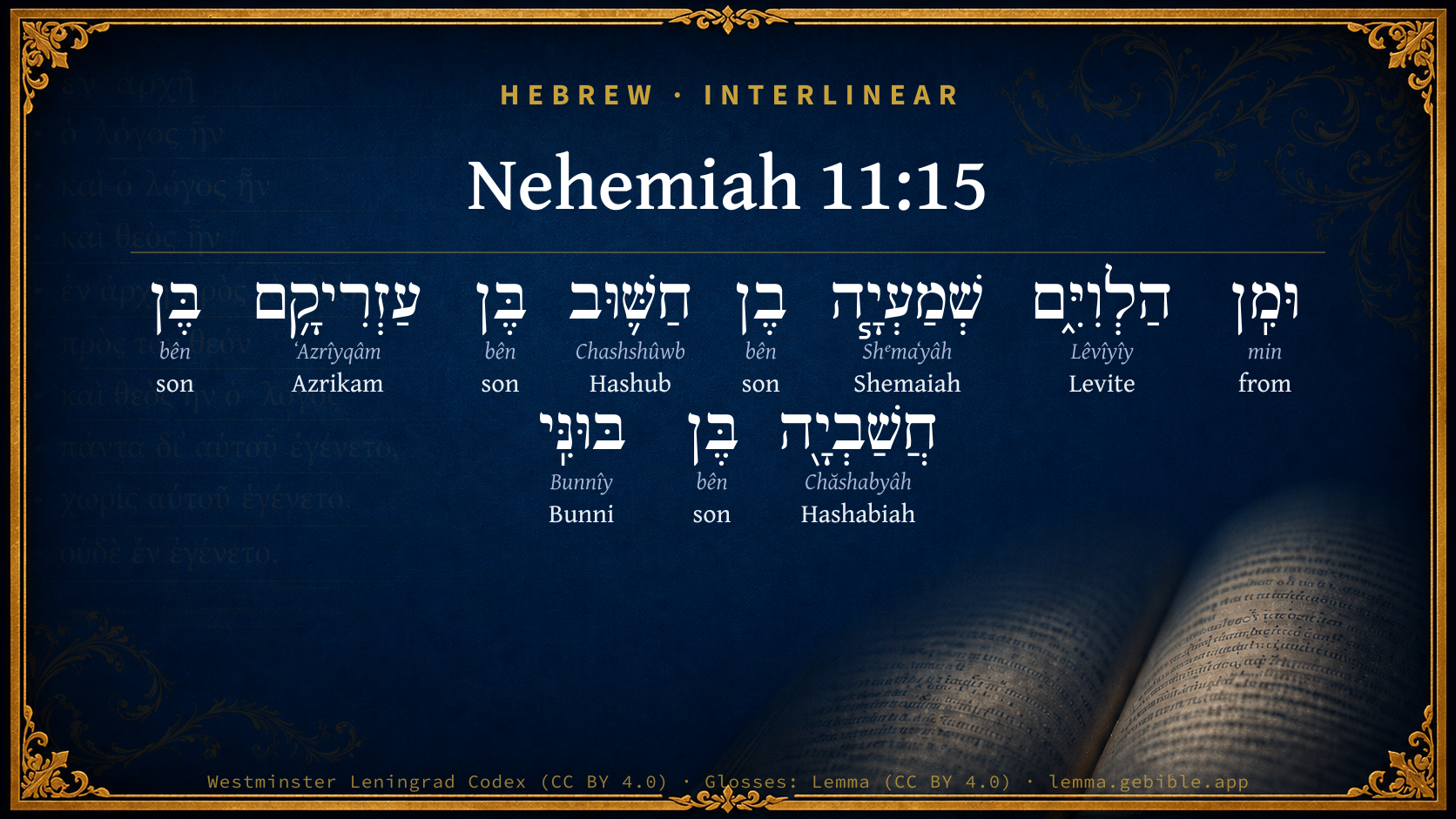
Nehemiah 11:15

Hebrew (Westminster Leningrad Codex) Nehemiah 11:15 appears in the Hebrew Old Testament. The text above is from the Westminster Leningrad Codex. Each word links to its Strong’s number, a concise gloss, and parsing drawn from the Open Scriptures Hebrew Bible morphology. Click any word for its full Brown-Driver-Briggs (BDB) entry.
Download image
Cite this verse

Nehemiah 11:15 (World English Bible). Public Domain. Lemma interlinear Bible study tool, https://lemma.gebible.app/v/nehemiah/11/15.

Show BibTeX & RIS
BibTeX
RIS
English Translation
Of the Levites: Shemaiah the son of Hasshub, the son of Azrikam, the son of Hashabiah, the son of Bunni;
World English Bible · Public Domain
Download a study sheet

One document with this verse’s original text, its word-by-word gloss line, the meaning frame, cross-references with their text, attributed commentary, and full source and license credits — printable, and it pastes into notes with its structure intact.

This verse Autodidact and up

Study sheet (.html) Plain text (.txt)

A passage Seminary Student

Up to 50 verses in one chapter. A passage sheet keeps up to 6 commentary sources and 12 cross-references per verse, in the order this page ranks them, and says so on the sheet whenever that leaves anything out. Ask for a single verse and you get the Autodidact verse sheet above.

Everything on this page stays free to read, with no account — the sheet is a download of what is already on screen, not access to it.

Want to remove ads? Support Godless Engineer
Compare translations 3

The same verse in 3 English versions, stacked beneath the original-language interlinear above. Click any original word for its lexicon entry.

Each is an independent rendering of the whole verse — the interlinear is not word-aligned to these translations.

Highlighted words mark where these versions differ — a whole-verse word diff, not a word-by-word alignment.

  • World English Bible Public Domain
    Of the Levites: Shemaiah the son of Hasshub, the son of Azrikam, the son of Hashabiah, the son of Bunni;
  • King James Version Public Domain
    Also of the Levites: Shemaiah the son of Hashub, the son of Azrikam, the son of Hashabiah, the son of Bunni;
  • unfoldingWord Literal Text CC BY-SA 4.0
    And from the Levites: Shemaiah, the son of Hasshub, the son of Azrikam, the son of Hashabiah, the son of Bunni;

unfoldingWord Literal Text — © unfoldingWord, licensed CC BY-SA 4.0. Word-aligned USFM3 via Door43 (git.door43.org/unfoldingWord/en_ult).

Versions to compare (up to 4)

3 of 4 selected

Show all 18 translations

Every available English version of this verse, each an independent rendering of the whole verse.

  • World English Bible Public Domain
    Of the Levites: Shemaiah the son of Hasshub, the son of Azrikam, the son of Hashabiah, the son of Bunni;
  • Berean Standard Bible Public Domain
    From the Levites: Shemaiah son of Hasshub, the son of Azrikam, the son of Hashabiah, the son of Bunni;
  • Majority Standard Bible Public Domain
    From the Levites: Shemaiah son of Hasshub, the son of Azrikam, the son of Hashabiah, the son of Bunni;
  • King James Version Public Domain
    Also of the Levites: Shemaiah the son of Hashub, the son of Azrikam, the son of Hashabiah, the son of Bunni;
  • American Standard Version (1901) Public Domain
    And of the Levites: Shemaiah the son of Hasshub, the son of Azrikam, the son of Hashabiah, the son of Bunni;
  • Revised Version (1885) Public Domain
    And of the Levites: Shemaiah the son of Hasshub, the son of Azrikam, the son of Hashabiah, the son of Bunni;
  • Geneva Bible (1599) Public Domain
    And of the Leuites, Shemaiah, the sonne of Hashub, the sonne of Azrikam, the sonne of Hashabiah, the sonne of Bunni.
  • Douay-Rheims (1899) Public Domain
    And of the Levites Semeia the son of Hasub, the son of Azaricam, the son of Hasabia, the son of Boni,
  • Young's Literal Translation Public Domain
    And of the Levites: Shemaiah son of Hashub, son of Azrikam, son of Hashabiah, son of Bunni,
  • Literal Standard Version CC BY-SA 4.0
    And of the Levites: Shemaiah son of Hashub, son of Azrikam, son of Hashabiah, son of Bunni,
  • Unlocked Literal Bible CC BY-SA 4.0
    From the Levites: Shemaiah son of Hasshub son of Azrikam son of Hashabiah son of Bunni,
  • unfoldingWord Literal Text CC BY-SA 4.0
    And from the Levites: Shemaiah, the son of Hasshub, the son of Azrikam, the son of Hashabiah, the son of Bunni;
  • Darby Bible Public Domain
    And of the Levites: Shemaiah the son of Hasshub, the son of Azrikam, the son of Hashabiah, the son of Bunni;
  • World Messianic Bible Public Domain
    Of the Levites: Shemaiah the son of Hasshub, the son of Azrikam, the son of Hashabiah, the son of Bunni;
  • Webster's Bible Public Domain
    Also of the Levites: Shemaiah the son of Hashub, the son of Azrikam, the son of Hashabiah, the son of Bunni;
  • Free Bible Version CC BY-SA 4.0
    From the Levites: Shemaiah, son of Hasshub, son of Azrikam, son of Hashabiah, son of Bunni;
  • Bible in Basic English Public Domain
    And of the Levites: Shemaiah, the son of Hasshub, the son of Azrikam, the son of Hashabiah, the son of Bunni,
  • JPS Tanakh (1917) Public Domain
    And of the Levites: Shemaiah the son of Hasshub, the son of Azrikam, the son of Hashabiah, the son of Bunni;

Literal Standard Version (2020), Covenant Press — licensed CC BY-SA 4.0. Text via the HelloAO Bible API (eBible.org). Unlocked Literal Bible (unfoldingWord) — licensed CC BY-SA 4.0. Text via the HelloAO Bible API (eBible.org). unfoldingWord Literal Text — © unfoldingWord, licensed CC BY-SA 4.0. Word-aligned USFM3 via Door43 (git.door43.org/unfoldingWord/en_ult). Free Bible Version, Dr. Jonathan Gallagher — licensed CC BY-SA 4.0. Text via the HelloAO Bible API (eBible.org).

Word by word

More ways to search: Search by grammar → Find every occurrence → Compare this word →

Practice this passage: Drill this verse → Learn its vocabulary →

About this verse

These counts appear in no published source. They are computed here, from the morphology-tagged text and Lemma’s own curated glosses. What Lemma adds →

11
words
8
distinct lemmas
Historical
section

Notable vocabulary

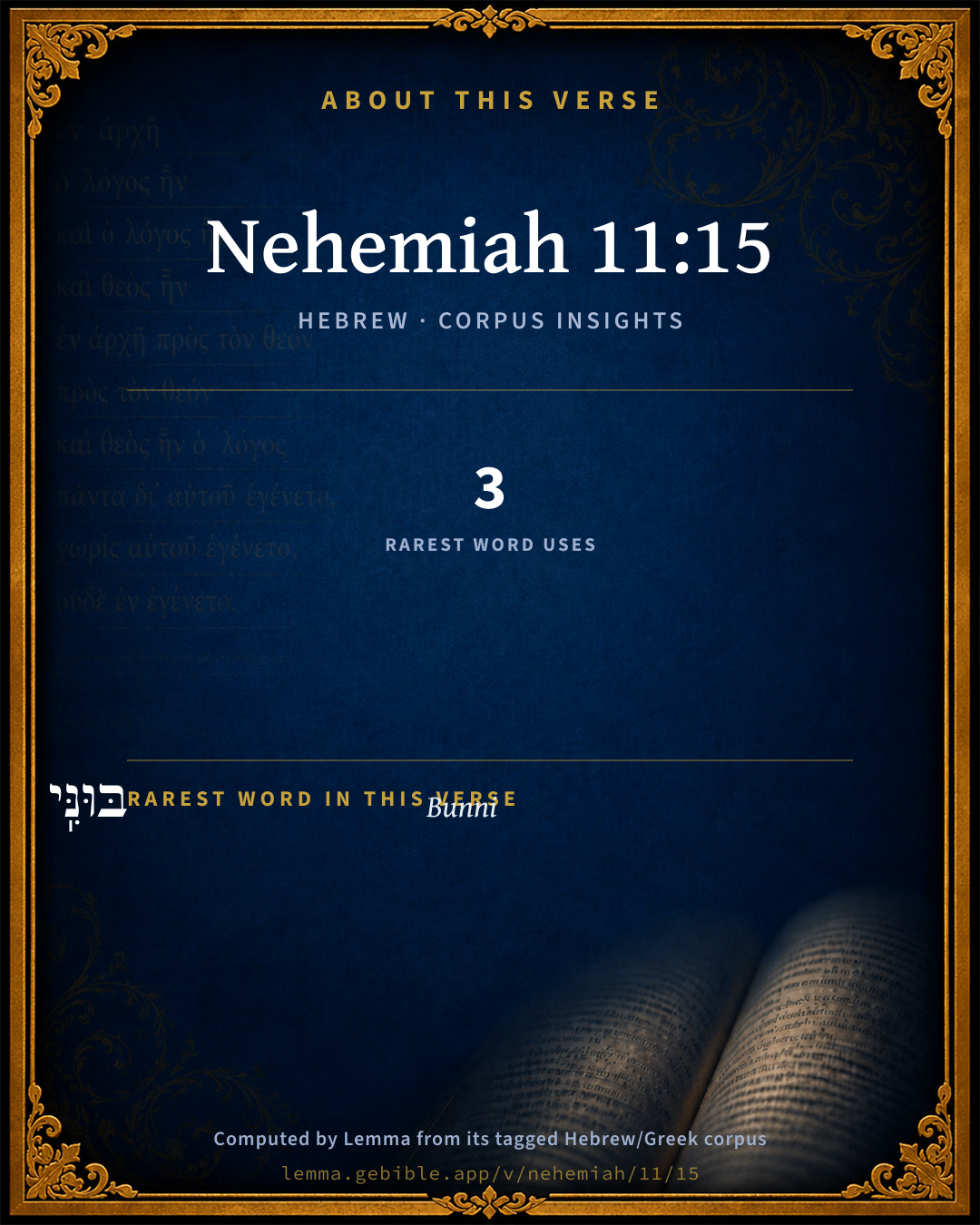
The rarest word here is בּוּנִּֽי Bunni H1138 — appearing just 3 times in the whole Hebrew Bible.

Shared distinctive vocabulary

בּוּנִּֽי Bunni H1138 occurs in 3 verses of the Hebrew Bible. Also found in:

Grammatical profile

  • 10 nouns
  • 1 preposition

Repetition

A word recurs within this verse — often emphatic in Hebrew:

Cross-references

2

Topical passages linked to Nehemiah 11:15 in the Treasury of Scripture Knowledge — connected by theme and wording, ordered by reader-vote popularity; previews shown in the World English Bible.

  • 1 Chronicles 9:14 Of the Levites: Shemaiah the son of Hasshub, the son of Azrikam, the son of Hashabiah, of the sons of Merari;
  • 1 Chronicles 9:19 Shallum the son of Kore, the son of Ebiasaph, the son of Korah, and his brothers, of his father's house, the Korahites, were over the work of the service, keepers of the thresholds of the tent: and their fathers had been over the camp of Yahweh, keepers of the entry.

Cross-references courtesy of OpenBible.info (CC BY 4.0).

Hebrew and Greek witnesses Masoretic Hebrew ↔ Greek Septuagint

The same verse in the two great witnesses to the Old Testament, shown verse-for-verse.

These are two independent witnesses, not word-aligned to each other, and the Septuagint is shown in lemma (dictionary) form.

Hebrew Nehemiah 11:15 Masoretic · Westminster Leningrad Codex

וּמִֽן הַלְוִיִּ֑ם שְׁמַעְיָ֧ה בֶן חַשּׁ֛וּב בֶּן עַזְרִיקָ֥ם בֶּן חֲשַׁבְיָ֖ה בֶּן בּוּנִּֽי

Of the Levites: Shemaiah the son of Hasshub, the son of Azrikam, the son of Hashabiah, the son of Bunni;

World English Bible · Public Domain

Greek LXX Structure differs

The Septuagint has no separate book of Nehemiah. Its Greek text is the second half of Esdras B (2 Esdras), chapters 11–23; Ezra is the first half (1–10).

A verse-for-verse comparison isn’t shown here because the chapters and verses don’t line up. Switch to the LXX edition with the MT / LXX toggle above to read the Greek directly.

On this verse, Keil & Delitzsch discusses the Septuagint’s reading. Read the note in Commentary ↓

Hebrew: Westminster Leningrad Codex (CC BY 4.0). Greek: Septuagint (public domain); English from a public-domain English Septuagint. How the Septuagint differs from the Hebrew →

Commentary

Notes on Nehemiah 11:15 from classic Christian and Jewish commentators (each source and its license shown beneath its notes). The classic Christian expositions comment on the surrounding passage and are grouped to its opening verse, so a note may address several verses; the Jewish commentaries on the Tanakh (Rashi and others) are per-verse, so they appear only where the commentator wrote on this verse.

Lemma curates 59 commentaries, every one of them public domain or Creative Commons licensed, each selected and text-cleaned for this edition rather than reprinted as found. About our sources →

Keil & Delitzsch

C. F. Keil & F. Delitzsch

Of Levites, Shemaiah, a descendant of Bunni, with the members of his house; Shabbethai and Jozabad, "of the heads of the Levites over the outward business of the house of God," i.e., two heads of the Levites who had the care of the outward business of the temple, probably charged with the preservation of the building and furniture, and the office of seeing that all things necessary for the temple worship were duly delivered. The names Shabbethai and Jozabad have already occurred, Neh 8:7, as those of two Levites, and are here also personal names of heads of Levites, as the addition הלויּם מראשׁי informs us. As the office of these two is stated, so also is that of those next following in Neh 11:17; whence it appears that Shemaiah, of whom no such particular is given, was head of the Levites charged with attending on the priests at the sacrificial worship (the האלהים בּית מלאכת, Neh 11:22). The three named in Neh 11:17, Mattaniah an Asaphite, Bakbukiah, and Abda a Jeduthunite, are the chiefs of the three Levitical orders of singers. Mattaniah is called התּחלּה ראשׁ, head of the beginning, which gives no meaning; and should probably, as in the lxx and Vulgate, be read התּהלּה ראשׁ: head of the songs of praise, - he praised for who praised, i.e., sounded the Hodu for prayer; comp. Ch1 16:5, where Asaph is called the chief of the band of singers. He is followed by Bakbukiah as second, that is, leader of the second band (מאחיו משׁנה like משׁנהוּ, Ch1 16:5); and Abda the Jeduthunite, as leader of the third. All the Levites in the holy city, i.e., all who dwelt in Jerusalem, amounted to two hundred and eighty-four individuals or fathers of families. The number refers only to the three classes named Neh 11:15-17. For the gatekeepers are separately numbered in Neh 11:19 as one hundred and seventy-two, of the families of Akkub and Talmon.

Keil & Delitzsch — Biblical Commentary on the Old Testament (1861–1891) — public domain (CC PDM 1.0). Text via the HelloAO Bible API. (Old Testament only.)

The Cambridge Bible for Schools and Colleges

gen. ed. J. J. S. Perowne

15. Also] R.V. And.

Hashub] R.V. Hasshub.

the son of Bunni] Instead of this termination to Shemaiah’s genealogy, we find ‘of the sons of Merari’ in 1Ch_9:14.

The Cambridge Bible for Schools and Colleges (gen. ed. J. J. S. Perowne; Cambridge University Press, 1878–1918) — public domain. Text from a community e-Sword module.

John Gill's Exposition

And the residue of Israel, of the priests and the Levites,..... All of them, besides those that dwelt at Jerusalem: were

in all the cities of Judah, everyone in his inheritance; the Israelites in the cities, houses, and estates enjoyed by their ancestors, and the priests and Levites in the cities given out of the several tribes.

John Gill's Exposition of the Whole Bible (1746–1763) — public domain (CC PDM 1.0). Text via the HelloAO Bible API.

Haydock's Catholic Bible Commentary

Semeia. The ancient Latin manuscripts read Sebenia. (Martinay.)

George Leo Haydock (1774–1849), Haydock's Catholic Family Bible and Commentary, 1859 edition — public domain. Excludes Psalms (Douay-Rheims chapter numbering differs from Protestant) and Deuterocanonical books (Catholic canon only).

The Pulpit Commentary

Vers. 15, 16. Also of the Levites: Shemaiah. Compare 1Ch_9:14. Shemaiah was a descendant of Merari. Together with Shabbethai and Jozabad (ver. 16), he had the superintendence of the outward business of the house of God; or, in other words, of its worldly affairs and money matters. As in the Christian Church a special order was appointed "to serve tables", (Act_6:2-5) so in the Jewish the secular business of the temple was intrusted to a few carefully-selected persons of the inferior order of the ministry, who were known to have a special capacity for such matters. (see 1Ch_26:29)

The Pulpit Commentary (1880–1919), ed. H.D.M. Spence-Jones & Joseph S. Exell — public domain. Text from a community e-Sword module.

unfoldingWord translationNotes

Door43 World Missions Community

Shemaiah ... Hasshub ... Azrikam ... Hashabiah ... Bunni ... Shabbethai ... Jozabad

These are the names of men. (See: How to Translate Names)

who were from the leaders of the Levites and were in charge

"from the leaders of the Levites, were in charge"

translationWords

Levi

son

works

house of God

unfoldingWord translationNotes — © Distant Shores Media and the Door43 World Missions Community, licensed CC BY-SA 4.0. Source: git.door43.org/Door43/en_tn.

Lesson kit

Teaching starters — assembled from the data on this page, not authored interpretation. Every prompt links to the verse data it draws on. Edit before teaching.

Nehemiah, in the Historical, opens this verse with 11 words (8 distinct Hebrew lemmas). Its most distinctive word is Bunnîy (“Bunni”). A historical commentator’s framing appears above. Read the whole chapter for the surrounding context.

Discussion questions

  1. How does “Bunni” (Bunnîy) shape what this verse is saying?
  2. How does Nehemiah 9:4, which shares the word «Bunni», read alongside this verse?
  3. What does the repetition of “son” (4× in this one verse) do in this verse?
  4. These translations render this verse differently. What is at stake in choosing one wording over another?
  5. Compare how Keil & Delitzsch and The Cambridge Bible for Schools and Colleges read this verse. Where do they agree or differ?

Things to notice

Reading settings

Reading text

Shown beneath each verse's original-language words.

Old Testament
Old Testament edition

Read the OT as the Masoretic Hebrew (MT) or the Greek Septuagint (LXX).

English shown for the Greek Septuagint (in the Hebrew ↔ Greek comparison).

Comparing translations? Open the Compare panel on any verse page to stack up to four side by side.