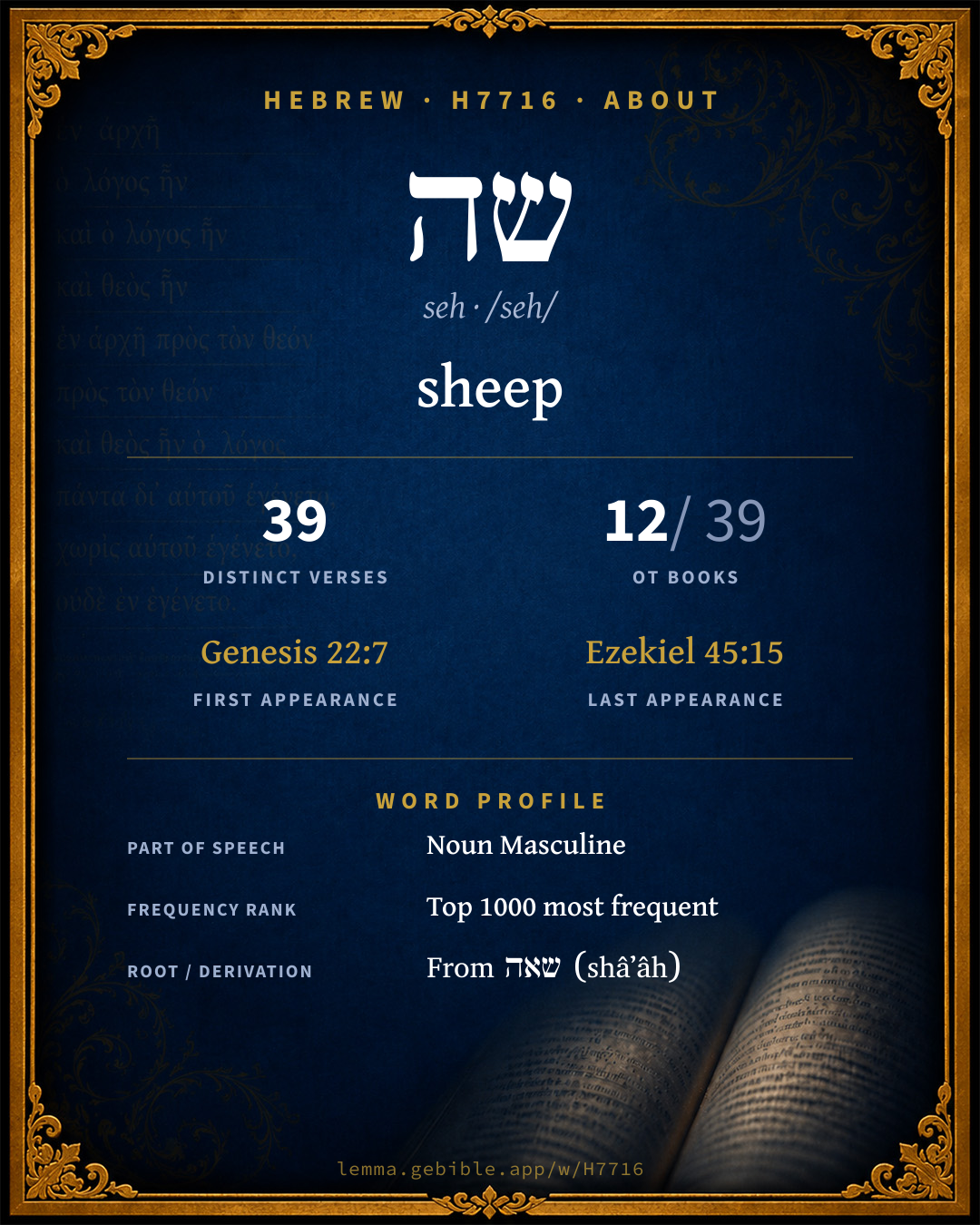
שֶׂה
sheep
also: lamb, goat, young sheep, young goat fuller range ↓
Full lexicon entry — Brown-Driver-Briggs (BDB)
From Brown-Driver-Briggs (BDB)
Where this word appears
See every Absolute-state word in the Hebrew Bible →
Grammar key — what these labels mean
Part of speech
- Noun
- A naming word — a person, place, thing, or idea.
Noun type
- Common
- A common noun — a general class of person, place, or thing (“king,” “city,” “water”), not a specific name.
State
- Absolute
- The independent form of a noun, not bound to a following word.
- Construct
- A noun bound to a following noun in a possessive / “of” relationship (the construct chain).
Gender
- Both
- Attested as both masculine and feminine.
Number
- Singular
- One.
Grammatical forms
- Noun, Common, Both, Singular, Absolute 42 times (89%)
- Noun, Common, Both, Singular, Construct 5 times (11%)
Parsed forms decoded from the imported morphology (morphhb / Westminster Leningrad Codex — WLC text public domain, morphhb tagging CC BY 4.0), counted across 47 parsed occurrences — not distinct verses.
Every verse where H7716 appears — 39 distinct verses across 12 books. Click any verse to open its interlinear word-by-word view. Verse text shown in the World English Bible for context — . Each verse’s Hebrew form is shown with its reference; the English is not keyword-highlighted, since the data carries no word-level English alignment. Use “Compare translations” on any verse to read it across multiple English versions. This concordance covers the Hebrew Bible; Septuagint (Greek Old Testament) occurrences are not indexed here.
Genesis 3 verses
- Genesis 22:7 הַ/שֶּׂ֖ה ptcl def.art + n c bs Isaac spoke to Abraham his father, and said, "My father?" He said, "Here I am, my son." He said, "Here is the fire and the wood, but where is the lamb for a burnt offering?"
- Genesis 22:8 הַ/שֶּׂ֛ה ptcl def.art + n c bs Abraham said, "God will provide himself the lamb for a burnt offering, my son." So they both went together.
- Genesis 30:32 שֶׂ֣ה שֶׂה n c bs n c bs I will pass through all your flock today, removing from there every speckled and spotted one, and every black one among the sheep, and the spotted and speckled among the goats. This will be my hire.
Exodus 10 verses
- Exodus 12:3 שֶׂ֥ה שֶׂ֥ה n c bs n c bs Speak to all the congregation of Israel, saying, 'On the tenth day of this month, they shall take to them every man a lamb, according to their fathers' houses, a lamb for a household;
- Exodus 12:4 מִ/שֶּׂה֒ הַ/שֶּֽׂה prep + n c bs ptcl def.art + n c bs and if the household be too little for a lamb, then he and his neighbor next to his house shall take one according to the number of the souls; according to what everyone can eat you shall make your count for the lamb.
- Exodus 12:5 שֶׂ֥ה n c bs Your lamb shall be without blemish, a male a year old. You shall take it from the sheep, or from the goats:
- Exodus 13:13 בְ/שֶׂ֔ה prep + n c bs Every firstborn of a donkey you shall redeem with a lamb; and if you will not redeem it, then you shall break its neck; and you shall redeem all the firstborn of man among your sons.
- Exodus 22:1 שֶׂ֔ה הַ/שֶּֽׂה n c bs ptcl def.art + n c bs "If a man steals an ox or a sheep, and kills it, or sells it; he shall pay five oxen for an ox, and four sheep for a sheep.
- Exodus 22:4 שֶׂ֖ה n c bs If the stolen property is found in his hand alive, whether it is ox, donkey, or sheep, he shall pay double.
- Exodus 22:9 שֶׂ֨ה n c bs For every matter of trespass, whether it be for ox, for donkey, for sheep, for clothing, or for any kind of lost thing, about which one says, 'This is mine,' the cause of both parties shall come before God. He whom God condemns shall pay double to his neighbor.
- Exodus 22:10 שֶׂ֛ה n c bs "If a man delivers to his neighbor a donkey, an ox, a sheep, or any animal to keep, and it dies or is injured, or driven away, no man seeing it;
- Exodus 34:19 וָ/שֶֽׂה conj + n c bs All that opens the womb is mine; and all your cattle that is male, the firstborn of cow and sheep.
- Exodus 34:20 בְ/שֶׂ֔ה prep + n c bs The firstborn of a donkey you shall redeem with a lamb: and if you will not redeem it, then you shall break its neck. All the firstborn of your sons you shall redeem. No one shall appear before me empty.
Leviticus 5 verses
- Leviticus 5:7 שֶׂה֒ n c bs "'If he can't afford a lamb, then he shall bring his trespass offering for that in which he has sinned, two turtledoves, or two young pigeons, to Yahweh; one for a sin offering, and the other for a burnt offering.
- Leviticus 12:8 שֶׂה֒ n c bs If she cannot afford a lamb, then she shall take two turtledoves, or two young pigeons; the one for a burnt offering, and the other for a sin offering: and the priest shall make atonement for her, and she shall be clean.'"
- Leviticus 22:23 וָ/שֶׂ֖ה conj + n c bs Either a bull or a lamb that has any deformity or lacking in his parts, that you may offer for a freewill offering; but for a vow it shall not be accepted.
- Leviticus 22:28 שֶׂ֑ה n c bs Whether it is a cow or ewe, you shall not kill it and its young both in one day.
- Leviticus 27:26 שֶׂ֔ה n c bs "'Only the firstborn among animals, which is made a firstborn to Yahweh, no man may dedicate it; whether an ox or sheep, it is Yahweh's.
Numbers 1 verse
Deuteronomy 4 verses
- Deuteronomy 14:4 שֵׂ֥ה וְ/שֵׂ֥ה n c bs cs conj + n c bs cs These are the animals which you may eat: the ox, the sheep, and the goat,
- Deuteronomy 17:1 וָ/שֶׂ֗ה conj + n c bs You shall not sacrifice to Yahweh your God an ox, or a sheep, in which is a blemish, [or] anything evil; for that is an abomination to Yahweh your God.
- Deuteronomy 18:3 שֶׂ֑ה n c bs This shall be the priests' due from the people, from those who offer a sacrifice, whether it be ox or sheep, that they shall give to the priest the shoulder, and the two cheeks, and the maw.
- Deuteronomy 22:1 שֵׂי/וֹ֙ n c bs cs + sfx pers 3ms You shall not see your brother's ox or his sheep go astray, and hide yourself from them: you shall surely bring them again to your brother.
Joshua 1 verse
Judges 1 verse
1 Samuel 4 verses
- 1 Samuel 14:34 שְׂיֵ֗/הוּ n c bs cs + sfx pers 3ms Saul said, Disperse yourselves among the people, and tell them, Bring me here every man his ox, and every man his sheep, and kill them here, and eat; and don't sin against Yahweh in eating with the blood. All the people brought every man his ox with him that night, and killed them there.
- 1 Samuel 15:3 שֶׂ֔ה n c bs Now go and strike Amalek, and utterly destroy all that they have, and don't spare them; but kill both man and woman, infant and suckling, ox and sheep, camel and donkey.
- 1 Samuel 17:34 שֶׂ֖ה n c bs David said to Saul, Your servant was keeping his father's sheep; and when there came a lion, or a bear, and took a lamb out of the flock,
- 1 Samuel 22:19 וָ/שֶׂ֖ה conj + n c bs Nob, the city of the priests, struck he with the edge of the sword, both men and women, children and nursing babies, and oxen and donkeys and sheep, with the edge of the sword.
Psalms 1 verse
Isaiah 4 verses
- Isaiah 7:25 שֶֽׂה n c bs All the hills that were cultivated with the hoe, you shall not come there for fear of briers and thorns; but it shall be for the sending forth of oxen, and for the treading of sheep."
- Isaiah 43:23 שֵׂ֣ה n c bs cs You have not brought me of your sheep for burnt offerings; neither have you honored me with your sacrifices. I have not burdened you with offerings, nor wearied you with frankincense.
- Isaiah 53:7 כַּ/שֶּׂה֙ prep det + n c bs He was oppressed, yet when he was afflicted he didn't open his mouth; as a lamb that is led to the slaughter, and as a sheep that before its shearers is mute, so he didn't open his mouth.
- Isaiah 66:3 הַ/שֶּׂה֙ ptcl def.art + n c bs He who kills an ox is as he who kills a man; he who sacrifices a lamb, as he who breaks a dog's neck; he who offers an offering, [as he who offers] pig's blood; he who burns frankincense, as he who blesses an idol. Yes, they have chosen their own ways, and their soul delights in their abominations:
Jeremiah 1 verse
Ezekiel 4 verses
- Ezekiel 34:17 שֶׂ֣ה לָ/שֶׂ֔ה n c bs prep + n c bs As for you, O my flock, thus says the Lord Yahweh: Behold, I judge between sheep and sheep, the rams and the male goats.
- Ezekiel 34:20 שֶׂ֣ה שֶׂ֖ה n c bs n c bs Therefore thus says the Lord Yahweh to them: Behold, I, even I, will judge between the fat sheep and the lean sheep.
- Ezekiel 34:22 שֶׂ֖ה לָ/שֶֽׂה n c bs prep + n c bs therefore will I save my flock, and they shall no more be a prey; and I will judge between sheep and sheep.
- Ezekiel 45:15 וְ/שֶׂה conj + n c bs and one lamb of the flock, out of two hundred, from the well-watered pastures of Israel; -for a meal-offering, and for a burnt offering, and for peace-offerings, to make atonement for them, says the Lord Yahweh.
About this entry
At a glance — auto-summarized from this page’s data, not written by a person. Every figure links to its source below. This summary describes the numbers; it doesn’t interpret them.
שה — transliterated seh — is a Hebrew noun carrying the sense “sheep.” Debuting at Genesis 22:7, it then recurs through the corpus. The Hebrew Bible uses it across 39 verses — moderately common. More than a quarter of its appearances fall in Exodus. Alongside “sheep” the lexicon also lists “lamb”, “goat”, and “young sheep” — part of its full sense range. See the sense tree, 39-verse concordance, and the renderings breakdown below.
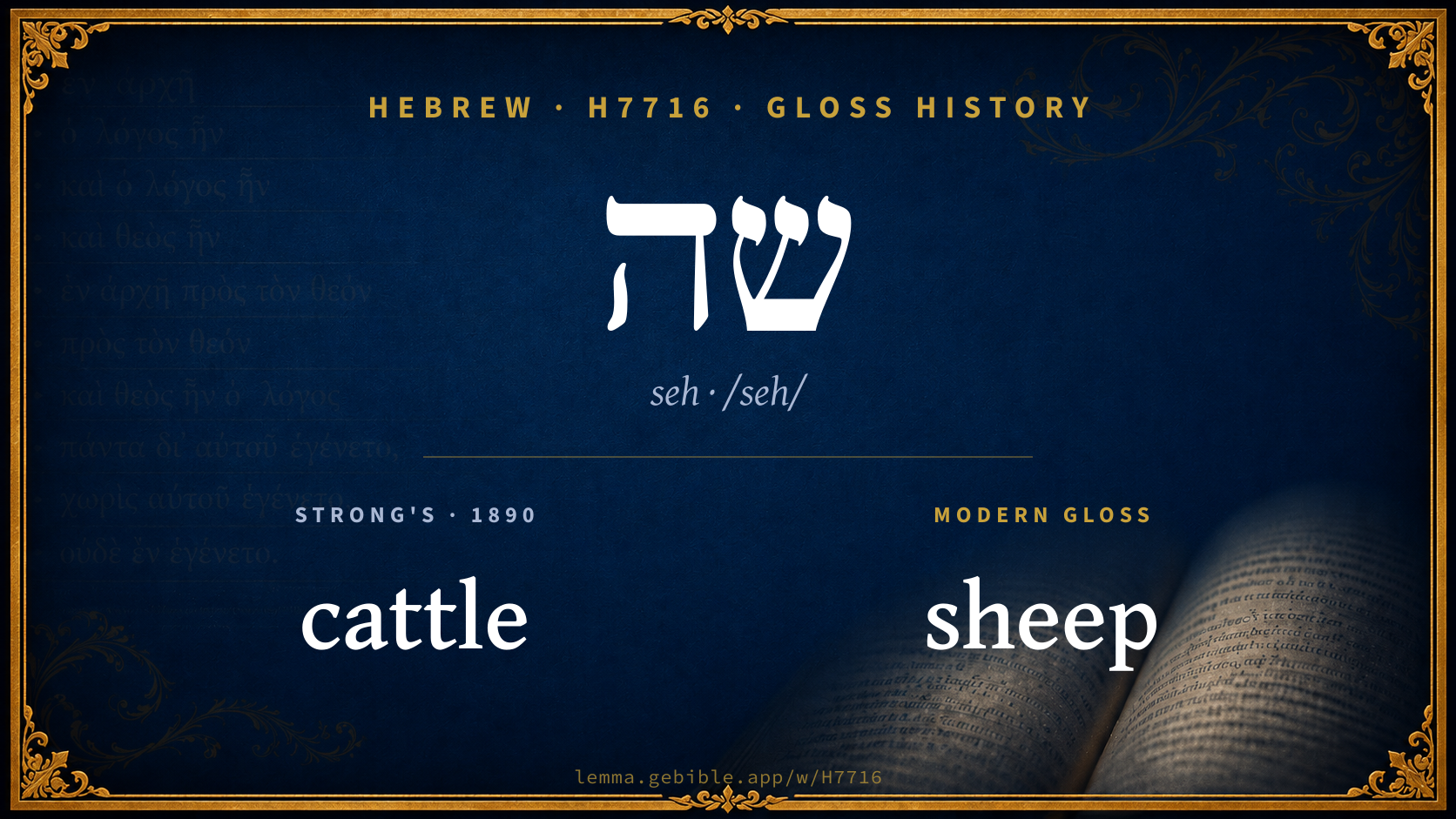
Gloss history
Strong's 1890 vs modern scholarship
About this word
Strong's H7716 catalogs a Hebrew word from the Hebrew Old Testament.
These counts are not copied from any lexicon or concordance. They are computed here, from the morphology-tagged Hebrew Old Testament. What Lemma adds →
- 39
- distinct verses
- The word appears in 39 distinct verses.
- 12 / 39
- OT books
- The word appears in 12 of 39 Old Testament books.
- #783
- by frequency
- Top 1000 most frequent Hebrew words (rank 783 of 8,640 Hebrew words by occurrence).
View all 39 occurrences in the concordance →
Most concentrated in
- Exodus 10 verses 26%
- Leviticus 5 verses 13%
- Deuteronomy 4 verses 10%
By section of the Old Testament
By traditional corpus
Conventional, traditional groupings — biblical authorship is debated, so this is a traditional corpus grouping, not an authorship claim. Each share is this word’s portion of its verses in that division of the Hebrew canon. Each figure is a share of the word’s 39 distinct verses.
- Torah (Pentateuch) 23 verses · 59%
- Prophets (Nevi'im) 15 verses · 38%
- Writings (Ketuvim) 1 verse · 3%
How translations render this word
Counts come from each version’s own published word-to-Strong’s tagging or interlinear alignment — an approximate guide to how each version renders this word, not a word-level alignment the data otherwise carries. Because each total is that version’s own tagged count, the per-version totals vary from one another and need not match the appearance or distinct-verse counts above. These counts may also differ from a printed concordance because Lemma counts each distinctly tagged rendering and does not collapse phrase taggings into a single head-word total. This is a fixed set of word-tagged versions (KJV, ASV, BSB, ULT) and does not change with the reading translation you choose elsewhere. Each version’s license is shown beside its name below (and on Sources).
- King James Version: Lamb 13×, Sheep 10×, Cattle 6×
- American Standard Version: Sheep 17×, Lamb 13×, Or a sheep 3×
- Berean Standard Bible: Sheep 19×, Lamb 11×, Another 2×
- unfoldingWord Literal Text: Sheep 20×, Lamb 12×, Flock 3×
King James Version Public Domain
Renders H7716 across 45 tagged occurrences — most commonly:
Plus 7 renderings that appear only once — usually multi-word phrases or single function words the recovered tagging swept in, not distinct renderings. Not rendered by a distinct English word in 1 further occurrence.
American Standard Version Public Domain
Renders H7716 across 45 tagged occurrences — most commonly:
Plus 8 renderings that appear only once — usually multi-word phrases or single function words the recovered tagging swept in, not distinct renderings.
Berean Standard Bible Public Domain
Renders H7716 across 44 tagged occurrences — most commonly:
Plus 8 renderings that appear only once — usually multi-word phrases or single function words the recovered tagging swept in, not distinct renderings. Not rendered by a distinct English word in 2 further occurrences.
unfoldingWord Literal Text CC BY-SA 4.0
Renders H7716 across 51 tagged occurrences — most commonly:
Plus 14 renderings that appear only once — usually multi-word phrases or single function words the recovered tagging swept in, not distinct renderings.
Senses in the full BDB
What do BDB’s symbols mean?
BDB uses these scholarly abbreviations:
| Symbol | Meaning |
|---|---|
| 𝔊 | the Septuagint (the ancient Greek translation, LXX) |
| 𝔙 | the Vulgate (the Latin translation) |
| 𝔖 | the Syriac version (the Peshitta) |
| 𝔗 | the Targum (the Aramaic translation) |
| ψ | the Psalms |
| √ | root (the underlying root or stem) |
| ‖ | parallel passage (a synonymous or contrasted parallel) |
| † | the dagger: every passage where the word occurs is cited |
The 2 senses and sub-senses the full Brown-Driver-Briggs lexicon distinguishes for this word, in lexicon order (not ranked by frequency), with BDB’s own verbatim wording and sub-sense lettering. Shown in Hebrew script with BDB’s own scholarly abbreviations. The condensed entry is in the Lexicon Entry tab. See also the Forms in the corpus table below.
- 1. a sheep, or goat, nom. unit. of צֹאן: as property Gn 30:32(×2) (E; + צֹאן coll., כְּשָׂבִים, עִזִּים), Ex 21:37(×2) (+ שׁוֹר, צֹאן coll.), 22:3 (+ שׁוֹר, חֲמוֹר), v 8 (id.), v 9 (id.; all E); Dt 22:1 (+ שׁוֹר), 1 S 17:34 (זה Kt van d. H. erron., v. Baer Dr), roaming pasture Is 7:25, straying ψ 119:176 (sim.), slaughtered Is 53:7 (in sim.); + שׁוֹר, חֲמוֹר Ju 6:4; 1 S 22:19; Jos 6:21 (J), + id. + גָּמָל 1 S 15:3; as sacrifice Gn 22:7, 8 (J), Ex 13:13; Lv 5:12; 12:8; Nu 15:11 (שׂ׳ בַּכְּבָשִׂים אוֹ בָּעִזִּים; all P), Dt 18:3 (+ שׁוֹר), Is 43:23; 66:3 (+ שׁוֹר), מִן־הַצֹּאן Ez 45:15; cf. Ex 34:19 (+ שׁוֹר), v 20 (J), Lv 27:26 (P; + שׁוֹר); fit for sacrifice Lv 22:28 (H); unfit v 23 (H), Dt 17:1 (both + שׁוֹר); as food 1 S 14:34 (+ שׁוֹר), שׂ׳ כְּשָׂבִים וְשׂ׳ עִזִּים Dt 14:4 (+ id.); for passover Ex 12:3(×2), 4(×2), 5 (P); fig. of Isr. Ez 34:17(×2) (‖ אֵילִים, עַתּוּדִים), v 20(×2), 22(×2). e.g. Genesis 30:32
- 2. coll. flock: שֶׂה פְזוּרָה Je 50:17 (= צֹאן אֹבְדוֹת v 6). e.g. Jeremiah 50:17
Senses from the full Brown-Driver-Briggs lexicon (Brown, Driver, Briggs; Oxford 1906 — public domain), digitized via Sefaria, supplemented by the OpenScriptures HebrewLexicon (CC BY 4.0). Full attribution on Sources.
Word origin
n.m. Gn 30:32 and (less often) f. Je 50:17 one of a flock, a sheep (or goat) (Assyrian šuʾu, Arabic شَاةٌ, pl. شَآءٌ, شِوَاهٌ, etc. (also wild ox), cf. Egyptian sau, sheep Bondi65, cf. Id.Ba NB § 2 b δ);—abs. שֶׂה Gn 30:32 +, cstr. שֵׂה Is 43:23 +; sf. שֵׂיוֹ Dt 22:1, שְׂיֵ֫הוּ 1 S 14:34; not in pl.;—
— Brown-Driver-Briggs (Oxford 1906, public domain), digitized via Sefaria, supplemented by the OpenScriptures HebrewLexicon (CC BY 4.0). See Sources.
Derived from שאה (shâʼâh) (H7582) — to crash.
Jastrow Dictionary
A second Hebrew/Aramaic lexicon for comparison, covering Aramaic and post-biblical (Talmudic, Targumic, Midrashic) usage that the biblical-Hebrew BDB does not. Matched by lemma rather than by Strong’s number, so a lemma may carry more than one Jastrow headword (shown separately below), and the entries cover usage well beyond the Bible.
שֶׂה
- (b. h.) lamb, young goat or young sheep. Bekh. I, 5 ר׳ א׳ מתיר בכלאים מפני שהוא שה R. El. permits the redemption of a first-born ass with a hybrid of goat and sheep, because it goes by the name of seh (complying with the law Ex. XIII, 13). Gen. R. s. 56 (ref. to Gen. XXII, 8) אלהים יראה לו השה בני ואם לאו אתה השה לעולה בני God will provide himself a lamb, my son, and if not, thou art the lamb for the offering, my son; Pesik. R. s. 40 יזמן קרבנו ואם לא שה לעולה בני he will prepare his sacrifice, and if not, my son be the lamb for the offering. Ib. שה לעולה סי לעילה לשון יונית (not חי) ‘seh for an offering’ is the Greek σέ (thee) for an offering. Bekh. 12ᵃ אביו שה its sire is a sheep. Ib. 7ᵃ שה מכל מקום a seh (young of sheep or of goats) under all conditions (even if it has the looks of an unclean animal). Pes. 118ᵃ בשֵׂיוֹ, v. עָנִי. B. Mets. 27ᵃ; a. v. fr. e.g. Exodus 13:13
A Dictionary of the Targumim, the Talmud Babli and Yerushalmi, and the Midrashic Literature (Marcus Jastrow; London, Luzac, 1903) — Public Domain. Digitized via Sefaria. Digitized via Sefaria. Full attribution on Sources.
Forms in the corpus
The 33 distinct written forms H7716 takes in the Hebrew Bible, most frequent first — each parse links to that state’s occurrences in the concordance. Hebrew forms include their vowel points and cantillation, so a single lemma takes many written forms.
Same root — word family
Other BDB entries built from the same root as H7716, grouped by Strong’s listed origin. These share a root / origin per the lexicon — not necessarily a shared meaning. Each links to that word’s own entry.
Derives from
Shares the same root
- שאה shâʼâh H7583 to gaze
- שאוה shaʼăvâh H7584 devastating storm
- שאון shâʼôwn H7588 roar
- שאיה shᵉʼîyâh H7591 ruin
- שאת shêʼth H7612 devastation
- שת shêth H8351 buttocks
Derived from this word
Proper names from this root
People and places named from this root — a name, not an additional meaning of the word.
Compare all same-root words → Showing 4 of 10 — not the complete family. 1 of the same-root words is a proper name (a person or place). They share a root, not necessarily a meaning.
Septuagint verse parallels
This word appears in 37 verses that also exist in the Greek Old Testament (Septuagint), out of the 39 Hebrew verses it occurs in. You can read those verses in Greek by switching the Old Testament edition to the Septuagint.
Read these verses in the Septuagint
- Genesis 22:7
- Exodus 12:3
- Leviticus 5:7
- Numbers 15:11
- Deuteronomy 14:4
- Joshua 6:21
- Judges 6:4
- 1 Samuel 14:34
- Isaiah 7:25
- Ezekiel 34:17
This is a verse-level parallel only — the same verses exist in both the Hebrew and Greek Old Testaments. No word-level Hebrew↔Greek correspondence is claimed: the data carries no such alignment, so no Greek word is shown as this Hebrew word’s translation. Coverage is not total — the Septuagint omits the deuterocanon and renumbers the Psalms, so some Hebrew verses have no direct Greek parallel.