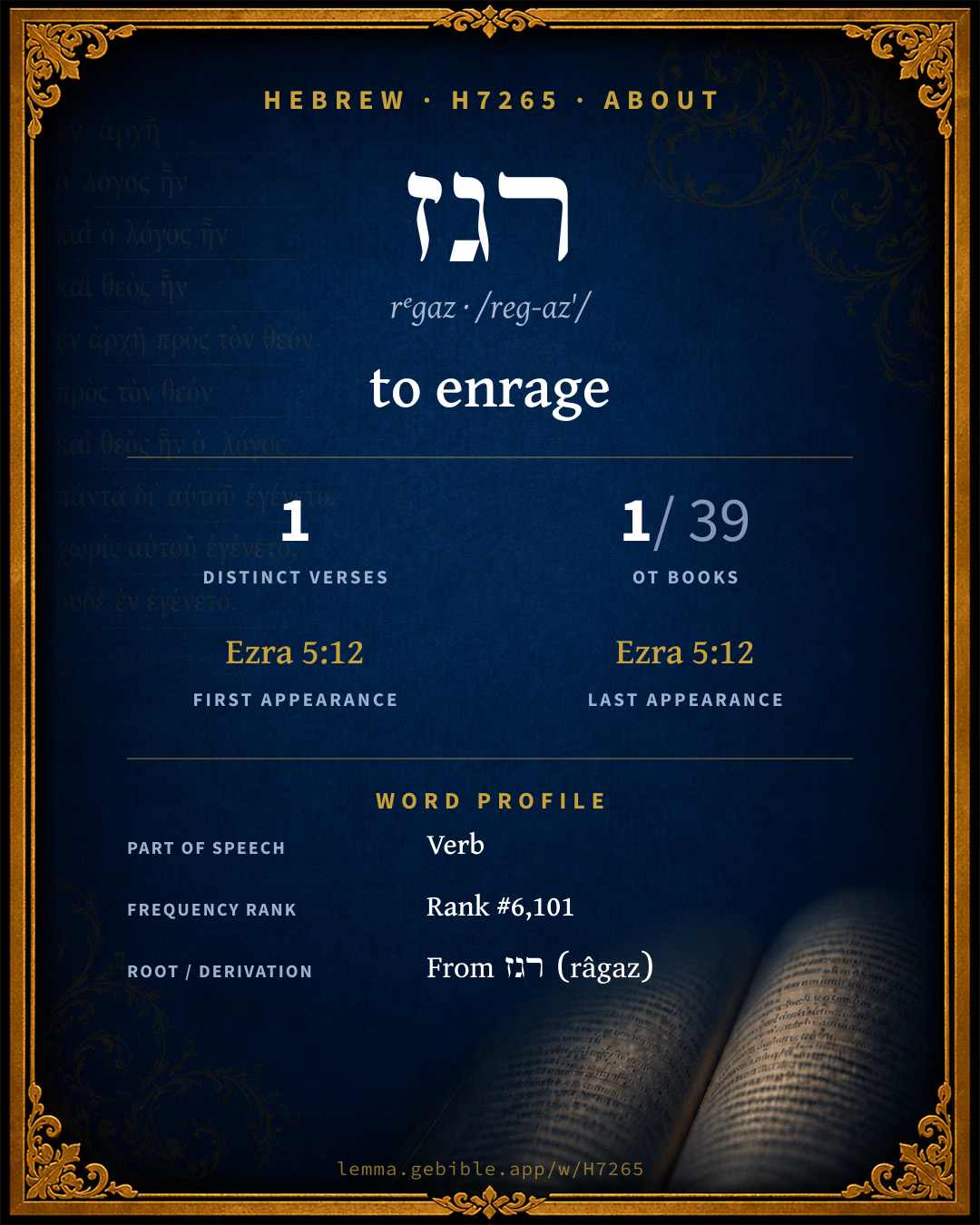
רְגַז
to enrage
Full lexicon entry — Brown-Driver-Briggs (BDB)
From Brown-Driver-Briggs (BDB)
Where this word appears
Grammar key — what these labels mean
Part of speech
- Verb
- An action or state-of-being word.
Stem
- Hiphil
- The causative active stem (“he caused / brought about”).
Form
- Perfect
- A completed action or state — Hebrew marks aspect (completeness) more than strict tense (“he wrote”).
Person
- 3rd Person
- The one spoken about (“he / she / it / they”).
Gender
- Masculine
- Grammatically masculine.
Number
- Plural
- More than one (in Hebrew, generally three or more).
Every verse where H7265 appears — 1 distinct verse across 1 book. Click any verse to open its interlinear word-by-word view. Verse text shown in the World English Bible for context — . Each verse’s Hebrew form is shown with its reference; the English is not keyword-highlighted, since the data carries no word-level English alignment. Use “Compare translations” on any verse to read it across multiple English versions. This concordance covers the Hebrew Bible; Septuagint (Greek Old Testament) occurrences are not indexed here.
Ezra 1 verse
About this entry
At a glance — auto-summarized from this page’s data, not written by a person. Every figure links to its source below. This summary describes the numbers; it doesn’t interpret them.
At its core, רגז (rᵉgaz) means “to enrage.” The Hebrew Bible uses it only 1 verse. The word gravitates to Ezra (100%). Scripture uses it exactly once, at Ezra 5:12. It clusters with רגז, ארגז and רגז under a shared root. Each statement above links to its evidence; the full detail follows below.
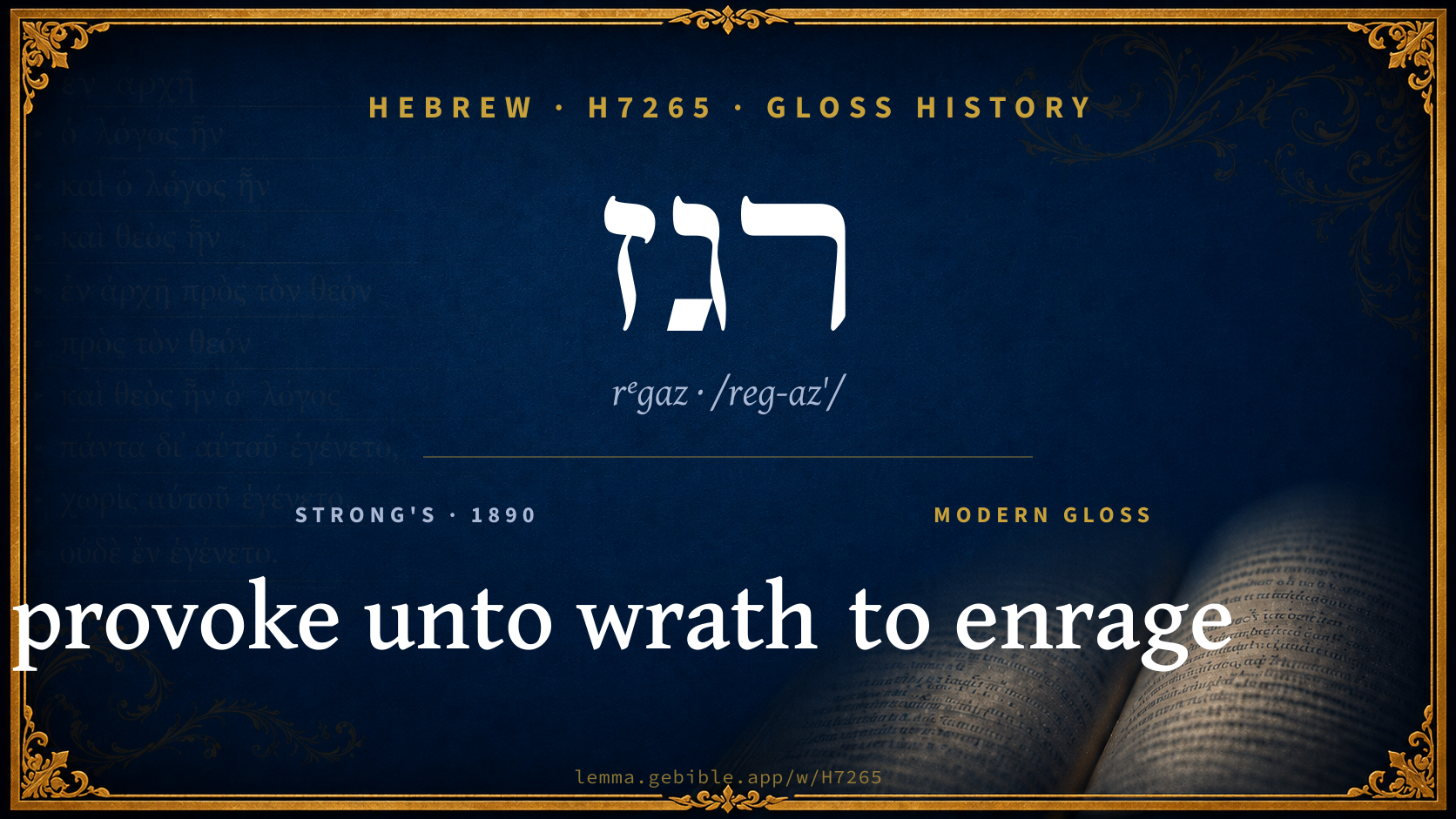
Gloss history
Strong's 1890 vs modern scholarship
About this word
Strong's H7265 catalogs a Hebrew word from the Hebrew Old Testament.
These counts are not copied from any lexicon or concordance. They are computed here, from the morphology-tagged Hebrew Old Testament. What Lemma adds →
- 1
- distinct verses
- The word appears in 1 distinct verse.
- 1 / 39
- OT books
- The word appears in 1 of 39 Old Testament books.
- #6,101
- by frequency
- Rank #6,101 (rank 6,101 of 8,640 Hebrew words by occurrence).
View all 1 occurrence in the concordance →
Most concentrated in
- Ezra 1 verse 100%
By section of the Old Testament
By traditional corpus
Conventional, traditional groupings — biblical authorship is debated, so this is a traditional corpus grouping, not an authorship claim. Each share is this word’s portion of its verses in that division of the Hebrew canon. Each figure is a share of the word’s 1 distinct verse.
- Writings (Ketuvim) 1 verse · 100%
How translations render this word
Counts come from each version’s own published word-to-Strong’s tagging or interlinear alignment — an approximate guide to how each version renders this word, not a word-level alignment the data otherwise carries. Because each total is that version’s own tagged count, the per-version totals vary from one another and need not match the appearance or distinct-verse counts above. These counts may also differ from a printed concordance because Lemma counts each distinctly tagged rendering and does not collapse phrase taggings into a single head-word total. This is a fixed set of word-tagged versions (KJV, ASV, BSB, ULT) and does not change with the reading translation you choose elsewhere. Each version’s license is shown beside its name below (and on Sources).
- King James Version: Had provoked 1×, Wrath 1×
- American Standard Version: Had provoked 1×, Wrath 1×
- Berean Standard Bible: Angered 1×
- unfoldingWord Literal Text: Be angry 1×, Caused 1×
King James Version Public Domain
Renders H7265 across 2 tagged occurrences — most commonly:
American Standard Version Public Domain
Renders H7265 across 2 tagged occurrences — most commonly:
Berean Standard Bible Public Domain
Renders H7265 across 1 tagged occurrence — most commonly:
unfoldingWord Literal Text CC BY-SA 4.0
Renders H7265 across 2 tagged occurrences — most commonly:
Senses in BDB
The 1 sense BDB distinguishes for this word, in lexicon order (not ranked by frequency or importance). The full entry — with sub-senses — is in the Lexicon Entry tab.
- (Aphel) to rage, enrage
Word origin
[ רְגַז ] vb. Haph. enrage;— Ezr 5:12
— Brown-Driver-Briggs (Oxford 1906, public domain), digitized via Sefaria, supplemented by the OpenScriptures HebrewLexicon (CC BY 4.0). See Sources.
Derived from רגז (râgaz) (H7264) — to tremble.
Jastrow Dictionary
A second Hebrew/Aramaic lexicon for comparison, covering Aramaic and post-biblical (Talmudic, Targumic, Midrashic) usage that the biblical-Hebrew BDB does not. Matched by lemma rather than by Strong’s number, so a lemma may carry more than one Jastrow headword (shown separately below), and the entries cover usage well beyond the Bible.
רָגַז
- to be unsteady, restless; to be agitated. Taan. 10ᵇ (ref. to Gen. XLV, 24) שמא תִרְגּוֹז עליכם הדרך lest the road become unsteady for you (you lose your way); Yalk. Gen. 152 תִרְגַּז. e.g. Genesis 45:24
- 1. to stir, excite, incite to anger. Ruth R. end אַרְגֵּיו יצרך (= הַרְגֵּיז), v. כָּעַס; Midr. Till. to Ps. IV, 5; Yalk. ib. 627; Pesik. Shub., p. 158ᵃ. Midr. Till. l. c. עד מתי … ומַרְגִּיזִין וכ׳ how long will you sin and create anger by saying &c.?; Yalk. l. c. ומְרַגְּזִים (v. infra). Ber. 5ᵃ (ref. to Ps. l. c.) לעולם יַרְגִּיז וכ׳ at all times let man stir up his good inclination against his evil inclination. B. Bath. 16ᵃ יורד … ומַרְגִּיז וכ׳ Satan comes down and leads (men) astray, and goes up and arouses (the Lord’s) anger, takes permission and takes life. Tanḥ. Emor 2 לא היה לך להַרְגִּיז לבוראך וכ׳ hadst thou no other means to provoke thy Creator to anger than through me, making me an object of worship?; Lev. R. s. 26. Esth. R. to IV, 15 וידע המרגיז וכ׳ and let this provoker (Haman) know that thou hast not forgotten &c.; a. e.
- 2. to be excited, fear. Tanḥ. l. c. הייתי מרגיז שמא וכ׳ I (Samuel) was frightened, lest it be the judgment day, and I feared myself.
- to be excited; to quarrel. Nidd. 16ᵇ שר הנִרְגָּז (בבית המשתאות) a chief officer (or scholar) that gets excited in the drinking house (a variant to הנרגן), v. רָגַל a. רָגַן.
- to rage. Mekh. B’shall., Shir., s. 9 התחילו מְרַגְּזִין they began to rage. Yalk. Ps. l. c., v. supra.
- same. Mekh. l. c. מִתְרַגְּזִין; Yalk. Ex. 251.
רְגַז I
- , to tremble; to be agitated, angry. Targ. Ps. LXXVII, 19. Targ. II Sam. XIX, 1. Targ. O. Gen. XL, 2. Targ. Ps. II, 12; a. fr.—Part. רָגֵיז. Targ. Zech. I, 15; a. e.
- to be shaken; to be excited. Targ. Ps. LXXVII, 17. Targ. Y. Ex. XV, 14.
- 1. to shake; to excite; to scandalize, make angry. Targ. Job IX, 6. Targ. Ps. LXXVIII, 8. Targ. O. a. Y. I Deut. XXXII, 21. Targ. Is. III, 16 (h. text תעכסנה!); a. fr.—Esp. to blaspheme. Targ. O. Lev. XXIV, 11. Targ. Prov. XXII, 14; a. fr. e.g. Deuteronomy 32:21
- 2. to be angry. Targ. Ps. LXXVIII, 62 (h. text התעבר).—[Midr. Till. to Ps. XXV, 4 מרגזין, read: מזגין, v. מְזַג.]
רֹגֶז
- , v. רוֹגֶז
רְגַז II
- (preced.) anger, wrath. Targ. Deut. IX, 20. Ib. XXIX, 27; a. e.
רַגָּז
- preced. wds.) trembling, fearful. Cant. R. to VIII, 9 (ref. to Lev. XXVIII, 65) שמה לב ר׳ וכ׳ there (in Babylonian captivity) a fearful heart, but &c.
A Dictionary of the Targumim, the Talmud Babli and Yerushalmi, and the Midrashic Literature (Marcus Jastrow; London, Luzac, 1903) — Public Domain. Digitized via Sefaria. Digitized via Sefaria. Full attribution on Sources.
Same root — word family
Other BDB entries built from the same root as H7265, grouped by Strong’s listed origin. These share a root / origin per the lexicon — not necessarily a shared meaning. Each links to that word’s own entry.
Derives from
Shares the same root
Derived from this word
Compare all same-root words → Showing 4 of 6 — not the complete family. They share a root, not necessarily a meaning.
Septuagint verse parallels
This word appears in 1 verse that also exists in the Greek Old Testament (Septuagint), out of the 1 Hebrew verse it occurs in. You can read those verses in Greek by switching the Old Testament edition to the Septuagint.
Read these verses in the Septuagint
This is a verse-level parallel only — the same verses exist in both the Hebrew and Greek Old Testaments. No word-level Hebrew↔Greek correspondence is claimed: the data carries no such alignment, so no Greek word is shown as this Hebrew word’s translation. Coverage is not total — the Septuagint omits the deuterocanon and renumbers the Psalms, so some Hebrew verses have no direct Greek parallel.