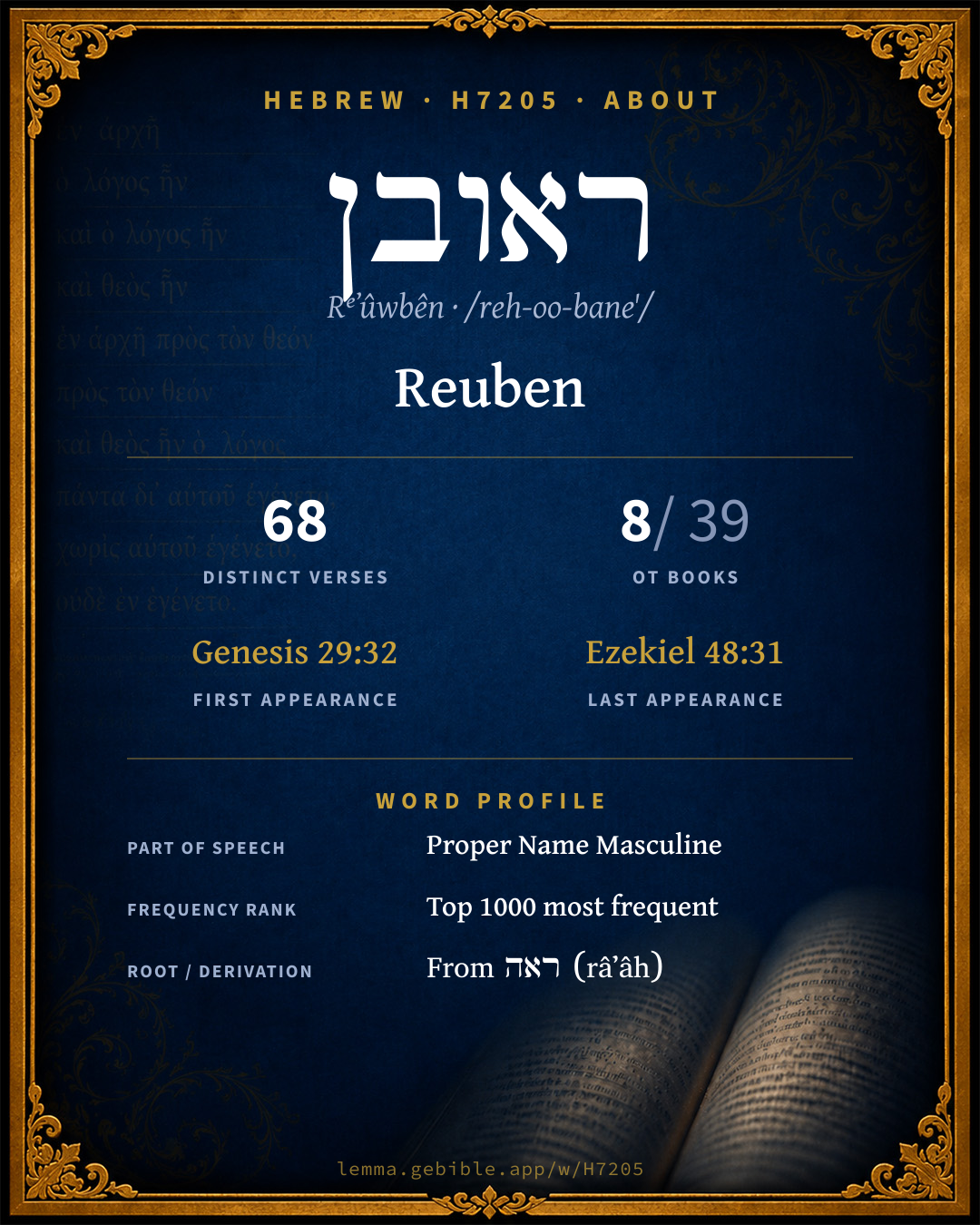
רְאוּבֵן
Reuben
BDB lists 4 entries for ‘Reuben’ fuller range ↓
Full lexicon entry — Brown-Driver-Briggs (BDB)
From Brown-Driver-Briggs (BDB)
Where this word appears
Grammar key — what these labels mean
Part of speech
- Noun
- A naming word — a person, place, thing, or idea.
Noun type
- Proper
- A name of a specific person, place, or people (e.g. Abraham, Zion, Israel).
Every verse where H7205 appears in the Book of Joshua — 21 distinct verses. Click any verse to open its interlinear word-by-word view. Verse text shown in the World English Bible for context — . Each verse’s Hebrew form is shown with its reference; the English is not keyword-highlighted, since the data carries no word-level English alignment. Use “Compare translations” on any verse to read it across multiple English versions. This concordance covers the Hebrew Bible; Septuagint (Greek Old Testament) occurrences are not indexed here.
Joshua
- Joshua 4:12 רְאוּבֵ֨ן n Proper The children of Reuben, and the children of Gad, and the half-tribe of Manasseh, passed over armed before the children of Israel, as Moses spoke to them:
- Joshua 13:15 רְאוּבֵ֖ן n Proper Moses gave to the tribe of the children of Reuben according to their families.
- Joshua 13:23 רְאוּבֵ֔ן רְאוּבֵן֙ n Proper n Proper The border of the children of Reuben was the Jordan, and the border [of it]. This was the inheritance of the children of Reuben according to their families, the cities and the villages of it.
- Joshua 15:6 רְאוּבֵֽן n Proper and the border went up to Beth Hoglah, and passed along by the north of Beth Arabah; and the border went up to the stone of Bohan the son of Reuben;
- Joshua 18:7 וּ/רְאוּבֵ֡ן conj + n Proper For the Levites have no portion among you; for the priesthood of Yahweh is their inheritance: and Gad and Reuben and the half-tribe of Manasseh have received their inheritance beyond the Jordan eastward, which Moses the servant of Yahweh gave them.
- Joshua 18:17 רְאוּבֵֽן n Proper and it extended northward, and went out at En Shemesh, and went out to Geliloth, which is over against the ascent of Adummim; and it went down to the stone of Bohan the son of Reuben;
- Joshua 20:8 רְאוּבֵ֑ן n Proper Beyond the Jordan at Jericho eastward, they assigned Bezer in the wilderness in the plain out of the tribe of Reuben, and Ramoth in Gilead out of the tribe of Gad, and Golan in Bashan out of the tribe of Manasseh.
- Joshua 21:7 רְאוּבֵ֤ן n Proper The children of Merari according to their families had out of the tribe of Reuben, and out of the tribe of Gad, and out of the tribe of Zebulun, twelve cities.
- Joshua 21:36 רְאוּבֵ֔ן n Proper Out of the tribe of Reuben, Bezer with its suburbs, and Jahaz with its suburbs,
- Joshua 22:9 רְאוּבֵ֨ן n Proper The children of Reuben and the children of Gad and the half-tribe of Manasseh returned, and departed from the children of Israel out of Shiloh, which is in the land of Canaan, to go to the land of Gilead, to the land of their possession, which they owned, according to the commandment of Yahweh by Moses.
- Joshua 22:10 רְאוּבֵ֣ן n Proper When they came to the region about the Jordan, that is in the land of Canaan, the children of Reuben and the children of Gad and the half-tribe of Manasseh built there an altar by the Jordan, a great altar to look on.
- Joshua 22:11 רְאוּבֵ֣ן n Proper The children of Israel heard say, Behold, the children of Reuben and the children of Gad and the half-tribe of Manasseh have built an altar in the forefront of the land of Canaan, in the region about the Jordan, on the side that pertains to the children of Israel.
- Joshua 22:13 רְאוּבֵ֧ן n Proper The children of Israel sent to the children of Reuben, and to the children of Gad, and to the half-tribe of Manasseh, into the land of Gilead, Phinehas the son of Eleazar the priest,
- Joshua 22:15 רְאוּבֵ֧ן n Proper They came to the children of Reuben, and to the children of Gad, and to the half-tribe of Manasseh, to the land of Gilead, and they spoke with them, saying,
- Joshua 22:21 רְאוּבֵ֣ן n Proper Then the children of Reuben and the children of Gad and the half-tribe of Manasseh answered, and spoke to the heads of the thousands of Israel,
- Joshua 22:25 רְאוּבֵ֤ן n Proper for Yahweh has made the Jordan a border between us and you, you children of Reuben and children of Gad; you have no portion in Yahweh: so might your children make our children cease from fearing Yahweh.
- Joshua 22:30 רְאוּבֵ֥ן n Proper When Phinehas the priest, and the princes of the congregation, even the heads of the thousands of Israel that were with him, heard the words that the children of Reuben and the children of Gad and the children of Manasseh spoke, it pleased them well.
- Joshua 22:31 רְאוּבֵ֨ן n Proper Phinehas the son of Eleazar the priest said to the children of Reuben, and to the children of Gad, and to the children of Manasseh, This day we know that Yahweh is in the midst of us, because you have not committed this trespass against Yahweh: now have you delivered the children of Israel out of the hand of Yahweh.
- Joshua 22:32 רְאוּבֵן֩ n Proper Phinehas the son of Eleazar the priest, and the princes, returned from the children of Reuben, and from the children of Gad, out of the land of Gilead, to the land of Canaan, to the children of Israel, and brought them word again.
- Joshua 22:33 רְאוּבֵ֥ן n Proper The thing pleased the children of Israel; and the children of Israel blessed God, and spoke no more of going up against them to war, to destroy the land in which the children of Reuben and the children of Gad lived.
- Joshua 22:34 רְאוּבֵ֥ן n Proper The children of Reuben and the children of Gad called the altar [Ed]: For, [said they], it is a witness between us that Yahweh is God.
About this entry
At a glance — auto-summarized from this page’s data, not written by a person. Every figure links to its source below. This summary describes the numbers; it doesn’t interpret them.
At its core, ראובן (Rᵉʼûwbên) means “Reuben.” It first appears in Genesis 29:32. Spanning 68 verses in 8 books, it ranks among the moderately common words of the Hebrew Bible. Its uses concentrate in Joshua (31% of all occurrences). Each statement above links to its evidence; the full detail follows below.
Gloss history
Strong's 1890 vs modern scholarship
About this word
Strong's H7205 catalogs a Hebrew word from the Hebrew Old Testament.
These counts are not copied from any lexicon or concordance. They are computed here, from the morphology-tagged Hebrew Old Testament. What Lemma adds →
- 68
- distinct verses
- The word appears in 68 distinct verses.
- 8 / 39
- OT books
- The word appears in 8 of 39 Old Testament books.
- #550
- by frequency
- Top 1000 most frequent Hebrew words (rank 550 of 8,640 Hebrew words by occurrence).
View all 68 occurrences in the concordance →
By section of the Old Testament
By traditional corpus
Conventional, traditional groupings — biblical authorship is debated, so this is a traditional corpus grouping, not an authorship claim. Each share is this word’s portion of its verses in that division of the Hebrew canon. Each figure is a share of the word’s 68 distinct verses.
- Torah (Pentateuch) 36 verses · 53%
- Prophets (Nevi'im) 26 verses · 38%
- Writings (Ketuvim) 6 verses · 9%
How translations render this word
Counts come from each version’s own published word-to-Strong’s tagging or interlinear alignment — an approximate guide to how each version renders this word, not a word-level alignment the data otherwise carries. Because each total is that version’s own tagged count, the per-version totals vary from one another and need not match the appearance or distinct-verse counts above. These counts may also differ from a printed concordance because Lemma counts each distinctly tagged rendering and does not collapse phrase taggings into a single head-word total. This is a fixed set of word-tagged versions (KJV, ASV, BSB, ULT) and does not change with the reading translation you choose elsewhere. Each version’s license is shown beside its name below (and on Sources).
- King James Version: Reuben 66×
- American Standard Version: Reuben 65×, Tribe of reuben 3×
- Berean Standard Bible: Reuben 43×
- unfoldingWord Literal Text: Reuben 70×
King James Version Public Domain
Renders H7205 across 72 tagged occurrences — most commonly:
Plus 6 renderings that appear only once — usually multi-word phrases or single function words the recovered tagging swept in, not distinct renderings.
American Standard Version Public Domain
Renders H7205 across 72 tagged occurrences — most commonly:
Plus 4 renderings that appear only once — usually multi-word phrases or single function words the recovered tagging swept in, not distinct renderings.
Berean Standard Bible Public Domain
Renders H7205 across 48 tagged occurrences — most commonly:
Plus 5 renderings that appear only once — usually multi-word phrases or single function words the recovered tagging swept in, not distinct renderings. Not rendered by a distinct English word in 24 further occurrences.
unfoldingWord Literal Text CC BY-SA 4.0
Renders H7205 across 73 tagged occurrences — most commonly:
Plus 3 renderings that appear only once — usually multi-word phrases or single function words the recovered tagging swept in, not distinct renderings.
Senses in the full BDB
What do BDB’s symbols mean?
BDB uses these scholarly abbreviations:
| Symbol | Meaning |
|---|---|
| 𝔊 | the Septuagint (the ancient Greek translation, LXX) |
| 𝔙 | the Vulgate (the Latin translation) |
| 𝔖 | the Syriac version (the Peshitta) |
| 𝔗 | the Targum (the Aramaic translation) |
| ψ | the Psalms |
| √ | root (the underlying root or stem) |
| ‖ | parallel passage (a synonymous or contrasted parallel) |
| † | the dagger: every passage where the word occurs is cited |
The 2 senses and sub-senses the full Brown-Driver-Briggs lexicon distinguishes for this word, in lexicon order (not ranked by frequency), with BDB’s own verbatim wording and sub-sense lettering. Shown in Hebrew script with BDB’s own scholarly abbreviations. The condensed entry is in the Lexicon Entry tab. See also the Forms in the corpus table below.
- 1. eldest son of Jacob and Leah Gn 29:32; 30:14 + 11 times Gn, Ex 1:2; 1 Ch 2:1; as head of family or clan Ex 6:14(×2); Nu 1:20; 26:5 (all P), 1 Ch 5:1, 3, cf. בְּנֵי אֱלִיאָב בֶּן־רְא׳ Dt 11:6. e.g. Genesis 29:32
- 2. as name of clan or tribe Ju 5:15, 16; Dt 27:13; Jos 18:7 (+ גָּד; both D), Dt 33:6 (poem), Ez 48:6, 7, 31; Nu 1:5 (P); so מַטֵה ר׳ Nu 1:21; 13:4; Jos 20:8; 21:7 (all P), 1 Ch 6:48, 63, מַחֲנֵה ר׳ Nu 2:10, 16; 10:18 (all P); בְּנֵי ר׳, as tribe, Nu 16:1b; 32:37 (both JE), 2:10; 7:20; 26:5; Jos 13:23(×2) (all P), also (+ Gad and often Manasseh) Nu 32:1, 2, 6, 25 (JE), Jos 4:12 (D), Nu 32:29, 31, 33; Jos 22:9 + 11 times 22 (all P), cf. 1 Ch 5:18; בֶן־ר׳ as tribe Jos 15:6; 18:7 (both P), מַטֵּה בְּנֵי־ר׳ 13:15 (P). e.g. Judges 5:15
Senses from the full Brown-Driver-Briggs lexicon (Brown, Driver, Briggs; Oxford 1906 — public domain), digitized via Sefaria, supplemented by the OpenScriptures HebrewLexicon (CC BY 4.0). Full attribution on Sources.
Word origin
n.pr.m. Reuben, Ρουβην[ιν] (behold a son! but Gn 29:32 makes = רָאָה בְּעָנְיִי(!); JosAnt. i, 19, 7 al. Ρουβηλος, 𝔖 ܪܘܽܒܝܺܠ, ר׳ then perhaps = Arabic رِيبَالٌ lion, cf. Di);—
— Brown-Driver-Briggs (Oxford 1906, public domain), digitized via Sefaria, supplemented by the OpenScriptures HebrewLexicon (CC BY 4.0). See Sources.
Derived from ראה (râʼâh) (H7200) — to see.
Forms in the corpus
The 21 distinct written forms H7205 takes in the Hebrew Bible, most frequent first — each parse links to that state’s occurrences in the concordance. Hebrew forms include their vowel points and cantillation, so a single lemma takes many written forms.
| Form | Parsing | Example | Uses |
|---|---|---|---|
| רְאוּבֵ֔ן | Noun, Proper | Genesis 35:22 | 10 |
| רְאוּבֵ֑ן | Noun, Proper | Genesis 29:32 | 8 |
| רְאוּבֵן֙ | Noun, Proper | Deuteronomy 27:13 | 7 |
| רְאוּבֵ֖ן | Noun, Proper | Deuteronomy 33:6 | 6 |
| רְאוּבֵ֣ן | Noun, Proper | Exodus 1:2 | 5 |
| רְאוּבֵ֥ן | Noun, Proper | Ezekiel 48:6 | 5 |
| רְאוּבֵ֨ן | Noun, Proper | Genesis 42:22 | 5 |
| רְאוּבֵֽן | Noun, Proper | Exodus 6:14 | 5 |
| רְאוּבֵ֗ן | Noun, Proper | Ezekiel 48:7 | 3 |
| רְאוּבֵ֜ן | Noun, Proper | Exodus 6:14 | 3 |
| רְאוּבֵ֤ן | Noun, Proper | 1 Chronicles 2:1 | 3 |
| רְאוּבֵ֛ן | Noun, Proper | Numbers 2:10 | 2 |
| רְאוּבֵ֧ן | Noun, Proper | Joshua 22:13 | 2 |
| וּ/רְאוּבֵ֡ן | Noun, Proper | Joshua 18:7 | 1 |
| כִּ/רְאוּבֵ֥ן | Noun, Proper | Genesis 48:5 | 1 |
| לִ/רְאוּבֵ֕ן | Noun, Proper | Numbers 1:5 | 1 |
| רְ֠אוּבֵן | Noun, Proper | 1 Chronicles 6:63 | 1 |
| רְאוּבֵ֞ן | Noun, Proper | Ezekiel 48:31 | 1 |
| רְאוּבֵן֒ | Noun, Proper | Deuteronomy 11:6 | 1 |
| רְאוּבֵן֩ | Noun, Proper | Joshua 22:32 | 1 |
| רְאוּבֵן֮ | Noun, Proper | Genesis 37:22 | 1 |
Same root — word family
Other BDB entries built from the same root as H7205, grouped by Strong’s listed origin. These share a root / origin per the lexicon — not necessarily a shared meaning. Each links to that word’s own entry.
Derives from
Shares the same root
- מראה marʼeh H4758 sight
- מראה murʼâh H4760 crop
- ראה râʼâh H7201 bird of prey
- ראה râʼeh H7202 seeing
- ראה rôʼeh H7203 seer
- ראוה raʼăvâh H7207 beholding
- ראי rᵉʼîy H7209 mirror
- ראי rŏʼîy H7210 appearance
- ראית rᵉʼîyth H7212 beholding
- רו rêv H7299 appearance
Proper names from this root
People and places named from this root — a name, not an additional meaning of the word.
- מוריה Môwrîyâh H4179 Moriah
- ראיה Rᵉʼâyâh H7211 Reaiah
- Ρουβην Rhoubḗn G4502 Reuben
- ראובני Rᵉʼûwbênîy H7206 Reubenite
Compare all same-root words → Showing 4 of 16 — not the complete family. 4 of the same-root words are proper names (people or places). They share a root, not necessarily a meaning.
Bible dictionary
Public-domain dictionary articles matched to this entry by name (Reuben). A biblical name can be shared by more than one person or place, so an article may treat several.
Easton's Bible Dictionary · M. G. Easton, 1897
Behold a son!, the eldest son of Jacob and Leah (Gen. 29:32). His sinful conduct, referred to in Gen. 35:22, brought down upon him his dying father's malediction (48:4). He showed kindness to Joseph, and was the means of saving his life when his other brothers would have put him to death (37:21, 22). It was he also who pledged his life and the life of his sons when Jacob was unwilling to let Benjamin go down into Egypt. After Jacob and his family went down into Egypt (46:8) no further mention is made of Reuben beyond what is recorded in ch. 49:3, 4.
Smith's Bible Dictionary · William Smith, 1863
(behold a son), Jacob's firstborn Child, (Genesis 29:32) the son of Leah. (B.C. 1753.) The notices of the patriarch Reuben give, on the whole a favorable view of his disposition. To him and him alone the preservation of Joseph's life appears to have been due and afterward he becomes responsible for his safety. (Genesis 37:18-30; 42:37) Of the repulsive crime which mars his history, and which turned the blessing of his dying father into a curse--his adulterous connection with Bilhah-- we know from the Scriptures only the fact. (Genesis 35:22) He was of an ardent, impetuous, unbalanced but not ungenerous nature; not crafty and cruel, as were Simeon and Levi, but rather, to use the metaphor of the dying patriarch, boiling up like a vessel of water over a rapid wood fire, and as quickly subsiding when the fuel was withdrawn. At the time of the migration into Egypt, Reuben's sons were four. (Genesis 46:9; 1 Chronicles 5:3) The census at Mount Sinai, (Numbers 1:20,21; 2:11) shows that at the exodus the men of the tribe above twenty years of age and fit for active warlike service numbered 46,600. The Reubenites maintained the ancient calling of their forefathers. Their cattle accompanied them in their flight from Egypt. (Exodus 12:38) Territory of the tribe .--The portion of the promised land selected by Reuben had the special name of "the Mishor," with reference possibly to its evenness. Under its modern name of the Belka it is still esteemed beyond all others by the Arab sheep-masters. It was a fine pasture-land east of the Jordan, lying between the river Arnon on the south and Gilead on the north. Though the Israelites all aided the Reubenites in conquering the land, and they in return helped their brothers to secure their own possessions, still there was always afterward a bar, a difference in feeling and habits, between the eastern and western tribes. The pile of stones which they erected on the west bank of the Jordan to mark their boundary was erected in accordance with the unalterable habits of Bedouin tribes both before and since. This act was completely misunderstood and was construed into an attempt to set up a rival altar to that of the sacred tent. No Judge, no prophet, no hero of the tribe of Reuben is handed down to us. The Reubenites disliked war clinging to their fields and pastures even when their brethren were in great distress. Being remote from the seat of the national government and of the national religion, it is not to be wondered at that the Reubenites relinquished the faith of Jehovah. The last historical notice which we possess of them, while it records this fact, records also as its natural consequence that they and the Gadites and the half-tribe Manasseh were carried off by Pul and Tiglath-pileser. (1 Chronicles 5:26)
Hitchcock's Bible Names Dictionary · Roswell D. Hitchcock, 1869
who sees the son; the vision of the son
Classic public-domain reference works; full attribution on Sources.
Septuagint verse parallels
This word appears in 66 verses that also exist in the Greek Old Testament (Septuagint), out of the 68 Hebrew verses it occurs in. You can read those verses in Greek by switching the Old Testament edition to the Septuagint.
Read these verses in the Septuagint
- Genesis 29:32
- Exodus 1:2
- Numbers 1:5
- Deuteronomy 11:6
- Joshua 4:12
- Judges 5:15
- 1 Chronicles 2:1
- Ezekiel 48:6
This is a verse-level parallel only — the same verses exist in both the Hebrew and Greek Old Testaments. No word-level Hebrew↔Greek correspondence is claimed: the data carries no such alignment, so no Greek word is shown as this Hebrew word’s translation. Coverage is not total — the Septuagint omits the deuterocanon and renumbers the Psalms, so some Hebrew verses have no direct Greek parallel.