
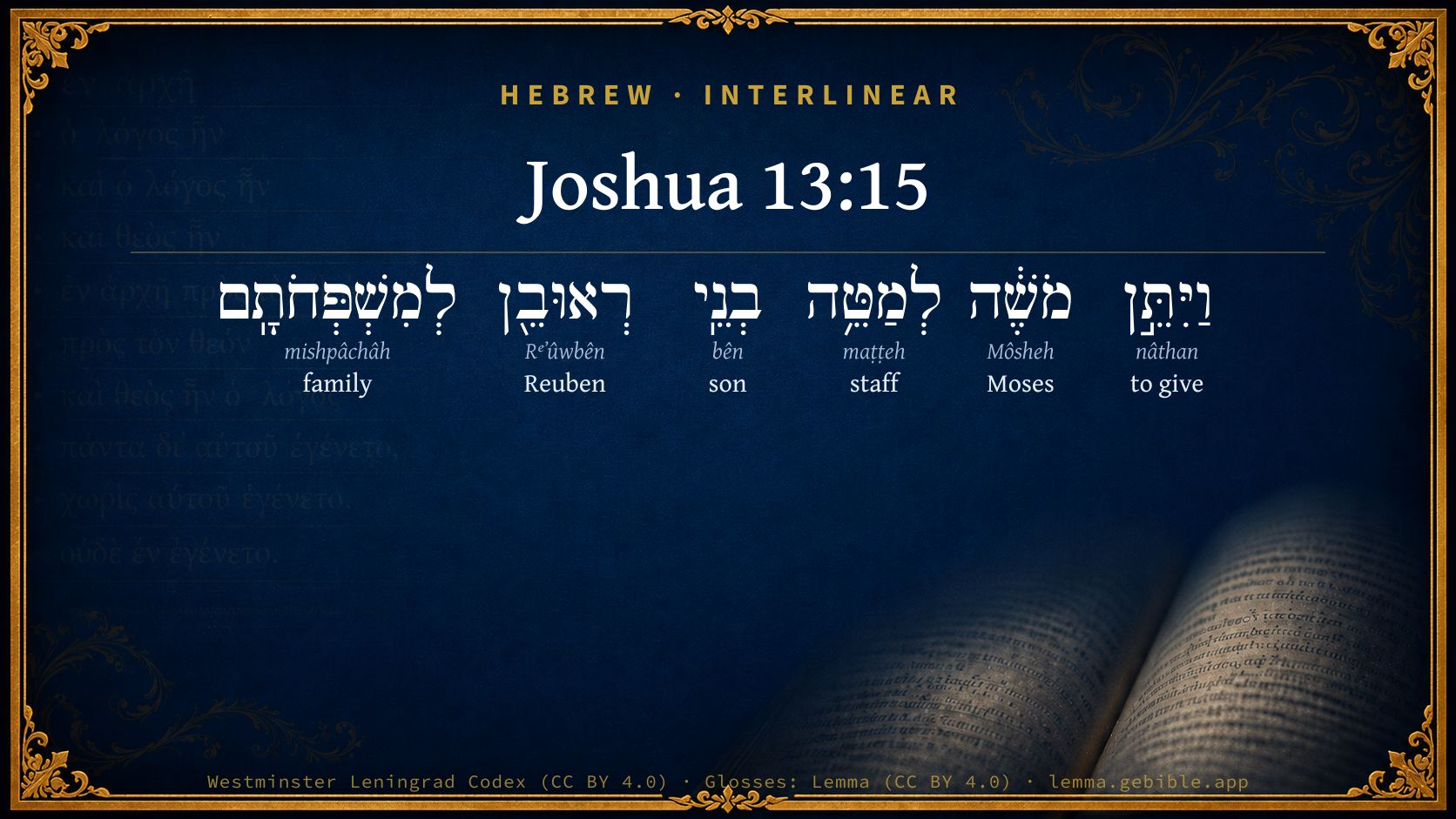
Joshua 13:15

Hebrew (Westminster Leningrad Codex) Joshua 13:15 appears in the Hebrew Old Testament. The text above is from the Westminster Leningrad Codex. Each word links to its Strong’s number, a concise gloss, and parsing drawn from the Open Scriptures Hebrew Bible morphology. Click any word for its full Brown-Driver-Briggs (BDB) entry.
Download image
Cite this verse

Joshua 13:15 (World English Bible). Public Domain. Lemma interlinear Bible study tool, https://lemma.gebible.app/v/joshua/13/15.

Show BibTeX & RIS
BibTeX
RIS
English Translation
Moses gave to the tribe of the children of Reuben according to their families.
World English Bible · Public Domain
Download a study sheet

One document with this verse’s original text, its word-by-word gloss line, the meaning frame, cross-references with their text, attributed commentary, and full source and license credits — printable, and it pastes into notes with its structure intact.

This verse Autodidact and up

Study sheet (.html) Plain text (.txt)

A passage Seminary Student

Up to 50 verses in one chapter. A passage sheet keeps up to 6 commentary sources and 12 cross-references per verse, in the order this page ranks them, and says so on the sheet whenever that leaves anything out. Ask for a single verse and you get the Autodidact verse sheet above.

Everything on this page stays free to read, with no account — the sheet is a download of what is already on screen, not access to it.

Want to remove ads? Support Godless Engineer
Compare translations 3

The same verse in 3 English versions, stacked beneath the original-language interlinear above. Click any original word for its lexicon entry.

Each is an independent rendering of the whole verse — the interlinear is not word-aligned to these translations.

Highlighted words mark where these versions differ — a whole-verse word diff, not a word-by-word alignment.

  • World English Bible Public Domain
    Moses gave to the tribe of the children of Reuben according to their families.
  • King James Version Public Domain
    And Moses gave unto the tribe of the children of Reuben inheritance according to their families.
  • unfoldingWord Literal Text CC BY-SA 4.0
    And Moses gave to the tribe of the sons of Reuben according to their clans.

unfoldingWord Literal Text — © unfoldingWord, licensed CC BY-SA 4.0. Word-aligned USFM3 via Door43 (git.door43.org/unfoldingWord/en_ult).

Versions to compare (up to 4)

3 of 4 selected

Show all 18 translations

Every available English version of this verse, each an independent rendering of the whole verse.

  • World English Bible Public Domain
    Moses gave to the tribe of the children of Reuben according to their families.
  • Berean Standard Bible Public Domain
    This is what Moses had given to the clans of the tribe of Reuben:
  • Majority Standard Bible Public Domain
    This is what Moses had given to the clans of the tribe of Reuben:
  • King James Version Public Domain
    And Moses gave unto the tribe of the children of Reuben inheritance according to their families.
  • American Standard Version (1901) Public Domain
    And Moses gave unto the tribe of the children of Reuben according to their families.
  • Revised Version (1885) Public Domain
    And Moses gave unto the tribe of the children of Reuben according to their families.
  • Geneva Bible (1599) Public Domain
    Moses then gaue vnto the tribe of the children of Reuben inheritance, according to their families.
  • Douay-Rheims (1899) Public Domain
    And Moses gave a possession to the children of Ruben according to their kindreds.
  • Young's Literal Translation Public Domain
    And Moses giveth to the tribe of the sons of Reuben, for their families;
  • Literal Standard Version CC BY-SA 4.0
    And Moses gives to the tribe of the sons of Reuben, for their families;
  • Unlocked Literal Bible CC BY-SA 4.0
    Moses gave an inheritance to the tribe of Reuben, clan by clan.
  • unfoldingWord Literal Text CC BY-SA 4.0
    And Moses gave to the tribe of the sons of Reuben according to their clans.
  • Darby Bible Public Domain
    And Moses gave [a portion] to the tribe of the children of Reuben according to their families.
  • World Messianic Bible Public Domain
    Moses gave to the tribe of the children of Reuben according to their families.
  • Webster's Bible Public Domain
    And Moses gave to the tribe of the children of Reuben inheritance according to their families.
  • Free Bible Version CC BY-SA 4.0
    This was the land that Moses allotted to the tribe of Reuben, by families:
  • Bible in Basic English Public Domain
    And Moses gave their heritage to the tribe of Reuben by their families.
  • JPS Tanakh (1917) Public Domain
    And Moses gave unto the tribe of the children of Reuben according to their families.

Literal Standard Version (2020), Covenant Press — licensed CC BY-SA 4.0. Text via the HelloAO Bible API (eBible.org). Unlocked Literal Bible (unfoldingWord) — licensed CC BY-SA 4.0. Text via the HelloAO Bible API (eBible.org). unfoldingWord Literal Text — © unfoldingWord, licensed CC BY-SA 4.0. Word-aligned USFM3 via Door43 (git.door43.org/unfoldingWord/en_ult). Free Bible Version, Dr. Jonathan Gallagher — licensed CC BY-SA 4.0. Text via the HelloAO Bible API (eBible.org).

Word by word

More ways to search: Search by grammar → Find every occurrence → Compare this word →

Practice this passage: Drill this verse → Learn its vocabulary →

About this verse

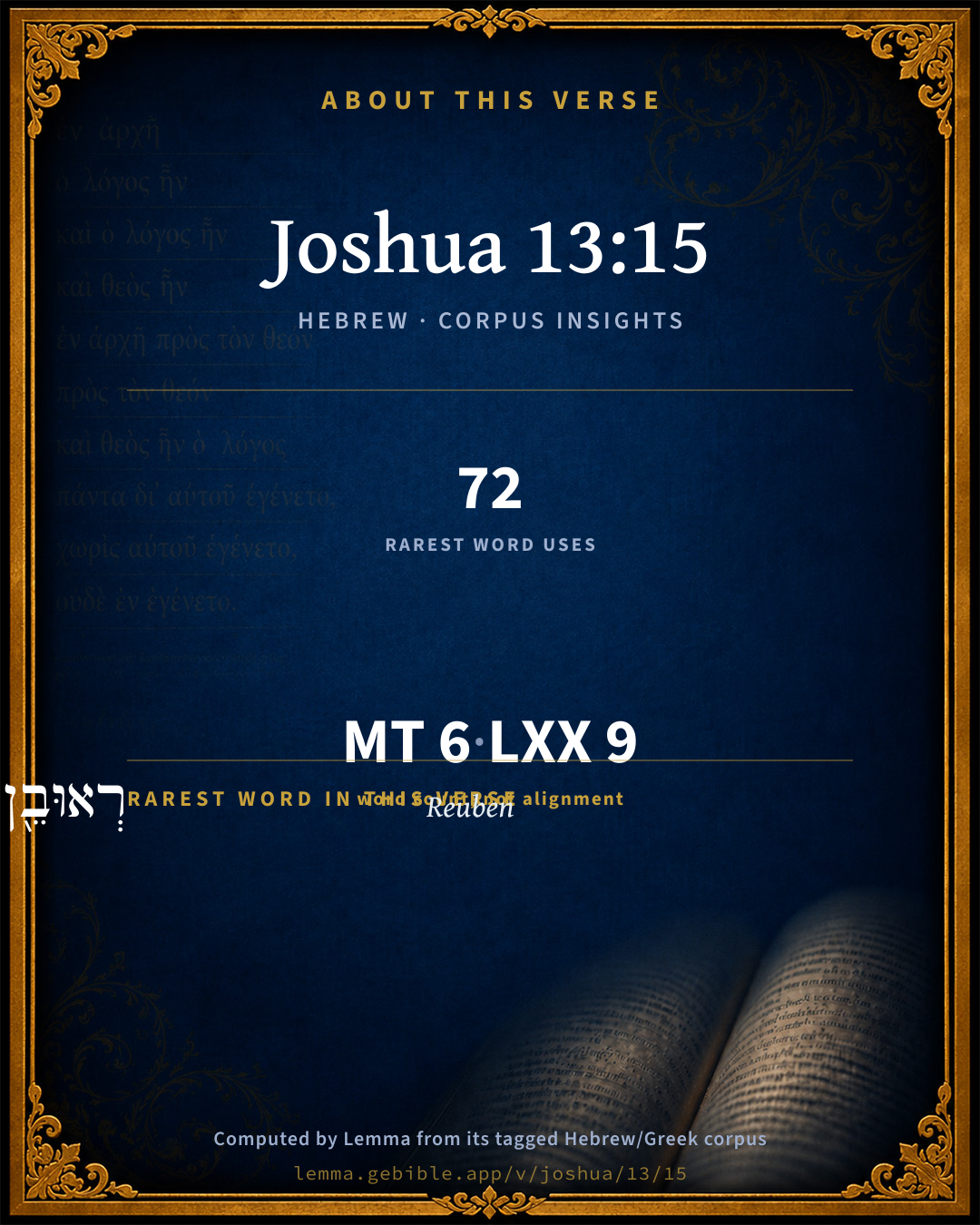
These counts appear in no published source. They are computed here, from the morphology-tagged text and Lemma’s own curated glosses. What Lemma adds →

6
words
6
distinct lemmas
Historical
section

Grammatical profile

  • 1 verb
  • 5 nouns

Verb forms

  • וַיִּתֵּ֣ן Qal · Sequential Imperfect

Hebrew & Septuagint length

In English translation the verse runs 14 words from the Hebrew and 14 from the Septuagint (LXX English) — the same length.

A rough comparison of the two English renderings, which tokenize alike — not a word-level alignment.

Word counts can differ between the Hebrew and the Greek without any difference in meaning — e.g. the Hebrew direct-object marker אֵת has no separate Greek word, and Greek often adds the article ὁ.

In the original languages it is 6 Hebrew tokens and 9 Greek tokens — but the two are counted differently (Hebrew bundles its prefixes and suffixes into one token; the Greek is in lemma form), so that isn’t a like-for-like length.

Hebrew and Greek witnesses Masoretic Hebrew ↔ Greek Septuagint

The same verse in the two great witnesses to the Old Testament, shown verse-for-verse.

These are two independent witnesses, not word-aligned to each other, and the Septuagint is shown in lemma (dictionary) form.

Hebrew Joshua 13:15 Masoretic · Westminster Leningrad Codex

וַיִּתֵּ֣ן מֹשֶׁ֔ה לְמַטֵּ֥ה בְנֵֽי רְאוּבֵ֖ן לְמִשְׁפְּחֹתָֽם

Moses gave to the tribe of the children of Reuben according to their families.

World English Bible · Public Domain

Greek LXX Joshua 13:15 Septuagint · lemma form

καί δίδωμι μωυσῆς ὁ φυλή ρουβην κατά δῆμος αὐτός

And Moses gave the land to the tribe of Ruben according to their families.

LXX2012 (modern English Septuagint) · Public Domain

Hebrew: Westminster Leningrad Codex (CC BY 4.0). Greek: Septuagint (public domain); English from LXX2012 (modern English Septuagint) (Public Domain). How the Septuagint differs from the Hebrew →

Targum (Aramaic paraphrase)

1

The Targum is the ancient Jewish Aramaic paraphrase of the Hebrew Scriptures — an interpretive translation, not the Hebrew text itself. Onkelos (literal) and Pseudo-Jonathan (expansive) render the Torah, and Jonathan the Prophets. Coverage is partial: where no permissively-licensed English translation exists for a verse, only the Aramaic is shown. This is verse-level text, not a word-by-word alignment to the Hebrew.

  1. Targum Jonathan Prophets (Joshua–Malachi)
    וִיהַב מֹשֶׁה לְשִׁבְטָא דִבְנֵי רְאוּבֵן לְזַרְעֲיַתְהוֹן:

    (no public-domain English translation for this verse)

    Targum Jonathan — Aramaic: “Mikraot Gedolot” (public domain). English: “Sefaria Community Translation” (CC0 1.0 (public-domain dedication)); “London "Chaldee Paraphrase," 1871” (public domain). Text via Sefaria.

Commentary

Notes on Joshua 13:15 from classic Christian and Jewish commentators (each source and its license shown beneath its notes). The classic Christian expositions comment on the surrounding passage and are grouped to its opening verse, so a note may address several verses; the Jewish commentaries on the Tanakh (Rashi and others) are per-verse, so they appear only where the commentator wrote on this verse.

Lemma curates 59 commentaries, every one of them public domain or Creative Commons licensed, each selected and text-cleaned for this edition rather than reprinted as found. About our sources →

Ellicott's Commentary for English Readers

DESCRIPTION OF THE TERRITORY DISTRIBUTED BY MOSES ON THE EAST OF JORDAN

(Jos_13:15-33).

(15) Reuben.—See also Num_32:33-42 and Deu_3:16, &c.

A Bible Commentary for English Readers, edited by Charles John Ellicott (1878–1897) — public domain. Text from a community e-Sword module.

Trapp's Complete Commentary

John Trapp

Jos 13:15 And Moses gave unto the tribe of the children of Reuben [inheritance] according to their families.

Ver. 15. According to their families,] i.e., Proportionably according to the number of their families.

John Trapp, A Commentary or Exposition upon All the Books of the Old and New Testament (1647–1656) — public domain. Text from a community e-Sword module.

Joseph Benson's Commentary

Jos 13:15. Moses gave, &c. — Having informed us in general what Moses gave to the two tribes and a half, the sacred historian proceeds to set down in particular what share each of them had in this country. According to their families — Dividing the inheritance into as many parts as they had families. But this is only spoken of the greater families; for the lesser distributions to the several small families were made by inferior officers, according to the rules which Moses had given them.

Joseph Benson's Commentary on the Old and New Testaments (1811–1818) — public domain. Text from a community e-Sword module.

Whedon's Commentary on the Bible

Daniel D. Whedon

REUBEN’S LOT, Jos_13:15-23.

[From this point on through chapter 19 follows a minute description of the territorial possessions assigned by Joshua to the tribes of Israel, and, while to a modern reader these chapters may appear as a dry and tiresome list of names, we should remember that they were as necessary and important as are the details of a modern deed of real estate to prevent future litigation. These lists of cities and borders were evidently compiled from the most ancient registers, and in all probability are substantially identical with those written by Joshua’s own hand, or under his supervision and direction. Their minuteness not only shows the care of the commissioners who determined them, but also the progress already made in the art of mensuration. See notes on Jos_18:4; Jos_18:9.

15. Children of Reuben — In Numbers 32 the children of Reuben and Gad are represented as petitioning Moses for an allotment on the east of Jordan, and they received their portion chiefly between the Arnon and the Jabbok. This district is now called the Belka, and Burckhardt describes the country and climate as exceedingly picturesque and delightful. “In the Belkan mountains we were refreshed by cool winds, and everywhere found a grateful shade of pine, oak, and wild pistachio trees, with a scenery more like that of Europe than any I had yet seen in Syria. The superiority of the pasturage of the Belka over that of all southern Syria is the cause of its possession being much contested. The Bedouins have this saying: ‘Thou canst not find a country like the Belka.’” Reuben and Gad had much cattle, and no wonder they desired a possession in these rich and delightful pasture hinds.

Daniel D. Whedon (gen. ed.), Commentary on the Old and New Testaments (1874–1909) — public domain. Text from a community e-Sword module.

Keil & Delitzsch

C. F. Keil & F. Delitzsch

The Possessions of the Two Tribes and a Half. - Jos 13:15-23. The tribe of Reuben received its inheritance in the south-namely, the territory from Aror in the Arnon valley, and from Ar in that valley, onwards, and the plain (table-land) by Medeba (see Jos 13:9), with Heshbon the capital and her towns, i.e., the towns dependent upon it, in the plain. Heshbon, almost in the centre between the Arnon and the Jabbok, was situated upon the border of the inheritance of the Reubenites, and was ceded to the Gadites, who gave it up to the Levites (Jos 21:39; Ch1 6:66 : see at Num 32:37). Dibon, called Dibon of Gad in Num 33:45, because the Gadites had built, i.e., fortified it, was on the south of Heshbon, only an hour from Aror, on the Arnon (Jos 13:9). Bamoth-baal, also called Bamoth simply (Num 21:20; Isa 15:2), is to be sought for on the Jebel Attarus (see at Num 21:20). It was thence that Balaam saw the end of the Israelitish camp (Num 22:41). Bethbaal-meon, the present ruin of Myun, three-quarters of an hour S.E. of Heshbon (see at Num 32:38). Jahza, where Sihon was defeated, was to the east of Medeba, according to the Onom.; and Dibon was on the border of the desert (see at Num 21:23). Kedemoth, on the border of the desert, to the north-west of Kalaat Balua, is to be sought on the northern bank of the Balua, or upper Arnon (see at Num 21:13). Mephaath, where there was a garrison stationed (according to the Onom.) as a defence against the inhabitants of the desert, is to be sought for in the neighbourhood of Jahza, with which it is always associated (Jer 48:21). Kedemoth and Mephaath were given up to the Levites (Jos 21:37; Ch1 6:64).

Keil & Delitzsch — Biblical Commentary on the Old Testament (1861–1891) — public domain (CC PDM 1.0). Text via the HelloAO Bible API. (Old Testament only.)

Tyndale Open Study Notes

Tyndale Open Resources

13:15-23 Because Reuben, Jacob’s firstborn son by Leah (Gen 29:32), forfeited his birthright by sleeping with his father’s concubine (Gen 35:22), the inheritance of his tribe was not of central importance. Although the tribe received a fertile portion of land, it was difficult to defend from neighboring nations. The tribe of Reuben eventually lost the southern portion to Moab.

Tyndale Open Study Notes — © Tyndale Open Resources, licensed CC BY-SA 4.0. Text via the HelloAO Bible API.

John Calvin's Commentaries

15. And Moses gave unto the tribe, etc What he seemed to have said with sufficient clearness he now follows more fully in detail, not only that the reading might incite the people to gratitude, seeing the divine goodness recorded in public documents, and, as it were, constantly before their eyes, but also that each might enjoy his inheritance without molestation and quarrel. For we know how ingenious human cupidity is in devising pretexts for litigation, so that no one can possess his right in safety unless a plain and perspicuous definition of his right make it impossible to call it in question. That country had been given without casting lots. It was therefore open to others to object that the just proportion had not been kept, and that the inequality behooved to be corrected. Therefore, that no unseasonable dispute might ever disturb the public peace, the boundaries are everywhere fixed by the authority of God, and disputes of every kind are removed by setting up landmarks. God does not by one single expression merely adjudge the whole kingdom of Sihon to the tribe of Reuben, but he traces their extreme limit from Aroer to the banks of the Arnon, and thus, making an entire circuit, contracts or widens their territory so as not to leave the possession of a single acre ambiguous. Moreover, how useful this exact delineation was may be learned from profane history, where we everywhere meet, not only with invidious but pernicious disputes among neighbors as to their boundaries.

We may add that the care which the Lord condescended to take in providing for his people, and in cherishing mutual peace among them, demonstrates his truly paternal love, since he omitted nothing that might conduce to their tranquillity. And, indeed, had not provision been thus early made, they might have been consumed by intestine quarrels.

I again beg my readers to excuse me if I do not labor anxiously in describing the situation of towns, and am not even curious in regard to names. Nay, I will readily allow those names which it was thought proper to leave as proper nouns in Hebrew to be used appellatively, and so far altered as to give them a Latin form.

It is worthy of notice, that when the land of the Midianites is referred to, the princes who ruled over it are called Satraps of Sihon, to let us know that they shared in the same overthrow, because they had involved themselves in an unjust war, and belonged to the government of Sihon, an avowed enemy. And to make it still more clear that they perished justly, it is told that among the slain was Balaam, by whose tongue they had attempted to wound the Israelites more grievously than by a thousand swords; just as if it had been said that in that slaughter they found the hostile banner, by which they had declared themselves at open war with the Israelites. When it is said that the Jordan was a boundary, and a boundary, it will be proper, in order to prevent useless repetition, to interpret that Jordan was a boundary to them according to its limits.

John Calvin's Commentaries (1540-1563) — public domain. Text from the Calvin Translation Society English edition (1840s-50s) via the Christian Classics Ethereal Library (ccel.org). Calvin's coverage is partial (roughly two-thirds of the Bible); uncommented books and verses are honest gaps, never fabricated. The 19th-century editor's footnotes and remarks are omitted so the notes are faithfully Calvin's own voice.

The Cambridge Bible for Schools and Colleges

gen. ed. J. J. S. Perowne

15–23. The Possession of the Tribe of Reuben

15. the tribe of the children of Reuben] The historian now gives us, on the faith of the ancient registers, the several boundaries of the tribes east of the Jordan.

Reuben] Reuben naturally comes first. His boundaries are more briefly given, Num_32:33-42.

The Cambridge Bible for Schools and Colleges (gen. ed. J. J. S. Perowne; Cambridge University Press, 1878–1918) — public domain. Text from a community e-Sword module.

John Gill's Exposition

And Moses gave unto the tribe of the children of Reuben inheritance according to their families. According to the number of them, and sufficient for them.

And Moses gave unto the tribe of the children of Reuben inheritance according to their families. According to the number of them, and sufficient for them.

Joshua 13:16

jos 13:16

jos 13:16

jos 13:16And their coast was from Aroer that is on the bank of the river Arnon,.... As the country of Sihon is described, Jos 13:9; from whence it appears that it was his country which was given to Reuben, though not all of it:

and the city that is in the midst of the river; See Gill on Jos 13:9,

and all the plain by Medeba; which reached unto Dibon, Jos 13:9.

John Gill's Exposition of the Whole Bible (1746–1763) — public domain (CC PDM 1.0). Text via the HelloAO Bible API.

Matthew Poole's English Annotations

Dividing the inheritance into as many parts as they had families; but this is only spoken of the greater families; for the lesser divisions or distributions to the several small families was done by inferior officers, according to the rules which Moses gave them.

Matthew Poole's English Annotations on the Holy Bible (1683–1685) — public domain. Text from a community e-Sword/MySword module.

The Pulpit Commentary

Reuben. This passage is an expansion of Num_32:33-42. We learn from it that the Israelites actually took possession of this land.But in the reigns of the wicked kings Omri and Ahab the power of Israel declined, and after the battle of Ramoth-Gilead, and the defeat and death of Ahab, the Moabites succeeded in shaking off the Israelitish yoke, and in wresting from Israel moreover a considerable portion of the territory of Sihon. In the next reign an attempt was made to regain possession of the lost territory. We learn from the Moabite stone that the important towns here mentioned, Medeba, Dibon, Baalmeon, Kiriathaim (or Kirjathalm, as it is here called), Ataroth, Nebo, Aroer, had fallen into the hands of Mesha at the rebellion, and that he had erected a citadel at Dibon, which had become his capital. Hence the endeavour to invade Moab from the south, recorded in 1Ki 3, which, however, though successful as a military promenade, was attended with no permanent results. For Isaiah (Isa 15) and Jeremiah (Jer 48) mention most of these places, as well as Elealeh and Heshbon, the former capital of Sihon, as being strongholds of the Moabite power. Jahaz, too, the place where Sihon gave battle of the Israelites, is numbered by Mesha, as well as at a later date by Isaiah and Jeremiah, among the possessions of Moab; while Horonaim, mentioned among the Moabite cities by the two prophets, is incidentally noticed by Mesha as having been captured from the Edomites. In this early extinction of the tribe of Reuben we may see the fulfilment of Jacob"s prophecy. (Ge 49) The plain by Medeba. See ver. 10; so again in the next verse.

The Pulpit Commentary (1880–1919), ed. H.D.M. Spence-Jones & Joseph S. Exell — public domain. Text from a community e-Sword module.

John Wesley's Explanatory Notes

According to their families - Dividing the inheritance into as many parts as they had families; but this is only spoken of the greater families; for the lesser distributions to the several small families was done by inferior officers, according to the rules which Moses gave them.

John Wesley, Explanatory Notes Upon the Whole Bible (1754–1765) — public domain. Text via the GEBible commentary corpus.

Kretzmann's Popular Commentary

Paul E. Kretzmann

The Territory of the two and one Half Tribes

v. 15. And Moses gave unto the tribe of the children of Reuben inheritance according to their families, Numbers 32.

v. 16. And their coast, their boundary, was from Aroer, that is on the bank of the river Arnon, and the city that is in the midst of the river, Ar in the valley of the Arnon, and all the plain by Medeba, east of the Dead Sea;

v. 17. Heshbon, the former capital of Sihon, and all her cities that are in the plain; Dibon, about four miles north of Arnon, and Bamothbaal, Num 24:20, and Bethbaalmeon, a short distance southeast of Heshbon, Num 32:38,

v. 18. and Jahaza, where Sihon was defeated, almost at the eastern edge of the plateau, and Kedemoth, later a city of the Levites, 1Ch 6:79, and Mephaath, another Levite city,

v. 19. and Kirjathaim, where Chedorlaomer defeated the Enim, Gen 14:5, and Sibmah, a suburb of Heshbon, and Zarethshahar in the mount of the valley, nearer to the Dead Sea than Heshbon,

v. 20. and Bethpeor, opposite Jericho, on the slopes of Mount Peor, and Ashdothpisgah, on the northeastern shore of the Dead Sea, and Bethjeshimoth, near the mouth of the Jordan,

v. 21. and all the cities of the plain, and all the kingdom, of Sihon, king of the Amorites, so far as it was contained in this plateau, which reigned in Heshbon, whom Moses smote with the princes of Midian, Num 21:24, Evi, and Rekem, and Zur, and Hur, and Reba, which were dukes of Sihon, vassals or tributaries, dwelling in the country, Num 31:8.

v. 22. Balaam, also, the son of Beor, the soothsayer, the diviner by the casting of lots, a name which brands him a false prophet, did the children of Israel slay with the sword among them that were slain by them, Num 22:5; Num 31:8.

v. 23. And the border, the boundary, of the children of Reuben was Jordan and the border thereof, to the territory of the Jordan in the west, for its main part was east of the Dead Sea. This was the inheritance of the children of Reuben after their families, the cities and the villages thereof, the latter being open towns, without walls or fortifications.

v. 24. And Moses gave inheritance unto the tribe of Gad, even unto the children of Gad, according to their families.

v. 25. And their coast, their boundary, as it included their territory, was Jazer, a city taken from the Amorites, Num 21:32, and all the cities of Gilead, that is, its southern part, below the Jabbok, the part of Ammonitis between the Arnon and the Jabbok, which the Amorites under Sihon had taken from the Ammonites (both the Aroer and the Rabbah here mentioned are not to be confounded with those of Moabitis);

v. 26. and from Heshbon, which was practically on the northern boundary of Reuben, unto Ramathmizpeh, that is, Ramoth in Gilead, and Betonim, these being the most important cities in the north; and from Mahanaim, Gen 32:2, a Levite city north of Jabbok, unto the border of Debir, or Lidhbir, probably on the heights which border the Jordan;

v. 27. and in the valley, Betharam, later Libias, Num 32:36, and Bethnimrah, and Succoth, where Jacob lived for some time. Gen 33:17, and Zaphon, the rest of the kingdom of Sihon, king of Heshbon, Jordan and his border, the river valley proper, even unto the edge of the Sea of Chinnereth, the southern end of the Sea of Galilee, on the other side Jordan eastward. While the Jabbok was, generally speaking, the northern boundary of the territory of Gad, the latter extended northward at least to include the plateau of Mahanaim and the Jordan valley to the Sea of Galileo.

v. 28. This is the inheritance of the children of Gad after their families, the cities, and their villages.

v. 29. And Moses gave inheritance unto the half tribe of Manasseh; and this was the possession of the half tribe of the children of Manasseh by their families.

v. 30. And their coast was from Mahanaim, from the boundaries of this city, all Bashan, all the kingdom of Og, king of Bashan, and all the towns of Jair which are in Bashan, threescore cities, Num 32:41;

v. 31. and half Gilead, the northern half, and Ashtaroth, and Edrei, cities of the kingdom of Og in Bashan, were pertaining unto the children of Machir, the son of Manasseh, even to the one half of the children of Machir by their families.

v. 32. These are the countries which Moses did distribute for inheritance in the Plains of Moab, while the children of Israel were encamped there, on the other side Jordan, by Jericho, eastward.

v. 33. But unto the tribe of Levi Moses gave not any inheritance; the Lord God of Israel was their inheritance, as he said unto them, Num 18:20; Deu 10:9. Note: The end of Balaam is an example of warning. Like him all those who come to the knowledge of the truth, but reject it, preferring the froth of this world to the substance of eternity, will be subject to a severe condemnation.

Paul E. Kretzmann, Popular Commentary of the Bible (1921–1924) — public domain. Text from a community e-Sword module.

unfoldingWord translationNotes

Door43 World Missions Community

Aroer ... Medeba

These are the names of places. (See: How to Translate Names)

gorge ... plateau

See how you translated these words in Joshua 13:9.

translationWords

Reuben

clan

unfoldingWord translationNotes — © Distant Shores Media and the Door43 World Missions Community, licensed CC BY-SA 4.0. Source: git.door43.org/Door43/en_tn.

Lesson kit

Teaching starters — assembled from the data on this page, not authored interpretation. Every prompt links to the verse data it draws on. Edit before teaching.

Joshua, in the Historical, opens this verse with 6 words (6 distinct Hebrew lemmas). Its most distinctive word is Rᵉʼûwbên (“Reuben”). A historical commentator’s framing appears above. Read the whole chapter for the surrounding context.

Discussion questions

  1. What does “Reuben” (Rᵉʼûwbên) contribute to the verse as a whole?
  2. These translations render this verse differently; the difference is in the English rendering, not the original. What questions does that raise?
  3. The verb «וַיִּתֵּ֣ן» is Qal Sequential Imperfect. How does its form color the action?
  4. Reading how Ellicott's Commentary for English Readers and Trapp's Complete Commentary read this verse, where do the two commentators agree and where do they part?

Things to notice

Reading settings

Reading text

Shown beneath each verse's original-language words.

Old Testament
Old Testament edition

Read the OT as the Masoretic Hebrew (MT) or the Greek Septuagint (LXX).

English shown for the Greek Septuagint (in the Hebrew ↔ Greek comparison).

Comparing translations? Open the Compare panel on any verse page to stack up to four side by side.