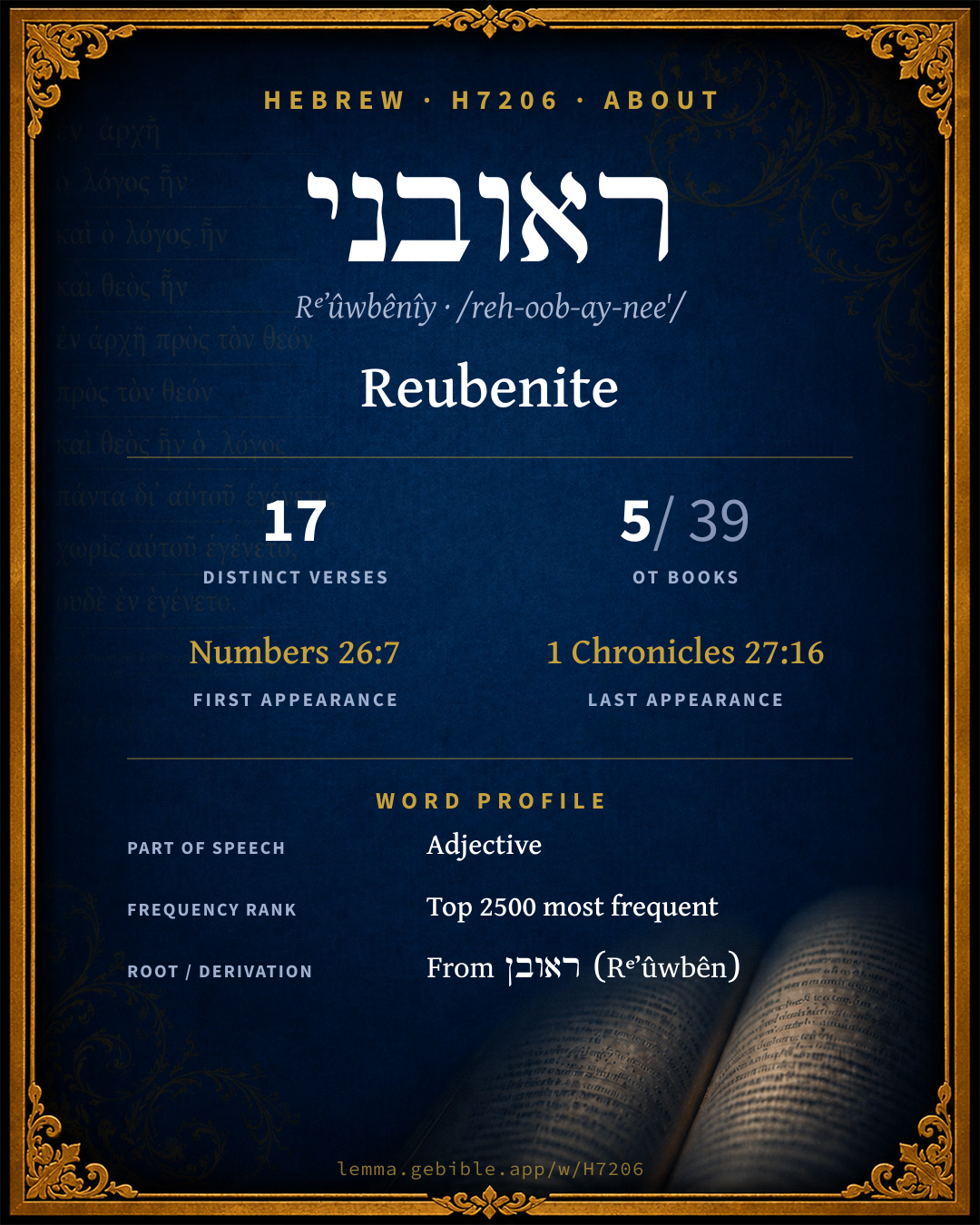
רְאוּבֵנִי
Reubenite
BDB lists 2 entries for ‘Reubenite’ fuller range ↓
Full lexicon entry — Brown-Driver-Briggs (BDB)
From Brown-Driver-Briggs (BDB)
Where this word appears
Grammar key — what these labels mean
Noun type
- Gentilic
- A noun naming a member of a people, tribe, or region of origin (e.g. an Israelite, a Moabite).
State
- Absolute
- The independent form of a noun, not bound to a following word.
Gender
- Masculine
- Grammatically masculine.
Number
- Singular
- One.
Every verse where H7206 appears — 17 distinct verses across 5 books. Click any verse to open its interlinear word-by-word view. Verse text shown in the World English Bible for context — . Each verse’s Hebrew form is shown with its reference; the English is not keyword-highlighted, since the data carries no word-level English alignment. Use “Compare translations” on any verse to read it across multiple English versions. This concordance covers the Hebrew Bible; Septuagint (Greek Old Testament) occurrences are not indexed here.
Numbers 2 verses
- Numbers 26:7 הָ/רֻֽאוּבֵנִ֑י ptcl def.art + n Gentilic ms These are the families of the Reubenites; and those who were numbered of them were forty-three thousand seven hundred thirty.
- Numbers 34:14 הָ/ראוּבֵנִי֙ ptcl def.art + n Gentilic ms for the tribe of the children of Reuben according to their fathers' houses, and the tribe of the children of Gad according to their fathers' houses, have received, and the half-tribe of Manasseh have received, their inheritance:
Deuteronomy 4 verses
- Deuteronomy 3:12 לָ/רֻֽאוּבֵנִ֖י prep det + n Gentilic ms This land we took in possession at that time: from Aroer, which is by the valley of the Arnon, and half the hill-country of Gilead, and the cities of it, gave I to the Reubenites and to the Gadites:
- Deuteronomy 3:16 וְ/לָ/רֻאוּבֵנִ֨י conj + prep det + n Gentilic ms To the Reubenites and to the Gadites I gave from Gilead even to the valley of the Arnon, the middle of the valley, and the border [of it], even to the river Jabbok, which is the border of the children of Ammon;
- Deuteronomy 4:43 לָ/רֻֽאוּבֵנִ֑י prep det + n Gentilic ms [namely], Bezer in the wilderness, in the plain country, for the Reubenites; and Ramoth in Gilead, for the Gadites; and Golan in Bashan, for the Manassites.
- Deuteronomy 29:8 לָ/רֽאוּבֵנִ֖י prep det + n Gentilic ms and we took their land, and gave it for an inheritance to the Reubenites, and to the Gadites, and to the half-tribe of the Manassites.
Joshua 4 verses
- Joshua 1:12 וְ/לָ/רֽאוּבֵנִי֙ conj + prep det + n Gentilic ms To the Reubenites, and to the Gadites, and to the half-tribe of Manasseh, spoke Joshua, saying,
- Joshua 12:6 לָ/רֻֽאוּבֵנִי֙ prep det + n Gentilic ms Moses the servant of Yahweh and the children of Israel struck them: and Moses the servant of Yahweh gave it for a possession to the Reubenites, and the Gadites, and the half-tribe of Manasseh.
- Joshua 13:8 הָ/רֽאוּבֵנִי֙ ptcl def.art + n Gentilic ms With him the Reubenites and the Gadites received their inheritance, which Moses gave them, beyond the Jordan eastward, even as Moses the servant of Yahweh gave them:
- Joshua 22:1 לָ/רֽאוּבֵנִ֖י prep det + n Gentilic ms Then Joshua called the Reubenites, and the Gadites, and the half-tribe of Manasseh,
2 Kings 1 verse
1 Chronicles 6 verses
- 1 Chronicles 5:6 לָ/רֽאוּבֵנִֽי prep det + n Gentilic ms Beerah his son, whom Tilgath Pilneser king of Assyria carried away captive: he was prince of the Reubenites.
- 1 Chronicles 5:26 לָ/ראוּבֵנִ֣י prep det + n Gentilic ms The God of Israel stirred up the spirit of Pul king of Assyria, and the spirit of Tilgath Pilneser king of Assyria, and he carried them away, even the Reubenites, and the Gadites, and the half-tribe of Manasseh, and brought them to Halah, and Habor, and Hara, and to the river of Gozan, to this day.
- 1 Chronicles 11:42 הָ/רֽאוּבֵנִ֗י לָ/רֽאוּבֵנִ֖י ptcl def.art + n Gentilic ms prep det + n Gentilic ms Adina the son of Shiza the Reubenite, a chief of the Reubenites, and thirty with him,
- 1 Chronicles 12:37 הָ/ראוּבֵנִ֨י ptcl def.art + n Gentilic ms On the other side of the Jordan, of the Reubenites, and the Gadites, and of the half-tribe of Manasseh, with all manner of instruments of war for the battle, one hundred twenty thousand.
- 1 Chronicles 26:32 הָ/ראוּבֵנִ֤י ptcl def.art + n Gentilic ms His brothers, men of valor, were two thousand seven hundred, heads of fathers' [houses], whom king David made overseers over the Reubenites, and the Gadites, and the half-tribe of the Manassites, for every matter pertaining to God, and for the affairs of the king.
- 1 Chronicles 27:16 לָ/רֽאוּבֵנִ֣י prep det + n Gentilic ms Furthermore over the tribes of Israel: of the Reubenites was Eliezer the son of Zichri the ruler: of the Simeonites, Shephatiah the son of Maacah:
About this entry
At a glance — auto-summarized from this page’s data, not written by a person. Every figure links to its source below. This summary describes the numbers; it doesn’t interpret them.
The Hebrew name ראובני centers on the idea of “Reubenite.” Debuting at Numbers 26:7, it then recurs through the corpus. Spanning 17 verses in 5 books, it ranks among the uncommon words of the Hebrew Bible. 1 Chronicles dominates its distribution — 6 of 17 verses. For the data behind this summary, explore 17-verse concordance and the renderings breakdown below.
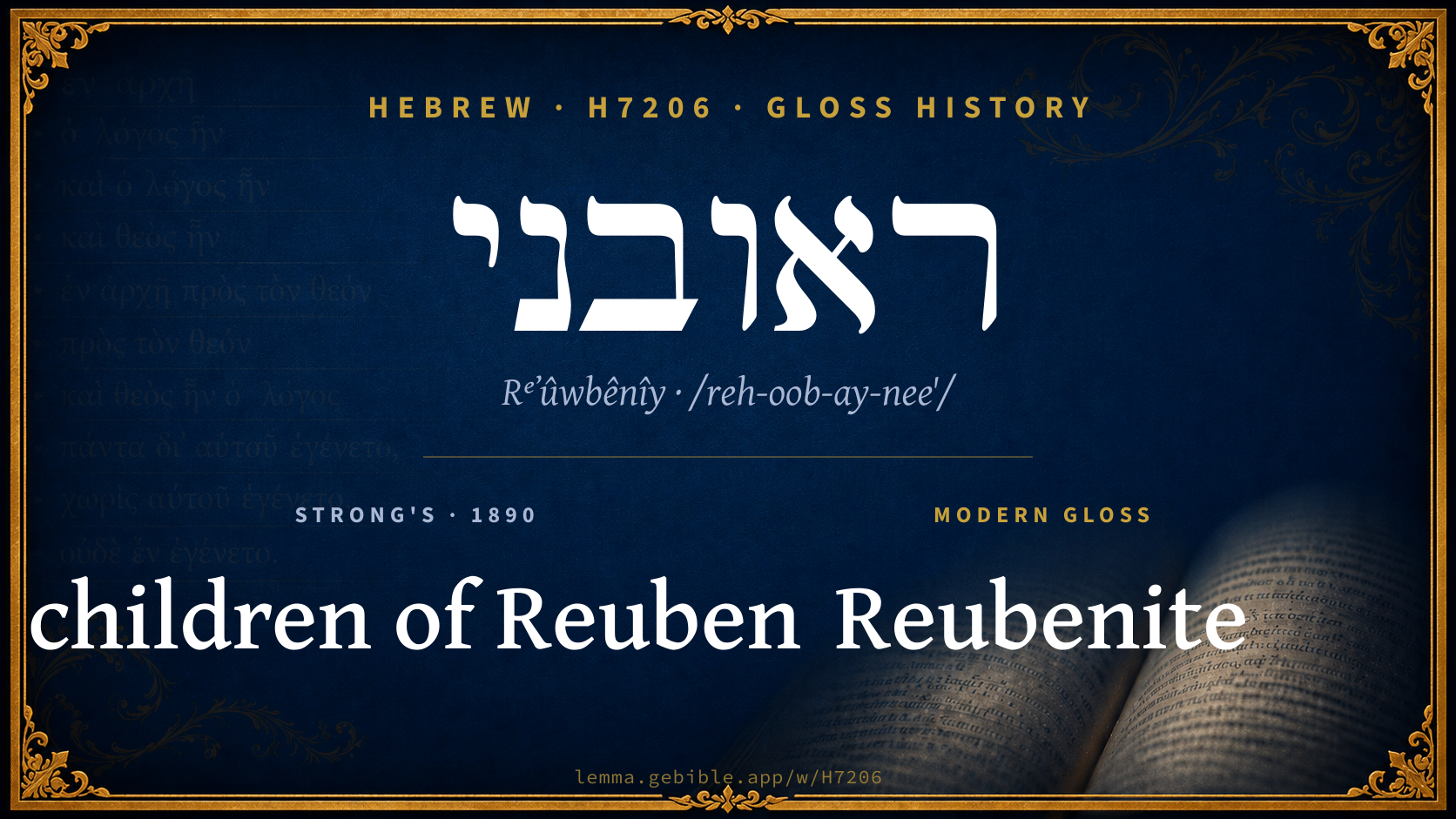
Gloss history
Strong's 1890 vs modern scholarship
About this word
Strong's H7206 catalogs a Hebrew word from the Hebrew Old Testament.
These counts are not copied from any lexicon or concordance. They are computed here, from the morphology-tagged Hebrew Old Testament. What Lemma adds →
- 17
- distinct verses
- The word appears in 17 distinct verses.
- 5 / 39
- OT books
- The word appears in 5 of 39 Old Testament books.
- #1,612
- by frequency
- Top 2500 most frequent Hebrew words (rank 1,612 of 8,640 Hebrew words by occurrence).
View all 17 occurrences in the concordance →
Most concentrated in
- 1 Chronicles 6 verses 35%
- Deuteronomy 4 verses 24%
- Joshua 4 verses 24%
By section of the Old Testament
By traditional corpus
Conventional, traditional groupings — biblical authorship is debated, so this is a traditional corpus grouping, not an authorship claim. Each share is this word’s portion of its verses in that division of the Hebrew canon. Each figure is a share of the word’s 17 distinct verses.
- Torah (Pentateuch) 6 verses · 35%
- Writings (Ketuvim) 6 verses · 35%
- Prophets (Nevi'im) 5 verses · 29%
How translations render this word
Counts come from each version’s own published word-to-Strong’s tagging or interlinear alignment — an approximate guide to how each version renders this word, not a word-level alignment the data otherwise carries. Because each total is that version’s own tagged count, the per-version totals vary from one another and need not match the appearance or distinct-verse counts above. These counts may also differ from a printed concordance because Lemma counts each distinctly tagged rendering and does not collapse phrase taggings into a single head-word total. This is a fixed set of word-tagged versions (KJV, ASV, BSB, ULT) and does not change with the reading translation you choose elsewhere. Each version’s license is shown beside its name below (and on Sources).
- King James Version: Reubenites 14×
- American Standard Version: Reubenites 13×
- Berean Standard Bible: Reubenites 9×, Reuben 3×
- unfoldingWord Literal Text: Reubenite 12×, Reubenites 5×
King James Version Public Domain
Renders H7206 across 18 tagged occurrences — most commonly:
Plus 4 renderings that appear only once — usually multi-word phrases or single function words the recovered tagging swept in, not distinct renderings.
American Standard Version Public Domain
Renders H7206 across 18 tagged occurrences — most commonly:
Plus 5 renderings that appear only once — usually multi-word phrases or single function words the recovered tagging swept in, not distinct renderings.
Berean Standard Bible Public Domain
Renders H7206 across 17 tagged occurrences — most commonly:
Plus 5 renderings that appear only once — usually multi-word phrases or single function words the recovered tagging swept in, not distinct renderings. Not rendered by a distinct English word in 1 further occurrence.
unfoldingWord Literal Text CC BY-SA 4.0
Renders H7206 across 18 tagged occurrences — most commonly:
Plus 1 rendering that appears only once — usually multi-word phrases or single function words the recovered tagging swept in, not distinct renderings.
Senses in BDB
The 2 senses BDB distinguishes for this word, in lexicon order (not ranked by frequency or importance). The full entry — with sub-senses — is in the Lexicon Entry tab.
- Reubenite = see Reuben " behold a son"
- a descendant of Reuben the son of Jacob
Word origin
רְאוּבֵנִי adj.gent. of foreg. [ רְאוּבֵן ]
— Brown-Driver-Briggs (Oxford 1906, public domain), digitized via Sefaria, supplemented by the OpenScriptures HebrewLexicon (CC BY 4.0). See Sources.
Derived from ראובן (Rᵉʼûwbên) (H7205) — Reuben.
Forms in the corpus
The 16 distinct written forms H7206 takes in the Hebrew Bible, most frequent first — each parse links to that state’s occurrences in the concordance. Hebrew forms include their vowel points and cantillation, so a single lemma takes many written forms.
| Form | Parsing | Example | Uses |
|---|---|---|---|
| לָ/רֽאוּבֵנִ֖י | Noun, Gentilic, Masculine, Singular, Absolute | Deuteronomy 29:8 | 3 |
| הָ/רֻֽאוּבֵנִ֑י | Noun, Gentilic, Masculine, Singular, Absolute | Numbers 26:7 | 1 |
| הָ/רֽאוּבֵנִ֗י | Noun, Gentilic, Masculine, Singular, Absolute | 1 Chronicles 11:42 | 1 |
| הָ/רֽאוּבֵנִי֙ | Noun, Gentilic, Masculine, Singular, Absolute | Joshua 13:8 | 1 |
| הָ/ראוּבֵנִ֤י | Noun, Gentilic, Masculine, Singular, Absolute | 1 Chronicles 26:32 | 1 |
| הָ/ראוּבֵנִ֨י | Noun, Gentilic, Masculine, Singular, Absolute | 1 Chronicles 12:37 | 1 |
| הָ/ראוּבֵנִי֙ | Noun, Gentilic, Masculine, Singular, Absolute | Numbers 34:14 | 1 |
| וְ/הָ/רֻאובֵנִ֖י | Noun, Gentilic, Masculine, Singular, Absolute | 2 Kings 10:33 | 1 |
| וְ/לָ/רֻאוּבֵנִ֨י | Noun, Gentilic, Masculine, Singular, Absolute | Deuteronomy 3:16 | 1 |
| וְ/לָ/רֽאוּבֵנִי֙ | Noun, Gentilic, Masculine, Singular, Absolute | Joshua 1:12 | 1 |
| לָ/רֻֽאוּבֵנִ֑י | Noun, Gentilic, Masculine, Singular, Absolute | Deuteronomy 4:43 | 1 |
| לָ/רֻֽאוּבֵנִי֙ | Noun, Gentilic, Masculine, Singular, Absolute | Joshua 12:6 | 1 |
| לָ/רֻֽאוּבֵנִ֖י | Noun, Gentilic, Masculine, Singular, Absolute | Deuteronomy 3:12 | 1 |
| לָ/רֽאוּבֵנִ֣י | Noun, Gentilic, Masculine, Singular, Absolute | 1 Chronicles 27:16 | 1 |
| לָ/רֽאוּבֵנִֽי | Noun, Gentilic, Masculine, Singular, Absolute | 1 Chronicles 5:6 | 1 |
| לָ/ראוּבֵנִ֣י | Noun, Gentilic, Masculine, Singular, Absolute | 1 Chronicles 5:26 | 1 |
Same root — word family
Other BDB entries built from the same root as H7206, grouped by Strong’s listed origin. These share a root / origin per the lexicon — not necessarily a shared meaning. Each links to that word’s own entry.
Derives from
Proper names from this root
People and places named from this root — a name, not an additional meaning of the word.
Compare all same-root words → 2 of the same-root words are proper names (people or places). They share a root, not necessarily a meaning.
Septuagint verse parallels
This word appears in 17 verses that also exist in the Greek Old Testament (Septuagint), out of the 17 Hebrew verses it occurs in. You can read those verses in Greek by switching the Old Testament edition to the Septuagint.
Read these verses in the Septuagint
This is a verse-level parallel only — the same verses exist in both the Hebrew and Greek Old Testaments. No word-level Hebrew↔Greek correspondence is claimed: the data carries no such alignment, so no Greek word is shown as this Hebrew word’s translation. Coverage is not total — the Septuagint omits the deuterocanon and renumbers the Psalms, so some Hebrew verses have no direct Greek parallel.