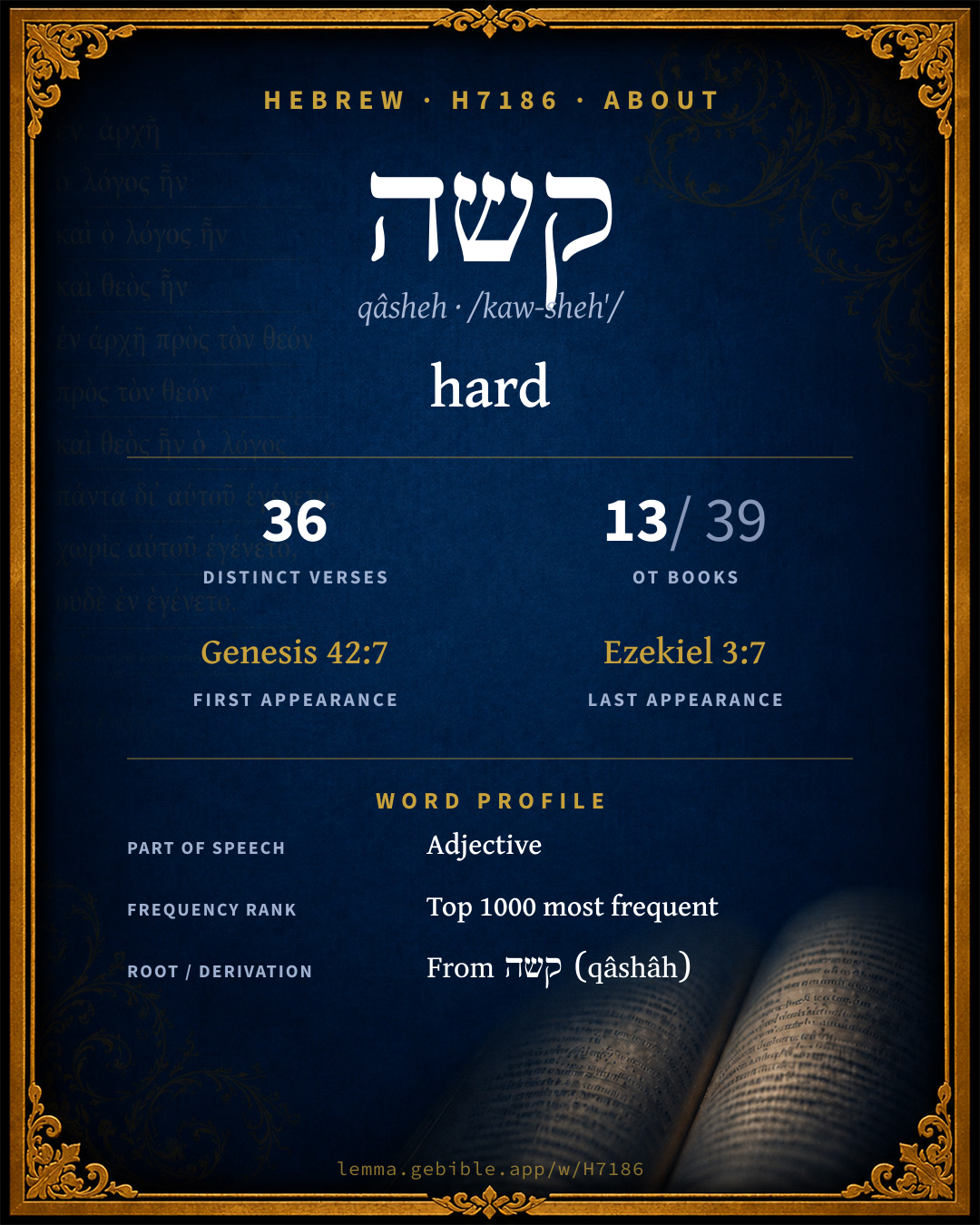
קָשֶׁה
hard
also: cruel, severe, obstinate fuller range ↓
Full lexicon entry — Brown-Driver-Briggs (BDB)
From Brown-Driver-Briggs (BDB)
Where this word appears
See every Absolute-state word in the Hebrew Bible →
Grammar key — what these labels mean
Part of speech
- Adjective
- A word that describes or qualifies a noun.
State
- Absolute
- The independent form of a noun, not bound to a following word.
- Construct
- A noun bound to a following noun in a possessive / “of” relationship (the construct chain).
Gender
- Feminine
- Grammatically feminine.
- Masculine
- Grammatically masculine.
Number
- Singular
- One.
- Plural
- More than one (in Hebrew, generally three or more).
Grammatical forms
- Adjective, Adjective, Feminine, Singular, Absolute 18 times (50%)
- Adjective, Adjective, Masculine, Singular, Construct 7 times (19%)
- Adjective, Adjective, Masculine, Singular, Absolute 5 times (14%)
- Adjective, Adjective, Feminine, Plural, Absolute 2 times (6%)
- Adjective, Adjective, Masculine, Plural, Construct 2 times (6%)
- Adjective, Adjective, Feminine, Singular, Construct 1 time (3%)
- Adjective, Adjective, Masculine, Plural, Absolute 1 time (3%)
Parsed forms decoded from the imported morphology (morphhb / Westminster Leningrad Codex — WLC text public domain, morphhb tagging CC BY 4.0), counted across 36 parsed occurrences — not distinct verses.
Every verse where H7186 appears — 36 distinct verses across 13 books. Click any verse to open its interlinear word-by-word view. Verse text shown in the World English Bible for context — . Each verse’s Hebrew form is shown with its reference; the English is not keyword-highlighted, since the data carries no word-level English alignment. Use “Compare translations” on any verse to read it across multiple English versions. This concordance covers the Hebrew Bible; Septuagint (Greek Old Testament) occurrences are not indexed here.
Genesis 2 verses
- Genesis 42:7 קָשׁ֗וֹת adj Adjective fp Joseph saw his brothers, and he recognized them, but acted like a stranger to them, and spoke roughly with them. He said to them, "Where did you come from?" They said, "From the land of Canaan to buy food."
- Genesis 42:30 קָשׁ֑וֹת adj Adjective fp "The man, the lord of the land, spoke roughly with us, and took us for spies of the country.
Exodus 7 verses
- Exodus 1:14 קָשָׁ֗ה adj Adjective fs and they made their lives bitter with hard service, in mortar and in brick, and in all manner of service in the field, all their service, in which they ruthlessly made them serve.
- Exodus 6:9 קָשָֽׁה adj Adjective fs Moses spoke so to the children of Israel, but they didn't listen to Moses for anguish of spirit, and for cruel bondage.
- Exodus 18:26 הַ/קָּשֶׁה֙ ptcl def.art + Adjective Adjective ms They judged the people at all times. They brought the hard causes to Moses, but every small matter they judged themselves.
- Exodus 32:9 קְשֵׁה adj Adjective ms cs Yahweh said to Moses, "I have seen these people, and, behold, they are a stiff-necked people.
- Exodus 33:3 קְשֵׁה adj Adjective ms cs to a land flowing with milk and honey: for I will not go up in the midst of you, for you are a stiff-necked people, lest I consume you in the way."
- Exodus 33:5 קְשֵׁה adj Adjective ms cs Yahweh said to Moses, "Tell the children of Israel, 'You are a stiff-necked people. If I were to go up into your midst for one moment, I would consume you. Therefore now take off your jewelry from you, that I may know what to do to you."
- Exodus 34:9 קְשֵׁה adj Adjective ms cs He said, "If now I have found favor in your sight, Lord, please let the Lord go in the midst of us; although this is a stiff-necked people; pardon our iniquity and our sin, and take us for your inheritance."
Deuteronomy 4 verses
- Deuteronomy 9:6 קְשֵׁה adj Adjective ms cs Know therefore, that Yahweh your God doesn't give you this good land to possess it for your righteousness; for you are a stiff-necked people.
- Deuteronomy 9:13 קְשֵׁה adj Adjective ms cs Furthermore Yahweh spoke to me, saying, I have seen this people, and, behold, it is a stiff-necked people:
- Deuteronomy 26:6 קָשָֽׁה adj Adjective fs The Egyptians dealt ill with us, and afflicted us, and laid on us hard bondage:
- Deuteronomy 31:27 הַ/קָּשֶׁ֑ה ptcl def.art + Adjective Adjective ms For I know your rebellion, and your stiff neck: behold, while I am yet alive with you this day, you have been rebellious against Yahweh; and how much more after my death?
Judges 2 verses
- Judges 2:19 הַ/קָּשָֽׁה ptcl def.art + Adjective Adjective fs But it happened, when the judge was dead, that they turned back, and dealt more corruptly than their fathers, in following other gods to serve them, and to bow down to them; they didn't cease from their doings, nor from their stubborn way.
- Judges 4:24 וְ/קָשָׁ֔ה conj + Adjective Adjective fs The hand of the children of Israel prevailed more and more against Jabin the king of Canaan, until they had destroyed Jabin king of Canaan.
1 Samuel 3 verses
- 1 Samuel 1:15 קְשַׁת adj Adjective fs cs Hannah answered, No, my lord, I am a woman of a sorrowful spirit: I have drunk neither wine nor strong drink, but I poured out my soul before Yahweh.
- 1 Samuel 20:10 קָשָֽׁה adj Adjective fs Then said David to Jonathan, Who shall tell me if perchance your father answer you roughly?
- 1 Samuel 25:3 קָשֶׁ֛ה adj Adjective ms Now the name of the man was Nabal; and the name of his wife Abigail; and the woman was of good understanding, and of a beautiful face: but the man was churlish and evil in his doings; and he was of the house of Caleb.
2 Samuel 2 verses
- 2 Samuel 2:17 קָשָׁ֥ה adj Adjective fs The battle was very severe that day: and Abner was beaten, and the men of Israel, before the servants of David.
- 2 Samuel 3:39 קָשִׁ֣ים adj Adjective mp I am this day weak, though anointed king; and these men the sons of Zeruiah are too hard for me. May Yahweh reward the evil-doer according to his wickedness."
1 Kings 3 verses
- 1 Kings 12:4 הַ/קָּשָׁ֗ה ptcl def.art + Adjective Adjective fs Your father made our yoke grievous: now therefore make you the grievous service of your father, and his heavy yoke which he put on us, lighter, and we will serve you.
- 1 Kings 12:13 קָשָׁ֑ה adj Adjective fs The king answered the people roughly, and forsook the counsel of the old men which they had given him,
- 1 Kings 14:6 קָשָֽׁה adj Adjective fs It was so, when Ahijah heard the sound of her feet, as she came in at the door, that he said, Come in, you wife of Jeroboam; why feign you yourself to be another? for I am sent to you with heavy news.
2 Chronicles 2 verses
- 2 Chronicles 10:4 הַ/קָּשָׁ֗ה ptcl def.art + Adjective Adjective fs Your father made our yoke grievous: now therefore make you the grievous service of your father, and his heavy yoke which he put on us, lighter, and we will serve you.
- 2 Chronicles 10:13 קָשָׁ֑ה adj Adjective fs The king answered them roughly; and king Rehoboam forsook the counsel of the old men,
Job 1 verse
Psalms 1 verse
Song of Solomon 1 verse
Isaiah 6 verses
- Isaiah 14:3 הַ/קָּשָׁ֖ה ptcl def.art + Adjective Adjective fs It shall happen in the day that Yahweh shall give you rest from your sorrow, and from your trouble, and from the hard service in which you were made to serve,
- Isaiah 19:4 קָשֶׁ֑ה adj Adjective ms I will give over the Egyptians into the hand of a cruel lord; and a fierce king shall rule over them, says the Lord, Yahweh of Hosts.
- Isaiah 21:2 קָשָׁ֖ה adj Adjective fs A grievous vision is declared to me; the treacherous man deals treacherously, and the destroyer destroys. Go up, Elam; besiege, Media; all the sighing of it have I made to cease.
- Isaiah 27:1 הַ/קָּשָׁ֜ה ptcl def.art + Adjective Adjective fs In that day Yahweh with his hard and great and strong sword will punish leviathan the swift serpent, and leviathan the crooked serpent; and he will kill the monster that is in the sea.
- Isaiah 27:8 הַ/קָּשָׁ֖ה ptcl def.art + Adjective Adjective fs In measure, when you send them away, you do contend with them; he has removed [them] with his rough blast in the day of the east wind.
- Isaiah 48:4 קָשֶׁ֖ה adj Adjective ms Because I knew that you are obstinate, and your neck is an iron sinew, and your brow brass;
Ezekiel 2 verses
- Ezekiel 2:4 קְשֵׁ֤י adj Adjective mp cs The children are impudent and stiff-hearted: I do sent you to them; and you shall tell them, Thus says the Lord Yahweh.
- Ezekiel 3:7 וּ/קְשֵׁי conj + Adjective Adjective mp cs But the house of Israel will not listen to you; for they will not listen to me: for all the house of Israel are of hard forehead and of a stiff heart.
About this entry
At a glance — auto-summarized from this page’s data, not written by a person. Every figure links to its source below. This summary describes the numbers; it doesn’t interpret them.
קשה (qâsheh) is a Hebrew adjective most often rendered “hard.” Beyond “hard” it also covers “cruel”, “severe”, and “obstinate” — see its full sense range. The Hebrew Bible uses it across 36 verses — moderately common. First canonically at Genesis 42:7, it enters the text early. It clusters with קשה, מקשה and קשי under a shared root. Dig into 36-verse concordance and the renderings breakdown below.
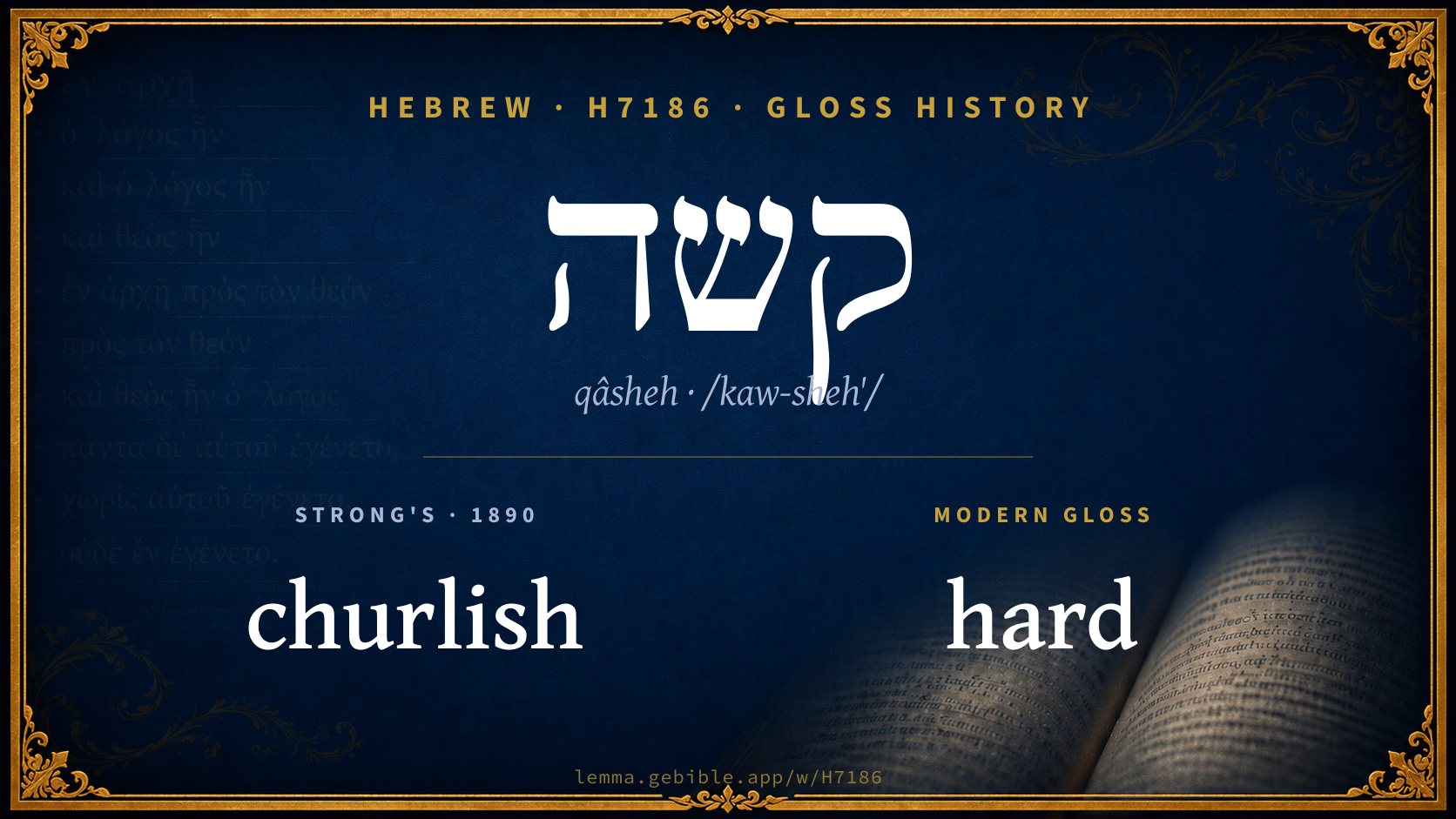
Gloss history
Strong's 1890 vs modern scholarship
About this word
Strong's H7186 catalogs a Hebrew word from the Hebrew Old Testament.
These counts are not copied from any lexicon or concordance. They are computed here, from the morphology-tagged Hebrew Old Testament. What Lemma adds →
- 36
- distinct verses
- The word appears in 36 distinct verses.
- 13 / 39
- OT books
- The word appears in 13 of 39 Old Testament books.
- #990
- by frequency
- Top 1000 most frequent Hebrew words (rank 990 of 8,640 Hebrew words by occurrence).
View all 36 occurrences in the concordance →
Most concentrated in
- Exodus 7 verses 19%
- Isaiah 6 verses 17%
- Deuteronomy 4 verses 11%
By section of the Old Testament
By traditional corpus
Conventional, traditional groupings — biblical authorship is debated, so this is a traditional corpus grouping, not an authorship claim. Each share is this word’s portion of its verses in that division of the Hebrew canon. Each figure is a share of the word’s 36 distinct verses.
- Prophets (Nevi'im) 18 verses · 50%
- Torah (Pentateuch) 13 verses · 36%
- Writings (Ketuvim) 5 verses · 14%
How translations render this word
Counts come from each version’s own published word-to-Strong’s tagging or interlinear alignment — an approximate guide to how each version renders this word, not a word-level alignment the data otherwise carries. Because each total is that version’s own tagged count, the per-version totals vary from one another and need not match the appearance or distinct-verse counts above. These counts may also differ from a printed concordance because Lemma counts each distinctly tagged rendering and does not collapse phrase taggings into a single head-word total. This is a fixed set of word-tagged versions (KJV, ASV, BSB, ULT) and does not change with the reading translation you choose elsewhere. Each version’s license is shown beside its name below (and on Sources).
- King James Version: Hard 4×, Roughly 4×, Cruel 2×
- American Standard Version: Hard 4×, Roughly 3×, Cruel 2×
- Berean Standard Bible: Harshly 4×, Are a stiff-necked 3×, Hard 3×
- unfoldingWord Literal Text: Hard 8×, Harshly 5×, Hard of 4×
King James Version Public Domain
Renders H7186 across 34 tagged occurrences — most commonly:
Plus 22 renderings that appear only once — usually multi-word phrases or single function words the recovered tagging swept in, not distinct renderings. Not rendered by a distinct English word in 2 further occurrences.
American Standard Version Public Domain
Renders H7186 across 34 tagged occurrences — most commonly:
Plus 23 renderings that appear only once — usually multi-word phrases or single function words the recovered tagging swept in, not distinct renderings.
Berean Standard Bible Public Domain
Renders H7186 across 35 tagged occurrences — most commonly:
Plus 21 renderings that appear only once — usually multi-word phrases or single function words the recovered tagging swept in, not distinct renderings. Not rendered by a distinct English word in 1 further occurrence.
unfoldingWord Literal Text CC BY-SA 4.0
Renders H7186 across 39 tagged occurrences — most commonly:
Plus 14 renderings that appear only once — usually multi-word phrases or single function words the recovered tagging swept in, not distinct renderings.
Senses in the full BDB
What do BDB’s symbols mean?
BDB uses these scholarly abbreviations:
| Symbol | Meaning |
|---|---|
| 𝔊 | the Septuagint (the ancient Greek translation, LXX) |
| 𝔙 | the Vulgate (the Latin translation) |
| 𝔖 | the Syriac version (the Peshitta) |
| 𝔗 | the Targum (the Aramaic translation) |
| ψ | the Psalms |
| √ | root (the underlying root or stem) |
| ‖ | parallel passage (a synonymous or contrasted parallel) |
| † | the dagger: every passage where the word occurs is cited |
The 4 senses and sub-senses the full Brown-Driver-Briggs lexicon distinguishes for this word, in lexicon order (not ranked by frequency), with BDB’s own verbatim wording and sub-sense lettering. Shown in Hebrew script with BDB’s own scholarly abbreviations. The condensed entry is in the Lexicon Entry tab. See also the Forms in the corpus table below.
- 1. hard, difficult, of a legal question (דָּבָר) Ex 18:26 (E). e.g. Exodus 18:26
- 2.
- a. severe, of battle 2 S 2:17, wind Is 27:8, servitude (עֲבֹדָה) 1 K 12:4 = 2 Ch 10:4; Dt 26:6; Is 14:3; Ex 1:14; 6:9 (both P); as n.coll. הִרְאִיתָ עַמְּךָ קָשָׁה ψ 60:5 thou hast made thy people see severe things; קְשֵׁה יוֹם Jb 30:25 i.e. one whose time (life) is hard, so 1 S 1:15 (reading קְשַׁת יוֹם for ק׳ רוּחַ, 𝔊 Th We Dr al.); severe, rough, of lord (אֲדֹנִים) Is 19:4, cf. 2 S 3:29 (c. מִן comp. [מִמֶּנּוּ? v. HPS]); הָלוֹךְ וְקָשָׁה עַל־ Ju 4:24 the hand of the sons of Israel went on being more and more severe upon Jabin; fierce, relentless, of י׳’s sword Is 27:1 (in fig.); rough, rude 1 S 25:3; severe things, of language Gn 42:7, 30 (E; c. דִּבֶּר), 1 S 20:10 1 K 12:13 = 2 Ch 10:13 (all c. עָנָה); וְאָנֹכִי שָׁלוּחַ אֵלַיִךְ קָשָׁה 1 K 14:6 I am commissioned with a severe (message) unto thee (Ges§ 121 d. N. 1 DaSynt. §§ 75 (d), 80); חָזוּת קָשָׁה Is 21:2. e.g. 2 Samuel 2:17
- b. fierce, intense, vehement, of קִנְאָה Ct 8:6 (‖ עַוָּה; cf. Gn 49:9). e.g. Song of Solomon 8:6
- 3. עַם־קְשֵׁה־עֹרֶף a people stiff of neck, stubborn, Ex 32:9; 33:3, 5; 34:9 (all JE), Dt 9:6, 13; עָרְפְּךָ הַקָּשֶׁה, 31:27; cf. דַּרְכָּם הַקָּשָׁה Ju 2:19; קְשֵׁי פָנִים Ez 2:4 (+ חִזְקֵי־לֵב), קְשֵׁי־לֵב 3:7 (+ חִזְקֵי־מֵצַח); ק׳ alone = stubborn Is 48:4. e.g. Exodus 32:9
Senses from the full Brown-Driver-Briggs lexicon (Brown, Driver, Briggs; Oxford 1906 — public domain), digitized via Sefaria, supplemented by the OpenScriptures HebrewLexicon (CC BY 4.0). Full attribution on Sources.
Word origin
adj. hard, severe;—abs. ק׳ Ex 18:26 +; cstr. 32:9 +; fs. קָשָׁה Dt 26:6 +; cstr. קְשַׁת 1 S 1:15; mpl. קָשִׁים 2 S 3:39; cstr. קְשֵׁי Ez 2:4; 3:7; fpl. קָשׁוֹת Gn 42:7, 30;—
— Brown-Driver-Briggs (Oxford 1906, public domain), digitized via Sefaria, supplemented by the OpenScriptures HebrewLexicon (CC BY 4.0). See Sources.
Derived from קשה (qâshâh) (H7185) — to be hard.
Jastrow Dictionary
A second Hebrew/Aramaic lexicon for comparison, covering Aramaic and post-biblical (Talmudic, Targumic, Midrashic) usage that the biblical-Hebrew BDB does not. Matched by lemma rather than by Strong’s number, so a lemma may carry more than one Jastrow headword (shown separately below), and the entries cover usage well beyond the Bible.
קָשָׁה
- , v. קשי
קְשֵׁה
- , v. קְשֵׁי
קָשֶׁה
- , קָשָׁה f. (b. h.; preced.) stiff, hard, difficult, severe; strong. Tosef. Sabb. IX (X), 2 שני זייפין מן הק׳ וכ׳ (some ed. הקַשׁ) two of the stiffest bristles of the swine; Sabb. 90ᵇ מקָשָׁה של חזיר אחת carrying one of the stiff bristles of the swine is punishable. Taan. 20ᵇ ק׳ כארז, v. קָנֶה. B. Bath. 88ᵇ ק׳ עונשן של וכ׳ the responsibility for fraud in measures is severer than that for incest. Ib. ק׳ גזל הדיוט וכ׳ robbing an individual is worse than robbing the altar. Gen. R. s. 26, end ק׳ היא המחלוקת וכ׳ strife is as bad as (the sins of) the generation of the flood. Gen. R. s. 71 ק׳ היא התפלה וכ׳ prayer is a powerful factor, for it reversed the divine decree. Taan. 8ᵃ שלמודו ק׳ עליו וכ׳ to whom his study is as hard as iron. Ib. 8ᵇ (in Chald. dict.) ק׳ יומא וכ׳, v. קָשֵׁי. Ex. R. s. 6 היה ק׳ בעיניהם וכ׳ it seemed too hard a task for them to give up idolatry; a. v. fr.—Erub. 83ᵇ בק׳ with difficulty, v. נַחַת.—[Num. R. s. 16 end קשה ערפם, v. קְשִׁי.]—Pl. קָשִׁים, קָשִׁין; קָשׁוֹת. Yeb. 47ᵇ, a. e. ק׳ גרים וכ׳, v. סַפַּחַת. Sot. 2ᵃ ק׳ לזווגן (Snh. 22ᵃ קשה), v. זָוַג. Pes. 118ᵃ ק׳ … כקריעת וכ׳ the providential support of man is as difficult (wonderful) as the splitting of the Red Sea. Ib. ק׳ … כפלים וכ׳ man’s support is twice as hard (painful) as travailing. Ber. 57ᵇ (etymolog. play on קישואים) מפני שהם ק׳ לגוף וכ׳ because they are as hard on the body as swords. Koh. R. to XII, 7 נבואות ק׳ hard (evil) prophecies; a. v. fr.
קשי
- (b. h.) to be stiff, hard, difficult. Y. Ber. I, 2ᶜ top קָשְׁתָה על דעתך this is difficult according to (not reconcilable with) thy opinion; ib. למה א"ל קשתה (not קשתיה) why did he say to him, it is difficult?—V. קָשֶׁה.
- (קִישְּׁתָה, with לילד or without) to have hard labor in travailing. Ḥull. IV, 1 בהמה המְקַשָּׁה לילד וכ׳ if an animal is in labor, and &c., v. עוּבָּר. Nidd. IV, 4 קִשְּׁתָה שלשה וכ׳ if she was in pain for three days within eleven days; Tosef. ib. V, 8 קִישֵּׁת, קִשֵּׁת. Ib. 10; a. fr.—[Gen. R. s. 61 שהיו מקשין וכ׳, read: מקישין, v. נָקַשׁ.]
- 1. to stiffen, harden. Nidd. 13ᵇ המַקְשֶׁה עצמו וכ׳ he who causes erection wilfully. Ex. R. s. 11 הרשע הזה ה׳ את לבו וכ׳ this wicked (Pharaoh) hardened his heart against the first three signs; a. e.
- 2. to become hard. Y. Pes. VI, 35ᵇ top שסופו להַקְשׁוֹת which gets hard in the course of time. Shebi. II, 10 אם הִקְשׁוּ וכ׳ (Y. ed. a. Bart. הוּקְשׁוּ Hof.) if they became hard (dry) and unfit for man to eat before New Year. (Y. ib. 34ᵃ bot. הקשו a. הוקשו).
- 3. to be severe. Gen. R. s. 19, opp. ריתה, v. רָתָה.
- 1. to become hard, v. supra.
- 2. to be found hard, distasteful. Tanḥ. Sh’laḥ 5; Num. R. s. 16 ה׳ הדבר והרע וכ׳ the thing was distasteful to and displeased his father.
- 1. to suffer severely (in travailing). Gen. R. s. 84 נִתְקַשֵּׁת אמו וכ׳ his mother was in hard labor at his birth.
- 2. to become hard, stiff. Tosef. Nidd. VI, 4 משׁיִתְקַשּׁוּ, v. קִשְׁקֵשׁ I, a. II. Gen. R. s. 98, a. שׁנִתְקַשֵּׁיתָה, v. קַשְׁיוּת.
- 3. to find one’s self in difficulty, to be perplexed, unable to understand or remember. Num. R. s. 15 beg. נ׳ משה במעשה וכ׳ Moses found the work of the candlestick more difficult to understand than &c.; כיון שנ׳ אמר וכ׳ when he still could not remember it, the Lord said &c. Ib.10; Tanḥ. B’haʿăl. 6 נִתְקַשֵּׁיתִי לעשותה I could not understand how to do it. Ib. נ׳ על משה it was too difficult for Moses; a. fr.
- 4. to be reluctant, strive against. Tanḥ. Sh’moth 18 כמה נ׳ יונה שלא וכ׳ how hard did Jonah strive not to go on his mission. Deut. R. s. 9 מִתְקַשֶּׁה כנגדו (the sun) refused to obey; a. e.
- 5. to make one’s self obnoxious. Gen. R. s. 61; Yalk. Chr. 1073 (play on יקשן, Gen. XXV, 2) שהיו מִתְקַשִּׁין בעולם they were obnoxious to the world (were hard to deal with); (Midr. Till. to Ps. XCII ed. Bub. שהיו בני אדם קשין). e.g. Genesis 25:2
A Dictionary of the Targumim, the Talmud Babli and Yerushalmi, and the Midrashic Literature (Marcus Jastrow; London, Luzac, 1903) — Public Domain. Digitized via Sefaria. Digitized via Sefaria. Full attribution on Sources.
Forms in the corpus
The 23 distinct written forms H7186 takes in the Hebrew Bible, most frequent first — each parse links to that state’s occurrences in the concordance. Hebrew forms include their vowel points and cantillation, so a single lemma takes many written forms.
Same root — word family
Other BDB entries built from the same root as H7186, grouped by Strong’s listed origin. These share a root / origin per the lexicon — not necessarily a shared meaning. Each links to that word’s own entry.
Derives from
Shares the same root
Compare all same-root words → Showing 4 of 5 — not the complete family. They share a root, not necessarily a meaning.
Septuagint verse parallels
This word appears in 35 verses that also exist in the Greek Old Testament (Septuagint), out of the 36 Hebrew verses it occurs in. You can read those verses in Greek by switching the Old Testament edition to the Septuagint.
Read these verses in the Septuagint
- Genesis 42:7
- Exodus 1:14
- Deuteronomy 9:6
- Judges 2:19
- 1 Samuel 1:15
- 2 Samuel 2:17
- 1 Kings 12:4
- 2 Chronicles 10:4
- Job 30:25
- Psalms 60:3
- Song of Solomon 8:6
- Isaiah 14:3
This is a verse-level parallel only — the same verses exist in both the Hebrew and Greek Old Testaments. No word-level Hebrew↔Greek correspondence is claimed: the data carries no such alignment, so no Greek word is shown as this Hebrew word’s translation. Coverage is not total — the Septuagint omits the deuterocanon and renumbers the Psalms, so some Hebrew verses have no direct Greek parallel.