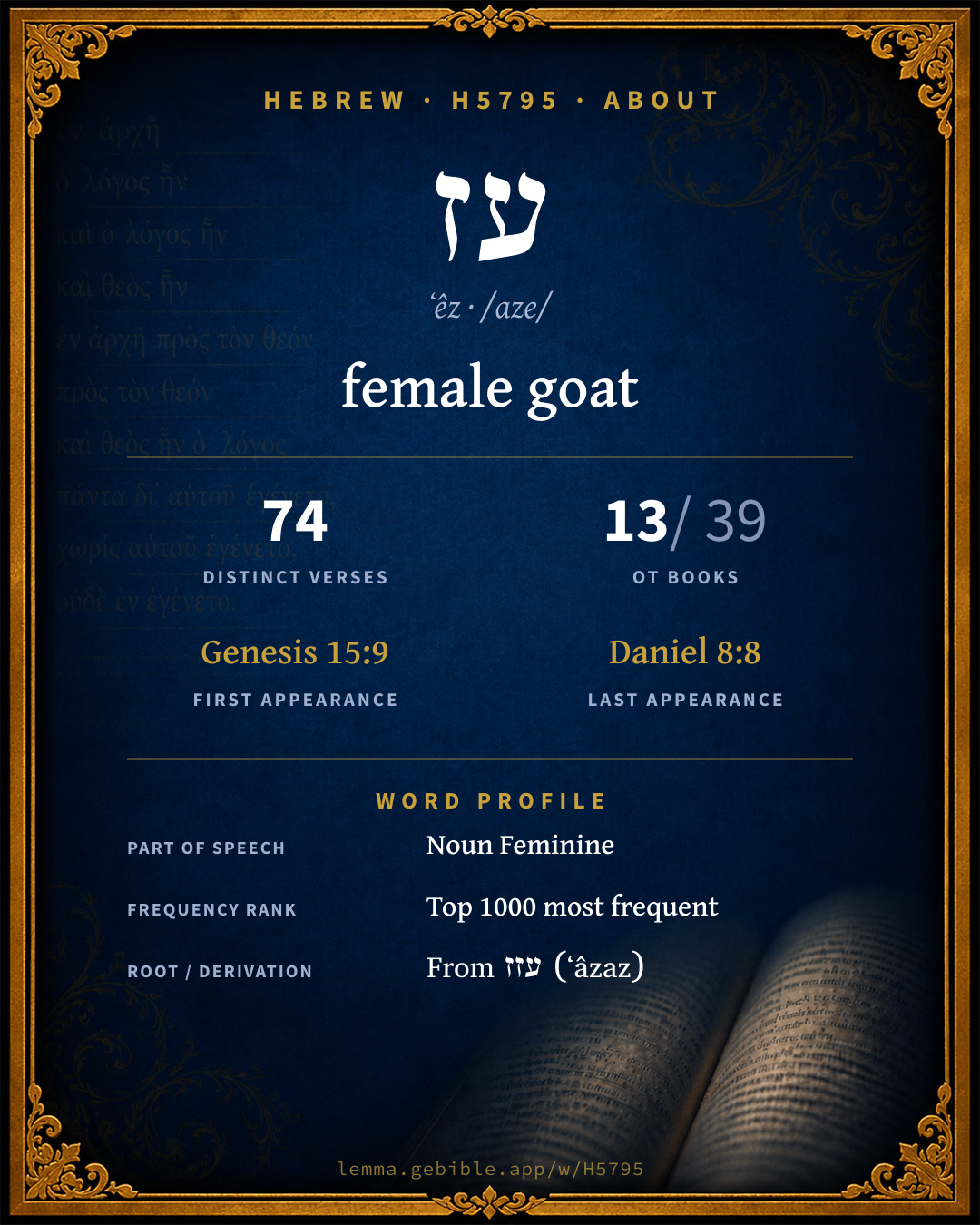
עֵז
female goat
Full lexicon entry — Brown-Driver-Briggs (BDB)
From Brown-Driver-Briggs (BDB)
Where this word appears
Grammar key — what these labels mean
Part of speech
- Noun
- A naming word — a person, place, thing, or idea.
Noun type
- Common
- A common noun — a general class of person, place, or thing (“king,” “city,” “water”), not a specific name.
State
- Absolute
- The independent form of a noun, not bound to a following word.
- Construct
- A noun bound to a following noun in a possessive / “of” relationship (the construct chain).
Gender
- Feminine
- Grammatically feminine.
Number
- Plural
- More than one (in Hebrew, generally three or more).
- Singular
- One.
Every verse where H5795 appears in the Book of Ezekiel — 2 distinct verses. Click any verse to open its interlinear word-by-word view. Verse text shown in the World English Bible for context — . Each verse’s Hebrew form is shown with its reference; the English is not keyword-highlighted, since the data carries no word-level English alignment. Use “Compare translations” on any verse to read it across multiple English versions. This concordance covers the Hebrew Bible; Septuagint (Greek Old Testament) occurrences are not indexed here.
Ezekiel
- Ezekiel 43:22 עִזִּ֥ים n c fp On the second day you shall offer a male goat without blemish for a sin-offering; and they shall cleanse the altar, as they did cleanse it with the bull.
- Ezekiel 45:23 עִזִּ֖ים n c fp The seven days of the feast he shall prepare a burnt offering to Yahweh, seven bulls and seven rams without blemish daily the seven days; and a male goat daily for a sin-offering.
About this entry
At a glance — auto-summarized from this page’s data, not written by a person. Every figure links to its source below. This summary describes the numbers; it doesn’t interpret them.
עז (ʻêz) is a Hebrew noun most often rendered “female goat.” It first appears in Genesis 15:9. The Hebrew Bible uses it across 74 verses — moderately common. Numbers dominates its distribution — 25 of 74 verses. Sharing its root, it stands alongside עזז, מעוז and עז. The sections below give every sense, occurrence, and version rendering.
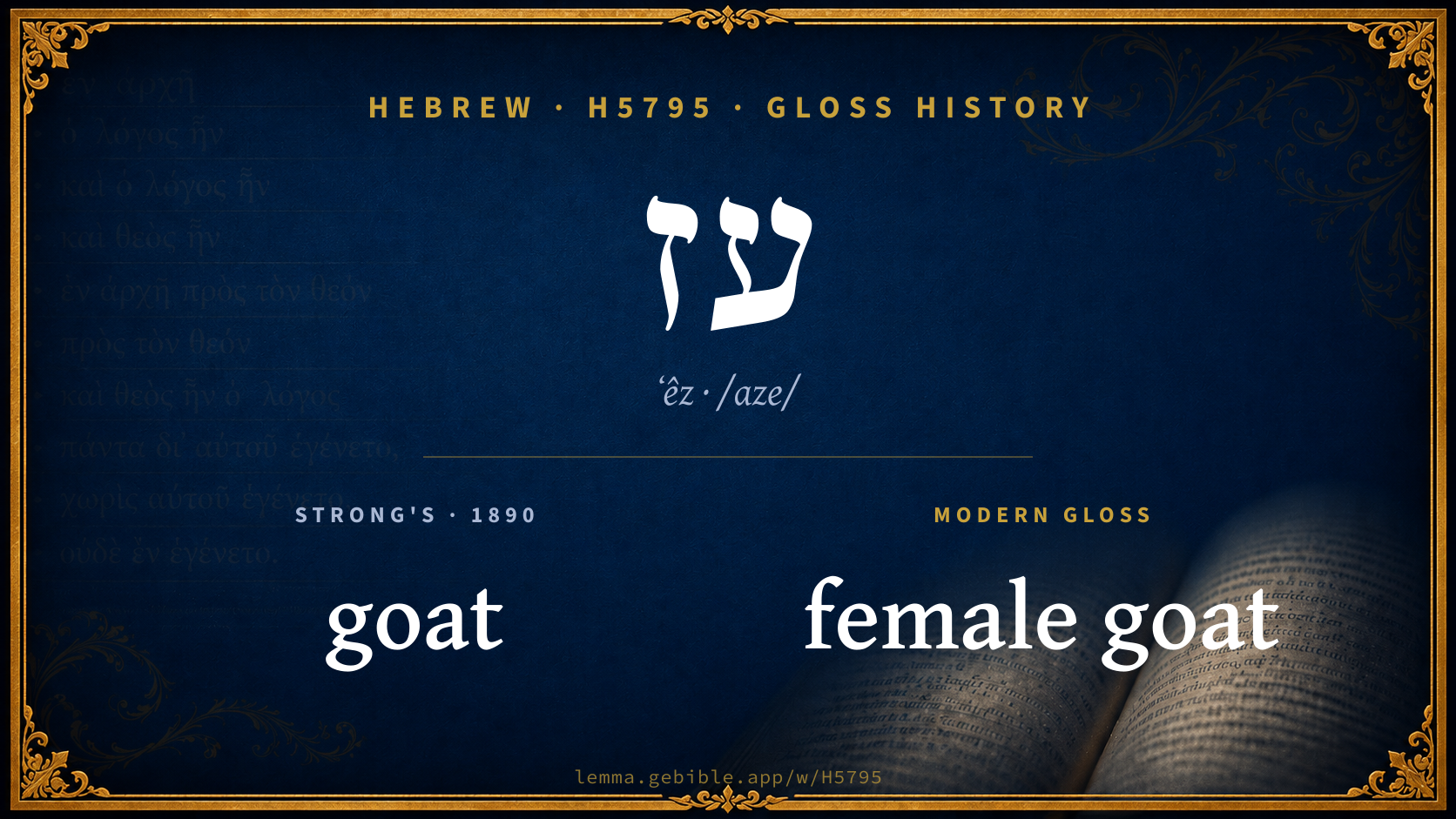
Gloss history
Strong's 1890 vs modern scholarship
About this word
Strong's H5795 catalogs a Hebrew word from the Hebrew Old Testament.
These counts are not copied from any lexicon or concordance. They are computed here, from the morphology-tagged Hebrew Old Testament. What Lemma adds →
- 74
- distinct verses
- The word appears in 74 distinct verses.
- 13 / 39
- OT books
- The word appears in 13 of 39 Old Testament books.
- #536
- by frequency
- Top 1000 most frequent Hebrew words (rank 536 of 8,640 Hebrew words by occurrence).
View all 74 occurrences in the concordance →
By section of the Old Testament
By traditional corpus
Conventional, traditional groupings — biblical authorship is debated, so this is a traditional corpus grouping, not an authorship claim. Each share is this word’s portion of its verses in that division of the Hebrew canon. Each figure is a share of the word’s 74 distinct verses.
- Torah (Pentateuch) 56 verses · 76%
- Prophets (Nevi'im) 11 verses · 15%
- Writings (Ketuvim) 7 verses · 9%
How translations render this word
Counts come from each version’s own published word-to-Strong’s tagging or interlinear alignment — an approximate guide to how each version renders this word, not a word-level alignment the data otherwise carries. Because each total is that version’s own tagged count, the per-version totals vary from one another and need not match the appearance or distinct-verse counts above. These counts may also differ from a printed concordance because Lemma counts each distinctly tagged rendering and does not collapse phrase taggings into a single head-word total. This is a fixed set of word-tagged versions (KJV, ASV, BSB, ULT) and does not change with the reading translation you choose elsewhere. Each version’s license is shown beside its name below (and on Sources).
- King James Version: Goats 36×, Goats' 9×, Goat 3×
- American Standard Version: Goats 27×, He-goat 7×, - goat 5×
- Berean Standard Bible: Goats 9×, Goat 8×, Goat hair 6×
- unfoldingWord Literal Text: Goats 44×, Goat 7×, Goats hair 6×
King James Version Public Domain
Renders H5795 across 68 tagged occurrences — most commonly:
Plus 12 renderings that appear only once — usually multi-word phrases or single function words the recovered tagging swept in, not distinct renderings. Not rendered by a distinct English word in 6 further occurrences.
American Standard Version Public Domain
Renders H5795 across 62 tagged occurrences — most commonly:
Plus 13 renderings that appear only once — usually multi-word phrases or single function words the recovered tagging swept in, not distinct renderings.
Berean Standard Bible Public Domain
Renders H5795 across 33 tagged occurrences — most commonly:
Plus 8 renderings that appear only once — usually multi-word phrases or single function words the recovered tagging swept in, not distinct renderings. Not rendered by a distinct English word in 41 further occurrences.
unfoldingWord Literal Text CC BY-SA 4.0
Renders H5795 across 76 tagged occurrences — most commonly:
Plus 6 renderings that appear only once — usually multi-word phrases or single function words the recovered tagging swept in, not distinct renderings.
11 senses and sub-senses in the full BDB
What do BDB’s symbols mean?
BDB uses these scholarly abbreviations:
| Symbol | Meaning |
|---|---|
| 𝔊 | the Septuagint (the ancient Greek translation, LXX) |
| 𝔙 | the Vulgate (the Latin translation) |
| 𝔖 | the Syriac version (the Peshitta) |
| 𝔗 | the Targum (the Aramaic translation) |
| ψ | the Psalms |
| √ | root (the underlying root or stem) |
| ‖ | parallel passage (a synonymous or contrasted parallel) |
| † | the dagger: every passage where the word occurs is cited |
The 11 senses and sub-senses the full Brown-Driver-Briggs lexicon distinguishes for this word, in lexicon order (not ranked by frequency), with BDB’s own verbatim wording and sub-sense lettering. Shown in Hebrew script with BDB’s own scholarly abbreviations. The condensed entry is in the Lexicon Entry tab. See also the Forms in the corpus table below.
- 1. as property Gn 30:22, 33, 35 (J), 31:38 (E), 1 S 25:2. e.g. Genesis 30:22
- 2. as food: עִזִּים (גְּדִי) גְּדָיֵי kid(s) of she-goats Gn 27:9, 16 (J) + 7 times, שְׂעִיר עִזּים 37:31 (J) a buck of goats, he-goat, שֵׂה עִזִּים Dt 14:4 a(n individual) goat; cf. Lv 7:23 (P; fat forbidden); also חֲלֵב ע׳ Pr 27:27 goats’ milk. e.g. Genesis 27:9
- 3. as sacrificial victim, chiefly P:
- a. in gen. Lv 22:27 (H), Nu 15:11. e.g. Leviticus 22:27
- b. in בְּרִית Gn 15:9 (JE; cf. v 18). e.g. Genesis 15:9
- c. פֶּסַח Ex 12:5 (שֶׂה), בְּנֵי עִזִּים 2 Ch 35:7. e.g. Exodus 12:5
- d. עוֹלָה Lv 22:19 (H), 1:10 Nu 28:30 (שְׂעִיר ע׳). e.g. Leviticus 22:19
- e. זֶבַח שְׁלָמִים Lv 3:12; 17:3 (H; cf. v 5), אִשֶּׁה Nu 18:17 (בְּכוֹר ע׳). f. חַטָּאת, שְׂעִיר ע׳ Ez 43:22; 45:23 Lv 4:23 + 3 times Lv, Nu 7:16 + 19 times Nu; שְׂעִירַת עִזִּים a single she-goat Lv 4:28; 5:6; צְפִירֵי עִזִּים 2 Ch 29:21 he-goats. e.g. Leviticus 3:12
- 4. עִזִּים = goats’ hair, as material 1 S 19:13, 16 Ex 25:4 + 6 times P (35:26 obj. of טָווּ!). e.g. 1 Samuel 19:13
- 5. in sim. חֲשִׂפֵי עִזִּים 1 K 20:27 (v. [חָשִׂיף]); כְּעֵדֶר הָע׳ Ct 4:1; 6:5, of flowing, undulating hair. e.g. 1 Kings 20:27
- 6. צְפִיר הָע׳ Dn 8:5, 8 he-goat in vision. e.g. Daniel 8:5
Senses from the full Brown-Driver-Briggs lexicon (Brown, Driver, Briggs; Oxford 1906 — public domain), digitized via Sefaria, supplemented by the OpenScriptures HebrewLexicon (CC BY 4.0). Full attribution on Sources.
Word origin
n.f. Gn 15:9 she-goat;—abs. ע׳ Gn 15:9 + 6 times; pl. עִזִּים 27:9 + 65 times; sf. עִזֶּיךָ 31:38;—
— Brown-Driver-Briggs (Oxford 1906, public domain), digitized via Sefaria, supplemented by the OpenScriptures HebrewLexicon (CC BY 4.0). See Sources.
Derived from עזז (ʻâzaz) (H5810) — to be strong.
Jastrow Dictionary
A second Hebrew/Aramaic lexicon for comparison, covering Aramaic and post-biblical (Talmudic, Targumic, Midrashic) usage that the biblical-Hebrew BDB does not. Matched by lemma rather than by Strong’s number, so a lemma may carry more than one Jastrow headword (shown separately below), and the entries cover usage well beyond the Bible.
עוֹז I
- fortitude, strength, majesty. Ber. 6ᵃ התפלין ע׳ הם לישראל T’fillin are a sign of strength to Israel. Ex. R. s. 8 לבושו של הקב"ה ע׳ the garment of the Lord is strength (with ref. to Ps. XCIII, 1). Midr. Till. to Ps. VIII, 3 אין ע׳ אלא תורה וכ׳ ‘strength’ means the Law, as we read (Ps. XXIX, 11) &c.; Mekh. B’shall., Shir., s. 3 אין עָוִּי וכ׳ ‘my strength’ (Ex. XV, 2) means &c. Ber. 16ᵇ תתכסה בעָזְּךָ clothe thyself in thy majesty; a. fr. e.g. Psalms 93:1
עַז
- strong, firm; vehement, rough; (of colors) bright, intense; (of smell and taste) pungent, acrid. Yoma 67ᵇ (expl. עזאזל) שיהא עז וקשה the mountain must be rough and hard (rocky). Yalk. Ps. 852 (ref. to Ps. XCIX, 4) you will find, מי שהוא עז וכ׳ he who is powerful does not care to abide by the law; Midr. Till. to Ps. l. c. ed. Bub. עוז (corr. acc.). Ab. V, 20 הוי עז כנמר וכ׳ be strong (energetic) like a tiger … to do the will of thy Father in heaven; a. fr.—עז פנים insolent, impudent. Ab. l. c.; a. e.—Fem. עַזָּה. Neg. I, 1, a. fr., v. בַּהֶרֶת. Ker. 6ᵃ כדי שתהא ע׳ that it may have a pungent flavor.—Pl. עַזִּים, עַזִּין; עַזּוֹת. Bets. 25ᵇ מפני מה … מפניּ שהם ע׳ why was the Law given to Israel? Because they are impetuous (and the Law was to discipline them). Ib. שלשה ע׳ הן וכ׳ three (creatures) are of a vehement temper, Israel among the nations, the dog among the beasts &c.; a. fr.—Sabb. 30ᵇ; Ber. 16ᵇ עַזֵּי פנים insolent people, v. עַזּוּת. Taan. 7ᵇ; a. e. e.g. Psalms 99:4
עֹז
- , v. עוֹז
עֵז
- c. (b. h.; goat. Bets. 25ᵇ אף עז וכ׳ (among the aggressive creatures, v. עַז) also the goat among the small cattle. Bekh. III, 1 עז בת שנתה וכ׳ that born of a goat in her first year belongs surely to the priest (as first-born); a. fr.—Pl. עִזִּים. Ḥull. 113ᵇ; a. fr.—V. עִיזָּה.
עֵז ²
- ch., v. עִיז
A Dictionary of the Targumim, the Talmud Babli and Yerushalmi, and the Midrashic Literature (Marcus Jastrow; London, Luzac, 1903) — Public Domain. Digitized via Sefaria. Digitized via Sefaria. Full attribution on Sources.
Forms in the corpus
The 31 distinct written forms H5795 takes in the Hebrew Bible, most frequent first — each parse links to that state’s occurrences in the concordance. Hebrew forms include their vowel points and cantillation, so a single lemma takes many written forms.
Same root — word family
Other BDB entries built from the same root as H5795, grouped by Strong’s listed origin. These share a root / origin per the lexicon — not necessarily a shared meaning. Each links to that word’s own entry.
Derives from
Shares the same root
- מעוז mâʻôwz H4581 refuge
- עז ʻaz H5794 strong
- עז ʻôz H5797 strength
- עזוז ʻĕzûwz H5807 might
- עזוז ʻizzûwz H5808 mighty
Derived from this word
Proper names from this root
People and places named from this root — a name, not an additional meaning of the word.
Compare all same-root words → Showing 4 of 12 — not the complete family. 3 of the same-root words are proper names (people or places). They share a root, not necessarily a meaning.
Septuagint verse parallels
This word appears in 74 verses that also exist in the Greek Old Testament (Septuagint), out of the 74 Hebrew verses it occurs in. You can read those verses in Greek by switching the Old Testament edition to the Septuagint.
Read these verses in the Septuagint
- Genesis 15:9
- Exodus 12:5
- Leviticus 1:10
- Numbers 7:16
- Deuteronomy 14:4
- Judges 6:19
- 1 Samuel 16:20
- 1 Kings 20:27
- 2 Chronicles 29:21
- Proverbs 27:27
- Song of Solomon 4:1
- Ezekiel 43:22
This is a verse-level parallel only — the same verses exist in both the Hebrew and Greek Old Testaments. No word-level Hebrew↔Greek correspondence is claimed: the data carries no such alignment, so no Greek word is shown as this Hebrew word’s translation. Coverage is not total — the Septuagint omits the deuterocanon and renumbers the Psalms, so some Hebrew verses have no direct Greek parallel.