
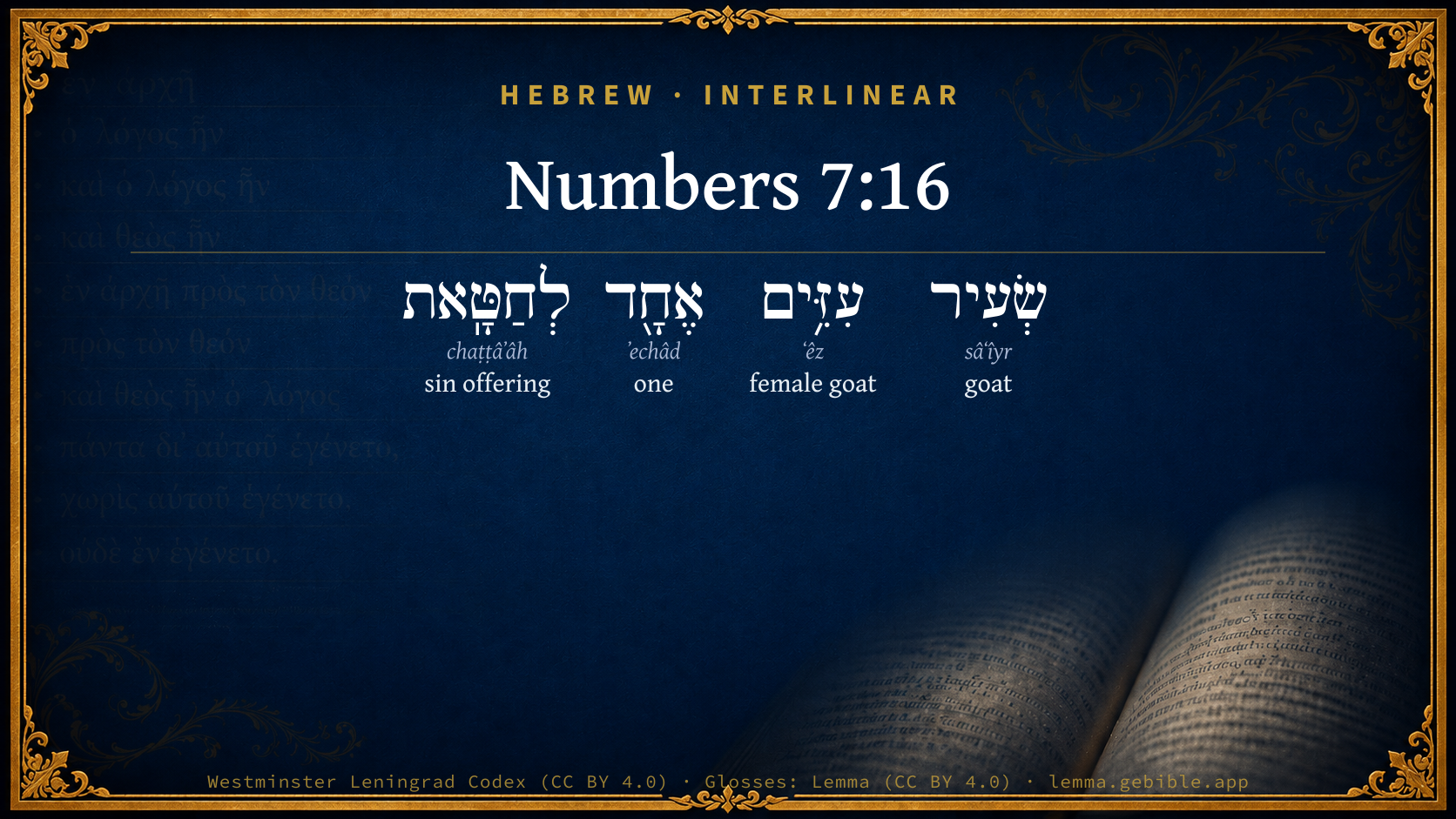
Numbers 7:16

Hebrew (Westminster Leningrad Codex) Numbers 7:16 appears in the Hebrew Old Testament. The text above is from the Westminster Leningrad Codex. Each word links to its Strong’s number, a concise gloss, and parsing drawn from the Open Scriptures Hebrew Bible morphology. Click any word for its full Brown-Driver-Briggs (BDB) entry.
Download image
Cite this verse

Numbers 7:16 (World English Bible). Public Domain. Lemma interlinear Bible study tool, https://lemma.gebible.app/v/numbers/7/16.

Show BibTeX & RIS
BibTeX
RIS
English Translation
one male goat for a sin offering;
World English Bible · Public Domain
Download a study sheet

One document with this verse’s original text, its word-by-word gloss line, the meaning frame, cross-references with their text, attributed commentary, and full source and license credits — printable, and it pastes into notes with its structure intact.

This verse Autodidact and up

Study sheet (.html) Plain text (.txt)

A passage Seminary Student

Up to 50 verses in one chapter. A passage sheet keeps up to 6 commentary sources and 12 cross-references per verse, in the order this page ranks them, and says so on the sheet whenever that leaves anything out. Ask for a single verse and you get the Autodidact verse sheet above.

Everything on this page stays free to read, with no account — the sheet is a download of what is already on screen, not access to it.

Want to remove ads? Support Godless Engineer
Compare translations 3

The same verse in 3 English versions, stacked beneath the original-language interlinear above. Click any original word for its lexicon entry.

Each is an independent rendering of the whole verse — the interlinear is not word-aligned to these translations.

Highlighted words mark where these versions differ — a whole-verse word diff, not a word-by-word alignment.

  • World English Bible Public Domain
    one male goat for a sin offering;
  • King James Version Public Domain
    One kid of the goats for a sin offering:
  • unfoldingWord Literal Text CC BY-SA 4.0
    one buck of the goats for a sin offering,

unfoldingWord Literal Text — © unfoldingWord, licensed CC BY-SA 4.0. Word-aligned USFM3 via Door43 (git.door43.org/unfoldingWord/en_ult).

Versions to compare (up to 4)

3 of 4 selected

Show all 18 translations

Every available English version of this verse, each an independent rendering of the whole verse.

  • World English Bible Public Domain
    one male goat for a sin offering;
  • Berean Standard Bible Public Domain
    one male goat for a sin offering;
  • Majority Standard Bible Public Domain
    one male goat for a sin offering;
  • King James Version Public Domain
    One kid of the goats for a sin offering:
  • American Standard Version (1901) Public Domain
    one male of the goats for a sin-offering;
  • Revised Version (1885) Public Domain
    one male of the goats for a sin offering;
  • Geneva Bible (1599) Public Domain
    An hee goate for a sinne offring,
  • Douay-Rheims (1899) Public Domain
    And his offering was a silver dish weighing one hundred and thirty sides, a silver bowl of seventy sides according to the weight of the sanctuary, both full of flour tempered with oil for
  • Young's Literal Translation Public Domain
    one kid of the goats for a sin-offering;
  • Literal Standard Version CC BY-SA 4.0
    one kid of the goats for a sin-offering;
  • Unlocked Literal Bible CC BY-SA 4.0
    He gave one male goat as a sin offering.
  • unfoldingWord Literal Text CC BY-SA 4.0
    one buck of the goats for a sin offering,
  • Darby Bible Public Domain
    one buck of the goats for a sin-offering;
  • World Messianic Bible Public Domain
    one male goat for a sin offering;
  • Webster's Bible Public Domain
    One kid of the goats for a sin-offering:
  • Free Bible Version CC BY-SA 4.0
    a male goat as a sin offering,
  • Bible in Basic English Public Domain
    One male of the goats for a sin-offering;
  • JPS Tanakh (1917) Public Domain
    one male of the goats for a sin-offering;

Literal Standard Version (2020), Covenant Press — licensed CC BY-SA 4.0. Text via the HelloAO Bible API (eBible.org). Unlocked Literal Bible (unfoldingWord) — licensed CC BY-SA 4.0. Text via the HelloAO Bible API (eBible.org). unfoldingWord Literal Text — © unfoldingWord, licensed CC BY-SA 4.0. Word-aligned USFM3 via Door43 (git.door43.org/unfoldingWord/en_ult). Free Bible Version, Dr. Jonathan Gallagher — licensed CC BY-SA 4.0. Text via the HelloAO Bible API (eBible.org).

Word by word

More ways to search: Search by grammar → Find every occurrence → Compare this word →

Practice this passage: Drill this verse → Learn its vocabulary →

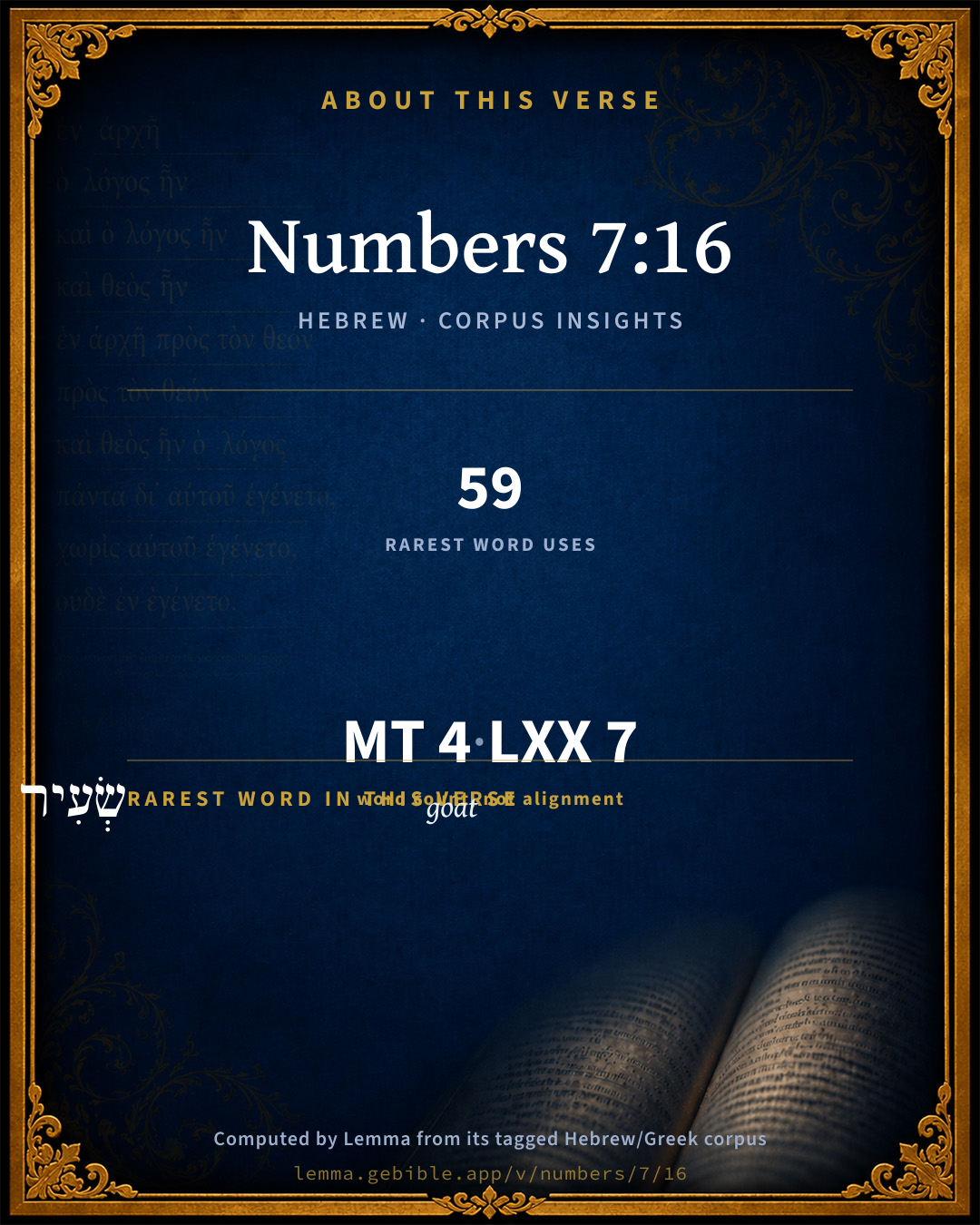
About this verse

These counts appear in no published source. They are computed here, from the morphology-tagged text and Lemma’s own curated glosses. What Lemma adds →

4
words
4
distinct lemmas
Pentateuch
section

Shared distinctive vocabulary

שְׂעִיר goat H8163 occurs in 57 verses of the Hebrew Bible. Also found in:

Grammatical profile

  • 3 nouns
  • 1 adjective

Hebrew & Septuagint length

In English translation the verse runs 7 words from the Hebrew and 9 from the Septuagint (LXX English) — closely comparable.

A rough comparison of the two English renderings, which tokenize alike — not a word-level alignment.

Word counts can differ between the Hebrew and the Greek without any difference in meaning — e.g. the Hebrew direct-object marker אֵת has no separate Greek word, and Greek often adds the article ὁ.

In the original languages it is 4 Hebrew tokens and 7 Greek tokens — but the two are counted differently (Hebrew bundles its prefixes and suffixes into one token; the Greek is in lemma form), so that isn’t a like-for-like length.

Cross-references

2

Topical passages linked to Numbers 7:16 in the Treasury of Scripture Knowledge — connected by theme and wording, ordered by reader-vote popularity; previews shown in the World English Bible.

  • Leviticus 4:23 if his sin, in which he has sinned, is made known to him, he shall bring as his offering a goat, a male without blemish.
  • Leviticus 4:25 The priest shall take some of the blood of the sin offering with his finger, and put it on the horns of the altar of burnt offering. He shall pour out the rest of its blood at the base of the altar of burnt offering.

Cross-references courtesy of OpenBible.info (CC BY 4.0).

Hebrew and Greek witnesses Masoretic Hebrew ↔ Greek Septuagint

The same verse in the two great witnesses to the Old Testament, shown verse-for-verse.

These are two independent witnesses, not word-aligned to each other, and the Septuagint is shown in lemma (dictionary) form.

Hebrew Numbers 7:16 Masoretic · Westminster Leningrad Codex

שְׂעִיר עִזִּ֥ים אֶחָ֖ד לְחַטָּֽאת

one male goat for a sin offering;

World English Bible · Public Domain

Greek LXX Numbers 7:16 Septuagint · lemma form

καί χίμαρος ἐκ αἴξ εἷς περί ἁμαρτία

and one kid of the goats for a sin-offering.

LXX2012 (modern English Septuagint) · Public Domain

On this verse, The Pulpit Commentary discusses the Septuagint’s reading. Read the note in Commentary ↓

Hebrew: Westminster Leningrad Codex (CC BY 4.0). Greek: Septuagint (public domain); English from LXX2012 (modern English Septuagint) (Public Domain). How the Septuagint differs from the Hebrew →

Targum (Aramaic paraphrase)

2

The Targum is the ancient Jewish Aramaic paraphrase of the Hebrew Scriptures — an interpretive translation, not the Hebrew text itself. Onkelos (literal) and Pseudo-Jonathan (expansive) render the Torah, and Jonathan the Prophets. Coverage is partial: where no permissively-licensed English translation exists for a verse, only the Aramaic is shown. This is verse-level text, not a word-by-word alignment to the Hebrew.

  1. Targum Onkelos Torah (Genesis–Deuteronomy)
    צְפִיר בַּר עִזִּין חַד לְחַטָּאתָא

    (no public-domain English translation for this verse)

    Targum Onkelos — Aramaic: “Onkelos Genesis” (public domain); “Onkelos Exodus” (public domain); “Onkelos Leviticus” (public domain); “Onkelos Numbers” (public domain); “Onkelos Deuteronomy” (public domain). English: “Sefaria Community Translation” (CC0 1.0 (public-domain dedication)); “J.W. Etheridge. The Targums of Onkelos and Jonathan Ben Uzziel on the Pentateuch. London: Longmans, Green, 1862” (public domain). Text via Sefaria.

  2. Targum Pseudo-Jonathan Torah (Genesis–Deuteronomy)
    צְפִיר בַּר עִזִין חָד קְרִיב לְחַטָאתָא

    one kid of the goats he brought for a sin offering;

    Targum Pseudo-Jonathan — Aramaic: “Targum Jonathan on Genesis” (public domain); “Targum Jonathan on Exodus” (public domain); “Targum Jonathan on Leviticus” (public domain); “Targum Jonathan on Numbers” (public domain); “Targum Jonathan on Deuteronomy” (public domain). English: “The Targum of Jonathan ben Uzziel, trans. J. W. Etheridge, London, 1862” (public domain). Text via Sefaria.

Commentary

Notes on Numbers 7:16 from classic Christian and Jewish commentators (each source and its license shown beneath its notes). The classic Christian expositions comment on the surrounding passage and are grouped to its opening verse, so a note may address several verses; the Jewish commentaries on the Tanakh (Rashi and others) are per-verse, so they appear only where the commentator wrote on this verse.

Lemma curates 59 commentaries, every one of them public domain or Creative Commons licensed, each selected and text-cleaned for this edition rather than reprinted as found. About our sources →

The Pulpit Commentary

One kid of the goats. Literally, "one shaggy one." Hebrew, sa "eer. Septuagint, cimaron . (see on Lev_4:23) It is noticeable that while the burnt offerings and peace offerings were multiplied, the sin offering remained a single victim.

The universality of the sin offering.

The sin offering was one of the expiatory sacrifices of the law. We meet with it so often and under such varied circumstances that it bears a striking testimony

(1) to the universality of sin, and

(2) to the need of an absolute, world-wide, everlasting atonement.

Classifying the references to the sin offering, we find various illustrations of this truth, fruitful of application to our need of the great offering" for sin at all times, and under the manifold circumstances of private and public life. The sin offering was required, and presented.

1. From one end of the year to the other, on every return of the new moon. (Num_28:15)

2. On feasts as well as fasts; at the feasts of Pentecost, trumpets, and tabernacles, (Lev_23:19 Num_29:5, Num_29:16) as well as on the day of atonement. (Le 16)

3. In connection with voluntary dedication, whether of gifts, (Num_7:16) or of personal consecration, as of the Nazarite. (Num_6:14)

4. At the consecration to sacred offices, as e.g. Aaron, (Exo_29:14) or the Levites. (Num_8:5-12)

5. At the consecration of sacred things, e.g., the altar of incense. (Exo_30:10) A sin offering was presented every year for the sanctuary. (Lev_16:15, Lev_16:16)

6. For sins of all classes of men; e.g., a priest, the whole congregation, a ruler, "one of the common people". (Le 4) In these offerings there were gradations, according to position and privilege, or according to means. (Lev_5:6, Lev_5:7)

7. For purification from unavoidable defilement, whether of leprosy (Lev_14:22) or childbirth. (Lev_12:6-8)

8. These offerings were for sins of omission or of ignorance, but not for presumptuous sins. P. (Le 5 Num_15:22-31 Heb_10:26, Heb_10:27)

The Pulpit Commentary (1880–1919), ed. H.D.M. Spence-Jones & Joseph S. Exell — public domain. Text from a community e-Sword module.

John Gill's Exposition

One kid of the goats for a sin offering. Though these offerings of the princes were by way of thanksgiving, and to express their joy and gladness at the erection of the tabernacle, its altars, and the service thereof; yet as this might not be without sin, which attends the best and purest performances of men, a sin offering was required, teaching us to look to Christ, who was made an offering for sin, for the taking away the sins of our holy things.

One kid of the goats for a sin offering. Though these offerings of the princes were by way of thanksgiving, and to express their joy and gladness at the erection of the tabernacle, its altars, and the service thereof; yet as this might not be without sin, which attends the best and purest performances of men, a sin offering was required, teaching us to look to Christ, who was made an offering for sin, for the taking away the sins of our holy things.

Numbers 7:17

num 7:17

num 7:17

num 7:17And for a sacrifice of peace offerings,.... So that here were all sorts of offerings on this occasion, meat and drink offerings, burnt offerings, sin offerings, and peace offerings: and for the latter were brought

two oxen, five rams, five he goats, five lambs of the first year; the reason why so many were brought and used for this sort of sacrifice was, because with these a feast was made, of which not only the priests partook, but the princes, and as many of their friends and acquaintance as they thought fit to invite:

this was the offering of Nahshon the son of Amminadab: which he offered out of his own substance, as the Targums of Jonathan and Jerusalem paraphrase it; though some have thought, that the presents and offerings were so large, and the princes not so very rich, or so much above the common people, as may be thought, that therefore they were assisted by the several tribes they were princes of: and as was this prince's offering, so were all the rest that follow in the order, according to their encampment under the several standards where they were fixed; and which were offered successively every day, the sabbath day or days not excepted, these being religious services, until the whole twelve were finished; and their presents and their offerings were exactly the same, and the account of them is given in the same words; they either agreeing together to make the same presents and offerings, or else they were directed to do so by the Spirit of God; whereby might be signified the common and equal right that they, and the tribes they represented, had in the altars, and the benefits arising from thence; as those that believe in Christ have an altar which is himself, they have a joint right to partake of, and have an equal share in the benefits of righteousness, peace, pardon, and atonement by him; see Heb 13:10; wherefore there is nothing more particularly to be observed in Num 7:17; only that in the several accounts of the presents and offerings of each prince, the vowel points in the Hebrew text are omitted, excepting in the names of persons that offer; which does not at all militate against the antiquity of the points, or their being coeval with the consonants, since, both in manuscripts and printed copies, these may be left out for brevity's sake, and quicker dispatch, and without any detriment, since they may be easily supplied from the first instance given; and they may be omitted on purpose, that these accounts might be the more taken notice of as a very wonderful thing, that their presents and offerings should be exactly alike; since the vowels being wanting, the naked letters may the more strike the eye, and lead the mind to notice them; and whereas the accents are all along continued, the reason of which may be, because the vowels once put, and read, might be more easily known, especially by one skilful in the Hebrew language, than the stops, distinctions, and divisions of the text, as a learned man has observed (i).

(i) Vid. Pfeiffer. Dubia vexata, cent. 2. loc. 19. p. 147.

John Gill's Exposition of the Whole Bible (1746–1763) — public domain (CC PDM 1.0). Text via the HelloAO Bible API.

Whedon's Commentary on the Bible

Daniel D. Whedon

16. Sin offering — See Leviticus 4, notes.

Daniel D. Whedon (gen. ed.), Commentary on the Old and New Testaments (1874–1909) — public domain. Text from a community e-Sword module.

Rashi

Rabbi Shlomo Yitzchaki (Rashi)

שעיר עזים אחד לחטאת ONE KID OF THE GOATS FOR A SIN-OFFERING, to make expiation for uncleanness caused by a grave in the depths of the earth, (i.e. one that is not known to exist and it might therefore be assumed that people passed over it and thereby unwittingly became unclean), which was only a doubtful uncleanness (one about which there exists a doubt as to whether it actually has been incurred or not) (cf. Sifrei Bamidbar 51).

Rashi on the Tanakh — English translations: “The Judaica Press complete Tanach with Rashi, translated by A. J. Rosenberg” (CC BY 4.0); “Pentateuch with Rashi's commentary by M. Rosenbaum and A.M. Silbermann, 1929-1934” (public domain); “The Metsudah Tanach series, Lakewood, N.J” (CC BY 4.0); and “The Book of Joshua, Metsudah Publications, 1997” (CC BY 4.0). Text via Sefaria.

Lesson kit

Teaching starters — assembled from the data on this page, not authored interpretation. Every prompt links to the verse data it draws on. Edit before teaching.

Numbers, in the Pentateuch, opens this verse with 4 words (4 distinct Hebrew lemmas). Its most distinctive word is sâʻîyr (“goat”). A historical commentator’s framing appears above. Read the whole chapter for the surrounding context.

Discussion questions

  1. How does “goat” (sâʻîyr) shape what this verse is saying?
  2. Genesis 27:11 shares the word «goat» with this verse. How do the two illuminate each other?
  3. These translations render this verse differently. What is at stake in choosing one wording over another?
  4. Reading how The Pulpit Commentary and John Gill's Exposition read this verse, where do the two commentators agree and where do they part?

Things to notice

Reading settings

Reading text

Shown beneath each verse's original-language words.

Old Testament
Old Testament edition

Read the OT as the Masoretic Hebrew (MT) or the Greek Septuagint (LXX).

English shown for the Greek Septuagint (in the Hebrew ↔ Greek comparison).

Comparing translations? Open the Compare panel on any verse page to stack up to four side by side.