
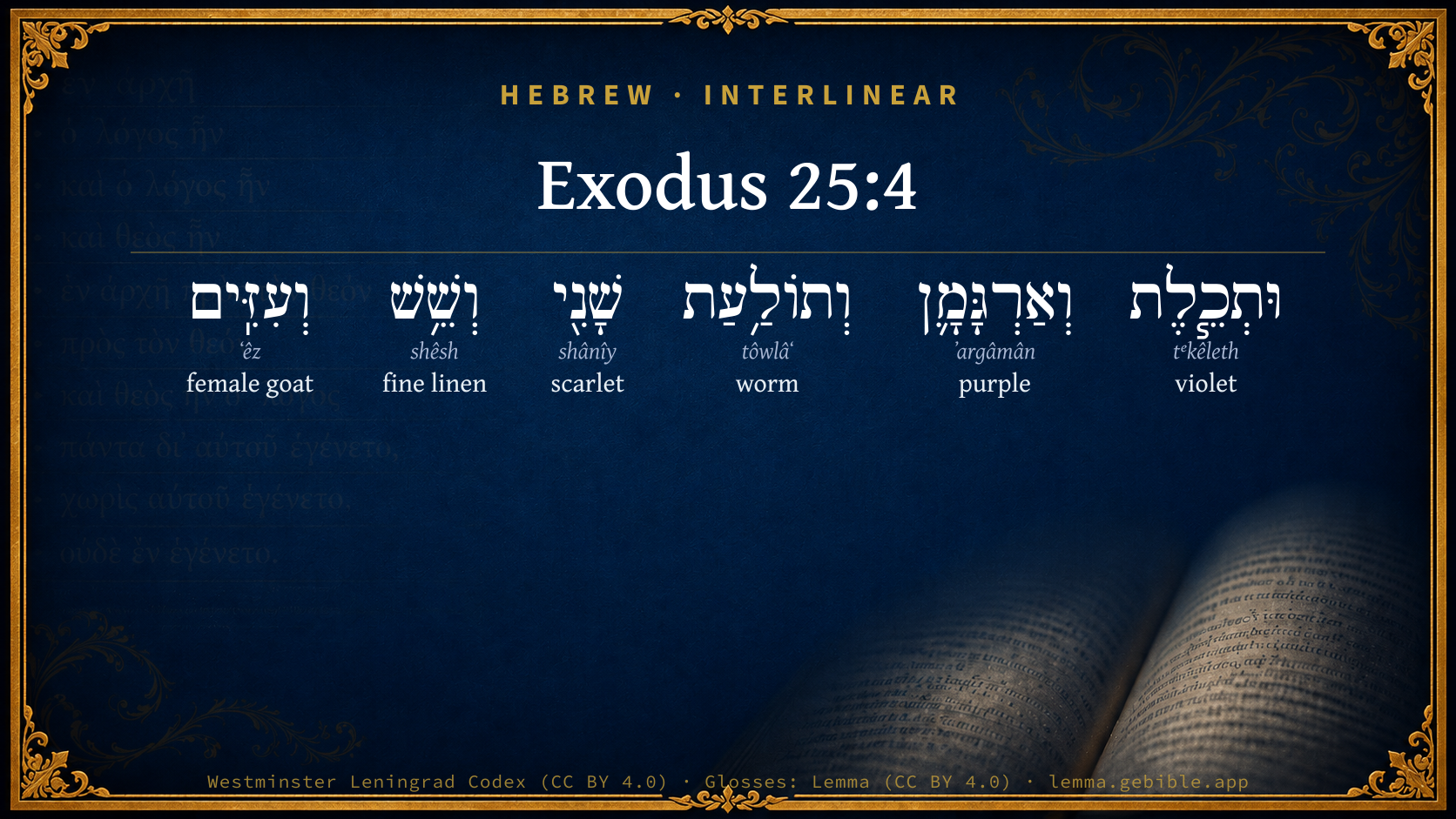
Exodus 25:4

Hebrew (Westminster Leningrad Codex) Exodus 25:4 appears in the Hebrew Old Testament. The text above is from the Westminster Leningrad Codex. Each word links to its Strong’s number, a concise gloss, and parsing drawn from the Open Scriptures Hebrew Bible morphology. Click any word for its full Brown-Driver-Briggs (BDB) entry.
Download image
Cite this verse

Exodus 25:4 (World English Bible). Public Domain. Lemma interlinear Bible study tool, https://lemma.gebible.app/v/exodus/25/4.

Show BibTeX & RIS
BibTeX
RIS
English Translation
blue, purple, scarlet, fine linen, goats' hair,
World English Bible · Public Domain
Highlights Full analysis ↓
Download a study sheet

One document with this verse’s original text, its word-by-word gloss line, the meaning frame, cross-references with their text, attributed commentary, and full source and license credits — printable, and it pastes into notes with its structure intact.

This verse Autodidact and up

Study sheet (.html) Plain text (.txt)

A passage Seminary Student

Up to 50 verses in one chapter. A passage sheet keeps up to 6 commentary sources and 12 cross-references per verse, in the order this page ranks them, and says so on the sheet whenever that leaves anything out. Ask for a single verse and you get the Autodidact verse sheet above.

Everything on this page stays free to read, with no account — the sheet is a download of what is already on screen, not access to it.

Want to remove ads? Support Godless Engineer
Compare translations 3

The same verse in 3 English versions, stacked beneath the original-language interlinear above. Click any original word for its lexicon entry.

Each is an independent rendering of the whole verse — the interlinear is not word-aligned to these translations.

Highlighted words mark where these versions differ — a whole-verse word diff, not a word-by-word alignment.

  • World English Bible Public Domain
    blue, purple, scarlet, fine linen, goats' hair,
  • King James Version Public Domain
    And blue, and purple, and scarlet, and fine linen, and goats' hair,
  • unfoldingWord Literal Text CC BY-SA 4.0
    and blue and purple and worm of scarlet and fine linen and goats’ hair

unfoldingWord Literal Text — © unfoldingWord, licensed CC BY-SA 4.0. Word-aligned USFM3 via Door43 (git.door43.org/unfoldingWord/en_ult).

Versions to compare (up to 4)

3 of 4 selected

Show all 18 translations

Every available English version of this verse, each an independent rendering of the whole verse.

  • World English Bible Public Domain
    blue, purple, scarlet, fine linen, goats' hair,
  • Berean Standard Bible Public Domain
    blue, purple, and scarlet yarn; fine linen and goat hair;
  • Majority Standard Bible Public Domain
    blue, purple, and scarlet yarn; fine linen and goat hair;
  • King James Version Public Domain
    And blue, and purple, and scarlet, and fine linen, and goats' hair,
  • American Standard Version (1901) Public Domain
    and blue, and purple, and scarlet, and fine linen, and goats' `hair',
  • Revised Version (1885) Public Domain
    and blue, and purple, and scarlet, and fine linen, and goats’ hair;
  • Geneva Bible (1599) Public Domain
    And blewe silke, and purple, and skarlet, and fine linnen, and goates heare,
  • Douay-Rheims (1899) Public Domain
    Violet and purple, and scarlet twice dyed, and fine linen, and goats' hair,
  • Young's Literal Translation Public Domain
    and blue, and purple, and scarlet, and linen, and goats' `hair',
  • Literal Standard Version CC BY-SA 4.0
    and blue, and purple, and scarlet, and linen, and goats’ [hair],
  • Unlocked Literal Bible CC BY-SA 4.0
    blue, purple, and scarlet material; fine linen; goats' hair;
  • unfoldingWord Literal Text CC BY-SA 4.0
    and blue and purple and worm of scarlet and fine linen and goats’ hair
  • Darby Bible Public Domain
    and blue, and purple, and scarlet, and byssus, and goats' [hair],
  • World Messianic Bible Public Domain
    blue, purple, scarlet, fine linen, goats’ hair,
  • Webster's Bible Public Domain
    And blue, and purple, and scarlet, and fine linen, and goats' hair.
  • Free Bible Version CC BY-SA 4.0
    blue, purple, and crimson thread; finely-spun linen and goat hair;
  • Bible in Basic English Public Domain
    And blue and purple and red, and the best linen, and goats' hair;
  • JPS Tanakh (1917) Public Domain
    and blue, and purple, and scarlet, and fine linen, and goats' hair;

Literal Standard Version (2020), Covenant Press — licensed CC BY-SA 4.0. Text via the HelloAO Bible API (eBible.org). Unlocked Literal Bible (unfoldingWord) — licensed CC BY-SA 4.0. Text via the HelloAO Bible API (eBible.org). unfoldingWord Literal Text — © unfoldingWord, licensed CC BY-SA 4.0. Word-aligned USFM3 via Door43 (git.door43.org/unfoldingWord/en_ult). Free Bible Version, Dr. Jonathan Gallagher — licensed CC BY-SA 4.0. Text via the HelloAO Bible API (eBible.org).

Word by word

More ways to search: Search by grammar → Find every occurrence → Compare this word →

Practice this passage: Drill this verse → Learn its vocabulary →

About this verse

These counts appear in no published source. They are computed here, from the morphology-tagged text and Lemma’s own curated glosses. What Lemma adds →

6
words
6
distinct lemmas
Pentateuch
section

First appearance in Scripture

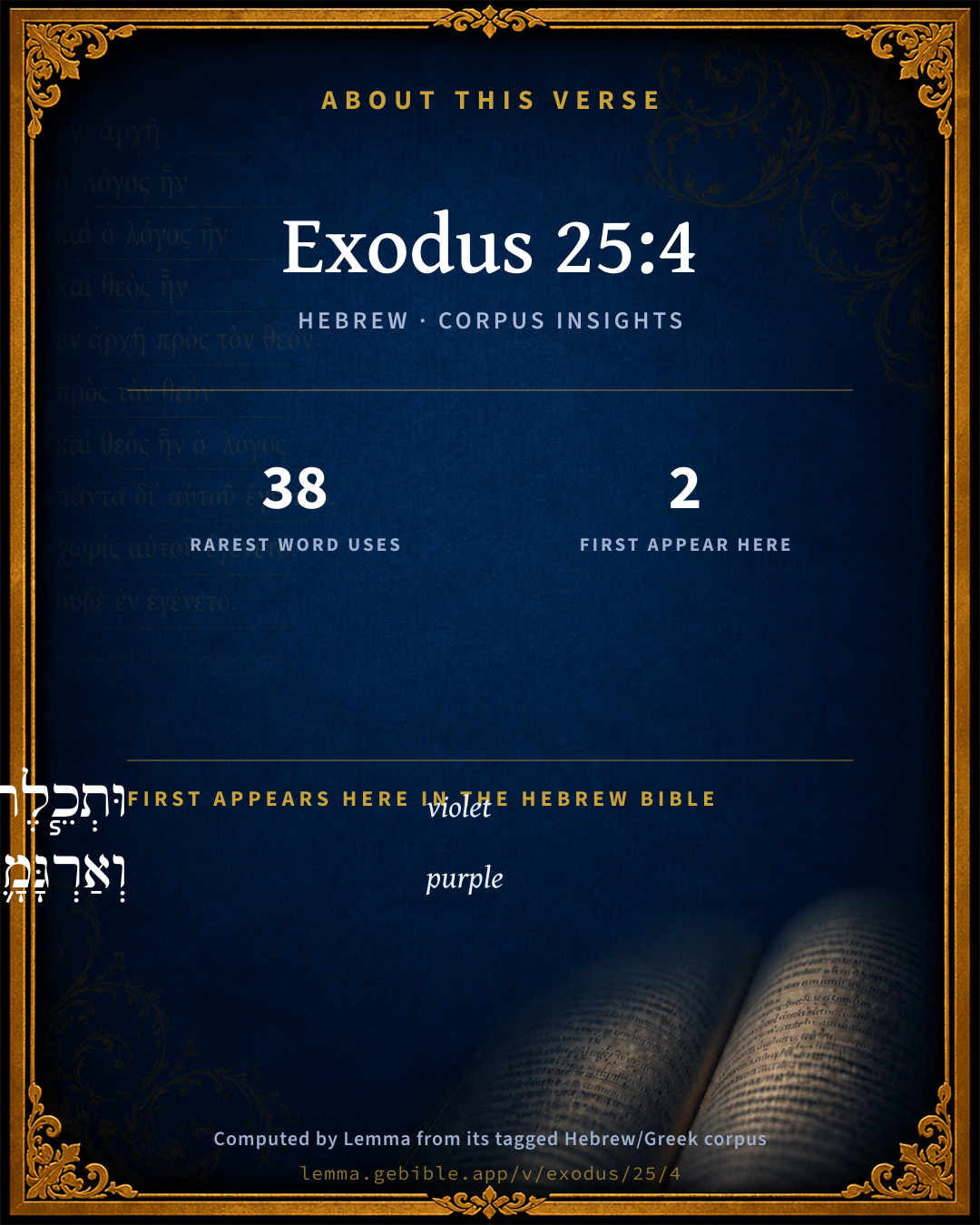
These words make their first canonical appearance in the Hebrew Bible here:

  • וּתְכֵ֧לֶת violet H8504
  • וְאַרְגָּמָ֛ן purple H713

Shared distinctive vocabulary

וְאַרְגָּמָ֛ן purple H713 occurs in 38 verses of the Hebrew Bible. Also found in:

Grammatical profile

  • 5 nouns
  • 1 adjective

Hebrew & Septuagint length

In English translation the verse runs 7 words from the Hebrew and 14 from the Septuagint (LXX English) — the Septuagint runs noticeably longer here. See the side-by-side →

A rough comparison of the two English renderings, which tokenize alike — not a word-level alignment.

Word counts can differ between the Hebrew and the Greek without any difference in meaning — e.g. the Hebrew direct-object marker אֵת has no separate Greek word, and Greek often adds the article ὁ.

Cross-references

3

Topical passages linked to Exodus 25:4 in the Treasury of Scripture Knowledge — connected by theme and wording, ordered by reader-vote popularity; previews shown in the World English Bible.

  • Revelation 19:8 It was given to her that she would array herself in bright, pure, fine linen: for the fine linen is the righteous acts of the saints.
  • Genesis 41:42 Pharaoh took off his signet ring from his hand, and put it on Joseph's hand, and arrayed him in robes of fine linen, and put a gold chain about his neck,
  • Ezekiel 16:10 I clothed you also with embroidered work, and shod you with sealskin, and I girded you about with fine linen, and covered you with silk.

Cross-references courtesy of OpenBible.info (CC BY 4.0).

Hebrew and Greek witnesses Masoretic Hebrew ↔ Greek Septuagint

The same verse in the two great witnesses to the Old Testament, shown verse-for-verse.

Here the Septuagint runs noticeably longer than the Hebrew — LXX2012 (modern English Septuagint) 14 words vs World English Bible 7. A rough length comparison of the two English translations, not a word-level alignment — read both below.

These are two independent witnesses, not word-aligned to each other, and the Septuagint is shown in lemma (dictionary) form.

Hebrew Exodus 25:4 Masoretic · Westminster Leningrad Codex

וּתְכֵ֧לֶת וְאַרְגָּמָ֛ן וְתוֹלַ֥עַת שָׁנִ֖י וְשֵׁ֥שׁ וְעִזִּֽים

blue, purple, scarlet, fine linen, goats' hair,

World English Bible · Public Domain

Greek LXX Exodus 25:4 Septuagint · lemma form

καί ὑάκινθος καί πορφύρα καί κόκκινος διπλοῦς καί βύσσος κλώθω καί θρίξ αἴγειος

and blue, and purple, and double scarlet, and fine spun linen, and goats' hair,

LXX2012 (modern English Septuagint) · Public Domain

On this verse, Adam Clarke's Commentary discusses the Septuagint’s reading. Read the note in Commentary ↓

Hebrew: Westminster Leningrad Codex (CC BY 4.0). Greek: Septuagint (public domain); English from LXX2012 (modern English Septuagint) (Public Domain). How the Septuagint differs from the Hebrew →

Targum (Aramaic paraphrase)

2

The Targum is the ancient Jewish Aramaic paraphrase of the Hebrew Scriptures — an interpretive translation, not the Hebrew text itself. Onkelos (literal) and Pseudo-Jonathan (expansive) render the Torah, and Jonathan the Prophets. Coverage is partial: where no permissively-licensed English translation exists for a verse, only the Aramaic is shown. This is verse-level text, not a word-by-word alignment to the Hebrew.

  1. Targum Onkelos Torah (Genesis–Deuteronomy)
    וְתִכְלָא וְאַרְגְוָנָא וּצְבַע זְהוֹרִי וּבוּץ וּמֵעַזֵי:

    (no public-domain English translation for this verse)

    Targum Onkelos — Aramaic: “Onkelos Genesis” (public domain); “Onkelos Exodus” (public domain); “Onkelos Leviticus” (public domain); “Onkelos Numbers” (public domain); “Onkelos Deuteronomy” (public domain). English: “Sefaria Community Translation” (CC0 1.0 (public-domain dedication)); “J.W. Etheridge. The Targums of Onkelos and Jonathan Ben Uzziel on the Pentateuch. London: Longmans, Green, 1862” (public domain). Text via Sefaria.

  2. Targum Pseudo-Jonathan Torah (Genesis–Deuteronomy)
    וְתִכְלָא וְאַרְגְּוָונָא וּצְבַא זְהוֹרֵי וּבוּץ וּמֵעַזֵּי

    and hyacinth, and purple, and crimson, and fine linen; and goats' skins,

    Targum Pseudo-Jonathan — Aramaic: “Targum Jonathan on Genesis” (public domain); “Targum Jonathan on Exodus” (public domain); “Targum Jonathan on Leviticus” (public domain); “Targum Jonathan on Numbers” (public domain); “Targum Jonathan on Deuteronomy” (public domain). English: “The Targum of Jonathan ben Uzziel, trans. J. W. Etheridge, London, 1862” (public domain). Text via Sefaria.

Commentary

Notes on Exodus 25:4 from classic Christian and Jewish commentators (each source and its license shown beneath its notes). The classic Christian expositions comment on the surrounding passage and are grouped to its opening verse, so a note may address several verses; the Jewish commentaries on the Tanakh (Rashi and others) are per-verse, so they appear only where the commentator wrote on this verse.

Lemma curates 59 commentaries, every one of them public domain or Creative Commons licensed, each selected and text-cleaned for this edition rather than reprinted as found. About our sources →

Trapp's Complete Commentary

John Trapp

Exo 25:4 And blue, and purple, and scarlet, and fine linen, and goats’ [hair],

Ver. 4. And blue, and purple, and scarlet,] i.e., Wool dyed with these colours; {Heb 9:19} to teach the Church that both themselves and their actions should be washed and dyed in the blood of Christ.

John Trapp, A Commentary or Exposition upon All the Books of the Old and New Testament (1647–1656) — public domain. Text from a community e-Sword module.

Joseph Benson's Commentary

Exo 25:4-5. Blue, and purple, and scarlet — Materials of those colours. Shittim-wood — A kind of wood growing in Egypt and the deserts of Arabia, very durable and precious.

Joseph Benson's Commentary on the Old and New Testaments (1811–1818) — public domain. Text from a community e-Sword module.

Geneva Bible (1599)

Geneva Bible translators

Or, yellow.

Geneva Bible (1599) marginal notes — public domain. Text via Bolls.life.

Jamieson, Fausset & Brown

Robert Jamieson, A. R. Fausset & David Brown

goats' hair--or leather of goats' skin.

Jamieson, Fausset & Brown — Commentary Critical and Explanatory on the Whole Bible (1871) — public domain (CC PDM 1.0). Text via the HelloAO Bible API.

Adam Clarke's Commentary

Verse 4. Blue] תכלת techeleth, generally supposed to mean an azure or sky colour; rendered by the Septuagint ὑακινθον, and by the Vulgate hyacinthum, a sky-blue or deep violet.

Purple] ארגמן argaman, a very precious colour, extracted from the purpura or murex, a species of shell-fish, from which it is supposed the famous Tyrian purple came, so costly, and so much celebrated in antiquity. See this largely described, and the manner of dyeing it, in Pliny, Hist. Nat., lib. ix., c. 60-65, edit. Bipont.

Scarlet] תולעת tolaath, signifies a worm, of which this colouring matter was made; and, joined with שני shani, which signifies to repeat or double, implies that to strike this colour the wool or cloth was twice dipped: hence the Vulgate renders the original coccum bis tinctum, "scarlet twice dyed;" and to this Horace refers, Odar., lib. ii., od. 16, v. 35: -

------------Te BIS Afro

Murice TINCTAE

Vestiunt LANAE.-----

"Thy robes the twice dyed purple stains."

It is the same colour which the Arabs call al kermez, whence the French cramoisi, and the English crimson. On this subject much may be seen in Bochart, Calmet, and Scheuchzer.

Fine linen] שש shesh; whether this means linen, cotton, or silk, is not agreed on among interpreters. Because שש shesh signifies six, the rabbins suppose that it always signifies the fine linen of Egypt, in which six folds constituted one thread; and that when a single fold was meant, בד bad is the term used. See Clarke on Ge 41:42.

Goats' hair] עזים izzim, goats, but used here elliptically for goats' hair. In different parts of Asia Minor, Syria, Cilicia, and Phrygia, the goats have long, fine, and beautiful hair, in some cases almost as fine as silk, which they shear at proper times, and manufacture into garments. From Virgil, Georg. iii., v. 305-311, we learn that goats' hair manufactured into cloth was nearly of equal value with that formed from wool.

Hae quoque non cura nobis leviore tuendae;

Nec minor usus erit: quamvis Milesia magno

Vellera mutentur, Tyrios incocta rubores.

Nec minus interea barbas incanaque menta

Cinyphii tondent hirci, setasque comantes,

Usum in castrorum, et miseris velamina nautis.

"For hairy goats of equal profit are

With woolly sheep, and ask an equal care.

'Tis true the fleece when drunk with Tyrian juice

Is dearly sold, but not for needful use:

Meanwhile the pastor shears their hoary beards

And eases of their hair the loaden herds.

Their camelots, warm in tents, the soldier hold,

And shield the shivering mariner from the cold."

DRYDEN.

Adam Clarke's Commentary on the Bible (1810–1826) — public domain. Text from a community e-Sword/MySword module.

Ellicott's Commentary for English Readers

(4) And blue, and purple, and scarlet.—The colours intended are probably a dark blue produced from indigo, which was the only blue known to the Egyptians, a purplish crimson derived from the murex trunculus, the main source of the “Tyrian dye” of the ancients, and a scarlet furnished by the coccus ilicis, or cochineal insect of the holm oak, which was largely employed in antiquity, though now superseded by the brighter tint obtained from the coccus cacti of Mexico. Linen yarn of the three colours mentioned seems to have been what the people were asked to furnish (Exo_35:25; Exo_39:1).

Fine linen—i.e., white thread spun from flax, which is found to be the material of almost all the Egyptian dresses, mummy cloths, and other undyed fabrics. It is of a yellowish white, soft, and wonderfully fine and delicate. (See Wilkinson in Rawlinson’s Herodotus, vol. ii., p. 233).

Goats’ hair.—The covering of an Arab tent is to this day almost always of goats’-hair. An excellent fabric is woven from the soft inner hair of the Syrian goat, and a coarse one from the outer coat of the animal. Yarn of goats’-hair was to be offered, that from it might be produced the first of the three outer coverings of the Tabernacle (Exo_26:7-14).

A Bible Commentary for English Readers, edited by Charles John Ellicott (1878–1897) — public domain. Text from a community e-Sword module.

The Cambridge Bible for Schools and Colleges

gen. ed. J. J. S. Perowne

4. Materials spun or woven.

blue] more exactly, purple-blue (LXX. ὑάκινθος, ὑακίνθινος, ‘dark blue’), or violet (Est_1:6 AV.), i.e. yarn or stump so coloured by means of a dye obtained from a shell-fish, found adhering to rocks in the Medit. Sea (cf. Eze_27:7), and said to be the Helix Ianthina (Ges. Thes. 1503; DB. i. 457a). Both this and the next named stuff were highly prized in antiquity, on account of their costliness and brilliancy. Violet is mostly mentioned in connexion with the Tent of meeting: but see also Jer_10:9, Eze_23:7; Eze_27:7; Eze_27:24, Est_1:6; Est_8:15, Sir_6:30.

purple] more exactly, purple-red (LXX. πορφύρα), a dye extracted from a small gland in the throat of two other species of shell-fish, the Murex brandaris and Murex trunculus, found on the coasts of Phoenicia (cf. Verg. ‘Tyrioque ardebat murice laena’). Robes of this colour were particularly distinctive of wealth and royalty: comp. Jdg_8:26, Eze_23:6, Son_3:10, 1Ma_4:23; 1Ma_10:20, Mar_15:17, Luk_16:19; and the frequent mention of purpura, purpureus by Latin authors in connexion with royalty.

scarlet] lit. ‘worm of shânî,’ i.e. probably (comp. the Arab, sanâ, to shine) ‘of brilliancy’ (cf. Pliny, H.N. xxxiii. 40 ‘cocci nitor’). The ‘worm’ is the cochineal insect, which resembles a berry, and is found attached to the leaves and twigs of the Syrian Holm-oak (whence its technical name of coccus ilicis): the colouring matter is obtained from the dried body of the female. (Our word ‘crimson’ comes from ḳirmiz, the Arabic name of the same insect.) See further NHB. 319, EB. i. 956, DB. iv. 416b. For allusions to this colour (outside the following chapters), see Isa_1:18, Jer_4:30, 2Sa_1:24, Pro_31:1.

fine linen] Heb. shçsh, prob. of Egypt, origin (cf. Eze_27:7; and Copt. shens = byssus): linen was much worn in Egypt by men of rank; see Erman, Index, or DB. s.v.; and cf. Gen_41:42. LXX. βύσσος, βύσσινος, from bûẓ, the later Heb. syn. of shçsh (found exclusively in Chr., Est., as 1Ch_15:27). The marg. cotton is less probable: see EB. iii. 2800. There was a superior quality of fine linen, called ‘fine twined linen’ (Exo_26:1; Exo_26:31; Exo_26:36, Exo_27:9; Exo_27:16; Exo_27:18, Exo_28:6; Exo_28:8; Exo_28:15, Exo_39:28-29): this was made from yarn of which each thread was composed of many delicate strands. The Egyptians excelled in work of this kind: Amâsis (b.c. 564–526) was said to have sent to Rhodes a corslet of which each thread consisted of 360 separate strands (Hdt. iii. 47, cited by Kn.; cf. Wilkinson-Birch, ii. 166 f.).

goats’ hair] This was spun by women into yarn (Exo_35:26): the fabric woven from it formed the ‘tent,’ or first covering, over the curtains constituting the ‘Dwelling’ (Exo_26:7). See also Exo 1Sa_19:13.

The Cambridge Bible for Schools and Colleges (gen. ed. J. J. S. Perowne; Cambridge University Press, 1878–1918) — public domain. Text from a community e-Sword module.

John Gill's Exposition

And blue, and purple, and scarlet,.... The Jewish doctors are much divided about the sense of the words so rendered by us; some will have one colour, and some another meant; but, according to those learned men, who have taken much pains in searching into the meaning of them, as Bochart and Braunius, it appears that our version of them is most correct: and by these we are not to understand the colours themselves, which could not be brought, nor even the materials for dying them are intended; but wool, or clothes, either silken or linen of those colours: of the former the apostle has taught us to expound them, Heb 9:19 and so Jarchi interprets them of wool thus died, and Josephus (a) also; which was made up into yarn, and wove, and was much used in the garments of the priests, in the curtains of the tabernacle, and in the vail between the holy and the most holy place:

and fine linen; the best of which was made in Egypt only, as Aben Ezra says, and much wore there, especially by the priests; and they had such an abundance of it that they traded to other nations with it, see Isa 19:9 and of which the Israelites might bring a considerable quantity with them out of Egypt; and

goats' hair; though the word hair is not in the text, it is rightly supplied, as it is by the Septuagint version, and others, for not goats themselves, but their hair must be meant; of this the curtains for the covering of the tabernacle were made; Jarchi interprets it the down of goats, the short, small, fine hair that grows under the other.

(a) Antiqu. l. 3. c. 6. sect. 1.

John Gill's Exposition of the Whole Bible (1746–1763) — public domain (CC PDM 1.0). Text via the HelloAO Bible API.

Haydock's Catholic Bible Commentary

Scarlet twice dyed. Aquila and Symmachus have transparent. This colour is often confounded with purple, as our Saviour’s robe is styled scarlet by St. Matthew xxvii. 28; and purple by St. John xix. 2. It was dyed with a worm called shani in Hebrew. (St. Jerome, ep. ad Fabiol.) --- Fine linen, byssus. Hebrew shesh, "or six folds," or it may mean cotton, which was highly esteemed by the ancients; (Arabic version; Herod.) and it is not probable that Moses would have passed over it unnoticed. (Calmet)

George Leo Haydock (1774–1849), Haydock's Catholic Family Bible and Commentary, 1859 edition — public domain. Excludes Psalms (Douay-Rheims chapter numbering differs from Protestant) and Deuterocanonical books (Catholic canon only).

Matthew Poole's English Annotations

Blue, or sky-coloured; but here you must not understand the mere colours, which could not be offered, but some materials proper for the work, and of the colours here mentioned, to wit, wool, or threads, or some suchlike things, as appears from Heb 9:19, and from the testimony of the Jews. Fine linen, which was of great esteem in ancient times, and used by priests and great officers of state. See Gen 41:42; Rev 19:8,14.

Goats’ hair; Heb. goats. But that their hair is understood, is apparent from the nature of the thing, and from the use of the word in that sense in other places.

Matthew Poole's English Annotations on the Holy Bible (1683–1685) — public domain. Text from a community e-Sword/MySword module.

Whedon's Commentary on the Bible

Daniel D. Whedon

4. Blue, and purple, and scarlet — The exact colours, tints, or shades denoted by the Hebrew words thus translated it is now hardly possible to determine with absolute certainty. The same may be said of the names of colours in all the ancient languages. The use of these different colours in the tabernacle probably served not only for the sake of beauty and variety, but also to suggest thoughts of heavenly excellence and glory. The three colours here named have always and everywhere been regarded as appropriate for the persons and palaces of kings. Blue, as the colour of the heaven, reflected in the sea, would naturally suggest that which is heavenly, holy, and divine. Hence it was appropriate that the robe of the ephod was made wholly of blue, (Exo_28:31; Exo_39:22,) and the breastplate was connected with it by blue cords, Exo_25:28. It was also by a blue cord or ribbon that the golden plate inscribed “Holiness to Jehovah” was attached to the high priest’s mitre, Exo_25:31. The loops of the tabernacle curtains were of this colour, (Exo_26:4,) and the children of Israel were commanded to place blue ribbons as badges upon the borders of their garments, (Num_15:37-41,) as if to remind them that they were children of the heavenly King, and were under the responsibility of having received from him commandments and revelations. Hence, too, it was appropriate that a blue cloth was spread over the holiest things of the tabernacle when they were arranged for journeying forward. Num_4:6-7; Num_4:11-12. Purple and scarlet, so often mentioned in connexion with the dress of kings, have very naturally been regarded as symbolical of royalty and majesty. Jdg_8:26; Est_8:15; Dan_5:7; Nah_2:3. Both these colours, along with blue, appeared upon the curtains of the tabernacle, (Exo_26:1,) and upon the vail that separated the holy place from the most holy. Exo_26:31. A scarlet cloth covered the holy vessels which were placed upon the table of showbread, and a purple cloth the altar of burnt offerings. Num_4:8; Num_4:13.

Fine linen — Hebrews שׁשׁ, shesh, believed to be an Egyptian word, translated by βυσσος in the Septuagint, and applied to an Egyptian fabric made of fine flax, and having a peculiar whiteness. Joseph’s vesture, when made ruler in Egypt, was of this material. Gen_41:42. It was used for the curtains and vails of the tabernacle, and for the garments of the priests. Exo_26:1; Exo_26:31; Exo_26:36; Exo_28:5-6; Exo_28:8; Exo_28:15; Exo_28:39.

Goats’ hair — A very solid fabric was woven of the hair of the goat, and was the most common material used for the covering of tents among the nomads of the East.

Daniel D. Whedon (gen. ed.), Commentary on the Old and New Testaments (1874–1909) — public domain. Text from a community e-Sword module.

The Pulpit Commentary

And blue, and purple, and scarlet. Cloths of these three colours seem to be meant. The material was probably wool; the blue dye probably indigo, which was the ordinary blue dye of Egypt; the purple was no doubt derived from one or other of the shell-fish so well-known to the Syrians (of which the one most used was the Murex trunculus), and was of a warm reddish hue, not far from crimson; the scarlet (literally, "scarlet worm" or worm scarlet,") was the produce of the Corcus ilicis, or cochineal insect of the holm oak, which has now been superseded by the Coccus cacti, or cochineal insect of the prickly pear, introduced into Europe from Mexico. And fine linen. The word used is Egyptian. It seems to have designated properly the fine linen spun from flax in Egypt, which was seldom dyed. and was of a beautiful soft white hue. The fineness of the material is extraordinary, equalling that of the best Indian muslins (Wilkinson"s Ancient Egyptians, vol. 3. p. 121). It would seem that the Israelite women spun the thread from the flax, (Exo_35:25) and that the skilled workmen employed by Moses wove the thread into linen (ib, 35). And goat"s hair. The soft inner wool of the Angora goat was also spun by the women into a fine worsted (ib, 26), which was woven into cloths, used especially as coverings for tents.

The Pulpit Commentary (1880–1919), ed. H.D.M. Spence-Jones & Joseph S. Exell — public domain. Text from a community e-Sword module.

John Wesley's Explanatory Notes

Blue, and purple, and scarlet - Materials of those colours.

John Wesley, Explanatory Notes Upon the Whole Bible (1754–1765) — public domain. Text via the GEBible commentary corpus.

Rashi

Rabbi Shlomo Yitzchaki (Rashi)

ותכלת AND BLUE PURPLE — wool dyed with the blood of the חלזון (a kind of shell-fish), the colour of which was greenish-blue (Menachot 44a).

וארגמן AND RED PURPLE — wool coloured with a kind of dye the name of which is ארגמן

ושש — this is what we call LINEN (Yevamot 4b).

ועזים is GOATS’ HAIR; therefore Onkelos translates it by וּמְעַזֵּי which denotes something that comes from the goats — not the goats themselves, for the Aramaic translation of עזים is עִזַּיָּא‎.

Rashi on the Tanakh — English translations: “The Judaica Press complete Tanach with Rashi, translated by A. J. Rosenberg” (CC BY 4.0); “Pentateuch with Rashi's commentary by M. Rosenbaum and A.M. Silbermann, 1929-1934” (public domain); “The Metsudah Tanach series, Lakewood, N.J” (CC BY 4.0); and “The Book of Joshua, Metsudah Publications, 1997” (CC BY 4.0). Text via Sefaria.

Lesson kit

Teaching starters — assembled from the data on this page, not authored interpretation. Every prompt links to the verse data it draws on. Edit before teaching.

Exodus, in the Pentateuch, opens this verse with 6 words (6 distinct Hebrew lemmas). Its most distinctive word is ʼargâmân (“purple”). The Greek Septuagint runs longer here. A historical commentator’s framing appears above. Read the whole chapter for the surrounding context.

Discussion questions

  1. What does “purple” (ʼargâmân) contribute to the verse as a whole?
  2. 2 words make their first appearance in Scripture here. What does this debut establish?
  3. How does Exodus 26:1, which shares the word «purple», read alongside this verse?
  4. The Septuagint runs longer here than the Hebrew. What might account for the difference?
  5. These translations render this verse differently. What is at stake in choosing one wording over another?
  6. Compare how Trapp's Complete Commentary and Joseph Benson's Commentary read this verse. Where do they agree or differ?

Things to notice

  • 2 words make their first canonical appearance in Scripture here.
  • These translations choose different wording for 1 word in this verse.
  • 6 distinct Hebrew lemmas span 6 words in this verse.

Reading settings

Reading text

Shown beneath each verse's original-language words.

Old Testament
Old Testament edition

Read the OT as the Masoretic Hebrew (MT) or the Greek Septuagint (LXX).

English shown for the Greek Septuagint (in the Hebrew ↔ Greek comparison).

Comparing translations? Open the Compare panel on any verse page to stack up to four side by side.