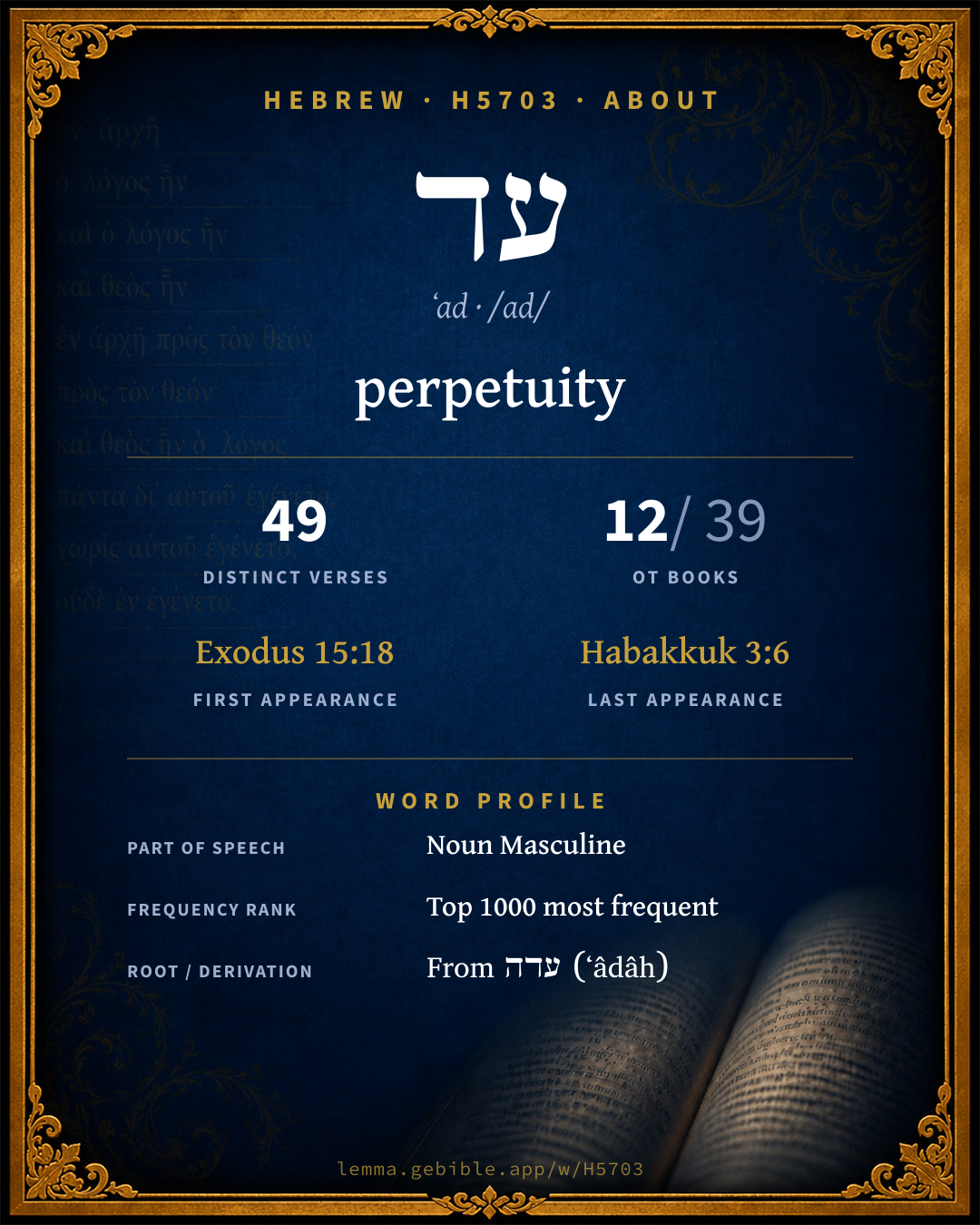
עַד
perpetuity
also: for ever, continuing future fuller range ↓
Full lexicon entry — Brown-Driver-Briggs (BDB)
From Brown-Driver-Briggs (BDB)
Where this word appears
Grammar key — what these labels mean
Part of speech
- Noun
- A naming word — a person, place, thing, or idea.
- Preposition
- A relational word (e.g. “in,” “to,” “from”) governing a noun.
Noun type
- Common
- A common noun — a general class of person, place, or thing (“king,” “city,” “water”), not a specific name.
State
- Absolute
- The independent form of a noun, not bound to a following word.
- Construct
- A noun bound to a following noun in a possessive / “of” relationship (the construct chain).
Gender
- Masculine
- Grammatically masculine.
Number
- Singular
- One.
- Plural
- More than one (in Hebrew, generally three or more).
Every verse where H5703 appears in the Book of Exodus — 1 distinct verse. Click any verse to open its interlinear word-by-word view. Verse text shown in the World English Bible for context — . Each verse’s Hebrew form is shown with its reference; the English is not keyword-highlighted, since the data carries no word-level English alignment. Use “Compare translations” on any verse to read it across multiple English versions. This concordance covers the Hebrew Bible; Septuagint (Greek Old Testament) occurrences are not indexed here.
Exodus
About this entry
At a glance — auto-summarized from this page’s data, not written by a person. Every figure links to its source below. This summary describes the numbers; it doesn’t interpret them.
עד (ʻad) is a Hebrew noun most often rendered “perpetuity.” Psalms dominates its distribution — 29 of 49 verses. Spanning 49 verses in 12 books, it ranks among the moderately common words of the Hebrew Bible. It also covers “for ever” and “continuing future”, alongside “perpetuity” — see its full sense range. Its English rendering has broadened — “ever” classically, “forever” (Berean Standard Bible) in modern versions; see the renderings breakdown. For the data behind this summary, explore the sense tree and the renderings breakdown below.
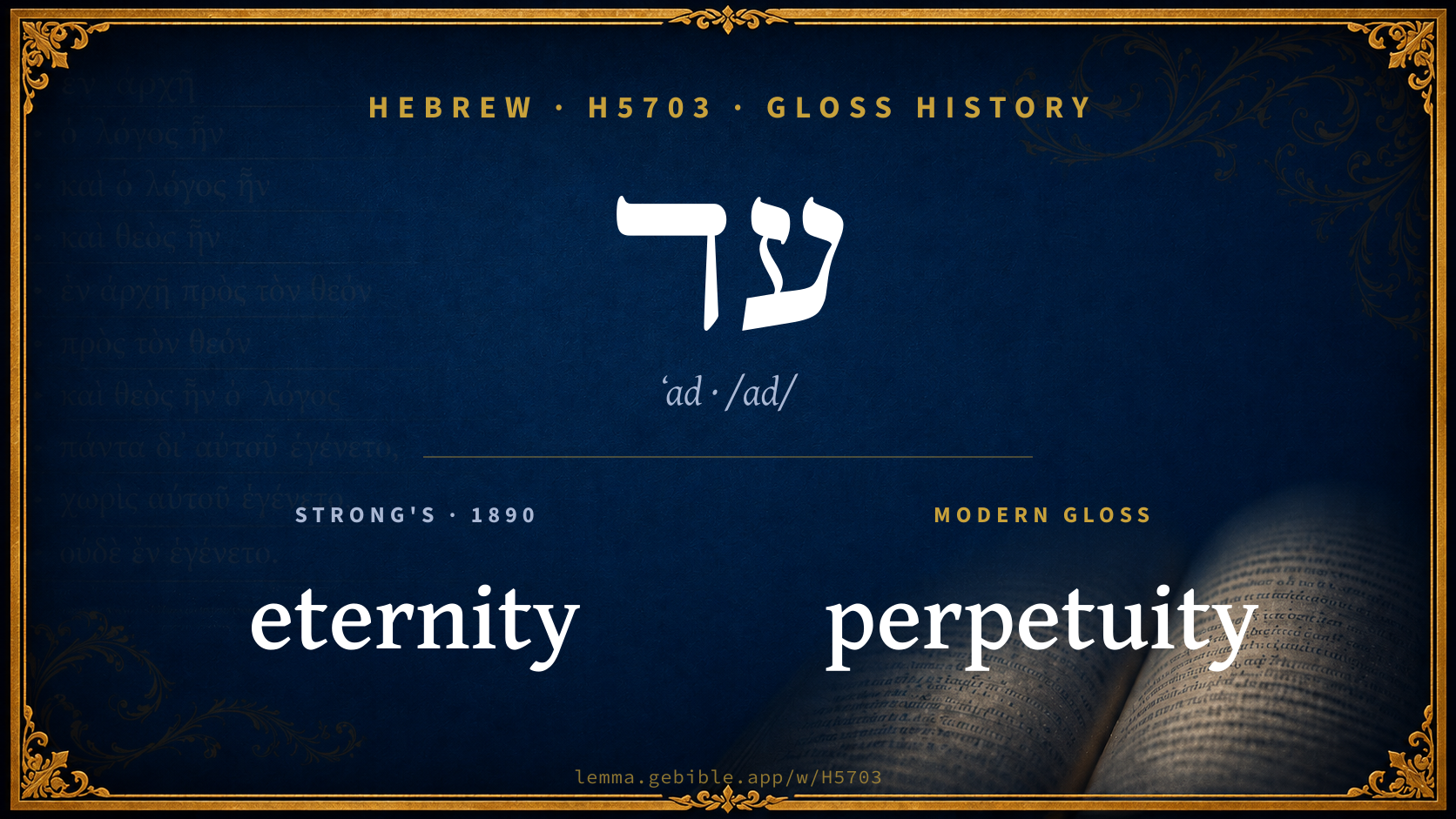
Gloss history
Strong's 1890 vs modern scholarship
About this word
Strong's H5703 catalogs a Hebrew word from the Hebrew Old Testament.
These counts are not copied from any lexicon or concordance. They are computed here, from the morphology-tagged Hebrew Old Testament. What Lemma adds →
- 49
- distinct verses
- The word appears in 49 distinct verses.
- 12 / 39
- OT books
- The word appears in 12 of 39 Old Testament books.
- #723
- by frequency
- Top 1000 most frequent Hebrew words (rank 723 of 8,640 Hebrew words by occurrence).
View all 49 occurrences in the concordance →
By section of the Old Testament
By traditional corpus
Conventional, traditional groupings — biblical authorship is debated, so this is a traditional corpus grouping, not an authorship claim. Each share is this word’s portion of its verses in that division of the Hebrew canon. Each figure is a share of the word’s 49 distinct verses.
- Writings (Ketuvim) 35 verses · 71%
- Prophets (Nevi'im) 11 verses · 22%
- Torah (Pentateuch) 3 verses · 6%
How translations render this word
Counts come from each version’s own published word-to-Strong’s tagging or interlinear alignment — an approximate guide to how each version renders this word, not a word-level alignment the data otherwise carries. Because each total is that version’s own tagged count, the per-version totals vary from one another and need not match the appearance or distinct-verse counts above. These counts may also differ from a printed concordance because Lemma counts each distinctly tagged rendering and does not collapse phrase taggings into a single head-word total. This is a fixed set of word-tagged versions (KJV, ASV, BSB, ULT) and does not change with the reading translation you choose elsewhere. Each version’s license is shown beside its name below (and on Sources).
BDB lists this Strong’s number as 3 distinct words (homographs). Each count above pools all of them and is not split by sense — see the Senses section below. A low-frequency rendering may belong to a different one of those words, not the primary meaning.
- King James Version†: Ever 39×, Everlasting 2×
- American Standard Version†: Ever 32×, Everlasting 2×
- Berean Standard Bible†: Forever 18×, Ever 16×
- unfoldingWord Literal Text†: Forever 20×, Ever 15×, Perpetuity 6×
King James Version Public Domain
Renders H5703 across 48† tagged occurrences — most commonly:
Plus 7 renderings that appear only once — usually multi-word phrases or single function words the recovered tagging swept in, not distinct renderings. Not rendered by a distinct English word in 1 further occurrence.
American Standard Version Public Domain
Renders H5703 across 45† tagged occurrences — most commonly:
Plus 11 renderings that appear only once — usually multi-word phrases or single function words the recovered tagging swept in, not distinct renderings.
Berean Standard Bible Public Domain
Renders H5703 across 41† tagged occurrences — most commonly:
Plus 7 renderings that appear only once — usually multi-word phrases or single function words the recovered tagging swept in, not distinct renderings. Not rendered by a distinct English word in 7 further occurrences.
unfoldingWord Literal Text CC BY-SA 4.0
Renders H5703 across 50† tagged occurrences — most commonly:
Plus 5 renderings that appear only once — usually multi-word phrases or single function words the recovered tagging swept in, not distinct renderings.
29 senses and sub-senses in the full BDB
What do BDB’s symbols mean?
BDB uses these scholarly abbreviations:
| Symbol | Meaning |
|---|---|
| 𝔊 | the Septuagint (the ancient Greek translation, LXX) |
| 𝔙 | the Vulgate (the Latin translation) |
| 𝔖 | the Syriac version (the Peshitta) |
| 𝔗 | the Targum (the Aramaic translation) |
| ψ | the Psalms |
| √ | root (the underlying root or stem) |
| ‖ | parallel passage (a synonymous or contrasted parallel) |
| † | the dagger: every passage where the word occurs is cited |
The 29 senses and sub-senses the full Brown-Driver-Briggs lexicon distinguishes for this word, in lexicon order (not ranked by frequency), with BDB’s own verbatim wording and sub-sense lettering. Shown in Hebrew script with BDB’s own scholarly abbreviations. The condensed entry is in the Lexicon Entry tab. See also the Forms in the corpus table below.
עד I and וָעֶ֑ד (so always) n.m. perpetuity ( = advancing time, cf. Assyrian adû, time, at the present time)
- 1. of past time: מִנִּי עַד Jb 20:4; הררי עד Hb 3:6 ancient mountains (cf. עולם 1) so Gn 49:26 (read הַרְרֵי עַד for הוֹרַ֔י עַד). e.g. Job 20:4
- 2. of future time, לָעַד (usually לָעַ֑ד) for ever:
- a. during lifetime, of king ψ 21:7 Pr 29:14; of others ψ 9:19; 22:27; 61:9 Pr 12:19. e.g. Psalms 21:7
- b. of things, לָעַד בַּצּוּר יֵחָֽצֵב֑וּן Jb 19:24. e.g. Job 19:24
- c. of continuous existence, of nations, גְּבֶרֶת עַד (of Babylon, cf. עולם 2 c) Is 47:7 (yet v. iii. עַד II 3); anger, לעד Am 1:11; elsewhere עֲדֵי עַד ψ 83:18; 92:8 Is 26:4; 65:18. e.g. Isaiah 47:7
- d. of divine existence, שֹׁכֵן עַד Is 57:15; attributes, לָעַד ψ 111:3, 10; 112:3, 9; residence in Zion, עֲדֵי עַד 132:14; law of God, לָעַד 19:10; promise as to dynasty of David, לָעַד 89:30; עֲדֵי עַד 132:12; inheritance of land, לָעַד 37:29; continuous relations between God and his people 1 Ch 28:9; Is 64:8; Mi 7:18 לעד. e.g. Isaiah 57:15
- e. phrases (see עולם 2 m): (לְ)עוֹלָם וָעֶ֑ד ψ 9:6; 10:16; 21:5; 45:7, 18; 48:15; 52:10; 104:5; 119:44; 145:1, 2, 21; Ex 15:18; Mi 4:5; Dn 12:3; לָעַד לְעוֹלָם ψ 111:8; 148:6; עַד־עוֹלְמֵי עַד Is 45:17.—Is 30:8 read (עַד־עוֹלָם) לְעֵד for a witness (𝔖 𝔊 𝔗 Ges Ew Di Che Du) for MT לָעַד. e.g. Psalms 9:6
עד II [m.] booty, prey (upon which one advances, falls)
עד III in poetry עֲדֵי (†Nu 24
- I. prep.
- 1. of space:—
- a. Gn 11:31 ויבאו עד חרן as far as Haran, 12:6; 13:3, 12 + often, Is 8:8 עד צואר יגיע, 15:4 עד יהץ נשׁמע קולם, 25:12; 26:5 ψ 36:6 אמונתך עד שׁחקים, 69:2 באו מים עד נפשׁ (cf. Jon 2:6; Mi 1:9; Je 4:10, 18), 90:3 תָּשֵׁב אֱנוֹשׁ עַד דַּכָּא, Jb 11:7, etc.; pregn. ψ 118:27 אִסְרוּ־חַג עַד וגו׳ bind … (and lead) up to …; Is 57:9 עַד מֵרָחוֹק even to afar (מִן 1 c); with the goal a person, Ex 22:8 עד האלהים יָבֹא דְבַר שְׁנֵיהֶם, 1 S 9:9 ψ 65:3 עָדֶיךָ כָל־בָּשָׂר יָבֹאוּ, Is 45:24; Jb 4:5, שׁוּב עַד י׳ Ho 14:2 al. (v. שׁוּב, stronger than שׁוּב אֶל־י׳); poet. Nu 24:20 וְאַחֲרִיתוֹ עֲדֵי אֹבֵד shall be even unto destruction, shall issue in destruction, v 24; rarely with verbs of attending, הֶאֱזִין עַד †Nu 23:18, הִתְבּוֹנֵן עַד †Jb 32:12; 38:18 (usually אֶל). Before another prep., 1 S 7:11 עַד מִתַּחַת ל׳, 1 K 4:12 עַד מֵעֵבֶר ל׳, עַד מֵעַל Ez 41:20, עַד לִפְנֵי Est 4:2, and even (si vera l.) עַד אֲלֵיהֶם 2 K 9:20: cf. עַד נֶגֶד Ne 3:16, 26, עַד נֹכַח Ju 19:10 +. e.g. Genesis 11:31
- b. In the combin. מִן … (וְ)עַד, as Gn 10:19 מצידון … עַד עַזָּה from Sidon … as far as Gaza + often (v. מן 5 a); and idiom., not of actual space, but of classes of objects, to express the idea of both … and, as Gn 19:4 מִנַּעַר וְעַד זָקִן from young to old (inclusively) = both young and old (v. מִן 5 b); without מִן, even to = including, Lv 11:42 Nu 8:4 even to (i.e. including) its base and its flowers, cf. 1 S 18:4. e.g. Genesis 10:19
- 2. Of time:
- a. (a) even to, until Gn 8:5 even to the 10th month, Ex 12:6 unto the 14th day, etc., v 15, 18, etc.; עד היום unto this day, Gn 19:37, 38, עד היום הזה 26:33; 32:33, both + often; עד יום sq. inf. Ex 40:37 Jos 6:10 Ju 18:30; עד בקר till morning, Ex 12:10 + (15 times), עד הבקר 16:23 + (11 times); so עד (ה)ערב Ex 18:13, 14 +, poet. עֲדֵי ערב ψ 104:23; עַד עוֹלָם Gn 13:15 + often; עַד שֶׁבַע פְּעָמִים 2 K 4:35; עַד דּוֹר וָדוֹר Is 13:20; v. also בְּלִי, and בִּלְתִּי, ad fin. And sq. another prep., Lv 23:16 עַד מִמָּחֳרַת הַשַּׁבָּת, Ne 13:9 עַד אַחַר הַשַּׁבָּת. With the force of against, Ju 6:31 יוּמַת עַד הַבֹּקֶר; cf. (b) end. (b) sq. inf., both of past time, as Gn 8:7; 32:25 עַד עֲלוֹת הַשַּׁחַר, 33:3; 34:5, and especially of future time, as 3:19 עַד שׁוּבְךָ until thy returning, 19:22; 27:45 Dt 7:20, 23; 20:20; 22:2; 28:20, 22,—both + often; cf. עַד בּוֹשׁ Ju 3:25 +; עַד תֹּם … Lv 25:29 + 10 times; עַד תֻּמָּם Dt 2:15 +; עַד כַּלֵּה †2 K 13:17, 19; Ezr 9:14; עַד כַּלּוֹתָ(ם) 1 S 15:18 Je 9:15 +; עַד אוֹר הַבֹּקֶר Ju 16:2 +; also in עַד הִשְׁמִדְךָ אֹתָם Dt 7:24 (cf. 28:48 Jos 11:14; 1 K 15:29; 2 K 3:25; 10:17; 24:20 [‖ Je 52:3 הִשְׁלִיכוֹ]; on the anom. הִ׳, v. Dr, read prob. הַ׳); and most prob. (cf. Köiii. 583) in שָׂרִיד (לָהֶם) עַד בִּלְתִּי הִשְׁאִיר לוֹ Dt 3:3 (v. Dr), + 5 times (v. supr. p. 117), read prob. הַשְׁאִיר. With the force of towards the end of, against, especially in עַד בֹּאָ(ם), Gn 43:25 Ex 22:25 Nu 10:21 והקימו את המשׁכן עַד בֹּאָם used to set up the tab. against their coming, 2 K 16:11; Ez 33:22; cf. 2 S 17:22. Ellipt. Ju 16:2 עַד אוֹר הַבֹּקֶר וַהֲרַגְנוּהוּ (wait) till the morning dawn, and we slay him! (GFM; Dr§ 115). (c) with various adverbs of time (q.v.), as עַד אָנָה, עַד־מָה, עַד מָתַי, עַד הֵנָּה, עַד כֹּה, עַד כֵּן, עַד עַתָּה, cf. עַד כַּמֶּה פְעָמִים (v. מָה 4 b). (d) to suggest also degree (cf. 3), עַד אֵין מָקוֹם until there is no place Is 5:8, עַד אֵין מִסְפָּר †ψ 40:13 Jb 5:9; 9:10; cf. Lv 26:18 וְאִם־עַד־אֵלֶּה and if even up to these things, even the end of all these punishments, you do not hearken to me. e.g. Genesis 8:5
- b. During (rare; proposes as far as the limit indicated, including the time previous, cf. ἕως: so often Aramaic עַד, ܥܕ, while), 2 K 9:22 with is peace עַד זְנוּנֵי אִיזֶבֶל during, etc.? Jb 20:5 עֲדֵי רָ֑גַע during a moment; sq. inf. Ju 3:26 עַד הִתְמַהְמְהָם during their delaying, Ex 33:22 Jb 7:19 עַד בִּלְעִי רֻקִּי Jon 4:2. e.g. 2 Kings 9:22
- 3. Of degree, to suggest a higher or the highest; as עַד מְאֹד even to muchness, i.e. exceedingly (v. מְאֹד), עַד מְהֵרָה even to haste †ψ 147:15; Est 5:6 וּמַה־בַּקָּשָׁתֵךְ עַד־חֲצִי הַמַּלְכוּת וְחֵעָשׂ, v 3; 7:2. See also עַד לְ, below. With a neg., to express not even as much as, Dt 2:5 לא אתן לכם מארצם עַד מִדְרַךְ כַּף רָ֑גֶל, and with אֶחָד, †Ex 9:7 לֹא מֵת … עַד־אֶחָד, simil. 14:28 Ju 4:16; 2 S 17:22 (read אֶחָד for אַחַד: v. Dr). Sometimes almost = Lat. adeo, 1 S 2:5 (si vera l.) עַד עֲקָרָה ילדה שׁבעה even to the barren, she hath borne seven, i.e. even the barren hath, etc., Jb 25:5 הן עד־יָרֵחַ ולא יאהיל, Hg 2:19. In comparisons, to the degree of, even like (rare), Na 1:10 עַד סִירִים סְבֻכִים (text dub.) entangled even like thorns, 1 Ch 4:27 לא הִרְבּוּ עד בני יהודה did not multiply to the degree of (i.e. like), etc. Cf. 2 S 23:19 עַד הַשְּׁלשָׁה לֹא בָא did not attain (in prowess) unto the three. e.g. Psalms 147:15
- 1. of space:—
- II. Conj.
- 1. until:—
- a. עַד אֲשֶׁר until that: (a) with pf., of past time, Ex 32:20 ויטחן עד אשׁר דָּק (Dt 9:21), Dt 2:14 עד אשׁר עָבַרְנוּ, Jos 3:17; 8:26; Ju 4:24; 1 K 10:7 (2 Ch 9:6), 2 K 17:20, 23; 21:16; with suggestion of degree, 1 S 30:4 (sq. אֵין, 1 K 17:17; rarely of future time (the ‘future perfect,’ Dr§17), 2 S 17:13 (of degree), Ez 34:21. So עַד שֶׁ- (often in NH; v. שֶׁ), †Ju 5:7 Ct 3:4(×2); עַד כִּי †Gn 26:13 עַד כִּי־גָדַל מְאֹד, 41:49 2 S 23:10 2 Ch 26:15; and (of future time) עַד אֲשֶׁר אִם †Gn 28:15; Nu 32:17; Is 6:11. (b) with impf., usually of future time, Gn 27:44 עַד אֲשֶׁר תָּשׁוּב חֲמַת אָחִיךָ, 29:8; Ex 23:30; 24:14 Lv 22:4; Nu 11:20; 20:17; 1 S 22:3; Ho 5:15 +; rarely of past time, Jon 4:5 עד אשׁר יראה till he should see, Ec 2:3. So (of the future) עַד שֶׁ- †Ct 2:7, 17; 3:5; 4:6; 8:4 ψ 123:2; and עַד כִּי †Gn 49:10 עַד כִּי־יָבֹא שִׁילֹה. e.g. Exodus 32:20
- b. עַד alone, until: (a) with pf., of past time, Jos 2:22; 4:23 עַד־עָבַרְנוּ, 1 S 20:41 עַד דָּוִד הִגְדִּיל, 2 S 21:10; 1 K 11:16; Ez 28:15; of the future (rare), 2 K 7:3 עַד מָ֑תְנוּ, Ez 39:15; Dn 11:36 עַד כָּלָה זָ֑עַם. So עַד אִם (of the fut.), †Gn 24:19, 33; Is 30:17; Ru 2:21. (b) with impf., of future time, 1 S 1:22 (ellipt.: cf. Ju 16:2, 12 a (b) end), Is 22:14; 26:20; 32:15; 62:1, 7 ψ 57:2; 71:18; Jb 27:5 +; of the past (rare), Ex 15:16 עד יעבור עמך, v 16 Jos 10:13 (poet.) עַד יִקֹּם גּוֹי אוֹיְבָיו, ψ 73:17; 2 Ch 29:34. In poetry, עַד is sometimes used to mark not an absolute close, but an epoch, or turning-point, in the fut., as ψ 110:1 (v. De) עַד אָשִׁית אֹיְבֶיךָ הֲדֹם לְרַגְלֶיךָ, Ho 10:12; Jb 14:6 (but v. 3); after a neg. cl., Gn 49:10; Nu 23:24 Is 42:4 ψ 71:18; 112:8; Jb 8:21 (but read prob. with Ew Hi Di Du al. עֹד he will yet, etc., understanding v 20 as present, not future). e.g. Joshua 2:22
- 2. While (rare: cf. 12 b):—
- a. with pf., 1 S 14:19 עד דִּבֶּר שׁאול while Saul spake. e.g. 1 Samuel 14:19
- b. with impf., ψ 141:10 יַחַד אָנֹכִי עַד אֶעֱבֹר while I at the same time pass by. e.g. Psalms 141:10
- c. with ptcp., Jb 1:18 עַד זֶה מְדַבֵּר (but read prob. עֹד, as v 16, 17), Ne 7:3. e.g. Job 1:18
- d. עַד שֶׁ- (without vb.) †Ct 1:12. So עַד לֹא while not = ere yet (of past time) †Pr 8:26 עד לא עשׂה ארץ (so עַד לָא, ܥܰܕ ܠܴܐ, often, e.g. Gn 24:15 𝔗, Mt 1:18); and עד אשׁר לא (of the fut.) †Ec 12:1, 2, 6 (cf. Talm. עַד דְּלָא, Mishn. עַד שֶׁלֹּא). e.g. Song of Solomon 1:12
- 3. Of degree, to the point that, so that even (rare), Is 47:7 Thou saidst, I shall be for ever a lady, עַד לֹא שַׂמְתְּ אֵלֶּה עַל לִבֵּךְ to the point that (going so far in thy pride that) thou didst not, etc. (but Hi Che Du al. join גְּבֶרֶת עַד I shall be for ever, a lady perpetually; v. 1. עַד); Jb 14:6 (Di De Bu Du) to the point that he may enjoy, etc., Is 22:14 (Du). In Jos 17:14 עַד אֲשֶׂר עַד כֹּה בֵּֽרְכַנִי י׳, read עַל אֲשֶׁר because that (Ges Buhl; cf. Di). e.g. Isaiah 47:7
- 1. until:—
- III. עַד לְ, a strengthened from for עַד found chiefly in Ch Ezr, and occurring in most of the above senses. Thus
- 1. of space: עַר לְבוֹא חֲמָת Jos 13:5; Ju 3:3; 1 Ch 13:5, עד ל׳ מִדְבָּ֫רָה 5:9, עד ל׳ מצרים 2 Ch 26:8; עַד לְמִזְרַח הַנָּ֑יְא 1 Ch 4:39, עַד לַמְצָד 12:17; עַד לִגְרָר 2 Ch 14:12; עַד לַשָּׁמַיִם 2 Ch 28:9; Ezr 9:6; עַד לְמֵרָחוֹק 2 Ch 26:15; Ezr 3:13. e.g. Joshua 13:5
- 2. Of time: עד לעולם 1 Ch 23:25; 28:7; עד למנחת הערבEzr 9:4; עַד לַדָּבָר הַזֶּה Ezr 10:14 prob. during (Keil: Ges Be with regard to, strengthened for לְּ); sq. inf. עַד לַעֲלוֹת הַמִּנְחָה 1 K 18:29; עַד לִכְלוֹת 1 Ch 28:20; 2 Ch 29:28; עַד לְכַלֵּה 2 Ch 24:10; 31:1; עד להשׁחית 26:16; עַד לָמוּת 32:24 (‖ 2 K 20:1 לָמוּת alone); Ezr 10:14 עד להשׁיב. e.g. 1 Chronicles 23:25
- 3. Of degree: עַד לְמַחֲנֶה גָדוֹל even unto (till there was) a great camp, 1 Ch 12:23; עַד לְמַ֫עְלָה = exceedingly 2 Ch 16:12; 17:12; 26:8; עַד לִמְאֹד 2 Ch 16:14; עַד לְשִׂמְחָה 29:30; עַד לָרֹב 31:10; עַד לְאֵין מַרְפֵּא 36:16. e.g. 1 Chronicles 12:23
Senses from the full Brown-Driver-Briggs lexicon (Brown, Driver, Briggs; Oxford 1906 — public domain), digitized via Sefaria, supplemented by the OpenScriptures HebrewLexicon (CC BY 4.0). Full attribution on Sources.
Word origin
II. and וָעֶ֑ד (so always) n.m. perpetuity ( = advancing time, cf. Assyrian adû, time, at the present time);—
III. n.[m.] booty, prey (upon which one advances, falls); cf. 𝔗 עֲדִי booty, Is 10:2; 33:23 +.—יֹאכַל עַד Gn 49:27 devour prey (‖ שָׁלָל); עַד שָׁלָל מַרְבֶּה Is 33:23 prey of great spoil; קוּמִי לְעַד Zp 3:8 (of God) my rising up to the prey (BrMP); אֲבִי עַד Is 9:5 father (i.e. distributor) of booty (Hi Kn Kue BrMP Du CheHpt; > Ges Ew Di al. everlasting father).
IV. in poetry עֲדֵי (†Nu 24:20, 24 ψ 104:23; 147:6; Jb 7:4; 20:5, and in עֲדֵי עַד Is 26:4; 65:18 ψ 83:18; 92:8; 132:12, 14: cf. אֱלֵי, עֲלֵי), prep. as far as, even to, up to, until, while (Aramaic עד, ܥܕ; Sab. עד, עדי, MordtmZMG xxx (1876), 27; DHMxxxvii (1883), 414, Assyrian adi Dl§ 81 a (Arabic عَدَا is except); perhaps akin to عَدَا pass on, advance to, Köii. 304, 309: עֲדֵי prob. from ground-form ʿădăy, Ol428, 421 Köii. 309 ff.; but LagSym. ii. 101–3, Mitth. i. 231 f.; as plur. like אַחֲרֵי);—with sf. עָדַי Nu 23:18 +, עָדֶיךָ Mi 4:8 +, etc., עָֽדֵיכֶם †Jb 32:12; 2 K 9:18 עַד־הֵם occurs; —as far as,- even to (differing from אֶל, in that the limit is included, as in Arabic حَتَّى FlKl.Schr. i. 402 f.):
— Brown-Driver-Briggs (Oxford 1906, public domain), digitized via Sefaria, supplemented by the OpenScriptures HebrewLexicon (CC BY 4.0). See Sources.
Derived from עדה (ʻâdâh) (H5710) — to pass on.
Jastrow Dictionary
A second Hebrew/Aramaic lexicon for comparison, covering Aramaic and post-biblical (Talmudic, Targumic, Midrashic) usage that the biblical-Hebrew BDB does not. Matched by lemma rather than by Strong’s number, so a lemma may carry more than one Jastrow headword (shown separately below), and the entries cover usage well beyond the Bible.
עַד
- turn, continuation; (prep.) up to, until, during, while; in place of. B. Mets. 87ᵃ; Snh. 107ᵇ עד אברהם up to Abraham’s time, v. זִקְנָה. B. Kam. 55ᵃ עד שאתה שואלני וכ׳ during the time that &c., instead of asking me &c. Gen. R. s. 58 עד שלא ישקיע וכ׳ before yet the Lord causes the sun of one righteous man to set, he causes that of another to rise. Kidd. 29ᵇ עד כ׳ שנה until a person is twenty years old. Ib. 31ᵃ עד היכן כיבוד וכ׳ how far does the duty of honoring parents go?; a. v. fr.—Ber. 26ᵇ (ref. to ib. IV, 1 ‘up to four hours’) עד וָעַד בכלל וכ׳ does it mean ‘up to’, and that ‘up to’ included, i.e. including the whole fourth hour of the day, or excluding the fourth hour? Nidd. 58ᵇ לימא בעד ועד בכלל קמיפלגי shall we say, their difference turns on the question whether ‘until’ is meant to include or to exclude the terminus? Ib. איכא עד ועד בכלל ואיכא עד ולא עד בכלל sometimes ‘until’ means inclusive of, and sometimes exclusive of. Ib. קמיפלגי בעד ועד דהכא they differ as to the meaning of the word ‘until’ in this case (in the Mishnah); a. fr.—בַּעַד, בְּעַד (cmp. עֲבוּר) in behalf of, for, about. Midr. Till. to Ps. IV וכי … הפונדק בַּעֲדֵינוּ (our w. missing in ed. Bub.) has that innkeeper opened his shop for the first time today, for our benefit? Midr. Till. to Ps. XII שאל בַּעֲדוֹ וכ׳ he inquired about him, where is he?; a. e.—וָעֶד, v. עוֹלָם.
עַד ²
- Targ. Gen. II, 5. Ib. XIV, 14; a. v. fr.—B. Bath. 21ᵃ עד שית לא תקביל up to six years of age admit no child to school. Gen. R. s. 44ᵃ, a. e. עד דסנדלך, v. כּוּבָּא I. Lam. R. to III, 20 עד דשמינא וכ׳, v. חֲשִׁיךְ II; a. fr.
עֹד
- v. עוֹד
עד
- , Targ. O. Lev. XI, 13 ed. Amst., v. עַר.
עֵד
- [present, confirming,] (cmp. סהד) witness, evidence. Ḥull. 10ᵇ, a. e. עד אחד נאמן וכ׳ in matters of ritual the statement of one witness is sufficient. Bekh. 36ᵃ, a. e. עד מפי עד a witness testifying to what he has heard from an eye-witness. R. Hash. 26, a. e. אין עד נעשה דיין a witness in the case cannot act as judge. Keth. 21ᵇ עד נעשה דיין a witness may act as judge; a. v. fr.—Pl. עֵדִים. Ib. דיינים המכירין חתימות ידי ע׳ if the judges know (can identify) the signatures of the witnesses to a document. Ib. II, 3 הע׳ שאמרו וכ׳ if witnesses declare, this is our signature, but we have been forced &c. Ib. 5 אם יש ע׳ וכ׳ if there is evidence that she was a married woman.—Kidd. 48ᵃ, a. fr. עידֵי חתימה, ע׳ מסירה, v. כְּרַת; a. v. fr.—Trnsf. evidence, proof. Sabb. 81ᵃ אם יש עליה עד (euphem.) if there is an evidence (stain of excrements) on it. B. Kam. 11ᵃ top (ref. to Ex. XXII, 12) יביא עד עורה Ar. (ed. אדורה, עדודה, v. אָדַר) he shall offer in evidence its hide.—Esp. a piece of cloth used by women for ascertaining their condition of cleanness or uncleanness. Nidd. VIII, 4 עד שהוא נתון וכ׳ if an examining rag (after use) has been put under the cushion &c. Ib. 14ᵇ; 12ᵃ משל לשמש ועד וכ׳ to speak allegorically (euphemistically), the servant and the examiner stand by the side of the threshold &c. (v. שַׁמָּשׁ). Ib. זהו עֵדָן של צנועות (Ar. עֵידָן) this (special) rag is that of the chaste women; a. fr.—Pl. as ab. Ib. I, 7. Ib. II, 1; a. fr. e.g. Exodus 22:12
A Dictionary of the Targumim, the Talmud Babli and Yerushalmi, and the Midrashic Literature (Marcus Jastrow; London, Luzac, 1903) — Public Domain. Digitized via Sefaria. Digitized via Sefaria. Full attribution on Sources.
Forms in the corpus
The 18 distinct written forms H5703 takes in the Hebrew Bible, most frequent first — each parse links to that state’s occurrences in the concordance. Hebrew forms include their vowel points and cantillation, so a single lemma takes many written forms.
Same root — word family
Other BDB entries built from the same root as H5703, grouped by Strong’s listed origin. These share a root / origin per the lexicon — not necessarily a shared meaning. Each links to that word’s own entry.
Derives from
Shares the same root
Derived from this word
Proper names from this root
People and places named from this root — a name, not an additional meaning of the word.
- מעדי Maʻăday H4572 Maadai
- מעדיה Maʻădyâh H4573 Maadiah
- עדה ʻÂdâh H5711 Adah
- עדו ʻIddôw H5714 Iddo
- עדיה ʻĂdâyâh H5718 Adaiah
Compare all same-root words → Showing 4 of 13 — not the complete family. 5 of the same-root words are proper names (people or places). They share a root, not necessarily a meaning.
Septuagint verse parallels
This word appears in 37 verses that also exist in the Greek Old Testament (Septuagint), out of the 49 Hebrew verses it occurs in. You can read those verses in Greek by switching the Old Testament edition to the Septuagint.
Read these verses in the Septuagint
- Exodus 15:18
- Numbers 24:20
- 2 Samuel 3:28
- 1 Chronicles 28:9
- Job 19:24
- Psalms 9:5
- Proverbs 12:19
- Isaiah 9:6
- Daniel 12:3
- Amos 1:11
- Micah 4:5
- Habakkuk 3:6
This is a verse-level parallel only — the same verses exist in both the Hebrew and Greek Old Testaments. No word-level Hebrew↔Greek correspondence is claimed: the data carries no such alignment, so no Greek word is shown as this Hebrew word’s translation. Coverage is not total — the Septuagint omits the deuterocanon and renumbers the Psalms, so some Hebrew verses have no direct Greek parallel.