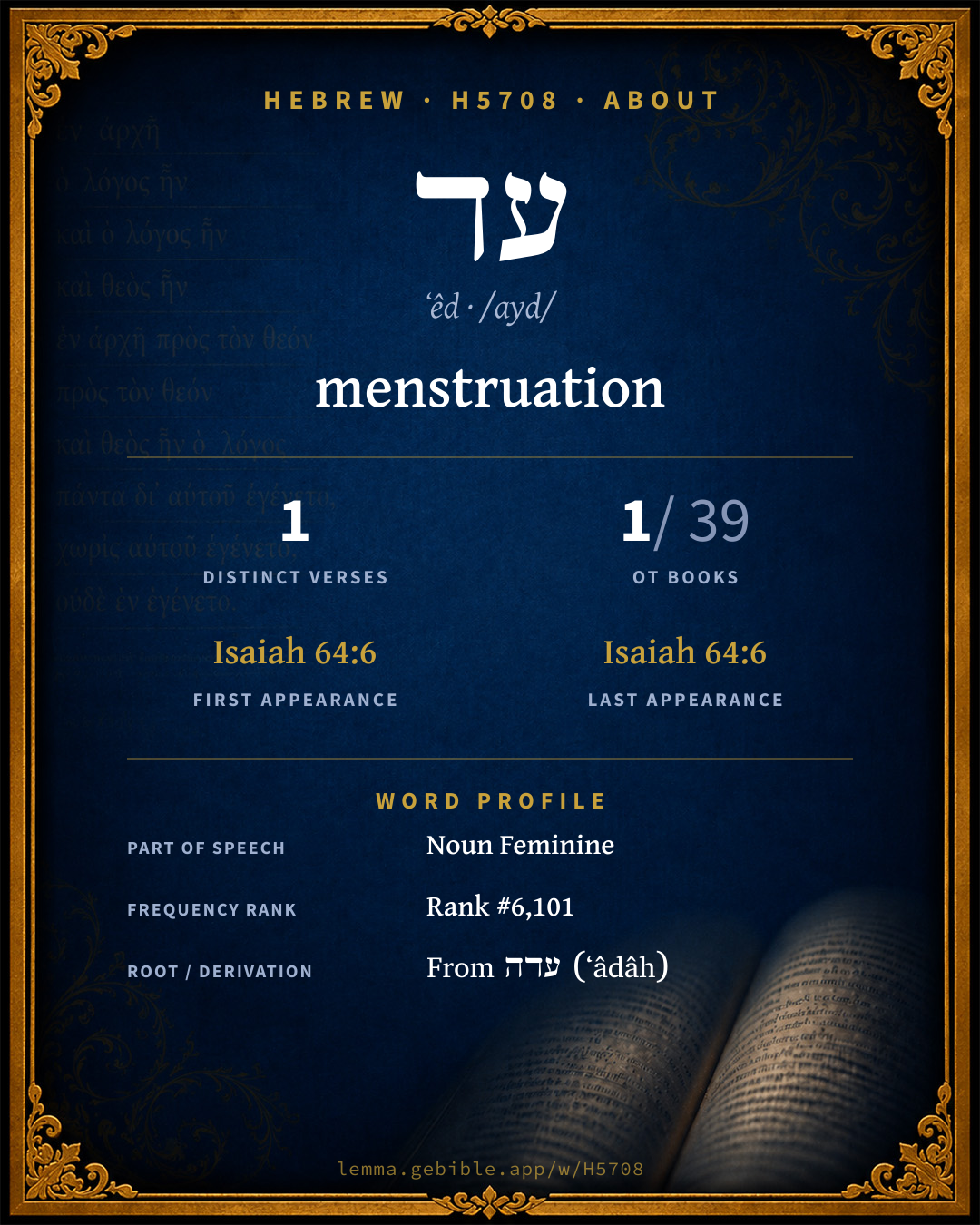
עִדָּה
menstruation
‘menstruation’ is one of 2 main senses fuller range ↓
Full lexicon entry — Brown-Driver-Briggs (BDB)
From Brown-Driver-Briggs (BDB)
Where this word appears
Grammar key — what these labels mean
Part of speech
- Noun
- A naming word — a person, place, thing, or idea.
Noun type
- Common
- A common noun — a general class of person, place, or thing (“king,” “city,” “water”), not a specific name.
State
- Absolute
- The independent form of a noun, not bound to a following word.
Gender
- Masculine
- Grammatically masculine.
Number
- Plural
- More than one (in Hebrew, generally three or more).
Every verse where H5708 appears — 1 distinct verse across 1 book. Click any verse to open its interlinear word-by-word view. Verse text shown in the World English Bible for context — . Each verse’s Hebrew form is shown with its reference; the English is not keyword-highlighted, since the data carries no word-level English alignment. Use “Compare translations” on any verse to read it across multiple English versions. This concordance covers the Hebrew Bible; Septuagint (Greek Old Testament) occurrences are not indexed here.
Isaiah 1 verse
About this entry
At a glance — auto-summarized from this page’s data, not written by a person. Every figure links to its source below. This summary describes the numbers; it doesn’t interpret them.
עד — transliterated ʻêd — is a Hebrew noun carrying the sense “menstruation.” With only 1 verse it sits in the long tail of Hebrew Bible vocabulary. Its uses cluster heavily in Isaiah (100% of all occurrences). Its lone occurrence is Isaiah 64:6. Its lexical range runs to 2 senses. See the sense tree, 1-verse concordance, and the renderings breakdown below.
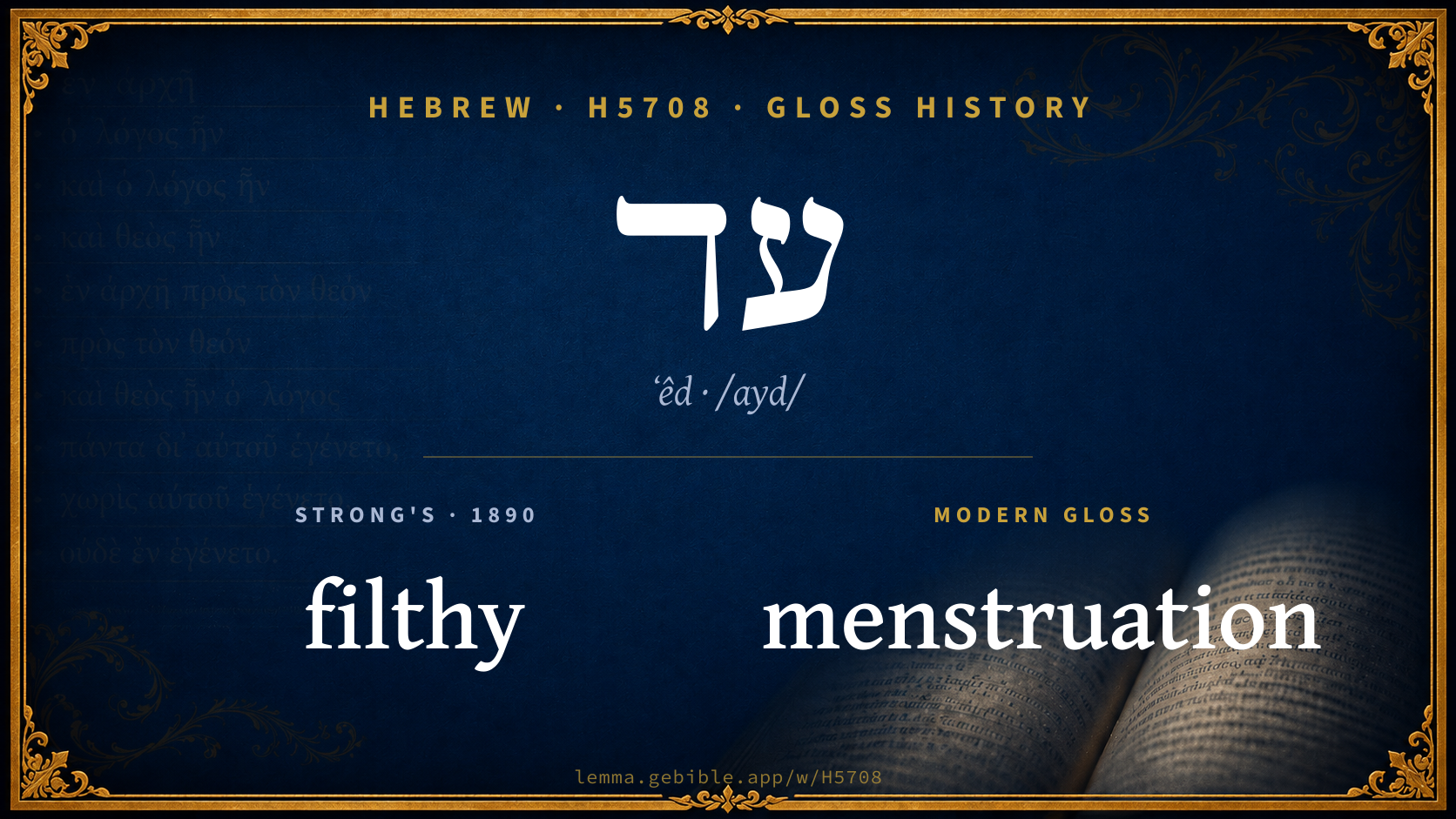
Gloss history
Strong's 1890 vs modern scholarship
About this word
Strong's H5708 catalogs a Hebrew word from the Hebrew Old Testament.
These counts are not copied from any lexicon or concordance. They are computed here, from the morphology-tagged Hebrew Old Testament. What Lemma adds →
- 1
- distinct verses
- The word appears in 1 distinct verse.
- 1 / 39
- OT books
- The word appears in 1 of 39 Old Testament books.
- #6,101
- by frequency
- Rank #6,101 (rank 6,101 of 8,640 Hebrew words by occurrence).
View all 1 occurrence in the concordance →
Most concentrated in
- Isaiah 1 verse 100%
By section of the Old Testament
By traditional corpus
Conventional, traditional groupings — biblical authorship is debated, so this is a traditional corpus grouping, not an authorship claim. Each share is this word’s portion of its verses in that division of the Hebrew canon. Each figure is a share of the word’s 1 distinct verse.
- Prophets (Nevi'im) 1 verse · 100%
How translations render this word
Counts come from each version’s own published word-to-Strong’s tagging or interlinear alignment — an approximate guide to how each version renders this word, not a word-level alignment the data otherwise carries. Because each total is that version’s own tagged count, the per-version totals vary from one another and need not match the appearance or distinct-verse counts above. These counts may also differ from a printed concordance because Lemma counts each distinctly tagged rendering and does not collapse phrase taggings into a single head-word total. This is a fixed set of word-tagged versions (KJV, ASV, BSB, ULT) and does not change with the reading translation you choose elsewhere. Each version’s license is shown beside its name below (and on Sources).
- King James Version: Are as filthy 1×
- American Standard Version: Are as a polluted 1×
- Berean Standard Bible: Are like filthy 1×
- unfoldingWord Literal Text: Menstrual 1×
King James Version Public Domain
Renders H5708 across 1 tagged occurrence — most commonly:
American Standard Version Public Domain
Renders H5708 across 1 tagged occurrence — most commonly:
Berean Standard Bible Public Domain
Renders H5708 across 1 tagged occurrence — most commonly:
unfoldingWord Literal Text CC BY-SA 4.0
Renders H5708 across 1 tagged occurrence — most commonly:
Senses in BDB
The 2 senses BDB distinguishes for this word, in lexicon order (not ranked by frequency or importance). The full entry — with sub-senses — is in the Lexicon Entry tab.
- menstruation
- filthy rag, stained garment (figuratively of best deeds of guilty people)
Word origin
n.f. menstruation, so Vrss (proposes time, period);—pl. abs. בֶּגֶד עִדִּים Is 64:5 i.e. stained garment (fig. of best deeds of guilty people; ‖ טָמֵא).
— Brown-Driver-Briggs (Oxford 1906, public domain), digitized via Sefaria, supplemented by the OpenScriptures HebrewLexicon (CC BY 4.0). See Sources.
Derived from עדה (ʻâdâh) (H5710) — to pass on.
Jastrow Dictionary
A second Hebrew/Aramaic lexicon for comparison, covering Aramaic and post-biblical (Talmudic, Targumic, Midrashic) usage that the biblical-Hebrew BDB does not. Matched by lemma rather than by Strong’s number, so a lemma may carry more than one Jastrow headword (shown separately below), and the entries cover usage well beyond the Bible.
עַד
- turn, continuation; (prep.) up to, until, during, while; in place of. B. Mets. 87ᵃ; Snh. 107ᵇ עד אברהם up to Abraham’s time, v. זִקְנָה. B. Kam. 55ᵃ עד שאתה שואלני וכ׳ during the time that &c., instead of asking me &c. Gen. R. s. 58 עד שלא ישקיע וכ׳ before yet the Lord causes the sun of one righteous man to set, he causes that of another to rise. Kidd. 29ᵇ עד כ׳ שנה until a person is twenty years old. Ib. 31ᵃ עד היכן כיבוד וכ׳ how far does the duty of honoring parents go?; a. v. fr.—Ber. 26ᵇ (ref. to ib. IV, 1 ‘up to four hours’) עד וָעַד בכלל וכ׳ does it mean ‘up to’, and that ‘up to’ included, i.e. including the whole fourth hour of the day, or excluding the fourth hour? Nidd. 58ᵇ לימא בעד ועד בכלל קמיפלגי shall we say, their difference turns on the question whether ‘until’ is meant to include or to exclude the terminus? Ib. איכא עד ועד בכלל ואיכא עד ולא עד בכלל sometimes ‘until’ means inclusive of, and sometimes exclusive of. Ib. קמיפלגי בעד ועד דהכא they differ as to the meaning of the word ‘until’ in this case (in the Mishnah); a. fr.—בַּעַד, בְּעַד (cmp. עֲבוּר) in behalf of, for, about. Midr. Till. to Ps. IV וכי … הפונדק בַּעֲדֵינוּ (our w. missing in ed. Bub.) has that innkeeper opened his shop for the first time today, for our benefit? Midr. Till. to Ps. XII שאל בַּעֲדוֹ וכ׳ he inquired about him, where is he?; a. e.—וָעֶד, v. עוֹלָם.
עַד ²
- Targ. Gen. II, 5. Ib. XIV, 14; a. v. fr.—B. Bath. 21ᵃ עד שית לא תקביל up to six years of age admit no child to school. Gen. R. s. 44ᵃ, a. e. עד דסנדלך, v. כּוּבָּא I. Lam. R. to III, 20 עד דשמינא וכ׳, v. חֲשִׁיךְ II; a. fr.
עֹד
- v. עוֹד
עד
- , Targ. O. Lev. XI, 13 ed. Amst., v. עַר.
עֵד
- [present, confirming,] (cmp. סהד) witness, evidence. Ḥull. 10ᵇ, a. e. עד אחד נאמן וכ׳ in matters of ritual the statement of one witness is sufficient. Bekh. 36ᵃ, a. e. עד מפי עד a witness testifying to what he has heard from an eye-witness. R. Hash. 26, a. e. אין עד נעשה דיין a witness in the case cannot act as judge. Keth. 21ᵇ עד נעשה דיין a witness may act as judge; a. v. fr.—Pl. עֵדִים. Ib. דיינים המכירין חתימות ידי ע׳ if the judges know (can identify) the signatures of the witnesses to a document. Ib. II, 3 הע׳ שאמרו וכ׳ if witnesses declare, this is our signature, but we have been forced &c. Ib. 5 אם יש ע׳ וכ׳ if there is evidence that she was a married woman.—Kidd. 48ᵃ, a. fr. עידֵי חתימה, ע׳ מסירה, v. כְּרַת; a. v. fr.—Trnsf. evidence, proof. Sabb. 81ᵃ אם יש עליה עד (euphem.) if there is an evidence (stain of excrements) on it. B. Kam. 11ᵃ top (ref. to Ex. XXII, 12) יביא עד עורה Ar. (ed. אדורה, עדודה, v. אָדַר) he shall offer in evidence its hide.—Esp. a piece of cloth used by women for ascertaining their condition of cleanness or uncleanness. Nidd. VIII, 4 עד שהוא נתון וכ׳ if an examining rag (after use) has been put under the cushion &c. Ib. 14ᵇ; 12ᵃ משל לשמש ועד וכ׳ to speak allegorically (euphemistically), the servant and the examiner stand by the side of the threshold &c. (v. שַׁמָּשׁ). Ib. זהו עֵדָן של צנועות (Ar. עֵידָן) this (special) rag is that of the chaste women; a. fr.—Pl. as ab. Ib. I, 7. Ib. II, 1; a. fr. e.g. Exodus 22:12
A Dictionary of the Targumim, the Talmud Babli and Yerushalmi, and the Midrashic Literature (Marcus Jastrow; London, Luzac, 1903) — Public Domain. Digitized via Sefaria. Digitized via Sefaria. Full attribution on Sources.
Same root — word family
Other BDB entries built from the same root as H5708, grouped by Strong’s listed origin. These share a root / origin per the lexicon — not necessarily a shared meaning. Each links to that word’s own entry.
Derives from
Shares the same root
Derived from this word
Proper names from this root
People and places named from this root — a name, not an additional meaning of the word.
- מעדי Maʻăday H4572 Maadai
- מעדיה Maʻădyâh H4573 Maadiah
- עדה ʻÂdâh H5711 Adah
- עדו ʻIddôw H5714 Iddo
- עדיה ʻĂdâyâh H5718 Adaiah
Compare all same-root words → Showing 4 of 11 — not the complete family. 5 of the same-root words are proper names (people or places). They share a root, not necessarily a meaning.
Septuagint verse parallels
This word appears in 1 verse that also exists in the Greek Old Testament (Septuagint), out of the 1 Hebrew verse it occurs in. You can read those verses in Greek by switching the Old Testament edition to the Septuagint.
Read these verses in the Septuagint
This is a verse-level parallel only — the same verses exist in both the Hebrew and Greek Old Testaments. No word-level Hebrew↔Greek correspondence is claimed: the data carries no such alignment, so no Greek word is shown as this Hebrew word’s translation. Coverage is not total — the Septuagint omits the deuterocanon and renumbers the Psalms, so some Hebrew verses have no direct Greek parallel.