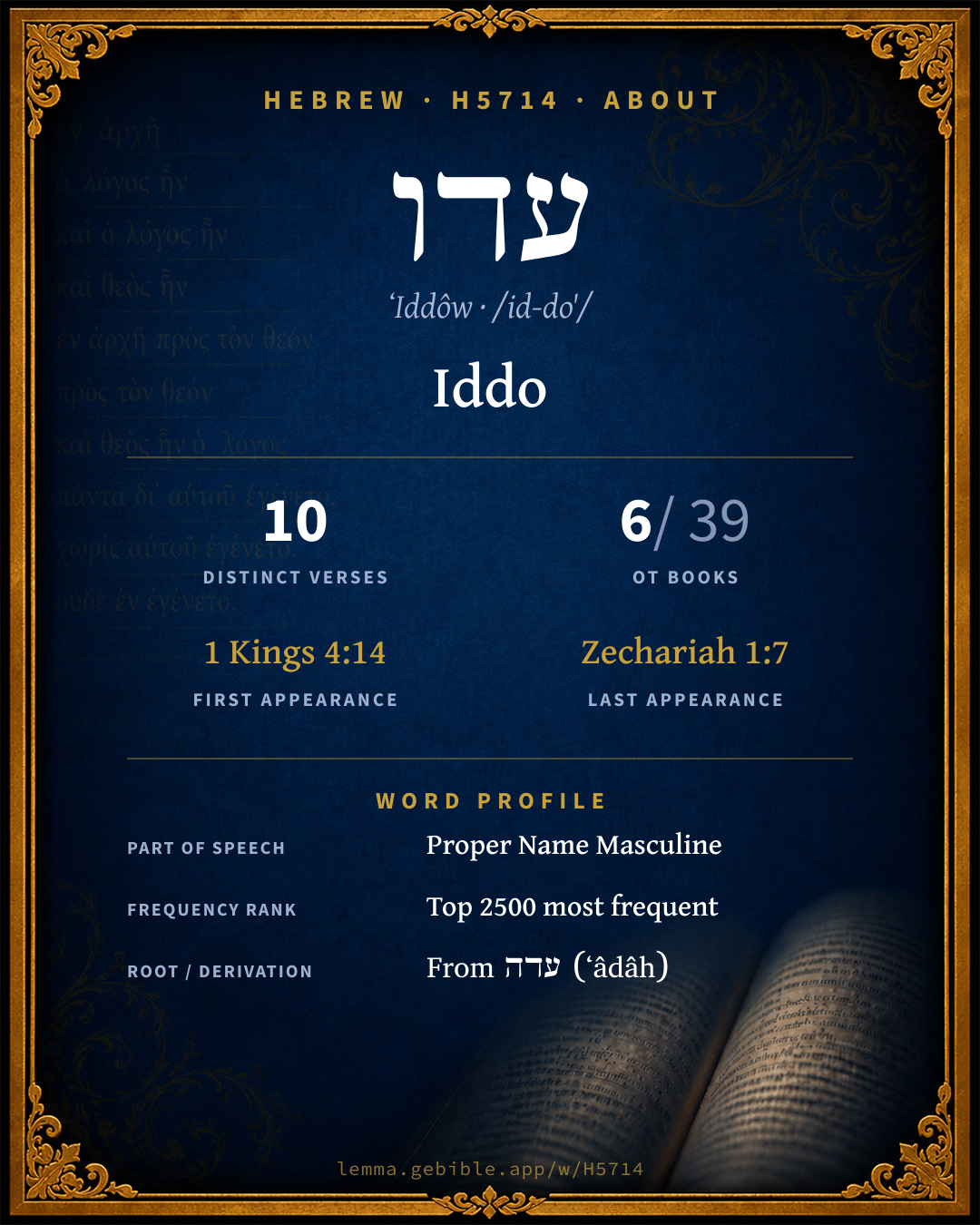
עִדּוֹ
Iddo
BDB lists 8 entries for ‘Iddo’ fuller range ↓
Full lexicon entry — Brown-Driver-Briggs (BDB)
From Brown-Driver-Briggs (BDB)
Where this word appears
Grammar key — what these labels mean
Part of speech
- Noun
- A naming word — a person, place, thing, or idea.
Noun type
- Proper
- A name of a specific person, place, or people (e.g. Abraham, Zion, Israel).
Every verse where H5714 appears — 10 distinct verses across 6 books. Click any verse to open its interlinear word-by-word view. Verse text shown in the World English Bible for context — . Each verse’s Hebrew form is shown with its reference; the English is not keyword-highlighted, since the data carries no word-level English alignment. Use “Compare translations” on any verse to read it across multiple English versions. This concordance covers the Hebrew Bible; Septuagint (Greek Old Testament) occurrences are not indexed here.
1 Kings 1 verse
1 Chronicles 1 verse
2 Chronicles 2 verses
- 2 Chronicles 12:15 וְ/עִדּ֥וֹ conj + n Proper Now the acts of Rehoboam, first and last, aren't they written in the histories of Shemaiah the prophet and of Iddo the seer, after the manner of genealogies? There were wars between Rehoboam and Jeroboam continually.
- 2 Chronicles 13:22 עִדּֽוֹ n Proper The rest of the acts of Abijah, and his ways, and his sayings, are written in the commentary of the prophet Iddo.
Ezra 2 verses
- Ezra 5:1 עִדּוֹא֙ n Proper Now the prophets, Haggai the prophet, and Zechariah the son of Iddo, prophesied to the Jews who were in Judah and Jerusalem; in the name of the God of Israel [prophesied they] to them.
- Ezra 6:14 עִדּ֑וֹא n Proper The elders of the Jews built and prospered, through the prophesying of Haggai the prophet and Zechariah the son of Iddo. They built and finished it, according to the commandment of the God of Israel, and according to the decree of Cyrus, and Darius, and Artaxerxes king of Persia.
Nehemiah 2 verses
Zechariah 2 verses
- Zechariah 1:1 עִדּ֥וֹ n Proper In the eighth month, in the second year of Darius, the word of Yahweh came to Zechariah the son of Berechiah, the son of Iddo, the prophet, saying,
- Zechariah 1:7 עִדּ֥וֹא n Proper On the twenty-fourth day of the eleventh month, which is the month Shebat, in the second year of Darius, the word of Yahweh came to Zechariah the son of Berechiah, the son of Iddo, the prophet, saying,
About this entry
At a glance — auto-summarized from this page’s data, not written by a person. Every figure links to its source below. This summary describes the numbers; it doesn’t interpret them.
עדו — transliterated ʻIddôw — is a Hebrew name carrying the sense “Iddo.” Debuting at 1 Kings 4:14, it then recurs through the corpus. The Hebrew Bible uses it across 10 verses — uncommon. Each statement above links to its evidence; the full detail follows below.
Gloss history
Strong's 1890 vs modern scholarship
About this word
Strong's H5714 catalogs a Hebrew word from the Hebrew Old Testament.
These counts are not copied from any lexicon or concordance. They are computed here, from the morphology-tagged Hebrew Old Testament. What Lemma adds →
- 10
- distinct verses
- The word appears in 10 distinct verses.
- 6 / 39
- OT books
- The word appears in 6 of 39 Old Testament books.
- #2,210
- by frequency
- Top 2500 most frequent Hebrew words (rank 2,210 of 8,640 Hebrew words by occurrence).
View all 10 occurrences in the concordance →
Most concentrated in
- 2 Chronicles 2 verses 20%
- Ezra 2 verses 20%
- Nehemiah 2 verses 20%
By section of the Old Testament
By traditional corpus
Conventional, traditional groupings — biblical authorship is debated, so this is a traditional corpus grouping, not an authorship claim. Each share is this word’s portion of its verses in that division of the Hebrew canon. Each figure is a share of the word’s 10 distinct verses.
- Writings (Ketuvim) 7 verses · 70%
- Prophets (Nevi'im) 3 verses · 30%
How translations render this word
Counts come from each version’s own published word-to-Strong’s tagging or interlinear alignment — an approximate guide to how each version renders this word, not a word-level alignment the data otherwise carries. Because each total is that version’s own tagged count, the per-version totals vary from one another and need not match the appearance or distinct-verse counts above. These counts may also differ from a printed concordance because Lemma counts each distinctly tagged rendering and does not collapse phrase taggings into a single head-word total. This is a fixed set of word-tagged versions (KJV, ASV, BSB, ULT) and does not change with the reading translation you choose elsewhere. Each version’s license is shown beside its name below (and on Sources).
- King James Version: Iddo 10×
- American Standard Version: Iddo 10×
- Berean Standard Bible: Iddo 9×
- unfoldingWord Literal Text: Iddo 10×
King James Version Public Domain
Renders H5714 across 10 tagged occurrences — most commonly:
American Standard Version Public Domain
Renders H5714 across 10 tagged occurrences — most commonly:
Berean Standard Bible Public Domain
Renders H5714 across 9 tagged occurrences — most commonly:
unfoldingWord Literal Text CC BY-SA 4.0
Renders H5714 across 10 tagged occurrences — most commonly:
Senses in the full BDB
What do BDB’s symbols mean?
BDB uses these scholarly abbreviations:
| Symbol | Meaning |
|---|---|
| 𝔊 | the Septuagint (the ancient Greek translation, LXX) |
| 𝔙 | the Vulgate (the Latin translation) |
| 𝔖 | the Syriac version (the Peshitta) |
| 𝔗 | the Targum (the Aramaic translation) |
| ψ | the Psalms |
| √ | root (the underlying root or stem) |
| ‖ | parallel passage (a synonymous or contrasted parallel) |
| † | the dagger: every passage where the word occurs is cited |
The 5 senses and sub-senses the full Brown-Driver-Briggs lexicon distinguishes for this word, in lexicon order (not ranked by frequency), with BDB’s own verbatim wording and sub-sense lettering. Shown in Hebrew script with BDB’s own scholarly abbreviations. The condensed entry is in the Lexicon Entry tab. See also the Forms in the corpus table below.
- 1. father of an officer of Sol. עִדֹּא 1 K 4:14; 𝔊 Αχελ, A Σαδωκ, 𝔊L Αχιαβ. e.g. 1 Kings 4:14
- 2. grandfather of prophet Zechariah עִדּוֹ Zc 1:1, עִדּוֹא v 7; 𝔊 Αδδω. e.g. Zechariah 1:1
- 3. a Levite עִדּוֹ 1 Ch 6:6; 𝔊 Αδει, 𝔊L Αδδω. e.g. 1 Chronicles 6:6
- 4. a priestly name עִדּוֹא van d. H. Ginsb (Baer עִדּוֹ) Ne 12:4; 𝔊א etc. Αδαιας; also עדיא v 16 Kt (עֲדָיָא?), Qr עִדּוֹא; 𝔊א τῷ Αδδαι, 𝔊L τῷ Αδαιᾳ. e.g. Nehemiah 12:4
- 5. a seer עִדּוֹ הַחֹזֶה 2 Ch 12:15 = הַנָּבִיא עִדּוֹ 2 Ch 13:22; 𝔊 Αδ(δ)ω; = יֶעְדּוֹ 2 Ch 9:29, Ιωηλ(δ). e.g. 2 Chronicles 12:15
Senses from the full Brown-Driver-Briggs lexicon (Brown, Driver, Briggs; Oxford 1906 — public domain), digitized via Sefaria, supplemented by the OpenScriptures HebrewLexicon (CC BY 4.0). Full attribution on Sources.
Word origin
Derived from עדה (ʻâdâh) (H5710) — to pass on.
Forms in the corpus
The 10 distinct written forms H5714 takes in the Hebrew Bible, most frequent first — each parse links to that state’s occurrences in the concordance. Hebrew forms include their vowel points and cantillation, so a single lemma takes many written forms.
| Form | Parsing | Example | Uses |
|---|---|---|---|
| עִדּ֥וֹא | Noun, Proper | Nehemiah 12:4 | 2 |
| וְ/עִדּ֥וֹ | Noun, Proper | 2 Chronicles 12:15 | 1 |
| ל/עדיא | Noun, Proper | Nehemiah 12:16 | 1 |
| לְ/עִדּ֥וֹא | Noun, Proper | Nehemiah 12:16 | 1 |
| עִדּ֑וֹא | Noun, Proper | Ezra 6:14 | 1 |
| עִדּ֣וֹ | Noun, Proper | 1 Chronicles 6:21 | 1 |
| עִדּ֥וֹ | Noun, Proper | Zechariah 1:1 | 1 |
| עִדֹּ֖א | Noun, Proper | 1 Kings 4:14 | 1 |
| עִדּֽוֹ | Noun, Proper | 2 Chronicles 13:22 | 1 |
| עִדּוֹא֙ | Noun, Proper | Ezra 5:1 | 1 |
Same root — word family
Other BDB entries built from the same root as H5714, grouped by Strong’s listed origin. These share a root / origin per the lexicon — not necessarily a shared meaning. Each links to that word’s own entry.
Derives from
Shares the same root
- עד ʻad H5703 perpetuity
- עד ʻêd H5708 menstruation
- עדא ʻădâʼ H5709 to pass away
- עדי ʻădîy H5716 ornaments
Proper names from this root
People and places named from this root — a name, not an additional meaning of the word.
- מעדי Maʻăday H4572 Maadai
- מעדיה Maʻădyâh H4573 Maadiah
- עדה ʻÂdâh H5711 Adah
- עדיה ʻĂdâyâh H5718 Adaiah
Compare all same-root words → Showing 4 of 10 — not the complete family. 4 of the same-root words are proper names (people or places). They share a root, not necessarily a meaning.
Bible dictionary
Public-domain dictionary articles matched to this entry by name (Iddo). A biblical name can be shared by more than one person or place, so an article may treat several.
Easton's Bible Dictionary · M. G. Easton, 1897
(1.) Timely (1 Chr. 6:21). A Gershonite Levite.
(2.) Lovely. The son of Zechariah (1 Chr. 27:21), the ruler of Manasseh in David's time.
(3.) Timely. The father of Ahinadab, who was one of Solomon's purveyors (1 Kings 4:14).
(4.) Lovely. A prophet of Judah who wrote the history of Rehoboam and Abijah (2 Chr. 12:15). He has been identified with Oded (2 Chr. 15:1).
(5.) Lovely. The father of Berachiah, and grandfather of the prophet Zechariah (Zech. 1:1, 7). He returned from Babylon (Neh. 12:4).
Smith's Bible Dictionary · William Smith, 1863
(timely or lovely).
+ The father of Abinadab. (1 Kings 4:14) + A descendant of Gershom, son of Levi. (1 Chronicles 6:21) + Son of Zechariah, ruler of the tribe of Manasseh east of Jordan in the time of David. (1 Chronicles 27:21) (B.C. 1014.) + A seer whose "visions" against Jeroboam incidentally contained some of the acts of Solomon. (2 Chronicles 9:29) He appears to have written a chronicle or story relating to the life and reign of Abijah. (2 Chronicles 13:22) (B.C. 961.) + The grandfather of the prophet Zechariah. (Zechariah 1:1,7) + The chief of those who assembled at Casiphia at the time of the second caravan from Babylon. He was one of the Nethinim. (Ezra 8:17) comp. Ezra 8:20 (B.C. 536.)
Hitchcock's Bible Names Dictionary · Roswell D. Hitchcock, 1869
his band; power; praise
Classic public-domain reference works; full attribution on Sources.
Septuagint verse parallels
This word appears in 8 verses that also exist in the Greek Old Testament (Septuagint), out of the 10 Hebrew verses it occurs in. You can read those verses in Greek by switching the Old Testament edition to the Septuagint.
Read these verses in the Septuagint
This is a verse-level parallel only — the same verses exist in both the Hebrew and Greek Old Testaments. No word-level Hebrew↔Greek correspondence is claimed: the data carries no such alignment, so no Greek word is shown as this Hebrew word’s translation. Coverage is not total — the Septuagint omits the deuterocanon and renumbers the Psalms, so some Hebrew verses have no direct Greek parallel.