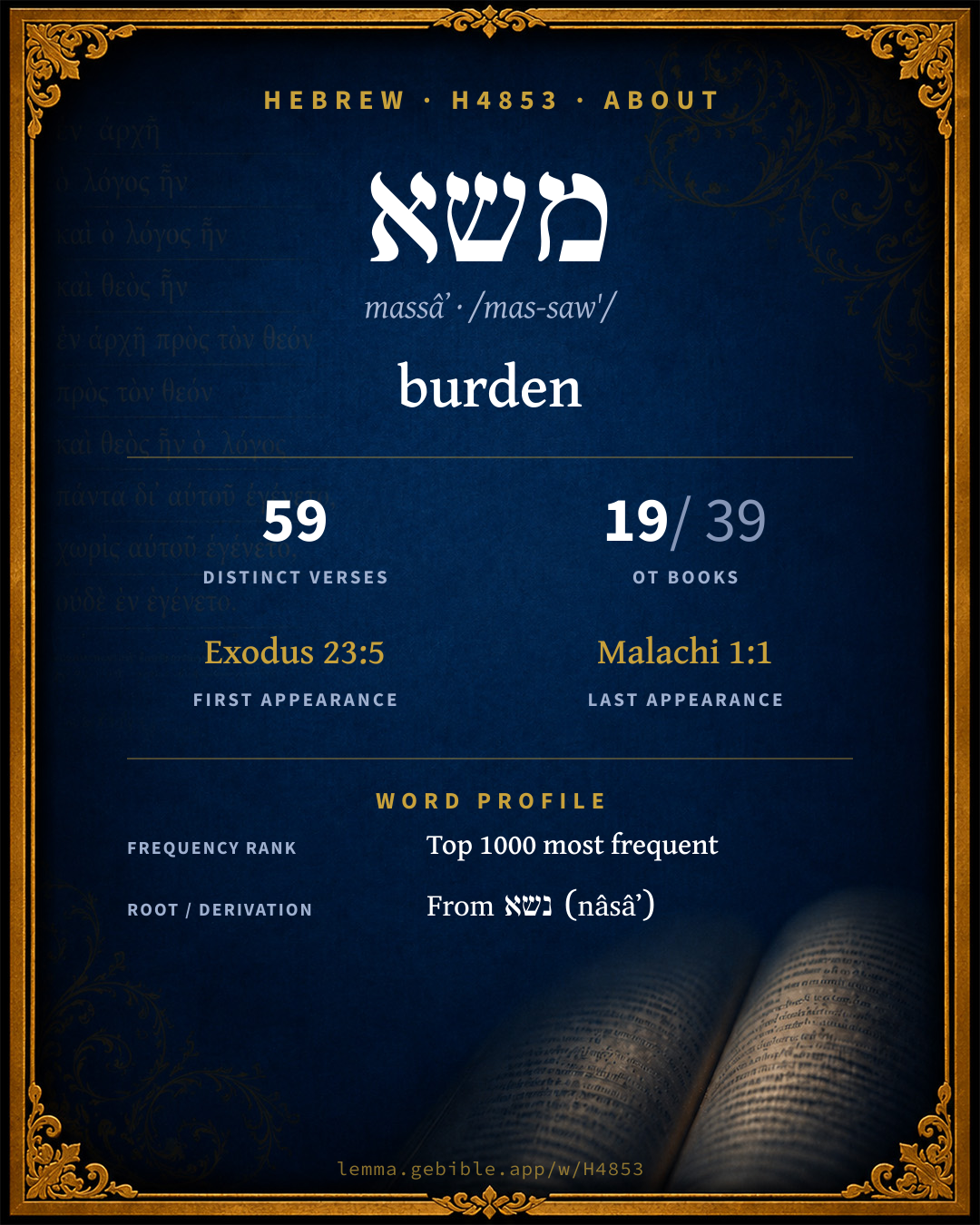
מַשָּׂא
burden
‘burden’ is one of 4 main senses fuller range ↓
Full lexicon entry — Brown-Driver-Briggs (BDB)
From Brown-Driver-Briggs (BDB)
Where this word appears
See every Absolute-state word in the Hebrew Bible →
Grammar key — what these labels mean
Part of speech
- Noun
- A naming word — a person, place, thing, or idea.
Noun type
- Common
- A common noun — a general class of person, place, or thing (“king,” “city,” “water”), not a specific name.
State
- Construct
- A noun bound to a following noun in a possessive / “of” relationship (the construct chain).
- Absolute
- The independent form of a noun, not bound to a following word.
Gender
- Masculine
- Grammatically masculine.
Number
- Singular
- One.
32 distinct verses where H4853 appears in the Absolute state, across 15 books. Filtered view — show all forms. Click any verse to open its interlinear word-by-word view. Verse text shown in the World English Bible for context — . Each verse’s Hebrew form is shown with its reference; the English is not keyword-highlighted, since the data carries no word-level English alignment. Use “Compare translations” on any verse to read it across multiple English versions. This concordance covers the Hebrew Bible; Septuagint (Greek Old Testament) occurrences are not indexed here.
Numbers 2 verses
- Numbers 4:24 וּ/לְ/מַשָּֽׂא conj + prep + n c ms This is the service of the families of the Gershonites, in serving and in bearing burdens:
- Numbers 4:47 מַשָּׂ֖א n c ms from thirty years old and upward even to fifty years old, everyone who entered in to do the work of service, and the work of bearing burdens in the Tent of Meeting,
2 Samuel 2 verses
- 2 Samuel 15:33 לְ/מַשָּֽׂא prep + n c ms David said to him, If you pass on with me, then you will be a burden to me:
- 2 Samuel 19:35 לְ/מַשָּׂ֔א prep + n c ms I am this day eighty years old: can I discern between good and bad? can your servant taste what I eat or what I drink? can I hear any more the voice of singing men and singing women? why then should your servant be yet a burden to my lord the king?
2 Kings 1 verse
1 Chronicles 2 verses
- 1 Chronicles 15:22 בְּ/מַשָּׂ֑א בַּ/מַּשָּׂ֔א prep + n c ms prep det + n c ms Chenaniah, chief of the Levites, was over the song: he instructed about the song, because he was skillful.
- 1 Chronicles 15:27 הַ/מַּשָּׂ֖א ptcl def.art + n c ms David was clothed with a robe of fine linen, and all the Levites who bore the ark, and the singers, and Chenaniah the master of the song [with] the singers: and David had on him an ephod of linen.
2 Chronicles 4 verses
- 2 Chronicles 17:11 מַשָּׂ֑א n c ms Some of the Philistines brought Jehoshaphat presents, and silver for tribute; the Arabians also brought him flocks, seven thousand and seven hundred rams, and seven thousand and seven hundred male goats.
- 2 Chronicles 20:25 מַשָּׂ֑א n c ms When Jehoshaphat and his people came to take the spoil of them, they found among them in abundance both riches and dead bodies, and precious jewels, which they stripped off for themselves, more than they could carry away: and they were three days in taking the spoil, it was so much.
- 2 Chronicles 24:27 הַ/מַּשָּׂ֣א ptcl def.art + n c ms Now concerning his sons, and the greatness of the burdens [laid] on him, and the rebuilding of the house of God, behold, they are written in the commentary of the book of the kings. Amaziah his son reigned in his place.
- 2 Chronicles 35:3 מַשָּׂ֖א n c ms He said to the Levites who taught all Israel, who were holy to Yahweh, Put the holy ark in the house which Solomon the son of David king of Israel did build; there shall no more be a burden on your shoulders: now serve Yahweh your God, and his people Israel.
Nehemiah 2 verses
- Nehemiah 13:15 מַשָּׂ֔א n c ms In those days saw I in Judah some men treading wine-presses on the Sabbath, and bringing in sheaves, and lading donkeys [therewith]; as also wine, grapes, and figs, and all manner of burdens, which they brought into Jerusalem on the Sabbath day: and I testified [against them] in the day in which they sold food.
- Nehemiah 13:19 מַשָּׂ֖א n c ms It came to pass that, when the gates of Jerusalem began to be dark before the Sabbath, I commanded that the doors should be shut, and commanded that they should not be opened until after the Sabbath: and some of my servants set I over the gates, that there should no burden be brought in on the Sabbath day.
Job 1 verse
Psalms 1 verse
Proverbs 2 verses
Isaiah 5 verses
- Isaiah 14:28 הַ/מַּשָּׂ֥א ptcl def.art + n c ms In the year that king Ahaz died was this burden.
- Isaiah 21:13 מַשָּׂ֖א n c ms The burden on Arabia. In the forest in Arabia shall you lodge, you caravans of Dedanites.
- Isaiah 22:25 הַ/מַּשָּׂ֣א ptcl def.art + n c ms In that day, says Yahweh of hosts, shall the nail that was fastened in a sure place give way; and it shall be hewn down, and fall; and the burden that was on it shall be cut off; for Yahweh has spoken it.
- Isaiah 46:1 מַשָּׂ֖א n c ms Bel bows down, Nebo stoops; their idols are on the animals, and on the cattle: the things that you carried about are made a load, a burden to the weary [animal].
- Isaiah 46:2 מַשָּׂ֑א n c ms They stoop, they bow down together; they could not deliver the burden, but themselves are gone into captivity.
Jeremiah 6 verses
- Jeremiah 17:21 מַשָּׂא֙ n c ms Thus says Yahweh, Take heed to yourselves, and bear no burden on the Sabbath day, nor bring it in by the gates of Jerusalem;
- Jeremiah 17:22 מַשָּׂ֤א n c ms neither carry forth a burden out of your houses on the Sabbath day holy, neither do any work: but make the Sabbath day, as I commanded your fathers.
- Jeremiah 17:24 מַשָּׂ֗א n c ms It shall happen, if you diligently listen to me, says Yahweh, to bring in no burden through the gates of this city on the Sabbath day, but to make the Sabbath day holy, to do no work therein;
- Jeremiah 17:27 מַשָּׂ֗א n c ms But if you will not listen to me to make the Sabbath day holy, and not to bear a burden and enter in at the gates of Jerusalem on the Sabbath day; then will I kindle a fire in the gates of it, and it shall devour the palaces of Jerusalem, and it shall not be quenched.
- Jeremiah 23:33 מַשָּׂ֖א מַשָּׂ֔א n c ms cs n c ms When this people, or the prophet, or a priest, shall ask you, saying, What is the burden of Yahweh? then shall you tell them, What burden! I will cast you off, says Yahweh.
- Jeremiah 23:36 וּ/מַשָּׂ֥א הַ/מַּשָּׂ֗א conj + n c ms cs ptcl def.art + n c ms The burden of Yahweh shall you mention no more: for every man's own word shall be his burden; for you have perverted the words of the living God, of Yahweh of Hosts our God.
Ezekiel 1 verse
Habakkuk 1 verse
Zechariah 1 verse
Malachi 1 verse
About this entry
At a glance — auto-summarized from this page’s data, not written by a person. Every figure links to its source below. This summary describes the numbers; it doesn’t interpret them.
משא — transliterated massâʼ — is a Hebrew word carrying the sense “burden.” It is not a single-sense word — see its full sense range. Spanning 59 verses in 19 books, it ranks among the moderately common words of the Hebrew Bible. Debuting at Exodus 23:5, it then recurs through the corpus. From the same root come נשא, משא and משאה. See the sense tree, 59-verse concordance, and the renderings breakdown below.
Gloss history
Strong's 1890 vs modern scholarship
About this word
Strong's H4853 catalogs a Hebrew word from the Hebrew Old Testament.
These counts are not copied from any lexicon or concordance. They are computed here, from the morphology-tagged Hebrew Old Testament. What Lemma adds →
- 59
- distinct verses
- The word appears in 59 distinct verses.
- 19 / 39
- OT books
- The word appears in 19 of 39 Old Testament books.
- #597
- by frequency
- Top 1000 most frequent Hebrew words (rank 597 of 8,640 Hebrew words by occurrence).
View all 59 occurrences in the concordance →
By section of the Old Testament
By traditional corpus
Conventional, traditional groupings — biblical authorship is debated, so this is a traditional corpus grouping, not an authorship claim. Each share is this word’s portion of its verses in that division of the Hebrew canon. Each figure is a share of the word’s 59 distinct verses.
- Prophets (Nevi'im) 35 verses · 59%
- Torah (Pentateuch) 12 verses · 20%
- Writings (Ketuvim) 12 verses · 20%
How translations render this word
Counts come from each version’s own published word-to-Strong’s tagging or interlinear alignment — an approximate guide to how each version renders this word, not a word-level alignment the data otherwise carries. Because each total is that version’s own tagged count, the per-version totals vary from one another and need not match the appearance or distinct-verse counts above. These counts may also differ from a printed concordance because Lemma counts each distinctly tagged rendering and does not collapse phrase taggings into a single head-word total. This is a fixed set of word-tagged versions (KJV, ASV, BSB, ULT) and does not change with the reading translation you choose elsewhere. Each version’s license is shown beside its name below (and on Sources).
BDB lists this Strong’s number as 3 distinct words (homographs). Each count above pools all of them and is not split by sense — see the Senses section below. A low-frequency rendering may belong to a different one of those words, not the primary meaning.
- King James Version†: Burden 40×, All their burdens 2×, Burdens 2×
- American Standard Version†: Burden 34×, ' burden 2×, All their burden 2×
- Berean Standard Bible†: Burden 29×, Load 7×, Is the burden 5×
- unfoldingWord Literal Text†: Burden 29×, Burden of 19×, Lifting up 3×
King James Version Public Domain
Renders H4853 across 66† tagged occurrences — most commonly:
Plus 20 renderings that appear only once — usually multi-word phrases or single function words the recovered tagging swept in, not distinct renderings.
American Standard Version Public Domain
Renders H4853 across 66† tagged occurrences — most commonly:
Plus 26 renderings that appear only once — usually multi-word phrases or single function words the recovered tagging swept in, not distinct renderings.
Berean Standard Bible Public Domain
Renders H4853 across 64† tagged occurrences — most commonly:
Plus 16 renderings that appear only once — usually multi-word phrases or single function words the recovered tagging swept in, not distinct renderings. Not rendered by a distinct English word in 2 further occurrences.
unfoldingWord Literal Text CC BY-SA 4.0
Renders H4853 across 70† tagged occurrences — most commonly:
Plus 14 renderings that appear only once — usually multi-word phrases or single function words the recovered tagging swept in, not distinct renderings.
Senses in the full BDB
What do BDB’s symbols mean?
BDB uses these scholarly abbreviations:
| Symbol | Meaning |
|---|---|
| 𝔊 | the Septuagint (the ancient Greek translation, LXX) |
| 𝔙 | the Vulgate (the Latin translation) |
| 𝔖 | the Syriac version (the Peshitta) |
| 𝔗 | the Targum (the Aramaic translation) |
| ψ | the Psalms |
| √ | root (the underlying root or stem) |
| ‖ | parallel passage (a synonymous or contrasted parallel) |
| † | the dagger: every passage where the word occurs is cited |
The 6 senses and sub-senses the full Brown-Driver-Briggs lexicon distinguishes for this word, in lexicon order (not ranked by frequency), with BDB’s own verbatim wording and sub-sense lettering. Shown in Hebrew script with BDB’s own scholarly abbreviations. The condensed entry is in the Lexicon Entry tab. See also the Forms in the corpus table below.
משא I
- 1. ‘son’ of Ishmael Gn 25:14 = 1 Ch 1:30. 𝔊 Μασση, Μασσα, etc. e.g. Genesis 25:14
- 2. realm of king Lemuel Pr 31:1 De Now Str Wild.—Perhaps = N. Arabic Masʾu Schr COT Gn 25, 14; KGF 102, 262 ff., 364 DlPar 302 f. e.g. Proverbs 31:1
משא II
- 1. load, burden of ass Ex 23:5 (E), mules 2 K 5:17, camels 8:9, cf. Is 46:1, 2; hanging on a peg Is 22:25 (fig.); forbidden on Sabbath Je 17:21, 22, 24, 27 Ne 13:15, 19; fig. of people as burden Nu 11:11, 17 (JE), Dt 1:12, cf. הָיָה לְמ׳ עַל־ 2 S 15:33; 19:36 (אֶל־), also וָאֶהְיֶה עָלַי לְמַשָּׂא Jb 7:20; of iniquities ψ 38:5.—Ho 8:10 read מְשֹׁהַ, so 𝔊 We Now GASm. e.g. Exodus 23:5
- 2. n. verb., lifting, uplifting, only מ׳ נַפְשָׁם Ez 24:25 the uplifting of their soul, i.e. that to which they lift up their soul, their heart’s desire. e.g. Ezekiel 24:25
- 3. n. verb., bearing, carrying, Nu 4:24 (+ לַעֲבֹד) 2 Ch 20:25; 35:3 (בַּכָּתֵף), so prob. 1 Ch 15:22(×2), 27 (cf. Be Kau; > singing, uplifting of voice, e.g. Öt); especially of responsibility and duty of bearing sacred vessels (often ‖ עֲבֹדָה, פְּקֻדָּה) Nu 4:15, 19, 27(×2), 49, עֲבֹדַת מ׳ v 47, מִשְׁמֶרֶת מ׳ v 31, 32. e.g. Numbers 4:24
- 4. perhaps what is carried, brought, i.e. tribute כֶּסֶף מ׳ 2 Ch 17:11 silver as tribute (+ מִנְחָה; cf. נשׂא Qal; others, silver by the load, i.e. in great quantity).—i. מַשָּׂא v. supr. p. 601 b. e.g. 2 Chronicles 17:11
Senses from the full Brown-Driver-Briggs lexicon (Brown, Driver, Briggs; Oxford 1906 — public domain), digitized via Sefaria, supplemented by the OpenScriptures HebrewLexicon (CC BY 4.0). Full attribution on Sources.
Word origin
I. n.pr.gent. et terr.
III. n.m. ψ 38:5 load, burden, lifting, bearing, tribute;—מ׳ abs. Ne 13:19 +; cstr. 2 K 5:17 +; sf. מַשָּׂאוֹ Ex 23:5 + 2 times; מַשַּׂאֲכֶם Dt 1:12; מַשָּׂאָם Nu 4:27 + 2 times;—
IV. n.m. Is 14:28 utterance, oracle (cf. נשׂא 1 b (6); Gf Je 23:33);—מ׳ abs. Is 14:28 +; usually cstr. 13:1 +;—of prophetic utterance: 2 K 9:25 Is 14:28 Ez 12:10 2 Ch 24:27 (c. עַל); מ׳ בָבֶל Is 13:1, מ׳ מוֹאָב 15:1, cf. 17:1; 19:1; 21:1, 11; 22:1; 23:1; 30:6 Na 1:1; מ׳ בערב Is 21:13 is later ins. (Di); מ׳ = revelation, הַמּ׳ אֲשֶׁר חָזָה חֲבַקּוּק הַנָּבִיא Hb 1:1; מ׳ י׳ utterance of י׳ Je 23:33, 34, 36, 38(×3) (cf. 2 K 9:25), vid. also v 33b (read אַתֶּם הַמַּשָּׂא), with word-play,—sq. וְנָטַשְׁתִּי, v 36b; מ׳ דְבַר י׳ Zc 9:1 (+ בארץ), 12:1 (+ עַל־יִשְׂרָאֵל), Mal 1:1 (+ אֶל־יִשׂ׳).—Pr 31:1 v. i. מַשָּׂא, p. 601 supr.; in 30:1 read מִמַּשָּׂא from Massa (Mühlau, De), or הַמַּשָּׂאִי (Wild), which however is perhaps not original, but borrowed from 31:1 (cf. Wildad loc. FrankenbergSpr. p. 5; corrupt name of Agur’s home or tribe, Kau).
— Brown-Driver-Briggs (Oxford 1906, public domain), digitized via Sefaria, supplemented by the OpenScriptures HebrewLexicon (CC BY 4.0). See Sources.
Derived from נשא (nâsâʼ) (H5375) — to lift.
Jastrow Dictionary
A second Hebrew/Aramaic lexicon for comparison, covering Aramaic and post-biblical (Talmudic, Targumic, Midrashic) usage that the biblical-Hebrew BDB does not. Matched by lemma rather than by Strong’s number, so a lemma may carry more than one Jastrow headword (shown separately below), and the entries cover usage well beyond the Bible.
מְשָׁא
- , v. מְשֵׁי
מַשָּׂא
- m (b. h.;
- 1. carrying. Kel. I, 1 מטמאין במ׳ make the carrier unclean. Ib. 3 ששוה מַגָּעוֹ למַשָּׂאוֹ the touch of which has the same effect as the carrying of it; a. fr.
- 2. מ׳ ומַתָּן carrying and giving, business, dealings; worldly affairs; intercourse. Sabb. 120ᵃ במ׳ ומ׳ in worldly affairs, opp. בדברי תורה. Kidd. 35ᵃ איש דבר מ׳ ומ׳ a man (has the protection of the law) because he is engaged in business. Yoma 86ᵃ מַשָּׂאוֹ ומַתָּנוֹ וכ׳ his dealings with men; a. fr.—Kidd. 30ᵇ כל משאו ומתנו בך he (the tempter) will always be busy with thee.
- 3. burden. Tanḥ. B’midb. 2, v. מַשּׂוֹא.—Trnsf. burden of prophecy. Gen. R. s. 44 עשרה לשונות נקראת נבואה … מ׳ וכ׳ prophecy goes by ten names: ‘vision’ … ‘burden’ &c.; ib. רבנן אמרי מ׳ כמשמעו וכ׳ the Rabbis say, the severest of all is massa, as its name indicates (burden) &c.; Cant. R. to III, 4; a. e.—Pl. מַשָּׂאוֹת. Gitt. 71ᵃ מ׳ ומתנות business transactions.
מֵשָׁא
- , v. מֵישָׁא
משא
- , Pes. 111ᵇ כרו מ׳, v. כְּרוּמְשָׁא
A Dictionary of the Targumim, the Talmud Babli and Yerushalmi, and the Midrashic Literature (Marcus Jastrow; London, Luzac, 1903) — Public Domain. Digitized via Sefaria. Digitized via Sefaria. Full attribution on Sources.
Forms in the corpus
The 32 distinct written forms H4853 takes in the Hebrew Bible, most frequent first — each parse links to that state’s occurrences in the concordance. Hebrew forms include their vowel points and cantillation, so a single lemma takes many written forms.
Same root — word family
Other BDB entries built from the same root as H4853, grouped by Strong’s listed origin. These share a root / origin per the lexicon — not necessarily a shared meaning. Each links to that word’s own entry.
Derives from
Shares the same root
- משא massôʼ H4856 partiality
- משאה massâʼâh H4858 uplifting
- משאת masʼêth H4864 burden
- מתנשא mithnassêʼ H4984 to exalt oneself
- נשא nᵉsâʼ H5376 to lift
- נשאת nissêʼth H5379 portion
- נשואה nᵉsûwʼâh H5385 load
- נשיא nâsîyʼ H5387 chief
- שאת sᵉʼêth H7613 exaltation
- שוא sôwʼ H7721 rising
Proper names from this root
People and places named from this root — a name, not an additional meaning of the word.
Compare all same-root words → Showing 4 of 14 — not the complete family. 2 of the same-root words are proper names (people or places). They share a root, not necessarily a meaning.
Septuagint verse parallels
This word appears in 57 verses that also exist in the Greek Old Testament (Septuagint), out of the 59 Hebrew verses it occurs in. You can read those verses in Greek by switching the Old Testament edition to the Septuagint.
Read these verses in the Septuagint
- Exodus 23:5
- Numbers 4:15
- Deuteronomy 1:12
- 2 Samuel 15:33
- 2 Kings 5:17
- 1 Chronicles 15:22
- 2 Chronicles 17:11
- Job 7:20
- Psalms 38:4
- Proverbs 30:1
- Isaiah 13:1
- Jeremiah 17:21
This is a verse-level parallel only — the same verses exist in both the Hebrew and Greek Old Testaments. No word-level Hebrew↔Greek correspondence is claimed: the data carries no such alignment, so no Greek word is shown as this Hebrew word’s translation. Coverage is not total — the Septuagint omits the deuterocanon and renumbers the Psalms, so some Hebrew verses have no direct Greek parallel.