
Jeremiah 23:36

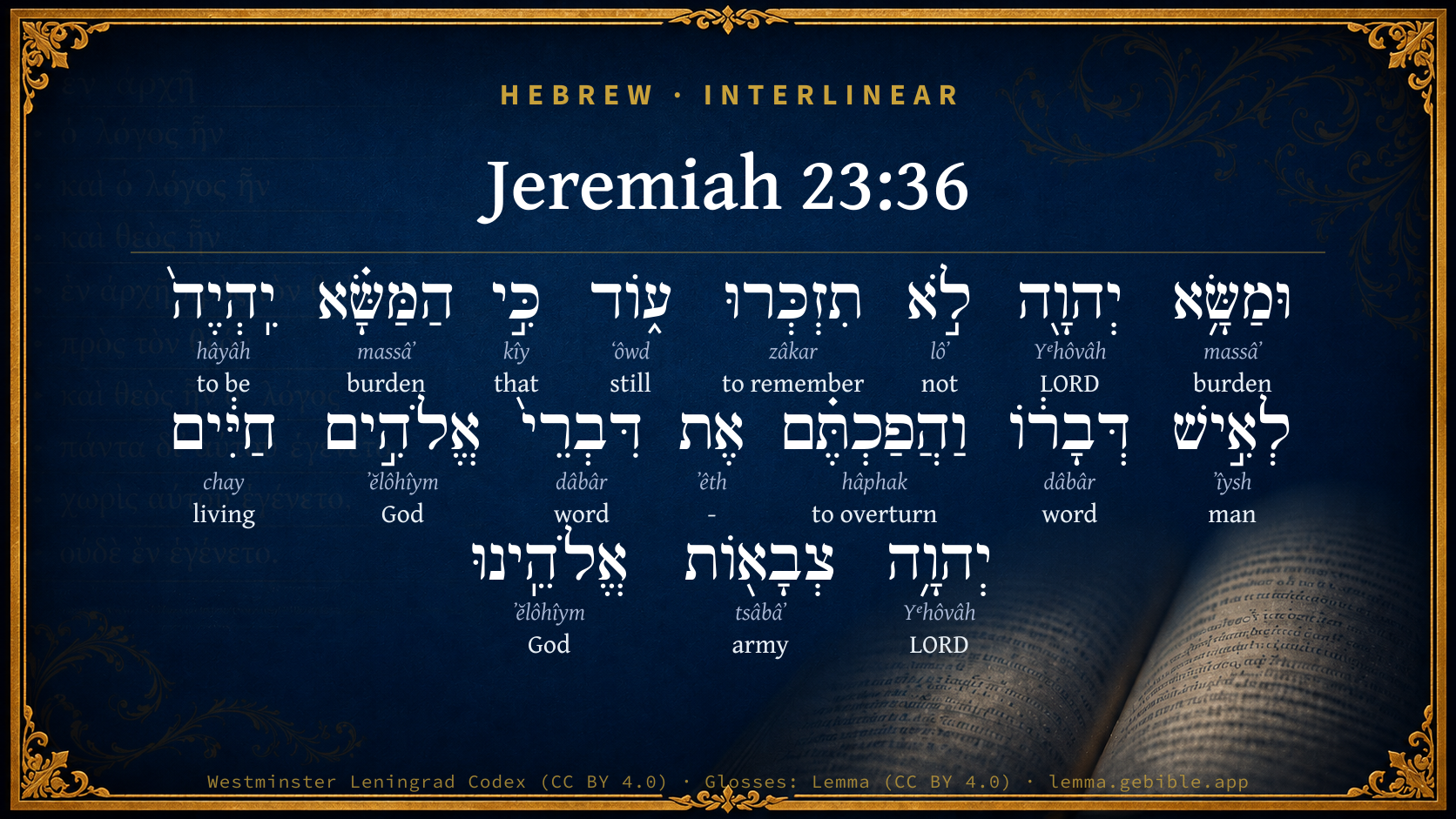
Hebrew (Westminster Leningrad Codex) Jeremiah 23:36 appears in the Hebrew Old Testament. The text above is from the Westminster Leningrad Codex. Each word links to its Strong’s number, a concise gloss, and parsing drawn from the Open Scriptures Hebrew Bible morphology. Click any word for its full Brown-Driver-Briggs (BDB) entry.
Download image
Cite this verse

Jeremiah 23:36 (World English Bible). Public Domain. Lemma interlinear Bible study tool, https://lemma.gebible.app/v/jeremiah/23/36.

Show BibTeX & RIS
BibTeX
RIS
English Translation
The burden of Yahweh shall you mention no more: for every man's own word shall be his burden; for you have perverted the words of the living God, of Yahweh of Hosts our God.
World English Bible · Public Domain
Download a study sheet

One document with this verse’s original text, its word-by-word gloss line, the meaning frame, cross-references with their text, attributed commentary, and full source and license credits — printable, and it pastes into notes with its structure intact.

This verse Autodidact and up

Study sheet (.html) Plain text (.txt)

A passage Seminary Student

Up to 50 verses in one chapter. A passage sheet keeps up to 6 commentary sources and 12 cross-references per verse, in the order this page ranks them, and says so on the sheet whenever that leaves anything out. Ask for a single verse and you get the Autodidact verse sheet above.

Everything on this page stays free to read, with no account — the sheet is a download of what is already on screen, not access to it.

Want to remove ads? Support Godless Engineer
Compare translations 3

The same verse in 3 English versions, stacked beneath the original-language interlinear above. Click any original word for its lexicon entry.

Each is an independent rendering of the whole verse — the interlinear is not word-aligned to these translations.

Highlighted words mark where these versions differ — a whole-verse word diff, not a word-by-word alignment.

  • World English Bible Public Domain
    The burden of Yahweh shall you mention no more: for every man's own word shall be his burden; for you have perverted the words of the living God, of Yahweh of Hosts our God.
  • King James Version Public Domain
    And the burden of the LORD shall ye mention no more: for every man's word shall be his burden; for ye have perverted the words of the living God, of the LORD of hosts our God.
  • unfoldingWord Literal Text CC BY-SA 4.0
    But ‘the burden of Yahweh’ you shall not mention again, for the burden will be each man’s word, for you have perverted the words of the living God, Yahweh of Armies, our God.

unfoldingWord Literal Text — © unfoldingWord, licensed CC BY-SA 4.0. Word-aligned USFM3 via Door43 (git.door43.org/unfoldingWord/en_ult).

Versions to compare (up to 4)

3 of 4 selected

Show all 18 translations

Every available English version of this verse, each an independent rendering of the whole verse.

  • World English Bible Public Domain
    The burden of Yahweh shall you mention no more: for every man's own word shall be his burden; for you have perverted the words of the living God, of Yahweh of Hosts our God.
  • Berean Standard Bible Public Domain
    But refer no more to the burden of the LORD, for each man’s word becomes the burden, so that you pervert the words of the living God, the LORD of Hosts, our God.
  • Majority Standard Bible Public Domain
    But refer no more to the burden of the LORD, for each man’s word becomes the burden, so that you pervert the words of the living God, the LORD of Hosts, our God.
  • King James Version Public Domain
    And the burden of the LORD shall ye mention no more: for every man's word shall be his burden; for ye have perverted the words of the living God, of the LORD of hosts our God.
  • American Standard Version (1901) Public Domain
    And the burden of Jehovah shall ye mention no more: for every man's own word shall be his burden; for ye have perverted the words of the living God, of Jehovah of hosts our God.
  • Revised Version (1885) Public Domain
    And the burden of the LORD shall ye mention no more: for every man’s own word shall be his burden; for ye have perverted the words of the living God, of the LORD of hosts our God.
  • Geneva Bible (1599) Public Domain
    And the burden of the Lord shall yee mention no more: for euery mans worde shall bee his burden: for ye haue peruerted the words of the liuing God, the Lord of hostes our God.
  • Douay-Rheims (1899) Public Domain
    And the burden of the Lord shall be mentioned no more, for every man's word shall be his burden: for you have perverted the words of the living God, of the Lord of hosts our God.
  • Young's Literal Translation Public Domain
    And the burden of Jehovah ye do not mention any more, For the burden to each is -- His word, And ye have overturned the words of the living God, Jehovah of Hosts, our God.
  • Literal Standard Version CC BY-SA 4.0
    And you do not mention the burden of YHWH anymore, || For the burden to each is His word, || And you have overturned the words of the living God, YHWH of Hosts, our God.
  • Unlocked Literal Bible CC BY-SA 4.0
    But you must no longer talk about the 'burden of Yahweh,' for the burden is every man's own word, and you have perverted the words of the living God, Yahweh of hosts, our God.
  • unfoldingWord Literal Text CC BY-SA 4.0
    But ‘the burden of Yahweh’ you shall not mention again, for the burden will be each man’s word, for you have perverted the words of the living God, Yahweh of Armies, our God.
  • Darby Bible Public Domain
    And the burden of Jehovah shall ye mention no more; for every man's own word shall be his burden: for ye have perverted the words of the living God, of Jehovah of hosts, our God.
  • World Messianic Bible Public Domain
    You will mention the message from the LORD no more, for every man’s own word has become his message; for you have perverted the words of the living God, of the LORD of Hosts, our God.
  • Webster's Bible Public Domain
    And the burden of the LORD shall ye mention no more: for every man's word shall be his burden; for ye have perverted the words of the living God, of the LORD of hosts our God.
  • Free Bible Version CC BY-SA 4.0
    Don't talk about “the burden of the Lord” anymore, because everybody has different ideas about this “burden,” perverting the words of the living God, the Lord Almighty, our God.
  • Bible in Basic English Public Domain
    And you will no longer put people in mind of the word of weight of the Lord: for every man's word will be a weight on himself; for the words of the living God, of the Lord of armies, our God, have been twisted by you.
  • JPS Tanakh (1917) Public Domain
    And the burden of the LORD shall ye mention no more; for every man's own word shall be his burden; and would ye pervert the words of the living God, of the LORD of hosts our God?

Literal Standard Version (2020), Covenant Press — licensed CC BY-SA 4.0. Text via the HelloAO Bible API (eBible.org). Unlocked Literal Bible (unfoldingWord) — licensed CC BY-SA 4.0. Text via the HelloAO Bible API (eBible.org). unfoldingWord Literal Text — © unfoldingWord, licensed CC BY-SA 4.0. Word-aligned USFM3 via Door43 (git.door43.org/unfoldingWord/en_ult). Free Bible Version, Dr. Jonathan Gallagher — licensed CC BY-SA 4.0. Text via the HelloAO Bible API (eBible.org).

Word by word

More ways to search: Search by grammar → Find every occurrence → Compare this word →

Practice this passage: Drill this verse → Learn its vocabulary →

וּמַשָּׂ֥א
massâʼ
H4853
“and · burden of”
Conjunction + Noun, Common, Masculine, Singular, Construct
Part of Speech
Conjunction + Noun
Type
Common
Gender
Masculine
Number
Singular
State
Construct
Full BDB Definition

Origin: from H5375

TWOT: 1421d , 1421e

Massa = "burden" - load, bearing, tribute, burden, lifting (noun masculine) - load, burden - lifting, uplifting, that to which the soul lifts itself up - bearing, carrying - tribute, that which is carried or brought or borne - utterance, oracle, burden (noun masculine) - a son of Ishmael (noun proper masculine)
  1. יְהוָ֖ה Yᵉhôvâh H3068 “LORD” Noun, Proper
  2. לֹ֣א lôʼ H3808 “not” Particle, Negative
  3. תִזְכְּרוּ zâkar H2142 “to remember” Verb, Qal, Imperfect, 2nd Person, Masculine, Singular
  4. ע֑וֹד ʻôwd H5750 “still” Adverb
  5. כִּ֣י kîy H3588 “that” Conjunction
  6. הַמַּשָּׂ֗א massâʼ H4853 “the · burden” Particle, Definite Article + Noun, Common, Masculine, Singular, Absolute
  7. יִֽהְיֶה֙ hâyâh H1961 “to be” Verb, Qal, Imperfect, 3rd Person, Masculine, Singular
  8. לְאִ֣ישׁ ʼîysh H376 “to/for · man” Preposition + Noun, Common, Masculine, Singular, Absolute
  9. דְּבָר֔וֹ dâbâr H1697 “word · his” Noun, Common, Masculine, Singular, Construct + Suffix, Personal, 3rd Person, Masculine, Singular
  10. וַהֲפַכְתֶּ֗ם hâphak H2015 “and · to overturn” Conjunction + Verb, Qal, Perfect, 2nd Person, Masculine, Plural
  11. אֶת ʼêth H853 “-” Particle, Direct Object
  12. דִּבְרֵי֙ dâbâr H1697 “words of” Noun, Common, Masculine, Plural, Construct
  13. אֱלֹהִ֣ים ʼĕlôhîym H430 “God(s)” Noun, Common, Masculine, Plural, Absolute
  14. חַיִּ֔ים chay H2416 “living” Adjective, Adjective, Masculine, Plural, Absolute
  15. יְהוָ֥ה Yᵉhôvâh H3068 “LORD” Noun, Proper
  16. צְבָא֖וֹת tsâbâʼ H6635 “armies” Noun, Common, Both, Plural, Absolute
  17. אֱלֹהֵֽינוּ ʼĕlôhîym H430 “God(s) · our” Noun, Common, Masculine, Plural, Construct + Suffix, Personal, 1st Person, Common, Plural

About this verse

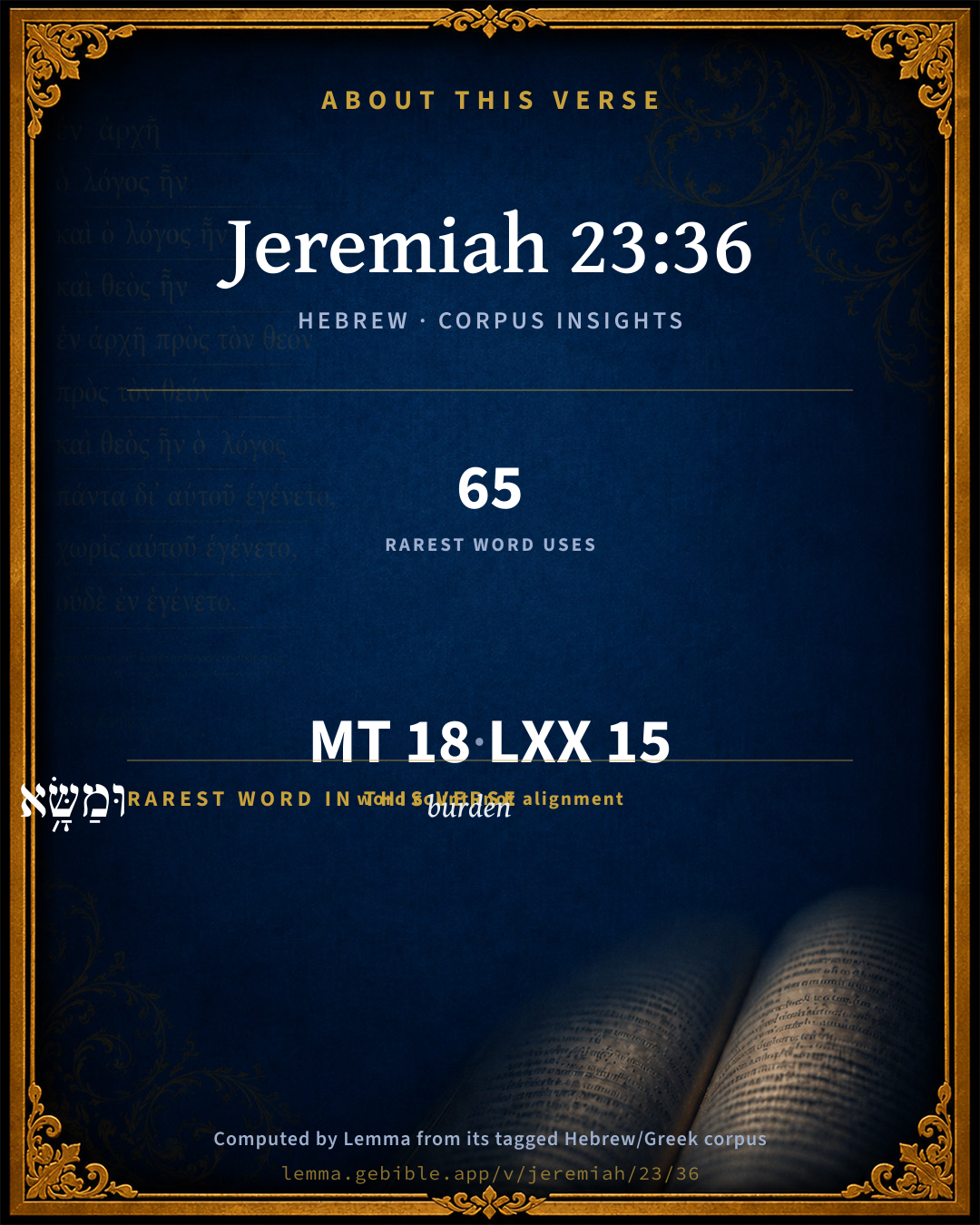
These counts appear in no published source. They are computed here, from the morphology-tagged text and Lemma’s own curated glosses. What Lemma adds →

18
words
14
distinct lemmas
Prophets
section

Grammatical profile

  • 3 verbs
  • 10 nouns
  • 1 adjective
  • 1 conjunction
  • 1 adverb
  • 2 particles

Verb forms

  • תִזְכְּרוּ Qal · Imperfect
  • יִֽהְיֶה֙ Qal · Imperfect
  • וַהֲפַכְתֶּ֗ם Qal · Perfect

Repetition

Words recur within this verse — often emphatic in Hebrew:

  • וּמַשָּׂ֥א burden H4853 ×2
  • יְהוָ֖ה LORD H3068 ×2
  • דְּבָר֔וֹ word H1697 ×2
  • אֱלֹהִ֣ים God H430 ×2

Hebrew & Septuagint length

In the original languages it is 18 Hebrew tokens and 15 Greek tokens — but the two are counted differently (Hebrew bundles its prefixes and suffixes into one token; the Greek is in lemma form), so that isn’t a like-for-like length.

Cross-references

22

Topical passages linked to Jeremiah 23:36 in the Treasury of Scripture Knowledge — connected by theme and wording, ordered by reader-vote popularity; previews shown in the World English Bible.

  • Isaiah 3:8 For Jerusalem is ruined, and Judah is fallen; Because their tongue and their doings are against Yahweh, To provoke the eyes of his glory.
  • Jeremiah 10:10 But Yahweh is the true God; he is the living God, and an everlasting King: at his wrath the earth trembles, and the nations are not able to abide his indignation.
  • 2 Peter 3:16 as also in all of his letters, speaking in them of these things. In those are some things hard to be understood, which the ignorant and unsettled twist, as they also do to the other Scriptures, to their own destruction.
  • 2 Kings 19:4 It may be Yahweh your God will hear all the words of Rabshakeh, whom the king of Assyria his master has sent to defy the living God, and will rebuke the words which Yahweh your God has heard. Therefore lift up your prayer for the remnant that is left.
  • Psalms 64:8 Their own tongues shall ruin them. All who see them will shake their heads.
  • Psalms 120:3 What will be given to you, and what will be done more to you, You deceitful tongue?
  • Deuteronomy 5:26 For who is there of all flesh, that has heard the voice of the living God speaking out of the midst of the fire, as we have, and lived?
  • 1 Samuel 17:26 David spoke to the men who stood by him, saying, What shall be done to the man who kills this Philistine, and takes away the reproach from Israel? for who is this uncircumcised Philistine, that he should defy the armies of the living God?
  • 1 Samuel 17:36 Your servant struck both the lion and the bear: and this uncircumcised Philistine shall be as one of them, seeing he has defied the armies of the living God.
  • Psalms 12:3 May Yahweh cut off all flattering lips, And the tongue that boasts,
  • Psalms 149:9 To execute on them the written judgment. All his saints have this honor. Praise Yah!
  • Proverbs 17:20 One who has a perverse heart doesn't find prosperity, And one who has a deceitful tongue falls into trouble.
  • Isaiah 28:13–14 Therefore shall the word of Yahweh be to them precept on precept, precept on precept; line on line, line on line; here a little, there a little; that they may go, and fall backward, and be broken, and snared, and taken.
  • Isaiah 28:22 Now therefore don't you be scoffers, lest your bonds be made strong; for a decree of destruction have I heard from the Lord, Yahweh of Hosts, on the whole earth.
  • Matthew 12:36 I tell you that every idle word that men speak, they will give account of it in the day of judgment.
  • Luke 19:22 "He said to him, 'Out of your own mouth will I judge you, you wicked servant! You knew that I am an exacting man, taking up that which I didn't lay down, and reaping that which I didn't sow.
  • Acts 14:15 "Men, why are you doing these things? We also are men of like passions with you, and bring you good news, that you should turn from these vain things to the living God, who made the sky and the earth and the sea, and all that is in them;
  • Galatians 1:7–9 and there isn't another gospel. Only there are some who trouble you, and want to pervert the Gospel of Christ.
  • Galatians 6:5 For each man will bear his own burden.
  • 1 Thessalonians 1:9 For they themselves report concerning us what kind of a reception we had from you; and how you turned to God from idols, to serve a living and true God,
  • 2 Peter 2:17–18 These are wells without water, clouds driven by a storm; for whom the blackness of darkness has been reserved forever.
  • Jude 1:15–16 to execute judgment on all, and to convict all the ungodly of all their works of ungodliness which they have done in an ungodly way, and of all the hard things which ungodly sinners have spoken against him."

Cross-references courtesy of OpenBible.info (CC BY 4.0).

Hebrew and Greek witnesses Masoretic Hebrew ↔ Greek Septuagint

The same verse in the two great witnesses to the Old Testament, shown verse-for-verse.

These are two independent witnesses, not word-aligned to each other, and the Septuagint is shown in lemma (dictionary) form.

Hebrew Jeremiah 23:36 Masoretic · Westminster Leningrad Codex

וּמַשָּׂ֥א יְהוָ֖ה לֹ֣א תִזְכְּרוּ ע֑וֹד כִּ֣י הַמַּשָּׂ֗א יִֽהְיֶה֙ לְאִ֣ישׁ דְּבָר֔וֹ וַהֲפַכְתֶּ֗ם אֶת דִּבְרֵי֙ אֱלֹהִ֣ים חַיִּ֔ים יְהוָ֥ה צְבָא֖וֹת אֱלֹהֵֽינוּ

The burden of Yahweh shall you mention no more: for every man's own word shall be his burden; for you have perverted the words of the living God, of Yahweh of Hosts our God.

World English Bible · Public Domain

Greek LXX Structure differs

In the Septuagint, Jeremiah is about an eighth shorter than the Hebrew and arranges its material differently — the Oracles Against the Nations (Hebrew chapters 46–51) appear in the middle of the Greek book, after 25:13. Because the chapter and verse boundaries do not line up, a verse-for-verse comparison with the Hebrew is not shown.

A verse-for-verse comparison isn’t shown here because the chapters and verses don’t line up. Switch to the LXX edition with the MT / LXX toggle above to read the Greek directly.

On this verse, The Cambridge Bible for Schools and Colleges discusses the Septuagint’s reading. Read the note in Commentary ↓

Hebrew: Westminster Leningrad Codex (CC BY 4.0). Greek: Septuagint (public domain); English from a public-domain English Septuagint. How the Septuagint differs from the Hebrew →

Targum (Aramaic paraphrase)

1

The Targum is the ancient Jewish Aramaic paraphrase of the Hebrew Scriptures — an interpretive translation, not the Hebrew text itself. Onkelos (literal) and Pseudo-Jonathan (expansive) render the Torah, and Jonathan the Prophets. Coverage is partial: where no permissively-licensed English translation exists for a verse, only the Aramaic is shown. This is verse-level text, not a word-by-word alignment to the Hebrew.

  1. Targum Jonathan Prophets (Joshua–Malachi)
    וּנְבוּאָה בִּשְׁמָא דַייָ לָא תִדְכְּרוּן עוֹד אֲרֵי נְבוּאֲתָא תְּהֵי לִגְבַר דִמְקַיֵם פִּתְגָמֵי רְעוּתֵיהּ וְאַתּוּן מְדַמָן לְבַטָלָא יַת פִּתְגָמֵי אֱלָהָא קַיָמָא דַייָ צְבָאוֹת אֱלָהָנָא:

    (no public-domain English translation for this verse)

    Targum Jonathan — Aramaic: “Mikraot Gedolot” (public domain). English: “Sefaria Community Translation” (CC0 1.0 (public-domain dedication)); “London "Chaldee Paraphrase," 1871” (public domain). Text via Sefaria.

Commentary

Notes on Jeremiah 23:36 from classic Christian and Jewish commentators (each source and its license shown beneath its notes). The classic Christian expositions comment on the surrounding passage and are grouped to its opening verse, so a note may address several verses; the Jewish commentaries on the Tanakh (Rashi and others) are per-verse, so they appear only where the commentator wrote on this verse.

Lemma curates 59 commentaries, every one of them public domain or Creative Commons licensed, each selected and text-cleaned for this edition rather than reprinted as found. About our sources →

The Cambridge Bible for Schools and Colleges

gen. ed. J. J. S. Perowne

36. every man’s own word shall be his burden] mg. is his burden, and ye pervert, etc. Either (a) he who has jokingly enquired after the “burden of the Lord” shall find that those lightly spoken words of his are in very deed the heaviest load to bear, or (b) (rendering for “shall be” is) no alleged prophetic utterance has in fact any higher authority than the speaker himself.

ye have perverted, etc.] The LXX omit this clause; also the greater part of Jer_23:37 (which is Jer_23:35 repeated). The accumulation of epithets in Jer_23:36 renders the clause suspicious.

The Cambridge Bible for Schools and Colleges (gen. ed. J. J. S. Perowne; Cambridge University Press, 1878–1918) — public domain. Text from a community e-Sword module.

Trapp's Complete Commentary

John Trapp

Jer 23:36 And the burden of the LORD shall ye mention no more: for every man’s word shall be his burden; for ye have perverted the words of the living God, of the LORD of hosts our God.

Ver. 36. For every man’s word shall be his burden.] That jeer of his afore mentioned shall lie heavy upon him, and cost him dear, for under the weight he shall sink and be crushed in pieces.

John Trapp, A Commentary or Exposition upon All the Books of the Old and New Testament (1647–1656) — public domain. Text from a community e-Sword module.

Joseph Benson's Commentary

Jer 23:36. For every man’s word shall be his burden — You shall be made severely to account for your loose and profane speeches, wherewith you deride and pervert the words and messages of God himself. Or, “Every man shall have most reason to regard his own word as hurtful and prejudicial to him. For the words of God were delivered with a salutary tendency, to warn sinners of the danger of their situation, and to call them to repentance. Those, therefore, who made a right use of them would have no cause to complain. But those who despised and rejected them perverted that which should have been for their wealth into an occasion of falling.” — Blaney.

Joseph Benson's Commentary on the Old and New Testaments (1811–1818) — public domain. Text from a community e-Sword module.

Tyndale Open Study Notes

Tyndale Open Resources

23:36 The Lord warned that no one should claim to have a prophecy from the Lord in order to exert authority over other people. Doing so would be contrary to God’s words and constitute a misuse of his name (Exod 20:7; see also Matt 20:25-28).

Tyndale Open Study Notes — © Tyndale Open Resources, licensed CC BY-SA 4.0. Text via the HelloAO Bible API.

Geneva Bible (1599)

Geneva Bible translators

The thing which they mock and contemn, shall come upon them.

Geneva Bible (1599) marginal notes — public domain. Text via Bolls.life.

Jamieson, Fausset & Brown

Robert Jamieson, A. R. Fausset & David Brown

every man's word . . . his burden--As they mockingly call all prophecies burdens, as if calamities were the sole subject of prophecy, so it shall prove to them. God will take them at their own word.

living God--not lifeless as their dumb idols, ever living so as to be able to punish.

Jamieson, Fausset & Brown — Commentary Critical and Explanatory on the Whole Bible (1871) — public domain (CC PDM 1.0). Text via the HelloAO Bible API.

Adam Clarke's Commentary

Verse 36. Every man's word shall be his burden] Ye say that all God's messages are burdens, and to you they shall be such: whereas, had you used them as you ought, they would have been blessings to you.

For ye have perverted the words of the living God] And thus have sinned against your own souls.

Adam Clarke's Commentary on the Bible (1810–1826) — public domain. Text from a community e-Sword/MySword module.

John Calvin's Commentaries

Jeremiah goes on with the same subject, that every one ought calmly and meekly to hear God speaking, he said, as we saw yesterday, that the prophets were to be asked as to what God had spoken and what he had answered; he thereby intimated that there must be docility, in order that God’s word may obtain credit, authority, and favor among us. He again repeats, that the word burden could not be endured by God; for, as we explained yesterday, this word was used commonly by the Jews as expressive of hatred or disdain, being as they were unwilling to receive sound doctrine.

In forbidding them to mention the word burden, it was the same thing as though he had said, “Let not this form of speaking be any longer in use among you.” He then adds, For to every one his word shall be his burden. By these words he shews that what is bitter in prophecies is as it were accidental; for God has nothing else in view in addressing men, but to call them to salvation. The word of God then in itself ought to be deemed sweet and delightful. Whence then is this bitterness and hatred towards it? even from the wickedness of men alone. As when a sick person, eating the most wholesome food finds it turned into poison, the cause being in himself; so it is with us, it is our own fault that the word of God becomes a burden. It was, moreover, the Prophet’s design to shew that the Jews had no reason to complain that prophecies were grievous to them, and always announced some trouble; for God wishes to address men with lenity and kindness, but he is forced by their wickedness to deal sharply with them. The Prophet seems, however, to go still farther, as though he had said, “Though prophecies should cease, yet every one shall be a prophet to himself; for as they murmur against God, and cannot bear his judgment, however silent God’s ministers may be, they will yet afford a sufficient cause for condemnation, who dare thus to rise up against God.”

We now see the design of the Prophet in saying, Ye shall no more mention the burden of Jehovah; that is, “This shameful proverb, which brands God’s word with disgrace, shall no more be used by you; this wicked practice shall cease, for else to every one of you; his word shall be a burden;” so the causal particle כי, ki, is to be rendered. But if another sense be preferred, I feel no objection, that is, that they ought to have considered the reason why God did not deal more mildly with them; which was, because they were of a perverse disposition, and thus they refused the paternal kindness which he was prepared to shew, provided they received it.

This passage is entitled to special notice, for we see how the greater part cannot bear threatenings and terrors when announced to them. Hence they entertain contempt and hatred towards heavenly doctrine; and yet none consider why God so often threatens and terrifies them in his word. For if men ceased to sin, God would cease to contend with them; but when they continually provoke him, is he to be silent? and further, are his prophets to suffer everything just to be violated, and God himself to be despised? Let us then know that the fault is in us when God seems to deal rigidly with us, for we do not allow him to use such a paternal language as he always would, were it not that we put a hinderance in the way.

The Prophet also adds, For ye have corrupted the words of the living God, of Jehovah of hosts our God So ought the words to be rendered. Here he justly accuses them, that they perverted the words of God, and in two ways, because they constrained God by their wickedness to speak otherwise than he wished, and also, because they were preposterous interpreters of his dealings. For though God may severely chastise us, yet it is our duty to receive his reproofs with a meek spirit, as they are necessary for us; but when we murmur and become refractory, we pervert the word of God. We hence see that the word of God is not only perverted in one way, but when we furiously oppose him, we prevent him to deal gently and kindly with us; and we do the same when we submit not to his reproofs, but rage against him whenever he summons us to judgment. And as their wantonness was in this instance so great, the Prophet here sets up against them in express terms the power of God.

He says first, that he is the living God; and by this term he reminded them that the ungodly, who vomited thus their blasphemies against him, would not go unpunished; “See,” he says, “with whom ye have to do; for you contend with the living God; this audacity will rebound on your own heads; ye then carry on a fatal war.” He, secondly, adds, that he is Jehovah of hosts; by which expression he again shews his power. And, thirdly, he says, that he is the God of that people; as though he had said, that not only their impiety was madness in daring to contend with God, but that it was also connected with ingratitude; for God had adopted them as his people, and had promised to be their God.

We now then see the design of the Prophet; he first warned them not to entertain hatred in their hearts to prophetic doctrine; secondly, he shewed that the whole fault was in themselves, as they constrained God to deal severely with them; and further, that they perverted the word of God, being false interpreters of it, and closing the door against his kindness when he invited all the pious and the teachable; and lastly, he exalts God’s power and commends his goodness, that he might thus aggravate the sin of the people in daring to carry on war with God himself, and in despising the favor conferred on them. It follows, —

John Calvin's Commentaries (1540-1563) — public domain. Text from the Calvin Translation Society English edition (1840s-50s) via the Christian Classics Ethereal Library (ccel.org). Calvin's coverage is partial (roughly two-thirds of the Bible); uncommented books and verses are honest gaps, never fabricated. The 19th-century editor's footnotes and remarks are omitted so the notes are faithfully Calvin's own voice.

Ellicott's Commentary for English Readers

(36) The burden of the Lord shall ye mention no more . . .—The misused term was no longer to be applied to the messages of Jehovah. If men continued to apply it to the words of their own heart, they would find it a “burden” in another sense (the prophet plays once more on the etymology of the word) too heavy to be borne. This would be the righteous punishment of the reckless levity with which they had treated the sacred Name which Jeremiah reproduces in all the amplitude of its grandeur. They had never realised the awfulness of speaking in the name “of the living God, the Lord of Sabaoth.”

A Bible Commentary for English Readers, edited by Charles John Ellicott (1878–1897) — public domain. Text from a community e-Sword module.

John Gill's Exposition

And the burden of the Lord shall be mentioned no more,.... Or the word of the Lord under that name, speaking of it in a ludicrous and scoffing manner:

for every man's word shall be his burden; every flout, scoff, and jeer of his, at the word of God, shall fall heavily upon him, with weight upon his conscience, and press him with guilt to the lowest hell; or, however, a heavy punishment for his sin shall light upon him: or, as the words may be rendered, "for his word is a burden to everyone" (u); that is, the word of the Lord is reckoned by everyone a burden; and with them a burden and the word of the Lord are synonymous terms; which ought not to be, and was offensive to the Lord; and therefore he forbids the use of such a phrase, and threatens to punish for it;

for ye have perverted the words of the living God, of the Lord of hosts, our God; derided them, and put a wrong sense upon them; and which is aggravated by their being the words of "the living God", who is the true God and his words true; and he lives and is able to resent and punish any ill usage of him, and ill treatment of his words; and not the oracles of lifeless idols: and they are the words of "the Lord of hosts", of all armies above and below, and so was able to make them good: and besides, they were the words of "our God", the God of Israel; who had in all ages kept his covenant with them, performed his promises to them, and had done great and good things for them.

(u) "quia onus erit unicuique verbum suum", Schmidt; "vel verbum ejus, nempe, Dei", Dieu.

John Gill's Exposition of the Whole Bible (1746–1763) — public domain (CC PDM 1.0). Text via the HelloAO Bible API.

Albert Barnes' Notes on the Bible

Every man’s word ... - Rather, every man’s burden shall be his word; i. e., his mocking use of the word “burden” shall weigh him down and crush him.

Perverted - i. e., put into a ridiculous light.

Albert Barnes' Notes on the Bible (1834–1885) — public domain. Text from a community e-Sword/MySword module.

Matthew Poole's English Annotations

The burden of the Lord shall ye mention no more; not in scorn and derision, as not believing there were any such judgments as they threaten; nor hardly, as if I sent yon no other messages but burdens. These false and irreverent speeches, which are in every man’s mouth, shall be burdensome to them, being such as shall bring down Divine vengeance upon them; because you have derided or misinterpreted the words of God, the living God; the sin of which is the more aggravated against you, because he is the living, mighty God, and because he hath been our God.

Matthew Poole's English Annotations on the Holy Bible (1683–1685) — public domain. Text from a community e-Sword/MySword module.

Whedon's Commentary on the Bible

Daniel D. Whedon

36. Every man’s word shall be his burden — The word “burden” shall have, to him who uses it tauntingly against my faithful prophet, a crushing fulfilment.

Daniel D. Whedon (gen. ed.), Commentary on the Old and New Testaments (1874–1909) — public domain. Text from a community e-Sword module.

The Pulpit Commentary

And the burden of the Lord, etc.; i.e. ye shall no longer use the word massa at all. Every man"s word shall be his burden; rather, the burden to every man shall be his word; i.e. his derisive use of the word massa shall be a burden which shall crush him to the ground. Ye have perverted; i.e. have turned them round, and put them into a ridiculous light" (Payne Smith).

The Pulpit Commentary (1880–1919), ed. H.D.M. Spence-Jones & Joseph S. Exell — public domain. Text from a community e-Sword module.

John Wesley's Explanatory Notes

Mention no more - Not in scorn and derision. For - These false and irreverent speeches which are in every man's mouth, shall be burdensome to them, shall bring down vengeance upon them. Perverted - Because you have derided, the words of God, the living God.

John Wesley, Explanatory Notes Upon the Whole Bible (1754–1765) — public domain. Text via the GEBible commentary corpus.

Rashi

Rabbi Shlomo Yitzchaki (Rashi)

For the burden shall be to the man of His word Although you pervert the massa into a pejorative, the prophecy (משא) of the word of the Lord shall be to the man of His word, and to the man of His counsel He reveals it, but you pervert it to an expression of a burden. This interpretation I did not hear, but it is the main interpretation. But this is how I heard it, namely that the burden shall be a burden of retribution for the one who says it, who asks, “What is the burden?” Another interpretation: משא is an expression of prophecy, and the false prophet would ask the true prophet to tell him the word of the Holy One, blessed be He, in the language in which the expression came to him, and the expression did not explain the speech adequately. Therefore, the false prophet would pervert it to another meaning and would speak after the fashion of the true prophet in order that they should believe him. And so did Hananiah son of Azzur do. Therefore, he says, “Do not ask the prophecy of the Lord,” the language of the expression, but “What did He speak?” or “What did He reply?” The explanation of the words you shall ask the true prophet to tell you what the Holy One, blessed be He, says, and to what His words are inclined.

for the prophecy shall be for the man of His word The unexplained expression the Holy One, blessed be He, said unexplained to the man of His counsel, who is not suspected of perverting it, but you ask it in order to pervert it, and you pervert the words of the Holy One, blessed be He, and that is what is stated above (v. 30): “those who steal My words from one another.” This too is a correct explanation.

Rashi on the Tanakh — English translations: “The Judaica Press complete Tanach with Rashi, translated by A. J. Rosenberg” (CC BY 4.0); “Pentateuch with Rashi's commentary by M. Rosenbaum and A.M. Silbermann, 1929-1934” (public domain); “The Metsudah Tanach series, Lakewood, N.J” (CC BY 4.0); and “The Book of Joshua, Metsudah Publications, 1997” (CC BY 4.0). Text via Sefaria.

Lesson kit

Teaching starters — assembled from the data on this page, not authored interpretation. Every prompt links to the verse data it draws on. Edit before teaching.

Jeremiah, in the Prophets, opens this verse with 18 words (14 distinct Hebrew lemmas). Its most distinctive word is massâʼ (“burden”). A historical commentator’s framing appears above. Read the whole chapter for the surrounding context.

Discussion questions

  1. How does “burden” (massâʼ) shape what this verse is saying?
  2. How does Isaiah 3:8, which shares this passage’s theme, read alongside this verse?
  3. What does the repetition of “burden” (2× in this one verse) do in this verse?
  4. These translations render this verse differently; the difference is in the English rendering, not the original. What questions does that raise?
  5. «תִזְכְּרוּ» is a Qal Imperfect verb. How does that grammatical form shape the action described?
  6. Compare how The Cambridge Bible for Schools and Colleges and Trapp's Complete Commentary read this verse. Where do they agree or differ?

Things to notice

Reading settings

Reading text

Shown beneath each verse's original-language words.

Old Testament
Old Testament edition

Read the OT as the Masoretic Hebrew (MT) or the Greek Septuagint (LXX).

English shown for the Greek Septuagint (in the Hebrew ↔ Greek comparison).

Comparing translations? Open the Compare panel on any verse page to stack up to four side by side.