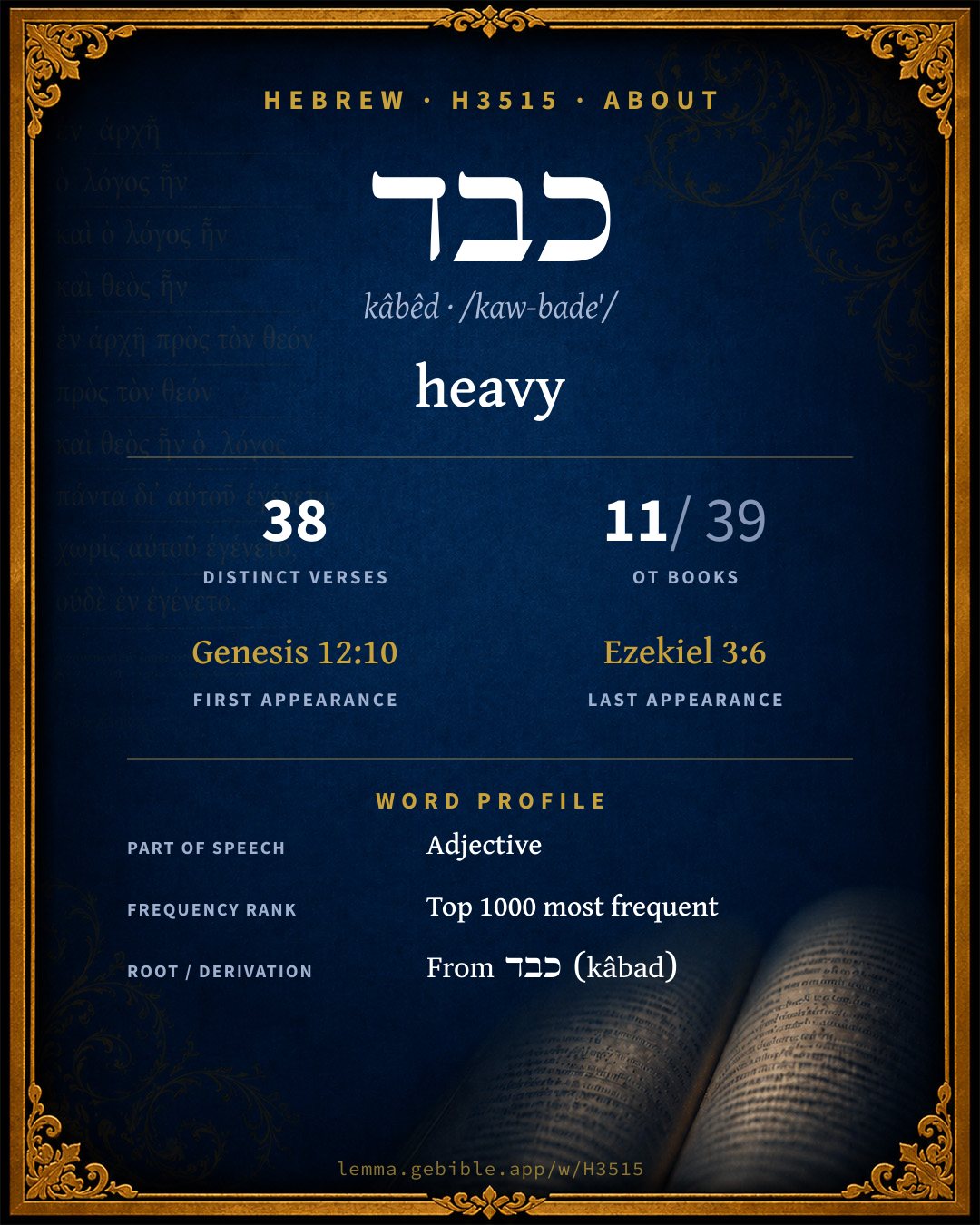
כָּבֵד
heavy
‘heavy’ is one of 6 main senses fuller range ↓
Full lexicon entry — Brown-Driver-Briggs (BDB)
From Brown-Driver-Briggs (BDB)
Where this word appears
Grammar key — what these labels mean
Part of speech
- Adjective
- A word that describes or qualifies a noun.
State
- Absolute
- The independent form of a noun, not bound to a following word.
- Construct
- A noun bound to a following noun in a possessive / “of” relationship (the construct chain).
Gender
- Masculine
- Grammatically masculine.
Number
- Singular
- One.
- Plural
- More than one (in Hebrew, generally three or more).
Every verse where H3515 appears in the Book of Psalms — 1 distinct verse. Click any verse to open its interlinear word-by-word view. Verse text shown in the World English Bible for context — . Each verse’s Hebrew form is shown with its reference; the English is not keyword-highlighted, since the data carries no word-level English alignment. Use “Compare translations” on any verse to read it across multiple English versions. This concordance covers the Hebrew Bible; Septuagint (Greek Old Testament) occurrences are not indexed here.
Psalms
About this entry
At a glance — auto-summarized from this page’s data, not written by a person. Every figure links to its source below. This summary describes the numbers; it doesn’t interpret them.
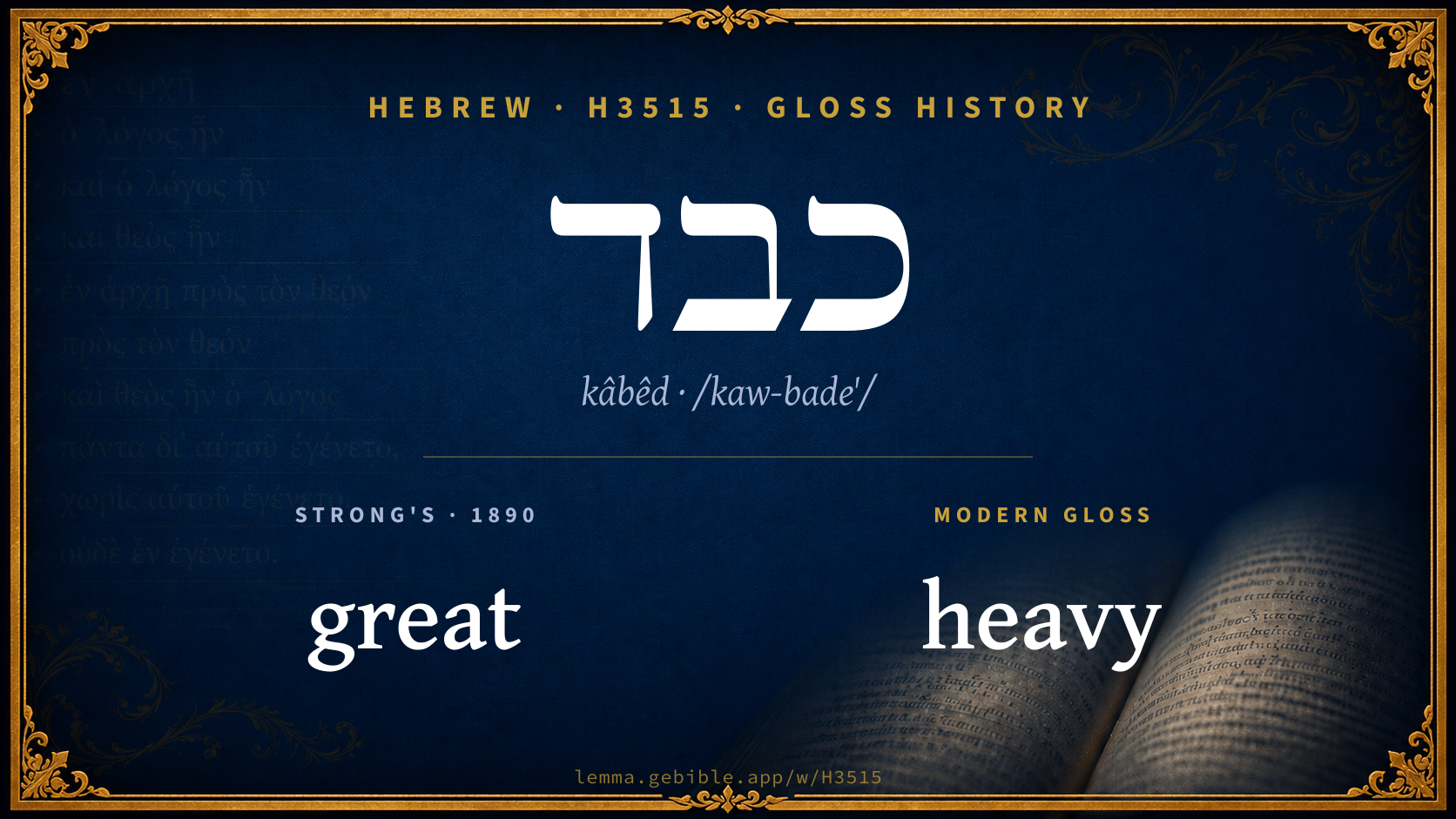
The Hebrew adjective כבד centers on the idea of “heavy.” Older and newer Bibles part ways — “great” in the King James Version, “heavy” (unfoldingWord Literal Text) in modern versions. See the renderings breakdown. It turns up in 38 verses across 11 books, a moderately common footprint. The word gravitates to Exodus (29%), then Genesis and 1 Kings. The lexicon spreads it across several senses; see its full sense range. For the data behind this summary, explore the sense tree and the renderings breakdown below.
Gloss history
Strong's 1890 vs modern scholarship
About this word
Strong's H3515 catalogs a Hebrew word from the Hebrew Old Testament.
These counts are not copied from any lexicon or concordance. They are computed here, from the morphology-tagged Hebrew Old Testament. What Lemma adds →
- 38
- distinct verses
- The word appears in 38 distinct verses.
- 11 / 39
- OT books
- The word appears in 11 of 39 Old Testament books.
- #922
- by frequency
- Top 1000 most frequent Hebrew words (rank 922 of 8,640 Hebrew words by occurrence).
View all 38 occurrences in the concordance →
By section of the Old Testament
By traditional corpus
Conventional, traditional groupings — biblical authorship is debated, so this is a traditional corpus grouping, not an authorship claim. Each share is this word’s portion of its verses in that division of the Hebrew canon. Each figure is a share of the word’s 38 distinct verses.
- Torah (Pentateuch) 21 verses · 55%
- Prophets (Nevi'im) 12 verses · 32%
- Writings (Ketuvim) 5 verses · 13%
How translations render this word
Counts come from each version’s own published word-to-Strong’s tagging or interlinear alignment — an approximate guide to how each version renders this word, not a word-level alignment the data otherwise carries. Because each total is that version’s own tagged count, the per-version totals vary from one another and need not match the appearance or distinct-verse counts above. These counts may also differ from a printed concordance because Lemma counts each distinctly tagged rendering and does not collapse phrase taggings into a single head-word total. This is a fixed set of word-tagged versions (KJV, ASV, BSB, ULT) and does not change with the reading translation you choose elsewhere. Each version’s license is shown beside its name below (and on Sources).
BDB lists this Strong’s number as 3 distinct words (homographs). Each count above pools all of them and is not split by sense — see the Senses section below. A low-frequency rendering may belong to a different one of those words, not the primary meaning.
- King James Version†: Great 8×, Grievous 6×, Heavy 4×
- American Standard Version†: Great 8×, Grievous 5×, Heavy 3×
- Berean Standard Bible†: Great 4×, Large 4×, Severe 4×
- unfoldingWord Literal Text†: Heavy 21×, Great 4×, Heavy of 3×
King James Version Public Domain
Renders H3515 across 38† tagged occurrences — most commonly:
Plus 12 renderings that appear only once — usually multi-word phrases or single function words the recovered tagging swept in, not distinct renderings.
American Standard Version Public Domain
Renders H3515 across 38† tagged occurrences — most commonly:
Plus 14 renderings that appear only once — usually multi-word phrases or single function words the recovered tagging swept in, not distinct renderings.
Berean Standard Bible Public Domain
Renders H3515 across 40† tagged occurrences — most commonly:
Plus 21 renderings that appear only once — usually multi-word phrases or single function words the recovered tagging swept in, not distinct renderings. Not rendered by a distinct English word in 1 further occurrence.
unfoldingWord Literal Text CC BY-SA 4.0
Renders H3515 across 42† tagged occurrences — most commonly:
Plus 9 renderings that appear only once — usually multi-word phrases or single function words the recovered tagging swept in, not distinct renderings.
33 senses and sub-senses in the full BDB
Hebrew verbs can shift meaning by stem (binyan): Qal is the basic action, Niphal is often passive or reflexive, Piel often intensifies or makes it factitive, and Hiphil is typically causative. The senses below are grouped under the stem BDB assigns to each. This entry also uses Pual (the passive of Piel) and Hithpael (reflexive or reciprocal).
What do BDB’s symbols mean?
BDB uses these scholarly abbreviations:
| Symbol | Meaning |
|---|---|
| 𝔊 | the Septuagint (the ancient Greek translation, LXX) |
| 𝔙 | the Vulgate (the Latin translation) |
| 𝔖 | the Syriac version (the Peshitta) |
| 𝔗 | the Targum (the Aramaic translation) |
| ψ | the Psalms |
| √ | root (the underlying root or stem) |
| ‖ | parallel passage (a synonymous or contrasted parallel) |
| † | the dagger: every passage where the word occurs is cited |
The 33 senses and sub-senses the full Brown-Driver-Briggs lexicon distinguishes for this word, in lexicon order (not ranked by frequency), with BDB’s own verbatim wording and sub-sense lettering. Shown in Hebrew script with BDB’s own scholarly abbreviations. The condensed entry is in the Lexicon Entry tab. See also the Forms in the corpus table below.
כבד I be heavy, weighty, burdensome, honoured (NH Pi. honour, and deriv., כֹּבֶד weight
Qal
- Pf. כ׳ Is 24:20; 3 fs. כָּֽבְדָה Gn 18:20 + 4 times; כָּבֵ֑דָה Ju 20:34; 3 mpl. כָּֽבְדוּ Gn 48:10; Impf. יִכְבָּד Ex 9:7 Is 66:5; יִכְבָּ֑ד Jb 6:3; 33:7 + 10 times Impf. (כָּבֵד Gn 12:10 + is given as 3 m. Pf. by some; but it is prob. taken better as adj. SS make כָּבֵד ψ 38:5 inf. abs.; < Thes adj.).— e.g. Isaiah 24:20
- 1. be heavy, in weight, of misfortune, heavier than sand Jb 6:3; of God’s hand in punishment 1 S 5:11, with אֶל 1 S 5:6; עַל ψ 32:4; of man’s hand in war Ju 1:35; יָדִי כָּֽבְדָה עַל־אַנְחָתִי my hand is heavy upon my groaning Jb 23:3 is explained by 𝔗 Hrz Schlottm as hand smiting me; but read rather with 𝔊 𝔖 Ew De Reu Di יָדוֹ of God’s hand; of pressure אַכְפִּי Jb 33:7 (𝔊 כַּפִּי); = vehement, sore, of battle Ju 20:34; c. אֶל 1 S 31:3 = עַל 1 Ch 10:3; burdensome, grievous; וְלֹא נִכְבַּד עָלֶי֑ךָ lest we be burdensome unto thee 2 S 13:25; of work laid upon one, bondage, with עַל Ex 5:9 (JE) Ne 5:18; of sin conceived as a burden Gn 18:20 (J), iniquities ψ 38:5; transgressions, with עַל Is 24:20. e.g. Job 6:3
- 2. heavy, insensible, dull, of the eyes, so as to be unable to see Gn 48:10 (JE); of the ears Is 59:1; of the לֵב, hard, insensible Ex 9:7 (J; P and E’s syn. is חָזַק, q.v.) e.g. Genesis 48:10
- 3. be honoured (cf. βαρύς) of a man Jb 14:21 (opp. יצערו: cf. Hiph. 3), of Tyre Ez 27:25, of Yahweh Is 66:5. e.g. Job 14:21
Niphal
- Pf. נִכְבַּד 2 S 6:20, נִכְבָּ֔ר 2 S 23:19, 23 1 Ch 11:21; נִכְבַּדְתָּ Is 43:4; + 2 times Pf.; Impf. אֶכָּבֵד Lv 10:3 Is 49:5; אִכָּֽבְדָה Ex 14:4, 17; אִכָּבֵ֑דָה 2 S 6:22; אִכָּֽבְדָ֯ Hg 1:8; Imv. הִכָּבֵד 2 K 14:10; Inf. הִכָּֽבְדִי Ex 14:18 Ez 39:13; Pt. נִכְבָּד Gn 34:19 + 6 times; pl. נִכְבָּדִים Nu 22:15; cstr. נִכְבַּדֵּי Is 23:8, 9 Pr 8:24; נִכְבַּדֶּיהָ Na 3:10; נִכְבְּדֵיהֶם ψ 149:8; Pl. f. נִכְבָּדוֹת ψ 87:3— e.g. 2 Samuel 6:20
- 1. pass.
- a. be made heavy from abundance, מַעְיָנוֹת נִכְבַּדֵּי־מָ֑יִם fountains abounding in water Pr 8:24. e.g. Proverbs 8:24
- b. be honoured, enjoy honour, of man 1 S 9:6; 22:14; 2 S 6:20, 22; 23:19 = 1 Ch 11:21, 2 S 23:23; 2 K 14:10; Is 43:4; 49:5; 1 Ch 4:9 וַיְהִי נִכְבָּד, 11:25 נִכְבָּד הוּא (altered from 2 S 23:23); but more frequent in pt. as subst. honourable, honoured, distinguished man Gn 34:19 Nu 22:15 (JE) Is 3:5; 23:8, 9; Na 3:10; ψ 149:8; נִכְבָּדוֹת ψ 87:3 glorious things; הַשֵּׁם הַנִּכְבָּד וְהַנּוֹרָא Dt 28:58 the glorious and awe-inspiring name (of Yahweh). e.g. 1 Samuel 9:6
- 2. medial, get oneself glory (or honour), of God Is 26:15; Ez 28:22; 39:13; Hg 1:8; with בְּ in or by any one Ex 14:4, 17, 18 (P); עַל־פְּנֵי Lv 10:3 (P). e.g. Isaiah 26:15
Piel
- Pf. 2 m. sf. כִּבַּדְתָּ֫נִי Is 43:23; 3 mpl. כִּבְּדוּ 1 S 6:6; + 3 times Pf.; Impf. יְכַבֵּד Mal 1:6 + 3 times; sf. יְכַבְּדָ֑נְנִי ψ 50:23; 3fs. sf. תְּכַבְּדֵנִי Is 43:20; אֲכַבְּדָה ψ 86:12; + 12 times Impf.; Imv. כַּבֵּד Ex 20:12 + 2 times; + 3 times Imv.; Inf. abs. כַּבֵּד Nu 22:17; + 2 times Inf.; Pt. מְכַבֵּד 2 S 10:3; + 4 times Pt.;— e.g. Isaiah 43:23
- 1. make heavy, insensible (cf. Qal 2) the לב(ב) 1 S 6:6(×2). e.g. 1 Samuel 6:6
- 2. make honourable, honour, glorify, usually c. human subj.:
- a. human obj., parents Ex 20:12 = Dt 5:16 (Dec.), Mal 1:6; Balaam Nu 22:17(×2), 37; 24:11(×2) (JE); sons of Eli 1 S 2:29; Saul 1 S 15:30; Nahash 2 S 10:3 = 1 Ch 19:3; Jerusalem La 1:8; more gen. ψ 15:4; subj. God 1 S 2:30 b ψ 91:15, cf. Pr 4:8. e.g. Exodus 20:12
- b. obj. things, sacred place Is 6:13 (God subj.); the Sabbath Is 58:13. e.g. Isaiah 6:13
- c. God obj. 1 S 2:30 a Is 24:15; 25:3; 43:20 ψ 22:24; 50:15, 23 Pr 14:31; + acc. rei זבחיך Is 43:23; + בְּ instr. (lips) Is 29:13; + מִן (מֵהוֶֹנ֑ךָ) Pr 3:9; obj. the name of י׳, c. acc. ψ 86:12; c. לְ ψ 86:9; obj. the מַלְאַךְ י׳ Ju 13:17. e.g. 1 Samuel 2:30
- d. subj. indef. (si vera l.), obj. God and man Ju 9:9 (of olive; on text, especially בּוֹ for בִּי, v. GFM). e.g. Judges 9:9
- e. obj. a heathen god לֶאֱלֹהַּ Dn 11:38(×2). e.g. Daniel 11:38
Pual
- be made honourable, honoured. Impf. יְכֻבָּ֑ד Pr 13:18; 27:18; Pt. מְכֻבָּד Is 58:13. e.g. Proverbs 13:18
Hiphil
- Pf. הִכְבִּיד La 3:7 + 5 times; 2 f. הִכְבַּדְתְּ Is 47:6; + 4 times Pf.; Impf. וַיַּכְבֵּד Ex 8:28; 9:34; Imv. הַכְבֵּד Is 6:10; Infin. abs. הַכְבֵּד Ex 8:11; cstr. הַכְבִּיד 2 Ch 25:19; Pt. מַכְבִּיד Hb 2:6.— e.g. Lamentations 3:7
- 1. make heavy, a yoke 1 K 12:10, 14 = 2 Ch 10:10, 14, Is 47:6; ellipt. with עַל Ne 5:15; a chain La 3:7; pledges, with עַל Hb 2:6. e.g. 1 Kings 12:10
- 2. make heavy, dull, unresponsive, the ears Is 6:10 Zc 7:11; the לֵב Ex 8:11, 28; 9:34; 10:1 (J). e.g. Isaiah 6:10
- 3. cause to be honoured, of depopulated districts of NE. Israel, Is 8:23, of restored nation Je 30:19 (‖ לא יצערו); shew or display honour, 2 Ch 25:19 לְהַכְבִּיד (in ‖ 2 K 14:10 הִכָּבֵד). e.g. Isaiah 8:23
Hithpael
- Imv. הִתְכַּבֵּד Na 3:15; f. הִתְכַּבְּדִי Na 3:15; Pt. מִתְכַּבֵּד Pr 12:9;— e.g. Nahum 3:15
- 1. make oneself heavy, dense, numerous (cf. כָּבֵד 1 b) as locusts Na 3:15(×2). e.g. Nahum 3:15
- 2. honour oneself Pr 12:9. e.g. Proverbs 12:9
כבד II heavy
- 1.
- a. heavy, a burden ψ 38:5; hands (weary of holding up) Ex 17:12 (E), hair of head 2 S 14:26, a corpulent old man 1 S 4:18; עַם כֶבֶד עָוֹן Is 1:4 a people heavy with (the burden of) iniquity; a cloud charged with rain Ex 19:16 (E); a rock of large size Is 32:2; oppressive, grievous, burdensome, a yoke 1 K 12:4, 11 = 2 Ch 10:4, 11; a famine Gn 12:10; 41:31; 43:1; 47:4, 13 (J); the vexation (כַּעַם) of a fool Pr 27:3; vehement, sore, of a mourning Gn 50:11 (J). e.g. Psalms 38:5
- b. massive, abundant, numerous, of a people עַם Nu 20:20 (J) 1 K 3:9; army חיל 2 K 6:14; 18:17 = Is 36:2; insect swarm Ex 8:20 (J). e.g. Numbers 20:20
- c. heavy, dull of speech and tongue Ex 4:10(×2) (JE); of the לֵב, hard Ex 7:14 (J). e.g. Exodus 4:10
- d. burdensome, of a thing Ex 18:18 (E) people Nu 11:14 (J); of a people to be understood Ez 3:5, 6. e.g. Exodus 18:18
- 2. in the usage of J כָּבֵד מְאֹד is frequent:
- a. very oppressive, grievous, of hail Ex 9 18:24; murrian Ex 9:3; lamentation Gn 50:10. e.g. Exodus 18:24
- b. very numerous, cattle Ex 12:38; army, מַחֲנֶה Gn 50:9; locusts Ex 10:14; so חַיִל 1 K 10:2 = 2 Ch 9:1. e.g. Exodus 12:38
- c. very rich, במקנה in cattle Gn 13:2. e.g. Genesis 13:2
כבד III [f. Gn 49, 6] liver (explained by Thes (quoting Galen) as the heavy organ, par excellence, of the body
Senses from the full Brown-Driver-Briggs lexicon (Brown, Driver, Briggs; Oxford 1906 — public domain), digitized via Sefaria, supplemented by the OpenScriptures HebrewLexicon (CC BY 4.0). Full attribution on Sources.
Word origin
I. vb. be heavy, weighty, burdensome, honoured (NH Pi. honour, and deriv., כֹּבֶד weight; Ph. n.pr.f. כבדת = honoured one, and in cpd. n.pr.; Ethiopic ከብደ be heavy, etc.; Assyrian kabâdu or kabâtu, grow or be heavy, DlHWB; cf. Arabic كَبَدٌ difficulty, distress; كَبَدَ iii. struggle with difficulties, etc.; Zinj. כבדו honour, DHMSendsch. 58; Sab. כבודת gifts of honour, = Heb. נדבה freewill offering DHMZMG 1883, 341 f.)—
II. adj. heavy;—כ׳ Gn 41:31 + 34 times; cstr. כְּבַד Ex 4:10(×2); כֶּ֫בֶד Is 1:4; pl. כְּבֵדִים Ex 17:12; cstr. כִּבְדֵי Ez 3:5, 6;—
III. n.[f. Gn 49, 6] liver (explained by Thes (quoting Galen) as the heavy organ, par excellence, of the body; NH כָּבֵד; Aramaic כַּבְדָא, ܟܰܒܕܳܐ; Arabic كَبِدٌ, cf. أَكْبَدُ (anything) large, thick in the middle; Ethiopic ከብድ Assyrian kabittu DlHWB temper, heart (fig.), Aramaic כְּבַד, ܐܶܬܟܰܒܰܕ be angry, because the liver was regarded as seat of emotions)—כ׳ Ex 29:13 + 11 times; כְּבֵדוֹ Pr 7:23; כְּבֵדִי La 2:11;—liver of man, as pierced by arrow Pr 7:23; poured out in sorrow La 2:11; of animals as consulted by divination רָאָה בַּכּ׳ Ez 21:26; elsewhere in P, in phrases (ה)יֹתֶרֶת (עַל־)הַכָּבֵד Ex 29:13, 22; Lv 3:4, 10, 15; 4:9; 7:4; 8:16, 25; 9:19; הַיֹּתֶרֶת מִן־הַכּ׳ Lv 9:10, of the animals suited for sacrifice.
— Brown-Driver-Briggs (Oxford 1906, public domain), digitized via Sefaria, supplemented by the OpenScriptures HebrewLexicon (CC BY 4.0). See Sources.
Derived from כבד (kâbad) (H3513) — to be heavy.
Jastrow Dictionary
A second Hebrew/Aramaic lexicon for comparison, covering Aramaic and post-biblical (Talmudic, Targumic, Midrashic) usage that the biblical-Hebrew BDB does not. Matched by lemma rather than by Strong’s number, so a lemma may carry more than one Jastrow headword (shown separately below), and the entries cover usage well beyond the Bible.
כָּבֵד I
- (b. h.) to be heavy, weighty, important; cmp. יָקַר.
- 1. to honor, hold precious; to show honor. Ab. IV, 1 איזהו מכובד המְכַבֵּד וכ׳ who will be honored? He who honors men. Sabb. 113ᵇ ר"י קרי למאניה מְכַבְּדוֹתַי Rabbi Joh. called his garments ‘my honorers’; B. Kam. 91ᵇ; Snh. 94ᵃ; a. fr.—Ber. 46ᵇ bot. אין מְכַבְּדִין וכ׳ we must not show honors (saying, ‘you go first’) on highroads &c. Part. pass. מְכוּבָּד, pl. מְכוּבָּדִים, מְכוּבָּדִין. Ab. l. c., v. supra. Ib. 6 כל המכבד … גופו מ׳ על וכ׳ he who honors the Law, will himself be honored of men. Ber. 60ᵇ, v. infra. Ab. Zar. III, 3, v. בָּזָה; a. fr.
- 2. (cmp. אִיקְרָא, יְקַר) to offer a gift. Tanḥ. Vayḥi 13 שמְכַבְּדִין מפירותיהם וכ׳ they offer of their fruits to kings; Gen. R. s. 99, end והם מבכרין (corr. acc.); a. e.
- 3. [to make look respectable,] to sweep, adjust the room. Ber. VIII, 4 מכבדיו את הבית וכ׳ (after meal) the room is put in order (the crumbs swept), and then &c. Bets. II, 7 (22ᵇ) מכבדין בין המטות (Bab. ed. בית המטות) (on Holy Days) you may sweep between the dining couches (the dining room); Y. ib. II, 61ᶜ bot. Tam. V, 5 היה מְכַבְּדָן לאמה one swept them (the coals) into the duct; a. fr.—Mikv. VIII, 4 כִּיבְּדָֹה את, הבית, v. בַּיִת 6.—[Ruth R. end וכבד some ed., read: וכָבַר.]
- to be honored; to pride, exalt one’s self. Gen. R. s. 1 כל המִתְכַּבֵּד בקלון וכ׳ whoever elevates himself at the expense of his neighbor’s degradation, has no share in the world to come; Y. Ḥag. II, 77ᶜ. Meg. 28ᵃ מימי לא נִתְכַּבַּדְתִּי וכ׳ I never elevated myself &c. Ber. 60ᵇ הִתְכַּבְּדוּ מכובדים be in honor dismissed, you honored ones (angels); a. e.—2) to be cleaned, swept; to be dressed, adorned. Pes. 7ᵃ שוקי … עשויין להתכ׳ וכ׳ the streets of Jerusalem used to be swept every day. Y. Nidd. I, beg. 48ᵈ כמבוי שהוא מתכבד וכ׳ like an alley which is regularly swept and flushed. Bab. Nidd. 56ᵃ חזקתז מתכבד it is presumed to be clean. Num. R. s. 13 לאכול ולשתות ולהתכבד to eat and drink and dress. [Tosef. Ter. X, 15 ליכבד, read with ed. Zuck. ליכבר, v. כָּבַר.]
- 1. to be heavy. Naz. I, 2 ה׳ שערו if his hair is too heavy on him.
- 2. to make heavy. Ex. R. s. 9; Tanḥ. Vaera 12 (play on כָּבֵד, Ex. VII, 14, a. הִכָּבְדִי XIV, 18) בלשון שהִכְבֵּדְתָּ בו בלשון אני מתכבד with the same expression (כבד) with which thou didst make heavy (Israel’s yoke), I shall be honored; Tanḥ. ed. Bub. ib. 14 שהכבדת את לבך wherewith thou didst harden thy heart. e.g. Exodus 7:14
- 3. to grow worse, be very sick (cmp. טָעַן II), opp. היקל. Snh. IX, 1 ה׳ ומת grew worse and died; ib. 78ᵇ; a. e.
- 4. to sweep. Num. R. s. 23; Tanḥ. Masʿé 13 הִכְבִּידָן he swept (drove) them out, v. מַכְבֵּד a. הָמַם.
כְּבַד
- ; Pa. כַּבֵּיד to clean, sweep. Nidd. 56ᵃ bot. כַּבִּיד ולא בדיק (= כַּבְּדִי) I swept (the alley) but did not search (for unclean objects).
- to be swept. Ib. 56ᵇ גומה לא מתכבדא a cavity is not swept (the broom does not strike it).
- (v. כָּבֵד III) to irritate, grieve. Targ. Prov. XVII, 25 ed. Lag. (ed. Ven. מכביר, Ms. מככיר, h. text כעס).
כֹּבֶד
- , v. כּוֹבֶד
כָּבֵד II
- (preced. wds.)
- 1. weight, pressure. Ḥag. 21ᵃ כְּבֵידוֹ של כלי the pressure of the (inner) vessel. Snh. 63ᵇ; Meg. 25ᵇ (sarcasm on כבודו, Hos. X, 5) א"ת כְּבוֹדוֹ אלא כְּבֵידוֹ (Ms. M. כּוֹבְדוֹ) read not ‘his dignity’ but ‘his weight’ for it is gone, i.e. the idol’s weight is reduced; Yalk. Is. 326 כְּבֵדוֹ. e.g. Hosea 10:5
- 2. importance, v. כָּבוֹד.
כָּבֵד III
- c. (b. h.; preced. wds.) [heaviness, seat of anger and melancholy,] liver. Ber. 61ᵇ top כ׳ כועס ומרה וכ׳ the liver is excited, and the gall pours a drop over it and quiets it. Ḥull. III, 1 ניטל הכ׳; ib. 2 ניטלה הכ׳ if the liver of an animal is gone. Arakh. V, 2 (20ᵃ) ערך כְּבֵדִי עלי (Bab. ed. כְּבֵידִי) I vow the value of my liver (being a vital organ); a. fr.
A Dictionary of the Targumim, the Talmud Babli and Yerushalmi, and the Midrashic Literature (Marcus Jastrow; London, Luzac, 1903) — Public Domain. Digitized via Sefaria. Digitized via Sefaria. Full attribution on Sources.
Forms in the corpus
The 20 distinct written forms H3515 takes in the Hebrew Bible, most frequent first — each parse links to that state’s occurrences in the concordance. Hebrew forms include their vowel points and cantillation, so a single lemma takes many written forms.
Same root — word family
Other BDB entries built from the same root as H3515, grouped by Strong’s listed origin. These share a root / origin per the lexicon — not necessarily a shared meaning. Each links to that word’s own entry.
Derives from
Shares the same root
Derived from this word
Compare all same-root words → Showing 4 of 7 — not the complete family. They share a root, not necessarily a meaning.
Septuagint verse parallels
This word appears in 38 verses that also exist in the Greek Old Testament (Septuagint), out of the 38 Hebrew verses it occurs in. You can read those verses in Greek by switching the Old Testament edition to the Septuagint.
Read these verses in the Septuagint
- Genesis 12:10
- Exodus 4:10
- Numbers 11:14
- 1 Samuel 4:18
- 1 Kings 3:9
- 2 Kings 6:14
- 2 Chronicles 9:1
- Psalms 38:4
- Proverbs 27:3
- Isaiah 1:4
- Ezekiel 3:5
This is a verse-level parallel only — the same verses exist in both the Hebrew and Greek Old Testaments. No word-level Hebrew↔Greek correspondence is claimed: the data carries no such alignment, so no Greek word is shown as this Hebrew word’s translation. Coverage is not total — the Septuagint omits the deuterocanon and renumbers the Psalms, so some Hebrew verses have no direct Greek parallel.