
Proverbs 8:24

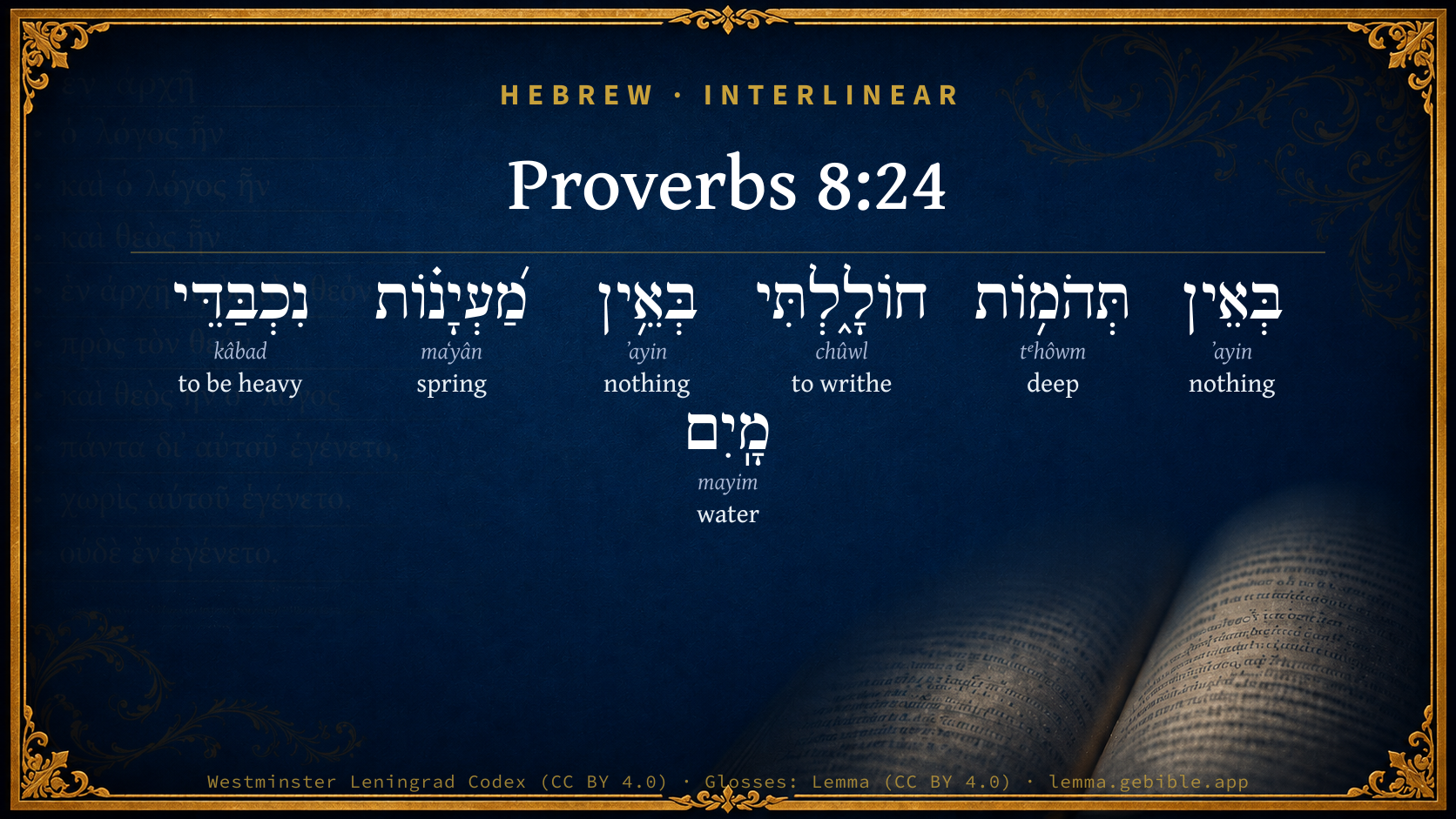
Hebrew (Westminster Leningrad Codex) Proverbs 8:24 appears in the Hebrew Old Testament. The text above is from the Westminster Leningrad Codex. Each word links to its Strong’s number, a concise gloss, and parsing drawn from the Open Scriptures Hebrew Bible morphology. Click any word for its full Brown-Driver-Briggs (BDB) entry.
Download image
Cite this verse

Proverbs 8:24 (World English Bible). Public Domain. Lemma interlinear Bible study tool, https://lemma.gebible.app/v/proverbs/8/24.

Show BibTeX & RIS
BibTeX
RIS
English Translation
When there were no depths, I was brought forth, When there were no springs abounding with water.
World English Bible · Public Domain
Download a study sheet

One document with this verse’s original text, its word-by-word gloss line, the meaning frame, cross-references with their text, attributed commentary, and full source and license credits — printable, and it pastes into notes with its structure intact.

This verse Autodidact and up

Study sheet (.html) Plain text (.txt)

A passage Seminary Student

Up to 50 verses in one chapter. A passage sheet keeps up to 6 commentary sources and 12 cross-references per verse, in the order this page ranks them, and says so on the sheet whenever that leaves anything out. Ask for a single verse and you get the Autodidact verse sheet above.

Everything on this page stays free to read, with no account — the sheet is a download of what is already on screen, not access to it.

Want to remove ads? Support Godless Engineer
Compare translations 3

The same verse in 3 English versions, stacked beneath the original-language interlinear above. Click any original word for its lexicon entry.

Each is an independent rendering of the whole verse — the interlinear is not word-aligned to these translations.

Highlighted words mark where these versions differ — a whole-verse word diff, not a word-by-word alignment.

  • World English Bible Public Domain
    When there were no depths, I was brought forth, When there were no springs abounding with water.
  • King James Version Public Domain
    When there were no depths, I was brought forth; when there were no fountains abounding with water.
  • unfoldingWord Literal Text CC BY-SA 4.0
    When there were no watery depths, I was brought forth, when there were no springs heavy with water.

unfoldingWord Literal Text — © unfoldingWord, licensed CC BY-SA 4.0. Word-aligned USFM3 via Door43 (git.door43.org/unfoldingWord/en_ult).

Versions to compare (up to 4)

3 of 4 selected

Show all 18 translations

Every available English version of this verse, each an independent rendering of the whole verse.

  • World English Bible Public Domain
    When there were no depths, I was brought forth, When there were no springs abounding with water.
  • Berean Standard Bible Public Domain
    When there were no watery depths, I was brought forth, when no springs were overflowing with water.
  • Majority Standard Bible Public Domain
    When there were no watery depths, I was brought forth, when no springs were overflowing with water.
  • King James Version Public Domain
    When there were no depths, I was brought forth; when there were no fountains abounding with water.
  • American Standard Version (1901) Public Domain
    When there were no depths, I was brought forth, When there were no fountains abounding with water.
  • Revised Version (1885) Public Domain
    When there were no depths, I was brought forth; when there were no fountains abounding with water.
  • Geneva Bible (1599) Public Domain
    When there were no depths, was I begotten, when there were no fountaines abounding with water.
  • Douay-Rheims (1899) Public Domain
    The depths were not as yet, and I was already conceived. neither had the fountains of waters as yet sprung out:
  • Young's Literal Translation Public Domain
    In there being no depths, I was brought forth, In there being no fountains heavy `with' waters,
  • Literal Standard Version CC BY-SA 4.0
    In there being no depths, I was brought forth, || In there being no fountains heavy [with] waters,
  • Unlocked Literal Bible CC BY-SA 4.0
    Before there were oceans, I was given birth— before there were springs abounding with water.
  • unfoldingWord Literal Text CC BY-SA 4.0
    When there were no watery depths, I was brought forth, when there were no springs heavy with water.
  • Darby Bible Public Domain
    When there were no depths, I was brought forth, when there were no fountains abounding with water.
  • World Messianic Bible Public Domain
    When there were no depths, I was born, when there were no springs abounding with water.
  • Webster's Bible Public Domain
    When there were no depths, I was brought forth; when there were no fountains abounding with water.
  • Free Bible Version CC BY-SA 4.0
    I was born when there were no ocean depths, when there were no springs pouring out water.
  • Bible in Basic English Public Domain
    When there was no deep I was given birth, when there were no fountains flowing with water.
  • JPS Tanakh (1917) Public Domain
    When there were no depths, I was brought forth; when there were no fountains abounding with water.

Literal Standard Version (2020), Covenant Press — licensed CC BY-SA 4.0. Text via the HelloAO Bible API (eBible.org). Unlocked Literal Bible (unfoldingWord) — licensed CC BY-SA 4.0. Text via the HelloAO Bible API (eBible.org). unfoldingWord Literal Text — © unfoldingWord, licensed CC BY-SA 4.0. Word-aligned USFM3 via Door43 (git.door43.org/unfoldingWord/en_ult). Free Bible Version, Dr. Jonathan Gallagher — licensed CC BY-SA 4.0. Text via the HelloAO Bible API (eBible.org).

Word by word

More ways to search: Search by grammar → Find every occurrence → Compare this word →

Practice this passage: Drill this verse → Learn its vocabulary →

About this verse

These counts appear in no published source. They are computed here, from the morphology-tagged text and Lemma’s own curated glosses. What Lemma adds →

7
words
6
distinct lemmas
Wisdom
section

Notable vocabulary

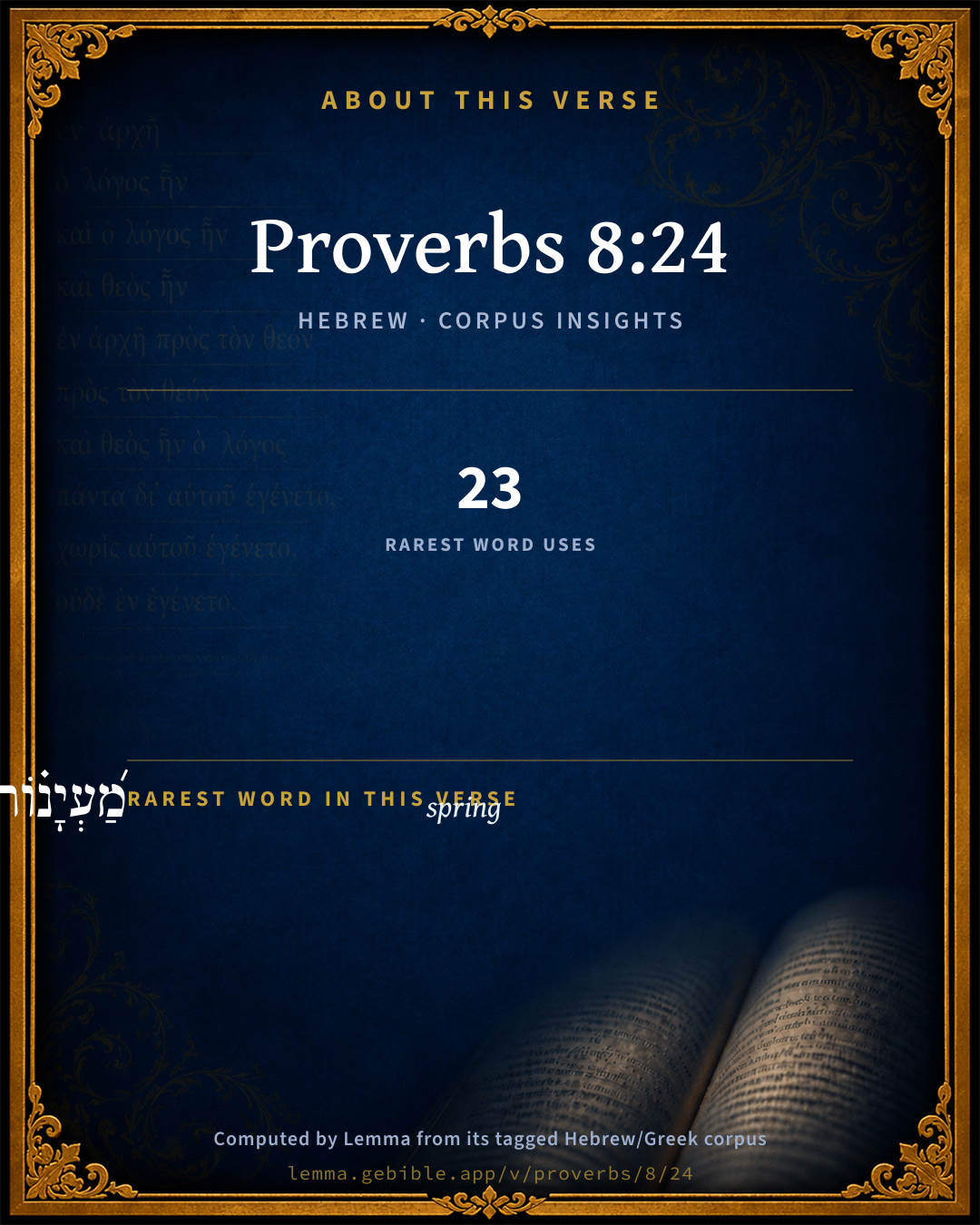
The rarest word here is מַ֝עְיָנ֗וֹת spring H4599 — appearing just 23 times in the whole Hebrew Bible.

Shared distinctive vocabulary

מַ֝עְיָנ֗וֹת spring H4599 occurs in 23 verses of the Hebrew Bible. Also found in:

Grammatical profile

  • 2 verbs
  • 3 nouns
  • 2 particles

Verb forms

  • חוֹלָ֑לְתִּי Polal · Perfect
  • נִכְבַּדֵּי Niphal · Participle Active

Repetition

A word recurs within this verse — often emphatic in Hebrew:

  • בְּאֵין nothing H369 ×2

Hebrew & Septuagint length

In English translation the verse runs 17 words from the Hebrew and 13 from the Septuagint (LXX English) — closely comparable.

A rough comparison of the two English renderings, which tokenize alike — not a word-level alignment.

Word counts can differ between the Hebrew and the Greek without any difference in meaning — e.g. the Hebrew direct-object marker אֵת has no separate Greek word, and Greek often adds the article ὁ.

Cross-references

8

Topical passages linked to Proverbs 8:24 in the Treasury of Scripture Knowledge — connected by theme and wording, ordered by reader-vote popularity; previews shown in the World English Bible.

  • Proverbs 3:20 By his knowledge, the depths were broken up, And the skies drop down the dew.
  • 1 John 4:9 By this was God's love revealed in us, that God has sent his one and only Son into the world that we might live through him.
  • Genesis 1:2 Now the earth was formless and empty. Darkness was on the surface of the deep. God's Spirit was hovering over the surface of the waters.
  • Hebrews 1:5 For to which of the angels did he say at any time, "You are my Son, Today have I become your father?" and again, "I will be to him a Father, And he will be to me a Son?"
  • Psalms 2:7 I will tell of the decree. Yahweh said to me, "You are my son. Today I have become your father.
  • John 1:14 The Word became flesh, and lived among us. We saw his glory, such glory as of the one and only Son of the Father, full of grace and truth.
  • John 3:16 For God so loved the world, that he gave his one and only Son, that whoever believes in him should not perish, but have eternal life.
  • John 5:20 For the Father has affection for the Son, and shows him all things that he himself does. He will show him greater works than these, that you may marvel.

Cross-references courtesy of OpenBible.info (CC BY 4.0).

Hebrew and Greek witnesses Masoretic Hebrew ↔ Greek Septuagint

The same verse in the two great witnesses to the Old Testament, shown verse-for-verse.

These are two independent witnesses, not word-aligned to each other, and the Septuagint is shown in lemma (dictionary) form.

Hebrew Proverbs 8:24 Masoretic · Westminster Leningrad Codex

בְּאֵין תְּהֹמ֥וֹת חוֹלָ֑לְתִּי בְּאֵ֥ין מַ֝עְיָנ֗וֹת נִכְבַּדֵּי מָֽיִם

When there were no depths, I was brought forth, When there were no springs abounding with water.

World English Bible · Public Domain

Greek LXX Proverbs 8:24 Septuagint · lemma form

πρό ὁ ὁ γῆ ποιέω καί πρό ὁ ὁ ἄβυσσος ποιέω πρό ὁ προἔρχομαι ὁ πηγή ὁ ὕδωρ

even before he made the depths; before the fountains of water came forth:

LXX2012 (modern English Septuagint) · Public Domain

On this verse, John Gill's Exposition discusses the Septuagint’s reading. Read the note in Commentary ↓

Hebrew: Westminster Leningrad Codex (CC BY 4.0). Greek: Septuagint (public domain); English from LXX2012 (modern English Septuagint) (Public Domain). How the Septuagint differs from the Hebrew →

Commentary

Notes on Proverbs 8:24 from classic Christian and Jewish commentators (each source and its license shown beneath its notes). The classic Christian expositions comment on the surrounding passage and are grouped to its opening verse, so a note may address several verses; the Jewish commentaries on the Tanakh (Rashi and others) are per-verse, so they appear only where the commentator wrote on this verse.

Lemma curates 59 commentaries, every one of them public domain or Creative Commons licensed, each selected and text-cleaned for this edition rather than reprinted as found. About our sources →

Trapp's Complete Commentary

John Trapp

Pro 8:24 When [there were] no depths, I was brought forth; when [there were] no fountains abounding with water.

Ver. 24. When there were no depths.] In mentioning God’s works of creation, some observe here, that wisdom proceeds from the lower elements to the superior and heavenly bodies: she begins with the earth, {Pro 8:23} goes on here to the waters, and so to the air, called streets, rendered "fields," {Pro 8:26} that is, the vast element of the air; which compared with the far less elements of earth and water, must needs seem exceedingly large, spacious, and open, as streets, or fields. Lastly, by "the highest part of the dust of the world," the Hebrew doctors understand the element of fire. Iudicium sit penes lectorem: let the reader judge.

John Trapp, A Commentary or Exposition upon All the Books of the Old and New Testament (1647–1656) — public domain. Text from a community e-Sword module.

Jamieson, Fausset & Brown

Robert Jamieson, A. R. Fausset & David Brown

brought forth--(Compare Psa 90:2).

abounding--or, "laden with water."

Jamieson, Fausset & Brown — Commentary Critical and Explanatory on the Whole Bible (1871) — public domain (CC PDM 1.0). Text via the HelloAO Bible API.

Adam Clarke's Commentary

Verse 24. When there were no depths] תהמות tehomoth, before the original chaotic mass was formed. See Ge 1:2.

I was brought forth] חוללתי cholalti, "I was produced as by labouring throes." Mr. Parkhurst thinks that the heathen poets derived their idea of Minerva's (wisdom's) being born of Jupiter's brain, from some such high poetic personification as that in the text.

Adam Clarke's Commentary on the Bible (1810–1826) — public domain. Text from a community e-Sword/MySword module.

Ellicott's Commentary for English Readers

(24) I was brought forth.—i.e., born. The same word is used in Psa_51:5 (7), and Job_15:7.

A Bible Commentary for English Readers, edited by Charles John Ellicott (1878–1897) — public domain. Text from a community e-Sword module.

John Gill's Exposition

When there were no depths, I was brought forth,.... Not only in the decree of God, as the head of the elect; foreordained to be the Redeemer of them, and to be the propitiation for their sins; and appointed the Judge of the world, and heir of all things; but "was begotten", as the Targum and Syriac version; the Septuagint is, "he begot me"; and so it is to be understood of the eternal generation and sonship of Christ; for the word is used of generation, Job 15:7. Christ is the firstborn of every creature, begotten, born, and brought forth before any creature was in being; see Psa 2:7; before the depths of the great sea were formed, for they were made by him, Psa 95:1; when there were no depths, but the infinite being and perfections of God, and the thoughts and purposes of his heart, which are his deep things, Job 11:7;

when there were no fountains abounding with water; or "heavy", or "honoured" (k) with it; when the fountains of the great deep were not; and when there were no other fountains which form rivers, and water the earth; when there were none but God the fountain of living waters; then was Christ as the only begotten son of God; and who was also set up as the fountain of all grace, life, and salvation for his people.

(k) "aggravati", Pagninus; "praegravati", Vatablus; "gravati", Michaelis; "honorabiles", Gejerus.

John Gill's Exposition of the Whole Bible (1746–1763) — public domain (CC PDM 1.0). Text via the HelloAO Bible API.

Albert Barnes' Notes on the Bible

Compare Gen. 1; Job 22; Job 26:1-14; 38: A world of waters, “great deeps” lying in darkness, this was the picture of the remotest time of which man could form any conception, and yet the co-existence of the uncreated Wisdom with the eternal Yahweh was before that.

Albert Barnes' Notes on the Bible (1834–1885) — public domain. Text from a community e-Sword/MySword module.

Haydock's Catholic Bible Commentary

Conceived. Having yet manifested none of my works. Since the creation, wisdom only seeks to communicate itself to us. (Calmet)

George Leo Haydock (1774–1849), Haydock's Catholic Family Bible and Commentary, 1859 edition — public domain. Excludes Psalms (Douay-Rheims chapter numbering differs from Protestant) and Deuterocanonical books (Catholic canon only).

Matthew Poole's English Annotations

No depths; no abyss or deep waters, either mixed with the earth, as they were at first, or separated from it.

Brought forth; begotten of my Father’s essence.

Matthew Poole's English Annotations on the Holy Bible (1683–1685) — public domain. Text from a community e-Sword/MySword module.

Whedon's Commentary on the Bible

Daniel D. Whedon

24. When… no depths, I was brought forth — Better, when no abysses, I was produced.

When… no fountains abounding with water — The precise idea of the last words is uncertain. The participle for “abounding,” נכבדי, may mean glorious. Perhaps it may be equivalent to our expression, “fountains of sparkling water.” The sentiment of the whole verse then would be: I was produced before there were either oceans or flowing streams. Brought forth, Stuart renders, “was born.” Produced is preferable, as corresponding better with the original, חוללתי, which, though sometimes used in the sense or was born, is not a specific term, like ילד, (yulladh,) but more general, like our words produced, originated, which may be applied to the beginning of any thing.

Daniel D. Whedon (gen. ed.), Commentary on the Old and New Testaments (1874–1909) — public domain. Text from a community e-Sword module.

The Pulpit Commentary

The preexistence of Wisdom is still more expressly set forth. When there were no depths (vers. 27, 28). The waste of waters which covered the face of the earth is meant that great deep on which primeval darkness brooded. (Gen_1:2) Before even this, man"s earliest conception of the beginning of the world, uncreated Wisdom was. Septuagint, "before he made the abysses". (see on Pro_3:20) I was brought forth; Vulgate, et ego jam concepta eram; Septuagint, at the end of ver. 25, genna me , "he begetteth me." The verb here is lWj (chul), which is used of the travailing of women, and is rightly translated, "brought forth by generation." It indicates in this place the energizing of Wisdom, her conception in the Divine mind, and her putting forth in operation.

When there were no fountains abounding with water; i.e. springs in the interior of the earth. (Gen_7:11; comp. Job 22 Job 26 Job 38) Septuagint, "Before the springs of the waters came forward (proelyein )."

The Pulpit Commentary (1880–1919), ed. H.D.M. Spence-Jones & Joseph S. Exell — public domain. Text from a community e-Sword module.

John Wesley's Explanatory Notes

No depths - No abyss or deep waters. Brought forth - Begotten of my father.

John Wesley, Explanatory Notes Upon the Whole Bible (1754–1765) — public domain. Text via the GEBible commentary corpus.

Keil & Delitzsch

C. F. Keil & F. Delitzsch

This her existence before the world began is now set forth in yet more explicit statements:

24 "When there were as yet no floods was I brought forth,

When as yet there were not fountains which abounded with water;

25 For before the mountains were settled,

Before the hills was I brought forth,

26 While as yet He had not made land and plains,

And the sum of the dust of the earth."

The description is poetical, and affords some room for imagination. By תּהומות are not intended the unrestrained primeval waters, but, as also Pro 3:20, the inner waters, treasures of the earth; and consequently by מעינות, not the fountains of the sea on this earth (Ewald, after Job 38:16), but he springs or places of springs (for מעין is n. loci to עין, a well as an eye of the earth; vid., Gen 16:7), by means of which the internal waters of the earth communicate themselves to the earth above (cf. Gen 7:11 with Gen 49:25). נכבּדּי־מים(abounding with water) is a descriptive epitheton to מעינות, which, notwithstanding its fem. plur., is construed as masc. (cf. Pro 5:16). The Masora does not distinguish the thrice-occurring נכבדי according to its form as written (Isa 23:8-9). The form נכבּדּי (which, like בּתּים, would demand Metheg) is to be rejected; it is everywhere to be written נכבּדּי nettirw (Ewald, 214b) with Pathach, with Dagesh following; vid., Kimchi, Michlol 61b. Kimchi adds the gloss מעיני מים רבים, which the Gr. Venet., in accordance with the meaning of נכבד elsewhere, renders by πηγαῖς δεδοξασμένων ὑδάτων (as also Bttcher: the most honoured = the most lordly); but Meri, Immanuel, and others rightly judge that the adjective is here to be understood after Gen 13:2; Job 14:21 (but in this latter passage כבד does not mean "to be numerous"): loaded = endowed in rich measure.

Pro 8:25

Instead of בּאין, in (yet) non-existence (24), we have here טרם, a subst. which signifies cutting off from that which already exists (vid., at Gen 2:5), and then as a particle nondum or antequam, with בּ always antequam, and in Pro 8:26 עד־לא, so long not yet (this also originally a substantive from עדה, in the sense of progress). With הטבּעוּ (were settled) (as Job 38:6, from טבע, to impress into or upon anything, imprimere, infigere) the question is asked: wherein? Not indeed: in the depths of the earth, but as the Caraite Ahron b. Joseph answers, אל קרקע הים, in the bottom of the sea; for out of the waters they rise up, Psa 104:8 (cf. at Gen 1:9).

Pro 8:26

ארץ וחוּצות is either, connecting the whole with its part: terra cum campis, or ארץ gains by this connection the meaning of land covered with buildings, while חוצות the expanse of unoccupied land, or the free field outside the towns and villages (cf. בּר, Arab. barrytt) (Fl.), vid., Job 5:10; Job 18:17 (where we have translated "in the steppe far and wide"); and regarding the fundamental idea, vid., above at Pro 5:16. Synonymous with ארץ, as contrast to חוצות, is תּבל, which like יבוּל (produce, wealth) comes from יבל, and thus denotes the earth as fruit-bearing (as אדמה properly denotes the humus as the covering of earth). Accordingly, with Ewald, we may understand by ראשׁ עפרות, "the heaps of the many clods of the fertile arable land lying as if scattered on the plains." Hitzig also translates: "the first clods of the earth." We do not deny that עפרות may mean clods of earth, i.e., pieces of earth gathered together, as Job 28:6, עפרת זהב, gold ore, i.e., pieces of earth or ore containing gold. But for clods of earth the Heb. language has the nouns רגב and מגרפה; and if we read together עפרות, plur. of the collective עפר (dust as a mass), which comes as from a n. unitatis עפרה, and ראשׁ, which, among its meanings in poetry as well as in prose, has also that of the sum, i.e., the chief amount or the total amount (cf. the Arab. râs âlmâl, the capital, τὸ κεφάλαιον), then the two words in their mutual relation yield the sense of the sum of the several parts of the dust, as of the atoms of dust (Cocceius; Schultens, summam pluverum orbis habitabilis); and Fleischer rightly remarks that other interpretations, as ab initio pulveris orbis, praecipus quaeque orbis terrarum, caput orbis terrarum (i.e., according to Rashi, the first man; according to Umbreit, man generally), leave the choice of the plur. עפרות unintelligible. Before these creatures originated, Wisdom was, as she herself says, and emphatically repeats, already born; חוללתּי is the passive of the Pilel חולל, which means to whirl, to twist oneself, to bring forth with sorrow (Aquila, Theodotion, ὠδινήθην; Graec. Venet. 24a, πέπλασμαι, 25b, ὠδίνημαι), then but poet. generally to beget, to bring forth (Pro 25:23; Pro 26:10).

Keil & Delitzsch — Biblical Commentary on the Old Testament (1861–1891) — public domain (CC PDM 1.0). Text via the HelloAO Bible API. (Old Testament only.)

unfoldingWord translationNotes

Door43 World Missions Community

General Information:

Wisdom continues to speak. (See: Personification)

Before the mountains were settled

"Before the bases of the mountains were put into place." This can also be put into active form. AT: "Before God made the foundations of the mountains and put them into their proper places" (See: Active or Passive)

translationWords

fountain

water

unfoldingWord translationNotes — © Distant Shores Media and the Door43 World Missions Community, licensed CC BY-SA 4.0. Source: git.door43.org/Door43/en_tn.

Rashi

Rabbi Shlomo Yitzchaki (Rashi)

I was created Heb. חוללתי.

Rashi on the Tanakh — English translations: “The Judaica Press complete Tanach with Rashi, translated by A. J. Rosenberg” (CC BY 4.0); “Pentateuch with Rashi's commentary by M. Rosenbaum and A.M. Silbermann, 1929-1934” (public domain); “The Metsudah Tanach series, Lakewood, N.J” (CC BY 4.0); and “The Book of Joshua, Metsudah Publications, 1997” (CC BY 4.0). Text via Sefaria.

Lesson kit

Teaching starters — assembled from the data on this page, not authored interpretation. Every prompt links to the verse data it draws on. Edit before teaching.

Proverbs, in the Wisdom, opens this verse with 7 words (6 distinct Hebrew lemmas). Its most distinctive word is maʻyân (“spring”). A historical commentator’s framing appears above. Read the whole chapter for the surrounding context.

Discussion questions

  1. What does “spring” (maʻyân) contribute to the verse as a whole?
  2. How does Genesis 7:11, which shares the word «spring», read alongside this verse?
  3. What does the repetition of “nothing” (2× in this one verse) do in this verse?
  4. These translations render this verse differently. What is at stake in choosing one wording over another?
  5. «חוֹלָ֑לְתִּי» is a Polal Perfect verb. How does that grammatical form shape the action described?
  6. Compare how Trapp's Complete Commentary and Jamieson, Fausset & Brown read this verse. Where do they agree or differ?

Things to notice

  • These translations choose different wording for 5 words in this verse.
  • “nothing” occurs 2× in this single verse.
  • 6 distinct Hebrew lemmas span 7 words in this verse.

Reading settings

Reading text

Shown beneath each verse's original-language words.

Old Testament
Old Testament edition

Read the OT as the Masoretic Hebrew (MT) or the Greek Septuagint (LXX).

English shown for the Greek Septuagint (in the Hebrew ↔ Greek comparison).

Comparing translations? Open the Compare panel on any verse page to stack up to four side by side.